
A customer is standing at the counter, holding two vitamin C serums. One is positioned as premium, the other as merely affordable. The question lands fast. Why does this one cost more, what does “stabilised” mean, and will it irritate my skin?
For Swiss pharmacies, spas, premium retailers, and clinic-led points of sale, that moment decides more than a single purchase. It shapes trust. If the answer stays at “vitamin C brightens”, the consultation feels generic. If the answer connects formula design, skin behaviour, packaging logic, and realistic usage advice, the product suddenly becomes credible.
That's where a professional understanding of a Vital C serum matters. On shelf, it looks like a simple antioxidant product. In practice, it sits at the crossroads of chemistry, skin physiology, merchandising, and regulatory discipline. The staff member who can explain those trade-offs clearly is the staff member who converts interest into confidence.
Empowering Your Expertise on Vital C Serums
The most common selling mistake with a Vital C serum is oversimplification. Teams reduce the conversation to “brightening” and “anti-ageing”, then lose the sale when a more informed customer asks about oxidation, skin sensitivity, or why one formula combines several forms of vitamin C instead of one.
That gap matters in Switzerland, where premium skincare shoppers often expect ingredient literacy. They don't just want a benefit claim. They want to know how a formula behaves, who it suits, how to use it, and whether the packaging protects what they're paying for.
What trade partners are actually being asked
In real consultations, the questions are usually practical:
- Why does one serum turn orange faster than another? Customers are often noticing oxidation, even if they don't use that word.
- Is stronger always better? Not with vitamin C. Potency on paper doesn't guarantee stability, comfort, or useful delivery.
- Can sensitive skin use it? Sometimes yes, but the answer depends on the vitamin C form, the vehicle, and the support ingredients around it.
- Why pair it with SPF? Because antioxidant support makes the most sense when skin faces daily environmental exposure.
Practical rule: The premium sale rarely depends on the ingredient headline alone. It depends on how well you explain the formula system behind it.
A strong consultation turns technical language into clean advice. “Stabilised” becomes “less likely to degrade quickly”. “Derivative” becomes “a form designed for better tolerance or better shelf performance”. “Antioxidant” becomes “support against daily environmental stress”.
Where premium positioning becomes credible
A high-quality Vital C serum earns its place when staff can explain three things clearly:
| What the customer sees | What the professional should explain | Why it matters commercially |
|---|---|---|
| Brightening promise | Antioxidant support and dullness reduction | Justifies daytime use and repeat purchase |
| Premium price | Stability, delivery, and supporting ingredients | Protects margin against price comparison |
| Different packaging styles | Oxidation control and shelf-life logic | Builds confidence in quality selection |
That's the difference between stocking a vitamin C serum and selling it properly. Premium skincare doesn't move on vague claims. It moves when the person recommending it knows what works, what doesn't, and where the trade-offs sit.
The Fundamental Science of Vitamin C in Skincare
Vitamin C remains one of the most commercially important actives in skincare because it solves a visible problem and a preventative one at the same time. Customers want brighter skin now. They also want support against the environmental wear that contributes to a tired, uneven appearance over time.

Think of vitamin C as a bodyguard for the skin. It doesn't replace sunscreen, barrier care, or disciplined formulation. It supports skin by helping defend against daily oxidative stress and by participating in pathways linked to firmer-looking, healthier-looking skin.
Why the ingredient matters
Two functions drive most of the category's relevance.
First, vitamin C acts as an antioxidant. In skincare language, that means it helps address the visible effects associated with environmental stress. This is why so many premium serums are positioned for morning use rather than only as a night treatment.
Second, it is relevant to collagen support. That connection is why vitamin C sits comfortably in anti-ageing, radiance, and preventative skincare ranges rather than being confined to “brightening” alone.
The commercial value comes from this dual role. One product can speak to dullness, environmental exposure, and visible ageing concerns without becoming incoherent.
How to translate the science at counter level
A technical explanation isn't always the best explanation. Staff need language that is accurate but usable.
- For dull skin: explain that vitamin C is used to help skin look brighter and less flat.
- For city living or commuting: explain that antioxidant care fits naturally into a daytime routine.
- For early ageing concerns: explain that vitamin C is often chosen because it supports a more refined, resilient-looking complexion.
According to the retailer description for IMAGE Skincare's VITAL C serum, the core benefit is to “brighten the skin, fight the appearance of dullness and reduce signs of environmental damage”, and it is best used in a daytime routine alongside SPF, where its antioxidant role is most relevant to daily oxidative stress, as noted on the Blake Spa product page for VITAL C serum.
Used well, a Vital C serum isn't a trend product. It's a daytime support step with a clear place in a routine.
What doesn't work in consultations
What doesn't work is treating all vitamin C serums as interchangeable. They aren't. Some are sharp, acidic, and short-lived. Others are built for comfort, hydration, and retail-friendly stability. The ingredient category is strong. The formula execution is what separates a dependable serum from a disappointing one.
Decoding the INCI List Stabilised vs Pure Vitamin C
Vitamin C serums fail for one of two reasons. Either the formula is unstable, or the explanation is. In trade settings, both problems show up the same way. The customer hears “vitamin C”, expects visible results, then finds the product too reactive, too irritating, or inconsistent over time.
The key issue is oxidation. Some forms of vitamin C are highly effective but difficult to keep stable in a water-based cosmetic system. Exposure to air, light, and water can push a formula to degrade, discolour, or lose elegance more quickly than customers expect.
The paradox of pure vitamin C
Pure L-ascorbic acid has strong recognition value. It also comes with formulation pressure. It can be demanding from a pH standpoint, often less forgiving for sensitive users, and more vulnerable in less protective packaging or vehicles.
That doesn't make it a bad ingredient. It means it requires discipline. When brands rely on the presence of pure vitamin C alone as the sales story, they often under-explain realities of shelf life, skin feel, and irritation potential.
Why stabilised derivatives matter
Premium formulas often use vitamin C derivatives to solve those problems. IMAGE Skincare's VITAL C Hydrating Anti-aging Serum uses multiple derivatives, including magnesium ascorbyl phosphate and tetrahexyldecyl ascorbate, and this multi-derivative approach improves stability and skin delivery compared with simpler single-form systems, helping preserve antioxidant activity through shelf life, according to the INCI breakdown on INCIdecoder for IMAGE VITAL C serum.
For a trade partner, that sentence translates into a simple commercial truth. Better form selection often means a serum is easier to sell, easier to use consistently, and easier to keep elegant in real retail conditions.
Common Vitamin C Forms at a Glance
| Vitamin C Form | Stability in Water | Primary Benefit | Best For |
|---|---|---|---|
| L-Ascorbic Acid | Lower | Direct antioxidant positioning | Experienced users who tolerate active formulas well |
| Magnesium Ascorbyl Phosphate | Better | Brightening support with a gentler profile | Sensitive, dry, or comfort-led routines |
| Tetrahexyldecyl Ascorbate | Better in sophisticated systems | Skin delivery and premium sensory feel | Premium anti-ageing and elegant daily serums |
| Multi-derivative blend | Built for balance | Stability plus broader formulation flexibility | Retail-friendly premium products |
How to read the INCI with commercial intent
A smart buyer or sales advisor doesn't stop at “contains vitamin C”. Look for the following:
- Derivative choice: This often tells you more about likely user experience than the front-label claim.
- Formula context: A derivative in a well-supported serum can outperform a louder but poorly protected concept.
- Positioning logic: If the product is built for dry or stressed skin, a lower-irritation approach often makes more sense than an aggressive acid-led one.
If a serum needs constant explanation to excuse its instability, it isn't a strong retail proposition.
What works and what doesn't
What works is explaining that stabilised doesn't mean weaker. It often means more usable. A serum that remains presentable, tolerable, and coherent over time is far easier to recommend than one that sounds impressive but creates friction in daily use.
What doesn't work is assuming customers want the most aggressive chemistry available. Most premium customers want reliability, comfort, and a formula that fits a real routine.
The Art of Formulation Beyond the Active Ingredient
An advanced Vital C serum is never just a vitamin C delivery tool. It is a complete formula system. The active may get the attention, but support ingredients determine whether the serum hydrates properly, feels elegant, sits well under other products, and remains persuasive at a premium price point.
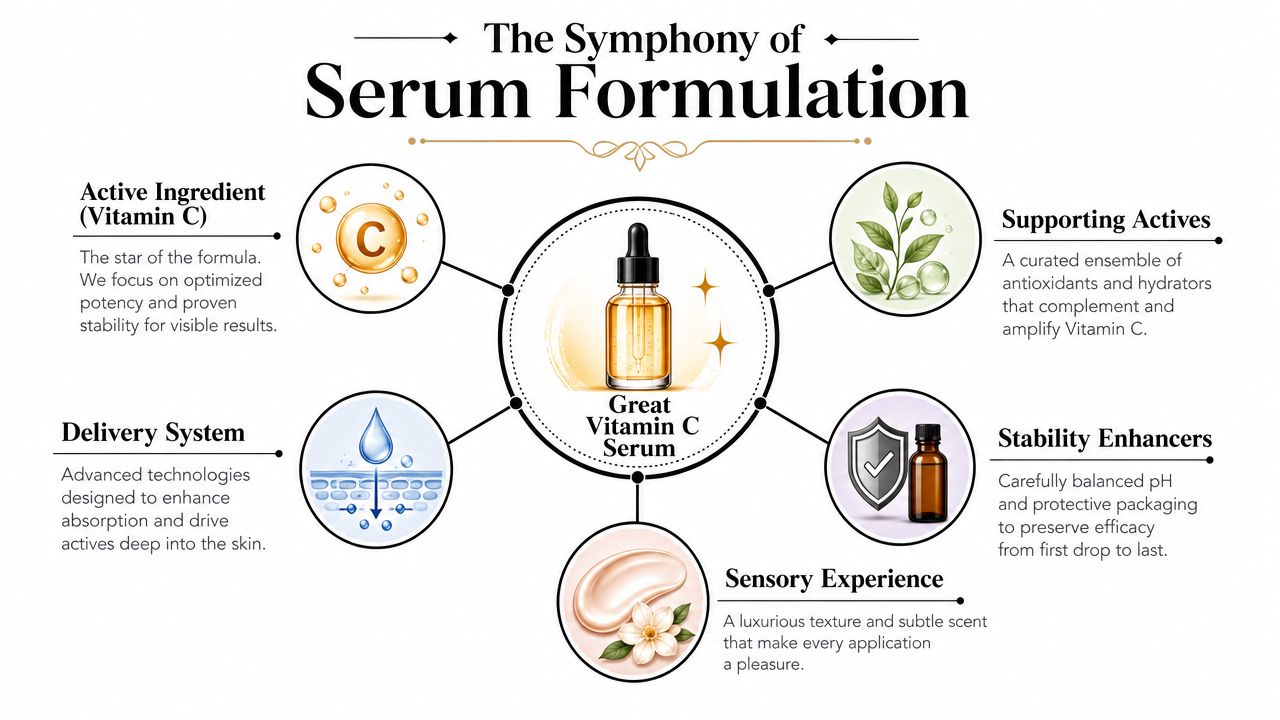
The fastest way to misjudge a serum is to evaluate it as a single-ingredient story. Customers don't apply isolated actives. They apply finished products. Texture, glide, comfort, scent, afterfeel, and compatibility with the rest of the routine all influence adherence.
The formula is an orchestra
A premium serum works when the elements support each other rather than compete.
- Vitamin support: Some advanced serums are built as multi-vitamin systems rather than one-note formulas.
- Botanical support: Plant extracts can help align the formula with soothing, comfort-oriented positioning.
- Hydration support: Humectants and skin-conditioning ingredients keep the product from feeling purely corrective.
The retail listing for VITAL C Hydrating Antioxidant A C E Serum identifies a 1 oz product with TCIN: 86274608 and UPC: 819984013834, and describes it as containing vitamins A, C, and E along with echinacea and green tea extract, positioned for anti-ageing use on mature skin and distributed through standardised retail channels, as shown on the Target product listing for IMAGE Skincare VITAL C Hydrating A C E Serum.
That matters commercially because it shows a familiar pattern in premium serum design. Brands that want longevity in the category don't rely on one headline active alone. They build a broader care story.
What to inspect beyond the vitamin C form
Here's the practical checklist I'd use when assessing whether a serum deserves premium shelf space:
- Hydration architecture: Does the formula support dry or environmentally stressed skin, or does it only chase potency?
- Antioxidant companionship: Vitamin E and botanical antioxidants often strengthen the overall positioning.
- Soothing balance: Extracts such as green tea or echinacea can make the formula easier to recommend to mature or comfort-seeking users.
- Texture discipline: A serum can have excellent actives and still fail because it pills, feels tacky, or layers badly under SPF.
A short visual explainer can help teams internalise that logic before they start selling.
How value is created on shelf
A premium price becomes easier to defend when the product feels complete. Customers recognise this quickly. They may not use formulator language, but they notice whether a serum feels hydrating or stripped-back, whether it sits comfortably under day cream, and whether it behaves like skincare rather than chemistry homework.
That is why “Does it contain vitamin C?” is the wrong first question. The better question is, “How is the entire formula built?”
Matching Serums to Skin Types and Concerns
Recommendation quality improves when teams stop matching products to age alone and start matching them to skin behaviour. A good Vital C serum consultation is less about demographics and more about tolerance, dryness level, visible dullness, and routine complexity.
Dry or mature skin
Dry or mature skin usually responds best to formulas that combine antioxidant support with hydration and comfort. In these consultations, a derivative-led serum often makes more sense than a highly acidic one. The skin usually needs resilience and suppleness, not challenge.
If the serum also includes supportive vitamins or comfort-oriented botanicals, the recommendation becomes stronger. Customers in this group tend to value skin feel as much as visible performance.
Dull or tired-looking skin
This is the easiest entry point for the category. Dullness is visible, relatable, and easy to discuss without overpromising. Position the serum as a daily brightening step that helps skin look fresher rather than as a dramatic corrective treatment.
For these customers, consistency matters more than intensity. A product they enjoy using every morning will outperform a harsher formula they abandon after a week.
Morning use is usually the cleanest recommendation because antioxidant support has the clearest logic when skin is heading into the day.
Sensitive or easily reactive skin
Sensitive skin consultations require more restraint. Don't sell “strong”. Sell appropriate. Customers in this group usually need a serum built around gentler forms of vitamin C, with a formula that also respects barrier comfort.
Use straightforward language:
- Tingling isn't the goal: Sensation doesn't prove efficacy.
- Daily use should be earned: Start with a modest frequency if the customer is cautious or highly reactive.
- Patch testing is sensible: Especially when the customer already uses retinoids, exfoliating acids, or prescription-led routines.
Common consultation answers
A few answers should become standard across the team.
Should I expect tingling?
Not necessarily. Some people feel nothing, and that's fine. Comfort often indicates a formula that is better matched to regular use.
Can I use it every day?
Many users can, but tolerance and the rest of the routine matter. If someone already uses several active products, advise them to introduce the serum carefully.
Morning or evening?
Morning is usually the stronger recommendation for an antioxidant serum, especially when paired with SPF.
Can it replace moisturiser?
Usually no. A serum can support hydration, but most routines still benefit from a moisturiser suited to the skin type.
A practical recommendation map
| Customer profile | Better recommendation style | Avoid |
|---|---|---|
| Dry, comfort-seeking skin | Hydrating derivative serum with supportive botanicals | Harsh, acid-forward formulas |
| Mature skin with visible fatigue | Multi-vitamin, antioxidant-led serum | Minimal formulas that ignore barrier comfort |
| Dull urban skin | Elegant daytime antioxidant serum | Overcomplicated routines with too many actives |
| Reactive skin | Gentle, stabilised option with calm positioning | Selling sensation as proof of performance |
The best recommendation feels specific. Not dramatic. Customers remember when the advice fits their skin rather than the script.
Packaging Shelf Life and Clean Certifications
A vitamin C serum can be well formulated and still underperform if the packaging works against it. This is one of the least appreciated buying signals at retail level. Customers often focus on dropper aesthetics. Professionals should focus on protection.
Why packaging is part of the formula
Vitamin C systems are vulnerable to environmental exposure. Packaging that reduces contact with air and light usually supports a more dependable product experience. Opaque containers and controlled-dispensing formats often make more sense than clear presentation-led packs.
That doesn't mean every dropper bottle is poor. It means packaging has to match formula sensitivity. When it doesn't, the serum may discolour faster, feel less trustworthy, and generate avoidable complaints.
What staff should check
- Opaque versus transparent: Visibility can look premium, but protection matters more than shelf drama.
- Pump versus dropper: Controlled dispensing can support stability and cleaner use.
- PAO marking: Teams should know where to find the Period After Opening symbol and how to explain it.
- Storage advice: Customers should be told to keep the product away from unnecessary heat and light.
Packaging isn't secondary. For vitamin C, it is part of product performance.
Where clean positioning becomes credible
Swiss consumers often look for more than efficacy. They also look for values. That's where recognised standards and ethical commitments matter, but they need to be handled properly. Certifications and cruelty-free commitments should support trust in sourcing, manufacturing discipline, and brand consistency. They shouldn't be used to distract from weak formula architecture.
For trade buyers, the stronger position is holistic. Ask whether the product combines sensible packaging, coherent ingredient selection, transparent labelling, and claims that stay within cosmetic boundaries. That combination is what makes “clean” feel substantial rather than decorative.
A well-chosen Vital C serum should communicate integrity before the customer even opens it. Formula, pack, and brand standards should all point in the same direction.
Merchandising Vital C Serums in Your Swiss Business
Vital C serums work best as hero products. They are easy to demonstrate, easy to explain visually, and easy to pair with adjacent categories. When a retailer treats them as just another serum, sales stay passive. When the team builds a clear consultation and merchandising system around them, the category becomes a reliable driver of premium skincare value.
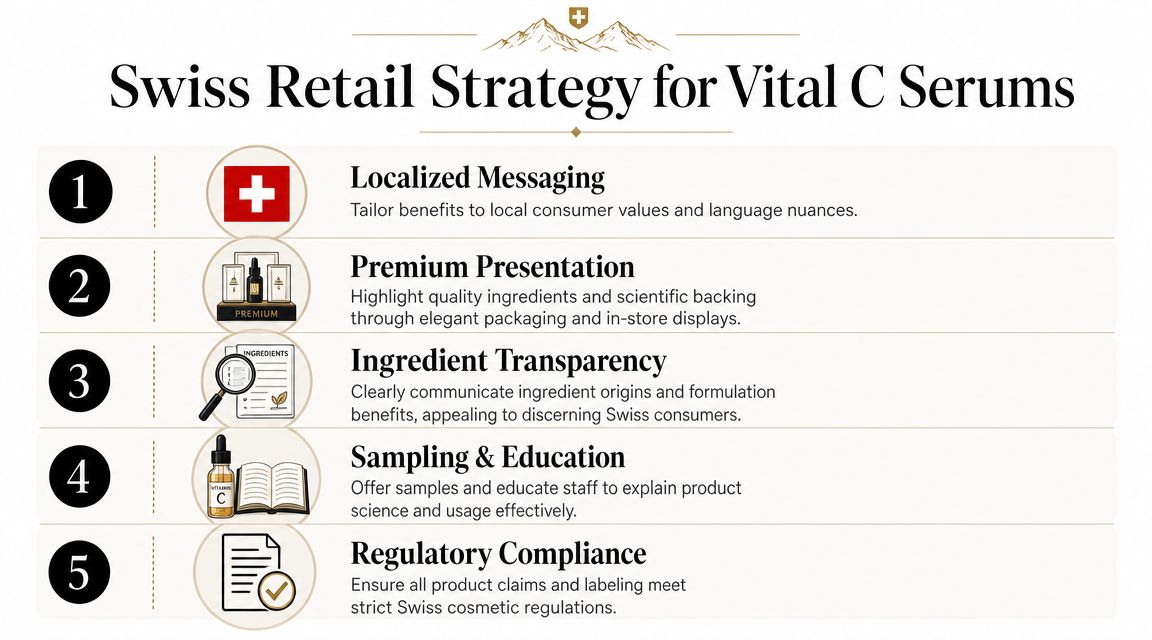
What the best stockists do differently
They train staff on a short, repeatable set of talking points. Not a brand monologue. A practical script.
- Lead with the user problem: dullness, environmental stress, uneven-looking tone, or a tired complexion.
- Explain the premium logic: stabilised forms, supportive formulation, elegant daytime use.
- Close with routine fit: serum first, then moisturiser, then SPF.
That final point matters because pairing a Vital C serum with SPF is one of the most natural cross-sell opportunities in skincare.
How to merchandise for confidence, not clutter
Create a small visual story around use occasion rather than grouping by brand.
A good display might include:
- The serum as the centrepiece
- An SPF beside it for daytime pairing
- A concise shelf card explaining “brightening plus environmental support”
- Sampling or tester access where appropriate
- Staff prompts focused on skin concern, not hype
For teams building broader promotional systems around premium beauty categories, this practical guide for profitable beauty campaigns is useful because it frames how education, presentation, and conversion work together in beauty retail.
The commercial case for the category
The category has clear commercial appeal because it combines recognisable benefits with premium positioning. One international reseller claims some formulations sell at 1.9 units per minute, which equates to about 2,736 units per day or roughly 998,000 units per year if sustained continuously, but because this appears on a marketing-led reseller page rather than an independently verified market source, it should be treated as a promotional demand signal, not neutral market data, as stated in the Facials in Orange article discussing VITAL C serum demand.
That distinction is important. You don't need to oversell the number. The more useful takeaway is qualitative. Global demand appears strong, and the product type has all the features of a repeat-purchase hero line when presented properly.
What moves the needle in-store
The strongest Swiss trade strategy is disciplined rather than flashy:
| Priority | What to do in practice |
|---|---|
| Staff education | Train on vitamin C forms, packaging logic, and morning-use advice |
| Cross-selling | Pair with SPF and barrier-supportive moisturisers |
| Premium defence | Explain formula system, not just ingredient name |
| Compliance mindset | Keep claims cosmetic, clear, and supportable |
A Vital C serum earns its space when the business treats it as a consultation tool, not only a SKU.
If you're building a differentiated premium skincare assortment for Swiss pharmacies, spas, clinics, or retail, beautysecrets.agency can help you source credible, ethically aligned brands and turn complex product science into clear commercial stories your team can sell with confidence.