Most advice on N-Acetyl L-Tyrosine gets the core question wrong. It's not a “better tyrosine”, and in clean-beauty or pharmacy-adjacent ranges that distinction matters because the ingredient's biggest strength is also where the marketing gets sloppy: it dissolves far more readily than free L-tyrosine, yet the clinical story shows that a meaningful share can still pass through the body unmetabolised.
That trade-off is exactly why Swiss buyers, formulators, and pharmacy teams should look at n acetyl l tyrosin with a practitioner's eye, not a label-reader's shortcut. Beauty merchandising often rewards elegant simplicity, but ingredients don't care about shelf language. If a brand wants to position N-Acetyl L-Tyrosine responsibly, it has to balance chemistry, formulation behaviour, safety screening, and retail claims discipline.
A useful way to think about the ingredient is the same way good advertisers think about a campaign. If you want a clear example of how brands deconstruct claims and visual positioning without overdoing it, the beauty advertising breakdowns piece is a smart reference point. The principle is the same here, strong positioning starts with an honest product story.
Why N-Acetyl L-Tyrosine Is Misunderstood in Clean Beauty
N-Acetyl L-Tyrosine gets pulled into wellness and beauty conversations as if it were a universal upgrade. That framing is too neat for reality. In formulations, it's valuable because it behaves differently from free L-tyrosine, and in clinical nutrition it has a history shaped by one very specific problem, how to deliver tyrosine in a usable form when free tyrosine is awkward to work with.
The label story is usually too simple
Clean-beauty shoppers often see an amino acid and assume the ingredient is there for a vague “skin support” or “brain support” effect. Retail teams repeat the simplified version because it's easier to sell than chemistry. But N-Acetyl L-Tyrosine is really a formulation tool first, and a physiological tyrosine source second.
That distinction matters because the ingredient's usefulness is strongest where water compatibility matters. In a clear toner, serum, or liquid self-care format, a soluble amino-acid derivative is much easier to formulate than free L-tyrosine, which is notoriously hard to handle in water-rich systems.
Practical rule: if the product concept depends on clarity, elegant texture, and predictable mixing, the acetylated form is the one that deserves attention.
The clean-beauty angle needs restraint
The clean-beauty market can over-index on “natural equals better”, but that instinct can mislead buyers here. N-Acetyl L-Tyrosine became relevant because it solved a technical problem, not because it sounded romantic on a pack. Swiss retailers should therefore treat it as a functional ingredient with a niche role, not a miracle amino acid.
That's also why generic “brain nootropic” language can feel off in a pharmacy or premium skincare setting. The better merchandising story is more grounded, this ingredient can support clean, well-behaved aqueous formats, while the body's retention of an oral dose is not perfect. That honesty builds trust with consumers who want premium formulas that still make sense scientifically.
The Chemical Identity and Solubility Advantage
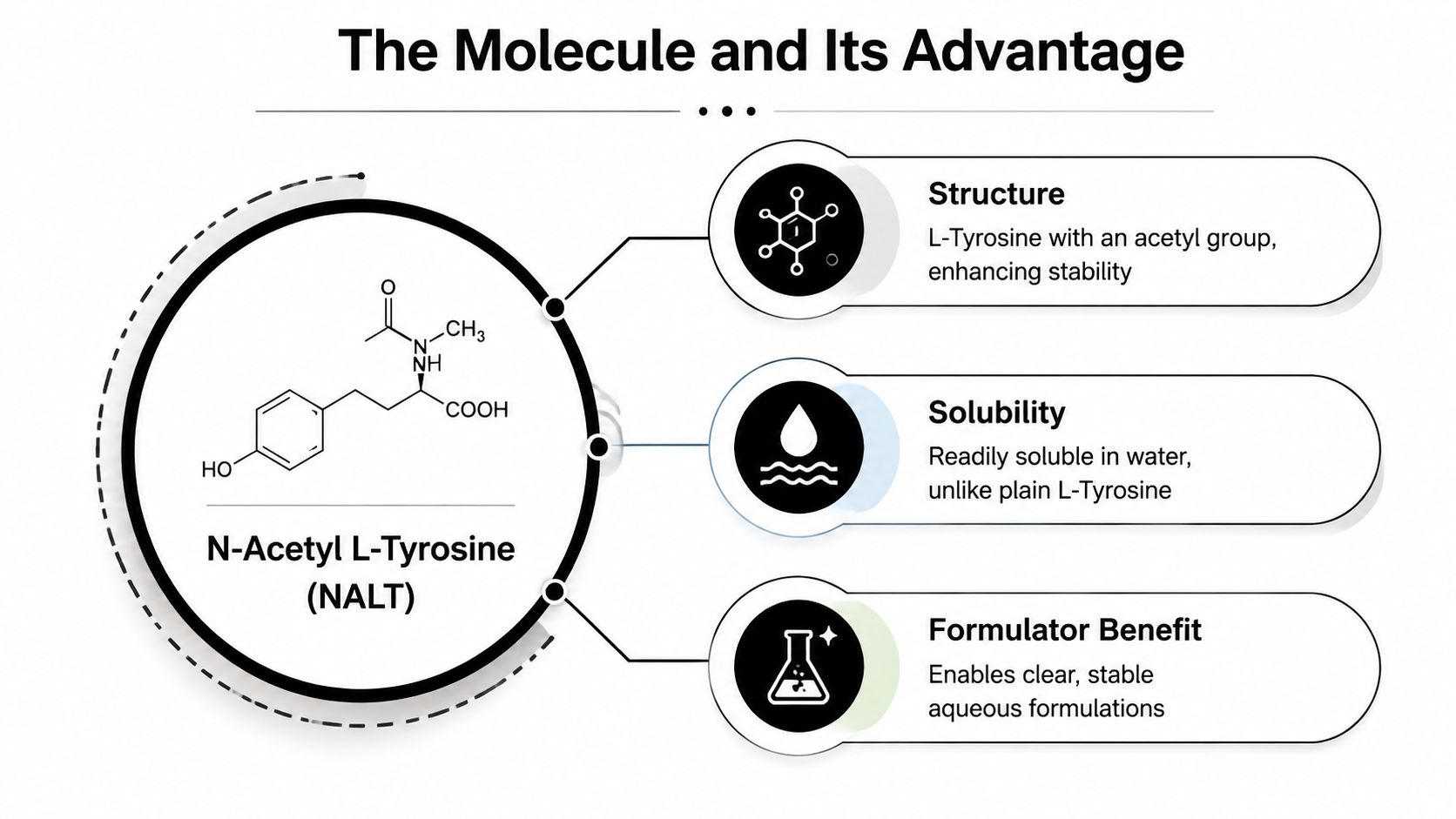
N-Acetyl L-Tyrosine is L-tyrosine with an acetyl group attached, and that small structural change has practical consequences for sourcing and formulation. In clean-beauty work, it behaves more like a tool for the water phase than like a novelty ingredient. That is why formulators pay attention to it, not only supplement brands.
What the numbers mean in practice
A technical guide reports a water solubility of 25 mg/mL for N-Acetyl L-Tyrosine versus about 0.45 mg/mL for L-tyrosine at 25 °C, a difference that is large enough to change how a formula is built. The same guide lists a molecular weight of 181.19 g/mol for N-Acetyl L-Tyrosine (benchchem technical guide). Another supplier reference reports 223.23 g/mol and a melting point around 149 to 154 °C, while also describing the ingredient as freely soluble in water (TCI Chemicals product data).
For formulators, that solubility gap is the point. Clear aqueous systems are easier to build, and there is less pressure to force a poorly soluble raw material into solution. That matters in toners, mists, and other liquid formats that need to stay visually clean and feel refined on skin. In practice, the acetylated form gives more room to work with the water phase without fighting haze or residue.
Why Swiss formulators care
Swiss and European beauty brands work in a market that rewards polished textures and ingredient stories that can stand up to scrutiny. A soluble tyrosine derivative fits that brief when the brief calls for premium toners, mists, or minimalist aqueous serums. It helps the formula behave well without making the retail story harder than it needs to be.
The pH profile still deserves attention. The same supplier reference notes a pH 2.0 to 3.0 profile in some grades (TCI Chemicals product data). Formulators should check buffering, active compatibility, and final sensory balance before assuming the ingredient can be dropped into any water-based system.
The chemistry is the reason it earns a place in the formula. It gives a formulator more room to design a stable, elegant water phase without wrestling a raw material that resists dissolution.
N-Acetyl L-Tyrosine Versus Free L-Tyrosine
The comparison is practical, not cosmetic. Free L-tyrosine is the familiar amino acid, but its weak water solubility makes it awkward in clear liquid systems. N-Acetyl L-Tyrosine was taken up because it handles that problem better, even though the body does not retain every milligram in the same way once it is administered.
Side by side for formulators and retailers
| Attribute | N-Acetyl L-Tyrosine | Free L-Tyrosine |
|---|---|---|
| Solubility | High, with quantified water solubility of 25 mg/mL at 25 °C (benchchem technical guide) | Much lower, about 0.45 mg/mL at 25 °C |
| Raw-material behaviour | Better suited to clear aqueous systems | Harder to keep dissolved in water-rich formats |
| Historical use | Adopted in clinical nutrition and pharmacy supply because free tyrosine is poorly soluble | Common biological amino acid, but less formulation-friendly in liquids |
| Clinical retention | Human data show substantial urinary loss after administration | Not covered in the same way in the cited clinical parenteral data |
| Retail story | Stronger technical story, but claims must stay restrained | Simpler to explain, less elegant in water-based product design |
The clinical limitation changes the marketing tone
The clinical parenteral literature adds a useful restraint. In adults receiving parenteral amino acids, about 35% of administered N-Acetyl L-Tyrosine was excreted unchanged in urine, and that proportion was described as not materially changing with infusion rate, nitrogen balance, or renal function (PubMed 14621123).
That does not make the ingredient weak. It does mean Swiss brands should avoid presenting N-Acetyl L-Tyrosine as automatically superior on physiology because it is more soluble. In a clean-beauty or pharmacy setting, the claim strategy needs to stay conservative. Lead with formulation elegance and ingredient transparency, not with broad efficacy language that the evidence does not support.
The chemistry is not the selling point by itself. The value is that the molecule gives a formulator more room to design a usable water phase without fighting a raw material that resists dissolution.
Formulation Stability and pH Considerations
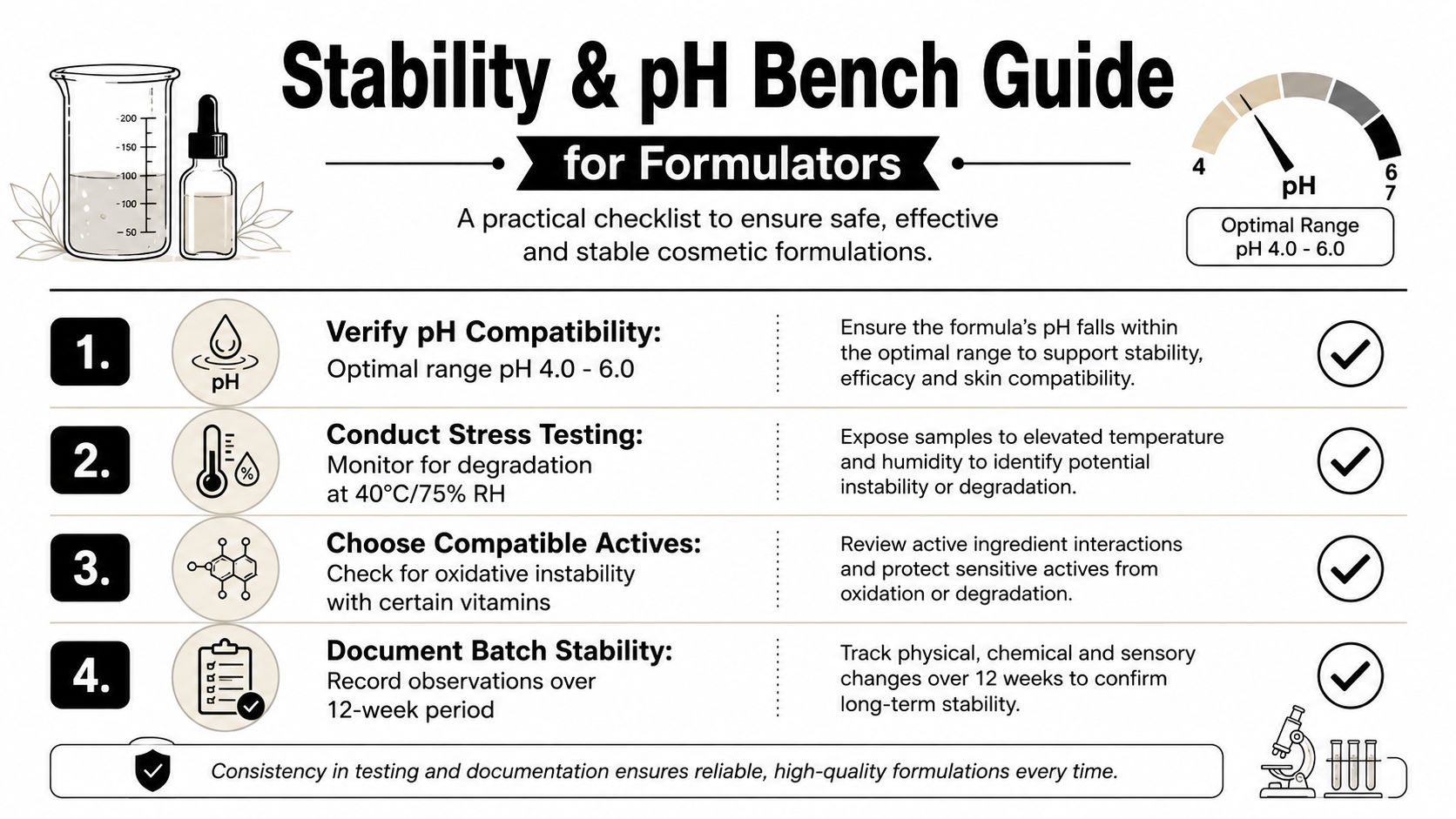
N-Acetyl L-Tyrosine can make a formula easier to build, but it does not remove the need for disciplined bench work. High solubility helps the process, yet it does not replace stability testing. Formulators still need to check pH, stress conditions, and compatibility with the rest of the formula before a batch goes into production.
Start with pH, not with marketing
Supplier information that places some grades in a pH 2.0 to 3.0 range should make every formulator pause before scale-up. That profile can work in certain systems, but it can also create trouble if the target product includes pH-sensitive actives, fragile emulsions, or a consumer-facing claim that depends on a gentle skin feel.
A practical bench sequence keeps the risk visible.
- Verify pH compatibility: check whether the target product's buffering system can handle the ingredient without drifting.
- Run stress tests: expose the formula to high heat and humidity, then watch for clouding, phase change, or odour shift.
- Check active interactions: some co-actives tolerate acidic environments better than others.
- Document batch observations: keep notes on clarity, viscosity, and colour across the stability window.
Clear systems need honest compatibility checks
N-Acetyl L-Tyrosine usually makes the most sense in aqueous serums, toners, and other clear liquids. It is less convincing in a rich cream or balm that does not need a soluble amino-acid story. In those formats, the ingredient can drift into being a marketing add-on rather than a meaningful formulation choice.
Retail teams also need to explain stability in plain terms. “Contains N-Acetyl L-Tyrosine” sounds technical, but customers care more about whether the product stays clear, feels comfortable on skin, and behaves consistently from bottle to bottle. In a Swiss setting, that standard is what supports repeat purchase.
If the formula is unstable at the bench, clean-beauty language will not save it on the shelf.
Safety Screening and Pharmacy Conversations
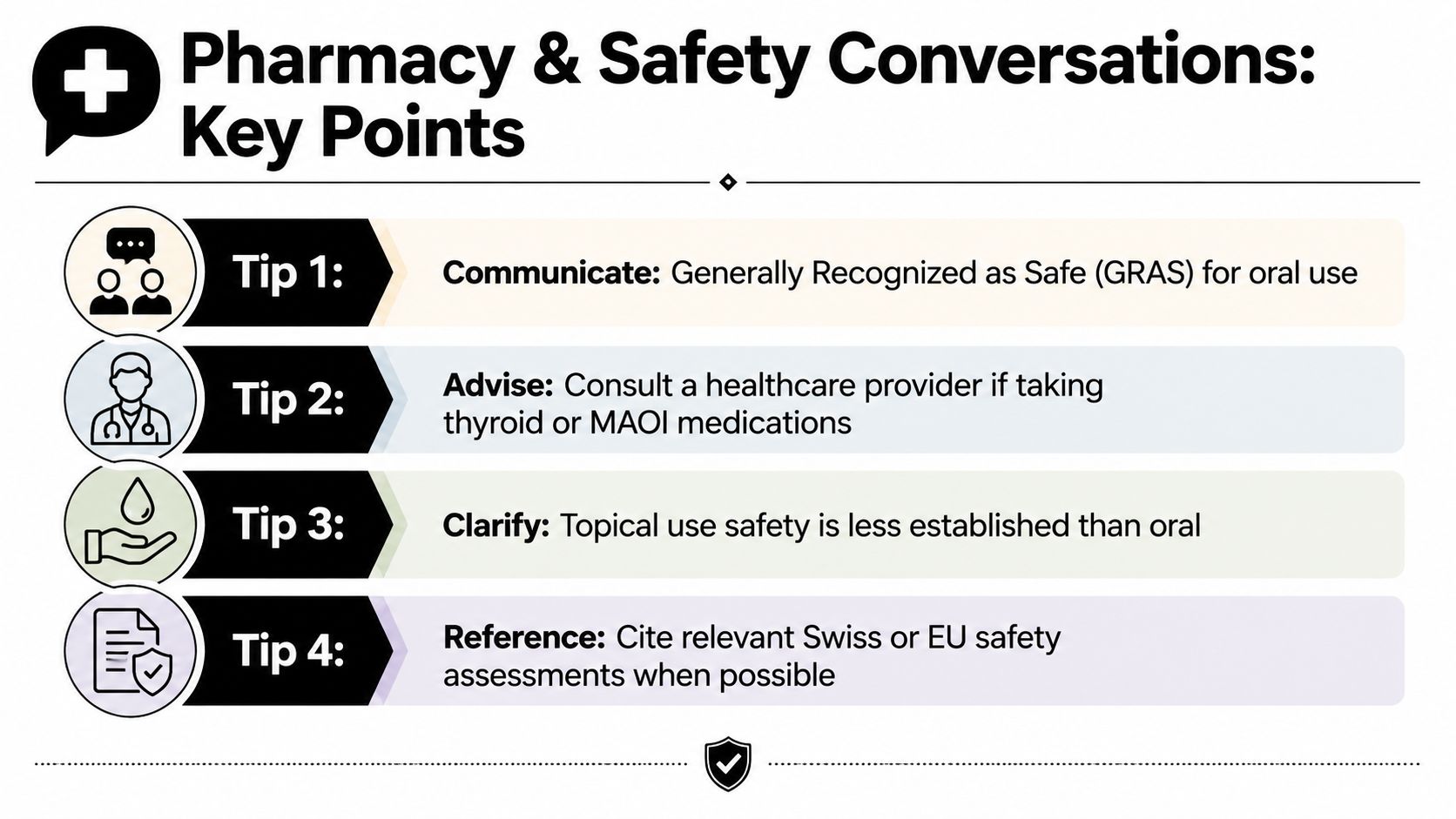
A lot of mainstream content fails in this regard. It talks about an amino acid as if every customer is interchangeable, then skips the questions pharmacy teams need to ask. N-Acetyl L-Tyrosine may sit in a cosmetic or wellness range, but the conversation around tyrosine still needs to respect medication use, thyroid concerns, and cardiovascular sensitivity.
The screening questions that actually help
Medical references note that tyrosine can affect blood pressure, heart rate, and mood, and may also cause gastrointestinal upset, drowsiness, or agitation (Examine tyrosine research overview). That does not mean every customer will experience these effects, but it does mean pharmacy-led self-care should include a quick screening conversation.
Useful front-of-shop questions are practical and non-alarmist.
- Medication use: are they taking thyroid medication or an MAOI?
- Cardiovascular history: have they been told to monitor blood pressure or heart rate?
- Sensitivity profile: do they already react strongly to stimulating products?
- Use case: are they buying for oral use, topical use, or general retail browsing?
Why this matters in Swiss retail
Swiss pharmacies have an unusually strong trust role, especially where self-care and medication counselling overlap. That makes vague supplement language less acceptable than in a generic online marketplace. The safest approach is to say what the ingredient is, what is known about tyrosine generally, and when a customer should speak with a clinician before regular use.
This is also where brands should support their retail partners properly. A staff sheet that explains the ingredient in plain language, flags the relevant medication questions, and avoids exaggerated performance claims is far more valuable than a glossy one-pager full of half-meaningful buzzwords. If you want staff confidence, give them a clear screening script and one or two concise product facts, not a mini manifesto.
Sourcing, Certifications, and Ethical Positioning
Swiss and European clean-beauty buyers don't just ask whether an ingredient works. They ask where it came from, how it was processed, and whether the brand can prove its ethical claims. That standard fits N-Acetyl L-Tyrosine well, because the ingredient sits in a premium, formulation-led category where transparency matters as much as function.
What buyers should ask suppliers
A good supplier conversation should go beyond the spec sheet. Buyers should ask for traceability, manufacturing quality documentation, solubility and pH data, and any available evidence that the ingredient is handled in a way that fits clean-beauty standards. If the product is going into a pharmacy or spa assortment, consistency matters just as much as the ingredient story.
Certification language also matters. Brands that align with frameworks such as ECOCERT and with cruelty-free commitments consistent with PETA and Cruelty Free International expectations have a cleaner story to tell in Swiss retail. That doesn't make the ingredient itself “certified”, but it does shape how a premium assortment is perceived by shoppers who expect the brand to mean what it says.
Positioning should be disciplined, not decorative
The ethical story works best when it is specific. A retailer can say the ingredient is part of a curated assortment built around traceable sourcing and recognised standards, but it should not imply that the molecule itself confers moral superiority. Buyers in Switzerland are generally too discerning for that.
beautysecrets.agency operates in this exact space, as a Swiss distributor of cosmetics and pharmaceuticals with a portfolio built around ecological processing, premium brands, and recognised clean-beauty commitments. That makes it relevant as a distribution model, not as a claim source, because the right merchandising framework for N-Acetyl L-Tyrosine is the same as for any other premium ingredient story, transparent supply, documented quality, and an honest fit with the channel.
Merchandising insight: the strongest clean-beauty pitch is not “this ingredient is special”, it's “this ingredient fits a documented, trustworthy product system”.
Positioning N-Acetyl L-Tyrosine for Swiss Retail and Spa Partners
A pharmacy shelf, a spa boutique, and an online clean-beauty shop all need different language for the same ingredient. The chemistry does not change, but the buyer's context does. That's why N-Acetyl L-Tyrosine should be positioned as a formulation-enabling ingredient with a responsible safety story, not as a broad-spectrum promise generator.
Channel-specific language that holds up
In pharmacies, the pitch should stay close to quality, compatibility, and screening. Staff can explain that the ingredient is used because it behaves well in water-based systems, while reminding customers to check medication interactions if the product is for oral use.
In spas, the story can lean more on ritual and texture. Clients care about how a product feels, whether it layers well, and whether the formula looks clean and elegant on skin. N-Acetyl L-Tyrosine fits there when it supports a sensorial aqueous format rather than shouting for attention.
For e-commerce, the winning angle is transparency. Product pages should say what form is used, why it was selected, and what the brand can substantiate. Avoid big cognitive claims, avoid performance theatre, and use the ingredient story to support credibility rather than inflate expectations.
A clean-beauty assortment that uses N-Acetyl L-Tyrosine well is one that respects the ingredient's real strengths. That is the standard Swiss consumers reward, especially when the brand communicates with precision instead of hype.
If you're building or refreshing a Swiss beauty or pharmacy assortment around ingredients like N-Acetyl L-Tyrosine, beautysecrets.agency can help you think through sourcing, positioning, and channel fit with a cleaner commercial story. Visit beautysecrets.agency to explore how its curated portfolio supports pharmacies, spas, and premium clean-beauty retail with transparent, ethically grounded formulations.