You're in the bathroom, the kettle's on, and you've grabbed the nearest SPF 50 because it was already open. It seems sensible enough, until your face starts shining by lunch, your foundation pills around the nose, or your eyes sting the moment you step outside. That mismatch, between a good label and a poor daily result, is the core reason sunscreen for face deserves its own rules.
A face product has to do more than block UV. It has to sit evenly on curved skin, survive makeup, feel comfortable enough to wear every day, and still cover the forgotten corners people miss when they're rushing. If you've ever wondered why a body sunscreen feels fine on your arms but wrong on your face, the answer is usually in the formula, the finish, and the way people apply it.
Why Your Face Needs a Different Sunscreen
You can see the problem most clearly on a busy weekday morning. Someone uses a family-size SPF 50 on the face, heads out thinking they're fully protected, then spends the rest of the day dealing with shine, a white film, or stinging around the eyes. The label looked strong, but the lived result was messy.
The face is a different surface
Facial skin gets less generous application than body skin, even from careful users. The tested film thickness behind SPF claims assumes 2 mg/cm² of product on the skin, and DermNet notes that standard directly in its explanation of SPF testing and UV coverage. In real life, the face rarely gets that much, especially once people factor in beard stubble, moisturiser, primer, or a quick morning routine. That means the protection you receive can be lower than the number on the tube, even before sweat or rubbing enter the picture.
The face also has a cosmetic job that the rest of the body usually doesn't. A good sunscreen for face has to disappear well enough to wear under makeup, but still stay visible enough for the user to know they've covered the edges of the forehead, jaw, and nose. If a formula feels greasy or shifts under foundation, people use less of it. That's a formulation failure, not user laziness.
Eye-area comfort changes the whole decision
The periorbital area is where many people give up first. If a sunscreen stings the eyelids or migrates into the inner corners, they'll stop using it consistently, or avoid those zones altogether. A practical habit check matters more than the front-label claim of “suitable for the face”.
If you're already dealing with visible sun damage, a useful companion resource is how to treat sun-damaged skin in the UK, because prevention and repair work best together. The point isn't to buy a miracle product, it's to choose a formula you'll keep on your skin every day.
Practical rule: if a sunscreen feels awkward on the face, people usually underapply it long before they stop using it.
Understanding SPF, UVA, and What Labels Actually Mean
SPF is only one part of the label, and it's the part people overread. SPF measures protection against UVB, the wavelengths that drive erythema and sunburn, while UVA is the longer-wave part of sunlight linked with photoageing and pigmentation. DermNet's explanation of SPF testing is useful here, because it reminds you that the rating comes from a standardised application rate, not from casual real-world smearing.
Read the label like a technician, not a shopper
For daily facial use in Switzerland and similar CH-market settings, a broad-spectrum face product should aim for SPF 30 to 50+, a UVA:UVB ratio of at least 1:3, and a critical wavelength of at least 370 nm, using the regulatory and dermatology-facing benchmark described in Health Canada's sunscreen monograph and the CH-relevant guidance in the brief. That combination matters because a high SPF can still leave weak UVA coverage, and UVA is the part you don't notice immediately.
The public often gets caught by the front number and ignores the rest. A bottle marked SPF 50 sounds definitive, yet if the UVA side is weak, the face still loses protection against the wavelengths that contribute to uneven tone and long-term visible ageing. The safest reading habit is simple, ask three questions, does it say broad-spectrum, does it show a credible UVA marker, and is the SPF high enough for daily facial use.
A quick mental checklist
Useful shorthand: strong face sunscreen means high enough SPF, real UVA coverage, and a finish you can wear every day.
That's the order that matters in practice. First, the protection has to be technically sound. Then it has to be wearable enough that you'll put it on tomorrow morning without thinking twice.
The label won't tell you everything, but it should tell you enough to rule out the obvious mismatches fast. If the product is vague on UVA, or if it reads like a beach formula rather than a face formula, keep looking.
Mineral vs Chemical Filters and Hybrid Formulas
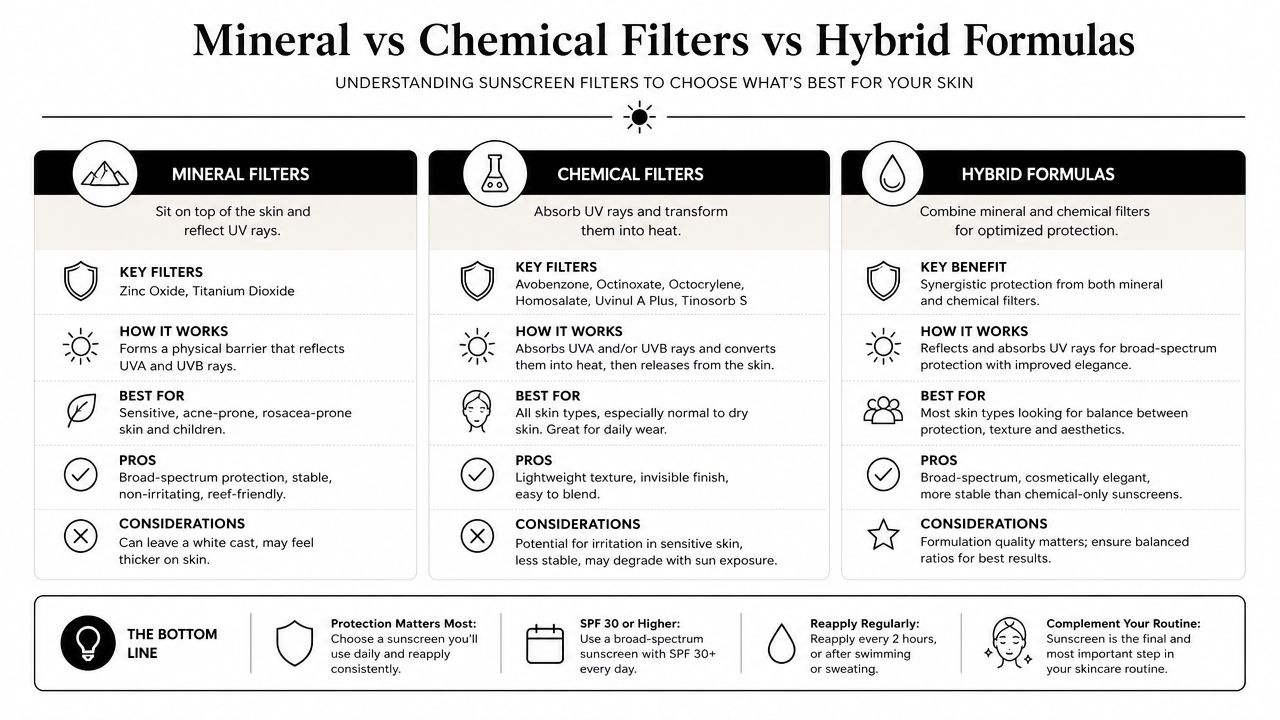
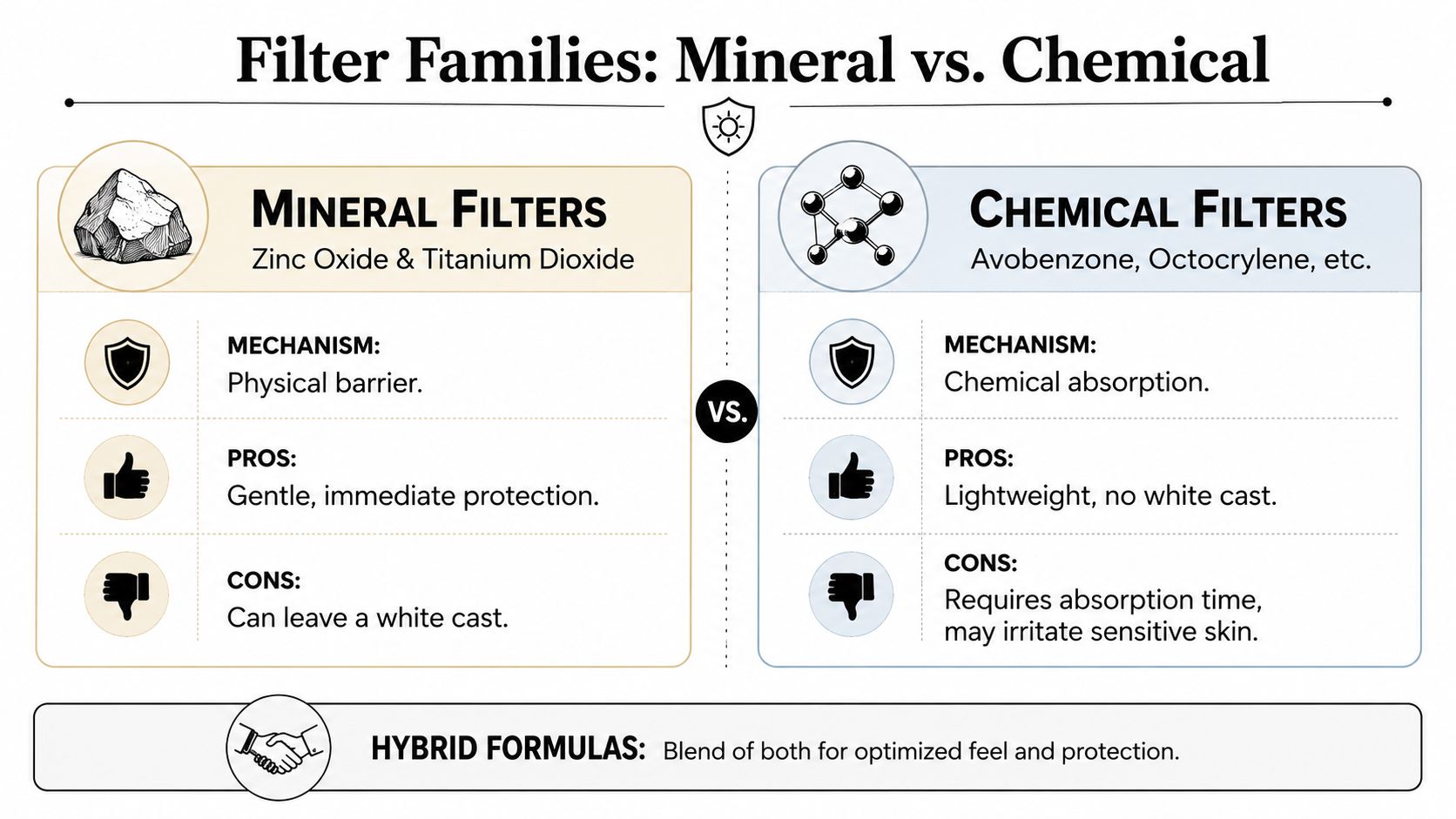
The filter family shapes how a face sunscreen feels long before anyone thinks about SPF. Mineral filters usually centre on zinc oxide and titanium dioxide, while chemical filters use modern organic absorbers that tend to disappear more easily into the skin. Many premium face formulas are hybrids because they try to keep the strength of both systems while softening the drawbacks.
What each family gives up
Mineral formulas often suit sensitive or post-procedure skin because they're usually less stingy and easier to trust near the eye area. The trade-off is cosmetic. They can leave a cast, feel heavier, or sit more obviously on medium to deep skin tones.
Chemical and hybrid formulas are often chosen for daily wear because they spread more smoothly over the curved topography of the face and usually sit better under makeup. That doesn't make them “better” in every case, it makes them more practical for people who care about invisible wear, layering, and speed in the morning. Some consumers still prefer mineral-leaning products for reactive skin or because they like the texture better.
Why the formula architecture matters
The question is not just mineral versus chemical, it's whether the formula delivers a uniform film. A hybrid system can help with both coverage and feel, which is why it's common in premium face care. If a product uses filters that suit the skin but the finish pills under concealer, the user won't keep it in rotation.
A helpful example for shoppers in the Swiss market is the way physical and hybrid sunscreens are discussed in Axis Y physical sunscreen for skincare fans, where the emphasis is on wearability as much as protection. That is the right lens for a face product. The best sunscreen is the one that gets applied evenly, stays comfortable, and fits the rest of the routine.
Matching Sunscreen to Your Skin Type
The wrong face sunscreen can make a good skincare routine feel clumsy. Oily skin looks shinier, dry skin feels tighter, sensitive skin stings, and acne-prone skin starts pilling over actives. The SPF number doesn't fix any of that.
What tends to work by skin profile
| Skin profile | Preferred texture | Filter family | Key label cues |
|---|---|---|---|
| Oily or combination | Fluid, gel-cream, matte finish | Chemical or hybrid | Non-comedogenic, oil-control, lightweight |
| Sensitive or reactive | Cream, lotion, or mineral-leaning formula | Mineral or gentle hybrid | Fragrance-free, eye-area friendly |
| Mature | Serum-cream, emulsion, soft-focus finish | Hybrid or mineral-leaning | Moisturising, makeup-compatible, broad-spectrum |
| Acne-prone | Lightweight fluid that layers cleanly | Hybrid or modern chemical | Non-comedogenic, low-pilling, fast-drying |
Oily and combination skin usually does best with a lighter texture that doesn't keep building shine through the day. A fluid or gel-cream finish is easier to live with under sunscreen reapplication, especially if the formula carries non-comedogenic positioning and a dry-touch feel. Acne-prone users often want the same thing, plus a product that sits politely over retinoids, azelaic acid, or benzoyl peroxide without dragging or flaking.
Sensitive and reactive skin is a different conversation. Fragrance-free formulas, shorter ingredient lists, and mineral-leaning systems are often easier to tolerate around the eyes and nose. Mature skin often benefits from a richer emulsion that smooths the look of texture without turning the face into a reflective patch by lunchtime.
Fit beats marketing language
A sunscreen can be technically excellent and still be wrong for the person using it.
That's the part most labels don't say out loud. If a shopper complains that every “face” SPF pills, stings, or feels greasy, the issue may be the finish rather than the protection factor. The goal is not just broad-spectrum coverage, it's a formula that behaves well on that specific face, in that specific routine.
The Zones Most People Forget and Why Tinted SPFs Help
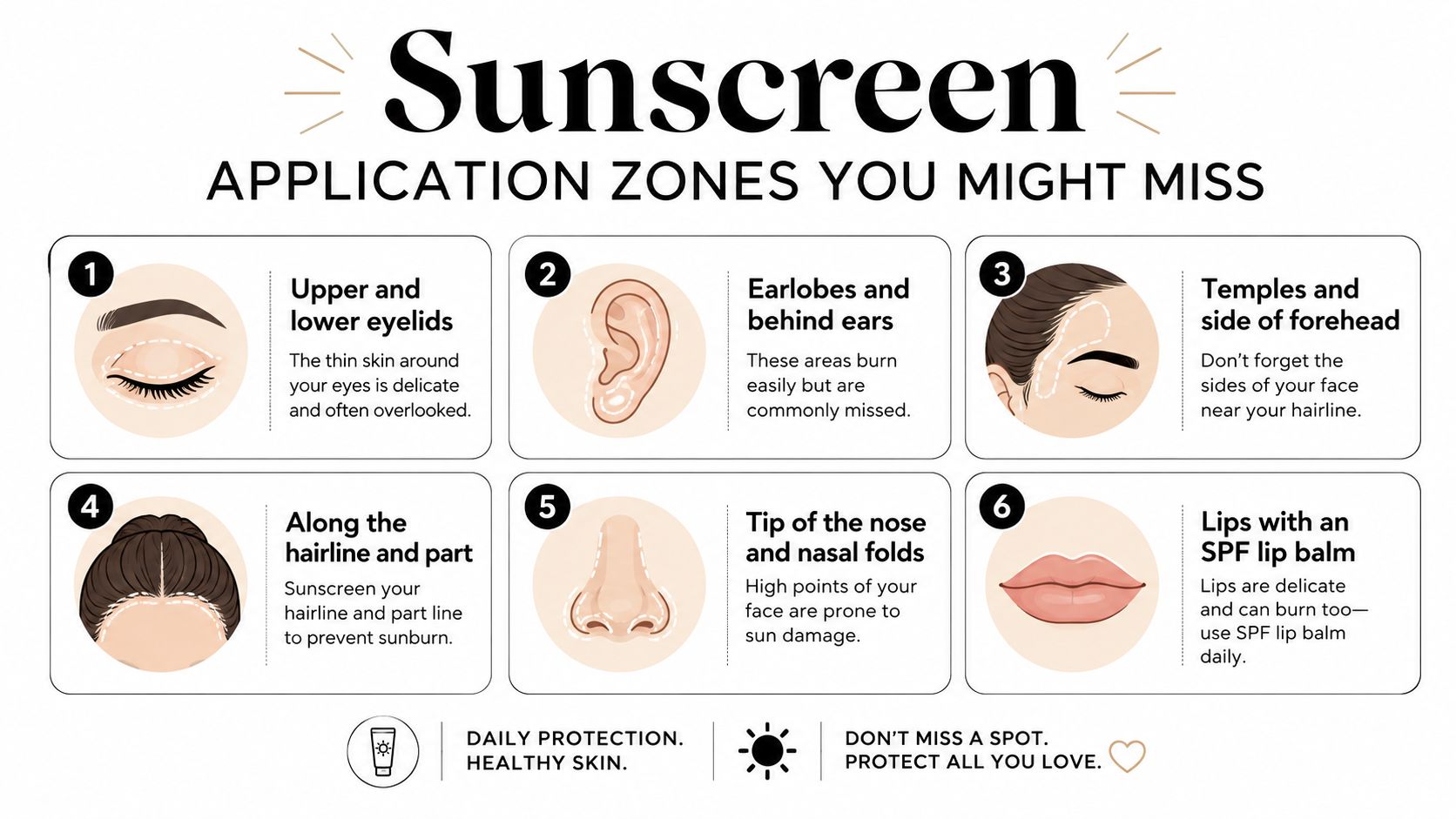
Even careful users miss the same places again and again. The eyelids, inner eye corners, temples, hairline, and ears are easy to skip because they're awkward to reach and easy to forget once the face already looks “covered”. A UV-imaging study in the brief found the eyelid region was missed at a median of 14% versus 7% in the rest of the face, and the medial canthus still got missed even after people were told how to apply more carefully (PMC study).
Why tinted formats help real people
Tinted face SPFs are useful because they create visual feedback. If you can see where the product has gone, you're less likely to leave pale gaps at the nose crease or around the temples. They also double as a light base, which helps people who wear makeup feel as if sunscreen is part of the routine instead of an extra layer fighting the foundation.
Mineral sticks can be helpful for eyelids because they reduce stinging and make precise placement easier. Under-eye areas and inner corners are still delicate, so the point is not to rub product hard into the skin, but to place it carefully and let it sit. A cushion or compact format can help with touch-ups if a user is already wearing makeup.
Layering without ruining the finish
Makeup compatibility matters because people rarely wear face sunscreen alone. The safest sequence is sunscreen first, then wait for it to settle, then apply foundation or skin tint. Mixing sunscreen directly into foundation is a bad habit if it means the sunscreen layer becomes uneven.
Practical note: if the face gets a second layer of makeup later, use a format designed for touch-ups, not a random amount of foundation mixed with SPF.
The point is coverage, not cosmetic perfection. If the ears, hairline, and eyelids are still forgotten, the face isn't really protected, no matter how polished the centre panel looks.
How to Apply, Layer, and Reapply Throughout the Day
The most expensive face sunscreen fails if it's used like a moisturiser dab. The useful habit is boring, fast, and repeatable. In practice, that means a reliable amount in the morning, a sensible place in the routine, and a plan for top-ups when the day gets messy.
A simple routine that people actually keep
Start with skincare you already use, then apply sunscreen as the last leave-on step before makeup. Mineral filters begin working on contact, while chemical filters are commonly given a short settling window before sun exposure, so the practical habit is to apply before leaving the house rather than at the door. If you need a memory aid, the two-finger method is a decent shorthand for face and neck, even though no shortcut beats careful coverage.
For reapplication, triggers matter more than clock-watching. Swimming, heavy sweating, towelling, mask wear, and long periods in direct UV all justify another layer, and the traditional “every two hours” advice still applies during sustained exposure. If you're indoors near windows, the logic is the same, the face still receives daylight and still needs a steady habit.
Making reapplication work with makeup
Powder SPFs, cushions, and mist formats can help, but they're tools for touch-up, not a replacement for the first full layer. A translucent powder with SPF is useful if the face is already made up and the main goal is reducing shine while adding some coverage. Cushion compacts are easier to place around the nose and cheeks without smearing everything underneath.
For a succinct practical breakdown, BotoxBarb's sunscreen routine guide is useful because it keeps the emphasis on frequency and daily habit, not just product marketing. That's the mindset to copy. Sunscreen works best when it behaves like a normal step, not a special occasion.
Reapplication is a behaviour problem first, a product problem second.
Packaging, Shelf Life, and What Retailers in Switzerland Should Look For
A good face sunscreen can be undermined at the shelf. Heat, light, poor cap seals, and messy tester hygiene all matter because the product spends a long time in packaging before the customer ever opens it. For Swiss pharmacies, drugstores, and clean-beauty stores, the right buying decision is partly a formulation question and partly a storage question.
What quality control should actually show
Serious sunscreen suppliers should be able to discuss emulsion stability, viscosity, pH, and active-ingredient assay using validated methods such as HPLC, because those checks help confirm that the formula still behaves the way it did at release. That matters for both mineral and chemical systems. A formula that separates, degrades, or changes texture over time may still look fine on the shelf, but it won't wear the same way on skin.
Packaging also shapes performance. Airless pumps and opaque tubes are safer choices for face products than clear packs sitting in sunlight, because they help protect both filter systems from avoidable stress. In a Swiss retail setting, that matters when products are displayed near windows or handled often by testers.
Certification is not the same as performance
ECOCERT and COSMOS tell you something important about ingredient standards and ecological positioning, while cruelty-free commitments aligned with PETA and Cruelty Free International speak to ethical marketing and testing policies. None of those labels replace the need to ask whether the face sunscreen delivers the promised UV profile, or whether the package protects it through the supply chain. A product can be ethically positioned and still be a poor face formula if the texture fails or the filters aren't stable.
For the shelf, the cleanest merchandising decision is simple. Keep the product away from heat, manage testers carefully, and pair face sunscreen with after-sun or antioxidant products only when the combination makes routine sense for the customer. The best store shelf doesn't just look premium, it helps the formula reach the face in the same condition it left the factory.
Common Questions About Face Sunscreens Answered
Tinted SPF can replace foundation for some people, but not all. If the tint matches well and the finish suits the skin, it can act as a light base, and the iron oxides in tinted formulas are often valued for visible-light coverage in daily wear.
Can you layer sunscreen with retinol or acids? Yes, but keep the routine tidy. Apply your actives at night if they're irritating, use sunscreen in the morning, and don't mix enough separate products that the sunscreen film becomes patchy.
Pregnancy and breastfeeding usually push cautious shoppers towards mineral-leaning formulas, especially if the skin is reactive or the eye area is sensitive. For children, fragrance-free mineral sticks and careful reapplication are usually the most practical starting point.
Reef-safe claims should not be the main buying reason. They may matter in some markets, but on a face product the priorities are still broad-spectrum performance, comfortable wear, and good daily adherence.
beautysecrets.agency helps Swiss retailers, pharmacies, and premium beauty partners build cleaner, more credible facial sun-care assortments without sacrificing performance. If you're curating sunscreen for face options that need to feel good under makeup, suit sensitive users, and still stand up to daily Swiss wear, visit beautysecrets.agency to explore their focused selection of ethical, high-quality brands.