You're standing at the appointment chair, or scrolling between saved photos at midnight, trying to decide whether the look you want is too glossy, too sharp, or too fussy for real life. French almond nails usually win that argument because they sit in the narrow space between polished and practical, and that's exactly why they keep coming back.
The combination isn't a random trend stack. The French manicure was popularised in Hollywood in 1975 by Jeff Pink, founder of ORLY, as a neutral look that worked through costume changes, then shown at Paris Fashion Week in 1976–1978 before the name stuck, while the almond shape had already become associated with elegance during World War II and later with Elizabeth Taylor (Passioné Beauty history of the French manicure, Country & Town House on almond nails). Put those two histories together and you get a style that has survived because it solves a real problem, it looks refined without being loud.
Why the French Almond Remains a Timeless Nail Choice
A lot of nail trends look good in a photo and feel awkward in a meeting, a gym class, or a week of typing. French almond nails have stayed relevant because they handle all three. The French tip brings structure, the almond silhouette softens the hand, and the result reads as neat instead of overdone.
That combination also has strong salon logic behind it. The modern French manicure grew through repeated revivals, first with crisp white tips and glossy finishes in the 1990s, then again in the 2000s and 2020s in softer, more natural versions (Passioné Beauty history of the French manicure). The almond shape fits that evolution because it doesn't fight the French tip, it extends it. A rounder edge can make the white line look broader, while an almond point makes the same design look cleaner and more lifted.
Practical rule: the French almond works because both elements carry restraint. If either the tip or the point becomes too aggressive, the style loses its elegance.
That's why this look still appears in both fashion and everyday salon work. It can feel classic on one client and modern on another, without changing the basic formula. For anyone deciding between bolder nail art and something more enduring, that's the attraction.
Preparation and Shaping Your Almond Nail from Start to Finish
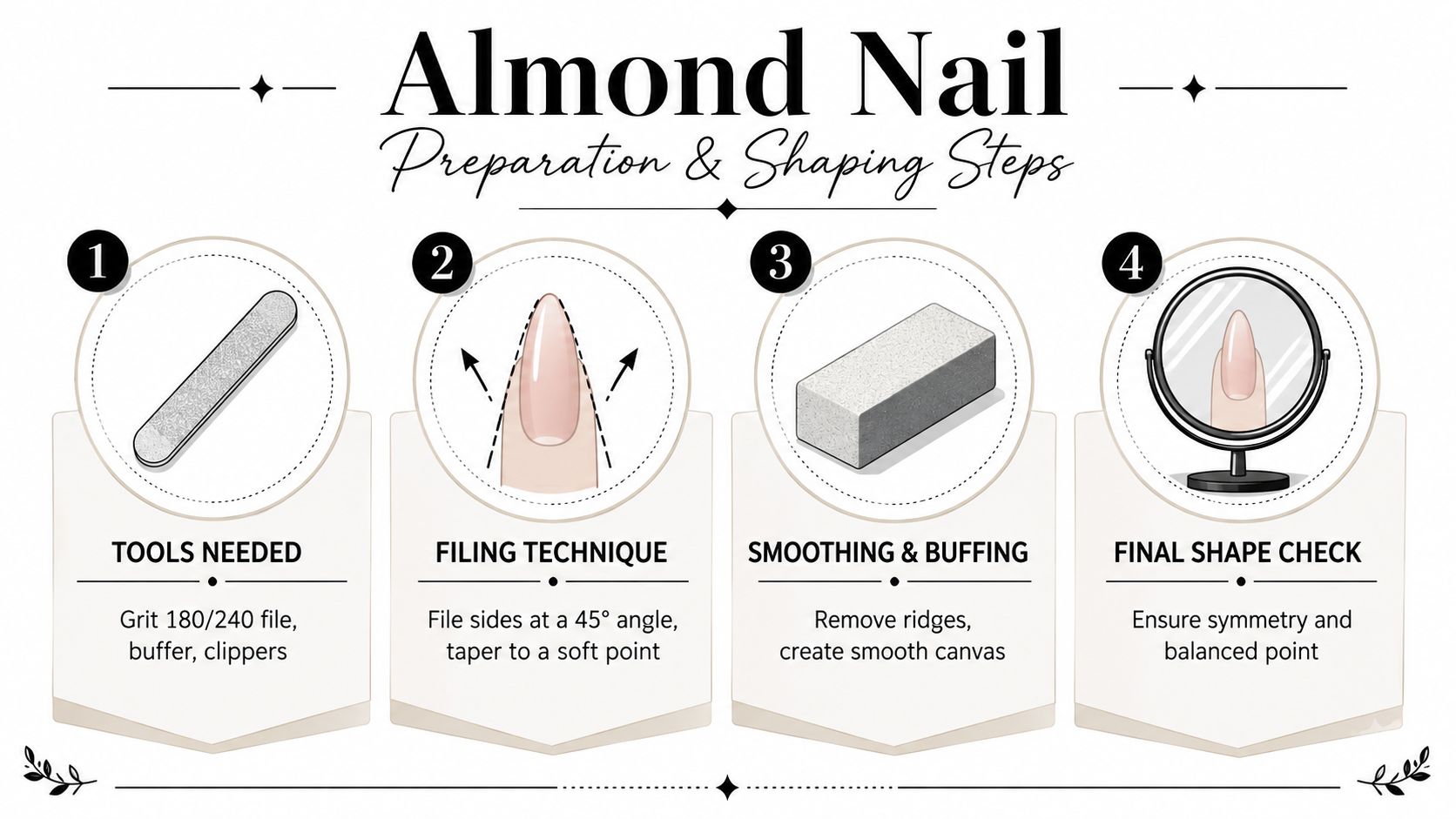
A good French almond begins before any polish touches the nail. If the shape is uneven, the tip will always look off, no matter how carefully the white line is painted. The cleanest result starts with straight sidewalls, then controlled inward filing so the nail tapers into a soft point rather than a spike (YouTube tutorial on sculpted almond shaping).
The shaping sequence that actually holds up
Start with cuticle work, because excess skin makes the final outline harder to read. Then gently buff the surface so product can sit evenly, and choose your cleanser or primer based on the nail plate in front of you. Oily nail beds usually need stronger prep, while sensitive skin responds better to a lighter touch.
For filing, use a grit around 180–240 and keep each side calm and deliberate. The safest habit is to reduce the sidewall in controlled passes and stop after no more than three passes per side, because over-filing thins the plate and makes the two sides drift out of balance (YouTube tutorial on sculpted almond shaping). That advice matters more than it sounds, especially on clients who already have flexible natural nails.
A technically correct almond also needs enough length to give the file something to work with. The shape is carved in from each sidewall and then softened at the tip, so short nails can be difficult to turn into a true almond without losing proportion. On very short natural nails, a cleaner oval can sometimes be the better choice.
Keep the sidewalls straight for longer than feels intuitive. The point should appear only at the end of the shaping process, not halfway through it.
Before product, check symmetry from the front and side. The tip should sit centred, the left and right taper should mirror each other, and the soft point should feel balanced rather than narrow. If one side looks heavier, fix that now, because French work magnifies small shape mistakes.
Step-by-Step Application for a Classic French Almond Manicure
A clean French almond starts with restraint. After the shape is set, every layer has to respect the taper of the nail, because heavy product flattens the silhouette and makes the free edge look wider than it should. Keep the French layer thin and streak-free so the line stays crisp and the almond profile stays light.
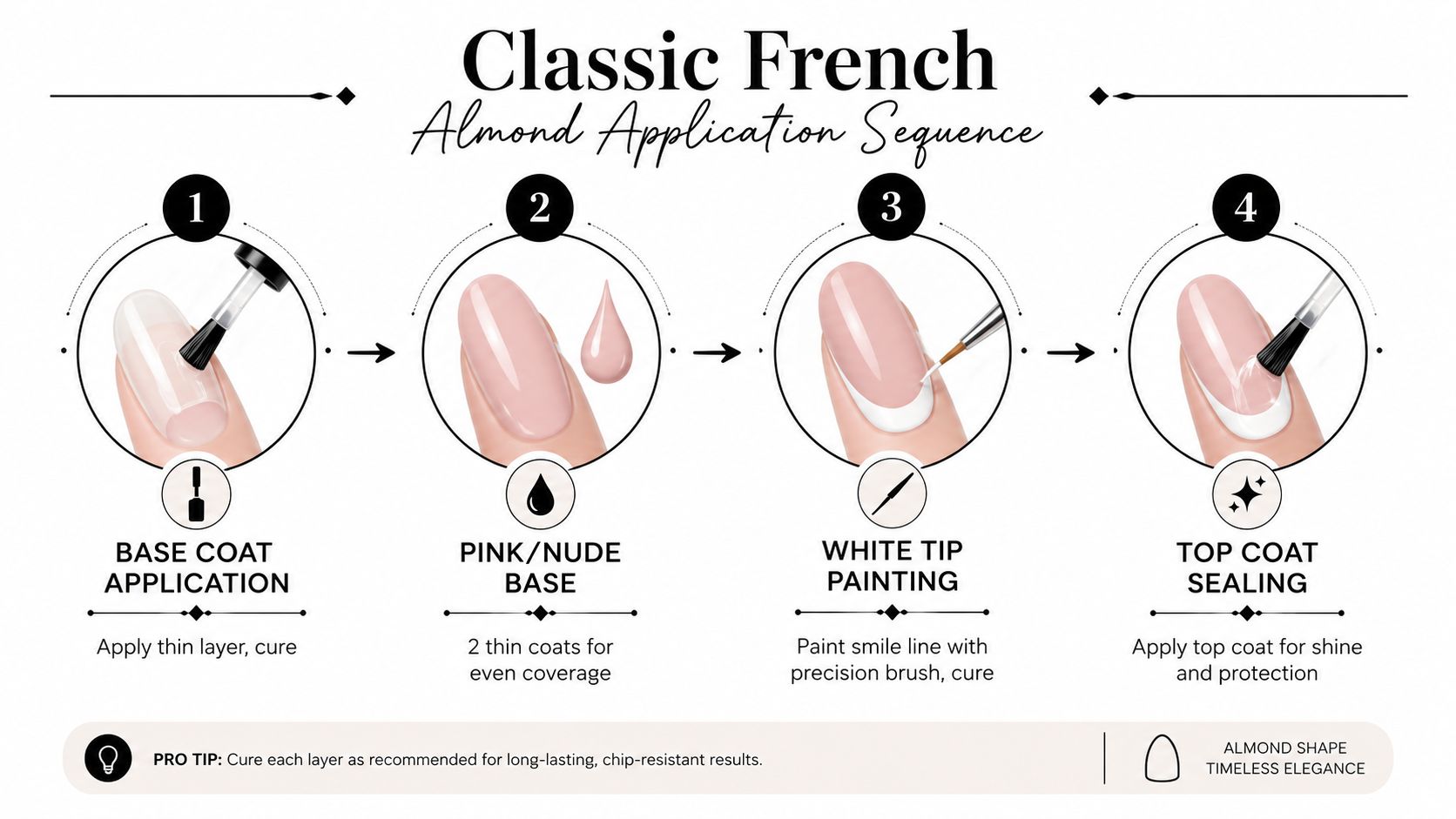
Getting the smile line right
Start by placing the smile-line apex at the middle of the free edge, then bring both endpoints up to the same height before you connect the curve and fill it in (Indigo Nails step-by-step French guide). On almond nails, that placement keeps the white band centred and stops the tip from pulling to one side as the hand moves.
In the source method, the white layer is cured for 30 seconds, then checked before the next step (Indigo Nails step-by-step French guide). That timing only works with a thin application. A thick line keeps its bulk after curing, so the curve needs to be correct before the lamp stage.
A shaping sequence built to last
- Base coat first. Apply a thin layer and lightly seal the free edge.
- Pink or nude base next. Two thin coats usually give an even background.
- Paint the white tip. Keep the brush controlled and the curve even.
- Finish with top coat. This adds shine and protects the edges.
That order gives you a cleaner surface to work on, especially with gels that self-level quickly. If you want to refine your method or compare product systems, the Omega Lasers training course finder can help you locate practical nail or beauty education nearby without guessing at what each course covers.
Cap the free edge lightly at the end. It takes only a small amount of product on the edge, and it helps the French line stay neat through wear rather than showing chips at the tips.
Choosing Clean and Ethical Products for French Almond Nails
The shape matters, but product quality decides how the manicure wears and how it feels on the nail. A polished French almond needs a base and top system that levels well, stays clear, and doesn't irritate the skin around the nail. That's where cleaner formulations deserve attention, especially for clients who want a beauty routine aligned with Swiss expectations around transparency and quality.
What to look for in clean formulations
The most useful filters are simple. Look for certified-organic ranges, cruelty-free commitments aligned with PETA and Cruelty Free International, and formulas approved under recognised standards such as ECOCERT. beautysecrets.agency curates brands including Abahna, Fushi, and Egyptian Magic, which sit in that broader clean-beauty space through different product types and ingredient philosophies.
| Certification or Standard | What It Means | Why It Matters for Nails |
|---|---|---|
| ECOCERT | Recognised formulation standard for ingredients and processing | Helps buyers choose products with clearer ingredient controls |
| Cruelty-free commitments | No animal testing under the brand's stated policy | Aligns with ethical purchasing expectations |
| Certified-organic positioning | Ingredient sourcing is built around organic standards | Useful for clients who prefer gentler beauty routines |
| Natural multi-purpose balm or oil | Fewer complicated additives in a supporting product | Can support cuticle care and hand comfort between services |
Abahna is known for global bathing rituals, Fushi for fresh-pressed organic oils and herbs blended in London, and Egyptian Magic as a widely loved all-natural multi-purpose cream. Those are not nail products in the narrow sense, but they matter in a manicure routine because cuticle condition, hand hydration, and product tolerance all affect how a French almond presents over time.
Decision rule: choose the product that gives you the clearest label, the least irritating feel, and the finish that stays neat on the nail edge.
The practical benefit is simple. Cleanly formulated prep and finishing products can support hydration, reduce the “tight” feeling that some clients dislike, and keep the manicure looking tidy rather than cosmetically overloaded. In a premium Swiss setting, that restraint usually reads better than dramatic product stacks.
Short Nails and Tip Width Rethinking French Almond Proportions
Short nails are where most French almond advice falls apart. Many guides act as if every hand has enough length for a dramatic point, but almond shaping generally needs more nail to work cleanly because the file comes in from each sidewall and the tip is softened at the end (Women's Health on almond nail shape). When the nail is too short, the result can drift towards a softened oval, and that's not a failure, it's just the honest shape the nail can support.
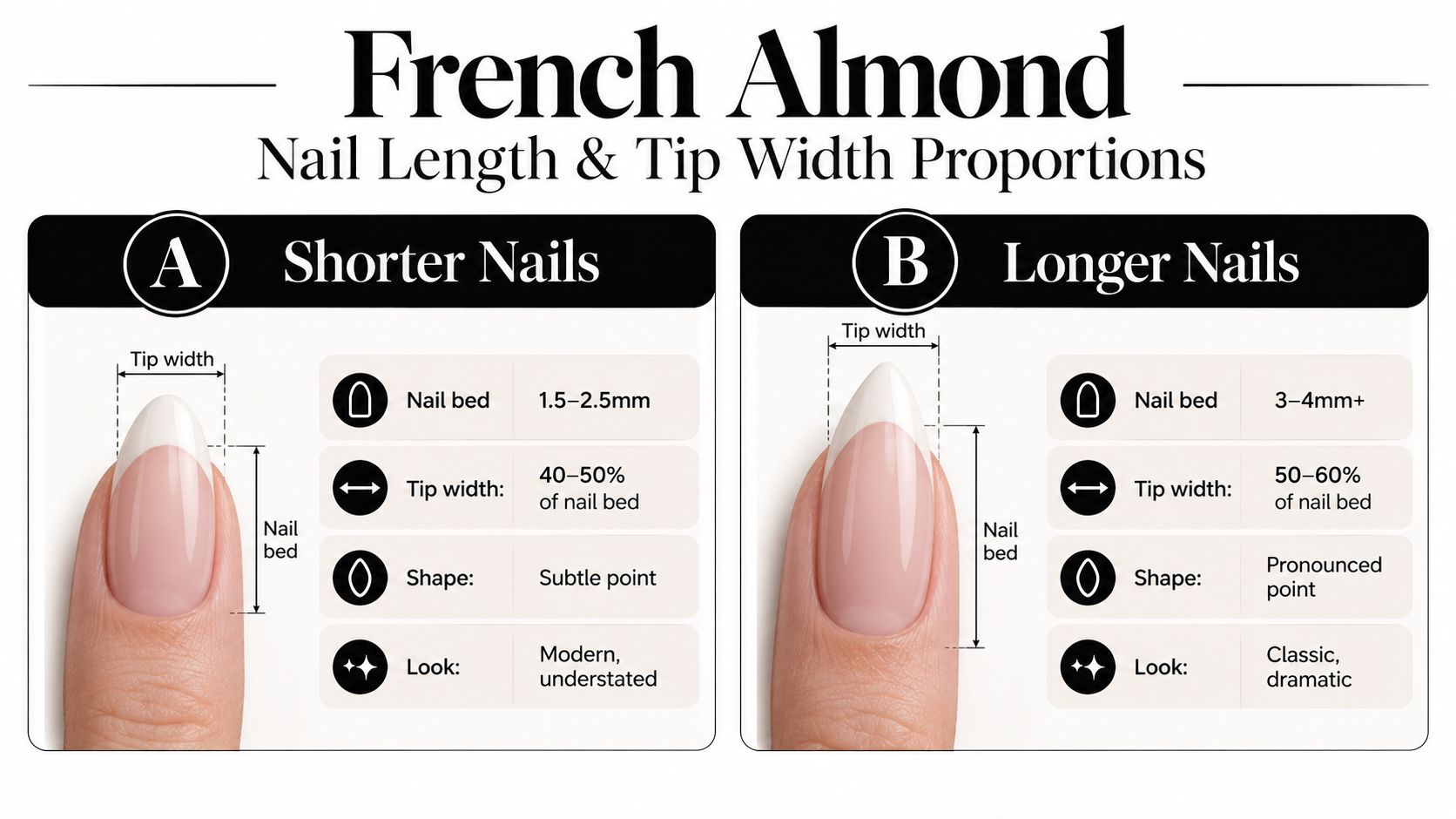
How to make the look work on shorter lengths
The fix is proportion, not force. On shorter nails, the French tip should stay narrow, around 1 to 2 mm, with even more restraint when the nail itself is compact (Mirelle Inspo on French tip almond proportions). A wider tip pulls the eye down and makes the almond silhouette feel heavy instead of elegant.
For shorter natural nails or overlays, ask for a subtle point and a very slim white border. If the goal is a tidy, wearable look, that's usually enough. Swiss clients who prefer minimal, clean aesthetics often do better with this quieter proportion than with a dramatic salon photo version that doesn't suit daily wear.
When discussing the service, be specific. Ask for:
- A narrow French band so the tip doesn't overpower the nail bed.
- A softened point rather than a sharp almond peak.
- A length that suits your routine instead of a shape copied from extension photos.
- A finish that stays slim at the sides, because side bulk makes short nails look wider.
That conversation matters more than chasing the “ideal” almond you see online. If the nail is short, polished restraint usually looks more expensive than a forced shape.
Aftercare, Longevity, and Styling Inspiration for French Almond Nails
A French almond can look immaculate on day one and tired by day five if aftercare gets ignored. Daily cuticle oil, sensible gloves for water-heavy tasks, and gentle top-coat refreshes between fills all help the manicure stay crisp. The right oil routine matters enough that a practical guide like ArtNaturals argan oil tips is worth keeping handy when you want to build a simple hand-care habit around the manicure.
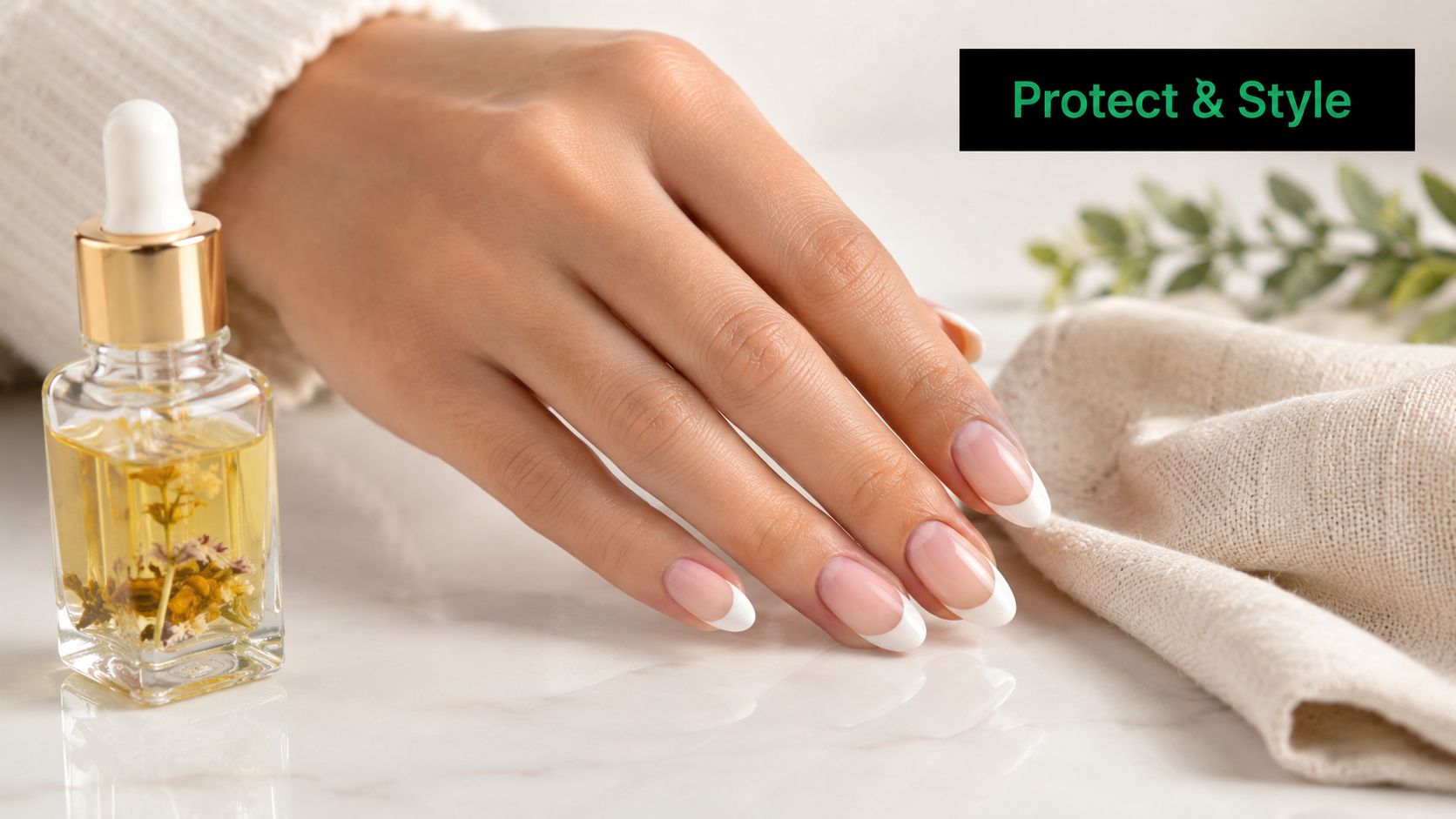
Inspiration that keeps the same clean logic
Once the classic version is in place, the almond shape gives you room to vary without losing the polished feel. Reverse French almond designs, soft ombré tips, and minimal nude bases all work because the silhouette already carries the elegance. The shape also suits seasonal updates, so a slight shift in colour or finish can feel fresh without becoming chaotic.
For salon buyers and beauty retailers in Switzerland, the service often pairs naturally with clean strengthening treatments or organic hand-care products. That creates a better upsell conversation than pushing unrelated add-ons, because the manicure and the care step support the same aesthetic. If you're choosing a provider, ask whether they stock clean finishing products and whether they can match the French line to your nail length rather than using a one-size-fits-all template.
Good shaping, clean products, and thoughtful aftercare decide whether French almond nails stay polished or start looking blunt. If you want the look done properly, book a technician who can work the proportion as carefully as the finish, or visit beautysecrets.agency to explore clean, ethically sourced beauty lines that fit a refined manicure routine.