A Swiss client walks in with freshly bleached lengths or silver hair that's gone dull at the ends, and the complaint is always the same. The shampoo is “fine”, but the yellow cast keeps coming back, and the shelf answer has been too vague for too long. No Yellow Shampoo is not a niche beauty story, it's a trade category with a clear job, which is to neutralise brassiness on blonde, grey, highlighted, and lightened hair without turning the conversation into guesswork.
For Swiss buyers, the mistake is stocking one purple bottle and calling it a range. The market now needs performance-led toning shampoo, sensitive variants, and, where your clientele expects it, certified clean-beauty options that look and read like premium care rather than corrective punishment. That shift isn't random. It sits on top of the move from soap-based washing to synthetic surfactant shampoos in the 1930s, when Schwarzkopf introduced the first shampoo using non-soap-based surfactants in 1933 and Colgate-Palmolive-Peet launched Halo as a “zero soap shampoo” in 1938, a formulation shift that made today's pigmented corrective shampoos commercially possible (Inventor Spot).
That history matters because premium Swiss consumers already buy haircare like skincare. They read ingredient decks, they ask about scalp tolerance, and they expect salons, pharmacies, and e-commerce stores to segment by need instead of pushing a one-size-fits-all purple wash. Halo's old positioning as clean-rinsing and safe for children also shows how quickly shampoo moved from basic cleansing into specialised grooming, a logic that still drives demand for violet and anti-brass formulas today (Smithsonian collection record).
Trade rule: if the customer's hair history is bleached, silver, porous, or frequently toned, a generic cleanser is not the right product category. Stock for the hair state, not for the shampoo colour.
Why Every Swiss Counter Now Needs a Toning Shampoo
Swiss buyers know the customer before she speaks. She's holding her hair up, pointing to a warm yellow band, and asking why her “colour-safe” shampoo hasn't kept the blonde cool. That's the moment when a counter either looks expert or looks underprepared.
No Yellow Shampoo is the retail answer to that problem. It's a corrective cleanser built to deposit violet or blue tone onto lightened hair, then rinse away cleanly enough to stay in maintenance territory rather than acting like a permanent toner. In Switzerland, that matters because premium haircare is already sold on function, not fluff. People expect the product to do something visible.
The category is broader than one purple bottle
A serious shelf in this category shouldn't stop at a single general-purpose SKU. You need different textures of the same solution, because the client's hair history decides the right formula. A weekly high-pigment wash suits someone with fresh highlights or very porous blonde, while a gentler, scalp-friendlier option is better for someone who wants to keep silver hair bright without making their wash routine feel harsh.
That split is also why the category belongs in pharmacies, spas, and premium e-commerce, not just in salons. The client often buys the first bottle from a hairdresser, then rebuys where convenience and trust meet. If your counter can't explain why one formula is stronger, why another is gentler, and why a third is better for sensitised scalps, you're leaving repeat business to someone else.
Practical rule: buyers should be able to answer three questions instantly, what shade problem does it fix, how often should it be used, and what hair type should avoid it.
What the shelf has to communicate
The message needs to be simple. No Yellow Shampoo is for colour correction, not everyday vanity washing. It should sit near blonde care, grey care, and post-lightening aftercare, not get lost among generic moisture shampoos. If you place it correctly, you're not just selling a cleanser, you're selling a visible result with a clear use case.
The Colour-Correction Science Behind No Yellow Shampoo
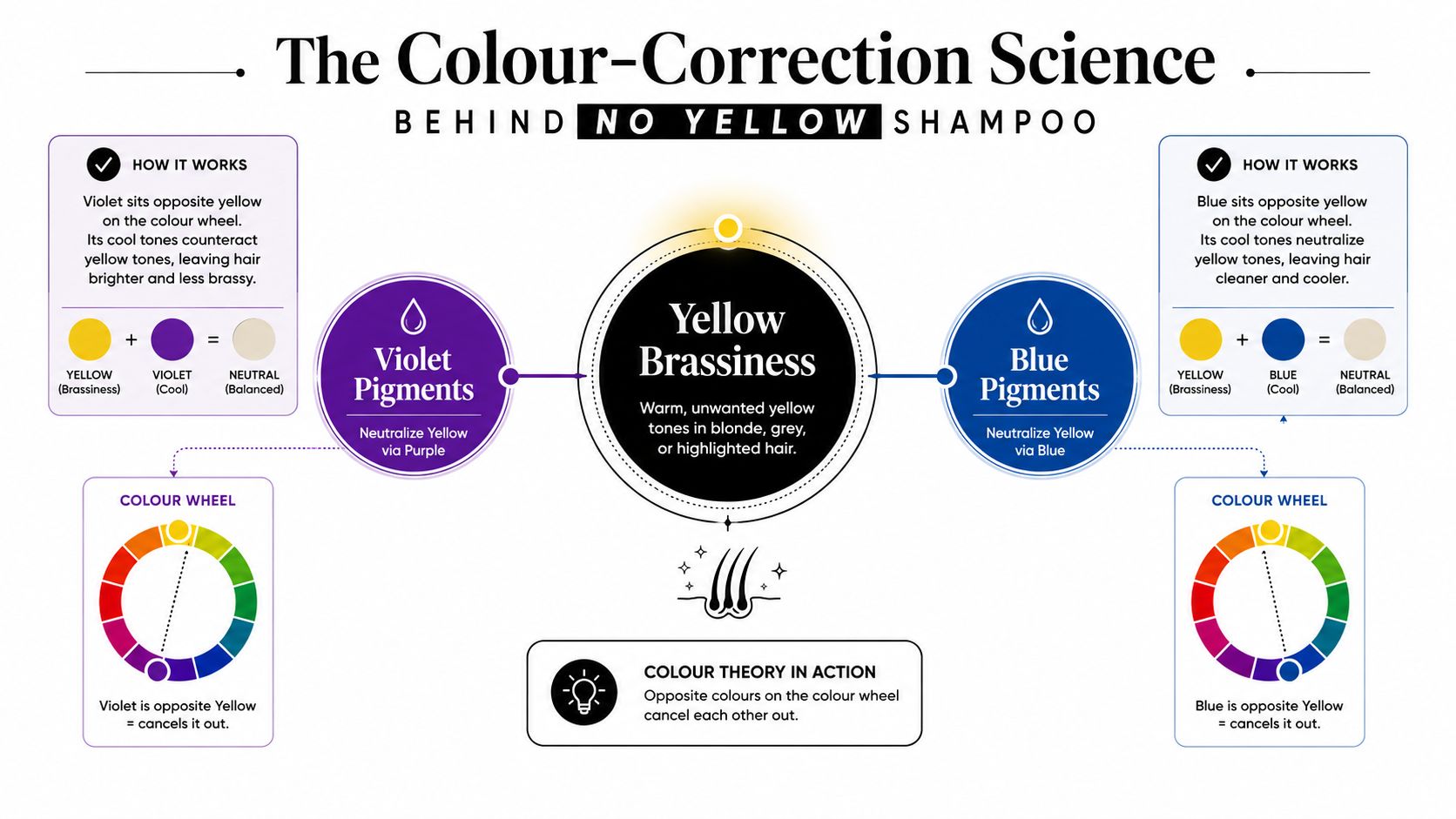
A shopper should understand one thing immediately. Violet cancels yellow. Blue helps push back warmer brass too. This is colour theory in practice, the same principle used in make-up correctors and digital white balance.
White balance works the same way for hair
A blonde, grey, or highlighted strand reflects unwanted warmth when the cuticle is open or the tone has faded. A violet shampoo deposits a small amount of complementary pigment onto the fibre and changes how the hair reflects light. The result is cooler-looking hair, not darker hair.
For a client, the explanation can stay simple. The shampoo lays down a cool pigment that counteracts yellow, so the hair looks more neutral and polished after rinsing. Trade buyers should be able to explain that mechanism before they decide what belongs on shelf.
Pigment is doing the work, not shine claims
Weak products hide here. Some formulas lean on “brightening” language without containing the kind of direct dye that changes the visual tone. The corrective job comes from direct dyes such as Acid Violet 43 (CI 60730) or HC Blue No. 2, which are used in Swiss-market toning formulas to deposit colour onto porous, lightened hair (Galaxus product disclosure).
That makes the visible result part of the formula itself. If the pigment is missing, the claim is empty. If the pigment is present but the wash system is too aggressive, the tone may land quickly and fade just as fast. Buyers should insist on pigment and control in the same bottle.
For trade staff, the takeaway is direct. No Yellow Shampoo should cool brassiness without turning the fibre into a lilac experiment. If the formula looks more like a styling pigment than a cleanser, it is the wrong maintenance product for most retail counters.
Reading the Ingredient Deck Like a Formulator
Swiss trade buyers should read a toning shampoo from the INCI list upward, not from the marketing copy down. The front label can promise cool blonde maintenance, but the ingredient deck shows whether the SKU will correct tone, rinse clean, and leave enough fibre support for repeated use. A serious formula gives you all three. A weak one only gives you purple water and a rough finish.
Start with the pigment system
The first checkpoint is the corrective dye. Look for Acid Violet 43 or a blue direct dye, then read where it sits in the list and how visible the formula is in the bottle. Swiss-market disclosures show that pigment placement usually tracks with strength, with higher placement pointing to a more forceful toning action and lower placement pointing to a gentler maintenance wash (Galaxus product disclosure). If the colour is vivid but the rest of the formula looks thin, you are looking at a product built to stain quickly, not to treat lightened hair well.
Read the cleansing base as a control mechanism
The surfactant system decides how the pigment behaves on hair. A harsher wash base can move colour fast, but it can also strip the fibre and make the result erratic on porous blonde or grey hair. Formula analyses from the Nordic clean-beauty side show a more measured approach in some toning shampoos, where milder cleansing agents are used to keep the deposit controlled and the feel less abrasive (Four Reasons formula disclosure).
That is the point buyers should focus on. The cleansing base is not a side detail. It determines whether the toner stays usable on sensitised lengths or turns into a one-wash correction that feels too aggressive for retail shelves aimed at regular upkeep.
Read the support system for fibre feel
The next layer is the conditioning backbone. Look for cationic care agents and film formers that reduce drag, improve slip, and stop repeated toning from leaving the hair coarse. On bleached and grey hair, that support is not cosmetic. It is the difference between a product that buyers can place with confidence and one that comes back with complaints about dryness and rough comb-through.
Some formulas also add protein-type support to steady the feel on porous fibre. That can help, but only if the rest of the deck does not fight it. A shampoo with strong pigment and no real fibre support will tone, then punish the hair. A formula with support built in is easier to sell in pharmacies, spas, and e-commerce because it matches the condition of lightened hair instead of pretending every blonde strand behaves the same.
Buyer's rule: read the deck in this order, pigment, cleansing base, fibre support. If the pigment is strong but the wash is harsh, place it as a correction SKU. If the cleansing system is moderated and the care system is obvious, it belongs in a more regular-use slot.
| Check point | Strong correction formula | Softer maintenance formula |
|---|---|---|
| Pigment profile | Clear visible corrective dye load | Gentler tint, lower visual intensity |
| Cleansing base | More assertive wash system | Milder surfactant mix |
| Fibre feel after rinse | Higher risk of dryness on porous hair | Better slip and softer finish |
| Best use | Occasional correction | Frequent upkeep on sensitised hair |
| Best channel | Salon backbar, performance e-commerce | Pharmacy, clean-beauty retail |
That is the method buyers need. Read the INCI list for what it controls, not for what it claims. A good No Yellow Shampoo tells you its job through the deck, then proves it in the rinse.
How to Use No Yellow Shampoo Without Damaging Hair
Most bad results come from usage, not from the concept itself. Customers either leave it on too long, use it too often, or expect a toning wash to behave like an everyday moisturising shampoo. That's how hair ends up flat, slightly lavender, or drier than before.
Use it as a corrective wash, not a daily cleanser
The cleanest protocol is straightforward. Start with a regular cleanse if the hair has product build-up or root oil, then apply the toning shampoo to wet hair, work it through the lightened lengths, and rinse well. For most clients, a contact time of two to five minutes is the practical bracket, with the shorter end better for porous hair that grabs pigment quickly.
Freshly bleached hair is the most unforgiving. It takes pigment fast, and it also loses pigment fast. That means you usually need a shorter contact time, not a longer one, if the client wants neutral blonde rather than a violet cast.
Pair it with a conditioner every time
This is not the shampoo to leave unsupported. Even well-balanced toning formulas can feel more stripping than a regular cleanser, so a mask or conditioner should follow immediately. On sensitised, grey, or heavily lightened hair, skipping that step is a fast way to create friction and a rough finish.
Practical rule: if the hair feels squeaky in the shower, the toning step has done enough cleansing and needs moisture support right after.
Know the situations where it fails
Do not push it as a daily habit on sensitive scalps. Don't sell it as the first wash immediately after a chemical service. Don't encourage layering multiple pigmented products in one routine, because that's how neutral blonde drifts into lavender or muddy grey. The product should solve brassiness, not create a second tone problem.
For trade staff, the best advice is blunt. Short contact, good rinse, follow with care. That's how you keep the result cool without overcooking the fibre.
Standard Versus Sensitive Toning Formulas
Swiss buyers should split no yellow shampoo into two shelves, performance first and tolerance first. The wrong choice annoys the customer fast. A standard formula gives a stronger tonal correction and a more assertive wash. A sensitive formula trades some punch for better comfort on bleached, grey, or scalp-reactive hair.
What the two formulas are trying to achieve
Standard toning shampoos suit resilient hair, oily roots, and clients who use heavy styling products. They need a cleanser that clears residue well enough for pigment to show quickly. Sensitive versions are built for frequent use, dry lengths, and clients who complain about tightness, itch, or a rough finish after washing. They should feel calmer on the scalp and leave less drag in the lengths.
For trade buyers, the question is where each version belongs. Salon backbars can carry the standard formula because stylists want fast visual correction and are prepared to control contact time. Pharmacies and dermatology-led counters should start with the gentler version because those shoppers usually want brass control without a harsh wash. Online retail can list both, but the merchandising message should be clear: one is for stronger colour correction, the other is for tolerance and regular use.
| Attribute | Standard Formula | Sensitive Formula |
|---|---|---|
| Cleansing feel | Stronger, more assertive | Milder, less stripping |
| Pigment effect | More immediate | More controlled |
| Fragrance profile | Usually more noticeable | Often reduced or absent |
| Best hair profile | Resilient, oily, heavily styled | Sensitised, dry, frequent-wash |
| Best channel | Salon backbar, performance retail | Pharmacy, dermatology-led retail |
What to look for on the label
A standard formula usually signals a cleaner, harder-working wash. Galaxus product disclosure shows the sort of stronger cleansing profile buyers will often see in a high-impact toning shampoo, which is useful where residue removal matters as much as colour correction. That sort of formula belongs on shelves where the customer expects a firmer wash and is not worried about a stripped feel.
Sensitive formulas send a different message. Four Reasons formula disclosure points to a gentler styling of the wash, with softer cleansing and more conditioning support. That is the version to stock where the client base includes sensitised scalps, dry blonde lengths, and grey hair that feels wiry after cleansing.
The buying rule is simple. Match the shampoo to hair history, not to marketing copy. Freshly lightened clients usually need a gentler hand, especially if their fibre is already porous. Older blonde, heavy product build-up, and clients who want a firmer correction can handle the standard route better. Grey hair often sits in the middle, but if the hair is coarse and dry, the sensitive option usually sells better because it keeps the fibre more manageable.
For pharmacies and clean-beauty counters, I would lead with the sensitive formula and keep the standard version as a secondary option. For salons and performance-led e-commerce, stock both and make the use case obvious on shelf and in the product copy. The range should let a buyer choose by scalp comfort, cleansing strength, and hair condition, not by bottle design.
Certification Cues That Matter for the Swiss Clean-Beauty Buyer
A toning shampoo gets judged twice in Switzerland, once for how it corrects colour and once for what the label says about the brand. Buyers know that quickly. A bottle can deliver good violet correction and still lose trust if the front only leans on vague plant imagery and soft promises.
The labels that actually change buying confidence
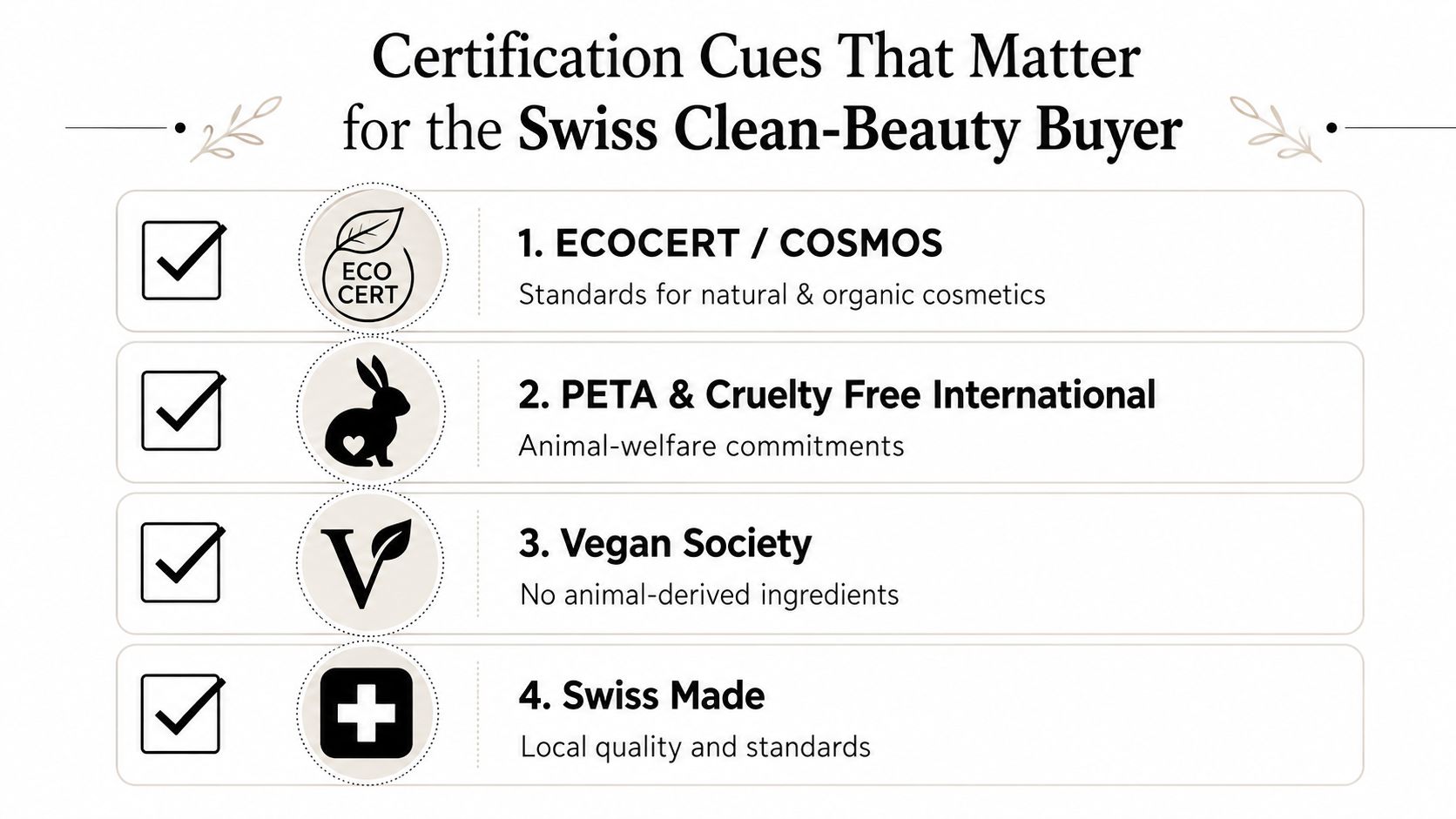
ECOCERT and COSMOS matter because they point to a real framework for natural and organic cosmetics, not loose “clean” language. PETA and Cruelty Free International matter because they signal animal-welfare commitments that Swiss shoppers recognise immediately. If a formula also carries a vegan claim, that gives the assortment a cleaner story for customers who want to avoid animal-derived ingredients entirely.
The A list of four key certification symbols important for Swiss clean beauty consumers including organic and cruelty-free labels. makes the buying logic visible on shelf. Brands like beautysecrets.agency emphasise compliance with recognised standards such as ECOCERT and cruelty-free commitments aligned with PETA and Cruelty Free International, which is the direction Swiss pharmacies, spas, and premium e-commerce partners should favour.
Why certification affects tolerability
Certification does more than tidy up the packaging story. In a toning shampoo, it often goes with cleaner fragrance profiles, fewer aggressive surfactant choices, and a more restrained preservative approach. That is the sort of formula many sensitive or frequent-use customers want when they need brass control without a scalp that feels hot or stripped.
A certified formula is never a guarantee of perfection, but it cuts down the guesswork in premium retail. The customer who reads ingredients is usually the same customer who notices a shampoo that smells too perfumed or feels too strong on bleached hair. Certified cues help sales staff steer that shopper faster and with more confidence.
If a brand talks only about plants but refuses to point to an audited standard, that is thin gruel for a Swiss premium assortment. No Yellow Shampoo with real certification cues gives pharmacies and e-commerce teams a stronger compliance story and a better answer at the point of sale.
Assortment Strategy for Pharmacies, Spas, and Online Retail
A smart assortment doesn't start with brand loyalty. It starts with channel behaviour. The pharmacy shopper is different from the salon client, and the online buyer is different again because there's no advisor standing there to explain how violet pigment works.
Build the range by use case
For pharmacies and drugstores, anchor the shelf with one sensitive, certified-clean variant and one higher-pigment weekly formula. That gives you a gentler entry point for the cautious buyer and a stronger correction option for the customer who already knows her blonde needs maintenance. Put the educational emphasis on scalp tolerance, frequency, and the difference between daily care and treatment washing.
For spas and salons, the backbar needs the practical size and the retail shelf needs the take-home counterpart. Pair a litre-style professional formula with a complementary conditioner or mask, because the post-toning softness is part of the result. If the client leaves feeling dry, she remembers the dryness more than the cool tone.
For e-commerce, the winner is clarity. Feature a hero SKU with strong certification cues and a second SKU for performance-focused shoppers, then explain usage on the product page in plain language. Don't assume the shopper knows contact time or porosity. Most won't.
Give the shopper something to test against
The best merchandising aid is a swatch, not a slogan. Blonde and grey hair samples make the effect visible fast, which is exactly what corrective haircare needs. In advisory-led retail, train staff to explain deposition in one sentence and then point to the recommended use rhythm.
A useful benchmark for content planning is the way a strong cinematic production studio shapes a story from a simple concept. Good tone-correction merchandising does the same thing. It turns a technical formula into a visual promise the shopper can understand immediately, without overselling what the shampoo can't do.
Merchandising note: if your online copy doesn't explain why one formula is for weekly use and another is for sensitive hair, the shopper will choose by colour of bottle and leave disappointed.
That's why the category works best as a three-part range. Sensitive, performance, and premium story-led. Anything less is incomplete.
A Buyer's Checklist and Where Toning Haircare Is Heading
Before you add or expand a No Yellow Shampoo line, check the basics in this order.
- Pigment system, confirm that the formula contains violet or blue direct dyes.
- Surfactant balance, decide whether the cleanser is strong enough for weekly correction or soft enough for frequent use.
- Conditioning support, look for polymers or proteins that reduce drag on porous hair.
- Fragrance profile, favour lighter or fragrance-free options for sensitive counters.
- Certification cues, verify whether ECOCERT, COSMOS, cruelty-free, or vegan claims are backed by a real standard.
- Channel fit, place the formula where its use pattern makes sense, not where there's a random gap on the shelf.
The next shift in Switzerland is obvious. Buyers will keep asking for certified-organic toning formulas, fragrance-free scalp-friendly variants, and better packaging discipline, including refill logic where it makes sense. Consumers already apply skincare-level scrutiny to haircare, and the brands that win will be the ones that treat toning shampoo as a curated mini-category, not a purple afterthought.
If you need a visual partner for product education, packaging storytelling, or retailer-facing content around this kind of category, the team at cinematic production studio is worth a look.
beautysecrets.agency curates Swiss-ready clean-beauty assortments that fit exactly this kind of category planning, from certified, gentle formulas to premium positioning for pharmacies, spas, and e-commerce. If you're reviewing your toning haircare range, visit beautysecrets.agency and build a sharper assortment around the products customers trust.