You're standing at the counter with a customer who says, “I need a rosacea cream test.” In Swiss retail, that usually means one of two things, a shopper wants reassurance that a cream won't sting, or a buyer wants a defensible way to justify listing a product for rosacea-prone skin. Treat it as a casual product claim and you'll overpromise. Treat it as a tolerability framework and you can make a smarter assortment decision.
Swiss buyers should be blunt about the category. Rosacea isn't a niche issue, and the visible signs that dominate real-world cases are not subtle. A clinical review notes that published prevalence estimates in the U.S. are typically 1.3% to 2.1%, and may reach 5%, while a Swiss study of rosacea patients found a mean disease duration of 4.7 years and very high rates of permanent erythema (95%), telangiectasia (97%), and papulopustules (77%) (AAFP review). That's the retail reality you're buying into, not a short-lived redness trend.
| Decision angle | What Swiss buyers should ask | What a weak answer looks like |
|---|---|---|
| Clinical meaning | Is this a diagnosis claim or a tolerability claim? | “It tests for rosacea.” |
| Safety evidence | Has it cleared both general and rosacea-specific testing? | “Dermatologist approved” with no method stated |
| Formula fit | Does it protect the barrier and avoid obvious irritants? | Fragrance-heavy, overly active, or aggressive texture |
| Channel fit | Does it suit pharmacy, spa, or premium clean-beauty shelving? | One-size-fits-all positioning |
If you sell into Swiss pharmacies or spas, your job isn't to find a miracle cream. Your job is to separate tolerable, transparent, and channel-appropriate from everything else. That's where most of the noise in the category falls apart.
What a Rosacea Creme Test Really Means in Switzerland
The phrase buyers keep hearing
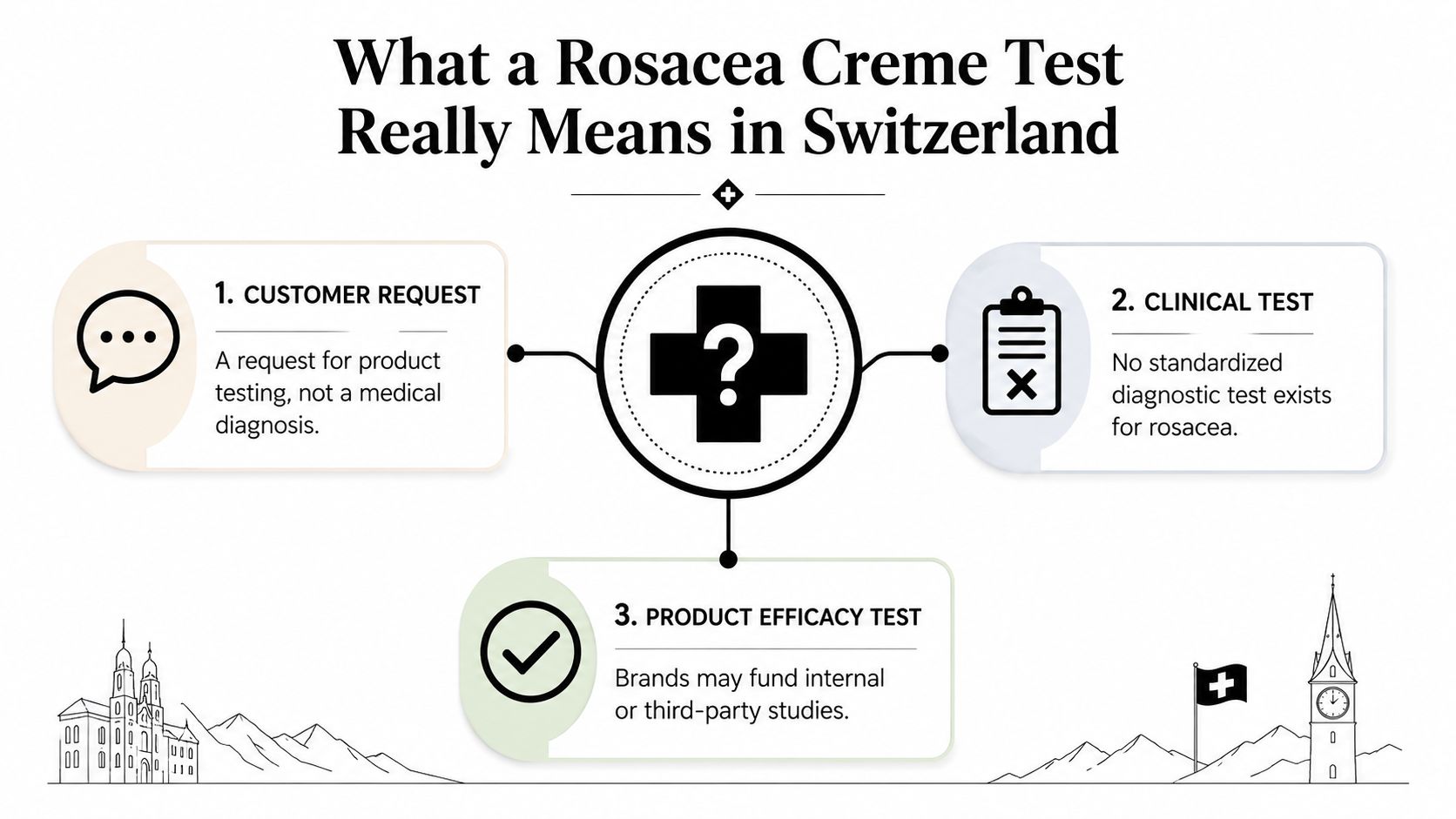
In practice, rosacea cream test is a sloppy shopper phrase. It sounds like a diagnostic shortcut, but the better reading is simple, a customer wants to know whether a cream is safe to try on reactive skin. That distinction matters in Switzerland because pharmacy staff and spa teams get pulled into medical-adjacent advice all the time, and the line between skincare and diagnosis needs to stay clean.
The most useful framing is this, there is no specific test for rosacea; diagnosis is clinical, and doctors may order tests only to rule out look-alike conditions (NIAMS guidance). So if a brand suggests its cream can “test” rosacea, that's marketing blur, not category intelligence.
What buyers should actually evaluate
The question for a Swiss assortment is whether a cream can survive a tolerability test. That means looking for formulas that are unlikely to trigger stinging, burning, itching, or barrier damage, especially in a market where sensitive-skin shoppers expect restraint, not drama. Swiss consumers are also used to cleaner positioning, so fragrance minimisation and simple routines aren't a bonus, they're table stakes.
Practical rule: If a product can't be described without implying diagnosis, don't list it that way.
For retail, the best use of the phrase is operational. A buyer should hear “rosacea cream test” and translate it into, “Can this product be patch-tested, used carefully, and sold with honest counselling?” That keeps the category grounded. It also stops your team from making medical claims you can't defend, which is exactly where premium beauty retailers get sloppy.
What a credible product test looks like
A brand can fund internal or third-party testing on a specific cream. That can be useful, but it's still not the same thing as diagnosing rosacea. For Swiss channels, the selling point is not “this proves rosacea”. The selling point is “this formula has been checked for real-world comfort on reactive skin and presented without overreach.”
That mindset protects your staff, your customers, and your brand range. It also keeps the assortment aligned with what Swiss shoppers already expect from fragrance-free, minimalist, and skin-respectful products.
Official Testing Benchmarks Every Buyer Should Know
The two layers that matter
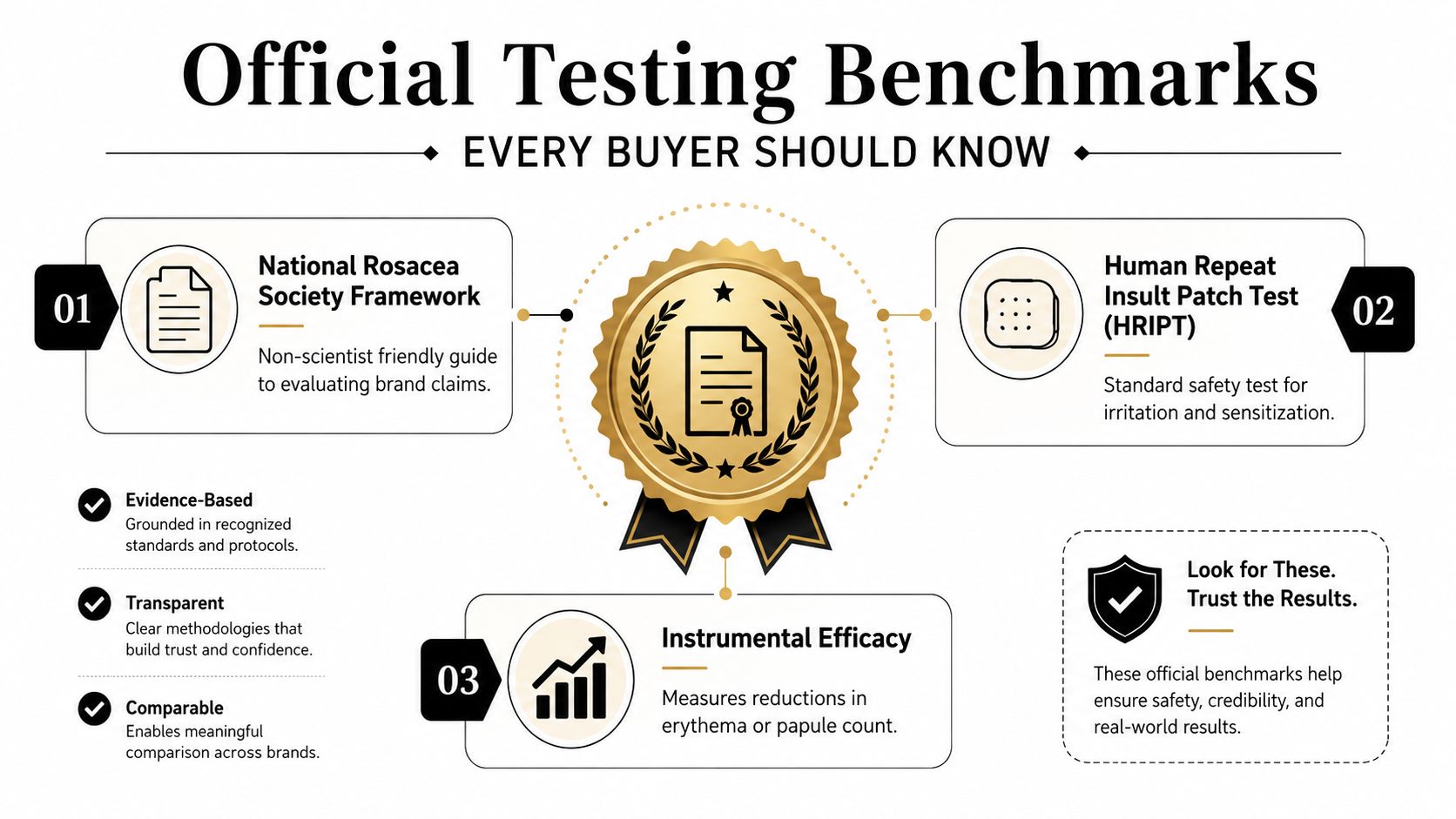
A credible rosacea cream needs two separate checks. The National Rosacea Society acceptance framework calls for human repeat insult patch testing (HRIPT) on at least 30 people and safety-in-use testing on at least 30 people with rosacea (National Rosacea Society guidelines). That is the benchmark a buyer should keep in mind before giving a formula shelf space.
HRIPT is the first gate. It measures irritation and sensitisation under repeated exposure, which tells you how a formula is likely to behave on skin in general. The rosacea-specific in-use panel is the second gate. It shows how the product performs on people whose skin is already reactive, flushed, and prone to discomfort.
Why both tests are needed
One test on its own leaves a hole. A formula can look fine on a general safety panel and still sting on rosacea-prone faces. It can also feel acceptable in use, while lacking the broader repeat-exposure safety evidence a buyer needs before listing it with confidence.
Patch-test research gives the commercial reason to insist on both layers. In one medical journal study, 38.5% of rosacea patients reacted positively to at least one allergen, compared with 25.0% of controls, and multiple-allergen reactions were significantly more common in the rosacea group (patch-test study). That is not a niche signal. It is a clear reason to treat contact sensitivity as part of assortment planning.
Buyer's rule: A rosacea cream should not only avoid irritation in theory, it should prove it under repeated use and on rosacea-prone skin.
How to read a brand's test claims
Ask for the method, not the slogan. If a brand says “dermatologically tested”, that is too vague to matter on its own. If it says HRIPT, ask who ran it, on how many people, and whether the formula was also tested in actual rosacea users. If it says “suitable for sensitive skin”, ask what that means in writing.
Swiss pharmacy and spa buyers need a defensible standard. General safety comes first, rosacea-specific comfort comes second, and sell sheets that blur the two should not pass review. Fragrance-free positioning and restrained formulas are easier to defend than glossy claims that sound medical but explain nothing.
What good evidence looks like
The strongest brands separate safety, in-use comfort, and performance instead of folding everything into one vague claim. That is the level of clarity buyers should reward. If the data cannot be explained clearly, it usually is not strong enough to support premium shelf space.
For Swiss assortments, the best benchmark is not just clinical language. It is whether the formula can also fit a cleaner retail brief, with cruelty-free and ECOCERT positioning where relevant, plus patch-test data that gives staff a real basis for counselling. That combination matters more than marketing fluff.
Reading the Ingredient List Like a Formulator
The actives that deserve shelf space
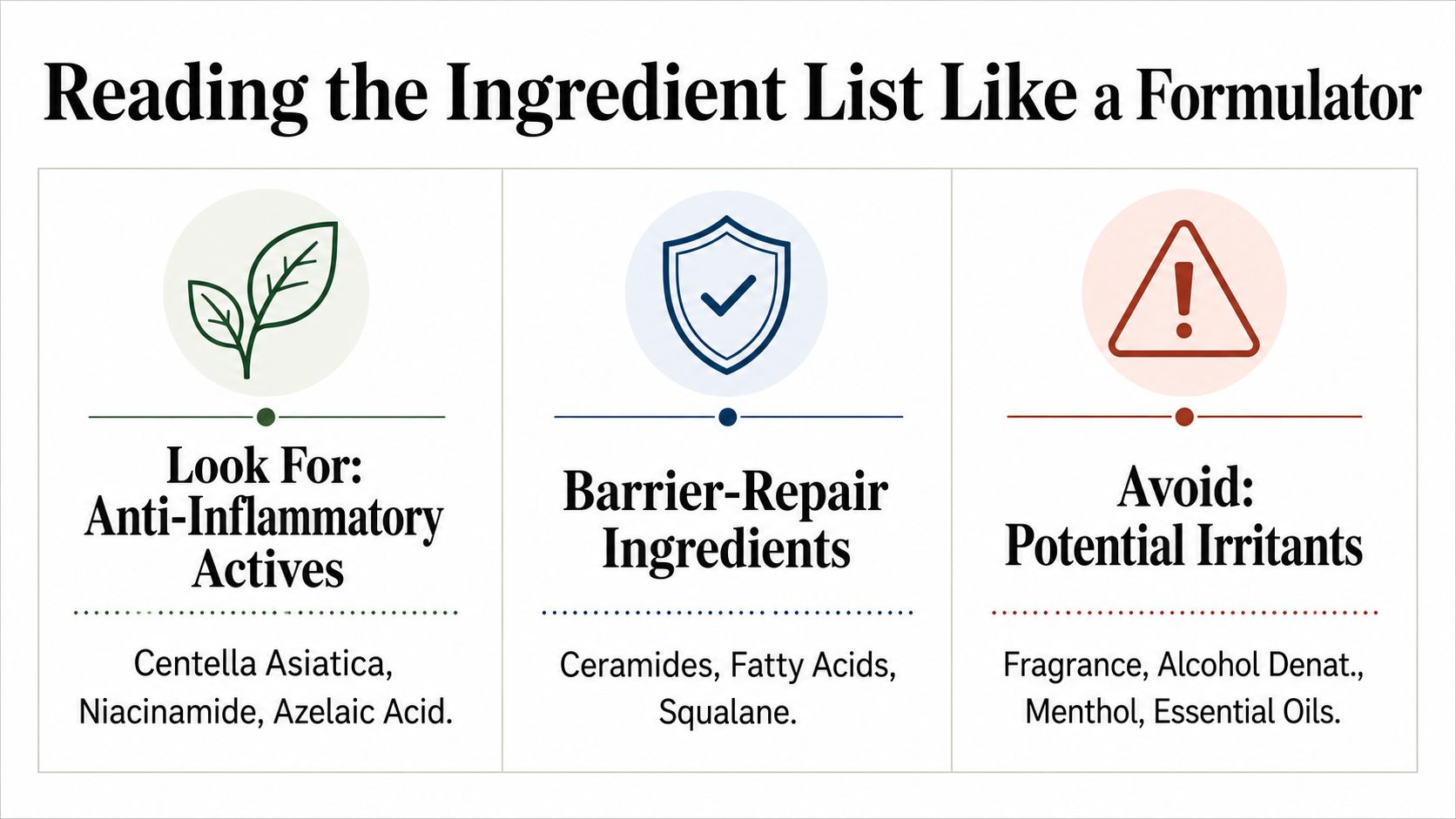
Start with ingredients that make sense for inflamed, reactive skin. Azelaic acid is the obvious anchor when a formula is trying to address redness and blemish-prone rosacea skin. It has a serious clinical profile in dermatology, and it belongs on the shortlist when a product is meant to support, not just soothe, red-prone faces. Niacinamide and Centella asiatica are also sensible supporting actives when the formula stays restrained.
The point isn't to pile on actives. It's to choose ingredients that support the skin without turning the cream into a mini treatment cabinet. For Swiss buyers, that restraint matters because pharmacy and premium spa customers both respond better to formulas that look calm on paper.
The barrier-support ingredients that move the needle
Rosacea-prone skin doesn't just want soothing language, it wants barrier support. Look for ceramides, fatty acids, and squalane. These don't sound glamorous, and that's exactly why they're useful. They help the formula behave like a support layer rather than a fight with the skin.
A barrier-first cream is especially important in a market where customers often arrive after trying too many active-heavy products. The cream doesn't need to be trendy. It needs to be tolerable, hydrating, and easy to keep using.
Candid trade advice: The best rosacea cream often looks boring in the INCI list. That's a strength, not a weakness.
The red flags that should get your attention
Now the blunt part. Fragrance is the easiest reason to skip a product in this category, and Swiss shoppers are already primed to avoid it. Contact-sensitivity research showing increased allergen reactivity in rosacea patients makes fragrance minimisation commercially important, not just cosmetically nice (patch-test study).
Watch for Alcohol Denat., menthol, and essential oils. They may read well in marketing copy, but they're common troublemakers in reactive-skin formulas. If a brand leads with a sensory story instead of a comfort story, that's a buying risk.
- Fragrance: Skip it unless there's a very strong, well-documented reason not to.
- Alcohol Denat.: A frequent mismatch for red, barrier-fragile skin.
- Menthol: Feels fresh, but freshness isn't the same as tolerability.
- Essential oils: Often too variable for a category built on predictability.
The formulator's verdict
A good rosacea-oriented cream usually combines barrier support, one or two measured calming actives, and a short ingredient list. That's the sweet spot for Swiss pharmacy and spa retail. If the formula tries to impress everyone, it usually ends up suitable for nobody.
Comparing Creams Across Clinical Evidence and Tolerability
A buyer needs a comparison tool, not a brand worship exercise. That's why the right way to compare a rosacea creme test candidate is by criteria, not by SKU name. You want to know which cream has real evidence, which one just has polished copy, and which one fits a red-prone customer without forcing your staff into medical explanations.
| Criterion | What to Look For | Red Flag |
|---|---|---|
| Clinical evidence | Clear testing method, ideally published or third-party data, with rosacea-specific use described | Vague phrases like “clinically inspired” or “expert approved” |
| Tolerability data | HRIPT plus in-use testing on rosacea-prone skin, with the protocol stated | “Dermatologically tested” with no details |
| Barrier support | Ceramides, fatty acids, squalane, or a similarly restrained support system | Heavy active load with little comfort logic |
| Irritant control | Fragrance-free or strongly fragrance-minimised, no obvious sensitiser story | Fragrance, menthol, or essential oils in a redness formula |
| Packaging | Airless pump or opaque tube that reduces contamination and limits light exposure | Open jar formats and overdesigned packaging with no practical benefit |
| Channel fit | Easy to explain on pharmacy shelves or in premium spa retail | Requires a long disclaimer to avoid overclaiming |
What good evidence looks like in practice
Good evidence is specific. A buyer should be able to tell whether the product was checked on real users, whether the brand used any formal patch-testing, and whether the claims stop at comfort or extend to visible performance. If the formula has supporting studies, those should be easy to locate and easy to summarise.
That matters because Swiss customers don't need a lecture. They need confidence. If the evidence story is messy, staff end up selling on intuition, and that's a weak basis for a redness-sensitive category.
What tolerability really measures
Tolerability is not just “it didn't explode in a lab”. It's whether the cream causes stinging, burning, tightness, or worsening redness once it touches real faces over time. That's why rosacea-specific in-use testing matters more than generic comfort claims.
If a product is meant for reactive skin but still has a rich perfume trail or an aggressive sensory finish, the formula is sending mixed signals. Buyers should trust the skin, not the copy.
The packaging angle buyers ignore too often
Packaging is not a vanity detail here. Airless pumps and opaque tubes are practical choices because they help reduce contamination and protect the formula from unnecessary light exposure. That's especially useful in pharmacy and spa settings, where products may sit open to frequent handling.
If a brand has strong testing but careless packaging, I'd still hesitate. In this category, the container should behave like part of the formula.
Why No Cream Can Diagnose Rosacea
No cream can diagnose rosacea. Diagnosis is clinical, based on signs, symptoms, and ruling out look-alike conditions. Swiss retailers should say that plainly, because a customer asking for a rosacea creme test often wants certainty, and a cream cannot deliver it. NIAMS makes the point clearly, there is no specific test for rosacea (NIAMS guidance).
What the retailer's role actually is
Your job is to recommend a tolerability-first routine and keep the language honest. That means pointing people toward fragrance-minimised, barrier-supportive formulas and away from products that pretend to “detect” rosacea through use.
Swiss retail rewards that discipline. Pharmacy customers want practical guidance, spa clients want comfort, and both groups respond better to recommendations that sound calm and credible. Staff lose trust fast when they drift into medical claims they cannot substantiate.
The conversation to have instead
Use this script: “We can't test for rosacea with a cream, but we can help you choose a formula that suits reactive skin better.” It is direct, accurate, and commercially clean. It moves the discussion from diagnosis to usability, which is where retail can add value.
Direct advice: Never sell a redness cream as a diagnostic tool. Sell it as a cautious choice for sensitive, rosacea-prone skin.
Patch-test guidance for cosmetics points in the same direction. It focuses on individual variation, fragrance avoidance, and trying a product on a peripheral area before facial use. That makes for a far better retail conversation than pretending a cream can tell someone what condition they have.
Matching Creams to Swiss Retail Channels
Swiss pharmacy shelves need different products from premium spa retail, and buyers who treat them as one channel end up with messy assortments. A rosacea creme test framework should sort the range by channel first, then by ingredient list.
Pharmacy shelves and drugstores
Pharmacy assortments should be built around the clearest formulas, the cleanest claims, and the easiest counselling points. These are the products that can sit beside sensitive-skin staples and still make sense to a busy pharmacist. Keep the story on tolerability, barrier support, and fragrance minimisation. In Swiss pharmacies and drugstores, that is what moves units and reduces staff friction.
Premium spa retail
Spa retail can carry more sensorial polish, but it still needs restraint. Products with a calmer texture, elegant packaging, and a comfort-first position usually fit here best. The line can feel more luxurious, but it should never feel more aggressive. Buyers should favour formulas that look refined without drifting into perfumed or overly active territory.
Mother-and-baby boutiques
This channel does not need a rosacea treatment story. It needs ultra-gentle, low-risk skincare that sounds safe for fragile routines and cautious parents. Certified-organic or very clean-label positioning can help here, as long as the formula stays simple and the claims stay modest. If the shelf message sounds clever but not safe, it is the wrong fit.
Multi-purpose balm destinations
These are best for multipurpose creams that can support dry, irritated, or compromised skin without pretending to do everything. If the balm has a short ingredient list, solid packaging, and an uncomplicated comfort story, it can work well alongside the more targeted rosacea range. Keep an eye on how the product is framed at shelf. A crowded claim stack usually confuses this channel and weakens conversion.
The channel lesson is straightforward. The more medical-adjacent the setting, the more evidence and clear counselling matter. The more lifestyle-led the setting, the more packaging and sensory comfort matter, but not at the expense of formula discipline. Retailers in Switzerland should buy for the customer they serve, not for a generic rosacea audience.
Recommendations and Stocking Checklist for Trade Partners
What I'd stock
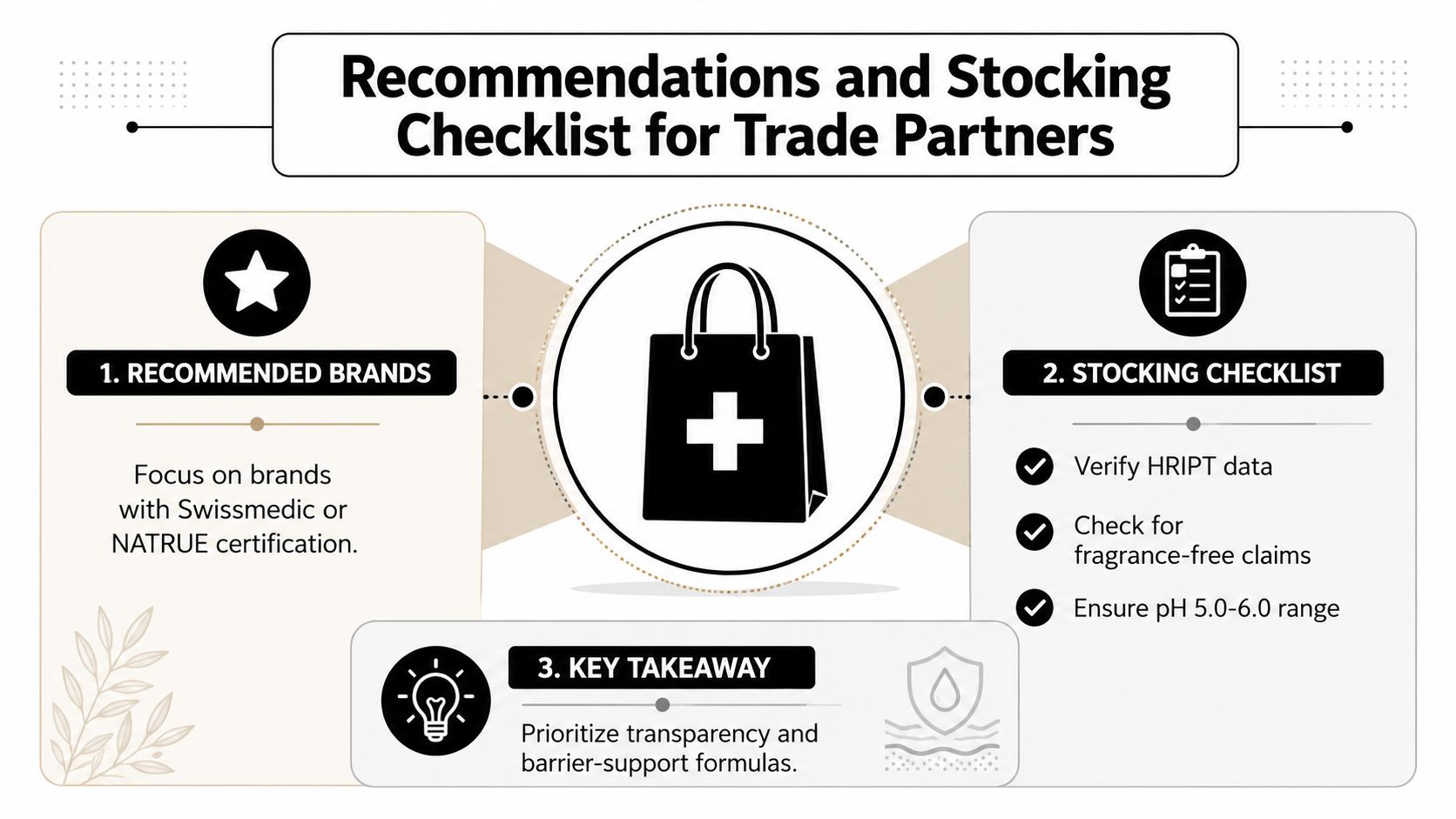
Swiss pharmacies, spas, and clean-beauty e-commerce need brands that can prove they belong in a sensitive-skin assortment. Start with ECOCERT-aligned positioning, cruelty-free commitments tied to PETA or Cruelty Free International, and a formula that reads calm on paper and on skin. If the brand leans on rosy language but cannot explain its testing, ingredient choices, and tolerability logic in plain terms, leave it off the list.
Packaging carries real weight here. I'd choose airless pumps and opaque tubes over decorative jars, because they suit reactive-skin formulas better and are easier for staff to recommend with confidence. I'd also favour minimal preservative systems when the rest of the formula stays disciplined, because this category works best when the product avoids unnecessary complexity.
The stronger buying standard is simple. Pick products that look credible to a pharmacist, feel safe to a spa therapist, and do not ask the customer to trust marketing fluff.
The short checklist
- Verify HRIPT data: Ask for the repeat insult patch test details, not a vague “tested” claim.
- Check for fragrance-free claims: If it is not fragrance-free, the justification needs to be strong.
- Look for peripheral patch-test counselling: Staff should tell customers to test on a small area before facial use.
- Prefer barrier-support formulas: Ceramides, fatty acids, and squalane are the right kind of boring.
- Favour practical packaging: Airless or opaque formats earn their place.
- Ask for evidence on rosacea-prone users: General skin claims are not enough in this category.
- Request proof of tolerability under real retail use: If a brand cannot support launch training, returns handling, and simple staff counselling, it is not ready for Swiss shelves.
Buy the cream that is transparent, barrier-supportive, and easy to explain. That combination moves stock, supports customer trust, and keeps the assortment disciplined.