Shangri-La Oman is useful as a case study only if you stop reading it as a single luxury hotel.
For a Swiss wellness buyer, the primary question is not whether the address is prestigious. It is whether the operating model can support consistent treatment delivery, retail discipline, therapist training, and brand protection across a large resort complex with different guest segments under one umbrella.
That is the practical lens here. The opportunity sits in the relationship between the three-property setup, the role of a shared spa platform, and the coming management change already noted elsewhere in this article. For potential partners, that affects more than logo fit. It affects procurement, SOP alignment, menu design, and the level of control a future operator may keep or rewrite.
If you are assessing Shangri-La Hotel Oman as a benchmark, stockist prospect, spa supply account, or regional collaboration lead, generic luxury language is a distraction. What matters is operational structure, guest mix, and the likelihood that product standards may shift once the current brand framework changes.
A shared spa can become the commercial heartbeat of a destination. If management, brand standards, and service protocols start to diverge across the complex, Swiss suppliers need to know where decisions will sit before committing training time, retail inventory, or treatment development.
An Introduction to Oman's Premier Luxury Destination
The label Shangri-La Hotel Oman hides the part that matters to a Swiss wellness buyer. This is a large luxury resort compound in Muscat, marketed under one destination name but structured in a way that affects how spa standards, retail execution, and partnership control function.
For trade assessment, the address alone is secondary. The commercial question is whether the site can support premium treatment protocols, disciplined product handling, and a guest journey that justifies Swiss positioning across beauty, spa, and wellness retail.
Location still matters because operations follow geography. The resort sits at Al Jissah Bay with beach access and practical road links to Muscat and the airport, which supports therapist scheduling, supplier visits, training days, and event logistics. Rate positioning is also firmly premium, so cosmetic and wellness decisions sit in the guest-facing value proposition rather than purely in procurement. The underlying property profile and location context are outlined in HotelChains' Muscat overview of the Shangri-La complex.
A high room rate does not automatically make a resort a good wellness partner.
What matters more is the operating environment behind the guest experience. In a resort of this scale, even a strong spa concept can weaken if treatment standards, retail display logic, therapist education, and replenishment discipline are not managed consistently across the wider complex. That is where many luxury partnerships underperform. The hotel looks right, but the operating model does not protect the brand.
The 2026 management transition raises the strategic value of this property for Swiss spa and beauty professionals. A future operator may keep parts of the wellness identity, revise them, or rebuild them around a different procurement and brand-standard framework. For any supplier considering treatment cabins, amenities, retail shelves, or staff training, the immediate task is to assess continuity risk now, before product standards and decision rights shift.
Decoding the Tripartite Resort Structure
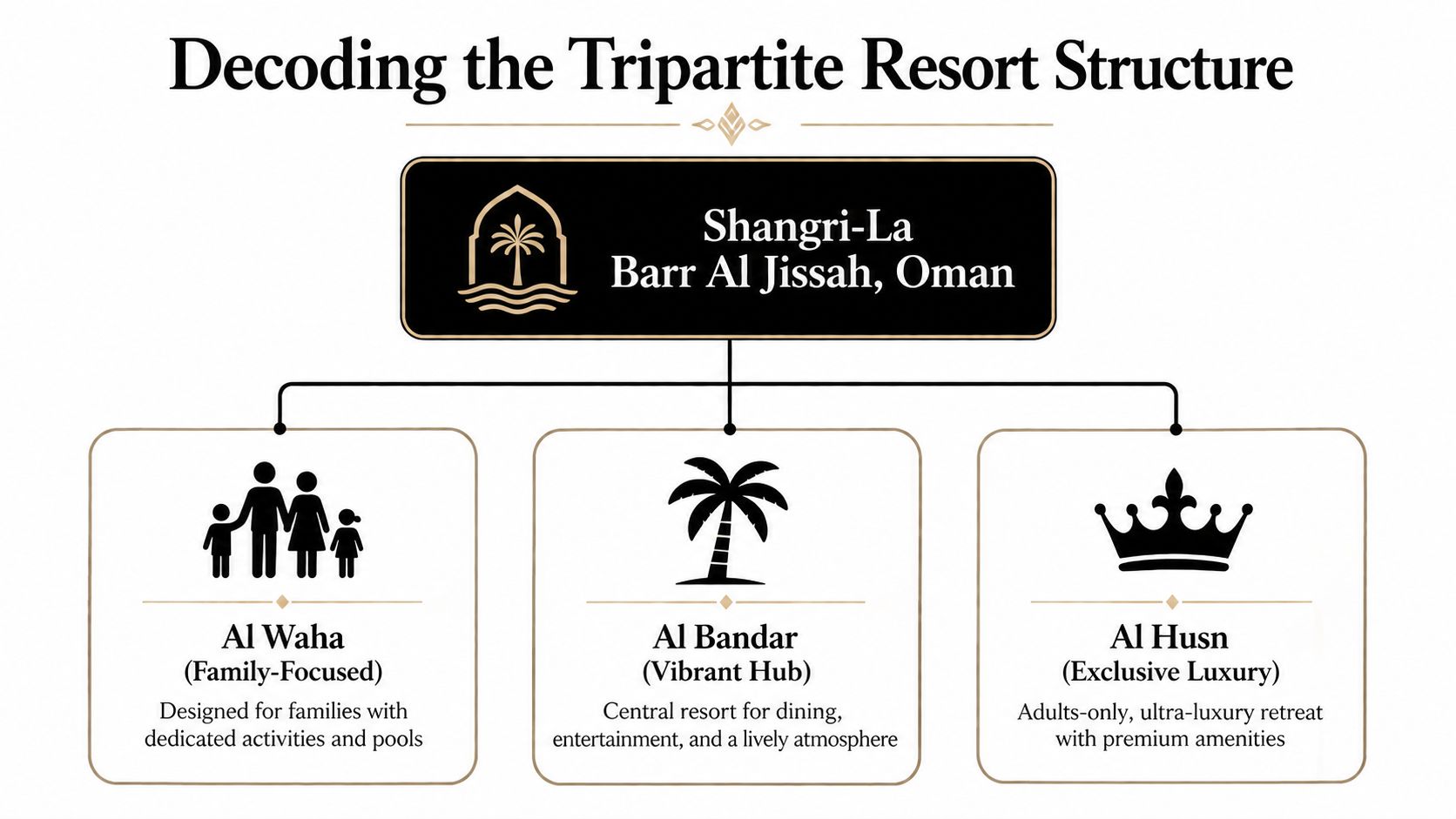
The clearest way to understand Shangri-La Hotel Oman is to treat it like a curated portfolio. One destination hosts three separate hospitality products, each aimed at a different type of luxury traveller, while a shared spa anchors part of the wellness experience across the whole complex.
The three-property model in practical terms
The property in Oman comprises Al Waha, Al Bandar, and Al Husn, and all three share a single integrated 1,500-square-metre spa facility, according to Design Holidays' resort description.
That single fact changes how a wellness consultant reads the site.
A shared spa usually means centralised treatment operations, pooled infrastructure, and tighter control over service consistency. It can also mean compromise. If one spa serves multiple guest profiles, the product assortment and treatment menu may drift toward the safest common denominator unless management actively protects premium segmentation.
What each wing means for brand positioning
Al Waha is described as the family-oriented resort element. That makes it relevant for wellness categories with broader household appeal, lighter treatment rituals, and retail that can sit comfortably beside family travel. Think practical luxury rather than highly rarefied spa storytelling.
Al Bandar is the residence-oriented component. In commercial terms, this often aligns with guests who stay longer, mix leisure with social activity, and may engage with wellness as part of a broader lifestyle experience rather than as the trip's sole purpose. Retail here needs repeat-use logic and everyday elegance.
Al Husn is the most obvious fit for high-touch spa positioning. It carries the strongest case for treatment rituals built around exclusivity, privacy, and refined brand theatre. If you distribute premium lines with a strong ingredient story, this is the part of the resort that most naturally supports deeper narrative selling.
The mistake many suppliers make is pitching the whole resort with one value proposition. The smarter move is to match one brand story to one guest environment.
What works and what doesn't in a shared-spa setting
A central spa structure can work very well when the operator does three things:
- Separates treatment pathways: Families, leisure couples, and luxury privacy-seeking guests shouldn't all receive the same spa narrative.
- Protects retail zoning: The merchandising strategy for a family-led wing isn't the same as one for a high-luxury adults-oriented environment.
- Defines product hierarchy: Entry-level body care, hero facial lines, and signature treatment products need clear placement rules.
What usually doesn't work is flattening the offer. When every wing receives the same menu language, same room ritual, and same retail display logic, the spa loses one of the main benefits of a multi-asset resort. Segment precision.
For Swiss wellness professionals, this structure is attractive because it can support more than one partnership tier. But that only holds if management preserves differentiation instead of hiding everything under one generic spa label.
A Deep Dive into Chi The Spa and Wellness Offerings
From a buyer's point of view, the most important spa fact isn't a treatment list. It's operational reach. The complex is a unified destination in Muscat, located at PO Box 644, Muscat, Oman 100, with the official enquiry line 968 24-776666, including enquiries about spa facilities, as listed in the Michelin hotel entry for Al Husn at Shangri-La's Barr Al Jissah Resort & Spa.
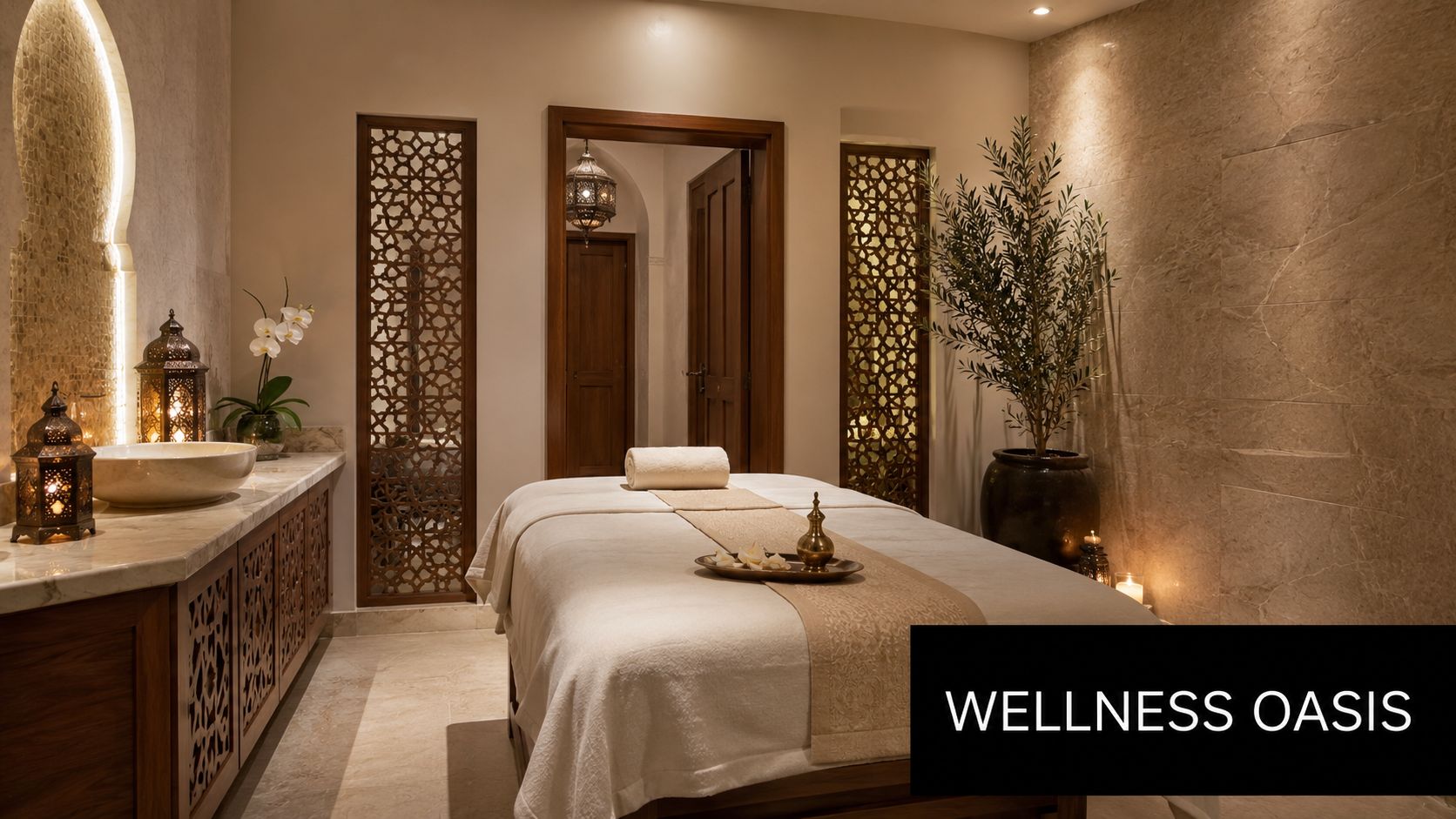
That centralised contact structure suggests a spa operation that has historically been presented as one destination asset rather than three fully separate wellness businesses. For partnership analysis, that can be efficient. One relationship may reach multiple guest segments. It can also create friction if the supplier wants a tighter luxury-only placement.
How a Swiss buyer should assess the spa
When I assess a resort like this for a Swiss spa or beauty retailer, I don't start by asking whether the spa looks beautiful. I ask whether the spa can hold a coherent product philosophy across treatment, retail, and guest expectation.
For a property with this level of prestige, a good spa partnership usually needs alignment across five practical areas:
| Area | What to check |
|---|---|
| Ingredient story | Whether products support a clear clean, natural, marine, botanical, or heritage-based narrative |
| Therapist usability | Whether protocols are realistic for high-volume luxury operations |
| Retail conversion logic | Whether guests can understand and continue the ritual at home |
| Standards documentation | Whether sourcing, cruelty-free claims, and certification language are transparent |
| Segment fit | Whether the same line can work across family, lifestyle, and ultra-luxury guest profiles |
Often, otherwise attractive hotel spas become challenging accounts. The treatment side may feel refined, but the retail logic is weak. Or the ingredient story sounds premium, yet no one can explain compliance or sourcing well enough for a Swiss trade partner.
Why wellness screening matters more now
Guests increasingly connect spa quality with broader wellbeing literacy. That doesn't mean every resort needs a clinic model. It does mean the most credible wellness partners can discuss guest suitability, contraindications, and personalised treatment decisions with confidence. For teams refining that side of spa consultation, a concise health risk assessment guide is a useful external reference point for how structured pre-treatment thinking supports better outcomes.
A resort of this type can support refined positioning if the spa isn't treated as a decorative amenity. It needs an operating philosophy.
Strong luxury spas don't just apply expensive products. They decide who each ritual is for, who it isn't for, and how the retail shelf continues the treatment experience.
What remains unclear for product-led partnerships
The open question is continuity. Existing coverage points to concern around whether high-end, ethically sourced cosmetic lines will be preserved through the next operating chapter, particularly for Swiss wellness partners with expectations around clean beauty, marine-based formulations, or recognised certification language.
That uncertainty matters because a shared spa often becomes the commercial heartbeat of a destination. If management changes product house, reformulates treatment identity, or separates the spa concept by wing, the account can shift from ideal partner to unsuitable prospect very quickly.
A visual impression helps, but it won't answer the sourcing question. This short video is useful mainly as environmental context.
The practical takeaway is simple. Don't evaluate Shangri-La Hotel Oman as a static spa opportunity. Evaluate it as a luxury wellness platform in transition, where current presentation and future procurement may not be the same thing.
Luxury Accommodation and Dining Across the Wings
Room stock and restaurant design matter for wellness buyers because they show how guests use the property. In a three-wing resort, accommodation is not a backdrop. It sets treatment demand, retail conversion, staffing pressure, and the level of product differentiation a partner will need to support.
As noted earlier, the Bar Al Jissah complex operates at scale. That has practical consequences. A large, mixed guest base usually pushes spa demand in two directions at once: high-volume recovery and family-friendly maintenance on one side, more private, higher-yield ritual treatment on the other. Suppliers who treat the resort as one homogeneous luxury account often misread that split.
Reading the guest journey by wing
Al Waha serves a family-led rhythm. Guests tend to value convenience, flexible timing, and treatments that fit around pool time, excursions, and multigenerational schedules. For a Swiss wellness brand, this wing is better suited to concise treatment menus, resilient cabin protocols, and retail that is easy to understand at first glance.
Al Bandar sits in the middle commercially and operationally. It functions as the social core, which usually means broader dining traffic, more varied guest intent, and less predictable treatment motivation. This is often the right setting for adaptable wellness offers: recovery massages, after-sun body care, and retail categories that bridge leisure, fitness, and beauty rather than insisting on a strict spa narrative.
Al Husn supports a different proposition. Privacy, pace, and service choreography matter more here. That makes it the natural home for longer rituals, more therapist-led consultation, and premium skincare lines that rely on scarcity, technique, and a stronger story at the point of sale.
The commercial mistake is obvious. One treatment architecture across all three wings may simplify training, but it weakens relevance.
Dining reveals service standards
Restaurants are also a useful proxy for how tightly the guest experience is managed. Where dining is active and communal, wellness purchasing is often more spontaneous. Guests add a massage, buy sun care, or pick up a body product because it fits the day. In more secluded, higher-ceremony settings, the spa needs to feel integrated with the room, the service tone, and the evening experience. Retail has to look curated, not merely displayed.
For Swiss retailers, that distinction affects everything from assortment depth to tester strategy. A broad body range may perform well in the busier wings. A prestige facial line with slower consultation and higher conversion value belongs where staff have the time and environment to sell it properly.
A practical reading of the resort looks like this:
- Al Waha: convenience-led, family-oriented, higher tolerance for simplified wellness choices
- Al Bandar: mixed-use, socially active, commercially flexible
- Al Husn: quieter, more exclusive, better suited to ritual-led premium positioning
This matters even more because the operating model may not stay fixed. If management standards, F&B concepts, or wing-level positioning shift under Hilton in 2026, the accommodation and dining logic could change before the spa menu visibly does. For partnership planning, that means assessing not only where a product fits today, but which wing can still protect its pricing power and brand story after the handover.
The Critical 2026 Management Transition and Its Impact
For a Swiss wellness buyer, the main risk at Shangri-La Oman is no longer the spa menu. It is operator continuity.
Bar Al Jissah is set to move under Hilton management in July 2026, as noted earlier. That change matters because spa partnerships are rarely protected by the guest-facing brand alone. They depend on procurement rules, training systems, retail ownership, audit discipline, and how much freedom the property keeps at unit level. A resort can look stable to the guest while its commercial logic changes completely behind the scenes.
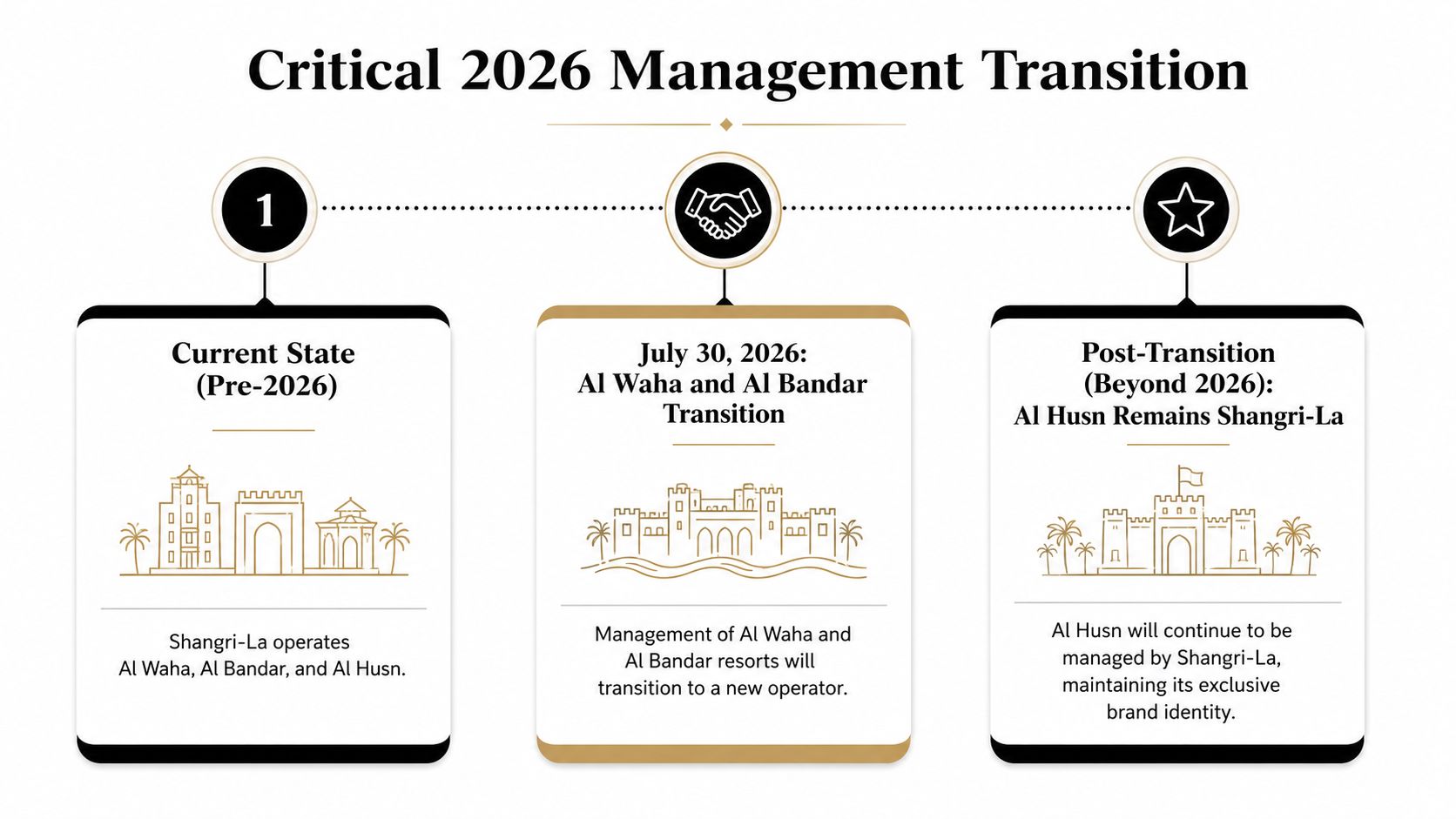
The practical question is not whether standards will rise or fall. The practical question is which standards will still matter after handover.
In my experience advising premium wellness retailers, management transitions usually affect five operational areas before the market sees any visible repositioning:
- Supplier approval: local buying flexibility may shrink if brand lists become more centralized
- Treatment architecture: signature rituals can be retained, simplified, or replaced to fit a new service model
- Retail economics: shelf space, tester policy, and margin expectations often change faster than treatment menus
- Compliance language: claims around natural sourcing, ethical production, or clean formulation may be redefined to fit a different brand framework
- Therapist capability: training can become more consistent, or more generic, depending on who controls education and assessment
None of that confirms deterioration. It confirms uncertainty, and uncertainty is expensive for any partner selling high-trust skincare or spa ritual products.
The split inside the destination creates two distinct commercial cases. Hilton-managed Bar Al Jissah will need to prove how much autonomy its wellness operation keeps and whether premium product curation remains a priority rather than an accessory to broader resort volume. Al Husn raises a different question. If it remains the clearest luxury expression within the complex, it may become the better fit for slower-selling, higher-margin lines that need consultation time, stronger therapist storytelling, and tighter control over discount risk.
That distinction matters for Swiss brands in particular. A results-led cosmeceutical line, a sensorial alpine body range, and a certified natural prestige brand do not need the same environment to perform well. One may benefit from broader reach and stronger occupancy. Another needs a quieter wing, more protected pricing, and therapists who can explain ingredients with confidence.
Before any supply discussion progresses, ask direct operating questions:
- Who controls spa procurement after July 2026? Property management, regional operator, or group purchasing.
- Will treatment protocols stay property-specific or move toward a standardized operator template?
- Which retail brands are protected by contract, and which are open to review?
- How will sustainability and ingredient claims be defined in guest materials and staff training?
- Will Al Husn and Bar Al Jissah keep clearly separated wellness positioning, or will the distinction soften?
Brands that treat this as a routine logo change will miss the core issue. The 2026 transition may redraw where premium skincare can hold price, where therapist-led retail can convert, and which wing can still support a credible luxury wellness story.
Exploring Beyond the Resort in Muscat
A luxury spa partnership doesn't depend only on the treatment room. It depends on the destination story guests carry into the treatment room. Muscat helps this resort because the wider setting supports a blend of coastal retreat, cultural depth, and soft adventure.
For international clients, nearby cultural experiences such as traditional souk visits, mosque architecture, and time in the historic parts of Muscat broaden the emotional range of the stay. Guests don't arrive wanting only relaxation. Many want place-based experiences, then return to the resort expecting the spa to complete that sense of destination.
Why this matters for wellness retail
That pattern has a direct retail implication. Guests who have spent the day engaging with Omani natural surroundings and culture often respond better to products and rituals that feel rooted, sensory, and transportive. A generic luxury line can still sell, but a line with a strong natural or provenance-led narrative usually has a stronger chance of feeling memorable.
Nature-driven excursions add another layer. Coastal settings, sun exposure, travel fatigue, and active days outside the resort all create obvious openings for body care, after-sun, hydration, soothing facial care, and recovery rituals. Those needs are practical, not abstract.
The unresolved destination question after 2026
There is still a material content gap for Swiss buyers. Existing coverage doesn't clearly distinguish the post-2026 spa offerings between the standalone Shangri-La Al-Husn and the new Hilton-managed property, leaving no clear answer on which location will align with demand for certified, marine-based luxury lines, as noted in this report on the post-transition gap.
That lack of differentiation makes Muscat harder to read as a partnership market than it should be. The destination appeal is strong. The product-path visibility isn't.
Strategic Insights for Swiss Wellness Partners
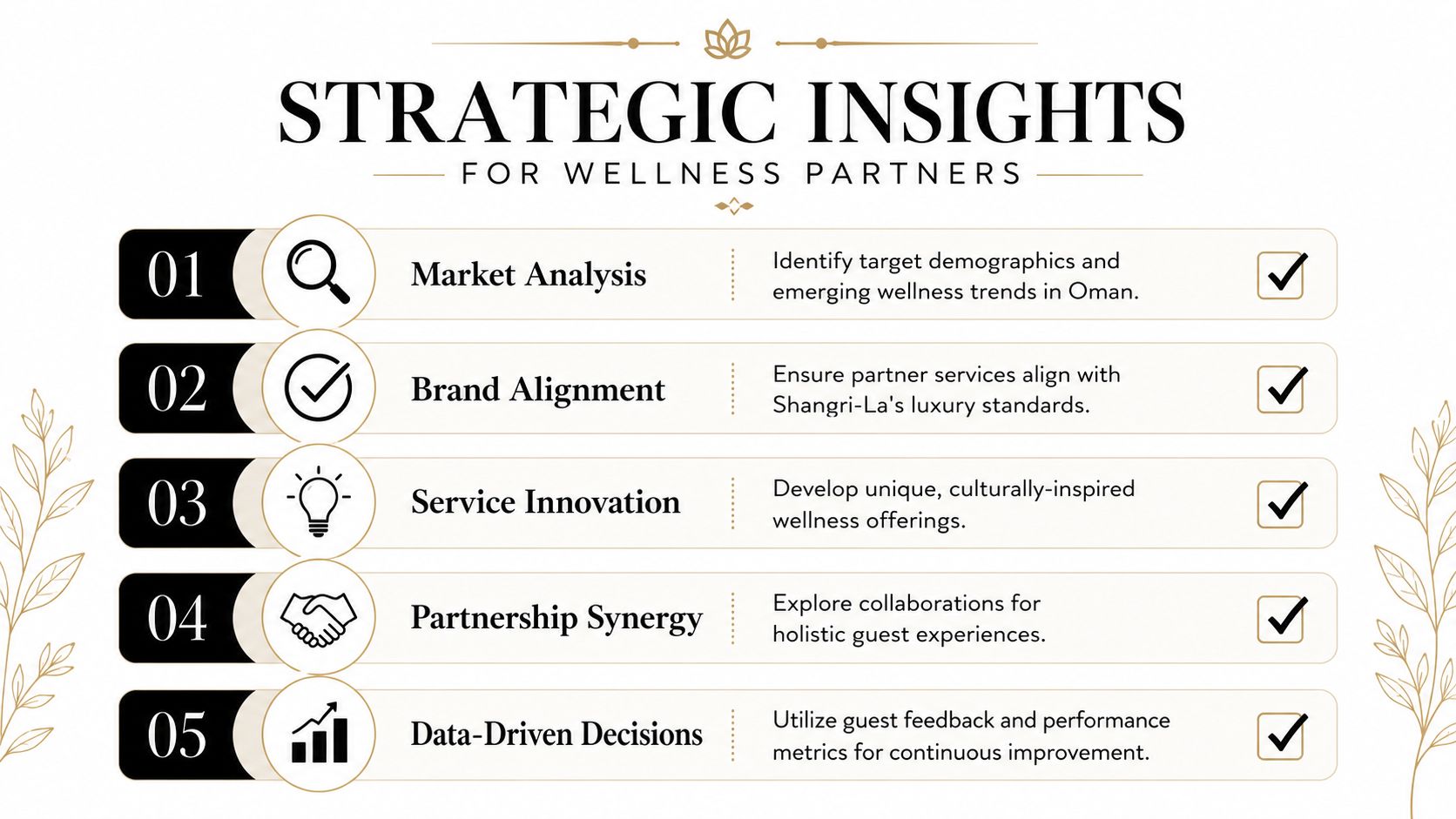
If I were advising a Swiss spa retailer, pharmacy buyer, or wellness distributor on Shangri-La Hotel Oman today, I wouldn't tell them to rush in because the address is prestigious. I'd tell them to treat the site as a two-track opportunity shaped by segmentation and transition risk.
Where the best opportunities probably sit
The stronger long-term fit for a tightly curated, high-story, premium cosmetic line is likely to come from the part of the destination that protects exclusivity most clearly. The broader commercial volume play may sit with the operator handling the larger resort traffic, provided standards remain compatible with your brand.
That means your evaluation should separate prestige alignment from distribution scale. Those aren't always the same account.
A workable due diligence checklist
Use a short decision framework before opening commercial talks:
- Map the target guest clearly: Decide whether your line is best suited to family-led resort traffic, lifestyle leisure guests, or privacy-focused luxury travellers.
- Request sourcing language in writing: If ethical sourcing, cruelty-free commitments, or certification matter to your business, verbal reassurance isn't enough.
- Ask who controls retail assortment: Hotel ownership, operator procurement, and spa management may not be the same decision-maker.
- Test treatment compatibility: A beautiful brand can still fail if protocols are too complex for resort cadence.
- Review access expectations: For premium clients arriving from the Gulf, mobility and trip pattern shape retail demand. A route such as Haute Jets Bahrain to Muscat gives useful context for how high-end regional travellers may access Muscat and why premium pre-arrival or in-resort wellness positioning can matter.
The best partner won't be the hotel with the loudest luxury story. It'll be the one that can document standards, protect brand fit, and explain its post-2026 spa direction without ambiguity.
Swiss wellness businesses are usually at their best when they stay selective. That discipline is exactly what this destination requires now.
If you're a Swiss retailer, pharmacy, spa, or hotel team looking to build a cleaner, more differentiated beauty assortment, beautysecrets.agency can help you source premium natural, marine-based, and ethically positioned brands that fit serious wellness environments.