A customer stands at the pharmacy counter and says the same thing staff hear every week: “I need a cleanser, but everything makes my skin feel tight.” In a spa retail corner, the wording changes slightly. “I want something gentle, but I still break out.” Online, it becomes a search query. low ph good morning cleanser.
That request isn't a fad. It reflects a change in how customers judge cleansing. They no longer equate squeaky-clean with healthy skin. They want comfort, oil control, clarity, and routine compatibility in one step. For Swiss retailers, that shift creates a merchandising opportunity because cleansing is the category where barrier trust often starts.
A well-chosen low pH cleanser can become the anchor product that improves routine adherence, supports active-serum sales, and reduces the risk of disappointment from over-stripping formulas. The commercial value isn't just in the bottle. It's in what happens after purchase: fewer complaints about dryness, easier product matching, and stronger confidence in your assortment.
The Modern Cleanser Your Customers Are Asking For
A cleanser earns its place in the routine faster than almost any other skincare product. Customers know after one or two washes whether it leaves skin comfortable, shiny, tight, or unsettled. That makes cleansing a high-stakes category for pharmacies and spas, because the first negative experience often reshapes how the customer judges everything sold alongside it.
Cleanser dissatisfaction is significant because it affects the entire basket. If the face feels stripped after step one, the customer may blame the serum for stinging, the moisturiser for “not being enough,” or the whole routine for being too active. From a retail perspective, a poorly matched cleanser can weaken confidence in products that are otherwise well chosen.
What customers usually mean by gentle
Customers rarely ask for a surfactant system with a specific pH target. They describe the result they want. In practice, “gentle” usually means four things:
- No tightness after rinsing: Skin should feel comfortable, especially across the cheeks and around the mouth.
- A fresh finish without a coated feel: Important for combination, oily, and blemish-prone skin that still dislikes harsh cleansing.
- Compatibility with treatment routines: Many customers already use exfoliating acids, retinoids, or anti-blemish products.
- Reliable daily use: The cleanser should fit ordinary mornings, not only periods of irritation.
That combination explains why low pH morning cleansers have become a reference point in modern assortments. They answer a common contradiction in customer demand. People want a product that feels light and effective, yet does not behave like a traditional foaming wash that removes more than necessary.
For Swiss retailers, that distinction has practical value. Much of Switzerland has hard water, and hard water can make cleansing feel harsher to the end user, especially in winter or at altitude where indoor heating and dry air already increase complaints about tightness and dehydration. A low pH cleanser cannot change the local water supply, but a well-built formula can reduce the perception of post-cleanse stress and improve satisfaction from the first week of use.
Why this matters for Swiss assortments
In the Swiss market, customers often arrive informed, cautious, and willing to pay more for products that feel credible. They do not need a trend story. They need a reasoned one. Low pH morning cleansers sell more effectively when presented as barrier-conscious daily cleansers that support the rest of the regimen.
That wording helps staff explain the benefit clearly. A useful comparison is breakfast before a long day. If the first step is too heavy or too harsh, everything that follows feels harder to manage. The same logic applies to cleansing. Start with a formula that respects the skin surface, and the customer is more likely to tolerate serums, use moisturiser consistently, and return for refill purchases.
For merchandising, position these cleansers near barrier-repair moisturisers, mild exfoliants, and entry-level retinoids rather than beside aggressive acne washes alone. That placement signals versatility. It also broadens the customer base from “problem skin only” to “daily skin health,” which is a stronger commercial position for pharmacies and spas serving mixed-age, mixed-concern clientele.
Understanding the Science of Skin pH and the Acid Mantle
A good sales conversation starts with one idea: skin isn't meant to be neutral like water or alkaline like soap. Healthy skin sits in a mildly acidic zone. Cosmetic chemists call the surface environment the acid mantle. Customers don't need the jargon, but your team should understand the principle because it explains why one cleanser leaves skin calm and another leaves it reactive.
Think of the acid mantle as a living shield. It helps the skin hold itself together, keep moisture where it belongs, and stay resilient when exposed to cleansing, weather, friction, and actives.

What pH means in real use
pH tells you whether something is acidic or alkaline. For skin, the practical question is simple: does the cleanser work with that surface environment, or does it push the skin away from it?
COSRX states that its Low pH Good Morning Gel Cleanser targets pH 5.31 ± 1.00, which places it close to the skin's natural acid mantle. The brand also notes that lower-pH surfactant systems preserve stratum corneum enzymes and barrier lipids better, helping reduce post-cleanse tightness, transepidermal water loss, and irritation on the COSRX product page.
For a retailer, the key message is not “acidic is always better”. The key message is that mildly acidic cleansing is often better aligned with daily skin comfort.
Why alkaline cleansing creates complaints
Customers often think foam equals effectiveness. Chemically, that's a poor shortcut. A high-foam, alkaline cleanse can remove oil aggressively, but it can also disturb the very surface conditions that keep skin comfortable.
When that happens, customers may report:
| Customer complaint | Likely formulation issue |
|---|---|
| “My skin feels tight after washing” | Cleansing system is too stripping for daily use |
| “My face gets shiny and dry at the same time” | Barrier disruption followed by compensatory oiliness |
| “Everything stings after cleansing” | Skin is less tolerant of the next routine step |
| “Winter makes this much worse” | Existing barrier stress is amplified by cleanser choice |
This is why low pH cleansers have become strategically important in premium and pharmacy channels. They solve a visible consumer problem at the very first step.
The acid mantle as a selling concept
You don't need to train staff to give a chemistry lecture. You do want them to explain cause and effect clearly.
A simple version works well at shelf or in consultation:
- Skin has a naturally mildly acidic surface.
- Harsh cleansing can disturb that balance.
- Disturbed skin is more likely to feel dry, tight, or reactive.
- A low pH cleanser helps clean without making comfort the trade-off.
Skin that feels “too clean” is often skin that has lost some of its tolerance for the rest of the routine.
What this means commercially
The science supports a broader retail point. Cleansers in this category are not only for sensitive skin. They're also for customers using active ingredients, recovering from seasonal dryness, or trying to manage oil without starting a strip-and-rebound cycle.
That widens the merchandising appeal. You can place these cleansers near barrier support, acne care, post-treatment homecare, or routine-building displays. One scientific concept creates several sellable pathways.
Why a Low pH Cleanser is Ideal for Morning Use
Morning cleansing has a different job from evening cleansing. At night, the skin may carry sunscreen, makeup, urban residue, and heavier sebum build-up. In the morning, the goal is lighter. You're clearing away overnight oil, sweat, and surface debris without undoing the skin's comfort before it faces the day.
That distinction matters because many customers over-cleanse in the morning. They use the same aggressive product twice daily, then wonder why their moisturiser and SPF don't sit well.

The morning role is preparation
A low ph good morning cleanser works when it resets the skin without pushing it into repair mode. That's why the morning format has such strong retail logic. It frames cleansing as preparation, not punishment.
For customers, that means:
- skin feels refreshed rather than depleted
- moisturiser applies more evenly
- SPF sits better on the surface
- active products are less likely to meet already-irritated skin
This is especially relevant for oily and combination skin. Those customers often ask for the strongest option available because they're frustrated by shine. Yet many of them do better with a gentler first step and better targeted leave-on products afterwards.
Why “good morning” is commercially useful wording
The phrase itself is useful merchandising language. It implies frequency, comfort, and a routine moment. It also creates a natural cross-sell path: morning cleanser, antioxidant serum, moisturiser, SPF.
You can train staff to ask a better question than “What skin type are you?” Ask, “How does your skin feel after washing in the morning?” The answer often reveals whether the current cleanser is already causing friction.
Counter script: “If your skin feels tight before you even apply serum, your cleanser may be doing too much.”
A benchmark formula in this segment combines mild surfactants with Tea Tree Oil and Betaine Salicylate, making it more than a plain detergent wash. Retail messaging around the category often emphasises deeper removal of dirt and oil, reduced pore appearance, and a non-stripping finish, as reflected in Ulta's listing for the cleanser.
For buyers, that combination is commercially useful. It lets you offer a product that still sounds effective to breakout-prone customers, while keeping the daily-use promise intact.
A short explainer video can help staff and customers grasp the idea quickly:
How to recommend it without overselling
Morning low pH cleansing isn't for every single customer in exactly the same way. Some very dry clients may prefer only water on certain mornings. Some makeup wearers will still need a fuller evening cleanse. The point isn't to make one cleanser do every job.
The point is to protect the first cleanse of the day from becoming the first source of irritation. That is easy for staff to explain, and customers usually understand it immediately because they can feel the difference after one use.
How to Evaluate a Low pH Cleanser Formulation
A customer in Zürich buys a cleanser because the front pack says “low pH.” Two weeks later, she tells the pharmacy team her skin still feels tight after washing. The lesson for buyers is simple. The pH claim attracts attention, but the full formula determines whether the product earns repeat purchase.
For a Swiss pharmacy, spa, or premium e-commerce assortment, a cleanser deserves the same careful review as a serum. It is a rinse-off product, yet it still affects comfort, treatment adherence, and the customer's sense that the whole routine is working. In practical retail terms, a good cleanser lowers complaints, supports cross-selling with actives, and reduces the risk that a client blames a retinoid or exfoliant for irritation that really started at the wash step.
Start with the cleansing base
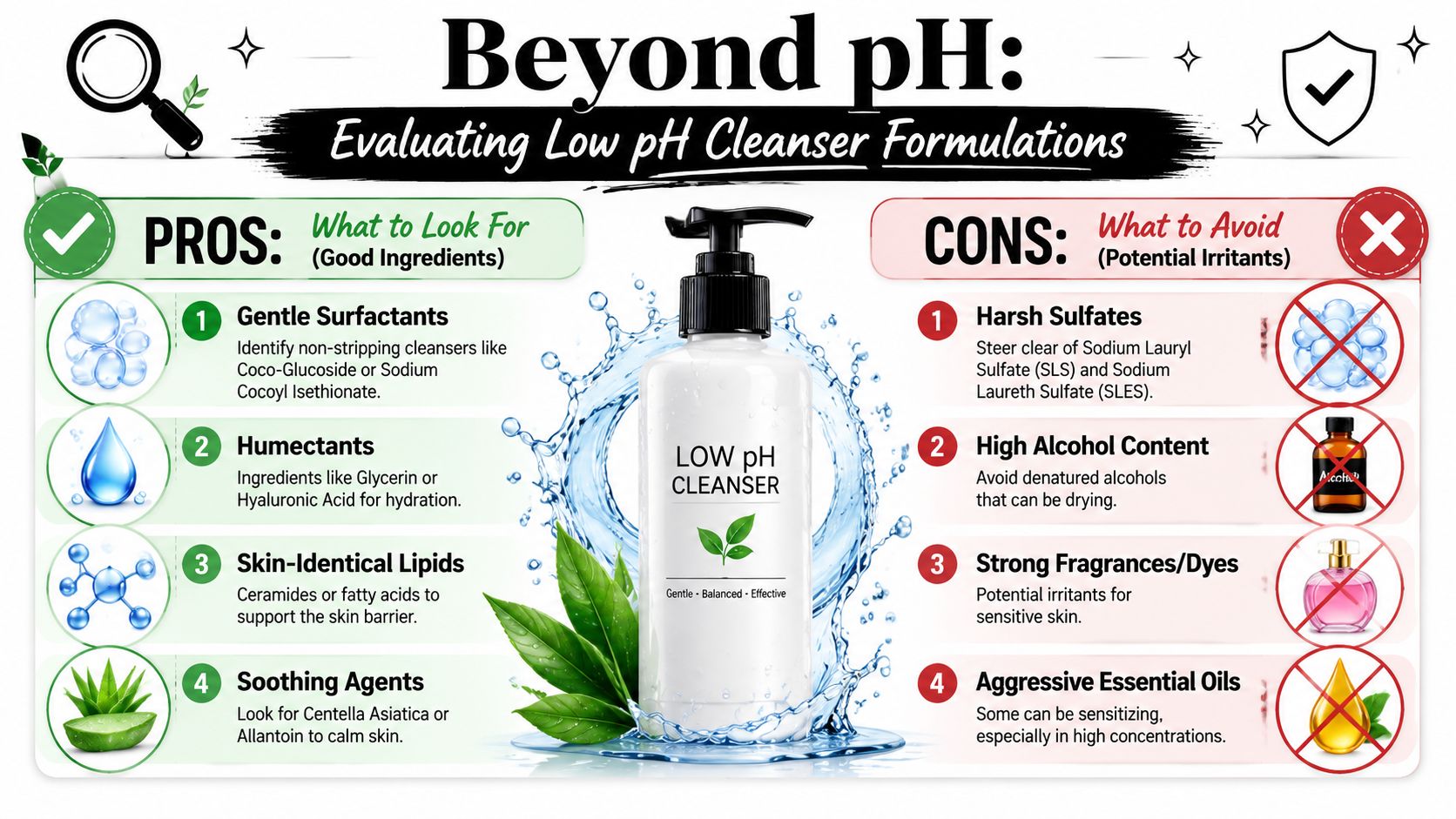
The benchmark COSRX formula uses a low-foam system with Cocamidopropyl Betaine and Sodium Lauroyl Methyl Isethionate and is formulated without parabens, sulfates, and artificial fragrances. The same ingredient profile includes Betaine Salicylate, Tea Tree Leaf Oil, and Allantoin. That ingredient mix places it in the gentle functional cleanser category rather than the harsh acne-strip category described earlier.
That first point matters most because surfactants do the cleansing work. pH sets the environment of the formula, but the surfactant system shapes how the wash feels on skin. A mild system acts more like a well-tuned fabric detergent for cashmere than a degreaser for workshop floors. Both clean. Only one is suited to repeated daily use on a delicate surface.
In Swiss conditions, that distinction matters even more. Many regions have hard water, and hard water can leave customers feeling less rinsed and more taut after cleansing. A formula with a mild surfactant blend and a modest foam profile often performs better in that setting because the wash experience feels controlled rather than aggressive.
What to look for on-pack and in the INCI
Use this buyer's filter:
- Mild surfactants first: Cocamidopropyl Betaine and Sodium Lauroyl Methyl Isethionate usually signal a gentler, low-foam cleansing profile.
- Comfort-support ingredients: Ingredients such as Allantoin help position the product around skin feel and tolerance, not only oil removal.
- Functional extras used with restraint: Betaine Salicylate and Tea Tree Leaf Oil can make the formula more relevant for oily or blemish-prone customers, but in a rinse-off cleanser they should support the formula rather than carry the whole selling story.
- Clear formula philosophy: “Without parabens, sulfates, and artificial fragrances” gives staff a simple way to explain what kind of cleanser they are holding.
- Texture fit for the channel: Gel textures often suit pharmacy and spa recommendations because they communicate freshness and control, while still reading as gentle if the foam is kept low.
Read the formula like a merchandiser, not only a chemist
A strong cleanser must pass technical and commercial tests at the same time.
| What you evaluate | Why it matters commercially |
|---|---|
| Surfactant mildness | Affects comfort, complaint rate, and repeat purchase |
| Presence of soothing ingredients | Gives staff a stronger recommendation for barrier-stressed or post-treatment customers |
| Functional actives in rinse-off format | Adds relevance for oily or congested skin without creating inflated expectations |
| Free-from positioning | Supports pharmacy, spa, and premium-clean narratives |
| Ingredient transparency | Builds trust with Swiss shoppers who often read labels closely |
The commercial question is not only “Will this cleanse?” Nearly every cleanser will. The better question is “Which customer can we recommend this to with confidence, in January in St. Moritz, in summer in Geneva, and in a hard-water household outside Basel?”
That is how assortment decisions get sharper.
A note on active ingredients in cleansers
Buyers sometimes overvalue active ingredients in wash-off products because they read like leave-on treatments on the carton. Rinse-off contact time is short. So the job of an ingredient like Betaine Salicylate is usually supportive. It can help the formula feel more suitable for oily or congested skin, but the main performance still comes from the total system: mild surfactants, appropriate pH, and a low-irritation design.
That distinction helps staff sell accurately. Accurate selling is good merchandising. Customers who understand that a cleanser supports clearer skin, rather than replacing a full acne routine, are less likely to feel disappointed.
A cleanser should earn trust first. Treatment claims should stay proportionate to rinse-off use.
What transparency signals can help assortment decisions
For Swiss buyers, transparency often strengthens the premium story. Ingredient disclosure, consistent pack sizing, and easy-to-verify product information all support buyer confidence, especially in pharmacies where staff may compare several imported cleansing gels side by side.
Use transparency as a merchandising tool as well as a technical one. If one formula gives clear INCI access, a coherent formula philosophy, and a believable benefit story, staff can explain it faster on the shop floor. That matters in high-service channels. It also matters online, where conversion often depends on whether the product page answers predictable objections such as “Will this dry me out?” or “Is it suitable if I use acids or retinoids?”
For spas, the screen is slightly different. Focus less on “free-from” as a slogan and more on whether the cleanser fits post-facial use, morning refresh cleansing, and barrier-conscious homecare recommendations. For pharmacies, place more weight on label clarity and customer self-selection. In both channels, the best low pH cleanser is the one that matches local water conditions, seasonal dryness, and the retailer's ability to explain the formula in one clear sentence.
Integrating Low pH Cleansers into Customer Skincare Routines
A customer walks into a Zurich pharmacy in January. Her skin feels tight after cleansing, but she is also breaking out around the chin and already using a retinoid at night. If staff recommend a stronger wash, they often make the routine less tolerable. If they place a low pH cleanser correctly, they remove one common source of friction and make the rest of the regimen easier to keep using.
That is the job of this product category. A morning cleanser should prepare the skin for what comes next, not create extra repair work for the toner, serum, or cream that follows.
Fit the cleanser to the routine, not just the skin type
Retail teams often sort cleansers by oily, dry, or sensitive skin. That is helpful, but it is only the first layer. A better selling method is to ask what else the customer uses and what environment the skin faces each day. In Switzerland, that often means hard water, cold outdoor air, and dry heated interiors. Those conditions can make a routine fail even when each individual product looks suitable on paper.
A low pH cleanser works like a mild reset at the start of the day. It removes overnight sweat, sebum, and skincare residue without pushing the skin into an irritated state before actives are applied.
Use routine-based language during consultation:
- Barrier-focused routine: Recommend it as the morning cleanse before a hydrating serum and a protective cream.
- Acne routine with leave-on actives: Position it as the gentle cleansing step that supports adherence to benzoyl peroxide, acids, or retinoids.
- Early-ageing or retinoid routine: Explain that a less aggressive wash reduces the chance of starting the day with unnecessary dryness.
- Post-treatment or spa homecare routine: Suggest it for daily cleansing after facials or exfoliating treatments, when clients want a product that feels low-risk.
This approach helps staff answer the question behind the question. “Can I use this with retinol?” usually means “Will my routine still feel comfortable after a week?”
Pairing with actives without causing routine fatigue
Customers often assume that stronger skincare requires stronger cleansing. Formulators usually work the other way around. The more active the leave-on routine becomes, the calmer the cleanser should be.
That principle is commercially useful because it reduces product conflict. If a customer uses vitamin C in the morning, retinoids at night, or exfoliating acids a few times a week, the cleanser should be the stable part of the system. A calm first step improves perceived compatibility across the whole basket.
Staff can explain it clearly.
Do
- recommend short wash time and lukewarm water
- place the cleanser before serums and creams that perform better on comfortable skin
- describe the result as clean, fresh, and non-tight
Do not
- add abrasive scrubs just because the customer reports oiliness
- imply that cleansing intensity will solve persistent acne on its own
- build a routine where both the cleanser and the treatment step feel aggressive
In an active-heavy routine, the cleanser should be the quiet product.
Build Swiss-ready routines that are easy to repeat
For pharmacies and spas, repeat purchase usually comes from comfort and consistency more than excitement. A cleanser is used every day, often twice a day. Small performance flaws become large loyalty problems. If a product leaves skin tight in Geneva's winter heating or feels residue-heavy in a hard-water area, customers notice quickly.
That is why merchandising should connect the product to use context. Morning shelf talkers and staff scripts can mention “suitable for routines with retinoids or acids” and “helpful where hard water and dry air make skin feel stripped.” Those claims are easier for customers to test in real life than vague promises about purity or detox.
Range planning matters too. In a pharmacy, this cleanser often sells best beside barrier serums, light moisturizers, and SPF, not beside harsh acne washes. In a spa, it fits well in post-treatment homecare sets and travel kits. If margin planning is part of the decision, align the category role with basket building and review your assortment architecture against a clear retail pricing strategy guide.
For allergen-conscious shoppers, keep the message careful and practical. Staff can say that some low pH cleansers are chosen because they avoid a long list of common irritants and feel easier to tolerate, as noted earlier. That keeps the conversation focused on suitability, not on overpromising.
Merchandising and Selling in the Swiss Market
Swiss retail strategy for this category should start with a local truth: customers don't experience cleansers in a vacuum. They use them with regional water, in winter heating, in Alpine cold, in dry indoor air, and often in routines that already include strong actives. A low pH cleanser becomes more compelling when you connect it to those realities.
Current product marketing often stops at pH and pore care. That leaves a useful gap for pharmacies, spas, and premium retailers.
Lead with Swiss relevance
A key angle in Switzerland is how a low pH cleanser performs in mineral-rich hard water and during low-humidity winter conditions. That's commercially important because hard water is linked to greater barrier irritation, making the non-stripping, pH-balanced cleanser story more relevant for local shoppers, as noted on Ulta's product listing page with the Swiss-market angle described in the source material.
That sentence alone can reshape your selling message. Don't just say “gentle cleanser”. Say “a smarter cleanser for skin dealing with hard water and winter dryness”.
In-store placement ideas that work
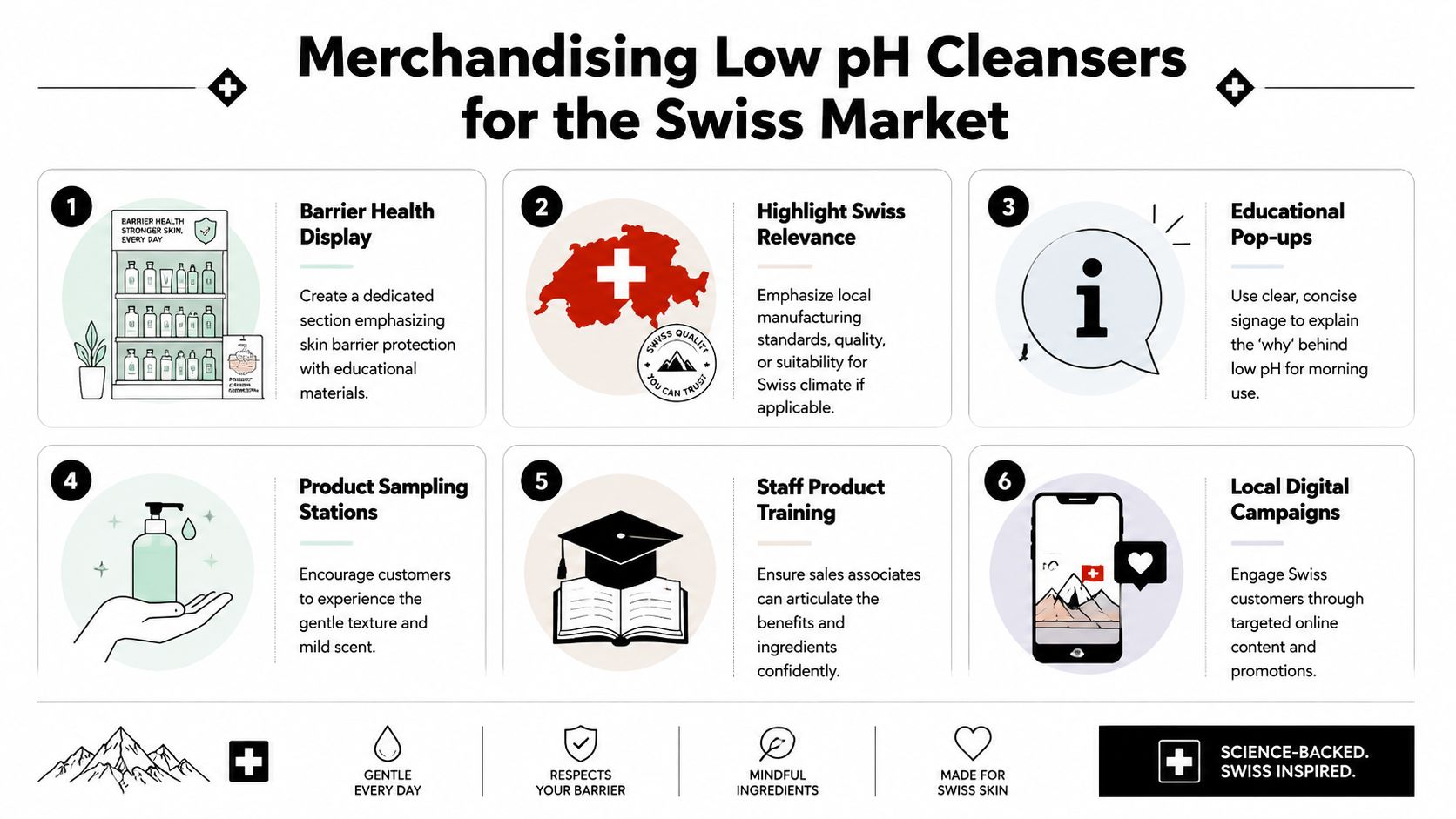
Low pH cleansers perform best when they are grouped by problem solved, not by abstract chemistry.
- Barrier health shelf: Place them beside ceramide creams, soothing serums, and fragrance-light moisturisers.
- Post-procedure homecare edit: In spas and clinics, position them near calming recovery products.
- Morning routine bay: Merchandise with SPF, antioxidant serums, and lightweight day creams.
- Oily but sensitive skin cluster: This is often the underserved shopper. They want clarity without punishment.
A small consultation card can help staff move the conversation from trend to function. Questions like “Does your skin feel tight after washing?” and “Does winter make your cleansing routine sting?” are better than broad skin-type quizzes.
Talking points for staff training
Use short, memorable language. Staff don't need to sound like formulators, but they should understand the logic.
| Customer concern | Useful response |
|---|---|
| Tightness after washing | “Your cleanser may be too stripping for daily use.” |
| Oily skin with sensitivity | “You may need gentler cleansing, then targeted leave-on care.” |
| Winter discomfort | “A barrier-conscious cleanser often matters more in the cold season.” |
| Hard-water frustration | “A low pH formula is a sensible first step when water exposure already feels drying.” |
Selling rule: Translate chemistry into a symptom the customer already recognises.
Digital content angles for Swiss retailers
This category also works well online because the pain point is easy to describe. Content can be educational without becoming technical.
Useful hooks include:
- The first step for skin that feels tight after washing
- Morning cleansing for hard-water regions
- How to keep skin comfortable during Swiss winter
- A better cleanser for oily skin that hates harsh foam
Merchandising should also connect to pricing logic. Cleansers often look simple, but margin, positioning, and refill potential depend on how the category is structured inside the store and online. If you're refining assortment and price architecture together, this retail pricing strategy guide offers a practical framework for thinking about product role, perceived value, and shelf placement.
The assortment decision to make
Not every low pH cleanser belongs in every Swiss channel. Pharmacies may prioritise tolerance and ingredient transparency. Spas may favour texture and post-treatment comfort. Premium e-commerce may need clearer comparison content and routine bundles.
The best commercial result comes from choosing products that can answer a local question. In Switzerland, that question often isn't “Is this low pH?” It's “Will this still feel good on my skin in winter, with my water, in a routine that already does a lot?”
If you're building a Swiss skincare assortment that needs stronger barrier logic, cleaner brand storytelling, and better-fit products for pharmacies, spas, clinics, or premium retail, beautysecrets.agency can help you curate brands that align with transparency, efficacy, and ethical formulation standards.