If a client wants visible anti-ageing results but has a reactive skin barrier, should you still reach for retinol first?
That question exposes the gap in most retail and clinic conversations about Retinol B3 serum. Too often, the recommendation is reduced to a formulaic script: use it at night, start slowly, wear sunscreen. That advice isn't wrong. It's just incomplete. Swiss pharmacies, spas, premium retailers, and aesthetic practices deal with a more demanding reality. Clients want efficacy, but they also expect comfort, transparency, clean positioning, and claims that stay firmly within cosmetic compliance.
In practice, a retinol B3 serum is not a universal yes. It's a managed recommendation. The product can be excellent for the right client profile, but only when staff understand the formulation logic, the tolerance curve, the climate context, and the merchandising pathway around it. That matters even more in Switzerland, where the audience often buys with a pharmacy mindset. They look for reassurance, ingredient clarity, and barrier support as much as headline anti-wrinkle language.
The Professional's Dilemma with High-Potency Actives
Retailers and practitioners face the same tension every day. Clients ask for stronger actives because they've heard retinol is the standard for lines, texture, and uneven-looking skin. The same clients then return with dryness, flaking, or fear after a poor first experience. That's where a good recommendation either builds loyalty or loses it.
Most consumer coverage treats a retinol B3 serum as an easy win. The harder truth is that efficacy and tolerability are in constant negotiation, especially for sensitive or acne-prone users. That gap in guidance is already visible in public-facing content discussing La Roche-Posay Retinol B3 Serum and the broader category, where the trade-off between performance and comfort is often underexplained for a Swiss audience that values ingredient transparency and barrier-oriented claims (Skin Elite discussion of Retinol B3 positioning).
Why the category is often misunderstood
Retinol gets grouped with “anti-ageing” in a very broad sense. That creates two problems.
First, clients assume all retinol products behave similarly. They don't. Vehicle, supporting ingredients, fragrance profile, and use instructions all shape the lived experience.
Second, some professionals overcorrect. They avoid recommending retinol at all for sensitive clients, even when a carefully designed B3-supported serum could be a sensible option if introduced properly.
Practical rule: Don't sell retinol as a hero ingredient on its own. Sell the system around tolerance.
A retinol B3 serum sits in an important middle ground. It signals activity, but also support. That's commercially useful because it lets pharmacy teams and therapists speak to both aspiration and caution. The client hears “results”, but also “we've thought about your barrier”.
What works in professional settings
The best recommendations usually share a few traits:
- They start with the client profile: first-time retinoid user, experienced active user, oily but resilient skin, dry and fragile skin, post-treatment homecare candidate.
- They define the expected journey: not instant perfection, but gradual acclimatisation.
- They package the serum with support: moisturiser, sunscreen, and clear frequency advice.
- They avoid overpromising: cosmetic maintenance language builds more trust than therapeutic language.
That last point is especially important in the Swiss context. A discerning buyer doesn't only ask whether a serum is strong enough. They also ask whether the recommendation feels measured, ethical, and credible.
Understanding the Retinol and Niacinamide Synergy
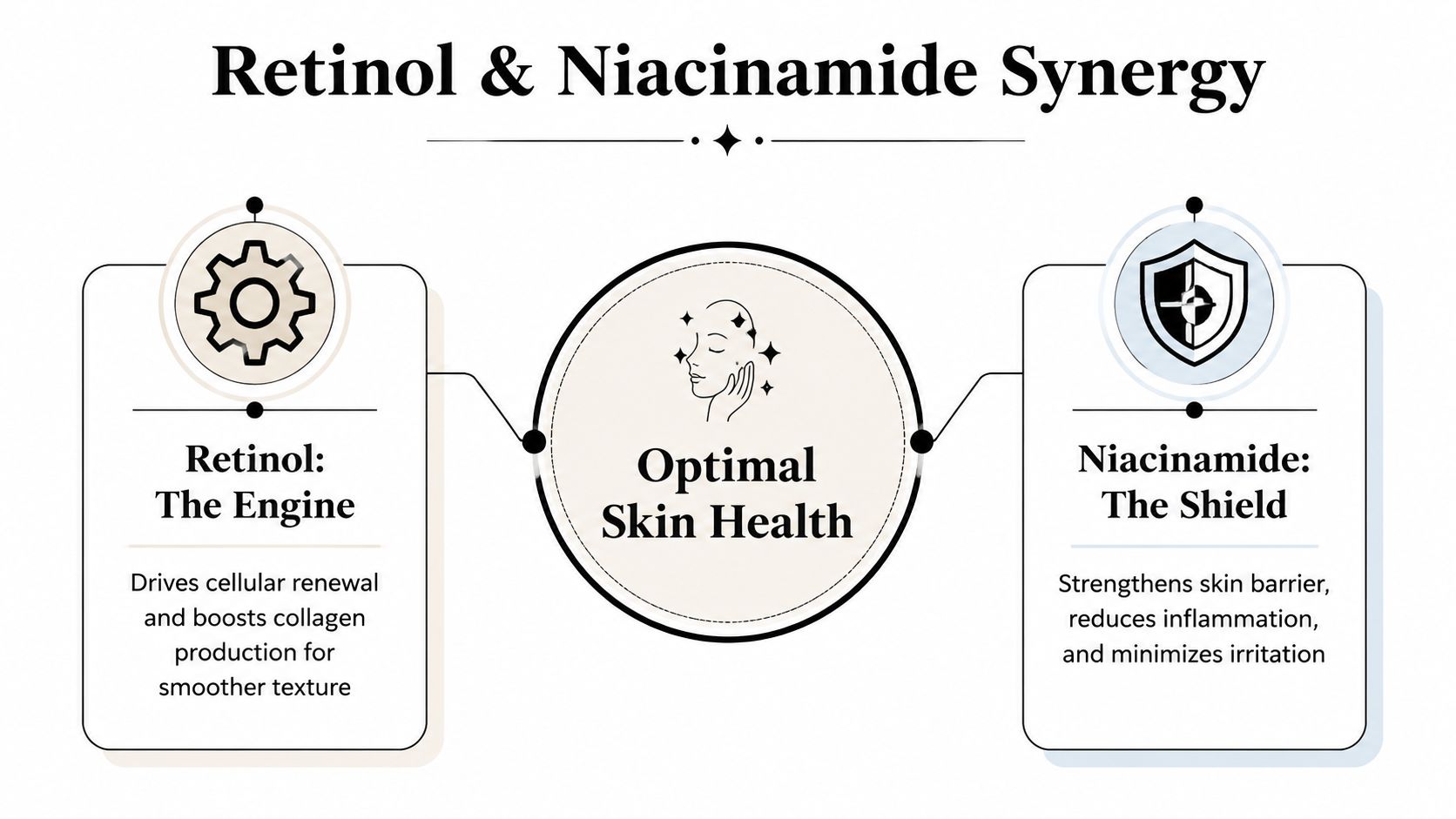
A strong retinol B3 serum works because the formulation combines pressure and protection. Retinol pushes the skin towards renewal. Niacinamide helps the skin tolerate that push with less disruption.
Retinol as the engine
Retinol is the performance driver. In practical cosmetic terms, it's the ingredient professionals reach for when the goal is smoother texture, improved surface refinement, and a more polished overall appearance. It's associated with keratinocyte turnover and collagen-related remodelling, which is why it has such a durable place in anti-ageing formulations.
A commercially disclosed benchmark for La Roche-Posay Retinol B3 Serum is 0.3% retinol combined with niacinamide, a pairing presented as balancing visible anti-wrinkle performance with a more tolerable experience for sensitive-skin use cases (PromoFarma product specification).
That benchmark matters for professional partners because it shows what the market considers a credible middle lane. Not negligible. Not excessively aggressive. Strong enough to be meaningful, but formulated to remain retail-friendly.
Niacinamide as the shield
Niacinamide does a different job. It supports barrier function and helps calm the formula's overall feel on skin. In a retail consultation, that's often the missing half of the story.
If retinol is the engine, niacinamide is the suspension system. It doesn't replace the active effect. It makes the ride more manageable.
A client rarely abandons retinol because they object to the idea of renewal. They abandon it because the formula asks more of their skin than their routine can support.
This is why Retinol B3 serum has stronger commercial logic than a simple single-active message. It gives staff a cleaner narrative: “We're recommending an active serum designed to pursue visible change while respecting tolerance”.
The mechanism also helps with category education:
- Retinol addresses renewal-focused goals: roughness, early signs of ageing, dullness, and uneven-looking surface quality.
- Niacinamide supports resilience: especially where redness, dehydration, or an easily disturbed barrier are part of the client profile.
- Together, they widen suitability: not for everyone, but for more people than a harder-edged retinol formula would.
A short training video can help teams explain this more consistently in-store or in clinic.
How to explain the pairing without sounding technical
Professionals often lose clients by overexplaining chemistry. Better language is simple and concrete.
| Ingredient | What to say to clients | Why it matters commercially |
|---|---|---|
| Retinol | “This is the renewing part of the serum.” | Supports the premium anti-ageing proposition |
| Niacinamide | “This helps the skin stay calmer and more comfortable.” | Lowers fear around irritation |
| Humectants and supportive base | “This is why the serum doesn't have to feel harsh to be active.” | Improves conversion for cautious buyers |
That framing is more useful than reciting INCI lists. Clients don't need a lecture. They need confidence that the serum has been built intelligently.
High-Performance Formulation and Ethical Sourcing
What separates a premium retinol B3 serum from a product that carries fashionable actives on the carton? In practice, it is the formula system, the pack, the supply chain, and the credibility of the claims. Swiss buyers, especially in pharmacy, selective retail, and clinic-adjacent channels, tend to assess the whole proposition.
What makes a serum professionally credible
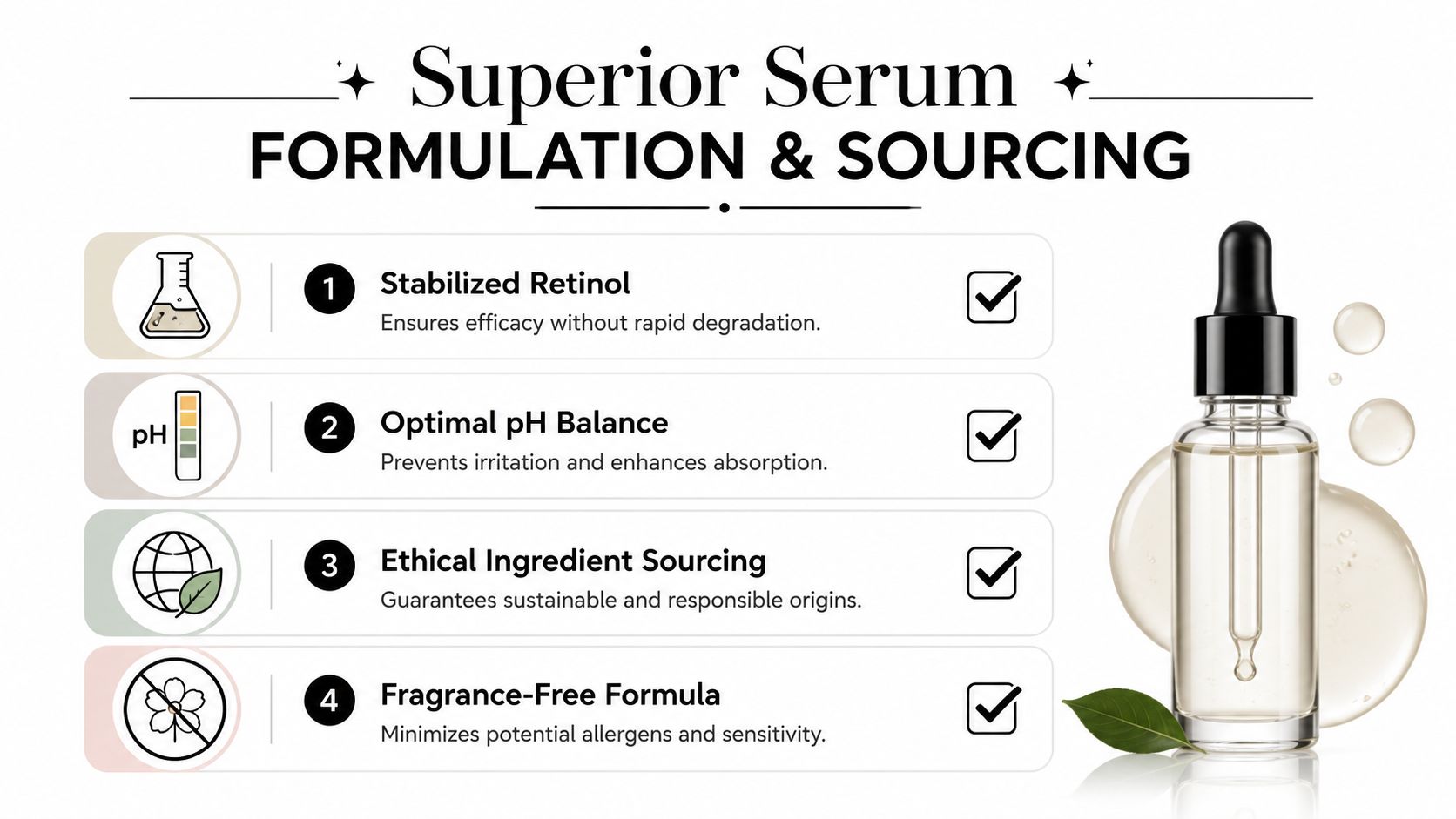
A credible retinol serum has to survive storage, repeated opening, transport, and real consumer handling. Retinol is sensitive to light, oxygen, and heat, so formula performance depends on more than the headline active. Packaging choice, antioxidant support, solvent system, and texture all affect whether the client finishes the bottle with a product that still performs as intended.
From a formulation and commercial standpoint, I assess four points first:
- Retinol stability: the active has to remain usable across the expected shelf life and use period, not just in a lab sample.
- Barrier-supportive base: humectants such as glycerin help reduce the dry, tight after-feel that often drives discontinuation.
- Layering behaviour: the serum should spread evenly, absorb in a reasonable time, and sit cleanly under moisturiser.
- Irritation control by design: excessive fragrance, high alcohol load, or an over-stripped base can undermine tolerability before the retinol itself becomes the issue.
La Roche-Posay presents its Retinol B3 Serum as a formula with pure retinol, niacinamide, and glycerin, with evening use directions and a drop-count application format on the brand product page (La Roche-Posay Retinol B3 Serum product details). For professional partners, that kind of operational detail matters. It informs staff training, expected bottle longevity, and the pricing conversation at shelf.
The base determines repeat use
Poor adherence often starts with poor cosmetic elegance. Clients describe the product as "too strong" when the actual problem is drag, tack, pilling, or a dehydrating finish.
A well-built base improves compliance because it makes night use feel manageable in winter heating, mountain air, and the low-humidity periods that many Swiss clients notice quickly. This matters in Alpine and urban settings alike. Climate stress can expose weak formulation choices fast.
The difference shows up in repurchase behaviour:
- A sharp, drying serum may attract ingredient-focused shoppers once.
- A balanced serum with good slip and enough humectant support is more likely to be finished and recommended.
That is the commercial test.
Ethical sourcing has to support, not dilute, the efficacy story
Swiss premium consumers often ask two questions at once. Does it work, and does the brand behave responsibly? A retinol B3 serum aimed at this audience needs a sourcing and claims framework that can stand up to scrutiny without drifting into vague green language.
Useful checkpoints include:
- Recognised certification or verification routes: where relevant to the brand or line, frameworks such as ECOCERT can support trust, but only if the scope is clear.
- Cruelty-free policy consistency: retailers want to know whether the claim applies brand-wide, by market, or only to selected SKUs.
- Raw material traceability: this supports professional selling, especially where trained staff are expected to answer supplier and origin questions.
- Packaging responsibility: recyclable components, secondary pack reduction, and air-restrictive formats all strengthen the proposition if they are properly executed.
The regulatory point is simple. In Switzerland, ethical and natural positioning still sits under the same expectation for truthful, supportable claims that applies across cosmetics. If a brand suggests gentleness, purity, sustainability, or dermatological suitability, those statements need defensible substantiation and a formula that behaves accordingly.
“Natural” on its own rarely justifies premium placement. High-performance, responsibly sourced, well-tolerated, and clearly documented does. That is the combination that earns trust with discerning Swiss clients and gives retailers a more durable merchandising story than trend language alone.
Client Guidance and Advanced Usage Protocols
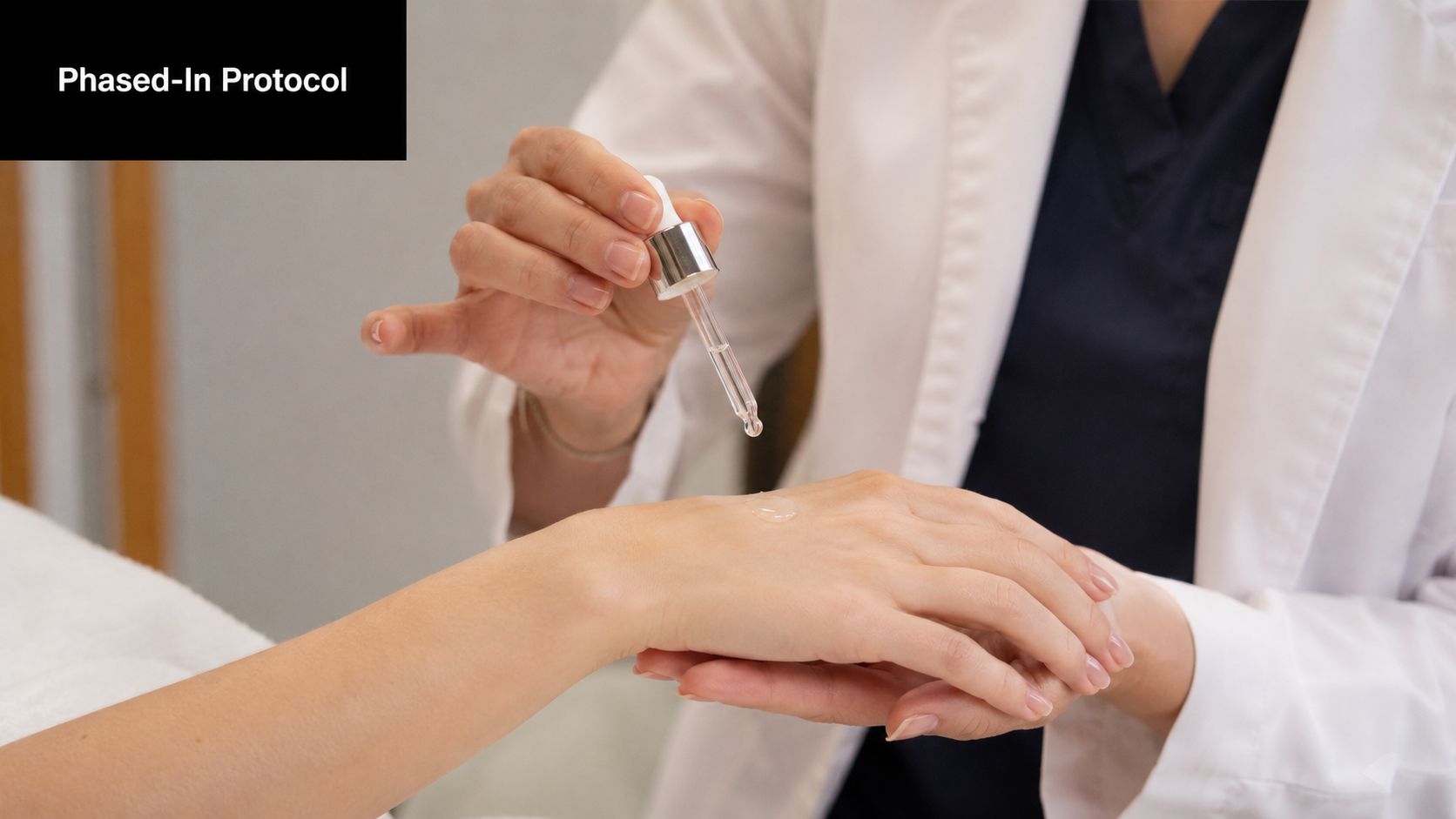
How do you turn a high-interest retinol sale into a repeat purchase instead of a return? The answer is less about the percentage on pack and more about the protocol given at first purchase. In practice, client outcomes improve when instructions are specific, seasonal, and realistic for the person in front of you.
A practical onboarding sequence
Retinol B3 serums perform best in restrained routines. Clients often arrive with too many actives already in use, especially exfoliating acids, peel pads, and aggressive cleansers. Adding retinol into that mix without simplifying the rest of the regimen is one of the fastest ways to create irritation and disappoint both client and retailer.
A workable starting protocol is simple:
- Use in the evening only. That fits both standard retinol practice and typical product labelling.
- Start with limited frequency. Two to three nights per week is usually enough for a new user or anyone with a reactive history.
- Apply to fully dry skin. This reduces the chance of an unnecessarily intense first experience.
- Follow with moisturiser. Barrier support should be built into the protocol, not added later as damage control.
- Require daily sunscreen. Any client using retinol needs clear morning photoprotection advice.
For La Roche-Posay Retinol B3 Serum, the pack directions specify evening use and a measured drop count, as noted earlier. For staff training, the broader point matters more than the exact number of drops. Dose control helps reduce overapplication, which is common with low-viscosity serums.
Layering choices that reduce problems
Application order should match skin status, not just product texture. For this reason, professional advice earns its margin.
| Client profile | Better approach | Why it usually works |
|---|---|---|
| Resilient, experienced user | Serum first, moisturiser after | Gives more direct exposure to the active |
| Dry or reactive user | Moisturiser, then serum, then moisturiser if needed | Reduces sting potential and improves comfort |
| Barrier-impaired client | Delay retinol introduction until comfort is restored | Protects adherence and avoids predictable complaints |
Clients who insist on keeping exfoliating acids in the routine need scheduling rules. Alternate nights usually produce better tolerance than stacking both categories in one evening. For clinic retail, I also advise staff to ask one blunt question at handover: “What else are you using at night?” That single question prevents many avoidable failures.
The Swiss winter problem
Swiss clients often use retinol under conditions that generic brand copy barely addresses. Cold air, altitude exposure in some regions, low outdoor humidity, and indoor heating all push transepidermal water loss in the wrong direction. A serum that feels elegant in mild weather can become difficult to tolerate in January, especially in clients who cleanse too aggressively or travel between heated interiors and mountain environments.
Public discussion of this gap has highlighted how standard advice often misses barrier protection in cold, dry conditions (Swiss winter use content gap discussion).
That changes the selling script. Frequency should follow skin condition, not the number of weeks since purchase. If the client reports tightness after cleansing, flaky nasolabial folds, or stinging with a basic moisturiser, the skin is already under environmental stress. Escalation at that point is poor practice.
Clinic note: During heating season, reduce frequency before tolerance breaks down. Three well-tolerated applications per week will outperform daily use that ends in abandonment.
Seasonal adjustments that actually help
Use direct language with clients and staff:
- Reduce frequency before stopping the product: this keeps the client engaged without forcing a daily schedule the skin cannot support.
- Add one supportive product, not three: a richer moisturiser is usually more useful than extra “repair” actives.
- Check the cleanser first: over-foaming and over-degreasing are common reasons a retinol serum gets blamed unfairly.
- Keep the morning routine comfortable: sunscreen sits better, and gets used more consistently, over hydrated skin.
- Delay reintroduction after procedures when needed: after peels, microneedling, or other barrier-challenging services, bring retinol back only once the skin is calm.
For Swiss merchandising, this section matters commercially as much as clinically. A premium, ethically positioned retinol B3 serum needs a credible use protocol that respects climate, tolerance, and client expectations around gentleness. Discerning buyers do not just want efficacy. They want a formula they can stay with, advice that feels precise, and a recommendation that does not ignore season, lifestyle, or skin comfort.
Managing Sensitivity and Common Contraindications
Sensitivity management is not a side conversation. It is the business model for selling active skincare responsibly. A client who feels guided through the retinisation phase is far more likely to trust the recommendation, complete the bottle, and come back for a second purchase.
What's expected and what isn't
Some adjustment is common when clients start a retinol B3 serum. Mild dryness, a sense of tightness, and light flaking can happen as the skin adapts. Panic usually begins when nobody warned the client that this was possible.
More important is knowing what should trigger a different response. Persistent burning, marked redness that doesn't settle, swelling, or a rash-like presentation should not be waved away as “normal retinol purging”. Professionals need cleaner language than that.
Use this distinction in staff training:
- Expected adaptation: mild dryness, slight flaking, transient discomfort after application.
- Likely overuse: repeated irritation after each use, stinging with basic products, visible barrier compromise.
- Potential intolerance or reaction: escalating redness, swelling, itching, or symptoms that feel disproportionate to the amount used.
The core interventions
Most tolerance issues can be improved with simple changes rather than product abandonment.
- Buffer the application: use moisturiser before the serum if the client is reactive.
- Add rest nights: there is no prize for forcing frequency.
- Strip back the rest of the routine: remove unnecessary exfoliants and harsh cleansers.
- Support the barrier: prioritise plain, replenishing moisturisers and conservative cleansing.
If a client says, “My skin feels hot even when I put moisturiser on”, stop treating it as a compliance issue. Treat it as a barrier issue.
That single shift prevents many avoidable returns.
Contraindications and caution points
Professionals should also keep the recommendation within clear safety boundaries. Retinol is a cosmetic active, but it still isn't for everyone. Pregnancy is commonly treated as a caution or exclusion point in professional counselling, and clients using prescription acne or retinoid therapies need a more careful conversation before adding another vitamin A step. The same applies when the skin is already irritated from procedures or from self-directed overuse of acids.
A disciplined recommendation sounds like this: start conservatively, monitor response, and suspend use when the barrier is clearly not coping. That's not timid selling. It's what keeps premium active skincare from turning into a short-term disappointment.
Swiss Market Compliance and Effective Merchandising
How do you sell a high-activity retinol B3 serum in Switzerland without drifting into medicinal territory or flattening the product into bland copy?
In the Swiss market, compliance and merchandising sit in the same conversation. A good serum can still underperform if the claim language is too aggressive for cosmetic rules, too vague for a pharmacy setting, or too detached from what Swiss clients value: efficacy, restraint, ingredient transparency, and responsible sourcing.
What Swiss compliance means in practice
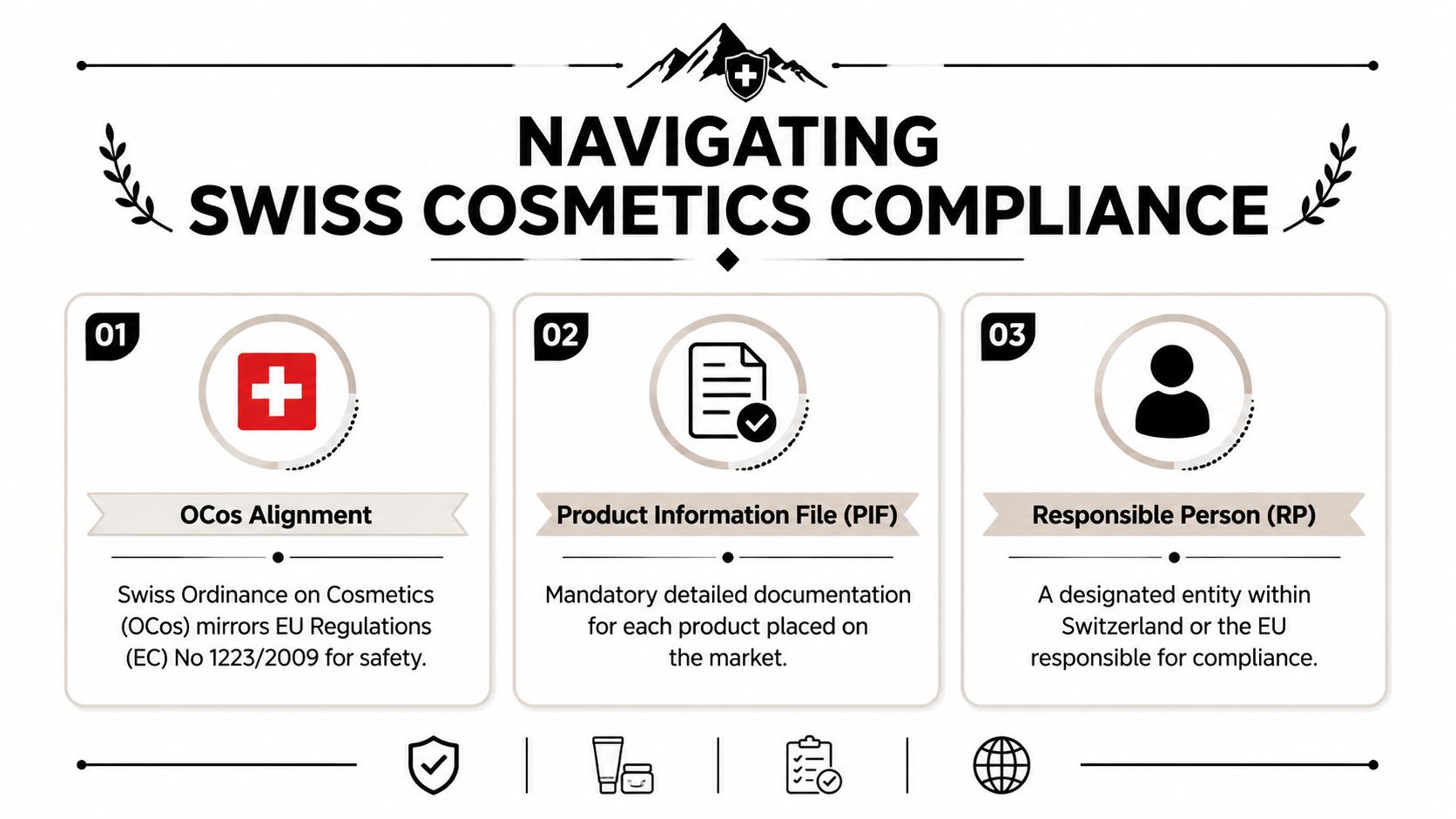
Under the Swiss Ordinance on Cosmetics (OCos), which broadly aligns with the EU cosmetic framework, a retinol serum must be presented as a cosmetic product rather than a medicinal treatment. The practical effect is clear. You can talk about improving the appearance of wrinkles, texture, tone, and skin comfort. You should not imply that the product treats disease, repairs pathology, or works like a prescription retinoid.
That affects copy, staff training, and assortment strategy.
A compliant product page or shelf card uses wording such as “helps smooth the look of uneven texture” or “supports a more even-looking complexion.” It avoids treatment language, cure language, and before-and-after framing that suggests a therapeutic claim. For Swiss pharmacies and para-pharmacies, that distinction matters even more because the retail setting already carries medical authority. Staff need language that is technically accurate and commercially useful.
Swissmedic and the federal framework on cosmetics set the tone here. Partners who want a firmer legal grounding should review the official Swiss cosmetics guidance through the Federal Food Safety and Veterinary Office and Swissmedic rather than relying on retailer copy.
Merchandising by channel
The same serum should not be sold the same way in every channel. Swiss buyers are too discerning for that, and the climate adds another layer. In alpine winters and low-humidity indoor environments, tolerance messaging often matters as much as anti-ageing messaging.
Pharmacy and drugstore
In pharmacy, the strongest approach is routine-based merchandising. Place the serum within an evening regeneration offer and keep a day protection product close by.
- Pair it with a plain moisturiser and a daily sunscreen.
- Give staff short, compliant phrases for benefit claims and objection handling.
- Use shelf talkers or routine cards that explain order of use, starting frequency, and who should begin cautiously.
This reduces two common problems: overpromising at the shelf, and under-explaining at the counter.
Spa and clinic
In spas and clinics, the serum performs best as disciplined homecare. Clients in these settings usually expect curation, not volume retail. The recommendation should reflect treatment timing, current skin status, and the client's willingness to follow instructions.
For premium Swiss clientele, ethical positioning also influences conversion, but only if the formula story is credible. If a brand claims natural inspiration, low-irritation design, or responsible sourcing, the packaging, INCI list, and training notes need to support that claim. Discerning buyers notice gaps quickly.
Premium e-commerce and selective retail
Online, the page has to do the work of a trained advisor. State who the serum suits, what the texture is like, where it sits in the routine, and why niacinamide is there. Add visible caution points for new retinol users. Keep the surrounding basket sensible. A retinol serum placed next to strong acids, abrasive cleansers, and peel pads can raise average order value in the short term and increase complaints later.
Merchandising quality is measurable. The Swissklip audit insights show how digital retail analysis can expose weak trust signals, confused positioning, and missed conversion support in premium categories.
The commercial goal is simple. Make the product easy to understand, easy to start, and difficult to misuse. In Switzerland, that is usually the strongest route to repeat purchase.
Professional FAQs for Retinol B3 Serums
How should I train staff to sell a retinol B3 serum well?
Train them on conversations, not scripts. They should know three things cold: who the product is best for, how to start it, and how to respond if the client says their skin is irritated. Role-play common objections. The strongest teams don't just repeat “night use only”. They explain why frequency, moisturising support, and sunscreen matter.
What are the strongest selling points for a premium retinol B3 serum?
Lead with formulation intelligence, not hype. A premium serum earns its place when the active level is credible, the supporting ingredients improve tolerance, the base layers well, and the brand story is clean and coherent. For Swiss buyers, ethical and transparent positioning can strengthen the sale, but only if the formula also feels professionally serious.
Should I recommend it to every anti-ageing client?
No. Some clients need a niacinamide-first or barrier-first routine before they're ready for retinol. Others may be better served by simpler maintenance products if they are highly reactive, inconsistent, or already overusing actives. A good recommendation protects the long-term relationship, even when the answer today is “not yet”.
Can it sit alongside in-clinic procedures?
Sometimes, but timing matters. Don't assume a client can resume a retinol B3 serum immediately after a procedure just because the product is sold as gentle. If the skin is heated, fragile, or visibly compromised, wait until the barrier has settled and restart conservatively.
How do I reduce returns and complaints?
Give written instructions. Keep them short. Include when to use it, how often to begin, what to pair it with, and what signs mean the client should pause and ask for advice. Complaints often come from ambiguity, not from the serum itself.
What is the most common commercial mistake?
Overselling speed. If staff promise dramatic change quickly, the client either overuses the product or becomes disappointed. Set expectations around consistency, comfort, and routine discipline. That produces better adherence and more believable premium positioning.
If you're building a Swiss-ready assortment of natural, ethically sourced skincare with the compliance discipline and partner support that premium retail requires, beautysecrets.agency is worth a closer look. The team works with pharmacies, retailers, spas, clinics, and e-commerce partners that want differentiated beauty and dermo-cosmetic lines without compromising on transparency, sourcing standards, or market fit.