You're probably here because your hair has reached that awkward point. Long enough to tie back, not long enough to feel dramatic, and somehow still heavy, flat, or shapeless. Or maybe you want a change, but a blunt bob feels too severe and a major chop feels risky.
That's exactly where shoulder-length hair with layers earns its place. It gives you movement without sacrificing versatility. It can look polished for work, relaxed on weekends, and modern without demanding a full restyle of your identity. For many clients, it's the haircut that finally makes their hair behave the way they hoped it would.
It also isn't a passing salon fad. In European and Swiss fashion cycles, layered medium cuts became especially important after the 1970s, when layered cutting moved from niche technique into mainstream styling, as noted in this Swiss market overview of layered shoulder-length hair. That staying power matters. A style lasts when it solves real problems, not just aesthetic ones.
The Timeless Appeal of Medium Length Layers
A client sits down, runs her hands through hair that keeps falling flat at the crown and flipping unpredictably at the ends, and says she wants a change that still feels like her. Shoulder-length layers keep coming up for a reason. They solve that exact brief. The cut gives enough length for a ponytail, a polished blowout, or a soft wave, while creating shape that a one-length mid-length cut often lacks.
Its appeal comes from proportion. Shoulder length sits at a useful midpoint on the body, so the hair still frames the face and neck without taking over your whole look. Add layers, and the cut stops behaving like one solid curtain. It starts moving in sections, which is why it can read refined in a work setting and relaxed on a weekend with only a small styling change.
Why this length keeps returning
Fashion changes. Good proportions last.
Medium layers keep returning because they adapt to taste, age, dress code, and hair texture better than many trend-led cuts. A soft version can feel expensive and understated. A choppier version can support curtain bangs, face-framing pieces, or a more editorial finish. The foundation stays useful even as trends shift around it.
That flexibility also matters for salons and retail partners. It is easier to recommend a cut when clients can see more than one version of themselves in it. Shoulder-length layers create a clear service story. You are not selling a dramatic reinvention. You are offering better shape, better movement, and more styling options, then pairing that result with products that support bounce, definition, heat protection, or frizz control. In the Swiss market, that language tends to resonate because clients often expect visible performance and ingredient quality in the same purchase.
Why it feels current without feeling temporary
Some haircuts date quickly because they rely on one strong visual signature. Medium layers last because the signature is softer. The cut can be worn smooth, brushed out, tucked behind the ears, or left with natural bend, and it still looks intentional.
That makes it a smart choice for clients who want relevance without chasing every micro-trend. It also makes it commercially strong. A wearable cut brings clients back for maintenance, glossing, fringe adjustments, and home-care advice. For premium salons and selective retailers, especially those working with natural or higher-quality formulations, this haircut creates a natural conversation about what the hair needs to keep its shape between appointments.
What clients often misunderstand
“Shoulder-length hair with layers” is not one haircut. It is a category.
That distinction matters. Two clients can ask for the same phrase and need completely different cutting plans. One may want quiet internal layering that keeps the outline full. Another may need visible face-framing and shorter crown pieces for lift. The haircut only works well when the stylist chooses where to remove weight and where to keep it.
Clients usually arrive with a reference photo. Professionals need a translation. The true question is not “Do you want layers?” It is “How much movement do you want, where do you want volume, and how much styling are you willing to do?” Once that is clear, medium layers stop being a vague trend term and become a very precise, highly customizable service.
Understanding the Magic of Layering
Layers aren't decoration. They're hair architecture.
A good stylist uses them to remove weight from specific places while protecting the outline of the haircut. That's why a layered cut can feel lighter, move better, and hold shape more naturally than a one-length cut of the same length.

What layers actually do
The clearest technical benefit is controlled weight removal. In shoulder-length hair, that improves bend, movement, and styling memory, and it's one reason variants such as the wolf cut and butterfly cut create lift at the crown and softness around the face, as described in Cosmopolitan's guide to shoulder-length layered cuts.
Consider tailoring a jacket. You're not just shortening fabric. You're shaping how it falls.
A blunt cut keeps all the mass at the perimeter. That can look crisp, but it can also make hair swing like a block. Layers shift that mass upward or inward so the hair bends more easily.
Three terms worth knowing in the salon chair
- Perimeter means the outer line of the haircut. If you love the feeling of fullness at the bottom, tell your stylist you want to keep the perimeter strong.
- Internal layers sit inside the haircut. They remove bulk and create movement without making the haircut look obviously layered from a distance.
- Face-framing pieces focus shape around the cheekbones, jawline, or collarbone. These are often what clients notice first, even when the actual engineering is happening elsewhere.
Practical rule: If you want movement but you're nervous about losing fullness, ask for internal layering with a preserved perimeter.
Why some layered cuts style better than others
Not every layered cut is easy. The easiest versions work with your natural fall pattern.
If your hair naturally flips at the ends, your stylist can place layers so that flip looks deliberate. If your crown tends to collapse, they can build lift higher up. If your hair puffs outward, they can reduce density where it gathers.
A strong layered haircut should answer one clear question: what is the hair trying to do on its own?
That's where the magic happens. Not fighting the fibre, but directing it.
Choosing Your Layering Style from Subtle to Statement
When clients say they want layers, they often mean very different things. One person wants hair that moves a little more. Another wants visible shape from across the room. The smartest consultation starts with the look, not the terminology.
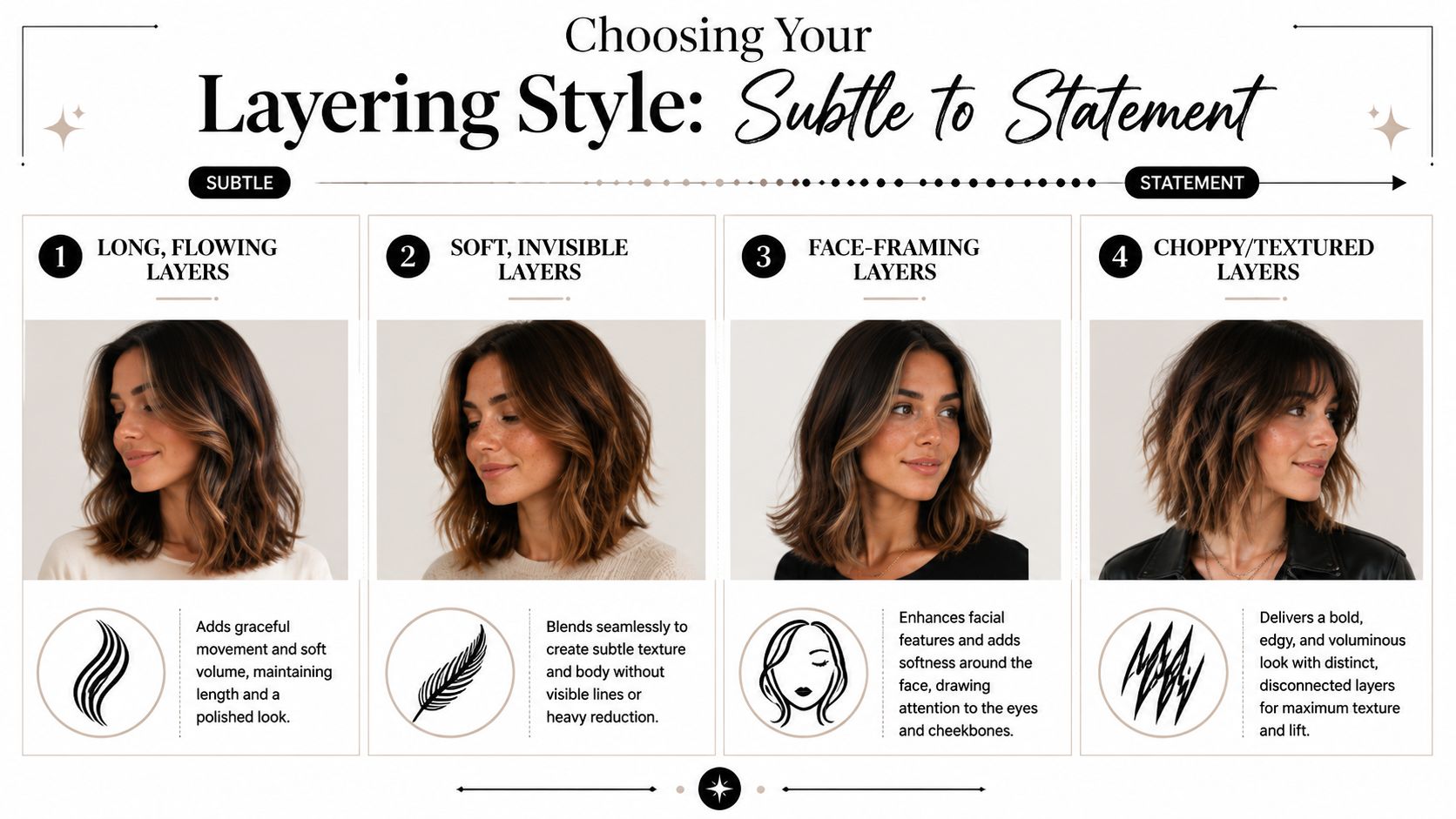
The four main directions
| Style | Best for | Visual effect | Styling feel |
|---|---|---|---|
| Long, flowing layers | Clients who want softness without losing polish | Gentle movement through the mid-lengths and ends | Easy to blow-dry smooth |
| Soft, invisible layers | Hair that feels heavy but shouldn't look “layered” | Cleaner outline with hidden body | Low-effort and office-friendly |
| Face-framing layers | Anyone wanting more shape around the front | Brighter, softer look around eyes and cheekbones | Noticeable even in a ponytail |
| Choppy or textured layers | Clients who like edge, lift, and separation | More texture, more air, more attitude | Needs product to show the shape |
Subtle layers for people who fear regret
Long or invisible layers are ideal if you've had a bad layered haircut before. They don't shout. They refine.
These cuts suit professional wardrobes, minimal styling routines, and clients who still want the option to wear their hair straight without obvious steps or shelves. If you like the phrase “I want it to look expensive but not fussy,” this is usually the lane.
Face-framing for instant change
Many medium cuts become flattering at this length. Face-framing layers can shift the entire haircut without removing much overall length.
They're useful if your hair feels plain around the front, or if you wear it tucked behind the ears and want a softer release around the face. They can also make a basic shoulder-length cut feel more customised.
If you're collecting inspiration before a consultation, the Challenge Hairstyle clinic profile can help you evaluate how salons present their cutting and styling aesthetic. That's useful when you want a result that feels more customized than generic.
Statement layers for texture lovers
Choppier layering has more personality. It creates visible separation, stronger crown lift, and a more fashion-led silhouette. Shag-inspired cuts, airy wolf influences, and piecey finishes thrive in this style.
Ask yourself whether you want people to notice the haircut or simply notice that your hair looks better. That answer usually points to the right layer category.
A strong statement cut can look brilliant, but it should match the way you style your hair. If you never use a diffuser, mousse, texture spray, or round brush, don't ask for a shape that depends on them.
Matching Your Cut to Your Hair and Face Shape
Shoulder-length hair with layers either works beautifully or disappoints. The difference isn't whether layers are fashionable. It's whether the layering pattern matches your density, texture, and proportions.
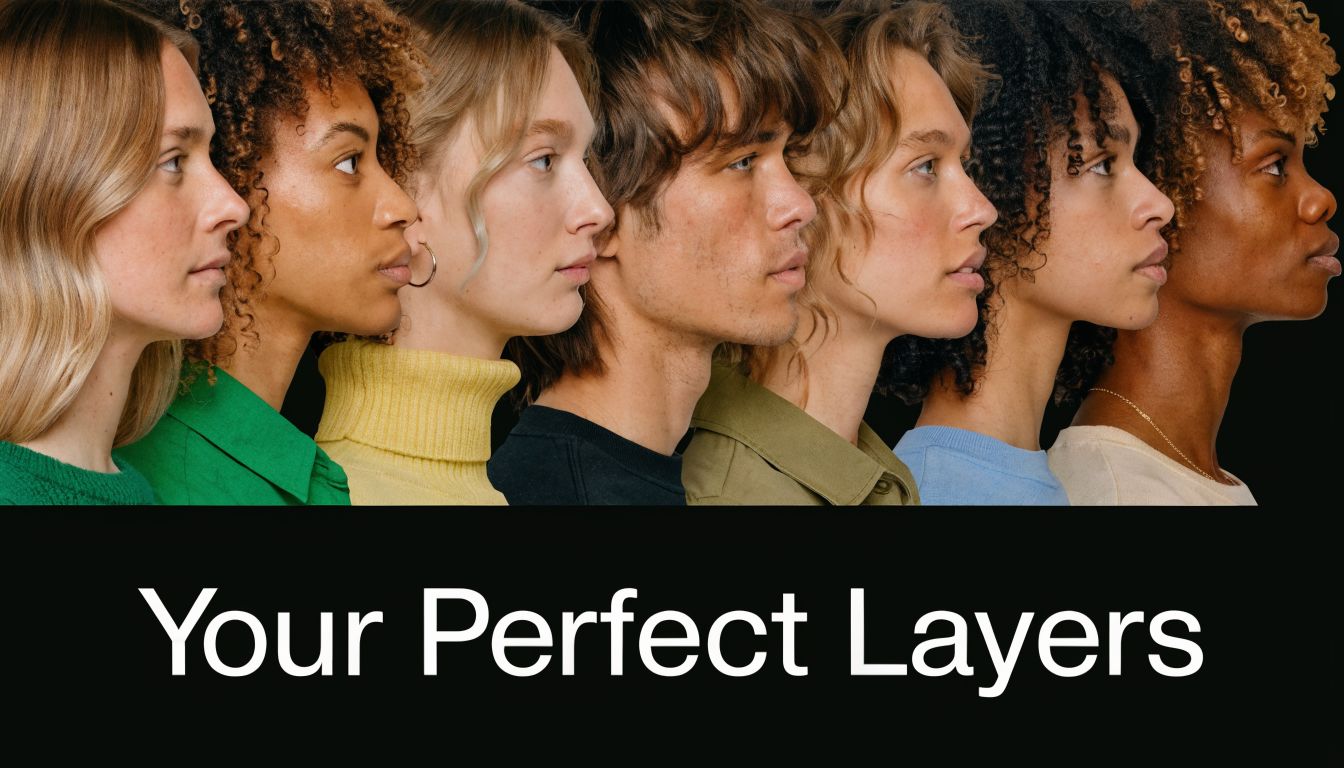
A common myth is that layers automatically add volume. Sometimes they do. Sometimes they remove the very weight that was making the hair look substantial. A more contrarian but useful view is this: on very fine hair, excessive internal layering can flatten the silhouette, while on dense hair, too little graduation can create a bulky triangle shape. The key is matching the technique to density, as noted in this discussion of shoulder-length haircut decision factors.
Start with hair density, not trend photos
Your density tells a stylist how much hair exists. Your texture tells them how that hair behaves. Both matter more than the trend name.
Fine hair
Fine hair usually needs restraint. Too many short layers can leave the ends wispy and disconnected.
Better options include:
- Soft internal layers that create movement without hollowing out the shape
- A blunt or gently textured perimeter so the cut still looks full
- Light face-framing pieces rather than heavy crown layering
If your hair is fine and straight, the goal is often lift with integrity. You want some shape, but the ends must still look present.
Thick or dense hair
Dense hair often benefits from more deliberate weight removal. Without it, shoulder-length hair can push outward at the bottom and lose flow.
Useful choices include:
- Graduated internal layering to reduce bulk
- Crown support if the top collapses under its own weight
- Face-framing that breaks up the front curtain of hair
For this hair type, a stylist should remove volume strategically, not randomly. Taking too much from the surface can create frizz or puff. Taking too little leaves the haircut static.
Dense hair usually doesn't need more hair. It needs better distribution.
Then consider texture
| Texture | What usually helps | What to avoid |
|---|---|---|
| Straight | Shape through the ends, clean framing around the face | Over-layering that makes the cut stringy |
| Wavy | Layers that encourage natural bend and reduce bottom heaviness | Cutting every wave pattern the same way |
| Curly | Thoughtful shrinkage planning and balanced weight removal | Copying a straight-hair reference photo exactly |
Wavy hair often thrives at shoulder length because the bend appears more easily once excess weight is gone. Curly hair can also look fantastic in this zone, but the cut needs to respect spring and shrinkage. A curl-aware cutting approach matters.
Face shape matters, but less than people think
Face shape should guide emphasis, not dictate the haircut.
- Round faces often suit soft length around the front rather than width at the cheeks.
- Square faces tend to work well with softness near the jaw and cheekbone area.
- Heart-shaped faces can benefit from fullness lower down to balance the upper face.
- Oval faces can wear many versions, so hair texture becomes the deciding factor.
The most flattering layered cuts don't “correct” your face. They support the lines you already have.
Styling and Maintaining Your Layers at Home
It is Wednesday morning. You have ten minutes, your hair dried in three different directions overnight, and you still want your cut to look like a choice rather than an accident. That is the ultimate test of shoulder-length layers.
A good layered cut should give you two clear options at home. You should be able to leave the hair soft and natural on low-effort days, or refine it into a polished shape when you want more control. The goal is not to fight the haircut. The goal is to support the structure your stylist built into it.
The air-dry routine that still looks intentional
Air-drying works best when you guide the hair early, before it starts setting in random bends. Layers behave a lot like fabric. If you smooth and place them while damp, they fall with more purpose. If you disturb them too much as they dry, they separate and puff.
This approach tends to suit soft layers, natural waves, and medium-density hair.
- Start with damp hair, not soaking hair. Blot first so your product stays on the hair instead of diluting with water.
- Apply a lightweight leave-in or a small amount of oil through mid-lengths and ends. This keeps the shorter pieces from turning feathery and helps the perimeter stay tidy.
- Comb once, then stop. Use fingers or a wide-tooth comb to place the shape, then let the pattern form.
- Add lift only where you need it. A light mousse or styling foam at the crown can keep the top from collapsing while the ends stay touchable.
- Direct the face frame on purpose. Twist or clip the front sections away from the face while they dry if you want the layers to open up around the cheekbones.
If you are exploring oils as part of a wider natural haircare routine, the Batana Oil hair growth guide gives useful context on how oil-based products are commonly discussed for scalp and length care. It is best read as product education, not as proof that any oil can replace cut quality or technique.
For clients in Switzerland who prefer premium, plant-led formulas, this is also where the retail conversation becomes more credible. The haircut often looks better with lightweight nourishment, not heavier coatings, so salon teams and stockists can recommend natural aftercare with a clear reason behind it.
The polished blow-dry approach
A smoother finish comes from section control, airflow direction, and tension. Heat alone does not create shape. The brush does the shaping, and the dryer sets it.
Use:
- A heat protectant
- A medium round brush
- Sectioning clips
- A dryer with a nozzle attachment
Follow the order carefully.
- Rough-dry first until the hair is partly dry.
- Divide the hair into sections no wider than the brush barrel.
- Aim airflow downward to smooth the cuticle.
- Lift at the roots only where you want height.
- Bend the ends slightly rather than over-curling them.
- Let each section cool before brushing through.
A layered cut looks expensive when the movement starts in the right place. Usually that means softness through the ends, not a curl on every piece.
This video gives a helpful visual reference for blow-drying mechanics and section control:
Product pairing by result
The easiest way to choose styling products is to match them to the job the haircut is trying to do. If the layers need separation, choose hold with flexibility. If the ends look dry, choose slip and softness. If the crown falls flat, choose root support.
| If you want | Reach for | Why it helps |
|---|---|---|
| Softer ends | Lightweight hair oil or finishing serum | Keeps layers from looking dry or overly wispy |
| Root lift | Volumising mousse | Supports height at the crown without a stiff finish |
| Smoother blow-dry | Heat protectant cream or balm | Improves slip and helps reduce roughness |
| Piecey texture | Dry texturising spray or flexible paste | Defines the layers while keeping movement |
For salon and retail professionals, this haircut creates a useful service-to-product link. Clients can usually feel when a cut is lighter, softer, or easier to style, but they do not always know which homecare products preserve that result. Clear recommendations close that gap and make retail feel considered rather than scripted, especially in the Swiss premium haircare space where ingredient story, sensory quality, and clean positioning often influence purchase decisions.
How often should you trim it
Shoulder-length layers usually hold their shape well until the ends lose definition or the face frame starts blending into the rest of the haircut. At that point, the cut often feels heavier even if the overall length has barely changed.
A refresh is usually more useful than a dramatic correction. Small, regular reshaping appointments help the layers keep their spring, keep the outline clean, and make daily styling faster.
A Professional Guide for Salon and Retail Partners
A client sits down with a reference photo and says, “I want movement, but I still want my hair to feel full.” That is the commercial strength of shoulder-length layers. The request sounds simple, yet it opens a useful consultation about shape, daily habits, maintenance cadence, and the products that keep the cut behaving as intended.
For salon teams, this service works well because the result is visible and easy for clients to feel. Hair can dry faster, sit lighter around the face, or hold a bend with less effort. For retail partners, that creates a clear path from cut to homecare. The recommendation is not abstract. It is tied to a specific outcome the client has already noticed in the mirror.
Consultation language that builds trust
Clients rarely want technical terms. They want to know what will happen and why.
Clear phrasing lowers resistance:
- “I'm taking weight out through the middle so the shape moves instead of sitting heavy.”
- “I'm keeping the outline solid, so you still have a full-looking perimeter.”
- “These front layers will open the face without creating extra work at home.”
That kind of language does two jobs at once. It helps the client picture the result, and it gives the stylist a natural way to explain aftercare. If the purpose of the cut is clear, the product recommendation also feels clear.
Clients are more likely to buy homecare when they understand which part of the haircut it protects.
Retail pairing that feels informed
Layered shoulder-length hair usually creates three retail conversations. Each one maps to a practical concern a client already has.
- Shape support with mousse, root lift, or flexible texture products for clients who want the layers to keep their bounce
- Fibre care with lightweight oils, masks, or leave-ins for clients whose ends start to separate or look rough
- Finish control with smoothing creams or dry finishing products for clients who want polish, definition, or humidity management
A useful recommendation sounds specific. “This keeps the ends from turning fluffy.” “This helps the crown hold shape without feeling sticky.” That is more persuasive than broad product praise because it connects formula to function, much like matching the right brush to the right blow-dry.
Strong categories for Swiss premium channels
In Swiss pharmacies, selective retail, wellness settings, and premium e-commerce, shoulder-length layers fit well with a quality-led haircare assortment. The cut attracts clients who often care about touch, finish, ingredient profile, and ease of use.
Merchandising works best when the language mirrors real hair behaviour:
- For fine hair, products that keep volume light and touchable
- For dense hair, formulas that soften bulk and reduce friction
- For air-dry routines, creams or oils that encourage separation without greasiness
- For polished styling, heat protection and blow-dry aids that improve control
Natural and ethically sourced positioning can strengthen the recommendation here, especially when the formulas also deliver a refined sensory experience. Clients choosing a customized, wearable cut often respond well to aftercare that feels equally considered.
The business case is straightforward. This haircut is highly adaptable, easy to personalise, and closely linked to ongoing maintenance. That gives salons and retail teams a credible story from consultation to checkout.
If you're building a premium hair and beauty assortment for Swiss retail, spa, clinic, or e-commerce channels, beautysecrets.agency offers a factual view of its natural and ethically sourced brand portfolio, including product lines that can support the care, finish, and maintenance needs discussed in this guide.