Only 37.5% of participants showed temporary skin-lightening with IV glutathione in a key trial, while 32% experienced adverse events according to the clinical review cited later in this article. That single contrast reframes the entire discussion for Swiss clinics. L-glutathione injection is being sold in the market as a fast aesthetic solution, but the commercial story and the medical story don't align cleanly.
In practice, this isn't just a treatment question. It's a sourcing question, a liability question, and a reputation question. For a Swiss pharmacy, drugstore group, medspa, or aesthetic clinic, the primary issue is whether a product promoted as a cosmetic differentiator can be handled like a serious sterile injectable. It must be.
Consumer demand has grown. So have the warnings. That combination is exactly why professionals need a stricter framework than the one used in generic wellness content.
The Glutathione Paradox in Aesthetics
The reduced glutathione for injection sector is projected to keep expanding through 2033, driven by consumer interest, while regulators have raised concerns about compounded products and documented risks including kidney dysfunction, liver toxicity, and other adverse events, as described in this market and risk overview of glutathione injections in 2025. That is the paradox. Demand is moving up, but confidence in the category shouldn't.
Swiss operators see this first-hand. Patients ask for “brightening drips”, “detox shots”, or “anti-ageing glutathione” because they've seen celebrity-led messaging and menu-style treatment marketing. The clinic, however, carries the medical and legal burden once the product enters the room.
Why demand doesn't equal readiness
Aesthetic demand often outruns evidence. That's common in injectables, but L-glutathione injection has an extra layer of difficulty because the use case is frequently cosmetic and off-label, while the route of administration carries the same expectations of sterility, traceability, and emergency readiness as any other parenteral product.
Commercial reality: A treatment can be easy to market and still be difficult to defend under scrutiny from a regulator, an insurer, or a harmed patient.
For Swiss businesses, that matters more than trend visibility. A treatment that attracts enquiries but creates uncertainty around sourcing, consent, adverse-event handling, and product status can weaken the clinic's position rather than strengthen it.
The core trade-off
The sales argument is speed and visibility. The professional argument is narrower:
- Short-term interest: Patients may associate injections with stronger or faster results.
- Operational burden: Clinics must manage cold-chain logic where relevant, sterile handling, documentation, and medical oversight.
- Regulatory exposure: Off-label cosmetic use sits in a different risk category from a simple over-the-counter skin supplement.
- Brand risk: One poorly sourced vial can damage trust far beyond this single service line.
That's why L-glutathione injection shouldn't be evaluated as a beauty add-on. It should be assessed as a controversial injectable with uneven evidence, meaningful safety concerns, and a sourcing profile that demands unusually careful vendor control.
The Science of The Master Antioxidant
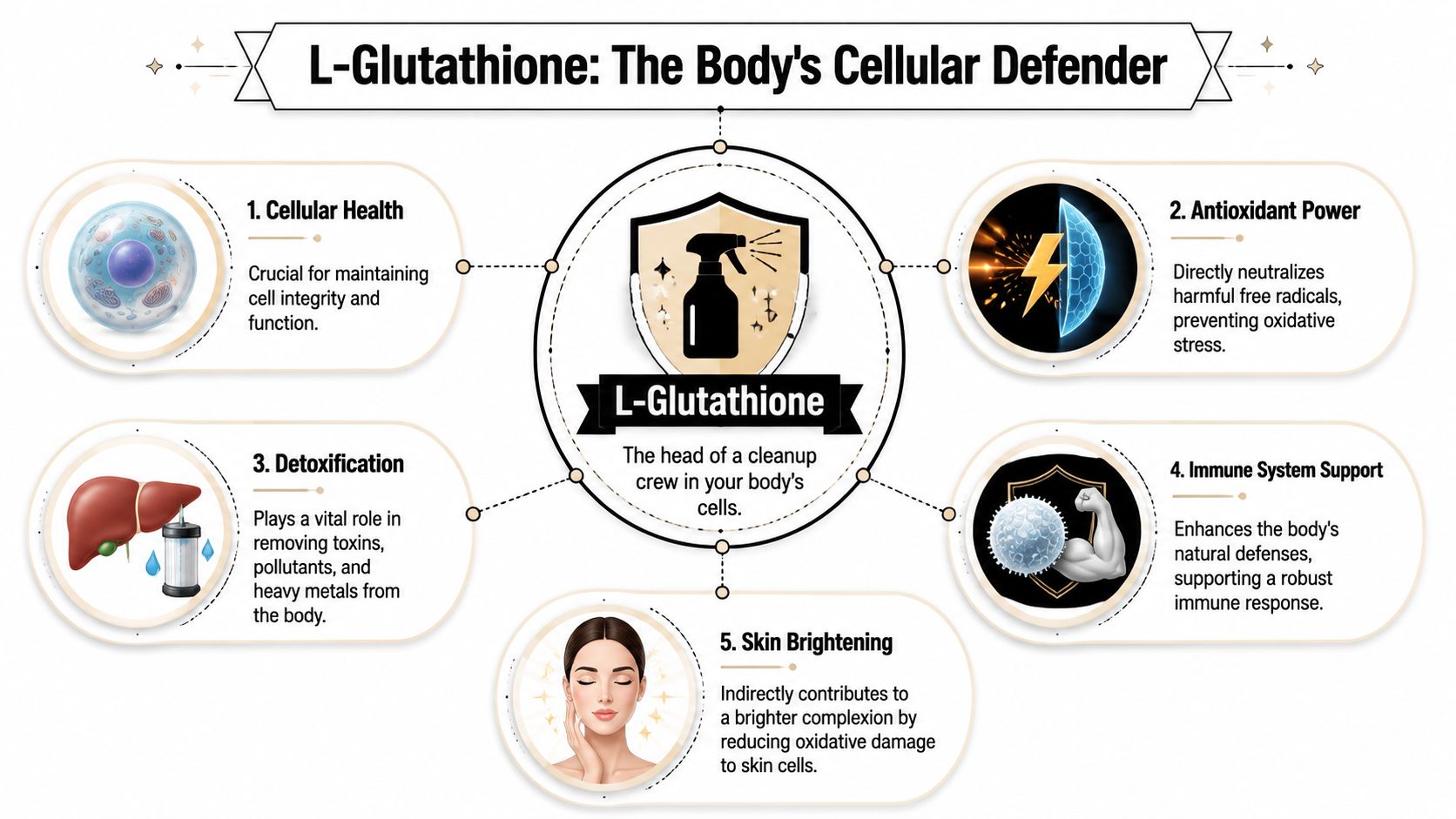
Glutathione is often called the body's master antioxidant, and that label is useful as long as it's not treated like magic. Think of it as the head of a cellular cleanup crew. It helps cells manage oxidative stress, supports detoxification processes, and helps maintain internal balance when tissues are under pressure from pollution, inflammation, illness, or ordinary metabolism.
That native biological role is real. The trouble begins when a legitimate antioxidant function gets stretched into oversized cosmetic promises.
What glutathione does inside the body
In broad clinical and pharmaceutical terms, glutathione participates in several important processes:
- Antioxidant defence: It helps neutralise reactive compounds that can damage cellular structures.
- Detoxification support: It plays a role in liver-associated detox pathways and in handling certain metabolic by-products.
- Redox balance: It helps maintain the chemical environment cells need to function normally.
- Immune support: Healthy glutathione status is tied to stable immune function.
Those functions explain why the ingredient appears across medical, supplement, and aesthetic conversations. They do not automatically prove that injecting it creates superior cosmetic outcomes.
Why it became linked to skin brightening
The cosmetic interest in L-glutathione injection rests mainly on its proposed effect on melanin formation. The common theory is that glutathione may influence pigment pathways, including tyrosinase activity, and may shift pigment production away from darker eumelanin and towards lighter pheomelanin.
That mechanism is biologically plausible enough to attract interest. It is not the same as strong clinical proof.
A plausible mechanism can justify research. It can't replace outcome data.
For Swiss professionals, this distinction matters in patient conversations. Many clients arrive having heard a simplified version: “glutathione blocks pigment, so injections whiten the skin.” That framing is too crude. Skin colour, hyperpigmentation, inflammation, UV exposure, hormonal factors, and barrier status all interact. A single antioxidant, even delivered parenterally, doesn't override that complexity.
What science supports and what it doesn't
There's little controversy around the statement that glutathione is important to cell biology. There is much more controversy around the statement that injectable glutathione is a dependable cosmetic intervention.
A practical way to explain it in clinic is this:
| Biological claim | Professional reading |
|---|---|
| Glutathione is an important endogenous antioxidant | Well accepted |
| Glutathione supports detoxification pathways | Reasonable and established in broad physiological terms |
| Glutathione injection is a reliable skin-lightening treatment | Not established to a standard that justifies casual cosmetic use |
| Injectable delivery must outperform oral or topical routes | Not something current evidence clearly proves |
That difference is where many treatment menus go wrong. They borrow the credibility of glutathione's natural biology, then use it to imply a level of cosmetic certainty that the evidence doesn't support.
Evaluating Clinical Evidence and Efficacy
The strongest way to discuss L-glutathione injection is to separate marketing language from clinical performance. When you do that, the picture becomes much less impressive than patient demand suggests.
In a key trial, intravenous glutathione at 1200 mg twice weekly for six weeks produced temporary skin-lightening in 37.5% of participants, compared with 18.7% in the placebo group, as reported in this systematic review on glutathione as a skin-lightening agent. That is not a useless signal. But it is also not the kind of strong, durable, high-confidence result that supports aggressive cosmetic positioning.
What the trial result actually means
A clinician should read that result with restraint.
First, the effect was temporary. Second, the difference versus placebo shows some activity, but not a broadly reliable one. Third, the treatment schedule was intensive. A patient hearing “IV glutathione works” usually isn't hearing the fuller message, which is that the benefit in published evidence appears limited, inconsistent, and not well standardised.
That matters in consent. If a clinic offers a treatment with uncertain durability, the patient must understand that the best-case marketing narrative is ahead of the evidence.
The evidence gap that clinics should care about
The review also concluded that there is no established superior efficacy of systemic IV delivery over topical or oral routes for skin-lightening. That point is commercially awkward but clinically important. If injection does not clearly outperform safer alternatives, the burden of justification becomes much higher.
Evidence test: If the risk profile rises with the route, the efficacy case has to rise with it too. Here, it doesn't clearly do that.
A Swiss clinic deciding whether to introduce L-glutathione injection should ask four direct questions:
Is the target outcome clearly defined?
“Brightening” is not a medical endpoint. Hyperpigmentation management requires a more specific indication and assessment method.Are results reproducible?
Current cosmetic evidence doesn't show a dependable pattern strong enough for routine menu treatment.Is maintenance understood?
Temporary effects usually create repeat-treatment pressure, which increases both cumulative cost and cumulative exposure.Would the same client be better served by another route?
In many cases, yes. Especially when the cosmetic objective is modest improvement rather than urgent medical intervention.
What works in real consultations
The best phrasing is calm and specific. Don't tell patients the treatment is “amazing” or “worth a try”. Don't tell them it “does nothing” either. Tell them the evidence shows a possible but limited short-term effect in some patients, and that injection is not a shortcut to predictable aesthetic outcomes.
That approach protects both the patient and the clinic. It also filters out the least suitable candidates, namely those expecting dramatic or permanent visible change from a treatment category that hasn't earned that promise.
Understanding the Safety Profile and Risks
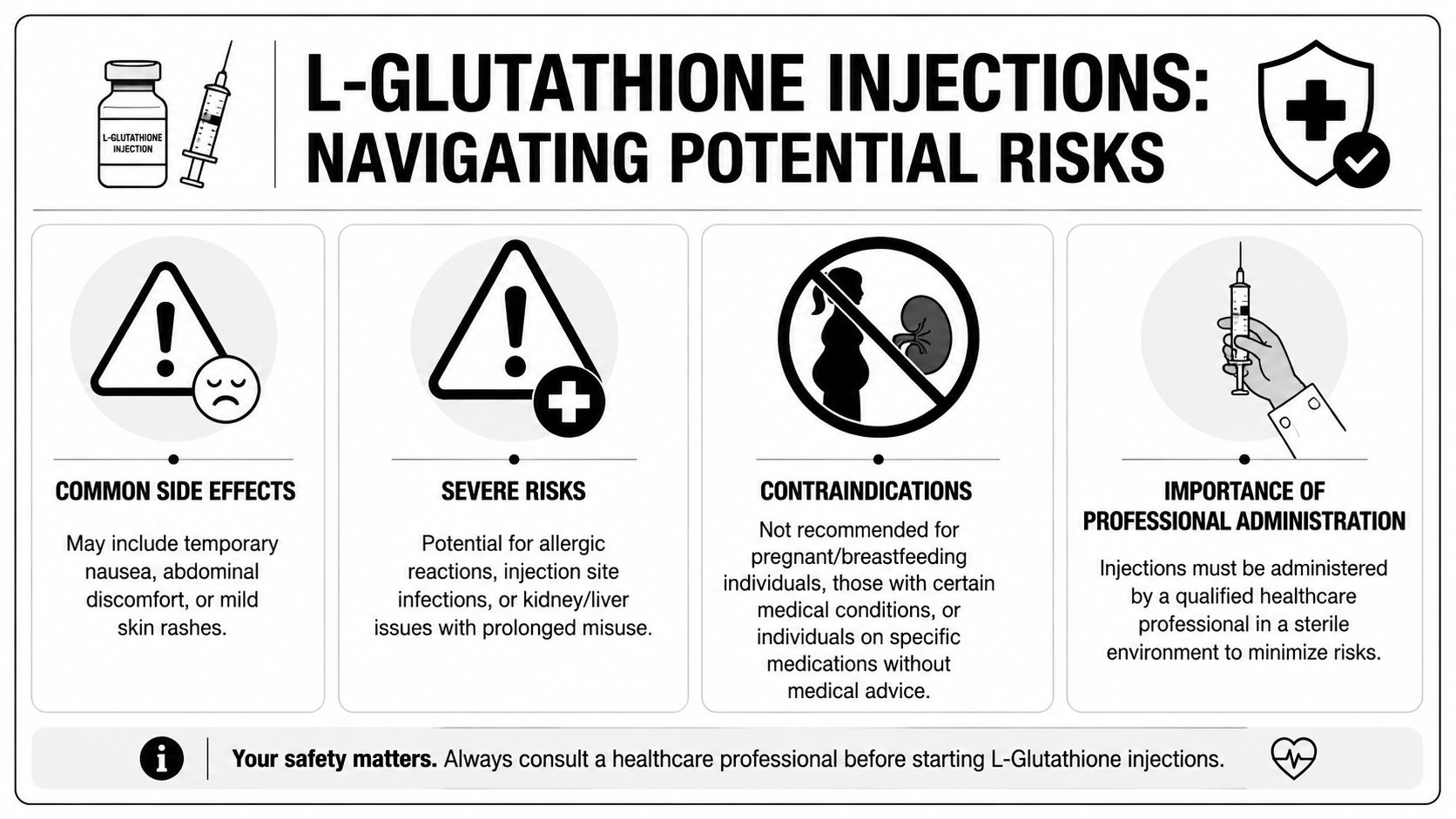
The safety discussion is where casual treatment marketing breaks down. Clinical studies report that 32% of patients receiving IV glutathione experienced adverse events, including liver dysfunction and one case of anaphylaxis, which contributed to regulatory warnings against its use for skin lightening, as noted in the clinical review discussed earlier. For a cosmetic indication, that is a serious signal.
Many clinics underestimate this because glutathione sounds familiar and benign. But route changes risk. Once an ingredient is injected, the tolerance for variability, contamination, and poor candidate selection drops sharply.
The risk profile isn't cosmetic
The reported concerns extend beyond mild discomfort. The broader set of warnings surrounding compounded glutathione products includes kidney dysfunction, liver toxicity, thyroid disturbances, abdominal cramping, and bloating. Even when an event is uncommon, the practical question for a clinic is different: are you set up to recognise it early, document it properly, and manage it safely?
For Swiss operators, that requires more than having a treatment chair and a syringe.
Patients often compare beauty injections to simple vitamin shots. Clinically, that's the wrong comparison. The better comparison is any elective sterile injectable that still requires adverse-event planning.
To keep the administration issues in perspective, it helps to look at how other injectable medicines are discussed from a side-effect standpoint. A patient-friendly example is FindMyScript on Lovenox side effects, which shows how even widely used injections require clear explanation of risks, monitoring, and warning signs. Cosmetic injectables deserve no less discipline.
A short explainer can also help when training non-prescribing staff or front-desk teams on why this treatment needs tighter control:
What a safe clinic process should include
If a clinic proceeds at all, the minimum operational standard should include:
- Medical screening: Review liver history, kidney history, allergy history, current medication use, and the actual indication.
- Emergency readiness: Anaphylaxis planning must exist before the first administration, not after the first scare.
- Informed consent: Patients need direct language about temporary benefit, uncertain long-term cosmetic value, and documented adverse events.
- Post-treatment instructions: Give written warning signs, not verbal reassurance only.
What doesn't work
Several habits increase risk quickly:
- Using “detox” as shorthand: It lowers the patient's risk perception and makes the treatment sound softer than it is.
- Delegating explanation to sales staff: Consent discussions for a controversial injectable can't be reduced to a package script.
- Treating repeat sessions casually: Temporary effect can push clinics into maintenance patterns before the safety justification is strong enough.
- Assuming a clean label means a clean injectable: Sterile quality depends on manufacturing and testing, not branding language.
For aesthetics, this is the central point. A treatment with limited cosmetic evidence and documented serious adverse events should never be normalised just because demand exists.
Navigating Swiss Sourcing and Regulation
For Swiss clinics, the biggest operational risk may not be whether L-glutathione injection works. It may be what exactly is in the vial, who made it, and under what sterile controls.
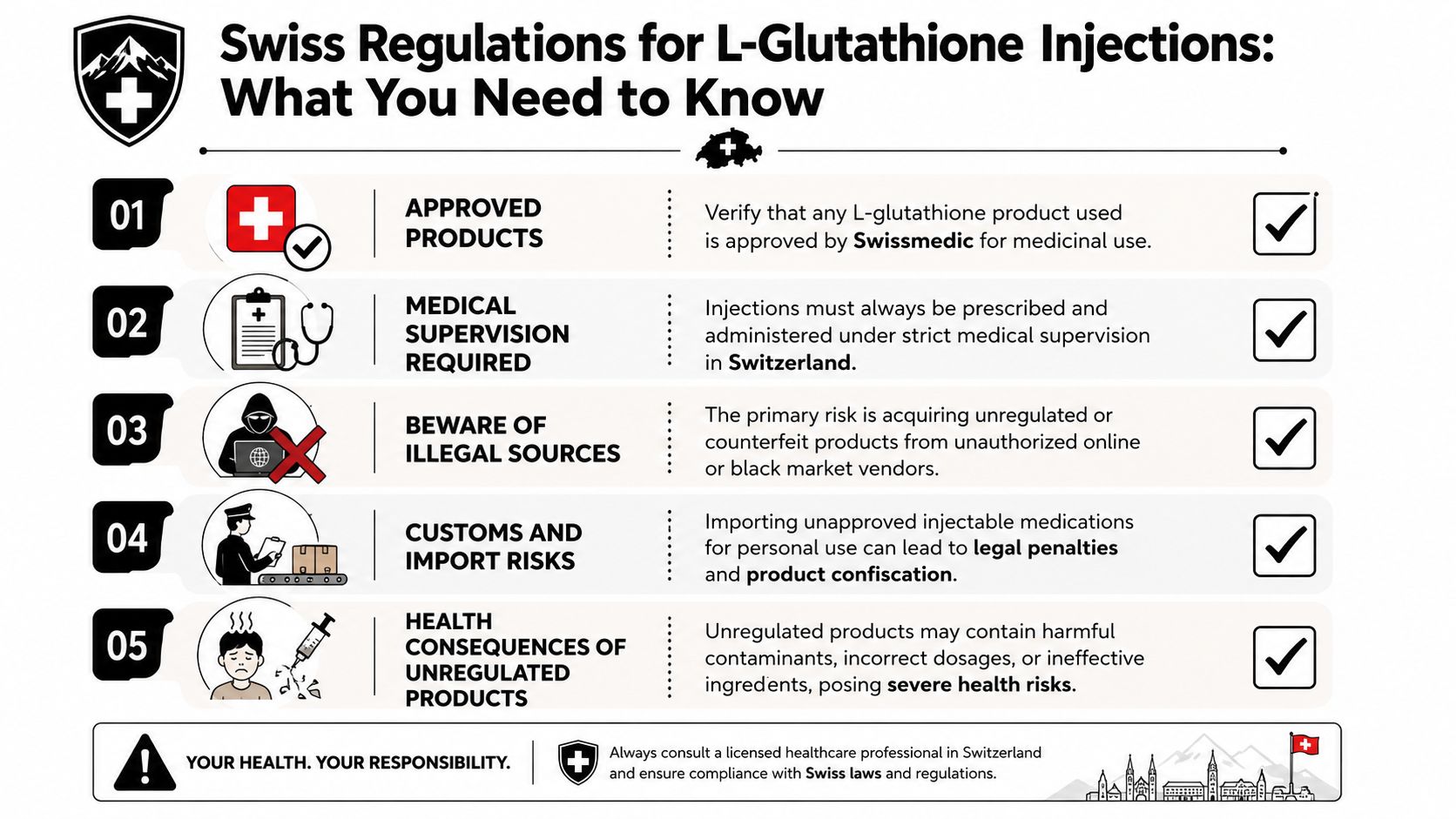
The U.S. FDA reported seven adverse events after compounded injectable glutathione and found excess bacterial endotoxin in every sample tested, with some results reaching five times the appropriate limit for the administered dose, according to this FDA warning on compounded sterile injectable glutathione. For a Swiss buyer, that is the most relevant sourcing warning in the category.
Why endotoxin risk changes the whole discussion
Endotoxin contamination is not a cosmetic defect. In a parenteral product, it can trigger acute inflammatory reactions. That shifts L-glutathione injection out of the “wellness” framing and back into the correct category: a sterile injectable product that demands pharmaceutical-grade controls.
In Switzerland, this matters especially when products are sourced cross-border, through niche distributors, or via compounding channels marketed more aggressively than they are documented. A supplier may present a polished dossier and still fail the standard a clinic actually needs.
Procurement rule: If the supplier can't prove sterility control and batch-level quality, don't buy the injectable. Interest from patients doesn't lower the threshold.
A practical Swiss vetting checklist
Before considering procurement, ask for documents that support legal and quality review. At minimum:
- Product status documentation: What is the product's regulatory basis, intended use, and lawful route into the Swiss market?
- Batch-specific certificate of analysis: Not a generic template. It must be tied to the batch offered.
- Sterility and endotoxin testing records: These should be current, traceable, and understandable to a pharmacist or responsible physician.
- Manufacturing standard evidence: GMP alignment or equivalent documented quality controls for sterile production.
- Cold-chain and handling instructions: If the product requires controlled handling, the chain must be documented from manufacturer to clinic.
- Adverse-event reporting pathway: If something goes wrong, who receives the report and how is the batch quarantined?
What to say no to immediately
Not every red flag requires a committee meeting. Some should end the conversation at once.
| Red flag | Why it matters |
|---|---|
| Supplier uses cosmetic language but avoids technical quality answers | Suggests the product is being sold as a trend rather than controlled as an injectable |
| Documents are generic, incomplete, or not batch-specific | You can't defend traceability later |
| Product origin changes from shipment to shipment | Variable sourcing increases quality uncertainty |
| Seller leans on testimonials instead of release testing | Marketing is replacing pharmaceutical evidence |
| “For professional use only” is the main reassurance | That phrase is not a quality system |
The Swiss legal and business angle
Region-specific public data on cosmetic glutathione injection in Switzerland are sparse. That means clinics can't rely on a mature domestic precedent to judge how aggressive they should be. In a grey zone, conservative practice is usually the better practice.
For most clinics, the safest position is to treat L-glutathione injection as a high-friction service line. It requires legal review, medical oversight, purchasing discipline, and a willingness to walk away from revenue if documentation is weak. That isn't overcautious. It's what good injectable governance looks like.
Comparing Alternatives to Injection
Once the injection route is assessed objectively, many clinics reach the same conclusion. If the patient's goal is antioxidant support or modest skin-focused support, safer routes usually deserve to be discussed first.
That doesn't mean oral or topical glutathione is perfect. It means the risk-benefit profile is often easier to justify.
Glutathione delivery method comparison
| Method | Bioavailability | Efficacy Evidence | Safety Profile | Typical Use Case |
|---|---|---|---|---|
| IV injection | Direct systemic delivery, but route alone doesn't prove superior cosmetic outcome | Limited and inconsistent for cosmetic skin-lightening; temporary effects have been reported in some patients | Highest practical risk because it is an invasive sterile injectable | Narrow medical settings with clinician oversight, not casual cosmetic use |
| Oral glutathione | Variable absorption; often chosen for convenience and lower treatment burden | More suitable where patients want general antioxidant support or gradual skin-health support | Generally preferred over injection in cosmetic contexts because it avoids injection-related risks | Patients seeking lower-risk supplementation |
| Liposomal oral forms | Marketed to improve delivery versus standard oral forms | Evidence is still discussed cautiously in practice, but the route is commercially popular | Lower procedural risk than injection | Retail or clinic-supported supplement programmes |
| Topical glutathione | Local application, dependent on formulation and routine adherence | Better framed as a skincare adjunct than a systemic intervention | Favourable from a safety and operational standpoint | Hyperpigmentation support as part of a broader topical regimen |
What tends to work better in a Swiss clinic
A good professional pathway often looks like this:
- Start with indication clarity: Is the patient asking for “whitening”, post-inflammatory hyperpigmentation support, general anti-ageing, or a wellness drip experience?
- Match the route to the goal: Topicals and oral supplements suit many cosmetic enquiries better than injections.
- Use combination thinking: Barrier repair, pigment management, sun protection, and realistic timelines often outperform a single dramatic-sounding injectable.
- Escalate only when justified: The more invasive the route, the stronger the evidence and supervision should be.
For clinics evaluating broader longevity or cellular-support categories, it also helps to compare how adjacent compounds are discussed in evidence-led professional education. This overview of NMN insights for professionals is useful because it shows a more disciplined way to assess mechanism, claims, and supplement quality before adding a trend-driven product line.
The commercial upside of choosing alternatives
There's a tendency to think the safer option is the less profitable one. That's not always true. Oral and topical programmes can be easier to standardise, easier to explain, easier to stock, and easier to integrate into repeat retail or clinic protocols. They also carry less procedural liability.
In many Swiss settings, that makes them the smarter business choice, not the weaker one.
FAQs for Swiss Trade Partners
What documentation should I request from a supplier before considering L-glutathione injection?
Ask for batch-specific quality documents, sterility data, endotoxin testing, manufacturing-standard evidence, product status documents, and a clear chain of supply. If the file is incomplete or overly commercial in tone, stop there. Injectable procurement should survive pharmacist-level scrutiny, not just a sales presentation.
Can I position it as a cosmetic brightening service if the patient requests it?
You can't rely on patient demand as your compliance framework. Cosmetic positioning increases the need for clear consent because the benefit is uncertain while the route carries real risk. If the service is offered at all, the language must stay factual and medically cautious.
Should Swiss clinics prefer subcutaneous or intravenous use?
The practical issue is not finding a more marketable route. It's whether the product, protocol, and indication are appropriate under proper medical supervision. Route-specific safety and protocol quality matter more than trend language, and current coverage often fails to answer those questions well.
How should front-desk or retail staff handle enquiries?
Use a strict triage script. Staff should never promise skin-lightening outcomes or minimise risk. They should explain that injectable glutathione requires clinician assessment and that safer alternatives may be more appropriate depending on the goal.
The clinic's first response should lower hype, not increase it.
What is the biggest mistake buyers make?
They focus on price and visible branding before verifying sterile quality controls. With L-glutathione injection, the cheapest vial can become the most expensive decision in the practice.
When is it smarter not to offer it at all?
If your team can't verify sourcing, deliver medical oversight, manage adverse-event readiness, and defend the indication in writing, don't add the service. Refusing a risky injectable can be the most professional commercial decision you make.
If you're a Swiss pharmacy, clinic, spa, or beauty retailer looking to grow with lower-risk, premium categories, beautysecrets.agency can help you build a more defensible assortment. Their focus on natural, ethically sourced, compliance-conscious cosmetic and pharmaceutical lines is a far better fit for long-term trust than chasing controversial injectable trends.