
Why do so many Swiss salons talk about natural nails as if it were a colour trend, when clients are often asking for something much bigger: a different service logic, a different product standard, and a different trust signal?
That gap is where the money is. If you treat Gel Nägel Natur as “beige polish with less shine”, you'll compete on taste. If you treat it as a premium category built on subtle aesthetics, disciplined structure, safer-feeling positioning, and transparent sourcing, you'll compete on expertise. That's a much stronger place to be.
Swiss buyers and spa owners should think about this category the way they think about premium skincare. Clients aren't only buying the visible result. They're buying confidence in the formula, confidence in the technician, and confidence that the service respects long-term nail condition.
The Billion-Franc Question What Is a Natural Gel Nail
A natural gel nail isn't one thing. That's the first mistake to fix.
For one client, it means a short, clean, understated finish that doesn't look “done”. For another, it means a gel system that feels more considered, with cleaner positioning, fewer red-flag ingredients, and better transparency from the supplier. If your team doesn't separate those meanings, your menu, retail shelf, and staff scripts will stay fuzzy.
Why this category deserves serious attention
Gel isn't a novelty category. It has history, process, and technical depth behind it. Swiss nail history material points to an early artificial nail precursor in 1934, when “Nu Nails” was developed by a Chicago dentist, while the modern commercial era of artificial nail enhancement is traced to the late 1960s and early 1970s in the US, as noted by Swiss gel nail history guidance.
That matters commercially. Mature categories don't disappear. They evolve.
The natural shift is one of those evolutions. Clients still want durability and polish, but they increasingly want those benefits delivered with restraint. Less visible bulk. Less obvious colour. Less sensory overload. Less confusion about what's in the product.
Practical rule: If your salon defines “natural” only by shade card, you're underserving the actual demand.
The real business question
The profitable question isn't “Should we offer natural gel nails?” You should.
The useful question is this: which version of natural are you selling? A visual result, a formula philosophy, or both? Once you answer that clearly, everything else becomes easier. Procurement, technician training, refill scheduling, removal standards, and premium pricing all become more coherent.
Here's the blunt view. Swiss salons that get this right will look more premium without becoming more complicated. Swiss buyers that get this right will curate more intelligently instead of stocking interchangeable gel systems with vague promises.
The Natural Look Versus The Natural Formula
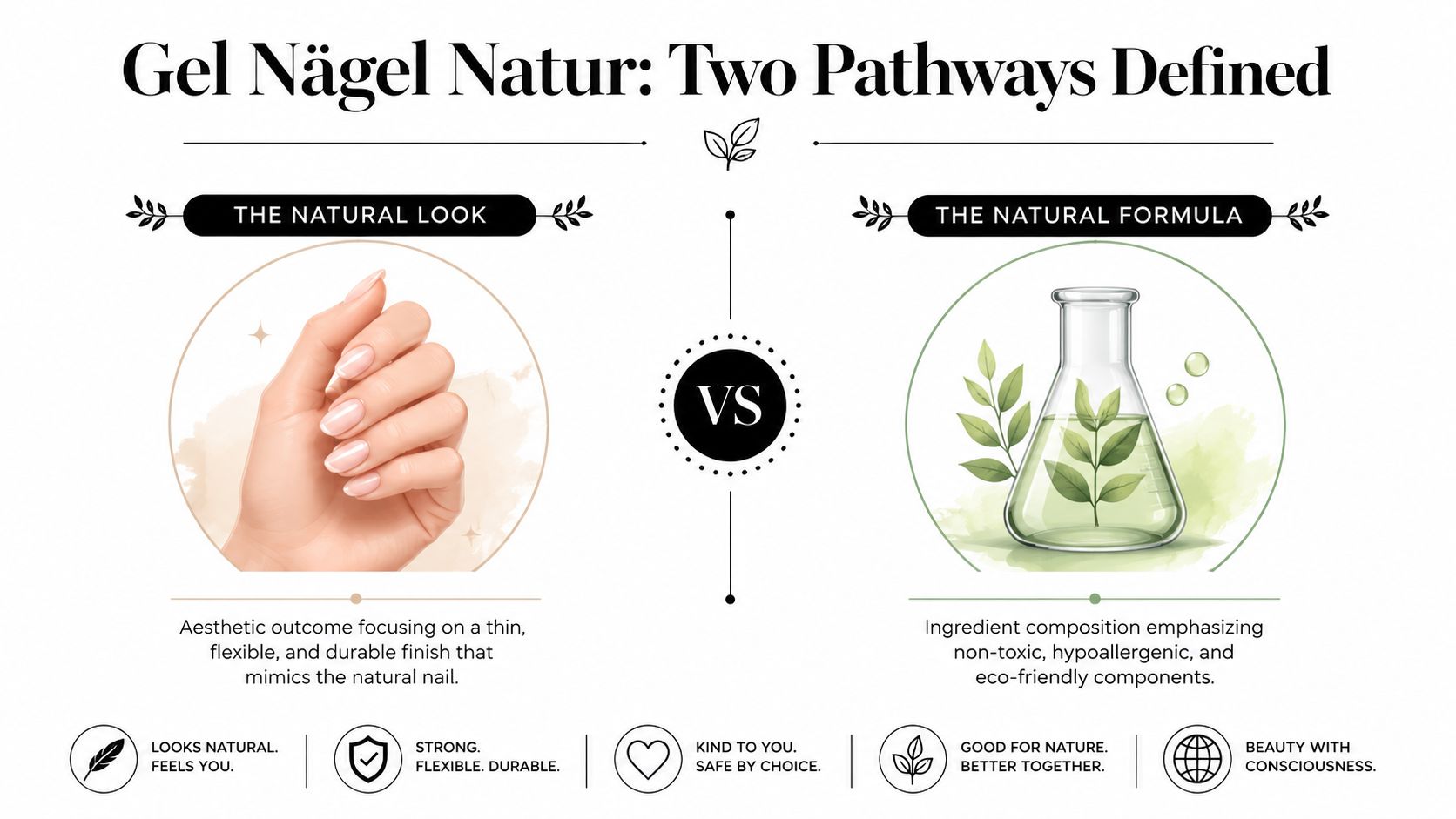
The phrase Gel Nägel Natur contains two different commercial paths. Most businesses blur them together. That's sloppy, and it creates avoidable disappointment.
One path is about what the client sees. The other is about what the client believes they're wearing.
The natural look
This is the aesthetic pathway.
The client wants nails that appear tidy, healthy, and believable. Think sheer pinks, soft nudes, translucent milky finishes, short lengths, and a shape that flatters the existing nail rather than announcing enhancement. The technician's job is to make the work disappear.
That means:
- Thin visual architecture with enough structure to last, but no bulky sidewalls
- Soft colour choices that even out the nail bed instead of masking it
- Controlled shine rather than mirror-like glare
- Balanced shape that suits office wear, daily hand use, and understated luxury
This client may never ask a single ingredient question. She still wants “natural”. She means appearance.
The natural formula
This is the sourcing and trust pathway.
The client may ask whether the gel is HEMA-free, whether the line is vegan, whether the brand tests on animals, or whether the supplier can explain where and how the products are made. Sometimes she asks directly. More often, she reads your menu, scans your retail shelf, and judges whether your business seems transparent.
Here, “natural” doesn't mean strictly raw or plant-only. In gel systems, that would be a misleading promise. It means cleaner positioned, more carefully selected, and easier to defend under scrutiny.
A spa owner should build this around three layers:
| Pathway | Client expectation | Business response |
|---|---|---|
| Natural look | “I want it to look like my nails, only better.” | Train for shape, apex control, tone matching, and subtle finishing |
| Natural formula | “I want products that feel more considered and transparent.” | Set sourcing standards, demand documentation, and market the criteria clearly |
| Both together | “I want understated beauty without compromise.” | Build a premium signature service |
Don't market one and deliver the other
Many businesses lose trust when they advertise natural nails but deliver a bulky overlay in a pale pink. Or when they talk about clean beauty yet can't answer basic supplier questions.
Natural-looking nails and naturally positioned formulas are related, but they are not interchangeable.
A disciplined salon names the distinction in its menu and in staff language. A disciplined retailer does the same in shelf labelling, digital copy, and buyer education. When clients know exactly what “natural” means in your business, they buy with less hesitation.
How to Source Cleaner Gel Systems for Your Spa or Retail Store
If you want to build a credible natural gel category, stop buying on packaging language alone. “Clean”, “gentle”, “professional”, and “salon grade” don't tell you enough. Buyers need a filter, not a vibe.
Build a sourcing checklist that your team can defend
Use a written standard. If it's not written, it won't survive staff turnover, distributor changes, or client questions.
Start with these screening criteria:
Ingredient review
Ask suppliers for full ingredient disclosure and technical documentation. If a brand hides behind marketing copy and won't provide detail, move on.Sensitivity-conscious options
Ask whether the system includes HEMA-free alternatives and whether the supplier can explain where those products fit in the service protocol. Don't present every client as the same.Ethical verification
If a brand claims vegan or cruelty-free positioning, ask for the exact certification basis or recognised programme alignment. Claims without backing belong in the reject pile.Professional compatibility
Confirm that the line includes base, builder, colour, top, and removal support that work coherently together. A “cleaner” hero SKU without a complete usable system creates service inconsistency.Label clarity
Reject products with unclear labelling, missing batch information, or vague importer details. Premium positioning starts with boring administrative competence.
Ask harder supplier questions
Most buyers ask, “What sells?” Better buyers ask, “What can I confidently stand behind in front of a sceptical Swiss client?”
Use questions like these:
- What ingredient disclosures do you provide to professional partners?
- Which formulas are designed for clients seeking more sensitivity-conscious options?
- What independent ethical or compliance standards can you document?
- How do you support salons with application and removal guidance?
- Can you explain the difference between your marketing claims and your technical claims?
That last question is important. A strong supplier can separate the emotional story from the practical product reality. A weak supplier can't.
Curate fewer, better systems
A cluttered gel offering weakens your authority. You don't need endless overlap. You need a core assortment with a reason to exist.
Buyer's view: A tighter range with stronger training support usually performs better than a crowded shelf full of near-identical claims.
For spas, that means selecting one primary professional system and perhaps one secondary option for specific client preferences. For retailers, it means presenting a small, coherent story around ethical positioning, transparency, and intended use, rather than chasing every trend-led launch.
If you can't explain why a product belongs in your assortment, it shouldn't be there.
Mastering the Art of the Natural Look Application
How do you turn a quiet, natural gel manicure into a premium Swiss service that clients rebook without questioning the price?
You stop treating the result as “simple.” Natural-looking gel work is technical, unforgiving, and commercially strong when your team executes it with discipline. Clients notice every thick sidewall, every bulky apex, every shade mismatch. A dramatic set can hide mistakes. A natural set cannot.
Start with structure, not shade
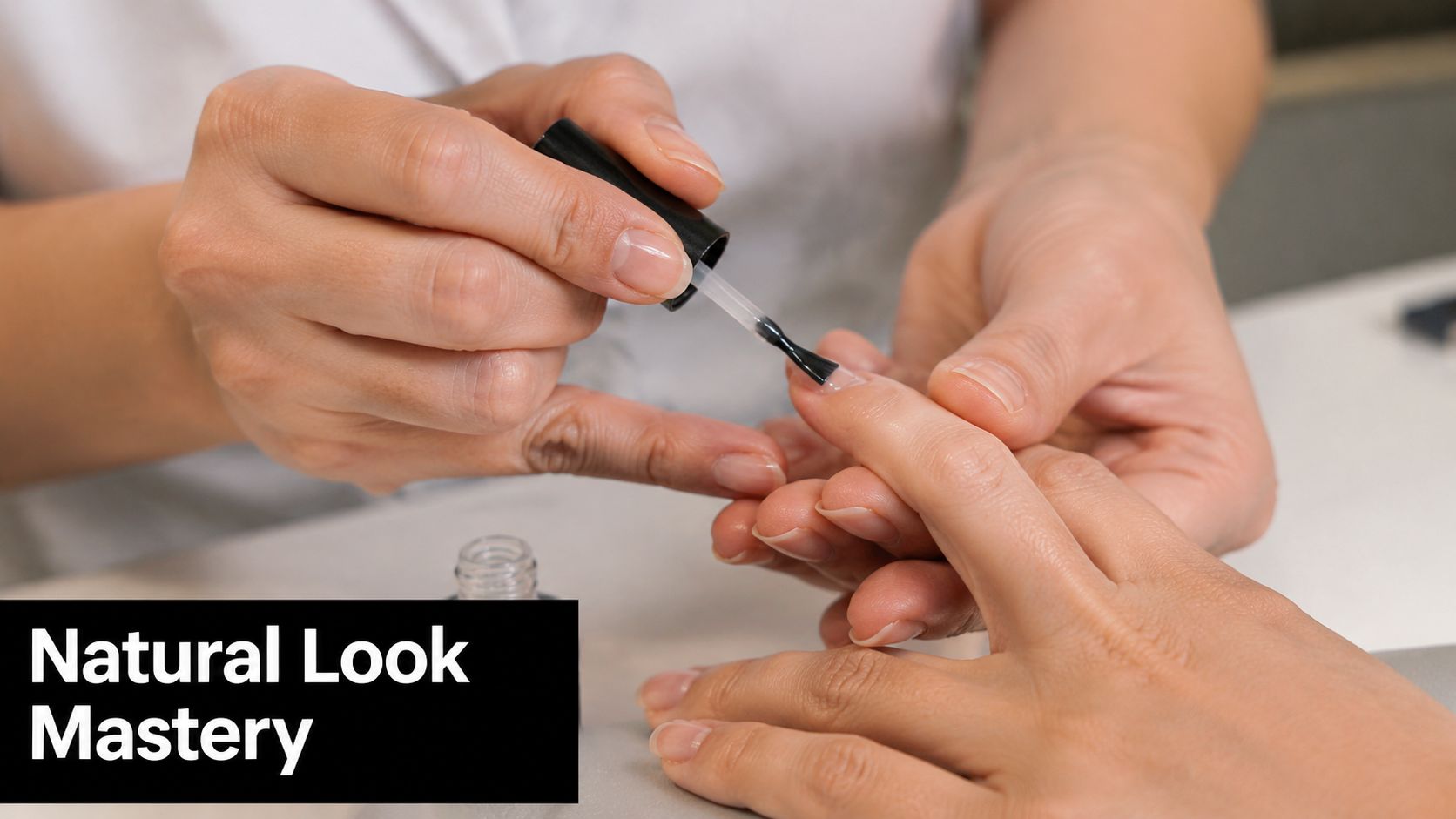
A profitable natural-look service begins with architecture. Shade choice matters, but structure decides whether the manicure looks expensive or amateur.
Gel systems are cured under UV or LED lamps and require controlled placement, shaping, and curing. That alone should shape your service design. Build enough appointment time for precision, because rushed natural work looks cheap fast. If your menu promises a refined Swiss finish, your timing, staff training, and treatment flow must support that promise.
For natural-nail gel services, builder product should create support without visible bulk. The client should see balanced shape, clean reflection, and a believable nail profile. Product volume should disappear into the look.
What technicians must control
Natural results depend on restraint and consistency in a few specific areas:
Cuticle margin
Keep the product line close and tidy. Flooding the cuticle destroys the clean finish and increases lifting risk.Apex placement
A subtle apex still matters. It supports wear and keeps the nail from looking flat or overbuilt.Sidewall slimness
Thick sidewalls make nails look artificial immediately. File for precision, not mass.Free-edge refinement
Short natural nails still need a crisp, intentional tip. Untidy edges lower the perceived value of the whole service.Tone selection
Stock sheer pinks, milky nudes, soft beiges, and neutral cover shades that suit different undertones. One “universal nude” is poor merchandising and weak service planning.
Many Swiss spas miss margin. They buy too few useful shades, then force technicians to improvise. A tighter, better-selected colour family improves consultation quality, service consistency, and retail credibility.
Build the service around maintenance, not a one-off appointment
Natural gel is a structural service. Treat it that way in your booking logic and your client communication.
Technical guidance from Slian on gel technique and refill timing explains that builder gel is applied in controlled layers and maintained through regular refills as nail growth shifts the stress area forward. That matters commercially. Refill appointments protect the result, preserve shape, and create predictable repeat business.
Train your team to explain rebalancing in plain language. The nail grows. The support point moves. If the structure is not restored, wear quality drops and breakage risk rises.
The natural look stays premium only while the structure stays balanced.
A useful visual reference can help technicians standardise what “subtle but structured” should look like in real service work.
Short, downward-growing, and inward-curving nails need a different plan
High-value natural services come from problem-solving, not from repeating the same application on every hand.
Guidance from this nail-shape tutorial on difficult natural nails shows why square shapes are harder to maintain on nails that grow downward or curve inward, and why careful support at the free edge plus considered filing can reduce lifting problems. For Swiss salons, these clients are commercially important. They want discreet, durable nails for work, travel, and daily life. They are not asking for spectacle. They are asking for reliability.
Use a different service plan for them:
| Nail condition | Better natural-look strategy |
|---|---|
| Very short nails | Focus on reinforcement, symmetry, and a clean free edge instead of chasing visible length |
| Downward-growing nails | Correct the visual line carefully and build support where the nail needs it most |
| Inward-curving nails | File underneath with control and avoid shapes that exaggerate the curve |
Premium positioning gains credibility. If your technicians can produce discreet, durable, flattering results on difficult natural nails, price resistance drops. The work justifies the service.
Professional Aftercare and Safe Removal Protocols
A premium natural gel service doesn't end when the client leaves. If you don't own aftercare and removal, you don't own the result.
Too many salons still act as if removal is a low-value interruption between profitable appointments. That thinking is wrong. Removal is where clients decide whether your business protects their nails or merely monetises them.
Aftercare should be taught, not assumed
Clients need simple, repeatable instructions. Keep the message narrow and memorable. Daily cuticle oil, sensible hand protection for harsh cleaning tasks, and no picking or peeling. These instructions suffice for effective care.
The business benefit is straightforward. When clients understand how to preserve the finish, they come back with better retention, fewer emergency repairs, and more trust in your professional judgement. That trust supports rebooking and retail recommendations.
Sell the maintenance mindset, not just the manicure.
Removal is part of your brand
If your salon promises nail health but removes product aggressively, your positioning collapses.
For a natural-looking gel service, the gold standard is a controlled professional removal approach that protects the natural nail plate. In practice, that means reducing bulk carefully, preserving control over how much product remains, and avoiding the kind of rough peel-off behaviour that clients often attempt at home.
Use this operational standard:
Book removal as a real service
Don't squeeze it into leftover minutes. It deserves technician attention.Keep a thin safety layer if appropriate
The aim is control, not bravado. Over-filing to prove thoroughness is bad technique.Re-assess before reapplication
Check the plate, sidewalls, and client habits before placing fresh product.Document problem patterns
If one client repeatedly arrives with lifting or trauma, note it and adjust service planning.
Turn aftercare into retention
Natural gel clients often value long-term appearance over instant drama. That makes them ideal repeat clients if you educate properly.
Give staff a script they can say naturally: your nails will look better at the next appointment if you oil the cuticles, avoid peeling, and return for professional maintenance instead of trying to “save time” at home. That message doesn't sound glamorous, but it builds stable revenue and a healthier service reputation.
Marketing and Pricing Natural Gel Services in Switzerland
How do you turn a restrained, natural-looking gel service into a premium line item instead of a low-margin add-on?
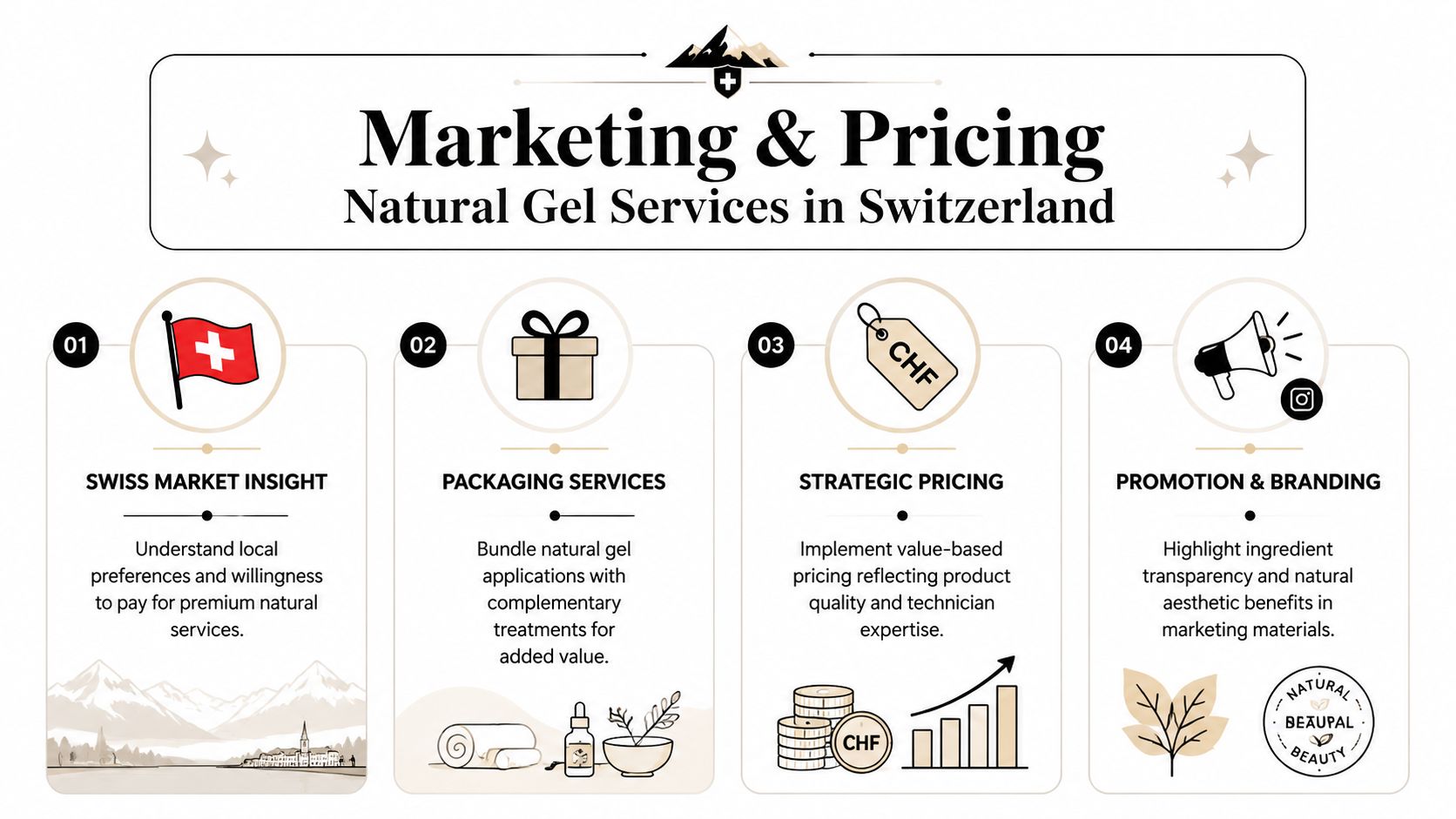
Start by pricing it as skilled technical work. Swiss clients do not pay more only for length, colour, or visible complexity. They pay for precision, credibility, comfort, and a result that fits their lifestyle. A clean natural finish often takes more judgement than a decorative set because every detail stays visible. Shape errors show. Bulk shows. Poor consultation shows.
Price by positioning, not by how quiet the result looks
Do not let “natural” push your service into the budget tier of your menu.
For Swiss spas and nail bars, the smarter model is a three-level structure. Keep the entry service narrow. Make the premium tier clearly different. Protect margin by attaching price to consultation quality, formula choice, finishing standard, and maintenance planning.
A practical menu structure looks like this:
Core natural gel service
For existing clients who want a tidy, understated finish and predictable maintenancePremium natural structure service
Includes more consultation, stricter shape correction, cleaner finishing, and an ingredient-conscious product choiceNatural gel maintenance membership or series
Built for repeat clients who book on schedule and want consistent upkeep with less price resistance over time
That model fits the Swiss market better than one flat “natural gel” line. It also gives your team a clear reason to recommend an upgrade without sounding pushy.
Rename the service so the value is obvious
“Natural gel refill” sounds routine. Routine services get compared on price.
Use names that signal outcome, discipline, and client type. Good examples include:
- Natural Structure Gel Manicure
- Sheer Builder Gel Service
- Clean Finish Overlay
- Executive Natural Nail Service
- Swiss Minimal Gel Manicure
Each name tells the client what kind of experience to expect. That matters in a market where many buyers are careful, ingredient-aware, and willing to pay for discretion over trend-driven nail art.
Write menu copy that sells trust
Weak menu copy sounds cosmetic. Strong menu copy sounds considered.
Use service descriptions that explain why your offer costs more and who it is for:
| Menu element | Weak version | Strong version |
|---|---|---|
| Service description | Natural gel nails | Sheer builder gel manicure with refined structure, slim sidewalls, and a polished natural finish |
| Formula message | Better ingredients | Ingredient-conscious gel options selected for clients who value clear product positioning |
| Client fit | For everyone | Suited to professionals, spa guests, and repeat maintenance clients who want discreet, well-groomed nails |
| Pricing logic | Slightly more than gel polish | Priced as a technical manicure with consultation, structure work, and higher finishing standards |
Many Swiss salons lose money by performing a premium service and then describing it like a commodity.
Market the service to the right Swiss client
A natural gel offer should attract office professionals, healthcare-adjacent workers, luxury spa clients, brides, and mature clients who want polish without visual noise. Market to those groups directly.
Your messages should focus on:
- polished nails that still look credible in professional settings
- clean, understated results suited to short and medium lengths
- careful product selection for clients who ask harder questions about formulas
- scheduled upkeep that protects appearance and reduces last-minute repairs
Do not market this category like a fashion trend. Market it as modern grooming with high standards.
Train staff to sell clarity, not charm
Reception and treatment room language drives conversion. If the team cannot explain why one natural gel service costs more than another, clients default to the cheaper option.
Give staff a short script they can use:
- This service is for clients who want a natural finish with better structure and less visible bulk.
- The higher price reflects consultation time, shaping accuracy, and a more refined finish.
- We also offer ingredient-conscious formula options for clients who prioritise transparency.
- Regular maintenance keeps the result cleaner and more cost-effective than irregular repair bookings.
That script works because it is specific. It reduces uncertainty, supports premium pricing, and helps your business stand apart from salons selling “natural” as a vague aesthetic label.
Conclusion Build Your Business on Quality and Transparency
The Swiss opportunity in Gel Nägel Natur isn't about copying a visual trend from social media. It's about building a sharper business model around what discerning clients already want: restraint, credibility, and care.
Salons that win in this category won't be the ones with the biggest colour wall. They'll be the ones that define natural clearly, source more intelligently, execute more precisely, and protect the client relationship after the appointment. Retailers that win will do the same on the shelf. Fewer empty claims. Better curation. Better answers.
That's the true upgrade. Not “more natural” as a slogan. More transparent as an operating standard.
If I were advising a Swiss spa owner today, I'd keep the strategy simple. Tighten your product criteria. Audit your menu language. Retrain your team on structure and refill logic. Treat removal as part of premium care. Then present the category with confidence.
Clients don't need another beige manicure. They need a business that knows what it's doing.
If you want a Swiss distribution partner that understands premium beauty, ethical sourcing, and transparent brand curation, explore beautysecrets.agency. It's a strong starting point for spas, retailers, pharmacies, and e-commerce buyers who want to build a more credible clean-beauty assortment.