
Your face feels tight after cleansing. The moisturiser you've used for years suddenly stings. Red patches show up around the nose and cheeks, and every new product seems to make things worse instead of better. For many people, that's the moment they realise they're not dealing with “just dry skin”. They're dealing with a damaged skin barrier.
In Switzerland, that problem has extra layers. High-altitude UV, cold wind, heated indoor air, and sharp temperature swings can push already-stressed skin into a cycle of irritation and slow recovery. Consumers feel the discomfort. Retail professionals hear the same complaints every day: “Everything burns”, “My skin won't calm down”, “I need something gentle, but effective”.
The good news is that barrier damage is usually understandable, and often manageable, once you know what's gone wrong.
Understanding Your Skin Barrier's Structure
Your skin barrier sits in the outermost part of the epidermis, called the stratum corneum. The easiest way to understand it is the classic brick-and-mortar model.
The bricks are flattened skin cells called corneocytes. They provide structure. The mortar is a blend of ceramides, cholesterol, and fatty acids that fills the spaces between those cells and keeps the wall sealed. When both parts are intact, skin stays comfortable, flexible, and far less reactive.
What this barrier actually does
The skin barrier has two main jobs.
- Keeps water in so skin stays supple instead of dry and brittle.
- Keeps irritants out such as pollutants, allergens, and microbes that can trigger inflammation.
When people hear the term transepidermal water loss, or TEWL, they often assume it means sweating. It doesn't. TEWL is the passive escape of water through the skin. Some water loss is normal. Too much means the wall is leaking.
A healthy barrier also depends on a slightly acidic surface, often called the acid mantle. That acidity matters because skin enzymes work best within that range. Those enzymes help organise lipids and support repair.
What changes when the barrier is damaged
According to Swiss dermatology guidelines from the Société Suisse de Dermatologie et Vénéréologie), a damaged barrier is scientifically marked by more than a 40% increase in TEWL, a 15 to 25% drop in ceramides, and a pH shift from a healthy 4.7 to 5.5 up to 6.0 to 7.0. Once that shift happens, the skin becomes worse at making the very lipids it needs to repair itself.
That's where many readers get confused. They think dry skin should be “scrubbed smooth” or treated with stronger actives. In reality, when the mortar is depleted, stronger treatment often creates more gaps in the wall.
Practical rule: If skin feels both dry and unusually reactive at the same time, think barrier weakness before you think exfoliation.
A useful way to picture it is this: hydration is the water inside the house, but the skin barrier is the roof and walls. If the roof is damaged, pouring in more water doesn't solve the structural problem. You need to repair the seal.
Key Symptoms of a Damaged Skin Barrier
A damaged skin barrier often announces itself through sensation before appearance. Skin may feel tight after washing, hot after applying a serum, or rough even when it looks shiny. People often describe it as “my skin suddenly hates everything”.
That reaction has a clinical basis. In Switzerland, 22% of all dermatology consultations are attributed to symptoms of a damaged skin barrier, and patients show reduced skin hydration plus a 40% increase in TEWL compared with the national average, according to the 2022 meta-analysis in the Journal of the European Academy of Dermatology.
Signs people notice first
The most common signs are familiar, but they often appear together:
- Persistent tightness after cleansing, even with products that used to feel mild
- Stinging or burning when applying moisturiser, sunscreen, or active treatments
- Flaking or rough texture that doesn't improve with simple hydration
- Redness that lingers rather than fading quickly
- New sensitivity to fragrance, acids, or even plain water
- A shiny but dehydrated look, especially on the forehead or cheeks
One of the most misleading symptoms is breakouts. A compromised barrier can coexist with spots, clogged pores, and inflammation. That doesn't always mean acne treatment should be intensified. Sometimes the opposite is true.
Damaged barrier or chronic skin condition
It's a common point of confusion for readers. A damaged barrier can look similar to eczema, rosacea, or irritant dermatitis, but they aren't the same thing.
A barrier problem is often linked to a recent trigger, such as over-exfoliation, harsh cleansing, cold weather, or too many active products introduced at once. Eczema and rosacea are broader inflammatory conditions that may involve barrier weakness, but they usually need a more personalized management plan.
A simple comparison helps:
| Feature | Damaged skin barrier | Chronic condition such as eczema or rosacea |
|---|---|---|
| Typical onset | Often after a trigger or routine change | Often recurrent or long-standing |
| Product reaction | Sudden stinging from previously tolerated products | Can be persistent even with careful routines |
| Recovery pattern | May improve with simplification and repair care | May need medical assessment and ongoing management |
If symptoms are severe, widespread, or keep returning despite a gentle routine, a pharmacist or dermatologist should assess whether barrier damage is the whole story.
Retail professionals can help by listening for trigger language. If a customer says, “It started after I used acids every night,” barrier damage is a reasonable first thought. If they say, “I've had this pattern for years and it flares unpredictably,” it may be more than a routine problem.
Common Causes and Triggers of Barrier Damage
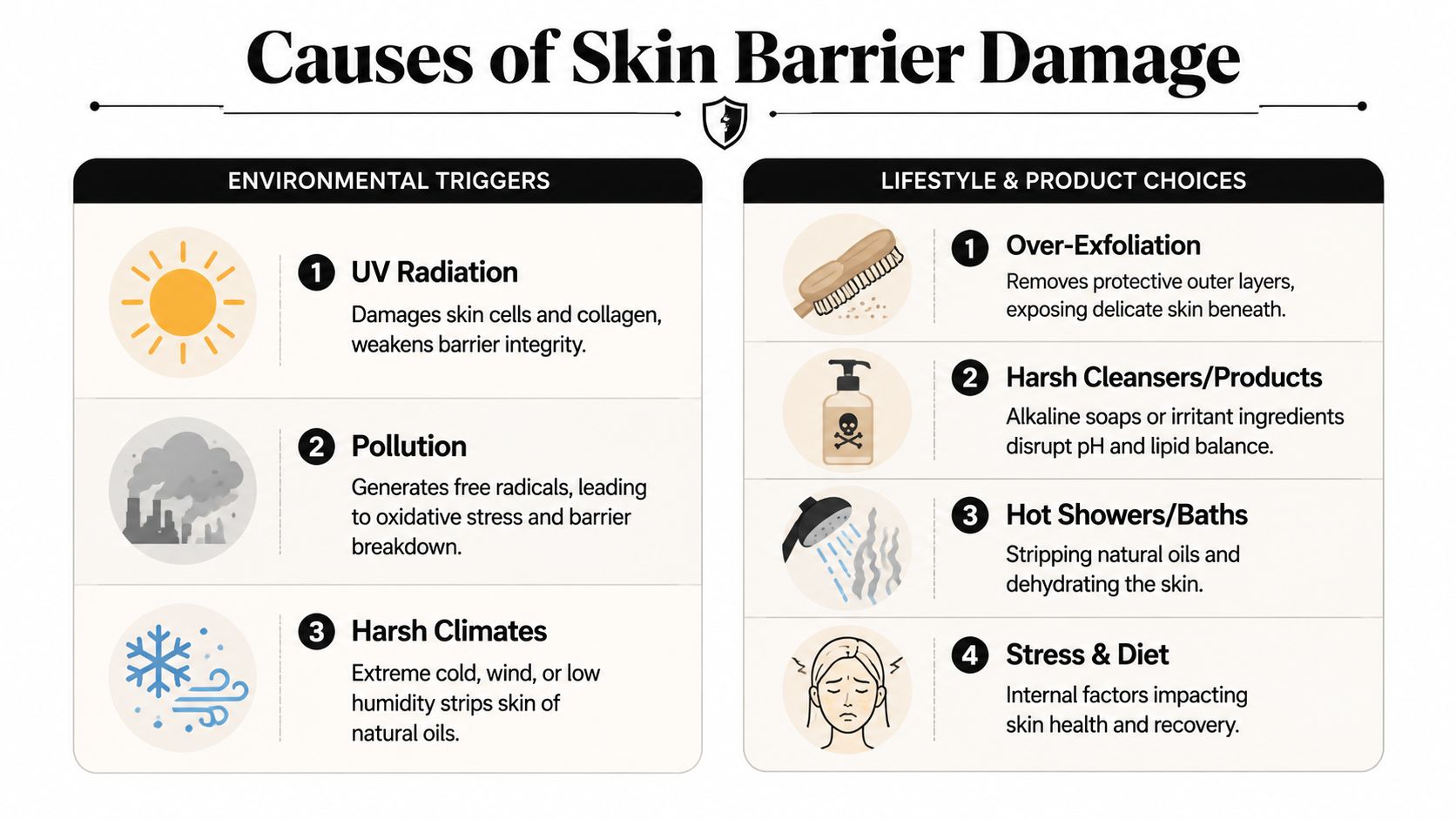
Some causes come from products. Others come from climate, lifestyle, and daily habits that seem harmless until they add up. In Swiss conditions, those triggers often overlap.
The biggest pattern I see is not one dramatic mistake. It's several small ones stacked together: a foaming cleanser, an acid toner, winter heating, mountain sun, and poor sleep during a stressful week. Skin doesn't need a major insult to lose resilience. It only needs repeated disruption.
Product mistakes that strip the barrier
The most common self-inflicted triggers are easy to recognise once you know them:
- Over-exfoliation with scrubs, strong acids, or too-frequent resurfacing
- High-pH cleansers that remove the lipids needed to keep the barrier sealed
- Too many actives at once, especially when retinoids, vitamin C, and exfoliants are layered without recovery time
- Fragranced or alcohol-heavy formulas used on already irritated skin
This is why “more skincare” can backfire. A routine with six products can be much harsher than a routine with two, even if each product is marketed as gentle.
The Swiss climate paradox
Switzerland adds a very specific challenge. MeteoSwiss and the Swiss Academy of Dermatology report that 78% of Swiss urban residents notice worse dryness during winter, while chronic stress can raise cortisol by 20 to 30% and reduce ceramide synthesis by up to 35%. In alpine regions, UV intensity is 1.5 times higher. This combination is what makes the Swiss climate paradox so important: strong sun outside, dry heated air inside, and constant temperature shifts in between, as documented by MeteoSwiss and the Swiss Academy of Dermatology.
That matters because skin has to adapt repeatedly in the same day. You leave a cold street, enter overheated transport, go back outdoors, then sit in a dry office. Each shift increases the demand on the barrier.
The Swiss climate paradox isn't just about winter dryness. It's about repeated stress from UV, low indoor humidity, and abrupt environmental change.
Lifestyle triggers people underestimate
A few non-product factors regularly make barrier repair slower:
- Hot water during showers or cleansing
- Rubbing skin dry with a towel instead of patting
- Poor sleep during periods of stress
- Unprotected sun exposure, especially during outdoor sport or travel to altitude
For retailers and clinic staff, the practical question is simple: what happened before the irritation started? Asking about ski weekends, city heating, a new exfoliant, or a rushed skincare overhaul often reveals the answer faster than a product label does.
An Evidence-Based Plan to Repair Your Skin Barrier
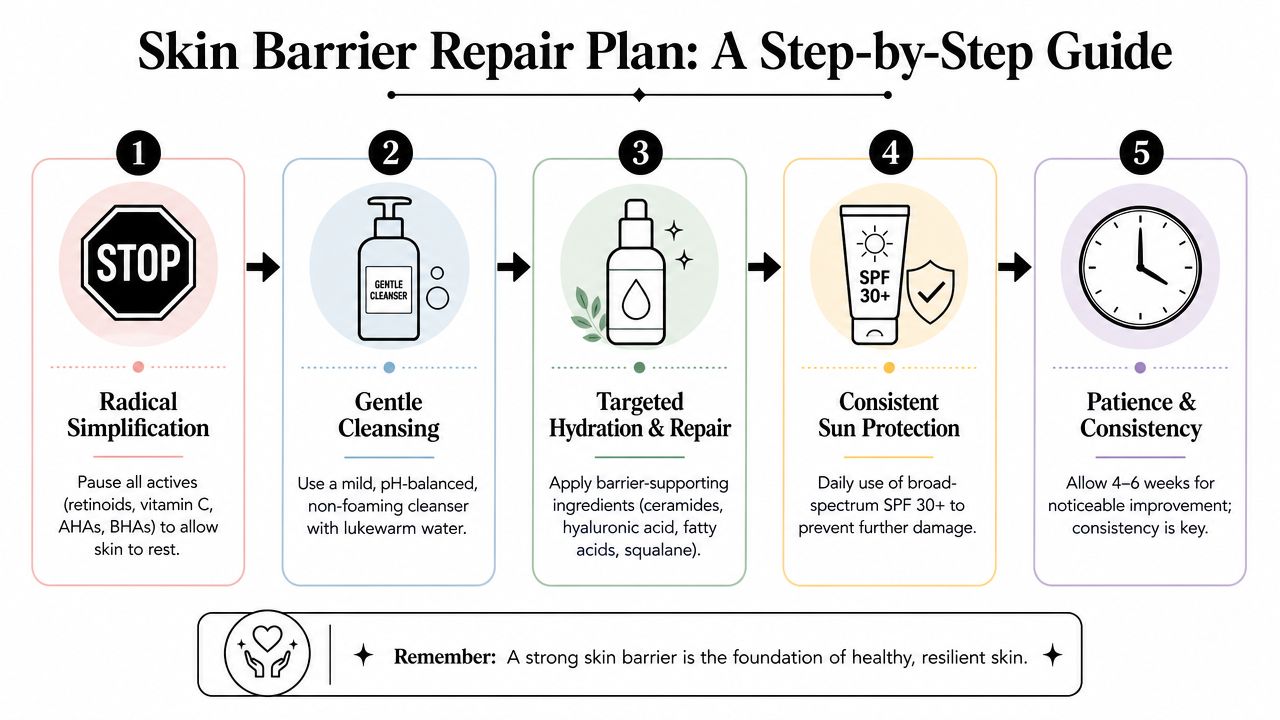
When the barrier is impaired, the first move isn't to search for a stronger treatment. It's to remove friction. Skin heals better when you stop challenging it.
That's why the most effective repair plans are usually the least exciting. They rely on fewer steps, calmer formulas, and consistency over novelty.
Step one is radical simplification
Start by pausing the products most likely to keep skin inflamed:
- Retinoids
- AHAs and BHAs
- Strong vitamin C serums
- Scrubs and cleansing brushes
- Any product that stings on contact
A landmark Swiss study found that 45% of patients with a compromised barrier only improved after following a strict minimalist routine for at least 12 weeks, and 76% needed daily moisturisers containing ceramides and cholesterol to restore function, according to the 2019 Swiss Society of Dermatology and Venerology study.
That timeline matters. Many people give up after a week because the skin isn't “fixed”. Barrier repair is often slower than irritation onset.
What a repair routine should include
A practical reset routine usually has only three essentials:
- A gentle cleanser that doesn't leave the face squeaky or tight
- A barrier-supportive moisturiser used consistently
- Daily sun protection so new damage doesn't outpace repair
Later in the process, if skin is calm and no longer reactive, you can reassess whether additional products are even necessary.
Here's a simple ingredient guide for product selection.
| DO: Prioritise These | DON'T: Avoid These |
|---|---|
| Ceramides for lipid replenishment | Fragrance on irritated skin |
| Cholesterol to support barrier structure | Essential oils if skin is stinging or red |
| Fatty acids for flexibility and seal | Drying alcohols in leave-on care |
| Glycerin for water binding | Harsh sulfates in cleansers |
| Hyaluronic acid for hydration support | Abrasive exfoliants during recovery |
| Niacinamide in a moderate barrier-supportive formula | Too many actives at once |
How to use those products well
Technique matters almost as much as formula.
- Cleanse with lukewarm water, not hot water.
- Apply moisturiser to slightly damp skin so humectants can hold onto available water.
- Use enough product to create comfort, not just a thin cosmetic layer.
- Protect every morning, especially in high-UV environments and during winter sports.
If you want a consumer-friendly companion resource that aligns with this minimalist approach, Mesoderm RX's guide to healthy skin is a useful practical read.
A short visual walkthrough can help if your routine feels overwhelming at first.
Recovery is about consistency, not speed
People often ask whether they should switch products repeatedly until they find “the one”. Usually, no. Constant product hopping gives skin a moving target.
Clinical mindset: During repair, success looks boring. Less redness. Less sting. Fewer bad days in a row.
A simple routine followed consistently is usually more effective than a complex routine used inconsistently. If a moisturiser is gentle, non-irritating, and supports the lipid barrier, the key is regular use long enough for the skin to respond.
Guiding Customers on Natural Barrier Support
Swiss consumers often want two things at once. They want products that feel natural and ethically sourced, and they want proof that those products can perform. Retailers, pharmacies, and spa teams need language that respects both priorities.
That starts with reframing “natural” correctly. Natural barrier support shouldn't mean vague botanical storytelling or heavily fragranced creams sold as gentle because they sound wholesome. It should mean formulations chosen for tolerance, barrier compatibility, and traceable sourcing.
How to explain natural barrier support clearly
When advising a customer, the strongest message is usually simple:
- Focus on function first. Ask whether the formula supports hydration, comfort, and lipid repair.
- Look for low-irritation design. Fragrance-free or very restrained formulas are often the safer recommendation for reactive skin.
- Match the product to Swiss conditions. A light gel may feel elegant in summer but may not be enough for winter heating and alpine exposure.
- Talk about ingredient purpose. Customers trust advice more when they hear what an ingredient is doing, not just that it's “clean”.
This helps retail teams move beyond trends and into professional guidance. “This supports a stressed barrier” is more useful than “This is a lovely natural cream”.
The case for marine collagen in Swiss retail
Marine-derived formulations are one of the more interesting premium options in this category, especially when a brand can show responsible sourcing and a credible formulation philosophy. Swiss-specific data adds a meaningful point here.
A 2025 Swiss Dermatology Association study found that 65% of patients with chronic barrier damage in Geneva and Zurich experienced 30% faster recovery with marine collagen-based formulations than with synthetic alternatives, as reported in the Swiss Dermatology Association study on marine collagen and barrier recovery.
For retail professionals, that matters because it supports a premium recommendation with a clinical rationale. Marine collagen isn't just a luxury story in this context. It can be positioned as a recovery-support ingredient for skin dealing with environmental stress, especially in high-altitude settings.
Customers usually understand premium pricing better when you connect it to recovery needs, ecological sourcing, and a clear use case.
A useful way to frame it at shelf level is:
| Customer concern | Helpful retail language |
|---|---|
| “My skin is dry and reactive all winter.” | “You may need a formula that supports the barrier, not just a light hydrator.” |
| “I want something natural but effective.” | “Look for ethically sourced ingredients with a clear barrier-support role.” |
| “Why choose marine-based care?” | “Marine ingredients can offer a strong support story for environmentally stressed skin, especially in Swiss conditions.” |
Some shoppers also ask about broader wellness ingredients and inflammation support. For a general educational overview, Hemp Well Ireland CBD insights can add context to that conversation, especially when customers are exploring how topical care fits into a wider skin-health picture.
Maintaining a Healthy Barrier for the Long Term
Once skin has settled, the next risk is relapse. Many people feel better, then return straight to frequent acids, daily retinoids, or aggressive cleansing. The barrier rarely likes that.
The smarter approach is controlled reintroduction. Add one active at a time. Keep the rest of the routine stable. Watch the skin for several days before deciding whether it's coping well.
A safer way to bring actives back
Use a slow sequence instead of a full routine reset overnight.
- Start with one product, not three. If you want to retry a vitamin C serum or a retinoid, choose only one.
- Use it less often at first. Recovery nights should still outnumber active nights.
- Buffer with moisturiser if the formula tends to feel strong.
- Stop at the first clear sign of renewed irritation rather than trying to “push through”.
Many people benefit from a simple rhythm: active night, recovery night, recovery night. That kind of spacing often protects the progress you've made.
Daily habits that protect the barrier
Maintenance isn't glamorous, but it works.
- Keep cleansing gentle and avoid the squeaky-clean feeling
- Use moisturiser consistently, not only when skin feels dry
- Wear sun protection every day, especially in alpine or reflective environments
- Adjust texture seasonally, with richer support during winter and drier indoor months
One rule matters more than most. If the skin starts to sting, tighten, or flush again, treat that as early feedback. Don't wait for full irritation before pulling back.
A healthy barrier is less about having the most advanced routine and more about knowing when your skin needs less.
Frequently Asked Questions and Troubleshooting
My skin is breaking out since I simplified my routine. Is that normal
Sometimes. A richer moisturiser can feel unfamiliar, and inflamed skin can show congestion while it settles. But painful, itchy, or rapidly worsening spots may mean a product doesn't suit you. Look at the pattern, not just the presence of blemishes.
When can I use vitamin C again
Wait until skin feels calm, no longer stings with basic products, and stays comfortable for a sustained period. Reintroduce one active at a time, slowly. If vitamin C causes immediate burning, your barrier likely isn't ready.
Can I over-moisturise a damaged skin barrier
You can use products that are too heavy for your comfort, but the bigger issue is usually poor product fit, not “too much healing”. The goal is balance: enough humectants, enough lipids, and enough protection to reduce water loss without making skin feel smothered.
Does diet affect the skin barrier
Diet isn't a quick topical fix, but overall nutrition can influence how well skin maintains itself. If someone has very dry, reactive skin, broader lifestyle factors may be part of the picture alongside skincare.
What if every product stings
Strip back further. Sometimes even a long ingredient list in a “sensitive skin” cream is too much during an acute flare. If even a minimal routine remains uncomfortable, seek professional advice to rule out an underlying skin condition.
How do I know if I'm improving
Look for smaller signs first: less tightness after washing, less redness by evening, and fewer products that trigger sting. Early progress often feels subtle before it looks dramatic.
If you're a Swiss retailer, pharmacy, spa, or clinic looking for natural, ethically sourced skincare lines that meet modern barrier-care expectations, beautysecrets.agency can help you build a stronger assortment with certified, high-performance brands suited for the Swiss market.