Most advice about Kojic acid soap is commercially convenient and operationally useless. It treats the product as a generic “whitening” bar, when a Swiss pharmacy or premium retailer should assess it as a targeted cosmetic active in a wash-off system. That distinction changes everything: what claims you allow, what evidence you request, how you train staff, and whether the product belongs in open self-selection or behind informed recommendation.
A good Kojic acid soap isn't merely trying to make skin look lighter. It is trying to reduce uneven pigmentation linked to melanin overproduction, especially post-inflammatory marks, sun spots, and patchy tone. That makes it closer to a corrective adjunct than an everyday cleansing staple. If a supplier presents it as a miracle brightener without discussing concentration, formulation stability, irritation risk, or compliant documentation, that is already a procurement warning sign.
In the Swiss market, the bar for credibility should be higher than the bar for marketing. Cosmetics placed on the market are expected to follow the same core framework as the EU Cosmetics Regulation, including a responsible person, product information file, safety assessment, and clear ingredient labelling, as discussed in this overview of cosmetic expectations for Swiss and EU-aligned buyers. For a pharmacy chain, that means the decision to stock Kojic acid soap should start with dossier quality, not social media demand.
A retailer who buys the claim “natural whitening soap” without asking for concentration, pH strategy, and safety substantiation is buying blind.
The product can earn a place in assortment. But only when it is positioned correctly: for localised hyperpigmentation, controlled use, and pharmacist-led guidance.
Beyond Whitening Hype A Professional Introduction
The phrase “skin whitening soap” should make a pharmacy buyer cautious, not interested. It usually signals poor claim discipline and weak clinical framing. Kojic acid soap should be discussed in terms of hyperpigmentation management, not identity-level skin lightening promises.
That matters because Kojic acid has a legitimate cosmetic role. Its value sits in helping reduce excess pigment formation in selected concerns such as post-inflammatory hyperpigmentation, sun-associated spots, and uneven tone. It does not belong in a sales script that implies blanket complexion transformation.
What Swiss buyers should challenge first
When I review brightening cleansers, I start with the mismatch between consumer promise and technical reality. A wash-off bar has limited contact time. That means results depend heavily on concentration, formula design, and disciplined use. If the product is sold as though more rubbing and more frequent use automatically improve outcomes, the guidance is already unsafe.
The Swiss context adds another filter. Buyers in pharmacies, drugstores, and premium beauty channels are usually expected to prefer traceable, compliant, and defensible products. In practical terms, the right question isn't “Does this soap whiten?” It is: What specific pigmentation concern is it intended for, and can the supplier document safe, stable use?
The more useful commercial frame
A responsible listing strategy treats Kojic acid soap as a targeted treatment cleanser. That means:
- Define the indication clearly: Suitable for uneven tone, post-blemish marks, and visible sun spots. Not a universal tone-changing product.
- Limit the claim language: Avoid broad whitening rhetoric. Use wording tied to brightening the appearance of localised discolouration.
- Control where it sits in the store: It fits better near corrective skincare and pharmacy advice than among general bath soaps.
- Prepare for customer screening: Sensitive skin, compromised barrier, or misuse for full-body depigmentation should trigger caution.
Pharmacy-led retail can outperform mass e-commerce. Staff can explain trade-offs. They can also stop the two common mistakes that undermine most outcomes: using the product too aggressively, and expecting it to replace broader pigment-control care.
How Kojic Acid Works on Hyperpigmentation
Kojic acid works by inhibiting tyrosinase, the enzyme involved in melanin synthesis. In plain language, it helps slow the process that produces excess pigment. That is why it is relevant for dark marks and uneven tone. It is not a bleach sitting on top of the skin, and it is not a colour remover in the crude way many consumer ads imply.
A simple analogy helps. Think of tyrosinase as a lock that starts part of the pigment-production pathway. Kojic acid acts like a key that fits into that process and interferes with it, so the skin produces less excess melanin in the treated area.

Why that mechanism matters in retail practice
This mechanism tells you what the product can and cannot do. It can support improvement in post-inflammatory hyperpigmentation, sun spots, and uneven tone. It will not behave like makeup, and it won't erase every form of discolouration, even if a customer uses more of it.
For staff education, that distinction is useful. If your team understands that pigment reduction starts upstream at melanin formation, they can explain why consistency and restraint matter more than aggressive scrubbing. They can also speak more confidently to customers who confuse hyperpigmentation with surface dullness. For a consumer-friendly refresher, Understanding hyperpigmentation gives a helpful overview of the types of marks people often try to treat.
Why formulation quality decides whether the mechanism survives the shelf
The ingredient story alone is not enough. Kojic acid is more stable in mildly acidic systems, with an effective and stability window around pH 3–5, according to Biolyphar's technical overview of Kojic acid properties. That is highly relevant for Swiss buyers because many classic soap bars run at a higher pH, and higher-pH soap bases can accelerate degradation and reduce performance.
This is the practical divide between a credible product and a weak one:
- A well-designed system uses a base and stabilisation approach that protects the active.
- A poor system advertises Kojic acid on pack but places it in a format that undermines its own efficacy.
- A careless system relies on strong whitening language while avoiding any meaningful technical disclosure.
Practical rule: If the supplier can't explain how the formula protects Kojic acid stability in a wash-off base, the mechanism on the front label may not survive in the actual product.
For pharmacies, this is why ingredient literacy has to extend beyond the INCI list. The molecule may be appropriate. The finished bar may still be wrong.
Evaluating Clinical Efficacy and Expected Results
Retail disappointment with kojic acid soap usually starts with a category error. Buyers treat a cleansing bar as if it should perform like a leave-on depigmenting treatment. In pharmacy practice, that assumption creates avoidable complaints, weak repeat purchase, and pressure on staff to defend results the format was never designed to deliver.
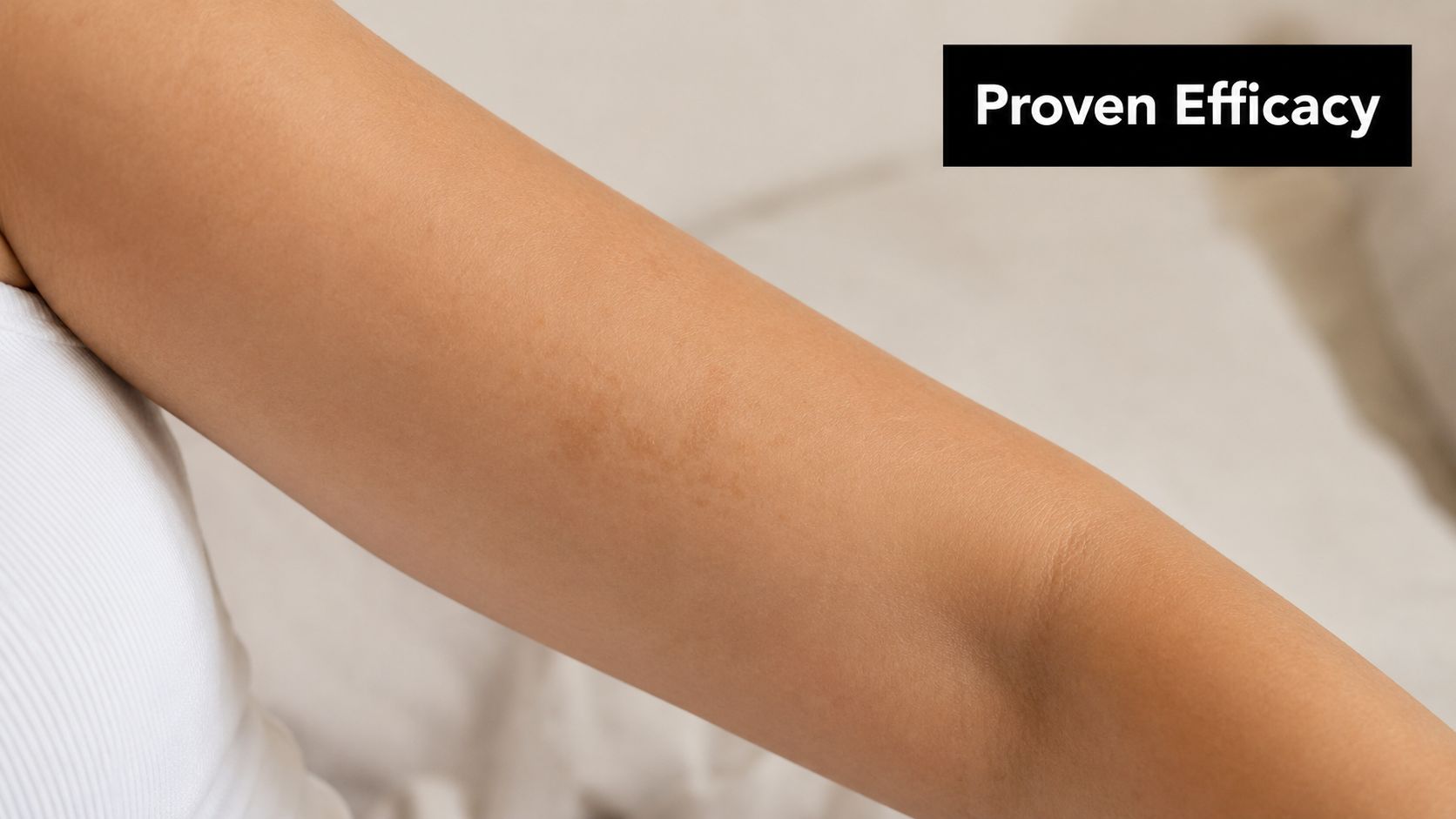
A better evaluation standard is pragmatic. Kojic acid soap can have a place in a Swiss pharmacy assortment if it is positioned as a supportive wash-off option for limited discolouration, not as a primary corrective product for stubborn or diffuse pigmentation.
Where it tends to make sense
The format is most credible for customers with localised marks who want a simple entry point before committing to a full routine. That often includes post-inflammatory marks after acne, mild uneven tone on the body, or discrete sun-related spots where expectations are modest and use can be controlled.
It is a weaker proposition for melasma-like patterns, widespread facial pigmentation, or customers already using retinoids, acids, or other irritating actives. In those cases, a soap bar can add friction to the routine without adding enough clinical upside.
For retail teams, the commercial triage is straightforward:
- Best fit: Limited hyperpigmented areas and customers who can follow restrained use instructions.
- Moderate fit: Recurrent body marks where the skin barrier is intact and the user is not chasing rapid change.
- Poor fit: Whole-face brightening expectations, barrier-impaired skin, or routines already carrying a high irritation load.
What results are realistic in practice
Real-world performance depends less on marketing language and more on user behaviour. Kojic acid soap tends to perform best as a brief-contact cleanser used consistently and cautiously. Results are usually incremental. The product may help soften the appearance of certain marks over time, but it rarely justifies dramatic before-and-after claims.
That distinction matters for Swiss and EU-facing retailers because efficacy claims sit close to compliance risk. If the pack, shelf talker, or staff script implies treatment-level correction, the product can drift into territory that regulators and pharmacy quality teams will examine more critically.
Concentration also needs disciplined interpretation. Some suppliers market higher-strength sounding bars as if the number alone proves superiority. In practice, the trade-off is obvious. More aggressive positioning can raise irritation risk, especially in a wash-off product that consumers may misuse by increasing contact time or frequency. For a pharmacy chain, that is not a minor issue. Irritation reduces trust in the category and increases the burden on staff to manage returns and complaints.
For broader category context, some buyers also review adjacent approaches such as Mesoderm RX dark spot solutions to compare where soaps sit versus leave-on correctors. The comparison is useful because it reinforces a simple point: soap is generally the lighter-touch format, not the endpoint treatment.
How to set expectations without creating compliance problems
The strongest sales approach is controlled, specific, and easy for staff to repeat. Good counselling language sounds like this:
This product may help reduce the appearance of certain dark marks with consistent use, but results are usually gradual and depend on skin tolerance, sun protection, and the cause of the pigmentation.
That wording protects credibility. It also fits how pharmacies should sell the category in Switzerland: measured claims, clear limits, and routine advice that reduces misuse.
The commercial benefit is practical. Customers who understand the likely pace and limits of improvement are less likely to overuse the bar, less likely to blame the retailer for unrealistic outcomes, and more likely to accept a paired recommendation for barrier support and daily photoprotection.
Formulation and Concentration Best Practices
When buyers evaluate Kojic acid soap, the most important variable is not the front-label promise. It is the finished formula. A weak formula with aggressive claims is common. A stable, sensibly dosed, irritation-aware formula is much harder to find.
The concentration discussion should be handled with restraint. The U.S. Cosmetic Ingredient Review originally concluded in 2010 that Kojic acid was safe for use in cosmetic products up to 1%, and its later amended safety assessment notes that the maximum concentration of use reported for leave-on skin care was 2% in 2008, but by 2024 the reported concentration had fallen to up to 1% in leave-on skin care preparations, as described in the CIR safety assessment record. For Swiss retailers, that shift supports a conservative purchasing posture.
Why higher-sounding strength is often the wrong buying signal
Retail buyers sometimes assume the stronger-sounding product is the better product. With Kojic acid soap, that logic often breaks down. Higher concentration may increase irritation risk. In a wash-off system, it can also tempt misuse, because customers read stronger numbers as permission to use the bar more aggressively.
A premium assortment should favour products that show discipline in four areas:
- Concentration restraint: A conservative level is easier to defend in pharmacy settings.
- Base selection: Soap versus syndet matters because the cleansing base influences both tolerability and active stability.
- Stability strategy: Packaging, pH control, and freshness all affect whether the active remains credible.
- Usage architecture: The formula should be designed for short, controlled contact rather than prolonged exposure.
Kojic Acid Soap Retailer Checklist
| Evaluation Criteria | Ideal Specification | Why It Matters |
|---|---|---|
| Concentration position | Conservative, safety-aligned level with clear supplier disclosure | Reduces the gap between marketing and defendable use |
| Cleansing base | Mild base with better tolerability than a harsh traditional bar | Helps limit irritation and customer dropout |
| Stability rationale | Supplier can explain how the active is protected in the formula | Supports performance consistency over shelf life |
| Packaging | Packaging that limits unnecessary exposure and supports product integrity | Helps protect formula quality after opening |
| Claim language | Focus on uneven tone and dark marks, not blanket whitening | Lowers regulatory and reputational risk |
| Use instructions | Brief contact time with clear follow-up care guidance | Prevents overuse and improves customer outcomes |
| Supplier dossier | Readily available compliance and safety documentation | Essential for Swiss pharmacy procurement |
The strongest product isn't the one with the loudest percentage. It's the one whose formulation choices still make sense after the marketing team is removed from the room.
If a supplier can't answer these questions cleanly, the safer commercial decision is to decline the listing.
Navigating Safety Risks and Client Guidance
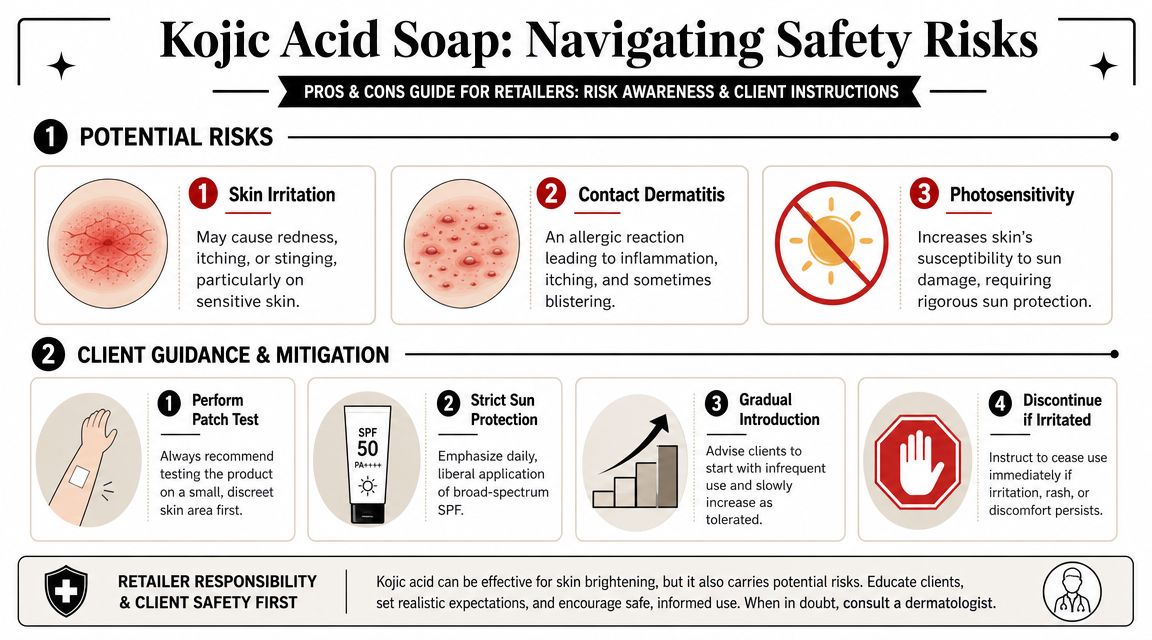
The main safety trade-off with Kojic acid soap is straightforward. Irritation and contact dermatitis are the most common adverse effects, and the risk rises on sensitive or damaged skin and with higher concentrations or excessive exposure. That makes client guidance part of the product itself. If the product requires controlled use, the retail model must support controlled use.
The protocol staff should actually give
Most customer disappointment comes from misuse, not from a bad ingredient. Staff should give clear, short instructions that are easy to remember and repeat.
- Patch test first. Advise application on a small discreet area before broader use.
- Use briefly. Keep contact time short, then rinse thoroughly.
- Avoid compromised skin. Don't apply to broken, inflamed, or already irritated areas.
- Follow with moisturisation. Barrier support helps reduce dropout due to dryness or stinging.
- Keep away from the periocular area. The margin for irritation is too narrow.
- Stop if irritation persists. Redness, burning, itching, or rash should prompt discontinuation.
A practical video can help reinforce counselling points during staff training or digital education:
Why Swiss sun guidance cannot be optional
A depigmenting product without sun-protection counselling is incomplete advice. Public content often ignores that point, but in Switzerland the omission is especially serious. Switzerland has one of Europe's highest melanoma burdens, with about 3,200 new cases annually, according to consumer guidance discussing stronger Kojic acid soap use and sun risk. If a customer uses pigment-correcting products and then neglects daily SPF, the treatment logic collapses.
This matters in alpine and summer exposure in particular. Even when the customer's primary concern is cosmetic, the pharmacy's guidance has to be protective.
Useful language for customer-facing teams
Some external educational pieces are useful because they discuss hyperpigmentation in sensitive skin without pushing a simplistic whitening narrative. Healtsy's expert advice on hyperpigmentation is one example staff can review to sharpen their own counselling language.
Use phrasing such as:
- For uneven tone, not full-face whitening: This is intended for specific dark marks and discolouration.
- Start gradually: If your skin is reactive, introduce it slowly.
- Moisturiser is part of the routine: Dry, irritated skin won't tolerate continued use well.
- Sun protection is essential: Without it, marks can persist or re-darken.
If the customer wants the brightening benefit but refuses daily SPF, the responsible answer is to slow down the sale and reset expectations.
Swiss and EU Regulatory Compliance for Retailers
For a Swiss retailer, Kojic acid soap is not a trend item first. It is a cosmetic product that must be legally supportable. That means your purchasing process has to move past pack copy and into documentation.

The benchmark Swiss buyers should use
The most useful technical benchmark is the European safety context around Kojic acid. The UK government's Scientific Advisory Group on Chemical Safety of Non-Food and Non-Medicinal Consumer Products summarised the European reassessment of Kojic acid and stated that a 1% concentration was considered safe for intended cosmetic use in face cream (including neck) and hand cream, with a sufficiently protective margin of safety of greater than 100, drawing on a rat oral NOAEL of 6 mg/kg bw/day from a 28-day study, adjusted to 2 mg/kg bw/day for time extrapolation, in the SAG-CS opinion on Kojic acid in cosmetic products.
This does not mean every soap at or below that level is automatically acceptable. It does mean Swiss buyers have a serious safety reference point when suppliers present wash-off products with bolder concentrations or vague claim language.
The documents that should be requested before listing
A Swiss pharmacy chain should ask for evidence in a fixed sequence. At minimum:
- Responsible person details: There must be a clearly designated responsible entity for the product on the market.
- Product Information File: The PIF should exist and be available to support compliance review.
- Safety assessment: This should reflect the actual finished formula, intended use, and foreseeable misuse.
- INCI and labelling review: Ingredient declaration and mandatory pack information must be clear.
- Claim substantiation: If the supplier uses wording around brightening, dark spots, or uneven tone, there should be supportable reasoning behind it.
These aren't bureaucratic extras. They are the difference between a controlled listing and a risky one.
A practical compliance screen for buyers
Use this simple internal filter before ranging any Kojic acid soap:
| Buyer Question | Acceptable Answer |
|---|---|
| Who is the responsible person? | The supplier identifies one clearly and in writing |
| Is there a PIF? | Yes, and the supplier can confirm its availability |
| Has a safety assessment been completed? | Yes, for the actual product and intended cosmetic use |
| Are the claims restrained? | Yes, focused on cosmetic appearance, not medical or sweeping whitening promises |
| Is the concentration disclosed or defensible? | Yes, with alignment to the safety context and intended use |
| Are the labels market-ready for Switzerland? | Yes, with clear ingredient and product information |
If one of these answers is vague, that is not a minor issue. It usually predicts later friction in complaints handling, regulator scrutiny, or customer dissatisfaction.
Key Talking Points for Pharmacy and Retail Sales
A good counter script does two jobs at once. It helps the customer use the product correctly, and it keeps the pharmacy out of preventable claims trouble.
For Swiss retail teams, the wording matters as much as the product. Staff should describe kojic acid soap as a cosmetic product for uneven-looking pigmentation, not as a whitening product and not as a treatment for melasma or other diagnosed skin disorders. That distinction supports cleaner customer expectations and reduces the risk of drifting into medicinal positioning.
How to explain what Kojic acid soap is
Use wording that is plain, controlled, and easy to repeat:
It is a cleansing product with kojic acid for areas that look darker than the surrounding skin, such as post-blemish marks or sun-related discolouration. It is intended for cosmetic brightening of uneven tone, not for changing overall skin colour.
That script is commercially useful. It sets a realistic benefit, avoids broad whitening language, and fits the way pharmacies should present higher-risk cosmetic products.
How to explain use without creating irritation problems
Keep the advice practical. Short contact time is the safer default, especially with soap formats that can be overused by customers who assume that a bar cleanser is mild by definition.
Staff can say:
- Use it on the area of concern: It is better suited to localised uneven tone than full-face or full-body routine use.
- Keep contact brief: Apply, cleanse briefly, and rinse well.
- Do not use on broken or inflamed skin: Delay use until the skin barrier is calmer.
- Apply a moisturiser after cleansing: This improves tolerance.
- Use daily sun protection: Without SPF, customers often worsen the same marks they are trying to fade.
One point is worth training explicitly. If a customer asks whether more frequent use will work faster, the correct answer is usually no. In practice, excessive use tends to produce irritation first, and irritated skin often develops more visible uneven tone, not less.
How to answer common customer questions
These replies are suitable for pharmacy teams and beauty advisers who need accurate, compliant language.
“Will it whiten my whole skin tone?”
No. It is intended for visible areas of uneven pigmentation, not for lightening the entire complexion.
“Can I use it every day?”
Only if the skin tolerates it well and the supplier instructions support that use. Many customers should start less often.
“Why is this sold in pharmacy instead of with ordinary soaps?”
Because it contains an active cosmetic ingredient and needs more careful guidance than a standard cleansing bar.
“What if my skin stings or becomes red?”
Stop use and simplify the routine. If symptoms persist, the customer should speak to a pharmacist or clinician.
“Can you recommend it for melasma?”
Pharmacy staff should stay careful here. They can discuss uneven-looking pigmentation as a cosmetic concern, but diagnosed conditions and treatment decisions should be referred appropriately.
The commercial benefit is straightforward. Clear scripts reduce returns, limit misuse-driven complaints, and help staff sell with confidence without creating claims that the label, safety file, or responsible person cannot support.
If your pharmacy, retail chain, spa, or e-commerce business wants help selecting compliant, premium skincare assortments for the Swiss market, beautysecrets.agency can support partner evaluation, brand curation, and category building with a focus on transparency, formulation quality, and Swiss trade realities.