A buyer meeting is coming up, and the category gap is obvious. Your shelves already cover cleansers, serums, masks, scalp treatments, and maybe even sleep sprays or silk pillowcases. But the customer who pays for a salon blow-dry, uses a premium leave-in, and wants her hair to look disciplined the next morning still walks out without the one item that protects all of that effort overnight.
That missing item is the silk hair bonnet.
For Swiss retailers, spas, and pharmacies, this isn't a novelty line. It's a small-format, high-perceived-value product that fits neatly into the broader wellness story consumers already understand: prevention beats repair, and a better night routine protects the investment they've already made in skin and hair.
The Silk Bonnet as a Modern Wellness Staple
A familiar retail pattern keeps repeating. A customer buys a nourishing mask, a scalp serum, and a smoothing oil. She follows the ritual carefully, then sleeps on a standard pillowcase, tosses around at night, and wakes up with flattened roots, frizz at the crown, and dry ends. The product assortment did its job only halfway.
That's why the silk bonnet belongs in a modern wellness offer. It closes the loop between treatment and protection. It's low effort, instantly understandable, and easy for staff to recommend as the final step in a nightly ritual.
The category also has more depth than many buyers assume. In the CH region, the bonnet tradition reaches back at least to the 13th century in European dress history, later becoming associated with elite women in the 18th century when silk entered the category, before broader adoption in the 19th century. That progression is part of the same Central European bonnet culture that shaped Swiss fashion and textile habits over time, moving head coverings from practical or religious use into status-linked fashion and personal care (European bonnet history and silk adoption).
Why that history matters commercially
Heritage helps premium categories sell. Not because customers want a costume reference, but because they respond to products that feel established rather than gimmicky.
A silk bonnet gives you three useful retail narratives at once:
- Protective care: It supports overnight hair protection.
- Quiet luxury: Silk already carries a strong premium code.
- Ritual value: It turns sleep into part of the beauty routine, not dead time.
A good bonnet doesn't compete with premium haircare. It makes premium haircare look more effective.
Where it fits in a Swiss assortment
For Swiss partners, the bonnet works best when it's treated as a wellness accessory, not as an impulse trinket. Position it with products that already signal care, quality, and nightly maintenance.
That makes it a natural fit for:
| Channel | Best position |
|---|---|
| Beauty retail | Next to hair masks, leave-ins, scalp care, and silk pillowcases |
| Spas and hotels | As a take-home extension of treatment rituals |
| Pharmacies and drugstores | Within gentle-care or fragile-hair solutions |
| Premium e-commerce | In sleep, scalp, and hair-preservation edits |
If you stock the right version, the silk hair bonnet stops being a side accessory and becomes part of a disciplined beauty routine. That's exactly where premium Swiss retail should place it.
Understanding the Hair and Scalp Benefits
The bonnet only earns its shelf space if staff can explain what it does. Keep the explanation simple. A silk hair bonnet works like a protective case for hair during the roughest part of the day for many strands: sleep.
Modern bonnet use is strongly tied to textured-hair protection. Industry accounts note that bonnets became a staple in textured-hair care in the 1950s, designed to reduce friction and moisture loss during sleep. That foundation still defines the category today, including in Switzerland's premium beauty segment where customers increasingly look for protective, low-friction overnight routines (origin of the bonnet in textured-hair care).
What happens overnight
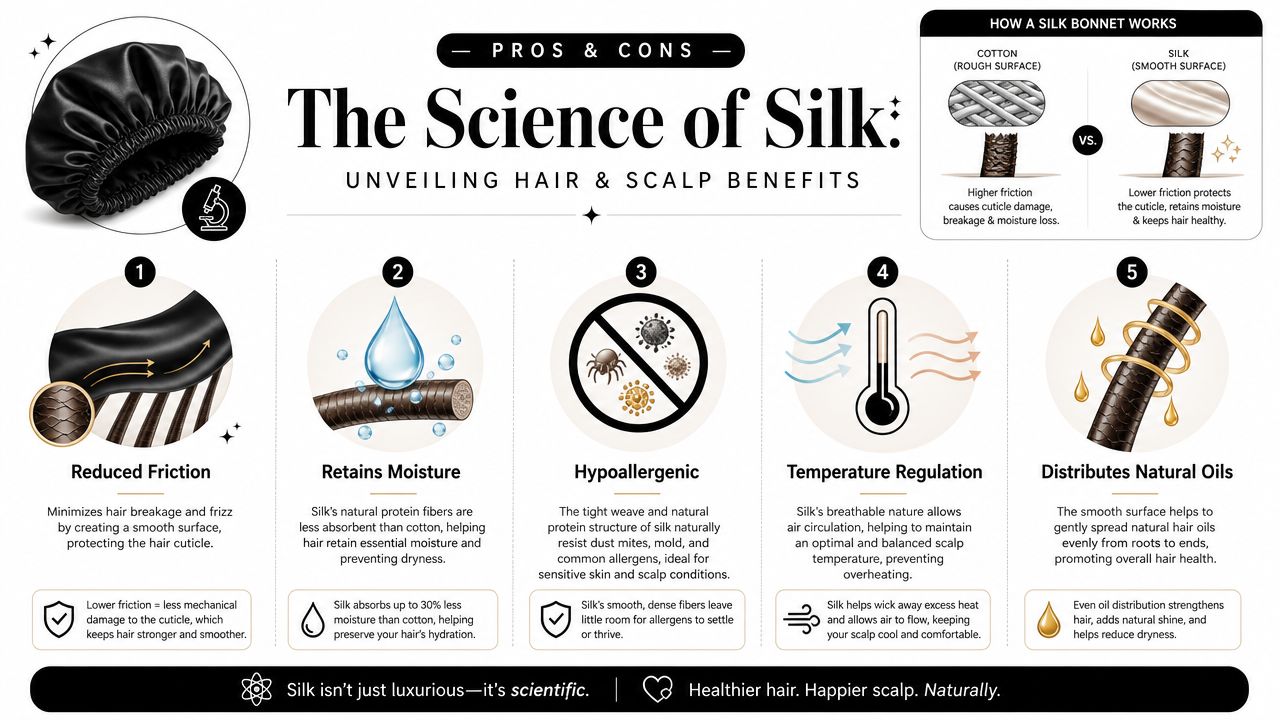
Hair doesn't stay still while someone sleeps. It rubs, catches, bends, and dries out. For customers with curls, bleached lengths, chemically treated hair, extensions, or a fresh blowout, that friction adds up fast in visible ways: frizz, shape loss, and a rougher finish by morning.
Silk helps because the surface is smoother than rougher textiles. That means less drag on the hair shaft and less disruption to the cuticle. In plain shop-floor language, hair slides instead of scrapes.
The benefits worth communicating
Don't overload the customer with pseudo-science. Give them the practical outcomes they care about.
- Less friction: Hair moves more smoothly inside the bonnet, so strands face less overnight stress.
- Better moisture retention: A gentler sleep surface helps keep hair from feeling as dry by morning.
- Style preservation: Blowouts, curls, and set styles hold their shape better when they aren't being crushed against bedding.
- Scalp comfort: A breathable, well-made bonnet can feel more comfortable than synthetic alternatives.
- Lower morning effort: Customers spend less time reworking the same style.
Practical rule: Sell the bonnet as damage prevention, not miracle repair.
Which customers will feel the value fastest
The strongest fit isn't limited to one hair type, but some groups understand the benefit immediately:
- Curly and coily customers who want to preserve shape overnight
- Colour-treated clients trying to avoid roughness and breakage
- Fine-hair customers whose blow-dries collapse easily
- Long-hair wearers dealing with tangling at the back and ends
- Sensitive-routine shoppers who already prefer gentle fabrics and low-stress care
This matters in-store because the product is easy to demonstrate verbally. Staff don't need a clinical script. They need one clean line: your night routine shouldn't undo your day routine.
Silk vs Satin a Guide for Premium Retailers
Many assortments go wrong. Buyers treat silk and satin as if they mean the same thing. They don't.
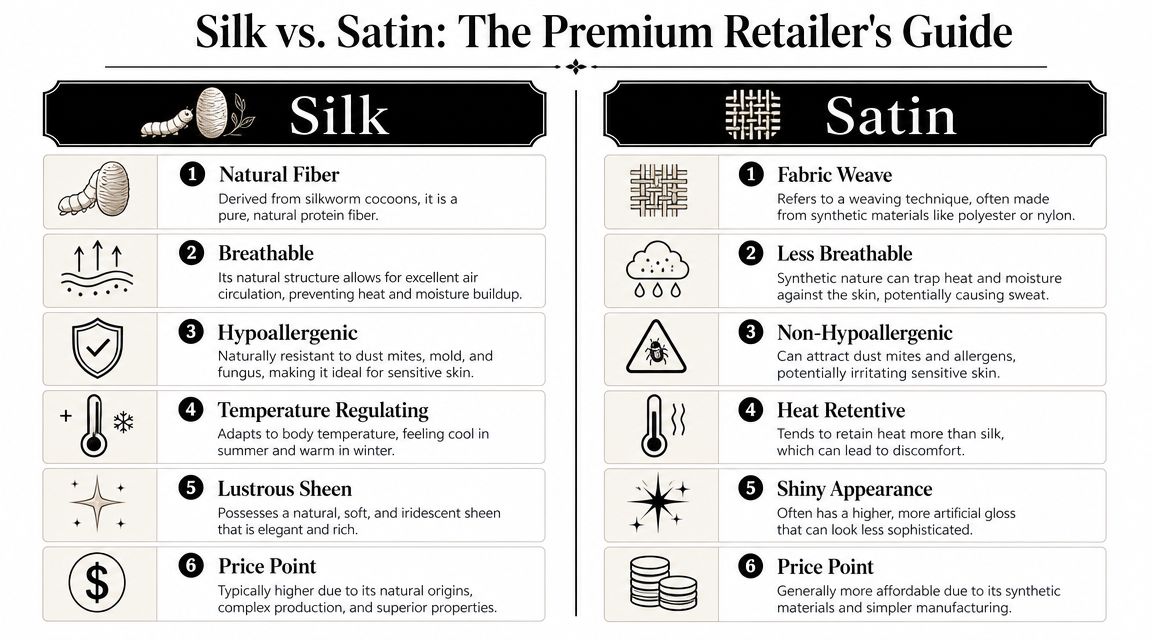
Silk is a fibre. Satin is a weave. A satin bonnet may be silk, but in most commercial assortments it's often synthetic. That distinction matters because Swiss premium customers are paying attention to material honesty. If your packaging says “satin feel” while the shopper assumes natural silk, you create confusion at best and distrust at worst.
The cleanest retail position
If your store stands for natural, premium, and transparent products, stock real silk and say so plainly. Don't hide behind vague wording like “silky”, “satin-soft”, or “luxury feel”. Those phrases usually signal compromise.
Here's the simplest way to explain the distinction at shelf level:
| Factor | Silk bonnet | Satin bonnet |
|---|---|---|
| What it is | Natural fibre | A weave, often synthetic in retail |
| Premium perception | Strong | Variable |
| Material transparency | Clear when labelled properly | Often confusing |
| Fit importance | Critical | Critical |
| Best use in assortment | Premium hero line | Entry-level or promotional line, if used at all |
A premium retailer shouldn't build this category around confusion. Genuine silk supports better storytelling, cleaner pricing logic, and fewer post-purchase complaints.
Material alone isn't enough
There's one important correction buyers need to hear. A silk bonnet isn't better if it doesn't stay on the head.
Consumer Reports highlighted the practical gap in this category: bonnets need to fit snugly and stay on all night, while product pages often over-focus on material claims and under-explain fit performance. That matters because a bonnet that slips off loses its functional advantage, regardless of fabric (Consumer Reports on bonnet fit and overnight wear).
A useful product demonstration can help anchor that point:
My recommendation for Swiss premium buyers
Be decisive. Don't build a mixed message category unless you have a clear tiering strategy.
- Choose silk for premium shelves: It aligns better with natural and high-quality positioning.
- Make fit part of the specification: Ask about band construction, hold, and comfort.
- Train staff to separate fibre from weave: This one point prevents a lot of bad selling.
- Avoid overclaiming: “Luxurious and protective” sells better than inflated promises.
If you want premium margins, give customers a premium material story they can trust.
For boutiques, pharmacies with curated wellness edits, and spas, real silk is the stronger commercial decision. Satin may win on opening price, but silk wins on credibility.
Sourcing Guide Key Specifications for Buyers
A Swiss retailer usually loses money on this category before the first unit sells. The problem starts in sourcing. A bonnet can look premium in a sales deck and still fail on fibre disclosure, fit range, seam finish, or packaging discipline once it reaches shelf.
A silk hair bonnet needs a buying brief with measurable standards. If the supplier cannot answer technical questions clearly, remove the item from consideration.
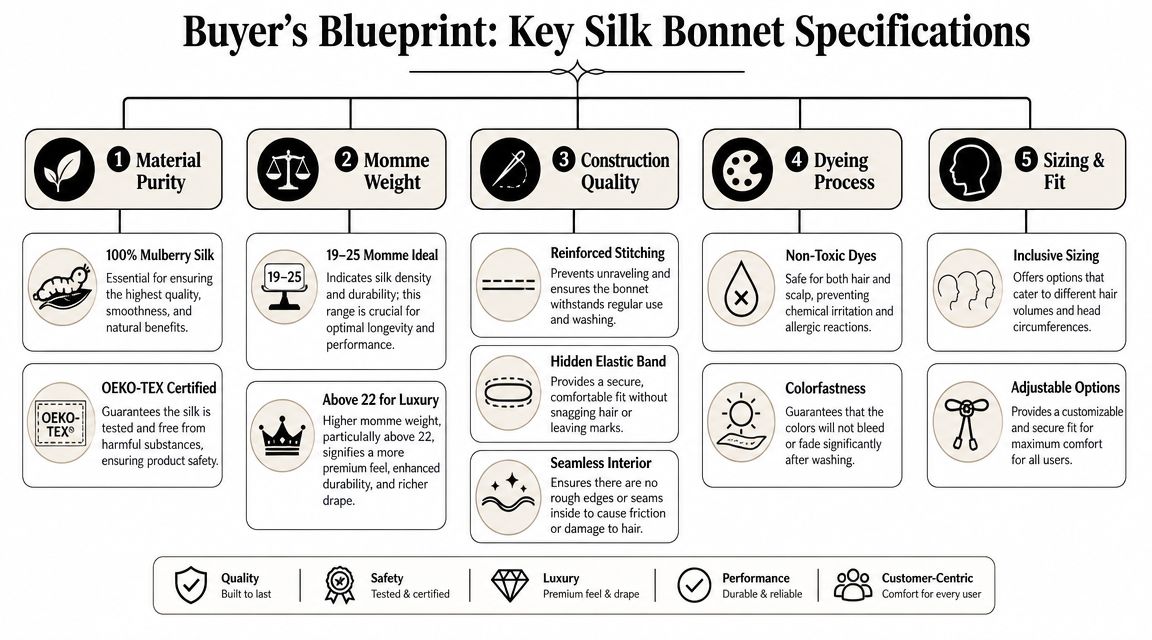
Start with the fabric specification
For premium Swiss retail, ask for precise fibre language on every SKU. “Silky,” “satin feel,” and “luxury blend” are merchandising phrases, not sourcing terms. Your purchase order should state fibre content, silk grade where available, fabric weight, and whether both the inner and outer layers match.
Use these supplier questions:
- Is the bonnet 100% silk, or only the lining?
- Is the silk mulberry silk?
- What fabric weight is supplied, and is it consistent across production runs?
- Are both sides the same material, or is one side a substitute fibre?
- Can the supplier provide fibre documentation and care labelling support for Swiss retail compliance?
That last point matters in pharmacies and wellness-led stores. If the pack implies purity or premium natural fibre and the specification is vague, trust drops fast.
Construction decides repeat purchase
Material gets the first sale. Construction gets the second.
Poorly placed seams, weak elastic channels, and thin stitching lead to complaints that show up as returns, not product reviews. Examine pre-production samples inside out. You want neat stitching, low-bulk seam finishing, a band that holds without pressing into the hairline, and shape retention after handling.
I would also push suppliers on closure design. Fixed elastic works for entry price lines. Adjustable bands, drawstrings, or better-engineered covered elastics are stronger choices for premium doors because they reduce fit risk across a broader customer base.
If the bonnet feels tight in a showroom fitting, it will feel worse after a full night's wear.
Size architecture should be part of the range plan
One size rarely serves this category well. That is a merchandising mistake, not just a design one.
Long hair, protective styles, curls, and higher-volume hair all need more internal space. Product formats built for longer hair often use an elongated shape rather than a round cap, with wider bands or adjustable features to improve hold and reduce compression, as shown in Mulberry Park Silks' long-hair bonnet specification example.
Use that insight to build a cleaner assortment:
| Customer need | What to stock |
|---|---|
| Short to medium hair | Standard bonnet with soft, stable hold |
| Long hair | Extended bonnet with more internal length |
| Curly or voluminous hair | Roomier shape with lower compression |
| Gift and travel purchase | Adjustable model with broader fit tolerance |
Swiss buyers should also think channel by channel. Spas can work with a tighter edit and stronger gift presentation. Pharmacies need clearer functional communication on pack. Boutiques can support a two-tier assortment if the material story is transparent.
Packaging and compliance should support the shelf price
Packaging is part of the specification. A premium bonnet in weak packaging creates immediate price resistance.
Ask for:
- Clear fibre disclosure on pack
- Legible care instructions in the required sales languages
- Barcode and importer label readiness
- Protective packaging that avoids crushing the bonnet in transit
- Giftable presentation for spa, boutique, and seasonal retail
- Evidence of textile safety and responsible dye handling where claimed
Do not allow inflated copy such as miracle repair claims or unsupported scalp promises. Clean, defensible language sells better in the Swiss market, especially in pharmacy and wellness environments where trust drives conversion.
My recommendation is simple. Buy fewer SKUs, specify them better, and insist on documentation before launch. That is how this category keeps its margin.
Care and Longevity Maximising Customer Value
A Swiss customer buys a premium silk bonnet, takes it home, washes it like standard cotton sleepwear, and comes back disappointed. That failure is preventable. Care guidance is part of the product, and retailers that treat it that way protect margin, reduce complaints, and increase repeat purchase confidence.
For this category, aftercare should be built into the sales process. Put the guidance on pack, repeat it on shelf talkers where appropriate, and train staff to deliver the same short script every time. Consistency matters more than long explanation.
The care message should be short and specific
Tell customers to wash gently, use a mild detergent, and air dry away from direct heat. That is clear, credible, and easy for sales teams in pharmacies, spas, and boutiques to repeat without creating friction at point of sale.
You do not need dramatic language. You need accurate language. Silk keeps its value when customers handle it as a fine textile rather than a throw-in accessory.
The care script I recommend for retail teams
- Wash gently: Hand wash or use a delicate cycle only if the supplier confirms it.
- Use mild detergent: Choose a detergent suitable for delicate fibres.
- Avoid aggressive products: No bleach, no strong stain removers, no harsh detergent blends.
- Dry naturally: Keep the bonnet away from tumble dryers, radiators, and direct sun.
- Store with care: Do not compress it under heavier items at home or in travel luggage.
Good care advice protects product performance and protects the retailer's reputation.
Why this matters commercially
A bonnet that keeps its handle, shine, and shape feels worth the shelf price months after purchase. A bonnet that loses finish quickly creates doubt about the whole category.
That is especially important in Swiss pharmacy and wellness retail, where trust is built through disciplined claims and disciplined usage advice. Clear aftercare reduces avoidable returns and gives staff a stronger answer when a customer asks why silk costs more.
There is also a marketing upside. Brands that communicate craftsmanship, maintenance, and longevity well tend to perform better in premium wellness categories. Smaller suppliers can support that message with content partnerships and effective outreach for artisan brands, especially when they need education-led visibility rather than discount-led promotion.
My recommendation is direct. Treat care instructions as a commercial tool, not a legal afterthought. If the supplier cannot provide clear multilingual care copy and a retailer-ready training script, the product is not ready for the Swiss market.
Merchandising and Marketing in the Swiss Market
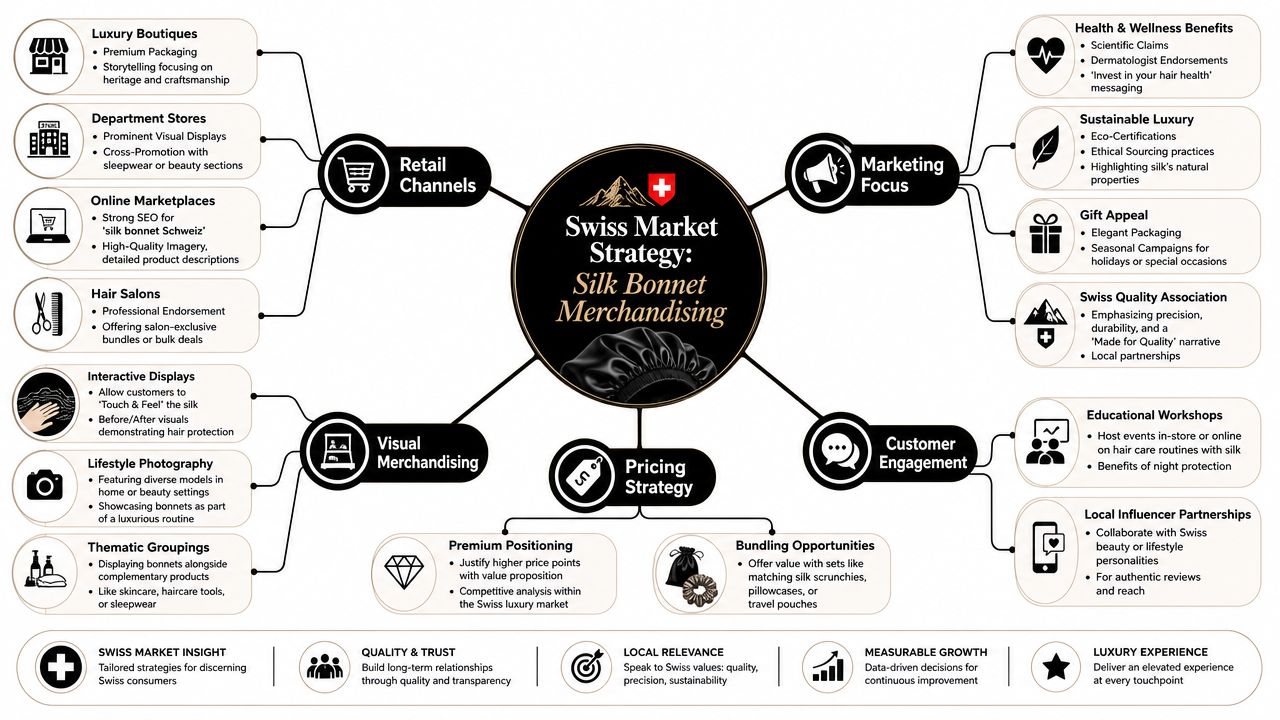
A silk bonnet won't sell well in Switzerland if you merchandise it like a novelty beauty add-on. Treat it as part of a wider sleep, scalp, and hair-preservation routine and it becomes much easier to move.
The strongest Swiss positioning combines function with restraint. Customers don't need loud claims. They need a product that looks credible, feels refined, and solves an obvious problem: overnight damage and style loss.
Best channel-by-channel positioning
Different channels should sell the same product differently.
Boutiques and premium beauty retail
Place the bonnet beside premium haircare, overnight masks, silk pillowcases, and refined self-care gifts. In this setting, presentation matters almost as much as specification. Texture, packaging, and colour palette should feel composed.
Use messages like:
- Protect your hair while you sleep
- The final step in your night routine
- Luxury that preserves your style
Spas and hotels
A bonnet works well as a post-treatment recommendation. If a guest has paid for scalp therapy, a smoothing ritual, or a premium blow-dry, the bonnet becomes the logical take-home item that extends the result.
This is also the best environment for bundle selling. Pair it with a leave-in treatment, a bath ritual product, or a sleep-focused gift edit.
Pharmacies and drugstores
Pharmacies should keep the language gentler and more functional. Focus on low-friction protection, comfort for fragile hair, and practical support for customers managing dryness or breakage-prone lengths.
The key is tone. Don't merchandise it as glamour. Merchandise it as intelligent care.
How to build a stronger launch narrative
Swiss buyers often underestimate how much this category benefits from education-led marketing. The product is simple, but the value story still needs framing.
Use content that shows:
| Marketing angle | Why it works |
|---|---|
| Overnight protection | Easy to grasp immediately |
| Style preservation | Connects to salon and beauty spend |
| Material honesty | Supports premium trust |
| Giftable wellness | Broadens seasonal relevance |
| Quiet luxury | Fits Swiss premium aesthetics |
If you're supporting artisan or niche labels in the category, founder storytelling and localised outreach matter. Teams building awareness around premium accessories often benefit from learning how agencies approach effective outreach for artisan brands, especially when the challenge is education rather than mass-market discounting.
Visual merchandising that actually helps conversion
Don't keep the bonnet flat in a drawer or buried in a mixed-accessories basket. It needs context.
Use:
- Touch points: Let shoppers feel the fabric if hygiene and packaging allow it.
- Routine grouping: Display it with masks, serums, combs, or pillowcases.
- Lifestyle imagery: Show it in a calm bedroom or post-bath setting, not a party-styling one.
- Staff prompts: A single line at point of sale can trigger the add-on. “How are you protecting the hair overnight?”
Retailers sell more bonnets when they present them as part of a ritual, not as a random textile accessory.
For the Swiss market, that distinction is decisive. The category performs best when it feels curated, useful, and understated.
Conclusion Elevating Your Assortment with Silk Bonnets
The silk hair bonnet deserves a place in premium Swiss retail because it solves a real consumer problem in a tidy, understandable format. It protects the results customers already pay for. It supports scalp and hair routines without adding effort. And it fits naturally into the broader movement toward preventive, ritual-based wellness.
The commercial case is strong when buyers stay disciplined. Choose genuine silk over vague satin language. Prioritise 6A long-fibre mulberry silk at around 22 momme when sourcing premium options. Pay close attention to fit, internal volume, and band construction. Merchandise the bonnet alongside haircare, sleep, and self-care categories rather than treating it like a novelty add-on.
For Swiss boutiques, spas, pharmacies, and selective e-commerce partners, this is a smart category if it's handled with clarity. The product is small, but the message is powerful: premium routines shouldn't stop at bedtime.
That's the opportunity. A well-chosen silk bonnet doesn't just add another SKU. It sharpens your assortment, improves your storytelling, and gives customers a practical reason to come back for a more complete beauty routine.
If you're building a more differentiated beauty and wellness assortment for the Swiss market, beautysecrets.agency can help you identify premium, ethically aligned product categories that fit modern retail expectations around quality, transparency, and sustainability.