A client walks into your pharmacy, boutique, or spa reception with a reference photo on their phone. They want dark red hair. Not bright copper, not fashion-crimson, but something richer. Glossy auburn, velvet mahogany, cherry so deep it reads brunette indoors and red in daylight. They also want it to stay that way.
That's where retail advice often breaks down. Most available content stops at shade inspiration or salon technique. It rarely helps Swiss retailers answer the questions clients ask after the appointment: why the colour already looks softer, what to use at home, what to avoid in hard-water areas, and whether a “clean” routine can still perform.
For premium Swiss beauty retail, this is a strong niche. Dark red hair sits at the intersection of identity, chemistry, and maintenance. Clients need more than a shelf of colour-safe products. They need someone who can translate salon reality into an aftercare plan they will follow.
The Allure and Challenge of Dark Red Hair
Dark red hair sells emotion first. Clients see depth, warmth, polish, and a shade that feels more intentional than standard brunette. Retailers should see something else as well: a colour category with high advisory value.
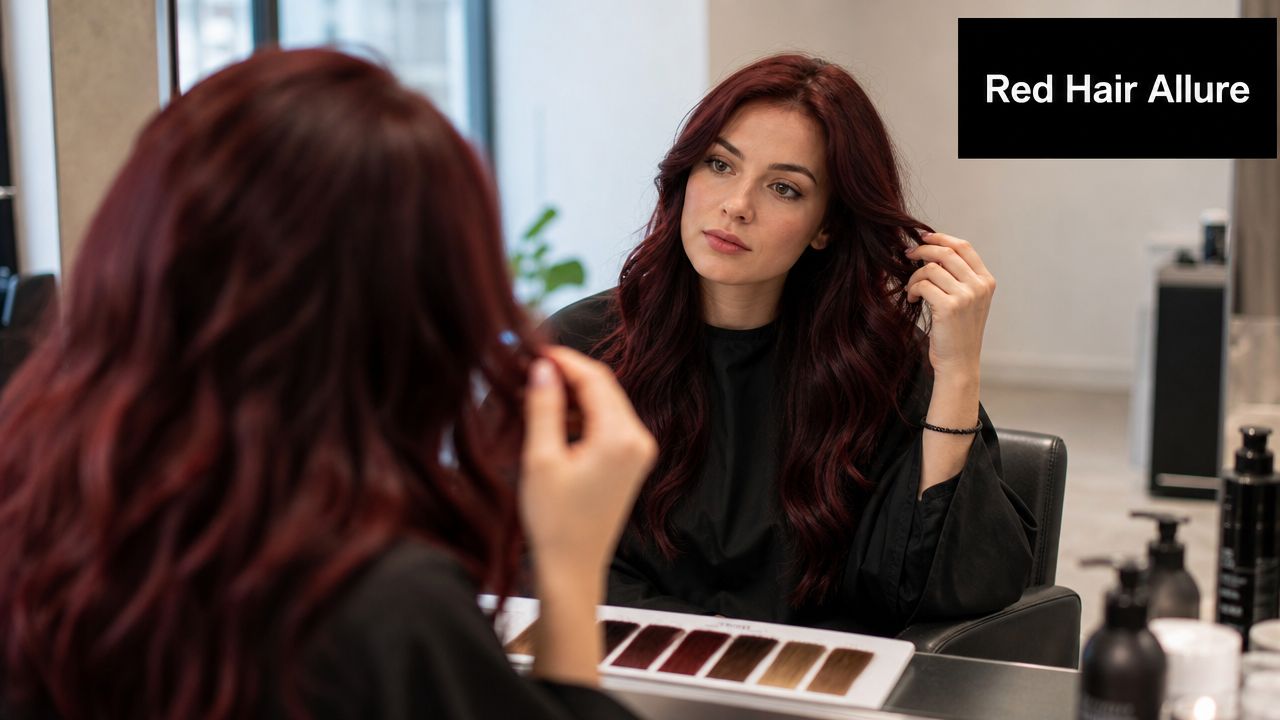
In practice, dark red isn't difficult because clients dislike it. It's difficult because it changes quickly if the aftercare is weak. The shade can lose brightness, sink too brown, or turn flat if the hair fibre is stressed or the maintenance routine is too aggressive. That creates a commercial gap. The sale isn't just shampoo. The sale is confidence, retention, and fewer disappointed returns.
Why this category needs better retail advice
Current online coverage leaves a clear blind spot. The most underserved angle is how dark red hair behaves in real maintenance cycles in Switzerland, because most visible content focuses on inspiration and salon technique rather than the practical questions clients ask after colouring. This tutorial-led view of shade control and maintenance nuance reflects that gap well.
For a Swiss retailer, that matters because the advisory role sits between salon chemistry and home behaviour. A stylist may create the result, but a retailer often shapes whether the client keeps it.
Practical rule: If a client is buying for dark red hair, treat the consultation like aftercare for a premium service, not like a routine wash-care sale.
Where retailers can win
Swiss pharmacies and premium beauty counters are well placed to own this space because clients already expect guidance there. They ask better questions in those environments. They're often more open to ingredient quality, scalp comfort, and refill or low-waste options. They also tend to trust a considered edit more than a crowded promotional wall.
That's why dark red hair works so well as a specialist category. It rewards precise advice. It also rewards restraint. Clients don't need ten products. They need the right ones, clearly explained, with realistic instructions and honest trade-offs.
Decoding the Spectrum of Dark Red Hues
Dark red hair is not one shade. It's a family of tones that sit on different brown depths with different undertones. If your team can't distinguish auburn from mahogany, or cherry from black-red, product advice becomes vague very quickly.
The easiest way to explain it to clients is with wine language. Auburn behaves like a lighter red wine with visible warmth. Mahogany has more brown structure. Burgundy or cherry moves cooler and deeper, with a red-violet impression rather than copper warmth.
The undertone is the real decision
Most clients point to depth first. “I want it dark.” The more important question is undertone.
A warm dark red carries copper, cinnamon, or chestnut energy. It feels softer and more natural. A cool dark red leans violet, berry, or cherry. It feels sharper, glossier, and more fashion-led. If a retailer misses that distinction, the client may buy the wrong maintenance products and then wonder why the result loses the quality they liked.
Dark Red Hair Shade Matrix
| Shade Name | Description | Undertone | Ideal For Starting Base |
|---|---|---|---|
| Auburn | Brown-red with visible warmth in natural light | Warm copper-red | Medium brown to dark brown |
| Chestnut-red | Soft brunette with red warmth woven through | Warm brown-red | Light brown to medium brown |
| Mahogany | Rich brown with controlled red depth | Neutral to warm red-brown | Medium brown to dark brown |
| Cherry | Deep red with a cooler, jewel-like cast | Cool red-violet | Dark brown where visible red is still desired |
| Burgundy | Saturated dark red that can read wine-toned | Cool violet-red | Brown bases seeking a more dramatic finish |
| Black-red | Near-black depth with red reflection | Deep cool red | Very dark brown to black hair |
How to talk about shade without sounding technical
Use contrast language clients understand:
- “Natural but richer” usually points to auburn or chestnut-red.
- “Dark and glossy” often means mahogany.
- “Visible red only when the light hits” usually means black-red.
- “More berry than copper” signals cherry or burgundy.
For internal staff training, one technical point matters. Industry guidance on auburn-family colour shows that medium-to-dark brown starting bases pair best with intensive red and mahogany blends, while very dark or black hair generally needs deeper cherry or black-red formulations to stay visible. The darker the base, the more carefully the stylist must manage lift, tone, and retention, as reflected in professional guidance on auburn and related shade families.
A client who says “I want dark red” is often describing depth, not undertone. Ask what they want to see in daylight.
Retail implication
This shade vocabulary has a direct effect on sell-through. Warm red clients usually respond well to care products that preserve shine and softness. Cool red clients are often more sensitive to dullness and tone shift. The recommendation might still be the same category, but the reason for purchase changes. One client wants warmth preserved. The other wants the red to stay visible instead of slipping into flat brown.
That distinction improves both trust and basket quality.
The Salon Science Behind the Shade
A client walks into a Swiss pharmacy six days after a salon visit. She loves the colour in daylight, but indoors it already reads flatter and darker than she expected. If the advisor only hears “my red is fading,” the recommendation will be too generic. If the advisor understands how the shade was built, the basket gets much more accurate.
Dark red is rarely a one-step story. In salon terms, the result depends on starting depth, previous colour history, porosity, and whether the stylist only deposited tone or had to lighten first. Professional colour education from Wella explains the core mechanism clearly: permanent colour uses alkalising agents to swell the cuticle so dye precursors can enter the fibre, while the natural melanin is lightened to make the target tone visible, as outlined in Wella's guide to hair colour levels and lifting. For retail teams, the business point is simple. Red looks rich when there is enough room in the hair for the tone to show and enough surface smoothness for light to reflect.
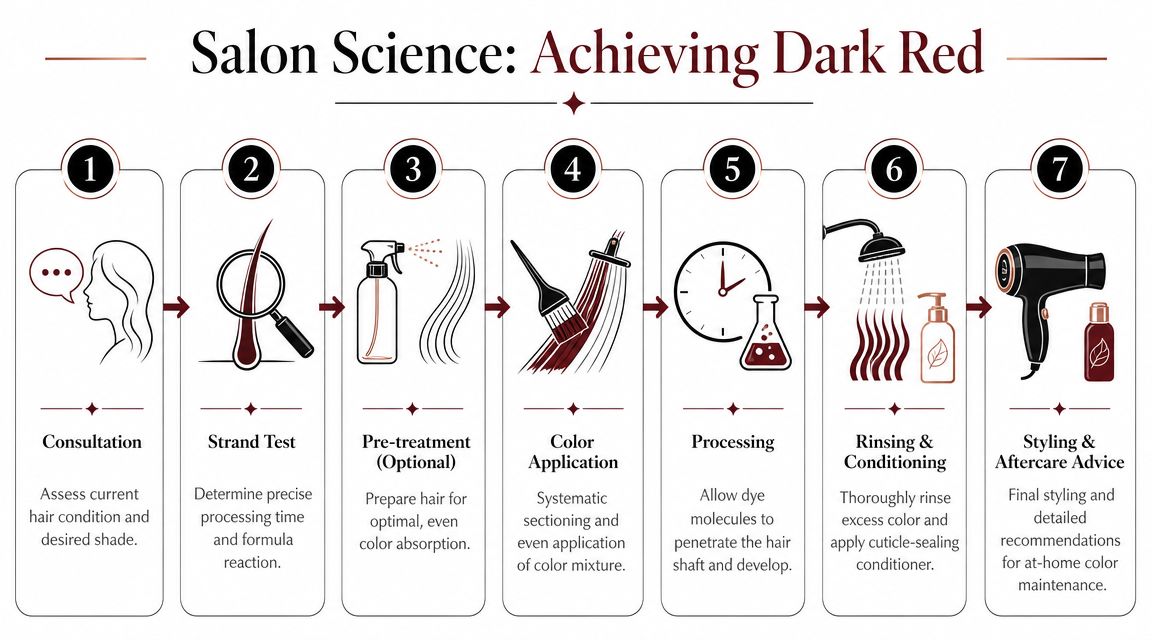
Deposit versus lift and deposit
This split should shape every product recommendation.
On a medium brown base, a dark auburn, mahogany, or red-brown can often be achieved with mostly deposit and controlled oxidation. Hair in that category usually keeps a smoother feel, stronger shine, and more predictable colour retention. The right retail support is mild cleansing, slip, and lightweight conditioning that protects surface gloss without coating the hair heavily.
On very dark brown or black hair, visible red usually requires pre-lightening or higher-lift colour before the red target shade is added. That changes the fibre. The cuticle has been opened more, the internal structure is less even, and the red reflection becomes harder to hold. Product advice should shift toward colour-safe cleansing, richer conditioning, heat protection, and fewer wash-related losses.
What clients report, and what it usually means
Clients describe results through feel and visibility, not chemistry.
- “It felt soft at the salon, but rougher after two washes.” This often points to raised cuticles and higher porosity.
- “The red is still there outside, but not inside.” The tone may still be present, but the reflective quality has dropped.
- “My roots look different from my ends.” That usually means different canvases. Virgin regrowth and pre-coloured lengths do not behave the same way.
- “My mask makes it nice for one day, then heavy.” The product may be too rich for the root area and not targeted enough for sensitised mids and ends.
Swiss retail teams can outperform generic e-commerce by asking what service was done, how dark the natural base was, and whether the hair had old colour on the ends. Those three questions usually reveal more than the shade name on its own.
Three technical realities with direct retail consequences
Porosity changes how red leaves the hair.
Red molecules do not disappear in a tidy, even way. On porous lengths, the visible red reflection often dulls first, while residual warmth stays behind. Clients read that as “it turned brown.” In practice, the red impact weakened before the colour fully washed out.
Surface condition matters almost as much as pigment choice.
Dark red sells on gloss. If the cuticle is rough, the tone can still be in the hair and yet look less luxurious. That is why a clean, low-stripping cleanser can support the visual result better than an aggressive “repair” shampoo that leaves the fibre coarse.
One routine rarely suits the whole head.
Roots, mids, and ends often need different handling. Advisors who recommend frequent clarifying or one heavy mask for everything usually shorten the life of the salon result.
For premium pharmacies and clean-beauty retailers, this is the opportunity. Sell maintenance based on service history, not just shade family. A client with a gloss refresh may need a lighter routine and shine support. A client with lift-and-deposit red usually needs more protection, less washing friction, and refill-friendly staples such as Fillaree's low-waste hair solutions.
When a client says the colour has “gone brown,” the red reflection has often weakened before the underlying tone has fully faded.
Teams that understand this salon science give better advice, reduce returns, and position premium aftercare as preservation of a professional service, not an optional add-on.
Preserving the Colour with Clean Aftercare
A client leaves the salon with a deep garnet gloss, then walks into a Swiss pharmacy two weeks later saying the colour already looks flatter. The right retail response is not a bigger basket. It is a tighter routine that protects the result she already paid for.
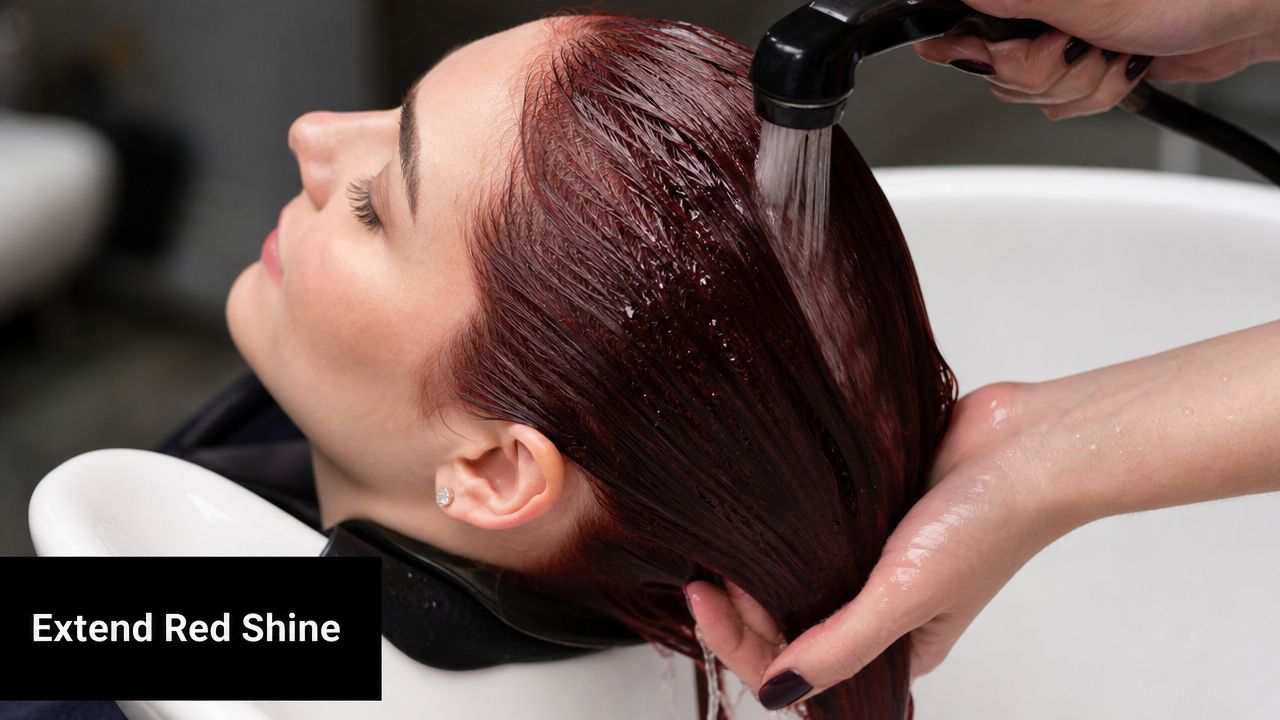
Dark red aftercare comes down to three controllable factors. Washing can strip surface smoothness. Heat can dry the fibre and flatten shine. Friction can make a rich red look tired before much pigment has left the hair. For premium retailers, that matters because clients often judge colour longevity by what they see in the mirror, not by what is chemically still present in the hair.
Essential Aftercare for Clients
Clients do best with a routine they will follow. In practice, dark red usually needs more discipline than product variety. Regrowth tends to become noticeable quickly on many clients, especially where the chosen red is deeper or cooler than the natural base, and a treatment mask used once or twice weekly is often a sensible recommendation for keeping the fibre smoother and the finish more reflective. For retail teams, that turns vague maintenance advice into a clear home plan.
Start with four core products:
- A gentle cleanser that cleans without leaving the hair squeaky, dry, or swollen.
- A conditioner with good slip to reduce friction during rinsing and detangling.
- A treatment mask used on schedule, not only after the hair already feels stressed.
- A leave-in or heat protectant for any client who blow-dries, curls, or straightens.
That is enough for many baskets.
The commercial value is clarity. Swiss pharmacies and clean-beauty retailers sell better when staff explain why each item is there. A mild cleanser protects the salon finish. A mask supports shine retention. A heat protectant helps the red keep its expensive-looking surface. Clients accept premium pricing more readily when the routine sounds specific and disciplined, not generic.
Clean beauty works when it protects performance
Clean beauty only helps retail if it holds up under coloured-hair conditions. Clients with dark red hair are not shopping for abstract ingredient philosophy. They want colour that stays polished between appointments, formulas that feel pleasant to use, and packaging choices that fit a more responsible purchase decision.
That is why I usually recommend a short routine with clear roles. One cleanser, one conditioner, one mask, one protective finisher. Compliance is better, the advice is easier for staff to repeat, and the client is less likely to replace half the routine with random products at home.
Packaging can support that story as well. For clients who want lower-waste options without giving up function, Fillaree's low-waste hair solutions show how refill-led hair care can sit credibly in a premium clean-beauty assortment.
What fades dark red fastest
Use this as a consultation tool.
- Frequent harsh washing roughens the cuticle and makes the colour look less glossy.
- High heat styling dries the fibre and reduces the richness clients associate with fresh red.
- Hard water exposure can leave the hair feeling coated or rough, which dulls reflection.
- Heavy styling residue can make a dark red tone read flat and muddy rather than refined.
A practical way to explain it is simple. If the hair surface loses smoothness, dark red loses impact first at the level clients notice most, which is shine.
Here's a useful visual aid to support that message during staff training or client follow-up:
What to sell together
Premium retail works best when bundles reflect client behaviour.
For the minimal client
Sell a cleanser, conditioner, and leave-in heat protector. This fits the client who wants straightforward maintenance and will use every item consistently.
For the motivated client
Add a treatment mask and give a clear usage rhythm. A written note or digital follow-up often improves repeat purchase rates because the client remembers exactly how to use the routine.
For the fragile-hair client
Lead with comfort, reduced friction, and moisture support. These clients often respond well when the recommendation feels protective rather than sales-led.
Clean formulas support dark red best when they are paired with fewer harsh washes, moderate heat use, and consistent conditioning.
Mastering the Client Consultation and Retail Strategy
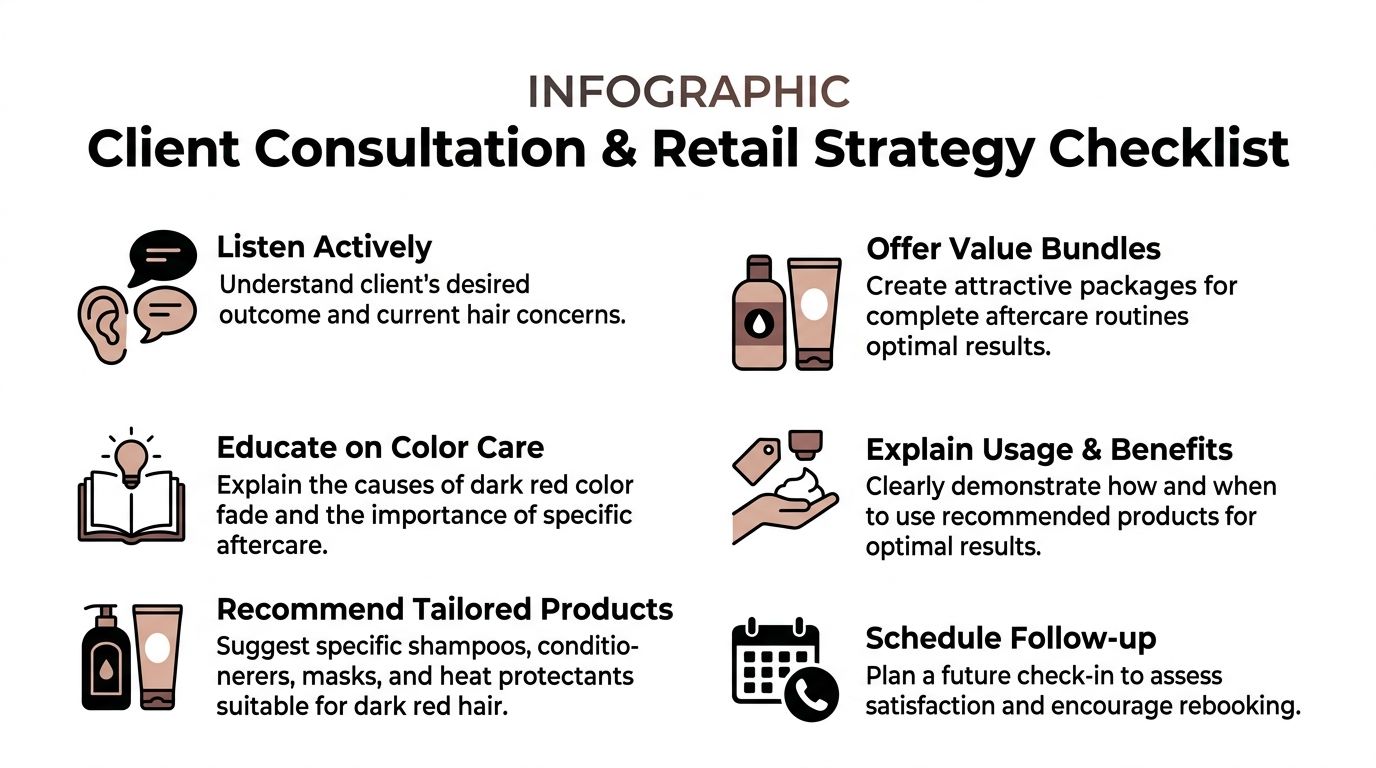
The strongest dark red retail sales rarely begin with “Do you need shampoo as well?” They begin with a short, intelligent consultation that sounds informed rather than scripted.
Dark red hair is a specialty category. In Switzerland, direct population figures for natural dark red are limited, but broader research places natural red hair among the rarest hair colours, occurring in 2% to 6% of people of Northwestern European ancestry and about 1% to 2% globally, according to a review of red hair genetics and prevalence. For retail, that rarity matters less as a demographic point and more as positioning. Clients should understand that red is not a casual maintenance category. It's a premium, intentional choice.
A consultation that builds trust
A good retail consultation is brief, but it isn't superficial. Start with questions that reveal treatment history and maintenance habits.
Ask things like:
- “Was your hair lightened first, or was colour applied onto your natural base?”
- “Do you style with heat most days, sometimes, or hardly ever?”
- “Is your goal to keep the red vivid, or keep it looking expensive and glossy?”
- “Do you want the simplest routine possible, or are you happy to maintain it properly?”
That last question is commercially important. Some clients want the look, but not the upkeep. You can still sell well to them, but the recommendation should be tighter and more realistic.
A model conversation on the shop floor
Client: “I had it done last week, but I know red fades quickly. I just need a shampoo.”
Advisor: “You do need a gentle cleanser, but shampoo alone usually won't protect the finish you paid for. How often do you wash, and do you use heat afterwards?”
Client: “Every other day, and yes, usually a dryer and sometimes a straightener.”
Advisor: “Then I'd keep your routine narrow but strategic. A gentle cleanser, a conditioner with more slip, and one leave-in for heat. If your ends already feel drier, add a mask through the week rather than washing more often.”
That exchange does three things. It respects the client's budget, links recommendation to behaviour, and makes the advisor sound competent rather than promotional.
How to move from single item to regimen
The upsell should feel like problem-solving.
Start with the risk
“The colour itself is rich, but red reflection drops fast when the hair gets dry or over-washed.”
Name the role of each product
“This cleanser is for gentle washing. This conditioner keeps the fibre smoother. This mask is what helps the colour still look polished by week three.”
Reduce overwhelm
“You don't need a complex routine. These are the pieces that do the work.”
What your staff should never do
- Don't promise permanence. Dark red changes. Clients handle that better when you explain maintenance clearly.
- Don't oversell repair language. If the concern is tone retention, say so. Not every issue is “damage”.
- Don't ignore lifestyle. A client who swims, blow-dries daily, or washes frequently needs different advice from a low-manipulation client.
The best retail consultation sounds like a diagnosis with a solution, not a script with a basket target.
Merchandising for premium Swiss retail
Dark red hair should have its own advisory logic in-store. That can be a dedicated shelf edit, a colour-preservation card, or a pharmacy consultation cue. The important thing is coherence.
A strong retail cluster usually includes:
- Cleansing support
- Conditioning and masking
- Heat and leave-in protection
- Optional tone-refresh support where appropriate
Train staff to speak in outcomes clients recognise: less fading into brown, better shine, softer feel, easier management, fewer disappointing wash days. Those are the phrases that convert.
Becoming the Go-To Expert for Dark Red Hair
Dark red hair is one of those categories that exposes the gap between selling products and giving advice. A retailer who only offers colour-safe basics becomes interchangeable. A retailer who can decode the shade, understand the salon process, and prescribe a clean aftercare routine becomes memorable.
That matters in Switzerland, where premium beauty customers often prefer edited assortments and informed recommendations over noise. They don't need a wall of options. They need someone who understands why mahogany behaves differently from cherry, why freshly coloured hair can feel fine at the root and dry at the ends, and why maintenance discipline matters more than product volume.
What expertise looks like in practice
It looks like asking one better question before recommending anything.
It looks like explaining trade-offs clearly. Warmth versus cool depth. Visibility versus subtlety. Simplicity versus upkeep.
It also looks like merchandising with intention. Not “hair care” as a generic block, but a curated answer to a specific client problem: how to keep dark red hair rich, reflective, and credible between appointments.
Why this niche is worth owning
Dark red hair rewards expertise because it's emotionally charged and technically fragile. Clients who feel well guided tend to come back. They remember who explained the upkeep accurately. They remember who sold them fewer products, but the right ones.
For a pharmacy, boutique, spa, or premium e-commerce partner, that's the larger opportunity. This isn't only about one shade family. It's about building a reputation for intelligent beauty advice in categories where mass retail usually underperforms.
Own that role, and dark red hair stops being a difficult colour category. It becomes a trust category.
If you're building a premium clean-beauty assortment for Swiss retail, beautysecrets.agency helps pharmacies, spas, boutiques, and e-commerce partners curate distinctive natural and ethically sourced brands with the compliance, product storytelling, and trade support needed to turn specialist advice into stronger retail performance.