You're standing in front of a clean-beauty pitch deck that looks polished, has soft colours, a calming founder story, and a shelf-friendly assortment. The problem is obvious if you buy for a Swiss pharmacy, spa, or premium retailer, because pretty slides don't tell you whether the formulas will survive scrutiny, whether the claims are defensible, or whether the line will move once it hits shelf.
Clean beauty is also not a neat legal bucket in Switzerland, so if you buy it like a category with a fixed definition, you'll end up listing a vibe instead of a product standard. That's the commercial trap. The better approach is to treat the best clean beauty products as a vetted set of SKUs that clear compliance, ingredient transparency, certification, and merchandising tests before they ever get a facings discussion.
Why Clean Beauty Needs a Trade Definition in Switzerland
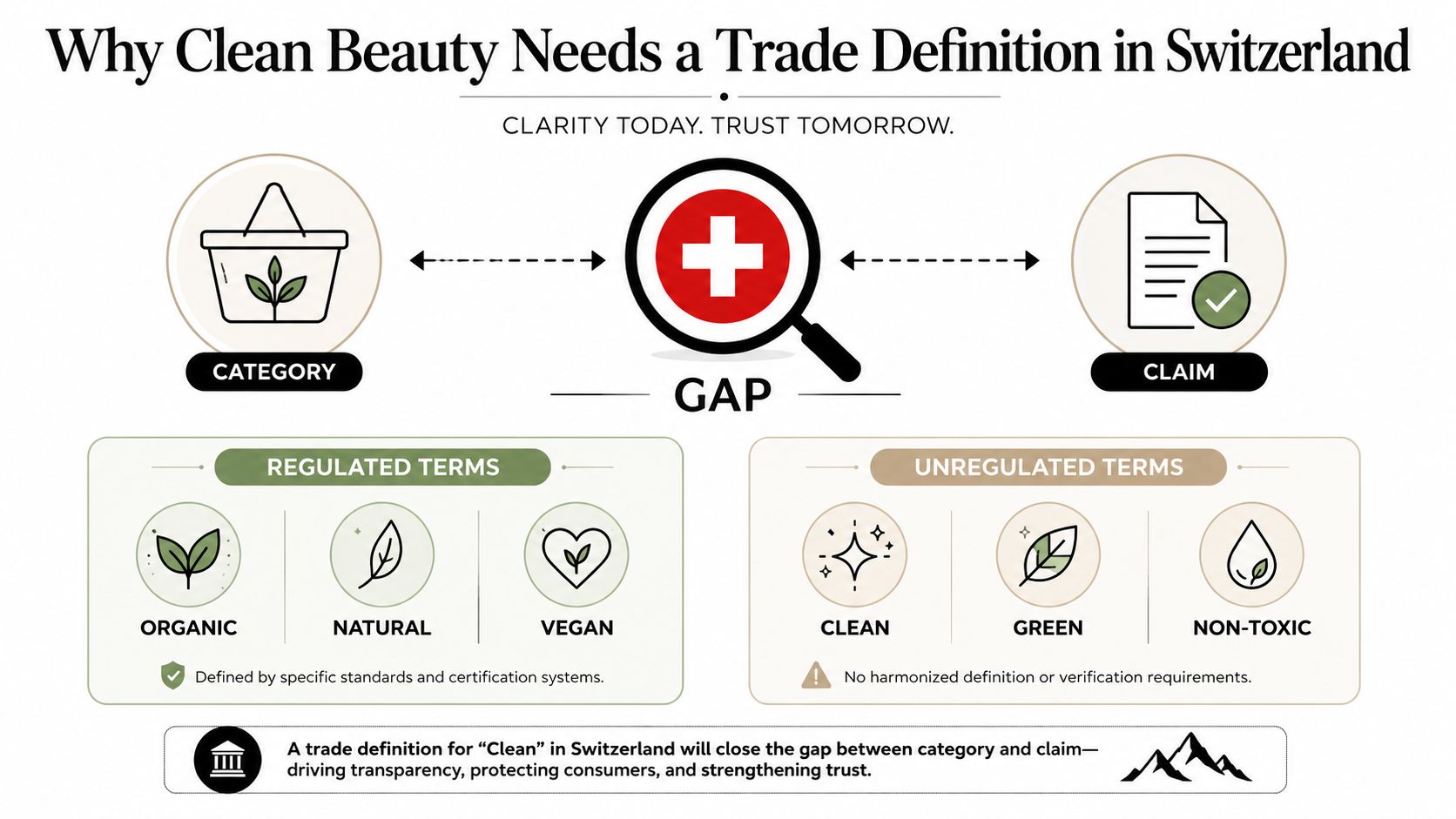
Switzerland doesn't give you a tidy legal shortcut for the word clean. That's the core issue. The Swiss Federal Food Safety and Veterinary Office cosmetics labelling framework pushes buyers towards ingredient disclosure and compliant claims, but the term itself is still a marketing label in practice, not a protected category, so the trade has to build its own working standard around evidence rather than mood. The practical implication is simple, if you can't explain why a SKU is clean in one sentence, you shouldn't buy it.
What a buyer should actually mean by clean
A useful trade definition is not “natural-looking” or “free from bad stuff” because both are vague and easy to abuse. It's formulation transparency, verified third-party standards, and documented ingredient avoidance, applied the same way across every candidate SKU. That gives you a standard you can brief to store teams, defend to category management, and apply consistently whether the brand is a heritage balm, a spa line, or a premium facial range.
The European and Swiss commercial context makes that discipline worth the effort. Grand View Research estimates that Europe accounted for 29.36% of global clean-beauty revenue in 2025, and that skincare held 41.4% of the global clean-beauty market in the same year, which is exactly why Swiss pharmacies and premium retailers should care about assortment quality in this space. The same report places the global clean-beauty market at USD 10.49 billion in 2025 and projects USD 35.30 billion by 2033 at a 16.8% CAGR (Grand View Research clean beauty market report).
Practical rule: if the brand can't show the full INCI, certification scope, and ingredient exclusions in writing, it's not ready for shelf.
Why sustainability language still needs proof
A lot of founders talk sustainability fluently, but that doesn't help a buyer if the supply chain story isn't documented. If you need a practical way to connect sourcing talk with measurable procurement discipline, a useful reference is prove your sustainability impact, because buyers need the same level of traceability thinking even when the shelf conversation is about cosmetics rather than logistics. The point isn't to become a sustainability auditor. The point is to stop confusing brand theatre with retail readiness.
The Compliance-First Vetting Workflow for Every SKU
Start with the document trail, not the founder's pitch. If you reverse the order, glossy brands pass the vibe check and fail the technical one later, which wastes everyone's time. The correct sequence is FSVO labelling review, then full INCI audit, then EWG Skin Deep cross-check, then certification verification. That order protects you from letting a strong logo override a weak formula.
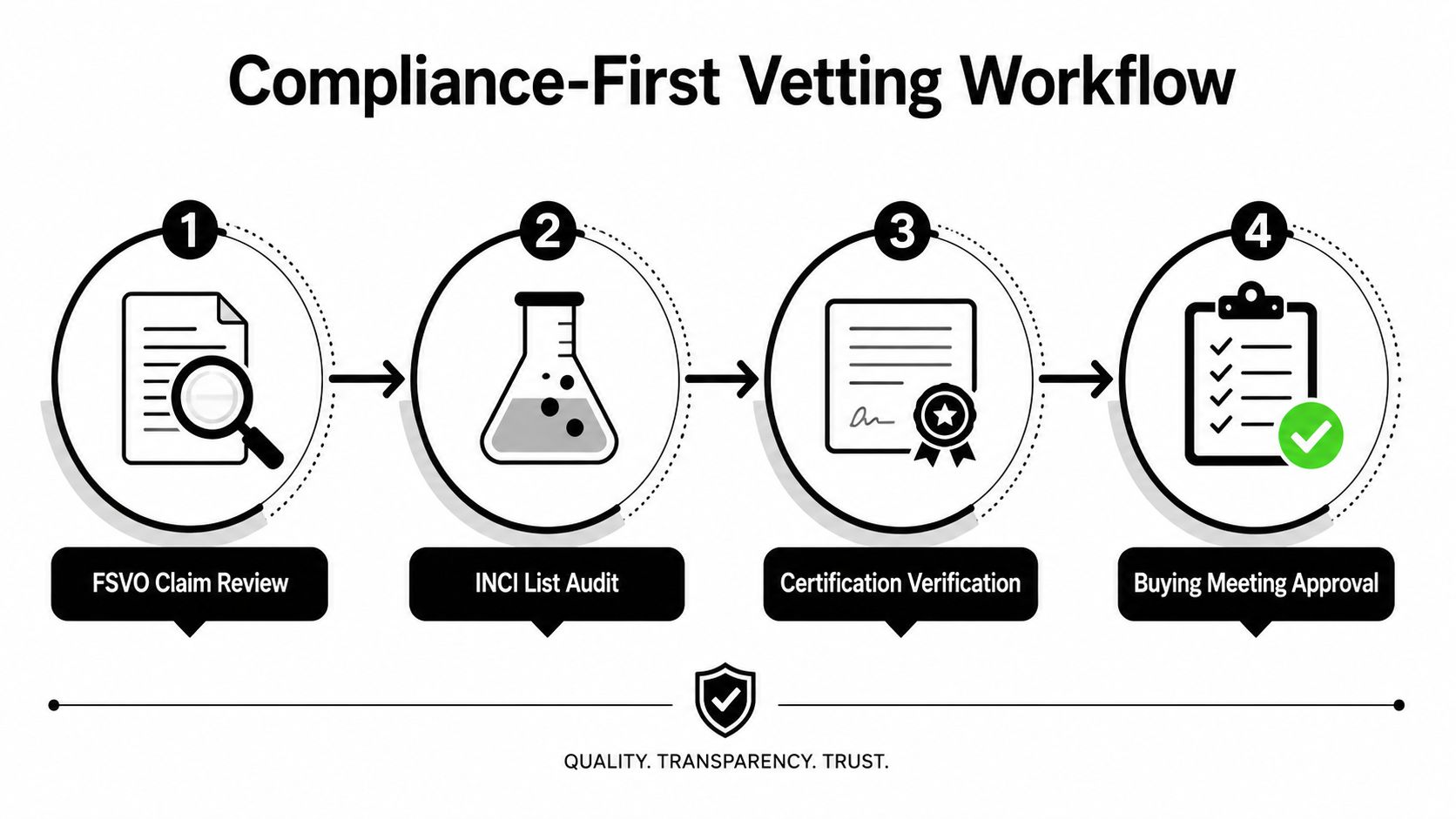
Stage one is the label and claim check
Ask for the product label as it will appear in Switzerland. Read it like a compliance officer, not a beauty editor. If the claim language is broad, vague, or unsupported, you already have a warning sign. The signal you want is a brand that can separate marketing language from regulatory language without getting defensive.
Next, run the full INCI list. You want the complete ingredient list, not a hero-ingredients slide. The trade question is straightforward, can this formula be defended by a buyer who has never met the founder and only has the pack copy in front of them?
Stage two is the hazard and certification cross-check
Once the INCI is in hand, cross-check the product on EWG Skin Deep for hazard flags, then ask for the certification documents. The relevant question is not whether the pack carries a nice seal, it's whether the brand can show the actual scope and status behind that seal. A logo without scope documentation is decorative.
A clean-buying meeting should end with one of three answers, pass, conditional pass, or fail. Anything else means the team hasn't done the work.
Stage three is the internal checklist
Turn the process into a one-page sheet that a junior buyer can run without supervision. Keep it brutally simple.
- FSVO label present: If the Swiss-compliant label is missing or inconsistent, stop.
- INCI complete: If the brand won't share the full list, stop.
- Hazard cross-check reviewed: If the formula has obvious red flags and no explanation, stop.
- Certification proof supplied: If the brand can't provide the scope document, stop.
This workflow is useful on lines like Fushi, JULISIS, or Little Butterfly London because it forces the same discipline across very different brand stories. The trade signal is not “interesting story”, it's “defensible assortment candidate.”
Which Certifications Actually Change a Listing Decision
Not every badge earns the same weight on a Swiss shelf. Some certifications move a product from “interesting” to “buyable”. Others mainly help a shopper feel reassured after the fact. If you treat them as interchangeable, you'll overpay for decorative credibility and underprice the certifications that reduce buyer risk.
| Certification | What It Verifies | Shelf Signal in CH | Trade Use |
|---|---|---|---|
| ECOCERT | Ingredient and process standards with an external audit trail | Strong, especially for shoppers who recognise natural and certified-organic positioning | Worth a price premium when the formula and packaging story are also clean |
| COSMOS | A recognised standard tied to cosmetics formulation and certification rules | Strong, because it reads as more technical than generic “natural” language | Good for premium skincare and sensitive-skin assortments |
| Cruelty-free standards aligned with PETA and Cruelty Free International | Animal-testing commitments and related controls | Clear and easy for shoppers to understand at shelf | Useful as a trust layer, but usually a supporting signal rather than the main reason to list |
| Retailer in-house seal | The retailer's own defined standards | Depends on how visible and trusted the retailer is | Useful internally, but it shouldn't replace third-party proof |
What deserves a premium
ECOCERT and COSMOS deserve the most attention when the formula is otherwise strong, because they help translate back-end discipline into front-end confidence. They're the marks that can justify a cleaner premium story in pharmacies, premium retailers, and spa environments where the buyer needs a sharper rationale than “the founder said it's natural.” Ask for the certification scope, not just the logo file. That tells you whether the claim covers the actual SKU you're buying.
Cruelty-free commitments matter too, especially in categories where shoppers are comparing several similar-looking products and need a fast trust signal. But don't overstate them. A cruelty-free seal doesn't tell you enough about texture, preservation, irritation risk, or fragrance system quality.
What should stay in the footnote
Retailer in-house seals can support a shelf story, but they're only as credible as the retailer's standards document. If the internal criteria are tight and transparent, they help. If they're fuzzy, they become a decorative sticker. That's why the founder's willingness to share certification paperwork matters more than the slide deck.
Trade rule: pay more for standards that reduce your risk, not for badges that only improve the landing page.
Reading an INCI Like a Buyer, Not a Marketer
Most buyers get trapped by “clean” language because the pack sounds reassuring and the formula isn't immediately legible. That's a bad habit. The INCI list is where the truth lives, and once you know what to look for, you can spot weak claims in under a minute.
Fragrance is the first place to press
If a brand says a product is fragrance-free, ask them to show the exact wording on the pack and the full formula. If the INCI just says parfum or fragrance, don't let anyone wave that away as a cosmetic detail. Ask what is in the scent system, whether it's intended for leave-on use, and whether it changes the irritation profile for facial or baby categories. Expert clean-beauty guidance consistently recommends reading the full INCI and avoiding vague fragrance disclosures, especially in sensitive-skin and SPF products (LIVETINTED clean beauty brand guidance).
Sunscreen and preservation need a harder conversation
SPF products are where marketing language gets especially slippery. If the brand sells sunscreen, it should disclose the UV filters clearly and be ready to explain the role of each one. Preservation is the same story. If the brand claims “preservative-free” in a product that clearly needs stability, you should ask how microbiological safety is being handled. A clean product that fails stability is not premium, it's a liability.
If a founder gets vague when you ask about preservation or UV filters, that's your answer.
Build a buyer script that travels well
Use the same questions every time so your team learns what good looks like.
- Can you share the full INCI in final pack order?
- What does the fragrance system contain, if anything?
- Which ingredients are excluded, and where is that exclusion documented?
- How is this formula preserved, especially in leave-on categories?
- If this is SPF, which UV filters are used and how are they disclosed?
The aim isn't to turn a buyer into a chemist. It's to make sure the buyer can spot when a claim is carrying more weight than the formula deserves. That's the difference between a good-looking launch and a defensible one.
Pricing, Margins and MOQ Realities for Premium Clean Lines
Clean beauty is often sold as an easy premium story, but the shelf maths still matter. Good formulas don't protect margin by themselves. If the MOQ is too high, the launch pack is too broad, or the refill story is weak, the retailer ends up carrying elegant stock that doesn't rotate fast enough. The line can be excellent and still be a poor commercial fit.
What usually pushes the economics off balance
The biggest hidden costs sit outside landed price. Staff training time, sampling, PDP development, tester management, and returns on sensitive-skin SKUs all consume margin. If a brand expects you to do the education work while they keep the story vague, you're funding their brand equity with your retail overhead. That's a bad trade.
For premium clean lines, the better negotiation is usually not “give me a lower price at any cost.” It's “give me a cleaner starter structure, lower risk on launch quantities, and support material that shortens sell-in and sell-through.” If you need a practical framework for offer design, the guide to irresistible offers in ecommerce is useful because the logic of bundling, clarity, and perceived value still applies when the channel is retail rather than pure play.
Which brands usually feel the most sellable
In Swiss channels, lines like Abahna, JULISIS, Les Thermes Marins de Saint-Malo, and Egyptian Magic tend to make sense when the story is easy to explain, the usage occasion is clear, and the SKU count doesn't overwhelm the shelf. That doesn't mean every item wins. It means the brand architecture already gives you a cleaner way to sell the category.
beautysecrets.agency is one distributor that fits that model in Switzerland, because it works with natural, ethically sourced formulations and carries brands that can be merchandised into pharmacy, spa, and premium retail settings. That matters only if the commercial structure is still disciplined. A beautiful brand with poor rotation is still dead stock.
Shelf Strategy, Sampling and Staff Training That Move Units
Once the SKU passes compliance and commercial review, the real work starts. Many retailers lose clean beauty at this stage. They list good products, then bury them in the wrong part of the shelf, fail to sample the right textures, and expect staff to explain certifications they barely understand. That's how clean beauty becomes a slow mover.
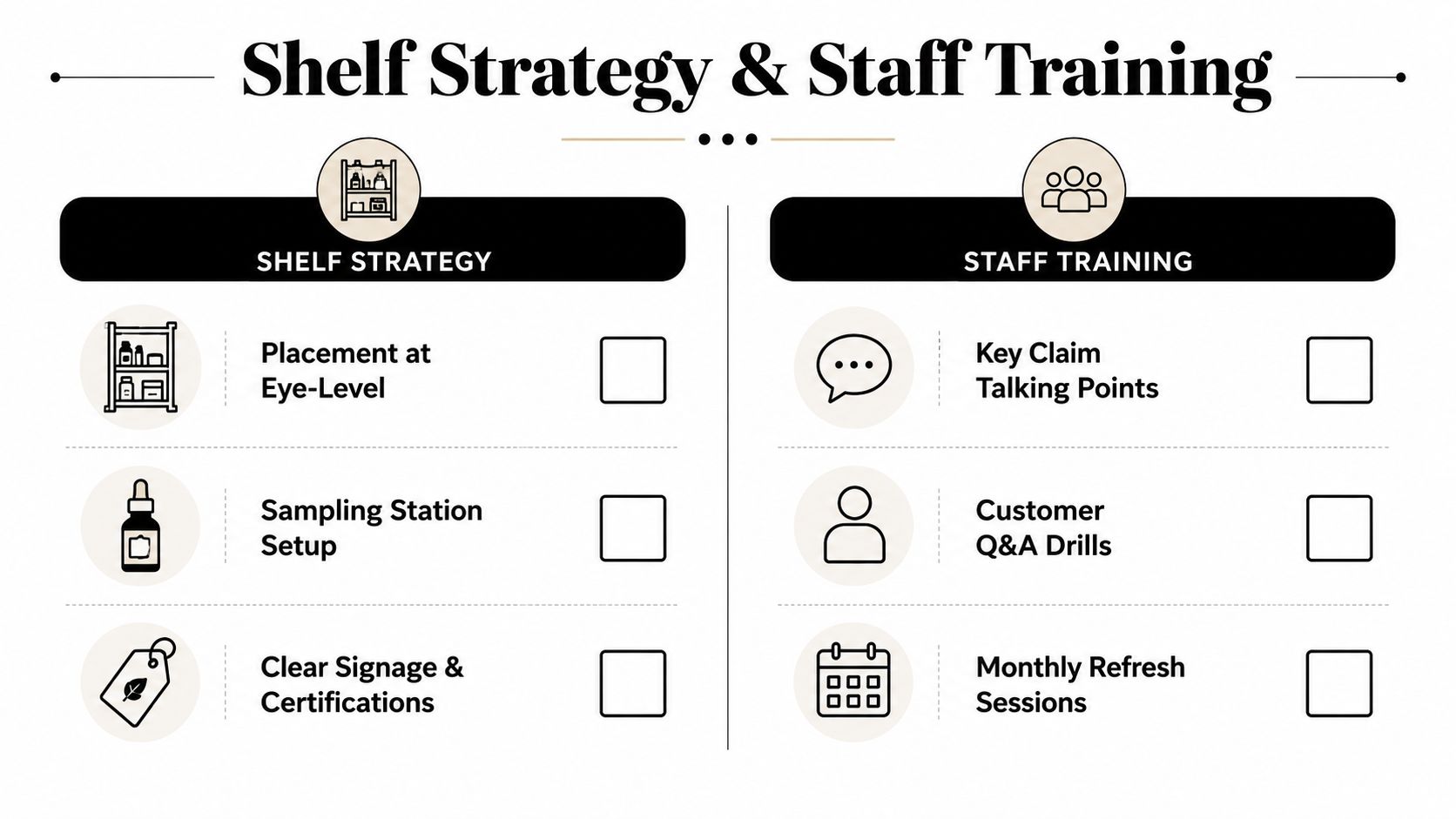
Cluster by claim, not just by brand
A pharmacy or premium retailer should group clean skincare by job to be done, not by who owns the logo. Put barrier repair, anti-ageing, baby care, and sensory bath and body into clear buckets. Shoppers don't browse certification archives, they shop solutions. If your shelf logic mirrors the way people think about skin needs, the line sells itself faster.
Sampling also matters more in clean beauty than many buyers admit. Texture, slip, absorption, and scent all affect repeat purchase, especially in sensitive-skin and baby categories. Use testers strategically on the products where feel matters most, not indiscriminately across everything. A hand cream might sell from a dab test. A facial serum usually needs a clearer explanation at the counter.
Staff need short scripts, not brand poetry
Frontline teams in Swiss pharmacies, boutiques, and department stores can't carry long training manuals in their heads. Give them short, defensible lines.
- ECOCERT or COSMOS means external standards, not just a natural-looking label.
- Cruelty-free tells you something important, but not everything about performance.
- INCI transparency beats vague “clean” language every time.
- Sensitive-skin shoppers need ingredient clarity, not marketing flourish.
A monthly refresh session is enough to keep the language tight if the material is good. The goal is not to memorise every ingredient. It's to make sure staff can explain why a certified line belongs in the assortment and who it is for. When staff understand the difference between a certification and a claim, conversion gets easier because the conversation feels trustworthy.
A Monday-Morning Sourcing Scorecard for Clean Beauty
Use one scorecard for every pitch and keep it brutal. If a brand can't pass compliance, the rest of the conversation doesn't matter. If it passes compliance but can't show credible certification, the score drops. If the formula is good but the margin shape is weak, you don't have a buyer's item, you have a vanity item.
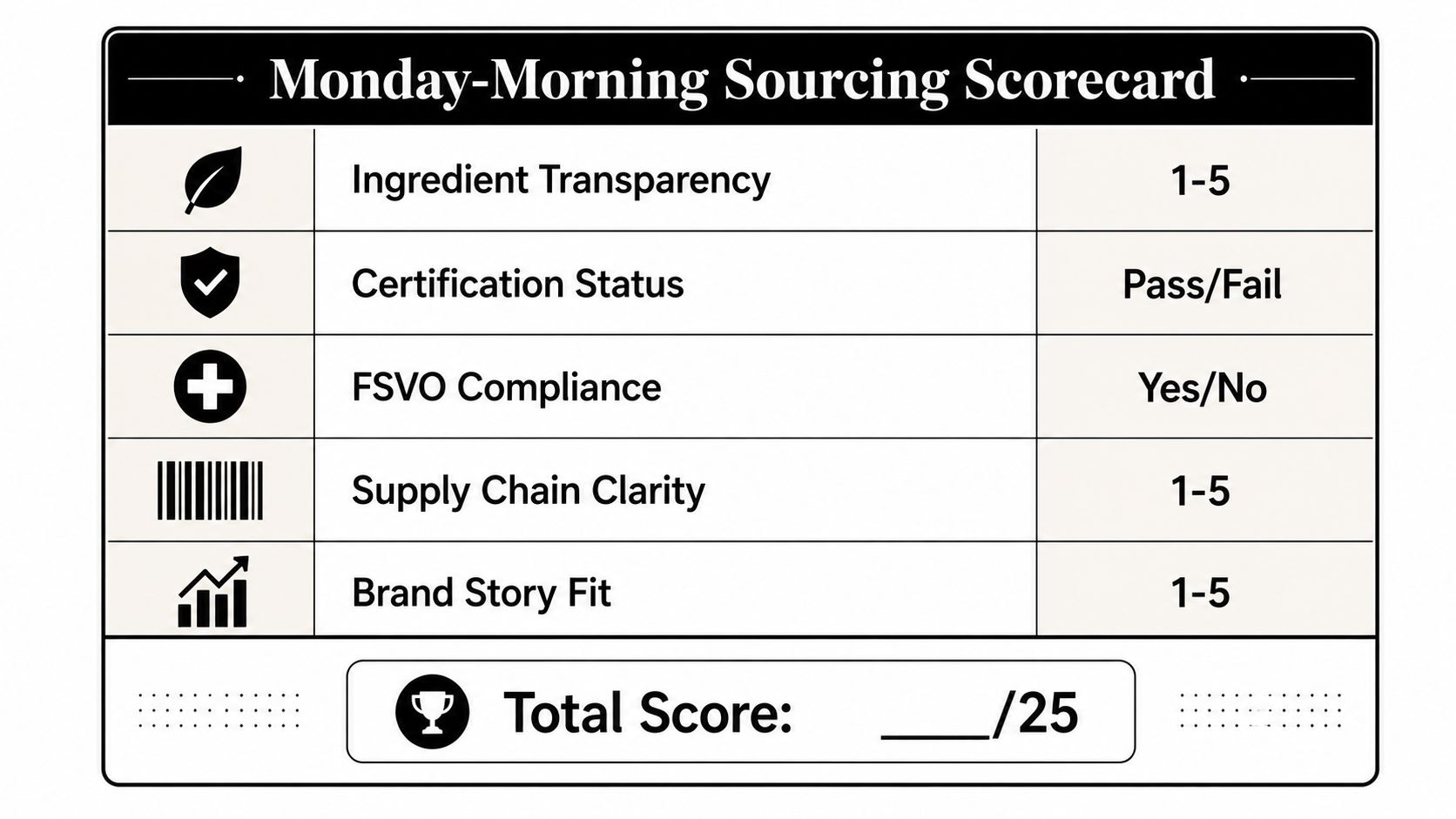
Score the candidate on what actually matters
- Ingredient transparency, 1 to 5. Can you read the INCI, understand the exclusions, and defend the formula?
- Certification status, pass or fail. Is there real third-party proof, not just a logo?
- FSVO compliance, yes or no. Does the label and claim set hold up in Switzerland?
- Supply chain clarity, 1 to 5. Can the brand explain sourcing, production, and documentation cleanly?
- Brand story fit, 1 to 5. Does the line match the retailer's channel, customer, and price architecture?
A simple cut-off protects the buying team from emotional decisions. If any of the hard checks fail, the product doesn't move forward. If the line passes the hard checks but scores poorly on story fit or supply chain clarity, it can still be a conditional no. That's how you keep the assortment premium without making it fragile.
The best clean beauty products are not the prettiest ones in the pitch deck. They're the ones that survive the checklist, make sense on shelf, and give staff a story they can tell with confidence.
If you want a Swiss distributor that already thinks this way, visit beautysecrets.agency. They work with natural, ethically sourced formulations and help retailers, pharmacies, spas, and premium e-commerce partners build assortments around compliance, certification, and shelf-ready storytelling.