A customer steps up to the counter with a familiar question. They’re holding a blister pack of vitamin e capsule supplements in one hand and a facial oil in the other. “Should I take this, or put it on my skin?”
That question sounds simple, but it isn’t. In a Swiss pharmacy or premium retail setting, the answer depends on what the customer means by “works”, what form of vitamin E the product contains, how the formula is built, and how carefully the label explains its origin. A generic answer misses the point. A good answer turns a routine sale into a professional consultation.
Vitamin E sits at the intersection of nutrition, skincare, formulation science, and clean-label expectations. Customers often assume that every vitamin e capsule is the same. Retail teams know that’s not true. A capsule may contain a common tocopherol form or a broader vitamin E complex. It may be positioned for oral use, used off-label as a topical oil, or paired with barrier-support skincare. It may also be naturally sourced or synthetic, which matters more in Switzerland than many brands realise.
For pharmacy chains, drugstores, spa boutiques, and premium e-commerce teams, this category rewards precision. Staff who can explain tocopherols versus tocotrienols, oral versus topical use, and natural versus synthetic sourcing give customers a reason to trust the recommendation and return for more than a refill.
Introduction The Modern Vitamin E Conversation
The modern vitamin E discussion starts with confusion. Many shoppers know the ingredient by reputation. They associate it with skin comfort, antioxidant care, after-sun routines, hair oils, capsules, and “natural beauty”. What they usually don’t know is how to sort those ideas into practical choices.
In retail, that confusion appears in predictable ways. One client wants support for dry, stressed skin and reaches for a vitamin e capsule because a friend suggested cutting it open. Another wants an ingestible supplement but assumes every label represents the same biological activity. A third reads “tocopherol” on a cosmetic and doesn’t know whether it’s there for skin benefit, product stability, or both.
That’s where product education matters.
What staff need to explain clearly
A strong consultation usually covers four points:
- Use route matters: Oral and topical vitamin E don’t do the same job in the same way.
- Form matters: “Vitamin E” is a family name, not a single molecule.
- Origin matters: Natural and synthetic forms shouldn’t be discussed as if they were automatically identical in customer perception.
- Label literacy matters: Ingredient naming often determines whether a customer sees a product as premium, pharmaceutical, or clean-beauty aligned.
A pharmacist doesn’t need to become a biochemist. But they do need enough precision to avoid overpromising, enough fluency to decode labels, and enough commercial awareness to merchandise the category intelligently.
A vitamin e capsule is rarely just a capsule in the customer’s mind. It’s a wellness product, a beauty product, and a trust test all at once.
In Switzerland, that trust test is sharper. Customers often cross-shop supplements, dermocosmetics, and natural beauty. If the shelf language is vague, the sale becomes price-led. If the explanation is clear, the sale becomes expertise-led.
Understanding the Two Families of Vitamin E
Vitamin E is best understood as a family with two main branches. They share a surname, but they don’t behave in exactly the same way. Those two branches are tocopherols and tocotrienols.
For most pharmacy customers, tocopherols are the familiar relatives. They appear more often in supplements, skincare labels, and standard educational material. Tocotrienols are the less familiar branch. They attract interest in more specialised formulations and premium ingredient conversations.
A useful way to explain the difference
Use a family analogy on the shop floor. Tocopherols are the branch everyone recognises. They’re established, widely used, and easy to find. Tocotrienols are the specialised cousins. They belong to the same wider family, but they’re discussed more often in technical, performance-focused, or niche ingredient contexts.
That framing helps customers understand a key truth. Not every “vitamin E” listing means the same thing.
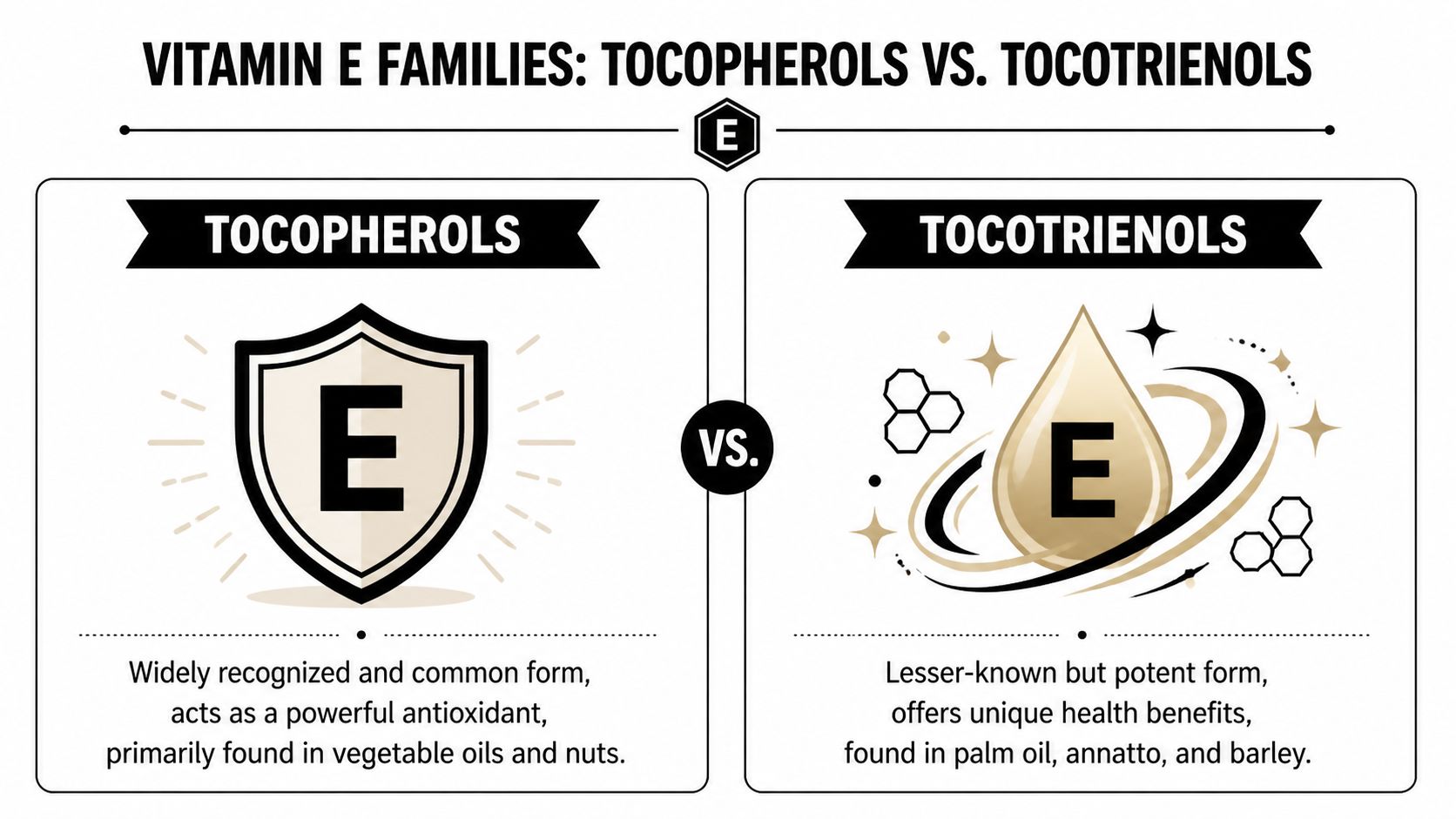
Tocopherols versus tocotrienols at a glance
| Feature | Tocopherols | Tocotrienols |
|---|---|---|
| Recognition in retail | More familiar to shoppers and staff | Less familiar, often requires explanation |
| Typical presence | Common in supplements and cosmetics | More often seen in specialised products |
| Ingredient language | Often listed as tocopherol or alpha-tocopherol | Usually highlighted when a brand wants to signal distinction |
| Retail conversation | Easy to position as classic vitamin E | Better positioned as part of an advanced ingredient story |
| Shopper perception | Established and straightforward | Niche, premium, or innovation-led |
Why this distinction matters in practice
In supplements, many products focus on alpha-tocopherol because it’s the best-known form for general consumer use. In cosmetic formulas, tocopherol may appear both as a skin-facing ingredient and as a support ingredient that helps protect oils within the formula itself. Tocotrienols, when present, often need stronger educational support because customers won’t recognise the term.
That means your shelf card, PDP copy, and staff script should do different jobs depending on the family in front of you.
For tocopherol-led products:
- Keep language direct.
- Explain antioxidant support in plain terms.
- Connect it to skin comfort, oil protection, and classic vitamin E familiarity.
For tocotrienol-containing products:
- Slow down the explanation.
- Use category language such as “broader vitamin E family” or “specialised form”.
- Avoid implying that “newer sounding” always means better for every shopper.
Retailers who want a clear consumer-facing explanation of source and body compatibility can also review OPTIMACY's guide to natural vs synthetic. It’s useful background for training teams to discuss why shoppers pay attention to ingredient origin, not just ingredient name.
Practical rule: When a customer says “I want vitamin E,” the next question should be “for swallowing, for skin, or for both?”
That one question often reveals whether the customer needs a supplement, a serum, a balm, or a better explanation.
Oral Supplementation Versus Topical Application
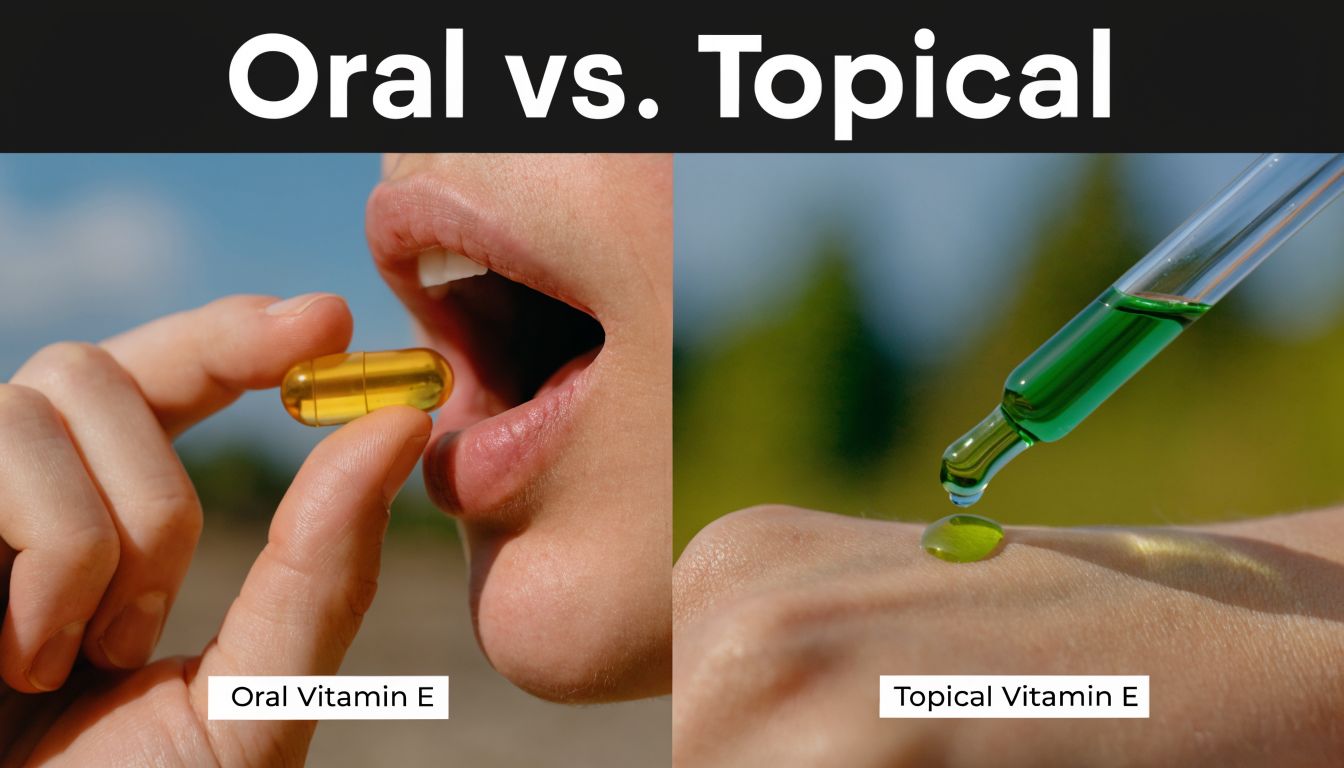
Many sales conversations veer off course. Customers often assume that swallowing a vitamin e capsule and applying vitamin E on the skin are interchangeable routes to the same result. They aren’t.
Oral use works from the inside out. Topical use works where you apply it. Both can belong in a routine, but they solve different problems and should be explained differently.
Oral use and the inside-out conversation
When a customer buys a vitamin e capsule as a supplement, they’re usually looking for broad support rather than a purely local cosmetic effect. That makes the conversation less about “instant glow” and more about internal nutritional support.
In practice, oral supplementation fits customers who:
- Prefer capsules to topical textures.
- Want a supplement as part of a broader wellness routine.
- Are already shopping in the pharmacy for nutritional products and want continuity across categories.
This is also where teams need discipline. Don’t promise that a capsule will behave like a face oil. Don’t imply that ingesting a supplement will target one specific patch of skin in the same way a topical treatment can. Keep the language realistic.
Topical use and the outside-in conversation
Topical vitamin E is easier for customers to understand because the route is visible. They apply it where they want support. That may be the face, lips, cuticles, dry areas, or a compromised-feeling skin barrier in need of comfort.
In skincare retail, topical vitamin E usually enters the conversation in four forms:
- Facial oils: Often positioned for dryness, comfort, and a soft finish.
- Balms and multipurpose salves: Useful for targeted care on small dry zones.
- Creams and lotions: More elegant for daily all-over use.
- Serums or treatment oils: Better for customers who want a more active, premium-feeling routine.
A simple floor explanation works well: oral vitamin E supports the body’s internal environment, while topical vitamin E supports the surface you can feel.
How to answer the common “Can I cut open the capsule?” question
Customers ask this often. The safest retail answer is practical rather than dramatic.
Yes, some people use the contents of a vitamin e capsule topically. But a capsule designed for swallowing isn’t automatically the best cosmetic formula for the face. It may feel heavy, greasy, or difficult to spread. It also hasn’t necessarily been designed for elegant sensory performance, stable pairing with other actives, or low-residue wear under make-up.
That’s why a dedicated topical product usually gives a better user experience.
If the customer wants skin results, sell skincare. If they want supplementation, sell a supplement. If they want both, explain the roles separately.
A consultation format that works well
Use a short comparison instead of a lecture.
| Customer goal | Better first option | Why |
|---|---|---|
| Dry-feeling facial skin | Topical vitamin E product | Direct local support and better texture choice |
| General supplement routine | Oral vitamin e capsule | Fits ingestible wellness habits |
| Damaged-feeling cuticles or elbows | Balm or oil with vitamin E | Targeted application is more practical |
| Wants “beauty from within” plus skincare | Combined oral and topical routine | Covers both routine preferences without pretending they are identical |
A short visual explainer can help staff training teams align on these distinctions:
Where retailers often overcomplicate the category
They use too much technical language for a basic buying decision. Most customers don’t need a chemistry lesson at the shelf. They need route clarity.
Try scripts like these:
- “This capsule is for supplementation. If your main goal is surface dryness, a topical product will feel more direct.”
- “You can think of the capsule as part of an inside-out routine, and the serum as the outside-in part.”
- “If you dislike oily textures, don’t cut open a capsule. Choose a cream or serum designed for skin use.”
That approach reduces returns, increases satisfaction, and positions the pharmacy team as careful rather than pushy.
The Role of Vitamin E in Cosmetic Formulation
Customers often see vitamin E on an ingredient list and assume it’s there only to benefit their skin. In many formulas, that’s only half the story. For formulators, vitamin E also helps protect the product itself.
That dual role matters for premium retail. It changes how you talk about quality, freshness, and why one oil-based product feels more thoughtfully built than another.
Skin-active and formula-protective
When formulators add tocopherol to an oil-based product, they may be doing two things at once. First, they may want the ingredient’s recognised skincare value. Second, they may want help protecting delicate plant oils in the formula from degrading too quickly.
For Swiss retail teams selling botanical oils, balms, and richer natural skincare, this is a valuable point. A label that includes tocopherol can signal that the brand has considered formula integrity, not just marketing claims.

Why this matters in oil-rich products
Natural beauty ranges often rely on botanical oils, waxes, and lipid-rich blends. Those ingredients can feel luxurious, but they also require careful stabilisation. Tocopherol can support that work.
This is especially relevant when discussing products such as:
- multipurpose balms,
- facial oils,
- body oils,
- rich creams with plant oil phases,
- herb-infused or seed-oil-based treatments.
A customer may not ask, “How has this formula been protected from oxidation?” But they do notice when a product smells tired, changes character early, or doesn’t inspire confidence after opening.
Better talking points for premium skincare
Avoid saying “vitamin E is in here, so it’s anti-ageing.” That’s too broad and often too vague for informed Swiss shoppers.
Use more precise language:
- “Tocopherol supports the formula as well as the skin.”
- “It’s often included in oil-based products to help maintain the quality of delicate plant oils.”
- “Seeing vitamin E on the list can be a sign the brand has thought about stability, not only the headline active.”
That language is especially useful for premium products whose value lies in craftsmanship as much as in trend ingredients.
How this supports price justification
A thoughtful formula does more than promise results. It protects its own ingredients so the product remains pleasant and credible through normal use. That’s part of what shoppers pay for when they buy a higher-end balm or facial oil from a curated range.
In staff training, I’d separate “hero ingredients” from “supporting intelligence”. Vitamin E often belongs to both groups. It can contribute to the user-facing story while also functioning behind the scenes.
Retail teams should treat tocopherol on a cosmetic label as a formulation clue, not just a marketing buzzword.
For broader training on nutrient-led skin conversations, Essential vitamins for radiant skin is a useful reference for teams who need a simple overview of how vitamin-based positioning appears in skincare education.
What to look for on the pack
A practical checklist helps staff read beyond the front claim:
- Ingredient context: Is tocopherol part of an oil-heavy formula where stabilisation makes sense?
- Formula style: Is the product a balm, oil, or richer emulsion where vitamin E has a clear supporting role?
- Brand coherence: Does the inclusion fit a thoughtful natural formulation story rather than a random claim?
- Texture expectation: A product with vitamin E may still vary widely in elegance, richness, and absorbency.
That last point matters. Vitamin E doesn’t guarantee a pleasant feel. The whole formula determines that. A strong retailer explains both the science and the sensorial outcome.
Guidance on Dosage Safety and Efficacy
This is the point where retail advice must become careful. Customers often ask for a “right dose” or a “stronger” product, but vitamin E isn’t a category where more automatically means better.
Because this article is limited to verified facts, it’s best to stay qualitative on exact dosing and keep the focus on safe interpretation, clear labelling, and referral when needed.
Oral supplements and label reading
When a customer buys a vitamin e capsule, encourage them to read the supplement facts panel closely. Different products may express strength in different units, and customers often compare packs without realising the format may differ.
What staff should say:
- The label unit matters.
- The capsule strength should be interpreted in context of the full routine.
- Customers taking other supplements should check for overlap.
- Anyone with a medical condition, medication use, or uncertainty about appropriateness should speak with a pharmacist or physician before adding a supplement.
That approach keeps the advice responsible without pretending retail staff are replacing medical care.
Topical use and concentration logic
For skincare, customers often assume that a more concentrated-looking formula is automatically more effective. That isn’t reliable. A heavy, sticky, or poorly balanced product may reduce adherence because the customer won’t use it consistently.
A better explanation is that efficacy depends on the whole formula:
- the base,
- the compatibility with other ingredients,
- the skin type,
- the area of application,
- and the customer’s willingness to use it regularly.
A practical safety script
If your team needs a short default response, use this:
- Clarify the route: “Are you planning to swallow it or apply it to the skin?”
- Check the routine: “Are you already using other supplements or active skincare?”
- Read the pack together: “Let’s confirm the unit, instructions, and intended use.”
- Escalate when needed: “If you’re taking medicines or have a health concern, it’s best to confirm with a healthcare professional.”
Common points of confusion
| Customer question | Better answer |
|---|---|
| “Is the strongest capsule the best one?” | Not necessarily. Suitability matters more than chasing the highest number on the pack. |
| “Can I use a capsule as skincare every day?” | It depends on your skin and the product design. A dedicated topical formula is often easier to tolerate and use well. |
| “Can I mix it with everything?” | Not automatically. Review the routine, especially if the customer already uses multiple actives or supplements. |
A good pharmacy conversation doesn’t only reduce misuse. It also protects trust. Customers remember when a team member slowed the sale down and gave sensible guidance.
Navigating Swiss Sourcing and Labeling Regulations
Swiss vitamin E retail has a specific tension at its centre. Customers often care strongly about natural origin, clean-label logic, and ethical sourcing. Yet the category is still presented too often as if all vitamin E forms should be treated as commercially interchangeable.
That’s not a smart position in a discerning market.
Swiss survey data from the 2023 «Ernährungsverhalten der Schweizer Bevölkerung» shows that 58% of Swiss adults prefer natural-origin dietary supplements when possible, yet most pharmacy leaflets present vitamin E capsules as interchangeable without specifying origin. The same gap affects how retailers position natural d-α-tocopherol versus synthetic dl-form in front of customers who actively care about transparency, clean labels, and product origin, as noted in the Cleveland Clinic vitamin E capsules overview.
Why origin changes the selling story
For Swiss customers, “synthetic versus natural” isn’t only a chemistry question. It’s a values question. It touches trust, processing assumptions, eco-ethical positioning, and the broader clean-beauty mindset that many shoppers apply across both ingestibles and cosmetics.
That means the label does commercial work.
A pack that clearly communicates source can support:
- a premium shelf position,
- a natural-lifestyle basket,
- stronger staff confidence,
- and better differentiation from commodity supplements.
A pack that stays vague may still sell, but it gives the customer less reason to choose it on anything other than convenience or price.
What staff should look for on ingredient labels
A retailer doesn’t need to make exaggerated claims about superiority. They do need to teach staff to identify and explain what the customer is buying.
Focus on these checkpoints:
- Form naming: Is the product transparent about the specific vitamin E form?
- Source language: Does the brand indicate plant origin or stay silent?
- Clean-label fit: Does the pack sit comfortably beside organic, ECOCERT-compatible, or natural beauty ranges?
- Cross-category logic: Would the same customer who buys a natural facial oil also feel good about this supplement label?
Premium Swiss retail triumphs in this regard. The sale isn’t only about substance. It’s about coherence.
A stronger shelf narrative for pharmacies
Instead of presenting every vitamin e capsule as a generic antioxidant, create two narratives.
The first is the standard pharmacy narrative. It emphasises familiarity, straightforward supplementation, and practical use.
The second is the transparent natural-origin narrative. It emphasises source clarity, plant-derived positioning, and alignment with eco-ethical or clean-beauty expectations.
Those narratives can coexist without attacking each other. But they shouldn’t be merged into bland language that tells the customer nothing.
Customers who read cosmetic ingredient lists often expect the same level of transparency from supplements.
That single insight matters in Zürich, Geneva, and any premium retail location where beauty and wellness categories overlap.
Regulatory caution and communication discipline
Swiss-facing retailers should keep their claims narrow and supportable. Don’t slide from “natural origin” into unqualified health claims. Don’t frame source transparency as a licence for medical promises. And don’t imply that a natural label automatically answers every question about efficacy, sustainability, or suitability.
What you can do safely is:
- explain the declared form on the label,
- discuss source transparency,
- connect ingredient origin to customer preferences,
- and position products according to shopper values.
Language that works well in store
Use these phrases with customers:
- “This product clearly states the form and source, which many customers prefer.”
- “If natural origin matters to you, let’s compare the label details rather than assuming all vitamin E products are identical.”
- “This option aligns better with a clean-label purchasing style.”
- “That one is more of a classic pharmaceutical-style supplement. This one is positioned more transparently around origin.”
That language is measured, useful, and retail-safe. It also gives staff a way to justify why one product belongs in a premium assortment and another belongs in a more functional everyday offer.
Retail Merchandising and Sales Strategies
The vitamin E category shouldn’t live in a single aisle mentally, even if it does physically. Customers shop it as a supplement, a skincare support ingredient, a recovery product, and a natural-lifestyle purchase. Merchandising should reflect that.
Build a cross-merchandising logic
A smart store doesn’t force the shopper to make all the connections alone. It helps them.
Try these placement strategies:
- Create a skin health zone: Place selected ingestible support near barrier creams, facial oils, and recovery balms.
- Use mirrored signage: In the supplement bay, reference topical partners. In skincare, reference ingestible options for customers building a broader routine.
- Segment by decision need: Separate “daily supplement”, “targeted topical care”, and “premium natural-origin choice”.
This helps staff sell by need state rather than by SKU code.
Train staff to sell the story, not just the pack
Short scripts are more effective than memorised technical speeches.
Examples:
- “If you want direct support for dry skin, I’d start with a topical product.”
- “If you’re building a broader routine, this vitamin e capsule works better as the ingestible part.”
- “This one is a good fit for customers who care about source transparency.”
- “This balm makes sense if you want vitamin E in a format designed for skin, not in a capsule texture.”
Use bundles carefully
Bundling works best when the rationale is clear.
Pairings that make sense:
- vitamin e capsule plus a barrier-support cream,
- facial oil with tocopherol plus a gentle cleanser,
- multipurpose balm plus hand care,
- a natural-origin supplement with a premium clean-beauty product.
The key is explanation. Customers should understand why the products belong together.
For online teams planning promotional cadence, optimizing e-commerce markdown strategies can help frame when discounts support conversion and when they risk undermining premium positioning. That’s useful in a category where trust and perceived quality matter as much as price.
One operational rule for managers
Audit your category language. If shelf talkers, PDPs, and staff scripts all say “antioxidant support” and nothing else, the assortment will blur together. Distinction drives confidence. Confidence drives conversion.
Conclusion Becoming the Vitamin E Expert
A vitamin e capsule becomes easier to sell when the team stops treating vitamin E as one simple thing. Expertise lies in the distinctions. Tocopherols and tocotrienols aren’t the same conversation. Oral and topical use aren’t the same route. Natural and synthetic origin aren’t the same retail story.
Swiss customers notice those details. When your staff can explain them clearly, they move from product sellers to trusted advisors. That shift matters. It strengthens credibility, improves merchandising decisions, and gives premium retailers a practical way to stand apart in a crowded wellness market.
If you’re building a cleaner, more differentiated vitamin E and skin wellness assortment for Swiss retail, beautysecrets.agency can help you source premium natural and ethically positioned brands, sharpen your category story, and turn technical product knowledge into stronger in-store and online sales.