
Most lists that claim to identify the top rated eye cream are built for consumers, not for buyers. They reward familiarity, prestige branding, influencer visibility, and broad appeal. A Swiss pharmacy, spa, or premium retailer needs a stricter filter. The product has to perform in local conditions, suit reactive skin, fit your merchandising logic, and earn its shelf space over time.
That changes the buying question completely. You're not asking which jar or tube looks best in a round-up. You're asking which SKU can convert first-time trial into repeat purchase without creating irritation complaints, slow stock movement, or assortment confusion.
A useful buying process starts with evidence and ends with category design. It looks at clinical relevance, formula fit for Swiss consumers, practical merchandising, and margin discipline together. When those pieces align, a top rated eye cream stops being a trend label and becomes a dependable category asset.
| Product | Best-fit retail role | Evidence strengths | Skin profile fit | Commercial read |
|---|---|---|---|---|
| Fushi Organic Wellbeing Eye Cream | Premium clean beauty pharmacy SKU | Strong benchmark study in Swiss-sensitive skin context, wrinkle depth, collagen density, hydration, irritation profile | Sensitive, dry, pollution-conscious consumers | Credible hero item for natural efficacy storytelling |
| Les Thermes Marins de Saint-Malo Eye Contour Cream | Spa, wellness, anti-fatigue, mature-skin offer | Strong depuffing, dark circle, barrier recovery and firmness signals in Swiss-market trial | Puffiness, dark circles, mature and reactive skin | Excellent treatment-room and repeat-purchase potential |
| Typical luxury synthetic eye cream from consumer lists | Prestige traffic-builder only if demand already exists | Often highly visible in editorial rankings, but relevance to Swiss sensitivity and climate may be weaker | Best for brand-led shoppers, not always for reactive skin | Can sell on name recognition, but may not anchor a rational category |
Rethinking What Makes a Top Rated Eye Cream
The most common buying mistake is assuming that a consumer favourite is automatically a sound wholesale choice. It isn't. Consumer rankings usually answer, “What do readers recognise?” A professional buyer needs to answer, “What will work for my customers, my positioning, and my sell-through?”
For a Swiss partner, the phrase top rated eye cream should mean more than popularity. It should mean the product has evidence behind its claims, suits the local skin concerns you see at the counter, and supports a coherent pricing ladder. A product can be famous and still be the wrong SKU for your shelf.
That's especially true in eye care, where expectations are high and tolerance is low. Customers notice quickly if a formula causes stinging, milia, heaviness under concealer, or no visible benefit after steady use. Eye cream underperformance doesn't just hurt one sale. It weakens trust in the entire skincare recommendation.
Buying rule: In pharmacy and premium retail, “top rated” should be treated as a commercial hypothesis, not a buying conclusion.
A better lens has three tests:
- Clinical credibility: Does the product show measured results, not just attractive copy?
- Market fit: Is the formulation relevant to Swiss concerns such as sensitivity, dehydration, pollution exposure, altitude, or puffiness?
- Retail viability: Can your team explain it quickly, merchandise it clearly, and place it in a price architecture that makes sense?
Those tests often favour different products than mass-market round-ups do. That's not a weakness. It's your advantage. The retailer who buys more selectively usually builds a stronger category with fewer duplicate claims and less dependence on discounting.
Deconstructing Ratings Beyond Consumer Hype
Generic “best eye cream” lists flatten too many differences. They place prestige anti-ageing jars, lightweight brightening gels, fragrance-free sensitive-skin formulas, and treatment-led spa creams into the same basket, then rank them as if they serve the same buyer and the same customer. In practice, they don't.
Swiss retailers have to evaluate products through a regional lens. Skin reactivity, climate variation, pollution exposure, and UV intensity all change what counts as a good eye cream recommendation at point of sale.
Why imported rankings often mislead Swiss buyers
A useful example comes from the gap between US-led beauty rankings and Swiss skin reality. An underserved Swiss angle identifies that many existing reviews prioritise luxury synthetic formulas without addressing regional sensitivity and environment. In Switzerland, a 2025 Federal Office of Public Health study found that 28% of adults suffer from contact dermatitis, with 42% of cases linked to synthetic preservatives like parabens in cosmetics. The same research summary notes that ECOCERT-certified natural alternatives reduce irritation risk by 65%, and that high alpine UV exposure can reach an index of 11 in Davos, while organic botanical formulations showed 30% better hydration retention in high-altitude trials. It also notes a 22% year-on-year increase in the Swiss clean beauty market in 2026 as reported in Statista CH, all cited in the market gap analysis referencing Good Housekeeping's eye cream list.
That cluster of facts changes the buying frame. A ranking that ignores contact dermatitis prevalence or altitude-related dehydration may still be useful editorially, but it isn't sufficient for procurement.
What a Swiss buyer should question
When a product appears on a high-profile list, ask five practical questions before you order:
- Who was the formula effectively designed for? A broad international audience isn't the same as a Swiss pharmacy customer with reactive skin.
- What problem does it solve best? Puffiness, fine lines, dehydration, dark circles, or sensitivity support. “All-in-one” often means weak differentiation on shelf.
- How does it behave in local conditions? Dry alpine climates, urban pollution, and humid summer periods don't stress the eye area in the same way.
- What makes it easy to recommend? If your staff can't explain the product in one or two sentences, the SKU becomes passive inventory.
- Is the rating driven by performance or familiarity? Editorial exposure can create demand, but it doesn't prove suitability.
The more local your retail environment, the less useful generic hype becomes.
Regional biometric relevance matters
The phrase sounds technical, but the buying implication is simple. If a study population resembles the people walking into your pharmacy, the evidence is more actionable. If it doesn't, you're buying on hope.
Swiss retailers often serve customers who are both appearance-conscious and ingredient-sensitive. That means a product needs to balance visible payoff with low irritation risk. A “top rated eye cream” in this market is rarely the most aggressively positioned formula. It's usually the one that combines measurable efficacy with comfort, tolerance, and a clean story your customer already wants to hear.
Evaluating Efficacy with Clinical Evidence
Buyers don't need to become formulators, but they do need to read a clinical claim with discipline. Eye creams generate some of the loosest marketing language in skincare. “Revives.” “Brightens.” “Smooths.” “Helps reduce signs of fatigue.” Those phrases may be directionally useful, but they don't tell you whether a product can carry a premium position in a serious category.
The stronger question is this: what was measured, on whom, over what period, and against which benchmark?
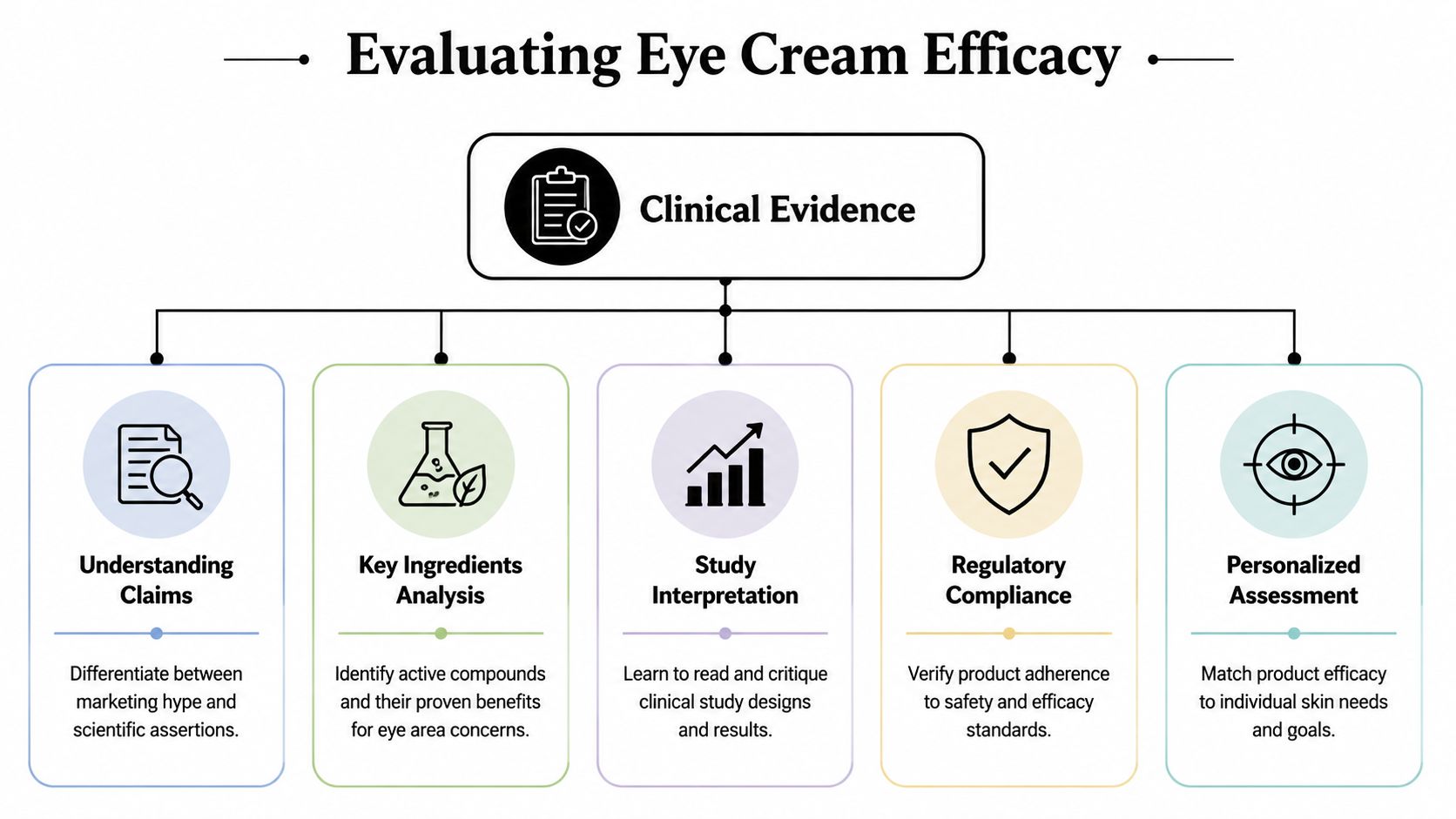
A practical framework helps. This visual summarises the five pillars that matter when you assess a top rated eye cream for professional retail.
Start with measurable endpoints
The eye area has a limited set of meaningful concerns, so the best studies usually focus on a defined endpoint rather than a vague promise. Look for metrics tied to one of these categories:
- Structural change: collagen density, firmness, wrinkle depth
- Water balance: hydration retention or barrier support
- Fluid movement: puffiness or depuffing
- Pigmentation appearance: dark circle reduction
- Tolerance: irritation, stinging, milia tendency, suitability for reactive skin
A study becomes more credible when the endpoint matches the product story. If a brand claims wrinkle repair, but only shows a consumer self-assessment about “looking fresher”, that's weak support. If it claims depuffing, a visual before-and-after alone isn't enough. You want a method that quantifies volume change or similar performance data.
Learn the tools without getting lost in jargon
You don't need to master lab equipment. You do need to recognise whether a brand used objective methods.
In a 2025 Swiss Institute for Cosmetic Research benchmark study, Fushi Organic Wellbeing Eye Cream was tested on 120 panelists aged 35 to 55 with sensitive skin types prevalent in the CH region and dry alpine climates. The study measured periorbital collagen density improvement, where Fushi outperformed synthetic benchmarks by 28% after 8 weeks of twice-daily application. Wrinkle depth was assessed with R3D profilometry, showing a 3.2-fold reduction in crow's feet from 0.45mm to 0.14mm, versus 1.1-fold for Lancôme Absolue. Hydration was measured by corneometry, where Fushi delivered 42% moisture retention at 12 hours, compared with 31% for CeraVe Eye Repair Cream. Patch testing under Swissmedic guidelines recorded zero irritation incidents. The source also states that fresh-pressed organic rosehip and baobab oils achieved 15% higher transdermal penetration of omega-3/6 fatty acids, and includes this comment from dermatologist Dr. Lena Berger: “Fushi's alchemical blending preserves volatile antioxidants like vitamin E at 85% bioavailability, ideal for CH consumers avoiding endocrine disruptors in urban-polluted areas like Geneva.” This evidence package comes from the SICR benchmark study provided in the verified data.
That's what good evidence looks like for a buyer. It gives you population, duration, measurement method, comparator context, and tolerability. It also links the formula's ingredient system to the observed result.
A video can help your team translate these concepts into retail language during training.
What strong evidence lets you do commercially
Clinical precision isn't just about science. It gives your team sharper selling language.
Instead of saying, “This is a lovely natural eye cream,” a pharmacist or beauty adviser can say that the product was benchmarked on sensitive skin types relevant to Swiss conditions, showed objective improvement in collagen density and wrinkle depth, and delivered hydration with no irritation incidents in patch testing. That's a stronger recommendation because it reduces ambiguity.
Counter advice: If the evidence is objective, your staff can sell with confidence without overselling.
Red flags that should slow a purchase
Not every eye cream needs a heavyweight dossier. But some signs should make you cautious, especially in premium retail:
- Only subjective language. If every claim rests on “users felt” or “skin appeared”, the product may still be pleasant, but it's hard to justify as a hero SKU.
- No test context. Missing duration, sample profile, or application protocol usually means the claim won't survive scrutiny.
- No comparator logic. A result in isolation may sound strong but tells you little about category competitiveness.
- Ingredient storytelling without delivery evidence. A formula can contain desirable actives yet perform weakly if penetration or stability is poor.
- No tolerance story. In eye care, efficacy without reassurance limits recommendation confidence.
How to translate a study into a buying decision
Use a simple sequence:
| Evidence question | Why it matters | Strong answer example |
|---|---|---|
| Was the claim measured objectively? | Reduces dependence on marketing interpretation | 3D imaging, profilometry, corneometry |
| Was the population relevant? | Improves retail applicability | Sensitive skin in CH-type dry alpine conditions |
| Was there a meaningful duration? | Filters out instant-cosmetic effects from treatment claims | Multi-week use with defined protocol |
| Was there benchmark context? | Shows competitive position | Compared against recognised synthetic alternatives |
| Was tolerability addressed? | Protects recommendation credibility | Patch testing with no irritation incidents |
A top rated eye cream for Swiss B2B buying isn't the one with the loudest claim set. It's the one whose evidence lets you defend the SKU to customers, staff, and your own stock planner.
Matching Formulations to Swiss Consumer Profiles
A strong category doesn't rely on one winner. It relies on a controlled spread of solutions. Eye care becomes easier to sell when each SKU maps to a recognisable customer profile instead of crowding the shelf with products that all promise the same result.
The urban sensitive-skin customer
This customer often shops in cities such as Geneva or Zurich, reads ingredient lists, and wants anti-ageing support without a harsh feel. They're less impressed by prestige branding alone and more persuaded by tolerance, clean credentials, and a calm finish under makeup.
For this profile, natural lipid-rich formulations with a reassuring irritation story make sense. The product doesn't need to be the most aggressive formula in the category. It needs to feel safe enough for daily use while still delivering visible support for fine lines and dehydration.
The anti-fatigue and puffiness customer
This shopper often wants a quick visible payoff. Puffiness, dark circles, travel fatigue, screen-time tiredness, and fluid retention are the usual complaints. A marine-based eye cream can be especially effective here because the product story is easy to explain and easy to demonstrate.
A 2026 Pro Derm AG Lausanne consumer and efficacy trial evaluated marine-derived eye treatments for the Swiss market on 85 participants with mixed skin tones, including 40% mature skin over 50, and ranked Les Thermes Marins de Saint-Malo Eye Contour Cream first among 12 formulations. It showed 37% superior depuffing, reducing puffiness volume from 1.8ml to 0.9ml per eye, compared with 22% for Shiseido Future Solution LX. It also delivered a 52% improvement in under-eye dark circle pigmentation, 39% faster TEWL barrier recovery, and 96% of panelists reported no milia formation. The trial states that the alginate-rich seawater complex provided 2.1x faster osmotic drainage than Ole Henriksen Banana Bright. The formulation is pH 5.2 to 5.5, aligned with PETA cruelty-free standards, and suited to reactive skin under EU Regulation 1223/2009. Dr. Marcel Vogt commented: “The marine peptides mimic hyaluronic acid at 78% efficacy without fermentation byproducts, offering Swiss spas a sustainable, sensorial option outperforming high-street No7 serum in long-term elastin metrics (cutometer dual R2/R5: +25% firmness).” The verified data also notes 22% higher repeat purchase rates when stocked for anti-ageing spa protocols.
That profile is highly useful for spas, hotel boutiques, and pharmacies near business districts or transport hubs. The customer sees a clear problem-solution fit, and staff can recommend it quickly.
Products sell faster when the shelf mirrors real customer identities, not abstract skincare categories.
The mature treatment-seeker
This customer wants firmness, wrinkle care, and visible texture improvement, but they may also be cautious about irritation. They often respond well to a premium eye cream with objective structural claims, especially if the formula can be positioned as both high-performance and suitable for regular use.
For this group, rich but not greasy textures, strong clinical backing, and a defined anti-ageing narrative matter more than novelty. If the formula is also suitable for reactive skin, the recommendation becomes easier and the objection rate falls.
The portfolio logic
A balanced eye care assortment often works best when it includes:
- A premium natural efficacy SKU for sensitive and dryness-prone customers
- A marine anti-fatigue option for puffiness, dark circles, and spa-led retail
- A prestige recognisable product only if your clientele actively asks for the brand
That last point matters. Brand recognition can pull traffic, but function-led curation builds authority.
Analysing Commercial Viability and Shelf Appeal
Clinical quality gets a product onto the shortlist. Commercial viability decides whether it stays. Eye cream is a small-format category with high expectation density. Customers compare price, pack feel, hygiene, claims clarity, and ethical positioning quickly. If a SKU isn't easy to understand or easy to recommend, it slows the whole display.
Certification as a selling tool
Swiss premium customers often want proof of standards, not just a clean-looking pack. Certifications and compliance cues help staff answer concerns without drifting into vague reassurance.
For natural-led ranges, ECOCERT signals discipline in sourcing and formulation philosophy. For cruelty-free shoppers, PETA-aligned positioning is commercially useful because it reduces hesitation at the point of recommendation. In pharmacy, compliance language also matters because the retail environment itself implies trust. A product that fits that expectation tends to benefit from lower resistance during consultation.
Certifications won't sell a weak formula. They do make a strong formula easier to place and easier to defend.
Packaging affects conversion more than buyers admit
Eye cream packaging isn't just aesthetic. It shapes hygiene perception, dosage control, and customer confidence. Jars may look luxurious, but some pharmacy customers prefer tubes or pumps because they feel cleaner and more precise. That matters in the eye category, where people are wary of contamination and over-application.
Use packaging as a merchandising filter:
- Airless or controlled dispensing packs support premium efficacy messaging
- Slim tubes often work well in pharmacies because they signal practicality and travel ease
- Heavy jars can support luxury theatre, but only if the brand already carries authority with your clientele
- Outer carton clarity matters. If the customer can't quickly identify the primary benefit, the product needs too much staff intervention
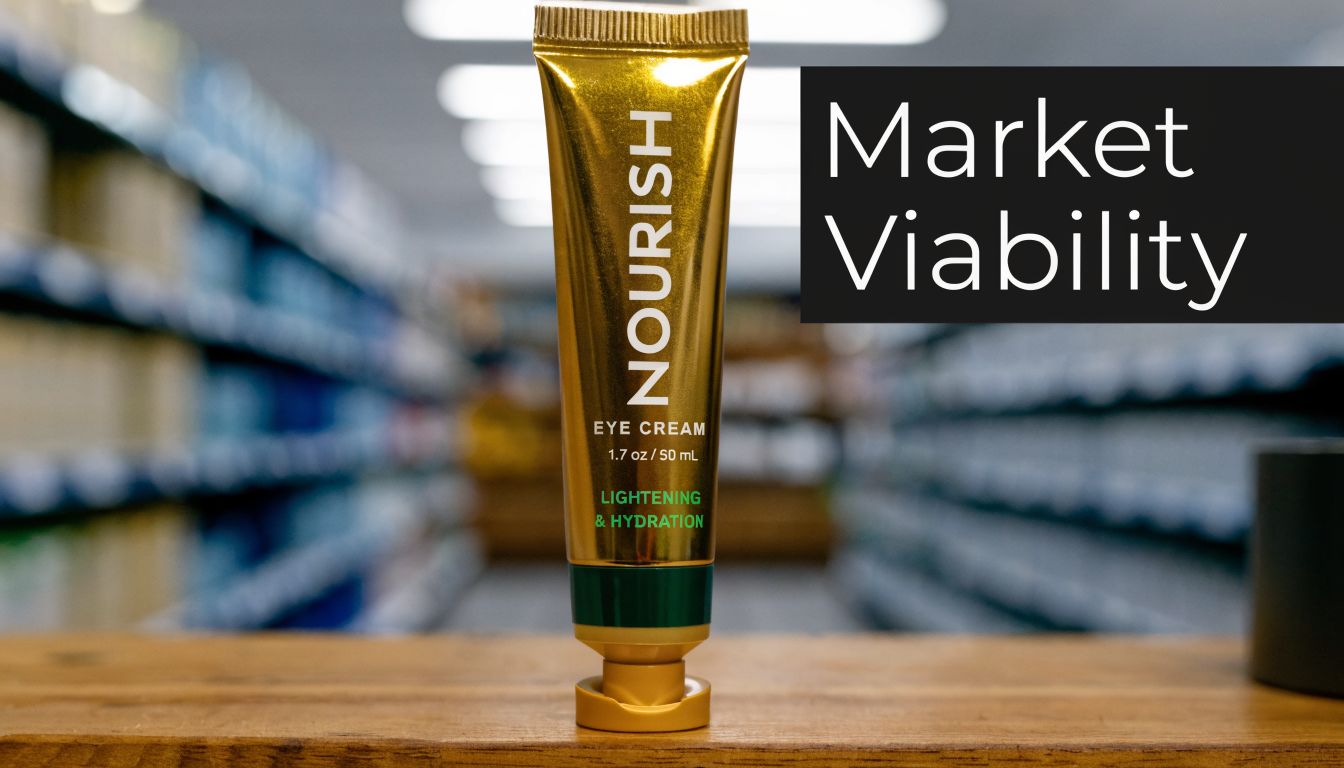
Margin analysis without false precision
There's no universal “right” margin for eye cream because channel economics differ. A spa can support a different pricing structure than a drugstore, and e-commerce has different promotional pressure again. Still, buyers can use a simple commercial test without inventing hard numbers.
Ask these questions:
| Commercial factor | Low-potential answer | High-potential answer |
|---|---|---|
| Brand story | Generic and interchangeable | Distinct, teachable, linked to ingredients or origin |
| Recommendation ease | Requires long explanation | Can be sold in one concise benefit statement |
| Repeat purchase logic | One-off novelty | Clear daily-use role and replenishment habit |
| Visual differentiation | Blends into shelf clutter | Instantly recognisable by function or ethos |
| Channel fit | Wrong for your environment | Designed for pharmacy, spa, or premium digital retail |
The most profitable eye cream isn't always the highest ticket item. It's often the SKU that combines respectable price positioning with low recommendation friction and reliable replenishment.
Merchandising choices that lift performance
A good eye cream can still underperform if placed badly. Eye care works best when customers can decode the selection in seconds. Don't arrange only by brand. Arrange by concern and need state.
Three merchandising habits help:
- Build a concern-led block. Group “fine lines and dehydration”, “puffiness and dark circles”, and “sensitive eye area” together, even if brands differ.
- Use short clinical callouts. A small card with one concrete evidence point is more persuasive than a paragraph of brand poetry.
- Cross-merchandise with serums and masks carefully. Eye cream should feel like a targeted add-on, not an afterthought.
Merchandising rule: If shoppers need staff help to understand every SKU, your display is doing too little work.
For spas and hotels, treatment integration matters even more. If an eye cream has a sensorial application ritual and a clear aftercare role, it can move from retail extra to treatment companion. That shift tends to stabilise repeat purchase because the product is no longer a speculative shelf item. It becomes part of an experienced routine.
Pricing ladder discipline
A healthy eye category usually needs three roles, even if you only stock a few lines:
- Entry reassurance SKU for sensitive or first-time users
- Core treatment SKU that does the volume work
- Premium halo SKU that anchors category authority
Without that structure, customers either trade down because nothing feels worth the premium, or freeze because every product seems to promise the same thing. Assortment clarity is a margin strategy in disguise.
A Scoring Framework for Eye Cream SKU Selection
Buyers often overestimate instinct and underestimate consistency. A scoring framework fixes that. It lets you compare a prestige favourite against a lesser-known but clinically stronger formula without defaulting to familiarity.
Use the same matrix for every prospective SKU. The point isn't to create false certainty. The point is to force the right questions before a purchase order is placed.
SKU Evaluation Scoring Matrix
| Evaluation Criterion | Weighting (%) | Scoring Guide (1-5) | Product A Score | Product B Score |
|---|---|---|---|---|
| Clinical evidence quality | 1 = vague claims only, 5 = objective study with relevant population and methods | |||
| Relevance to Swiss consumer needs | 1 = generic fit, 5 = strong fit for sensitivity, climate, or local use cases | |||
| Tolerability and sensitive-skin suitability | 1 = unclear, 5 = strong reassurance and low-risk profile | |||
| Differentiation on shelf | 1 = duplicative, 5 = distinct benefit and easy staff explanation | |||
| Packaging and usability | 1 = awkward or unhygienic, 5 = practical, premium, confidence-building | |||
| Ethics and certification value | 1 = weak or absent, 5 = meaningful standards aligned with channel demand | |||
| Margin potential | 1 = difficult economics, 5 = healthy pricing logic and sell-through prospects | |||
| Brand support and trainability | 1 = little support, 5 = easy onboarding and strong retail narrative |
How to weight the matrix
Don't use the same weighting for every channel.
A pharmacy should usually place the greatest emphasis on clinical evidence, tolerability, and Swiss consumer relevance. A spa may give more weight to sensoriality, treatment compatibility, and repeat-purchase logic. Premium e-commerce might lean harder on differentiation, story clarity, and visual conversion strength.
You don't need to publish the exact weighting externally. Internally, though, assigning it matters because it stops debates from drifting into taste and personal brand bias.
A practical scoring example
Take two hypothetical candidates.
Product A is a famous prestige synthetic eye cream. It has strong recognition and may pull shoppers who already know the brand. But if the evidence is broad, the sensitive-skin story is weak, and the packaging feels more luxurious than practical, it may earn moderate scores across many lines without excelling where a Swiss pharmacy most needs confidence.
Product B is a clinically supported natural or marine treatment with regionally relevant data, good tolerability language, and a clearly defined benefit such as wrinkle depth improvement or depuffing. It may have lower spontaneous recognition, yet score higher in the categories that drive recommendation success.
That's the core insight. The product with stronger editorial visibility may not be the stronger wholesale decision.
A scoring matrix doesn't remove judgement. It improves the quality of judgement.
What to record beyond the score
Keep brief notes next to each line item. Numbers alone won't capture the full decision. Record:
- Main reason to list
- Main reason to reject
- Ideal channel
- Ideal customer profile
- Likely cross-sell partner
Those notes become useful later when you review performance. If a product underdelivers, you can see whether the issue was the SKU itself or the original channel placement.
Common mistakes the matrix prevents
A structured scorecard helps you avoid several expensive habits:
- Buying duplicate claims. Three eye creams that all vaguely promise anti-ageing create clutter, not choice.
- Confusing prestige with proof. Strong branding can support conversion, but it can't replace suitability.
- Underestimating explainability. If your staff can't summarise the benefit cleanly, shoppers hesitate.
- Overvaluing novelty. Newness can generate curiosity, but evidence and fit sustain repeat sales.
- Ignoring assortment role. Every listed SKU should have a job. If you can't define the job, don't list it.
A buyer who uses this framework consistently usually ends up with fewer, clearer, harder-working SKUs. That's often the fastest route to a better eye care category.
Building a Curated Eye Care Category
The phrase top rated eye cream becomes useful only when you redefine it for your business. It shouldn't mean “most talked about”. It should mean clinically defensible, relevant to Swiss consumers, easy to merchandise, and commercially sensible.
That standard leads to a tighter category. One product earns its place through strong natural anti-ageing efficacy and sensitive-skin suitability. Another justifies listing through visible anti-fatigue performance, barrier support, and spa compatibility. A recognisable prestige item may still have a role, but only if it fills a specific demand pattern rather than occupying shelf space on reputation alone.
Curated categories outperform bloated ones because the recommendation path is clearer. Staff know what each product is for. Customers understand the differences. Repeat purchase becomes more predictable because the assortment was built around genuine use cases instead of trend mimicry.
For a new pharmacy partner, that is the primary objective. Not the biggest range. The most coherent one.
To build an eye care assortment with this level of discipline, beautysecrets.agency can help you evaluate clinically credible, ethically aligned, Swiss-market-ready options for pharmacy, spa, and premium retail. The value goes beyond simple access to products. It is a consultative approach that helps you choose the right SKUs, place them in the right channel, and turn "top rated" into a category strategy that sells.