A customer walks into your pharmacy on a cold Zurich afternoon, runs a hand through brittle ends, and asks for “something natural that helps”. Another wants support for a dry, tight scalp after weeks of alpine air and indoor heating. A third has seen castor oil all over social media and wants to know whether it belongs in a serious routine or in the realm of overhyped remedies.
That’s where good retail selection matters.
For Swiss pharmacies, drugstores, premium beauty retailers, and spa partners, castor oil for hair sits in a useful category. It has heritage, a recognisable ingredient story, and enough product science to justify a place on shelf when it’s stocked and explained properly. It also fits neatly with what many Swiss customers already value: transparent sourcing, cruelty-free positioning, and formulations that feel closer to wellness than trend-chasing.
Castor oil isn’t a miracle. It is, however, a commercially strong ingredient when you frame it correctly. It supports scalp comfort, helps reduce the look and feel of dryness, and gives damaged or coarse hair a denser, more protected finish. For retailers already selling treatment oils, masks, scalp care, or pharmacy-led beauty, it can strengthen a “repair and resilience” assortment. If you already educate customers on lighter oils, resources on argan oil benefits for hair can also help staff explain where castor oil sits on the spectrum: heavier, more occlusive, and better suited to targeted use than casual all-over application.
The Growing Demand for Natural Hair Solutions
Swiss customers don’t usually ask for “ingredients” in the abstract. They ask for outcomes. Less breakage. More comfort. A calmer scalp. Hair that looks less stressed by weather, colouring, heat styling, or over-cleansing.
Castor oil works in retail because it answers those questions in a language customers already understand. It’s botanical, familiar, and easy to position within a premium natural assortment. It also carries a story that feels credible in pharmacy and wellness settings, especially when paired with ethical certification and clear consultation advice.
Why castor oil keeps earning shelf space
A trend product spikes quickly, then disappoints. Castor oil has lasted because it solves a real retail problem: customers want a treatment that feels substantial. They often equate “working” with texture, ritual, and visible conditioning. Castor oil delivers that sensory payoff immediately, while also fitting a broader clean beauty narrative.
For trade partners, that creates several advantages:
- Clear hero ingredient story. “Castor oil” is easier to explain than a long INCI list with no standout point.
- Strong basket-building potential. It pairs naturally with scalp brushes, gentle shampoos, treatment masks, silk accessories, and lighter blending oils.
- Cross-channel relevance. It works in pharmacy, spa retail, department store beauty halls, and curated e-commerce.
Stock castor oil if your team can explain both its strengths and its limits. That’s what turns curiosity into repeat purchase.
Where the commercial opportunity sits
The opportunity isn’t just in selling a bottle of oil. It’s in helping customers choose the right format. Some want a neat, cold-pressed oil. Others need a formulated blend that reduces heaviness. Some should be directed to a scalp treatment, while others will do better with a mask or conditioning serum.
That distinction matters because Swiss customers tend to reward retailers who sound measured, not theatrical. If your team says castor oil can support healthier-feeling hair and a more comfortable scalp, that lands well. If they promise dramatic regrowth to everyone, trust disappears fast.
Understanding the Science of Castor Oil for Hair Health
The best castor oil consultation starts with one fact: castor oil is unusually rich in ricinoleic acid. Castor oil, derived from the seeds of the Ricinus communis plant, has been a staple in Swiss natural cosmetics for hair care, aligning with Switzerland's strong tradition of ethical, ECOCERT-certified formulations. Comprising 90% ricinoleic acid, a monounsaturated fatty acid, it offers moisturizing and anti-inflammatory properties that support scalp health, which matters in the CH region where harsh alpine climates affect up to 40% of the population with dry scalp conditions, according to the cited overview of castor oil for hair.

What ricinoleic acid actually does
Retail staff don’t need to speak like chemists, but they do need a simple explanation that holds up under scrutiny.
Think of ricinoleic acid as a dense conditioning key. It doesn’t flood hair with water. Instead, it helps form a protective layer that holds softness in place and reduces roughness on the fibre surface. That’s why castor oil often works best on hair that feels coarse, over-processed, frizzy, or fragile from environmental stress.
For scalp care, the conversation is slightly different. The benefit isn’t that castor oil “forces” growth. The stronger argument is that it can help support a healthier scalp environment by softening dry areas and reducing the cycle of irritation that often leads customers to scratch, over-wash, or apply too many products at once.
Why customers feel a result quickly
Castor oil is thick. That’s not a flaw. It’s part of the performance profile.
A lighter oil can give slip and shine, then disappear. Castor oil tends to stay where it’s applied. On the right hair type, that creates a noticeable coating effect that improves flexibility and reduces the brittle feel customers often describe as “straw-like”. In retail language, that means it performs well as a treatment oil, not as a casual finishing gloss for everyone.
A useful way to train staff is to separate claims into two groups:
| Function | What staff can say confidently | What staff should avoid |
|---|---|---|
| Scalp comfort | Helps soften dry-feeling scalp and supports a more comfortable scalp routine | “Cures scalp conditions” |
| Hair fibre support | Helps hair feel more conditioned, protected, and less prone to roughness | “Repairs all damage permanently” |
| Growth conversation | Supports the conditions for stronger-looking hair when used consistently | “Makes everyone’s hair grow fast” |
What makes it different from lighter oils
Castor oil isn’t interchangeable with argan, jojoba, or grapeseed oil. Those oils often suit fine hair and daily use more easily. Castor oil belongs in a more deliberate treatment role because of its density and staying power.
Practical rule: Sell castor oil as a targeted care step, not as a universal oil for every head of hair.
That single line helps avoid many returns and complaints. Fine, straight hair common in Switzerland may not tolerate a heavy occlusive oil as well as coarse or highly textured hair. That doesn’t make castor oil ineffective. It means your assortment should include both pure oils and blended options, then match them to the customer in front of you.
Choosing the Right Castor Oil Variety for Your Assortment
Not all castor oil products solve the same problem. Buyers usually encounter two broad retail stories: cold-pressed castor oil and Jamaican black castor oil (JBCO). Customers may assume they’re interchangeable. They aren’t.
The right choice depends on your channel, your customer profile, and whether your team can confidently explain texture and use case.
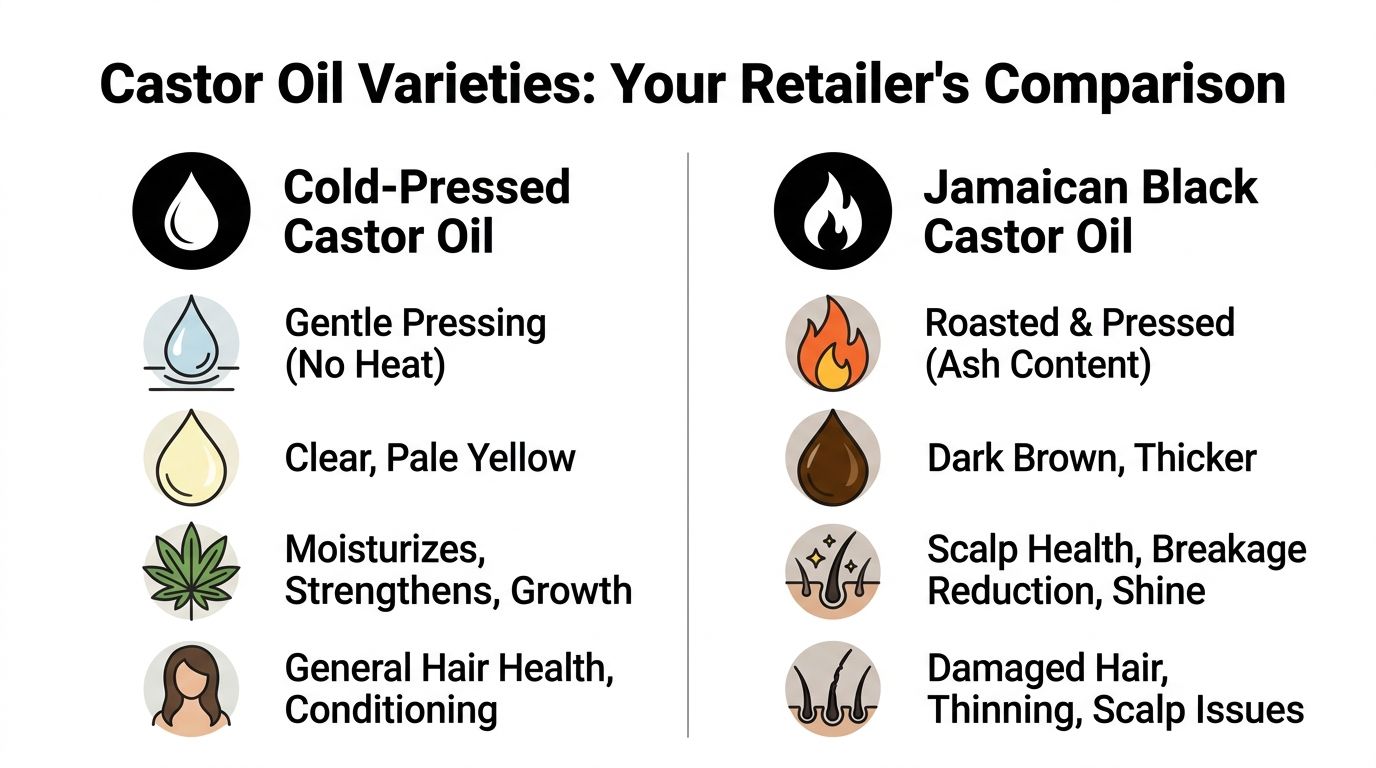
Castor Oil Varieties At a Glance
| Attribute | Cold-Pressed Castor Oil | Jamaican Black Castor Oil (JBCO) |
|---|---|---|
| Extraction approach | Pressed without heat | Roasted, then pressed |
| Appearance | Clear to pale yellow | Darker brown, visually heavier |
| Retail positioning | Premium purity, sensitive-scalp routines, facial and hair crossover use | Strong ritual identity, scalp-focused and damage-focused routines |
| Customer perception | Clean, refined, minimalist | Robust, traditional, intensive |
| Best fit in assortment | Pharmacies, premium clean beauty, treatment-led displays | Texture care, damage care, heritage-led merchandising |
When cold-pressed is the better buy
Cold-pressed castor oil usually makes the most sense for Swiss pharmacies and premium retailers because it aligns neatly with the expectations of customers looking for gentle, well-presented, ethically sourced products. It’s easier to position within ECOCERT-adjacent conversations, and it sits well beside other botanical oils and pharmacy-led treatment products.
It also gives staff a cleaner recommendation path for customers with:
- Sensitive-feeling scalp
- Dry ends and breakage concerns
- Minimalist routines
- Interest in multi-use beauty oils
Cold-pressed oil is often the safer flagship item because it feels more versatile, even though it still requires guidance on dilution and quantity.
When JBCO earns a place
JBCO has a different strength. It carries cultural recognition and a richer ritual profile. Some customers actively seek it out for scalp massage, breakage care, or thicker-looking finish. In stores where staff can explain the difference well, it can broaden the assortment without cannibalising the cold-pressed option.
What matters is context. If your store mainly serves customers wanting refined, elegant textures, JBCO may sell more slowly unless it is paired with clear consultation and education. If your clientele already buys richer masks, butters, and intensive treatments, it can perform well as a specialist SKU.
Don’t stock both varieties just to appear complete. Stock both only if your team can differentiate them in one sentence at shelf.
A practical buying framework
Use this checklist before adding a castor oil line:
- Assess your customer base. Is your core shopper more likely to buy pharmacy-grade simplicity or treatment-rich ritual products?
- Check formulation role. Is the oil sold neat, blended, or inside a wider scalp or hair system?
- Review packaging logic. Dropper bottles suit targeted application. Larger bottles can create overuse if no dosing guidance appears on pack.
- Plan staff wording. If the sales team can’t explain why one oil is lighter in feel and another more intensive, the assortment becomes confusing.
For most Swiss retailers, a tightly edited range works better than a broad one. One premium cold-pressed SKU, one blended treatment for easier use, and one specialist richer option is often a more coherent strategy than a cluttered wall of similar oils.
Proven Application Methods and Client Guidance
Good sell-through depends on what happens after purchase. Castor oil has a narrow margin between “helpful” and “too much”, so customers need clear instructions. If your team gives vague advice such as “apply a little when needed”, many will overuse it, struggle to rinse it out, and assume the product failed.

A stronger consultation starts with a measurable method. In a 2008 controlled study, a lotion containing 35% castor oil applied topically to rabbits resulted in increased hair length by up to 15% and enhanced thickness by 12%. The same overview notes that castor oil’s viscosity is 984 mPa·s at 20°C, compared with 32 mPa·s for coconut oil, which helps explain why it creates such a persistent occlusive layer on hair and scalp, as summarised in this Medical News Today review of castor oil for hair.
Pre-shampoo scalp treatment
This is the most reliable recommendation for Swiss retail. It gives customers the conditioning and scalp-softening benefits without asking them to wear a heavy oil all day.
Use this script at the counter:
- Apply a small amount to the scalp in sections.
- Massage gently with fingertips.
- Leave it on before washing rather than using it as a leave-on.
- Shampoo thoroughly and repeat if needed.
This method works especially well for customers dealing with winter dryness, tightness after cleansing, or a flaky-looking scalp that isn’t caused by a medical condition.
A practical companion resource for staff and customers is ArtNaturals' guide to using castor oil, which shows familiar application formats that can support in-store education.
Hair mask blending for better spread
Pure castor oil can be difficult to distribute evenly. A better recommendation for many customers is to blend it with a lighter oil before use. That improves spreadability and reduces the risk of patchy application or greasy roots.
Try this consultation framework:
- For coarse or chemically treated hair: suggest a richer mask focused on mid-lengths and ends.
- For fine straight hair: recommend a lighter blend and shorter contact time.
- For customers new to oils: start with a pre-shampoo use only.
If the customer has fine hair, advise them to treat castor oil like a concentrate, not like a serum.
Lead into the tutorial with a visual demonstration when training staff or creating product education content:
Targeted brows and lash line caution
Customers often ask about eyebrows and lashes because castor oil has a strong beauty folklore around those areas. In retail, the safest position is measured enthusiasm. It can be used sparingly for conditioning, but staff should avoid sweeping claims and should stress careful, hygienic application.
For point-of-sale guidance, keep it simple:
- Use very little. More isn’t better.
- Apply precisely. Avoid migration into the eye area.
- Stop if irritation appears. Conditioning should never come at the cost of comfort.
What works best in real consultations
The strongest scripts are specific. Staff should ask:
- Is the concern scalp dryness, breakage, or appearance of thinning?
- Is the hair fine, thick, colour-treated, or heat-damaged?
- Does the customer want a rinse-out ritual or a leave-on product?
Then match the recommendation accordingly.
A customer with dry ends and bleached hair may love castor oil in a weekly mask. A customer with fine straight hair may prefer a blend or a product where castor oil appears lower in the formula. A customer with an oily scalp may do better with targeted end-only use or a different category altogether.
Ensuring Safety and Managing Customer Expectations
Retail credibility is built more by restraint than by excitement. Castor oil sells well when teams describe it accurately. It can support healthier-feeling scalp and hair. It can also be too heavy, too sticky, or the wrong fit for some customers.
That honesty matters most in pharmacy.
The risk retailers must explain clearly
A rare 2017 PMC case highlighted acute hair felting linked to high-viscosity castor oil on long hair, and the cited guidance notes that Swiss recommendations advise limiting concentrations in leave-on formulations. The same source makes the commercial point obvious: responsible retailers need to counsel customers on proper use to avoid compact, irreversible matting, as described in the PMC case report on acute hair felting.
That sounds dramatic because it is. It’s also preventable.
Customers at highest risk are usually those with long, fine, damaged, or already tangled hair who apply a heavy oil too generously and don’t rinse effectively. This is why “more moisture” is not always better advice.
Safety guidance worth putting on shelf talkers
A short in-store guidance card can reduce misuse immediately:
- Patch test first. Sensitive scalps don’t always tolerate rich oils well.
- Use on detangled hair. Never apply heavily to matted or fragile lengths.
- Prefer rinse-out use. Pre-shampoo application is easier to control than leave-on saturation.
- Go light on long hair. Concentrate on scalp sections or ends rather than coating everything.
The safest castor oil recommendation is usually the least glamorous one: small amount, short contact time, thorough wash-out.
How to talk about growth without overpromising
Customers often ask whether castor oil “grows hair”, and many retailers misstep in their responses. A responsible answer is that direct growth claims aren’t the strongest part of the evidence base. What castor oil does better is support the condition of the scalp and hair fibre, which may help hair look fuller, shinier, less brittle, and more resilient over time.
That wording protects trust.
It also helps staff avoid two common mistakes. The first is promising rapid transformation. The second is dismissing castor oil altogether because it isn’t a miracle. A balanced recommendation sounds more professional than either extreme.
When not to recommend it
Some customers aren’t good candidates for neat castor oil:
- very fine straight hair that gets weighed down easily
- customers who dislike double cleansing
- people with sensitive scalps who react badly to heavy occlusive products
- anyone expecting instant regrowth from a cosmetic oil
For those shoppers, a blended treatment or a lighter oil often leads to a better long-term outcome and fewer complaints at the counter.
Merchandising and Marketing for the Swiss Market
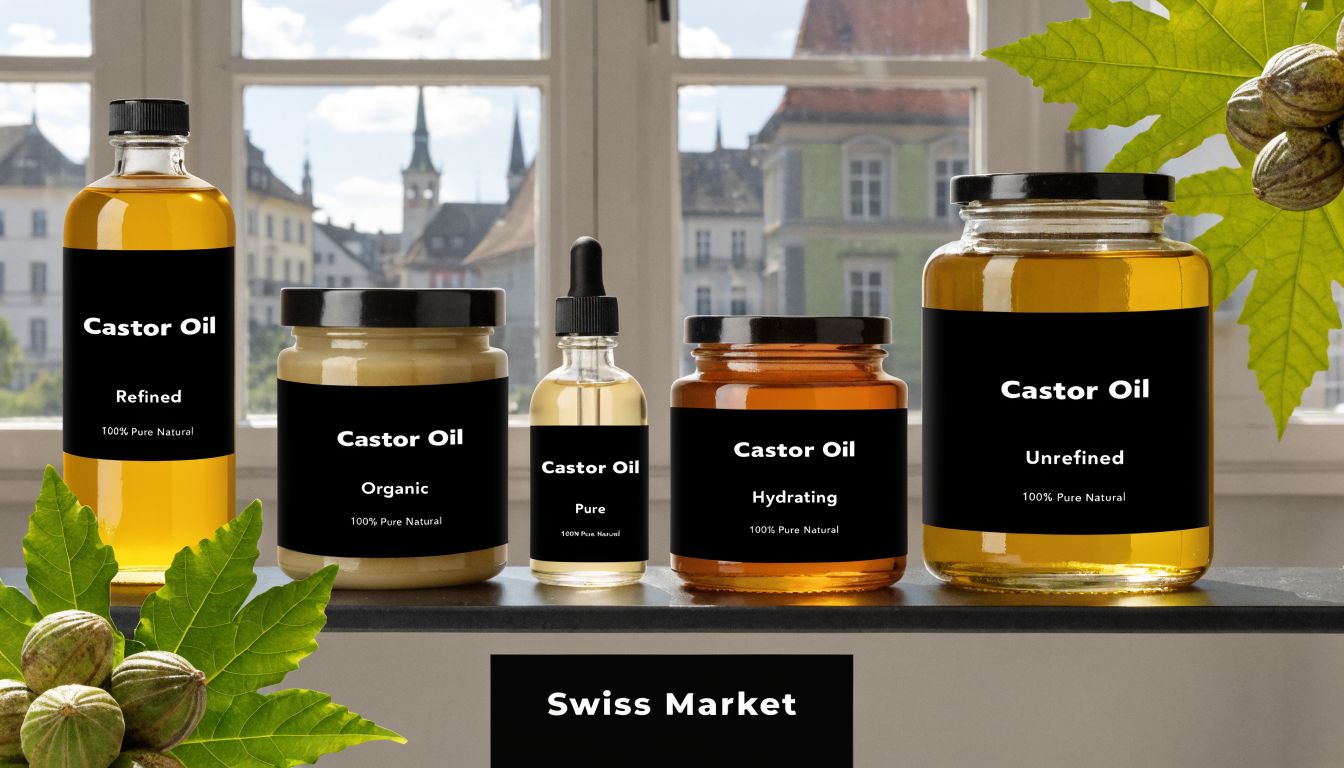
In Swiss retail, castor oil shouldn’t be merchandised as a novelty bottle beside random beauty extras. It performs better when placed inside a clear problem-solution story. Dry scalp. Hair stress. Breakage. Winter protection. Ritual repair.
That framing matters because one of the biggest market gaps is educational, not just product-based. A cited 2025 trend notes a 15% rise in CH-specific search queries such as “castor oil scalp irritation CH” on Digitec/Galaxus, signalling that shoppers are looking for local, practical answers rather than generic internet hype, according to this market-gap discussion around castor oil in CH retail.
Build a category, not a lonely SKU
A single castor oil bottle with no context usually underperforms. A small treatment destination works better.
Merchandising ideas that translate well in Swiss pharmacy and premium beauty settings:
- Create a scalp health shelf block. Place castor oil beside gentle cleansers, scalp brushes, and treatment masks.
- Merchandise by concern. “Dry scalp”, “Breakage support”, and “Over-processed hair” are easier for customers to shop than ingredient names alone.
- Bundle with a lighter partner oil. This helps your team recommend blending for first-time users.
- Use consultation cards. A short “best for / not ideal for” guide reduces poor-fit purchases.
Lead with certification and sourcing language
Swiss consumers often read labels carefully. If a castor oil line is ethically sourced, cruelty-free, or aligned with recognised certification standards such as ECOCERT, that deserves visible placement in marketing materials and shelf communication.
Don’t reduce those credentials to logos alone. Train staff to translate them into buyer value:
| Certification or ethical cue | What it signals to the customer | Best retail use |
|---|---|---|
| ECOCERT-aligned story | Ingredient integrity and formulation discipline | Shelf strips, online product bullets |
| Cruelty-free positioning | Ethical screening and modern brand values | Window messaging, brand pages |
| Cold-pressed sourcing | Minimal processing and premium treatment identity | Tester stands, consultation scripts |
Shelf language that actually converts
Avoid the usual clichés. “Miracle growth oil” attracts attention but weakens trust. Better wording is specific and calm.
Useful shelf and digital phrases include:
- Supports dry scalp comfort
- Intensive oil for brittle lengths
- Best used as a pre-wash treatment
- A richer botanical oil for targeted care
- Suitable for customers seeking a cruelty-free ritual treatment
Better merchandising starts with better language. If the claim sounds exaggerated, a Swiss pharmacy customer will question the whole display.
Train the team around trade-offs
Most failed castor oil sales aren’t caused by the product. They’re caused by poor matching. Staff should be able to explain, in plain terms, that castor oil is richer than many other oils and therefore best for selected use cases.
That training should cover:
- when to recommend neat oil versus a blend
- why fine hair may need less
- how to discuss scalp comfort without making medical claims
- how ethical sourcing supports premium pricing
When sales associates can explain those points naturally, castor oil moves from “internet trend” to “credible treatment option”.
Frequently Asked Questions from Retail Partners
Can customers use castor oil on colour-treated hair
Yes, often as a rinse-out treatment rather than a heavy leave-on. Colour-treated hair usually benefits from a protective, conditioning step, especially when the lengths feel rough or fragile. The key is dosage. Keep application focused on mid-lengths and ends unless the scalp is the specific concern.
For very porous or bleached hair, recommend starting with a blended mask format. That usually gives a better cosmetic result than saturating the hair with neat castor oil.
How does castor oil compare with argan or coconut oil
Castor oil is typically the richest and most occlusive of the three in retail use. Argan oil usually feels lighter and more cosmetic on fine or everyday styling routines. Coconut oil often appeals to customers already comfortable with heavier oils, though its feel and performance profile differ from castor oil.
The practical distinction is this: castor oil is better sold as a targeted treatment. Argan is often easier as a finishing or smoothing oil. If your store carries all three, staff should recommend by hair type and use occasion, not by trend.
Is it suitable for oily scalps
Sometimes, but only with caution. An oily scalp customer doesn’t always need more oil at the root. If they’re interested in castor oil for hair, a better starting point is usually occasional, limited use or application only to dry lengths and ends.
If the customer’s scalp feels both oily and irritated, don’t jump straight to castor oil. Ask whether the issue may be build-up, overwashing, or sensitivity to other products. In many cases, a calmer shampoo routine is the first fix.
What should staff say when customers ask if castor oil grows hair
Say that castor oil is best understood as a scalp and hair-conditioning ingredient, not a guaranteed growth treatment. It may help support a healthier environment for stronger-looking hair, but results vary and overpromising is a mistake.
That answer tends to build trust because it sounds considered. Customers usually accept nuance when it’s delivered clearly.
What’s the best retail format to stock
For pharmacies and premium retailers, the safest mix is usually:
- a cold-pressed neat oil for informed users
- a blended treatment oil for broader customer compatibility
- a mask or scalp formulation for easier adoption
This structure serves both ingredient-led shoppers and customers who want a ready-made solution with less risk of misuse.
Should stores offer testers
If packaging and hygiene standards allow it, yes. Texture matters enormously with castor oil. Customers often understand the product better once they feel how dense it is. A tester can also support a quick consultation: “This is why we recommend using it before shampoo, not as a heavy leave-in”.
If testers aren’t practical, use a texture description card. Simple wording like “very rich”, “best applied sparingly”, and “ideal for targeted treatment” helps reduce mismatched purchases.
How should opened bottles be stored and rotated in store advice
Advise customers to keep the bottle tightly closed, away from heat, light, and unnecessary humidity. The exact shelf life depends on the brand, formulation, and packaging, so staff should follow the manufacturer’s period-after-opening guidance rather than improvise. This is especially important for premium natural lines where customers expect freshness and care.
For in-store stock rotation, keep bottles clean, upright, and grouped with related treatment products so they remain part of a consultation-led category rather than becoming orphaned stock.
What if a customer says castor oil made their hair feel worse
That doesn’t automatically mean the product is poor quality. It usually means one of three things happened: too much was applied, the customer’s hair type wasn’t a good match for neat use, or the oil wasn’t washed out properly.
The right response is to troubleshoot, not defend the product. Ask how they used it. If needed, redirect them to a lighter blend, shorter treatment time, or a different oil category. That saves the relationship and often the sale.
Can castor oil work in a luxury spa or wellness retail setting
Absolutely, if the ritual is curated properly. It suits slower, treatment-led selling environments where staff can explain why a denser oil belongs in a weekly care ritual rather than a quick styling step. In spa retail, the story should emphasise scalp comfort, hair nourishment, and ethical ingredient quality.
Done well, castor oil can sit comfortably between pharmacy credibility and wellness ritual.
If you're building a premium natural hair and scalp assortment for the Swiss market, beautysecrets.agency can help you curate ethically sourced, certification-aligned brands with the product education and trade support needed to sell them credibly. For pharmacies, retailers, spas, and e-commerce partners, that means assortments designed for real customer needs, not just shelf presence.