
A customer walks up to the counter and asks for one product that will even the complexion, calm visible redness, feel light, and still offer daytime UV support. In a Swiss pharmacy or spa boutique, that conversation happens often. The client doesn't want a full foundation routine. They want skin that looks rested, polished, and believable.
That is exactly where erborian cc cream earns its shelf space. It sits between skincare and make-up, which is useful commercially because it opens conversations with clients who normally shop only one of those categories. It also solves a common retail problem. Advisors often need a product that feels premium, demonstrates quickly, and doesn't demand a long explanation to win the sale.
For Swiss partners, the product isn't just interesting because it's popular. It matters because the formula, application method, and SPF positioning all need to be explained correctly if you want repeat purchase rather than a one-time curiosity buy.
The Modern Customer's Quest for Hybrid Beauty
A good advisor can usually spot the hybrid-beauty customer before she says the words. She tests textures on the back of her hand, asks whether it will look heavy, and wants to know if she can use it instead of foundation on workdays. She may also ask whether it fits a simple routine, especially if she already uses a serum and a separate cream in the morning.

Erborian cc cream fits that demand because it isn't selling full-coverage transformation. It sells correction, comfort, and speed. In-store, that makes the demonstration far easier. Clients can see the finish settle quickly, and the advisor can explain it as a complexion product for people who still want their skin to look like skin.
Why it works in Swiss retail
Swiss customers often expect three things at once. They want efficacy, they want a clean and credible formula story, and they want practical use in daily life. A hybrid complexion product answers all three if the staff frames it properly.
Use it as a bridge product in these situations:
- For the skincare-first client: position it as the finishing step that adds tone-evening without the feel of classic foundation.
- For the make-up shopper: position it as the lighter weekday option that still supports a polished result.
- For the pharmacy environment: present it as a routine-simplifier, not a trend item.
Stocking a hybrid product only works when staff know how to explain where it belongs in the routine and where it doesn't.
There is also a digital merchandising angle here. Teams working on e-commerce presentation can borrow ideas from skincare brand experience optimization to improve product discovery, simplify shade education, and reduce hesitation around texture and finish. That matters because erborian cc cream is a product people often understand best once they see it in use.
What retailers often get wrong
The biggest mistake is shelving it only with make-up. That limits who notices it. The second mistake is talking about it in vague terms like "all-in-one". Clients hear that phrase too often and stop listening.
Be more specific. Explain that it helps visually correct uneven tone, offers a lighter alternative to foundation, and suits clients who value a fast morning routine. That language is clearer, more credible, and easier for staff to repeat consistently.
The Science Behind the High-Definition Finish
Many complexion products promise a natural finish. Erborian cc cream has a more interesting mechanism behind that promise. The product comes out looking pale, then changes as it is blended into the skin. For staff training, that transformation is the key point to explain well because it turns curiosity into confidence.
How the pigment technology actually works
The easiest analogy is this. Think of the formula as carrying tiny colour capsules suspended in a cream base. When the customer blends it with fingertips, the movement and pressure break those capsules. That release allows the tint to shift from opaque-looking cream to adaptive coverage on the skin.
According to the ingredient and formula breakdown on INCIDecoder, encapsulated pigment technology in Erborian CC Cream enables adaptive shade-matching via silsesquioxane crosspolymers that rupture under shear force during fingertip blending, transforming the cream to a translucent tone-adaptive coverage. The same source notes Centella Asiatica Extract with Madecassoside >0.5%, 24-hour hydration with corneometry +28% in 30-subject trials, and a blur index of +35% measured with Visioscan VC 98.
That matters at the counter because customers don't buy "crosspolymers". They buy the visible result those polymers create. The texture looks smoother, pores and micro-irregularities appear softer, and the finish avoids the mask-like effect that often causes people to abandon foundation.
What to say in a consultation
Use plain language first, then add technical support if the client wants more depth.
- Start with the visible effect: "It begins as a pale cream, then adapts as you blend."
- Explain why fingers help: "Your fingertips activate the pigment technology properly."
- Connect skin comfort to skincare: "Centella helps support a calmer, more comfortable feel on the skin."
Practical rule: Demonstrate on one side of the face or jawline first. The product sells best when the client sees the before-and-after contrast in real time.
Why the finish feels polished rather than made-up
The formula doesn't behave like a classic high-pigment foundation. It corrects selectively and leaves some of the natural skin character visible. That is why it appeals to clients who dislike heavy base products, but still want the complexion to look more even.
From a retail perspective, this also lowers the risk of disappointment. Products that promise too much coverage often come back with complaints about weight, cakiness, or an obvious colour line. Erborian cc cream performs best when the advisor positions it as light corrective coverage with a soft-focus finish, not as a substitute for full camouflage.
The ingredient story that supports the sale
Centella Asiatica is the ingredient clients recognise most easily, and for good reason. It supports the product's soothing identity. The silsesquioxane crosspolymer story is less consumer-friendly, but extremely useful in staff education because it explains the blurring and adaptive behaviour.
When staff understand both pieces, they can answer two different customer types. One asks, "Will it calm my skin?" The other asks, "Why does it come out white?" Erborian cc cream gives you a credible answer to both.
Navigating the Erborian CC Cream Portfolio
Retail success depends on matching the right formula to the right concern. If every advisor reaches for the original formula first, you will miss sales from clients who needed a redness-specific or ultra-light option. The Erborian CC family works best when you treat it as a small wardrobe, not a single hero item.
Four formulas and four retail conversations
The original CC Cream is the broadest entry point. It suits the client who wants tone correction, a soft radiant finish, and a quicker alternative to foundation. In most stores, this is the default demonstration product because it communicates the adaptive-pigment story most clearly.
CC Red Correct belongs in the redness conversation. It is the one to discuss when the customer points to flushing around the cheeks, reactive-looking skin, or visible unevenness that isn't solved by a standard tint. Don't oversell it as medical correction. Position it as cosmetic balancing with a more targeted visual purpose.
CC Water is for the client who recoils from richer textures. If someone says, "I don't want to feel anything on my skin," this is the formula to sample. It fits warm-weather routines, younger customers entering the category, and clients who like fresh, weightless finishes.
CC Dull Correct is the brightening conversation. It suits tired, sallow, or uneven-looking complexions where the issue is less about redness and more about lack of radiance. This is often the right suggestion for clients who describe their skin as "grey", "flat", or "not fresh".
Erborian CC Cream Formula Comparison
| Formula | Primary Use | Texture | Finish | Best For (Skin Type/Concern) |
|---|---|---|---|---|
| Original CC Cream | General colour correction and daily complexion evening | Cream | Natural, softly radiant | Most skin types, clients replacing light foundation |
| CC Red Correct | Visibly neutralising redness | Cream | More corrective, still natural | Redness-prone or reactive-looking skin |
| CC Water | Lightweight complexion enhancement | Fresh gel-like fluid feel | Dewy, very light | Clients who dislike richer textures or heavy bases |
| CC Dull Correct | Reviving tired-looking tone | Lightweight correcting cream | Brightened, fresh finish | Dull or sallow-looking complexions |
How to train staff to choose quickly
A useful consultation shortcut is to listen for the first skin concern the client names.
- If she says "I want less redness", begin with CC Red Correct.
- If she says "I hate foundation", begin with the original CC Cream or CC Water.
- If she says "My skin looks tired", begin with CC Dull Correct.
Another simple rule helps avoid poor recommendations.
Don't match by formula name alone. Match by the client's first frustration and preferred texture.
Assortment planning for Swiss retailers
For pharmacies, the original CC Cream and CC Red Correct usually make the strongest pairing because they answer the broadest demand: overall tone correction and visible redness. For spas and hotel boutiques, CC Water often performs well because guests respond to sensorial texture and quick application. For premium clean-beauty e-commerce, the portfolio works best when each variant is shown with a clear use case rather than grouped as near-identical alternatives.
The range becomes much easier to sell once every product has a distinct role. Confusion kills conversion. Clear positioning improves it.
SPF, UV Protection, and Swiss Compliance
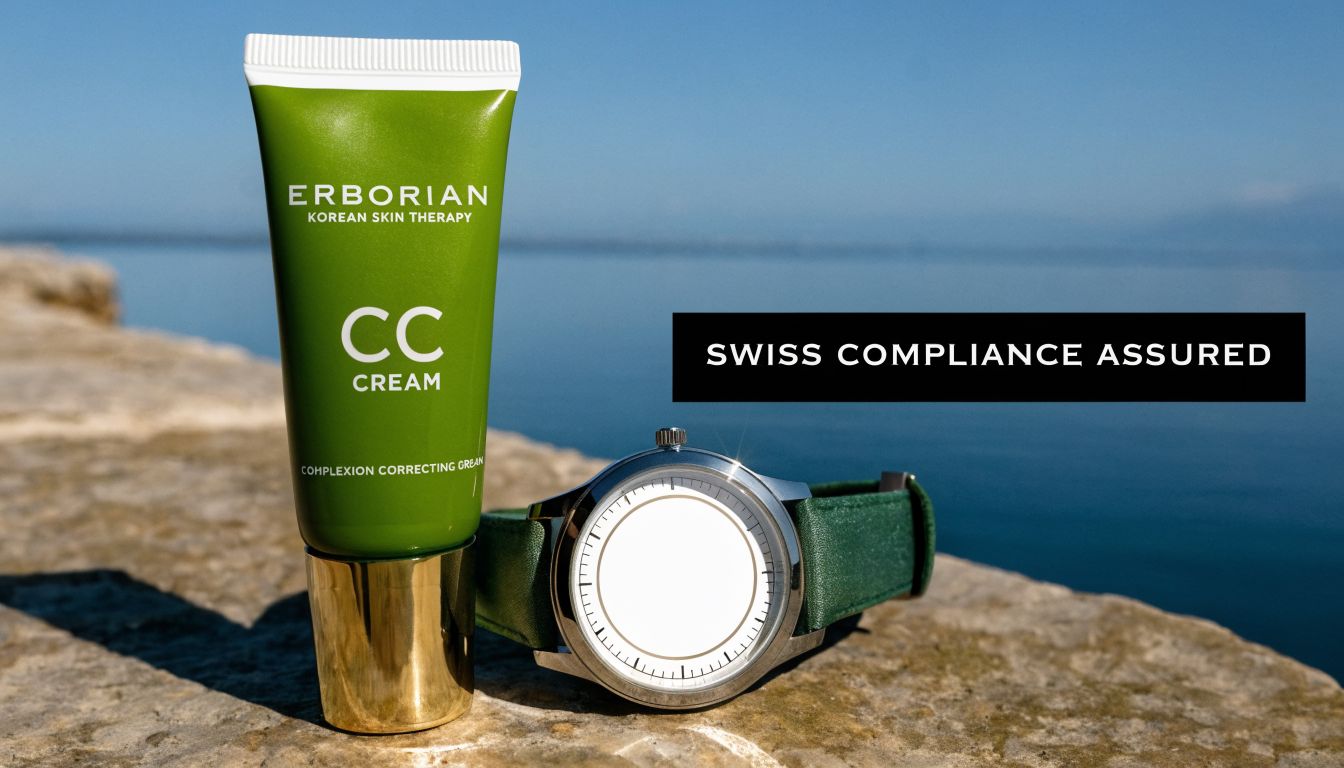
Swiss retailers need a more disciplined conversation around SPF than many general beauty channels use. Clients are informed, pharmacists are careful, and mountain exposure changes how people think about daily protection. Erborian cc cream can absolutely be part of that conversation, but it has to be explained accurately.
What is in the SPF system
According to Marie Claire's product breakdown of Erborian CC Cream, Erborian CC Cream SPF 25 combines chemical filters Octinoxate 6.00% and Octisalate 2.00% with physical filters including Titanium Dioxide and Zinc Oxide, reaching a critical wavelength >370nm that meets Swissmedic guidelines for broad-spectrum claims under EU Cosmetics Regulation 1223/2009. The same source notes the use of non-nano Titanium Dioxide and a preservation system with Phenoxyethanol at 0.54%, within the 1% regulatory limit.
That gives the product a strong compliance and formulation story for Swiss points of sale. It also gives staff something concrete to say when a customer asks whether the formula aligns with current clean-beauty expectations. The non-nano Titanium Dioxide detail is especially useful with ingredient-conscious shoppers.
What this means for pharmacies and spas
The hybrid filter system is commercially helpful because it lets the advisor speak to both performance and reassurance. Some clients trust mineral filters more. Others want the cosmetic elegance that often comes with a hybrid approach. This formula sits in the middle, which usually makes recommendation easier.
Use these talking points in-store:
- Broad-spectrum support: relevant for daytime city use and everyday exposure.
- Hybrid filter design: useful for clients who want a modern, wearable texture.
- Regulatory clarity: important for pharmacy teams who need confidence in claims language.
If your e-commerce team needs a better way to organise SPF claims, shade education, and routine-building blocks on product pages, these Shopify sections for skincare brands offer useful merchandising ideas.
The trade-off to explain honestly
SPF inside a complexion product is valuable, but it doesn't remove the need for correct usage. If staff treat the product as a casual add-on with no discussion of amount or routine placement, clients may overestimate the protection they are getting. Good retail practice means celebrating the SPF while still explaining where dedicated sunscreen may remain the stronger recommendation.
That balanced message builds trust. In Swiss retail, trust matters more than a fast but careless sale.
Application and Client Consultation Guide
A strong formula can still disappoint if the advisor applies it poorly. Erborian cc cream is one of those products that benefits from technique. The application has to support the technology. Otherwise the finish can look patchy, underwhelming, or too subtle for the client's expectations.
The best way to apply it
For this product, fingertips usually give the clearest result because they help activate the encapsulated pigments. Start with skincare already absorbed. Dispense a small amount, then blend from the centre of the face outward, where most clients want the most correction.
The usage guidance on Erborian's CC Cream product page notes that the hybrid SPF 25 system is particularly effective in high-altitude Swiss regions and recommends a pea-sized application of 0.5g per face, providing 1/2mg/cm² coverage for labelled SPF efficacy. The same source describes the hybrid approach as outperforming many single-filter sunscreens in PPD tests.
That recommendation is useful for consultations because it gives staff a practical benchmark. Customers often underapply complexion products, especially when they are aiming for a "barely there" look.
Consultation script that works in-store
Use a simple sequence:
- Confirm the goal. Ask whether the client wants redness correction, general evening out, or a fresher finish than foundation.
- Apply with fingers first. This lets the client see the adaptive technology perform as intended.
- Pause before adding more. The finish often settles more naturally after a moment.
- Decide whether to build. Some clients need only a veil. Others want a second pass on the cheeks or around the nose.
Apply, blend, then assess. Don't chase coverage too quickly.
Shade selection without overcomplicating it
Because the product adapts, the consultation doesn't need to feel like a classic foundation matching service. That is a commercial advantage. Still, advisors should avoid saying it suits everyone. A better approach is to say the formula is designed to adapt within a range, then test directly along the jawline or cheek where the client has visible unevenness.
For undertone-sensitive clients, watch what happens after blending rather than making a decision from the cream's initial appearance. The out-of-tube colour can mislead less experienced staff.
Routine placement and layering
In a standard morning routine, erborian cc cream belongs near the finish. Apply skincare first, let it settle, then use the CC cream as the complexion step. If the client wants extra coverage, concealer can be added afterwards only where needed.
What doesn't work well is heavy layering over tacky creams or oils that haven't absorbed. That can interfere with blending and reduce the elegant finish the formula is known for. In post-treatment or sensitised routines, keep the routine calm and minimal. Too many active layers underneath can make any complexion product harder to wear comfortably.
Merchandising and Proven Selling Points
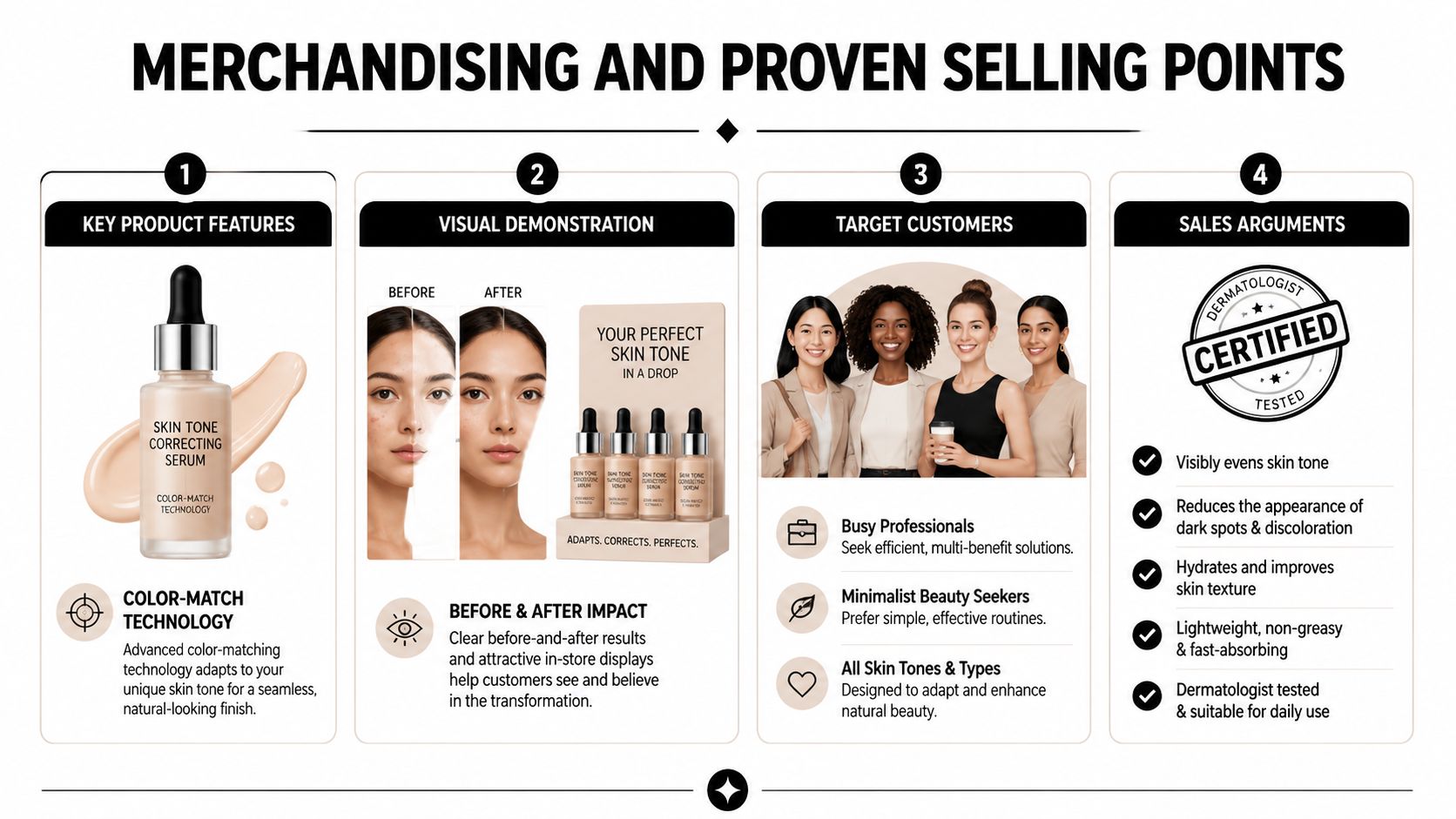
This is the sort of product that should never be left to passive shelf browsing. Erborian cc cream sells best when it is demonstrated, compared, and given a clear role in the store. Put it in a dead zone between unrelated make-up items and it becomes just another tube. Put it where customers can understand its purpose, and it becomes a conversion product.
The commercial proof point
A strong retail story needs more than a nice texture. It needs evidence that people who try the product want to buy it. In a SoPost UK sampling campaign for Erborian, 89% of consumers were new to the brand, 55% expressed intent to purchase a full-size product within six months, 9.7% bought the product immediately after trial, and 412 of 569 respondents gave it a five-star rating.
Those are valuable figures for a Swiss buyer because they point to two things. First, the product works as an acquisition tool, not only a loyalty item. Second, trial matters. If customers can experience the finish on skin, the commercial case gets much stronger.
Best merchandising positions
Three placements tend to work well:
- Between skincare and make-up: this is the most logical home because the product speaks to both shoppers.
- Inside a quick-routine edit: pair it with cleanser, serum, and SPF-led day care to create a fast morning story.
- At consultation stations: the texture and colour adaptation are easier to understand when seen live.
For social merchandising and content creation, teams looking at short-form video can use ideas from this viral.new guide to tiktok sales to show real application, side-by-side corrections, and routine integration. Erborian cc cream is visual. That makes it more teachable and more sellable online.
A product demonstration can also help staff training. This brand video is useful for showing finish and application style:
What to say at shelf and counter
Keep the messaging commercially sharp.
- For busy professionals: "This gives a polished weekday complexion without a full make-up routine."
- For minimalists: "It evens tone while keeping the skin looking natural."
- For pharmacy clients: "It combines complexion correction with a credible SPF and skincare-led formula story."
The easiest sale often starts with a hand or jawline demo, not a long verbal explanation.
Trial sizes versus full-size retailing
When a product has a strong try-to-buy profile, sample strategy matters. Smaller formats are useful in gift-with-purchase, travel edits, spa retail, and advisor-led introduction. Full-size becomes easier to sell once the client has seen the texture transform and knows the product fits her routine.
That is why erborian cc cream shouldn't be treated as a shelf-only item. It is a demonstration-led retail product with clear cross-category appeal.
Advanced FAQs for Swiss Professionals
Some of the most important questions about erborian cc cream sit in the grey area between make-up, skincare, and pharmacy guidance. That is where poor advice creates returns. Clear advice creates loyalty.
Can it replace a dedicated sunscreen
Sometimes, but not always the way clients hope. The need for clearer guidance is recognised in the Swiss context, and Erborian's broader CC Cream product guidance highlights that Swiss consumers are diligent sunscreen users, with over 60% reporting regular use, while practical advice is still needed on whether the product should be used alone or layered with a dedicated sunscreen.
In daily urban routines with moderate exposure, some clients may choose it as their daytime complexion-and-protection step. In stronger UV conditions, extended outdoor time, or mountain settings, a dedicated sunscreen underneath is the safer professional recommendation.
Is it suitable for sensitive or post-procedure clients
Proceed carefully. The texture and Centella story make it attractive for clients who want a gentler-feeling complexion product, but post-peel or visibly compromised skin needs cautious judgement. In those cases, prioritise barrier comfort and medical or post-treatment guidance first. Introduce the CC cream only when the skin is ready for cosmetic layering.
Where does it sit in a pharma-aligned routine
Use it near the end. A simple sequence works best: cleanse, treat, moisturise if needed, SPF strategy, then erborian cc cream as the complexion finish. If the client uses intensive actives, keep the morning routine calm so the product can sit evenly.
What is the most professional way to sell it
Sell it with boundaries. Promise a natural correcting finish, not full coverage. Explain where it excels, and explain when another SPF step is wiser. That style of recommendation is what makes the product sustainable in Swiss retail, not just fashionable.
If you're building a premium assortment for Swiss pharmacies, spas, boutiques, or clean-beauty e-commerce, beautysecrets.agency can help you select, position, and retail products with stronger compliance logic, clearer education, and better in-store usability. Their portfolio approach is built for partners who want differentiated brands, credible ingredient stories, and support that goes beyond the listing of SKUs.