A category manager once told me that the fastest way to test a classic fragrance is to watch who picks it up without prompting. Gabriela Sabatini still gets that reaction because customers recognise the name, remember the bottle, or respond to the style of scent once it hits the blotter.
The Story of an Iconic Fragrance
In fragrance retail, heritage only matters if it can still sell. Gabriela Sabatini Parfum has that advantage because its story is easy for staff to tell and easy for customers to understand.
The line began in 1989 in partnership with Mülhens (4711), and that date matters because it places the launch early in the celebrity-fragrance era rather than deep into today's crowded endorsement market. Gabriela Sabatini herself brought unusual credibility to the project. Before the perfume launch, she had already become a major international tennis figure, born on 16 May 1970, reaching world No. 3 in both singles and doubles and winning 41 titles across both disciplines, as noted in Gabriela Sabatini's biography.

Why the origin story still works at shelf level
Most celebrity perfumes struggle in Swiss pharmacy and drugstore environments because the endorsement feels detached from the product. This one doesn't. Sabatini's public image carried discipline, femininity, polish and international visibility. Those qualities translate naturally into fragrance language.
That gives retail staff a usable script. They don't need to oversell glamour or pretend the scent is niche. They can position it as a classic designer fragrance with a genuine personality behind it, not just a licensed name.
A few practical consequences follow from that:
- Recognition helps conversion: Customers who know the name often need less education.
- Heritage supports gifting: A classic with a known backstory feels safer than an unfamiliar launch.
- The line has memory value: Some shoppers buy it for themselves, others to reconnect with a period of their lives.
Retail insight: Classics sell best when the story is short, clear and repeatable in under 20 seconds.
What Swiss retailers should take from the history
For a Swiss pharmacy chain, this history isn't decorative. It's commercial. A long-running fragrance with a strong origin story gives the assortment stability. It attracts shoppers who don't want experimental olfactory concepts and don't need a long consultation to feel confident.
It also fills a very specific gap in modern assortments. Many stores now skew towards minimal, clean, or highly trend-led fragrances. That leaves space for a fuller, more recognisable, more traditionally feminine profile. Gabriela Sabatini Parfum belongs in that space.
The important trade-off is this. Its legacy is an asset, but only if the retailer presents it as intentional heritage, not leftover stock. Display, staff language and product grouping decide which of those two readings the customer takes away.
Deconstructing the Scent Profile
Retail teams sell this fragrance better when they stop calling it “floral” and start describing its movement on skin. Gabriela Sabatini Parfum has a clear structure, and that structure is why it has stayed readable to customers for so long.
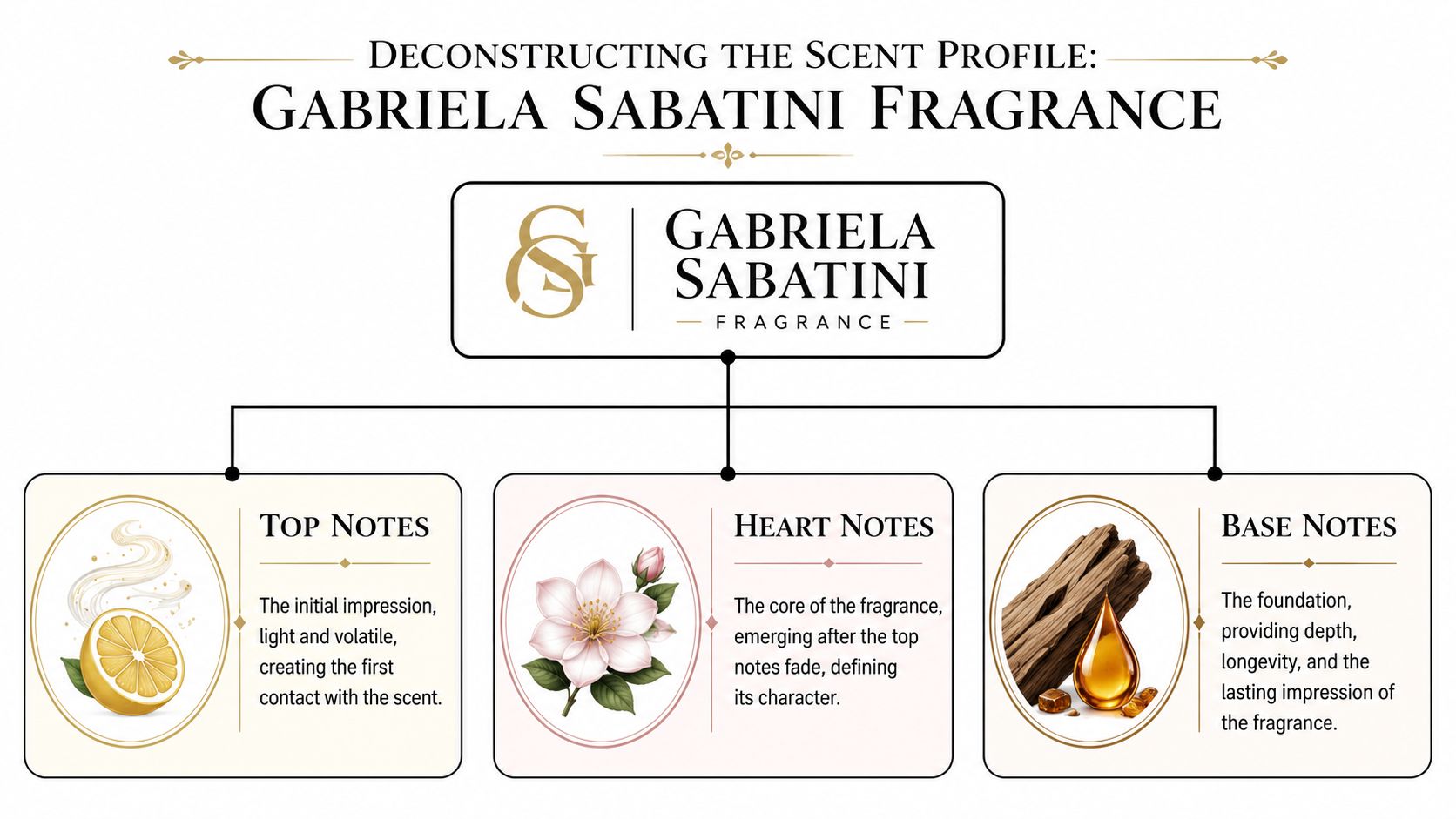
The most useful technical description is a classic white-floral oriental. FragranceNet lists top notes of bergamot, lemon, mandarin orange and fruity accords, a heart of jasmine, orange blossom, lily of the valley, rose, honeysuckle and heliotrope, and a base centred on vanilla, amber, tonka, sandalwood, musk, oakmoss and patchouli in its Gabriela Sabatini Eau de Toilette listing.
How to explain the opening
The top is brighter than many customers expect from a fragrance with such a warm reputation. Citrus and fruity facets give the first impression lift. Depending on how the wearer's skin handles aldehydic brightness, the opening can feel polished rather than juicy.
That matters at the counter. If a customer smells only the first minute on paper, they may assume the fragrance is fresher and lighter than it really is. Staff should explain that the opening is only the introduction.
| Note Layer | Key Scents |
|---|---|
| Top Notes | Bergamot, lemon, mandarin orange, fruity accords |
| Heart Notes | Jasmine, orange blossom, lily of the valley, rose, honeysuckle, heliotrope |
| Base Notes | Vanilla, amber, tonka, sandalwood, musk, oakmoss, patchouli |
Where the fragrance becomes itself
The heart is the identity. Jasmine, orange blossom and honeysuckle are especially important when describing it to customers because they signal a rich floral centre rather than a sheer or watery one.
Some modern shoppers decide whether they love it or leave it based on these characteristics. If they enjoy soft white florals with real body, the perfume makes sense. If they want transparent musks or airy skin scents, it probably won't.
Later in the wear, the base does the heavy lifting. Vanilla, amber, tonka, sandalwood and musk create the sweet, resinous dry-down that gives the fragrance its character and memory.
A quick visual helps staff discuss that evolution in-store:
Smell it in stages, not in one verdict. The top attracts attention. The base decides whether the customer comes back for the bottle.
What works and what doesn't in customer language
Good descriptions are concrete. Weak descriptions are generic.
Use phrases like:
- “Bright citrus opening” if the customer wants to know the first impression.
- “Full floral heart” if they like classic feminine compositions.
- “Warm vanilla-amber base” when discussing the finish and character.
Avoid saying it's “for everyone”. It isn't. This fragrance works best for customers who appreciate structure, sweetness and a clear floral identity.
Analyzing Performance Longevity and Sillage
Performance is one of the strongest reasons to stock Gabriela Sabatini Parfum, but it's also where poor sales advice can create disappointment. This is not a whisper-soft modern mist. It has presence, and staff should say so plainly.
According to Notino's product description, the heart notes typically last 2 to 3 hours, while the base can last 4 hours to over a day. That range explains why some customers describe it as persistent long after the floral centre has softened.
What longevity means in daily Swiss use
In practical retail terms, longevity here is a selling point for customers who dislike frequent reapplication. It's less compelling for shoppers who want something discreet for close office environments.
In Swiss conditions, this style tends to make more sense in cooler weather, evening wear, or spaces where the fragrance can unfold slowly. Indoor heating can push the sweeter base forward, which some wearers love and others find too assertive. In alpine cold, the richer dry-down often feels more balanced than it does in summer transit or tightly enclosed offices.
That means the recommendation should depend on use case, not on taste alone.
- For office wear: suggest lighter application and a test on skin rather than paper only.
- For dinner, social events, or winter gifting: lean into the warm base and noticeable trail.
- For customers who ask for “something that lasts”: this is a credible classic option.
Managing expectations around sillage
Sillage is harder to pin down numerically, and it shouldn't be oversold. What can be said with confidence is that the composition has enough density in the floral heart and amber-vanilla base to leave a noticeable impression when applied generously.
That's an advantage in classic fragrance retail. It's a drawback if a sales associate presents it as effortless, minimalist or barely-there.
For teams refining their language around wear time and scent development, Essentia's guide for lasting luxury is useful background reading because it helps frame how customers think about staying power versus projection.
A strong performer doesn't suit every situation. It suits the customer who wants to be able to smell her fragrance later in the day.
The trade-off is clear. Gabriela Sabatini Parfum delivers persistence, but it needs accurate consultation. That's what protects satisfaction.
Identifying the Gabriela Sabatini Customer Persona
The most reliable customer for Gabriela Sabatini Parfum usually isn't chasing novelty. She's buying with confidence, memory, and a preference for fragrances that don't disappear into skin within the hour.
The core buyer
She values timelessness over trend language. She may know the fragrance already, or she may respond to the style because it feels complete, feminine and self-assured. In many stores, she's the customer who asks for something elegant, recognisable and warm rather than “clean”, “green” or “minimal”.
She also tends to appreciate a fragrance that does a clear job. She wants scent, not ambiguity. If she buys in a pharmacy or drugstore setting, that often means she trusts edited assortments and prefers products with a long-standing reputation.
A helpful working persona looks like this:
- Classic in taste: She likes floral signatures with body and a real dry-down.
- Deliberate in purchase habits: She doesn't need endless launches. She buys when something suits her.
- Open to heritage branding: A known name reassures her more than a niche story full of abstract references.
The secondary buyer
There's another customer worth noting. She may be younger, but she's interested in retro fragrance styles, stronger structures and perfumes that feel distinct from current sheer-market launches. For her, Gabriela Sabatini Parfum can read as vintage in the best sense.
This group needs different language. Nostalgia alone won't convert them. They respond better to terms like white floral, amber, vanilla, and classic designer composition.
Retail teams that want a sharper sense of how luxury fragrance buyers evaluate quality, image and personal fit can borrow ideas from this expert guide to luxury fragrances. It's a useful reminder that customers often choose based on identity as much as notes.
Who it doesn't suit
This fragrance usually won't satisfy shoppers who want clean-beauty aesthetics translated directly into scent style. It also won't please customers looking for barely perceptible musk or brisk citrus freshness with no sweetness underneath.
That's not a weakness. It's clarity. In retail, a fragrance with a defined wearer often performs better than one positioned as universally acceptable.
Strategic Positioning in the Swiss Market
For Swiss pharmacies and drugstores, Gabriela Sabatini Parfum works best as an anchor classic. It shouldn't compete for the same role as a niche launch or a natural-leaning minimalist fragrance. It should sit in the assortment as a recognisable, dependable choice for customers who want a familiar designer style.
Swiss retail positioning already supports that reading. In the local market, Gabriela Sabatini is framed as a classic, long-running designer fragrance from 1989, with strongest fit among customers seeking heritage-style florals with stronger sweetness and tenacity, rather than minimalistic clean-beauty compositions, according to Oh Feliz's Swiss market view of Gabriela Sabatini.

Where it fits in a modern assortment
A well-built fragrance assortment needs tension. If every SKU is trend-led, the selection becomes fragile. If every SKU is heritage, it starts to look static.
Gabriela Sabatini Parfum earns its place because it balances newer entries. It gives the retailer a scent with known identity, broad recognition, and a profile that many shoppers can understand on first smell. In a pharmacy environment, that matters. Customers often want decisiveness, not an extended sampling ritual.
A sensible positioning model looks like this:
- Use it as the classic floral reference point in the range.
- Place it near other recognisable designer names, not beside eco-minimal fragrance concepts.
- Present it as timeless elegance, not as a rediscovered trend piece.
Commercial strengths and real risks
The strengths are straightforward. It has heritage. It has a clear scent profile. It serves a customer segment that many modern assortments under-address.
The risks are just as real. Without active framing, some shoppers will read it as dated. Without trained staff, its richer style may be introduced too vaguely. Without thoughtful placement, it can disappear between trendier launches and cleaner pharmacy staples.
Commercial rule: Don't ask a classic to behave like a novelty launch. Ask it to deliver recognition, trust and repeat purchase.
A pharmacy chain can make this product work when it treats it as part of a balanced architecture. Let niche do discovery. Let natural do ingredient storytelling. Let Gabriela Sabatini Parfum do what classics do best. Reassure the buyer and close the sale with confidence.
Merchandising and Retail Activation Strategies
Once you decide to list Gabriela Sabatini Parfum, execution matters more than theory. A classic fragrance can sell steadily for years, but only if the store makes it easy to notice, easy to understand and easy to trust.

Shelf placement and visual logic
Don't hide it in a bargain corner and expect the heritage story to survive. Placement shapes perception. If the bottle sits beside neglected clearance stock, customers assume the fragrance belongs to the past for the wrong reasons.
Better practice is to integrate it with other enduring designer references and give it eye-level visibility where possible. A small sign with two or three note cues is often enough. You don't need theatrical storytelling. You need clarity.
For teams refining fixture design, spacing and customer flow, these retail merchandising techniques offer a practical framework for turning passive shelf presence into active discovery.
What staff should say at the counter
Staff training should focus on usable phrases, not brand mythology. Short scripts work best.
Try language like:
- “This is a classic white-floral oriental.”
- “It opens brighter than people expect, then becomes warmer and sweeter.”
- “It suits customers who enjoy a fuller floral signature with lasting presence.”
What doesn't work is vague praise such as “very nice”, “for all ages”, or “good for everyone”. That language kills confidence because it says nothing.
If a sales associate can't describe the dry-down, they're not ready to sell the fragrance.
Cross-selling and basket building
This fragrance lends itself to practical companion products. The best pairings don't compete with it.
Consider:
- Unscented body lotion: Helps customers extend wear without distorting the scent profile.
- Gift wrap or seasonal gifting support: Classics often perform well when bought for someone else.
- Travel atomisers: Useful for customers who want touch-up convenience without carrying the full bottle.
Avoid cross-selling with heavily fragranced body products unless the customer specifically asks for layering ideas. The floral heart and sweet base can become crowded quickly.
Authenticity and sourcing discipline
Many retailers are careless concerning long-running fragrances. These often circulate in multiple bottle variants, pack styles and online listings, which can confuse both shoppers and buyers. Ferwer highlights that Swiss shoppers face authenticity concerns because listings can be confusing, with multiple bottle variants and price points, making clear sourcing guidance essential in the Ferwer product overview for Gabriela Sabatini Eau de Toilette.
For a pharmacy chain, that translates into a straightforward rule set:
- Buy from traceable authorised channels.
- Document bottle and packaging references internally.
- Train staff to explain variant differences calmly and clearly.
- Avoid mixing uncertain supply with trusted inventory.
Customers forgive a classic style. They don't forgive doubt about authenticity.
Conclusion Timeless Appeal in a Modern World
Gabriela Sabatini Parfum lasts in retail for the same reason many classics do. It knows what it is. The story is grounded in real celebrity credibility from 1989, the scent profile has a distinct floral-to-amber progression, and the performance answers a practical customer need for presence and staying power.
For Swiss pharmacies and drugstores, that combination has real commercial value. This isn't the fragrance to present as niche, natural, or trend-first. It works when the store treats it as a heritage designer reference with clear identity and dependable appeal. In the right assortment, it gives balance.
It also solves a problem that many modern fragrance edits create. When a shelf leans too heavily towards abstract concepts or ultra-clean scent styles, some customers stop seeing themselves in the offer. Gabriela Sabatini Parfum brings those customers back into the conversation.
The key is disciplined positioning. Sell the history briefly. Describe the scent accurately. Set expectations around strength. Merchandise it with respect. Source it carefully.
Do that, and this fragrance doesn't feel old. It feels established.
If you're building a more differentiated beauty and wellness assortment for Swiss retail, beautysecrets.agency can help you shape a portfolio with stronger commercial logic, credible brand stories and better alignment between customer demand, channel fit and long-term sell-through.