Switzerland's anti-ageing skincare ingredients market was valued at USD 13.19 million in 2024, with serum already the largest format at USD 4.30 million. The same market study identifies hyaluronic acid as the fastest-growing ingredient category, while the overall market is projected to reach USD 17.61 million by 2032, at a 4.22% CAGR for 2025 to 2032. Swiss anti-ageing skincare market data
That changes the buying question. The best hyaluronic acid serum for Swiss shelves isn't automatically the most expensive bottle or the one with the biggest concentration claim. It should match molecular weight, vehicle quality, certification, pharmacy pricing, post-procedure needs, and Switzerland's dry indoor and alpine climate.
A Switzerland-focused analysis places the OTC hyaluronic acid market at CHF 80–130 million in 2026, with topical skincare representing about 25–35% of total value. Standard topical serums sit around CHF 25–45 for 30 ml, while premium multi-molecular formulas can reach CHF 55–90 for 30 ml. The source projects 5–8% annual growth from 2026 to 2035, driven by premiumisation, preventive skincare, and aesthetic dermatology. Swiss OTC hyaluronic acid market analysis
| Buyer priority | Best formula direction | Swiss retail fit |
|---|---|---|
| Pure daily hydration | Single-weight or dual-weight HA | Entry pharmacy and drugstore |
| Winter dryness | Dual-weight or multi-molecular HA | Pharmacy, premium skincare |
| Post-procedure support | Simple linear or crosslinked HA | Dermatology and aesthetic clinics |
| Mature preventive routine | Multi-molecular HA with compatible actives | Boutique and premium pharmacy |
| Clean-beauty positioning | Verified ECOCERT or COSMOS formula | Selective parapharmacy and boutique |
What Defines a High-Performance Hyaluronic Acid Serum
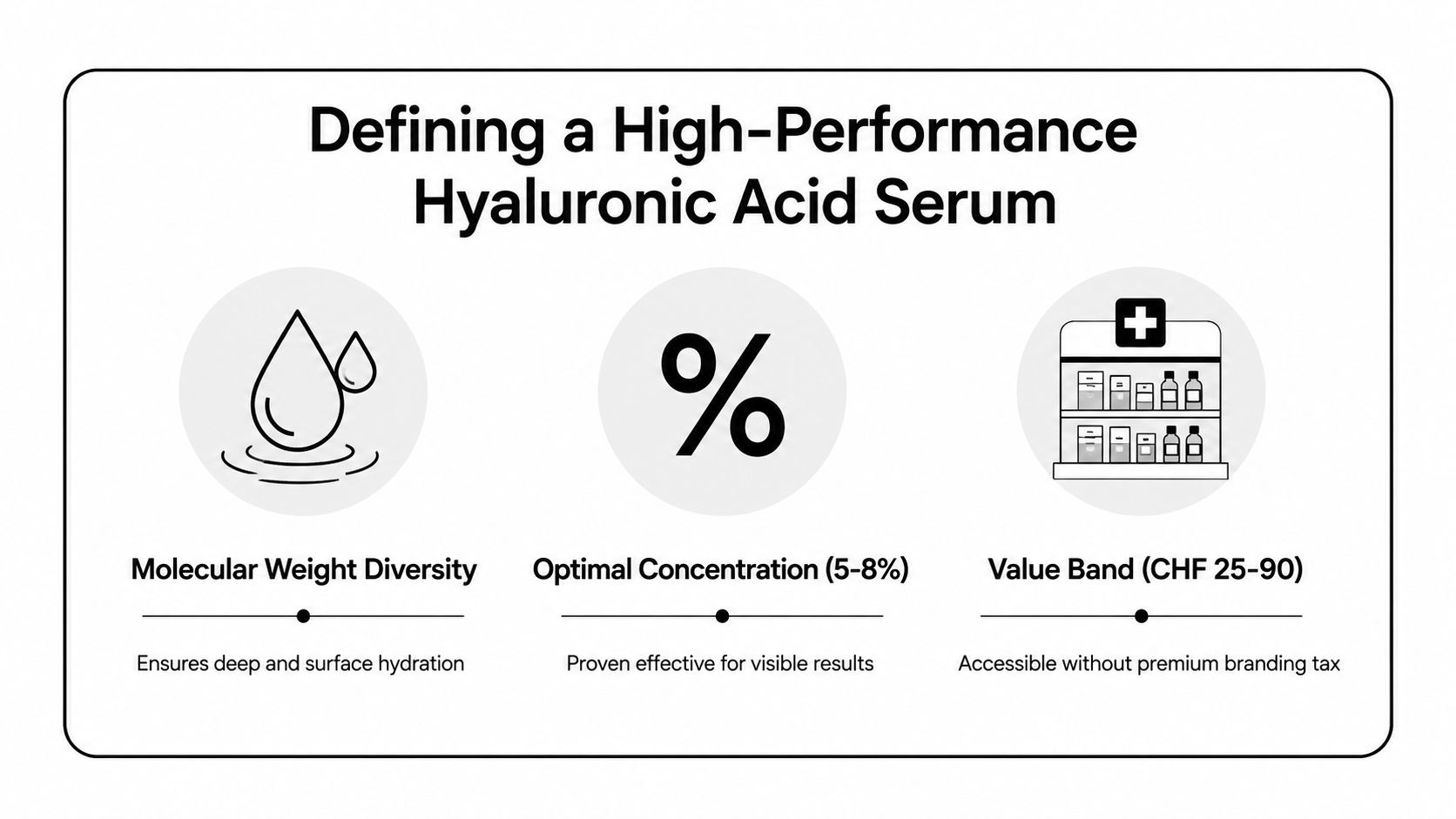
A high-performance serum earns its place on a Swiss shelf through formulation evidence, not brand prestige. Within the CHF 25–90 retail band, certification can help separate value tiers, but it should never excuse weak texture, unclear HA composition, or poor packaging. ECOCERT or COSMOS status may support a premium positioning, while an uncertified formula can still win on molecular design, stability, and daily usability.
Performance rests on three linked decisions: active concentration, molecular weight architecture, and vehicle integrity. A strong HA claim means little if the serum pills under SPF, feels sticky, or leaves skin tight. Pharmacy buyers should judge the complete use experience, especially for customers applying products in dry indoor air, cold outdoor conditions, or after aesthetic procedures.
Concentration is only one part of performance
Use the stated concentration to screen products, then examine the HA form and supporting ingredients. Sodium hyaluronate, hydrolysed HA, and crosslinked HA behave differently in a finished formula, so the percentage cannot stand alone.
Glycerin and panthenol support water binding and comfort. Squalane adds an emollient finish and can reduce the dry, tight sensation that humectant-heavy gels sometimes create. The right vehicle spreads quickly, layers under moisturiser, and leaves enough slip for consistent use. That matters at pharmacy level, where repeat purchase depends on comfort as much as the ingredient claim.
Pharmacy rule: Choose the serum that feels elegant on damp skin, disappears under cream, and avoids pilling. A more concentrated gel loses its value when customers stop using it.
Certification should support the formulation story
ECOCERT or COSMOS certification can signal controlled sourcing and manufacturing standards. It does not confirm the ideal molecular weight profile for every customer. Treat certification as a trust and assortment filter, then review the formula, packaging, stability documentation, and usage instructions separately.
A practical definition is straightforward. A high-performance HA serum should provide measurable hydration retention, credible third-party stability testing, transparent HA architecture, and dependable behaviour in Swiss indoor dryness and cold outdoor conditions. Its price should reflect formulation work and supporting evidence, not just a luxury label.
Molecular Weight and Concentration Demystified
Molecular weight determines where HA mainly behaves, while concentration influences the intensity and texture of the formula. Retail teams don't need to turn every consultation into a chemistry lesson. They do need to explain why a surface film, a lighter fraction, and a supporting vehicle can serve different needs.
Low molecular weight HA is generally selected for a lighter, more readily distributed feel. Mid-weight material helps bridge surface and deeper hydration behaviour, while high molecular weight HA stays closer to the surface and creates a comforting moisture film. Crosslinked HA forms a more persistent reservoir-like network, whereas linear HA gives formulators greater flexibility across different layers and textures.
The concentration bands below work as a buyer's reference framework, not as a universal efficacy law. Product performance still depends on pH, preservatives, solvents, humectants, packaging, and the quality of the raw material.
| Molecular weight | Depth of action | Typical concentration | Retail use case |
|---|---|---|---|
| Low, 50–150 kDa | Lighter, more mobile hydration across upper layers | Under 1% as a supporting humectant | Lightweight formulas and oily or combination skin |
| Mid, 500–1000 kDa | Balanced surface and intermediate hydration | 1–2% working daily-hydration range | Mainstream pharmacy serums |
| High, above 1000 kDa | Predominantly surface film and immediate comfort | 2% or more in treatment-oriented formats | Dry, mature, or climate-stressed skin |
| Crosslinked HA | Surface reservoir effect with longer-feeling hydration | Varies by formula | Premium and post-procedure positioning |
Use performance claims as comparison anchors
Swissgetal's Hyaluron Pure provides a useful local shelf benchmark. Its product page reports a 60.0% increase in skin moisture after two weeks, 72-hour moisture retention, and an 80.0% increase in cell growth, reported as RGR, using a two-HA system. Those figures are product-reported outcomes, so buyers should treat them as a comparison anchor rather than a universal promise for every HA serum. Swissgetal Hyaluron Pure product data
A category manager should ask whether an incoming brand can document comparable testing, not whether its label says “multi-weight”. The back-office cheat sheet is therefore: under 1% means supporting hydration, 1–2% means everyday working range, and 2% or more suggests a more treatment-led claim, provided the vehicle remains comfortable and stable.
Apply every HA serum to slightly damp skin, then seal it with a cream. Swiss product guidance commonly uses that sequence because HA performs better when the skin surface has available water, and the cream helps reduce evaporation in heated or low-humidity environments.
Comparing Single-Weight, Dual-Weight and Multi-Molecular Systems
The right HA architecture depends on the customer's tolerance, climate, treatment history, and willingness to pay. A single-weight serum can be the smartest choice for a narrow need, while a multi-molecular product can justify premium shelf space when customers want one product to cover several hydration situations.
Single-weight systems
Single-weight serums are usually the easiest to formulate and explain. They suit minimal routines, sensitive users who want fewer variables, and clinics that need a straightforward hydrator after a treatment. Their weakness is equally clear: one molecular fraction gives the skin one dominant hydration behaviour.
That simplicity can be a strength after a peel or microneedling session, especially when the rest of the routine already contains a barrier cream and SPF. It can also support an entry-level price point without adding unnecessary actives.
Dual-weight systems
Dual-weight HA combines a lower and higher molecular fraction. In practical retail language, the lower fraction supports lighter hydration while the higher fraction improves surface comfort and plumping. This is the strongest general-purpose architecture for Swiss pharmacies because it offers a visible formulation story without becoming overly complicated.
The Teoxane SA Geneva split-face study offers a Switzerland-relevant efficacy reference. In 24 women aged 35–55, twice-daily use of a crosslinked HA serum after filler, microneedling, or mandelic acid peel produced statistically significant improvements in skin surface topography and hydration compared with untreated control sides at days 14 and 28. Blinded investigators also rated improvements in moisture, tone, radiance, texture, uniformity, and global appearance, with no adverse events observed. Teoxane-linked split-face clinical study
Multi-molecular systems
Multi-molecular serums add further fractions, often including mid-weight or crosslinked HA. They make the strongest hero-SKU proposition for everyday retail because they can address immediate surface feel, layered hydration, and longer-lasting comfort in one product. Pairings with niacinamide, panthenol, antioxidants, or peptides can broaden the routine, although every added active increases the need for compatibility and sensitive-skin testing.
| System type | Composition | Performance profile | Best Swiss channel |
|---|---|---|---|
| Single-weight | One HA fraction | Simple, focused, one-dimensional hydration | Clinics, sensitive-skin shelves, entry retail |
| Dual-weight | Low and high molecular fractions | Surface comfort plus lighter layered hydration | Mainstream pharmacies |
| Multi-molecular | Low, mid, high, and possibly crosslinked fractions | Broad hydration profile and stronger premium story | Premium pharmacies, boutiques, e-commerce |
The commercial conclusion is direct. Post-aesthetic clinics should favour purity and predictability, while everyday pharmacy shelves should lead with dual-weight or multi-molecular options. Don't force every customer into the most complex formula. Complexity should earn its space through better usability, better documentation, or a clearer climate and treatment benefit.
Certifications and Ethical Claims That Matter in Switzerland
Certification matters most when it changes how a product can be listed, explained, and trusted. Swiss pharmacies and selective retailers should separate verified certification, ingredient-origin claims, cruelty-free statements, and Swiss Made positioning, because they answer different buyer questions.
| Certification | Regulatory body | Key requirement | Buyer value in Switzerland |
|---|---|---|---|
| ECOCERT | ECOCERT certification organisation | Compliance with the relevant certified natural or organic standard | Strong clean-beauty filter and formulation credibility |
| COSMOS Natural | COSMOS-standard network | Verified natural formulation and processing requirements | Clear natural positioning for pharmacies and boutiques |
| COSMOS Organic | COSMOS-standard network | Organic-standard requirements across eligible ingredients and processing | Stronger organic shelf story |
| PETA cruelty-free | PETA programme | Brand declaration and programme criteria | Supports an accessible cruelty-free message |
| Cruelty Free International Leaping Bunny | Cruelty Free International | Supply-chain monitoring and cruelty-free standard | More rigorous external reassurance |
| Natural-origin claim | Brand or certifier, depending on wording | Must be substantiated by documentation | Useful only when the calculation and method are transparent |
| Swiss Made | Swiss legal designation framework | Must meet the applicable Swiss Made criteria | Supports provenance and price perception, not HA efficacy |
Certification and marketing aren't interchangeable
ECOCERT and COSMOS are especially valuable for clean-beauty shelves at Manor, selective parapharmacies, and specialist boutiques. They help staff communicate that a product has passed an external standard rather than relying on vague language such as “green”, “pure”, or “clean”.
Cruelty-free marks support emotional storytelling, but they don't establish organic status, HA concentration, molecular weight, or post-procedure suitability. Vegan claims require separate documentation because a cruelty-free product isn't automatically vegan.
Watch marketplace listings that present a large natural-origin percentage without naming the calculation method or certifying body. A strong buyer file should include the certificate, scope, renewal status, ingredient-origin documentation, and substantiation for vegan or cruelty-free claims.
Buyer's test: If a claim changes the shelf position or price, ask who verified it, what standard applies, and whether the documentation covers the finished serum rather than only selected ingredients.
Swiss Made can strengthen local provenance and justify a premium perception, but it shouldn't be treated as a substitute for formula transparency. For HA, the most defensible sequence is verified certification first, complete technical documentation second, and origin storytelling third.
Matching Serum Profiles to Swiss Skin and Climate Conditions
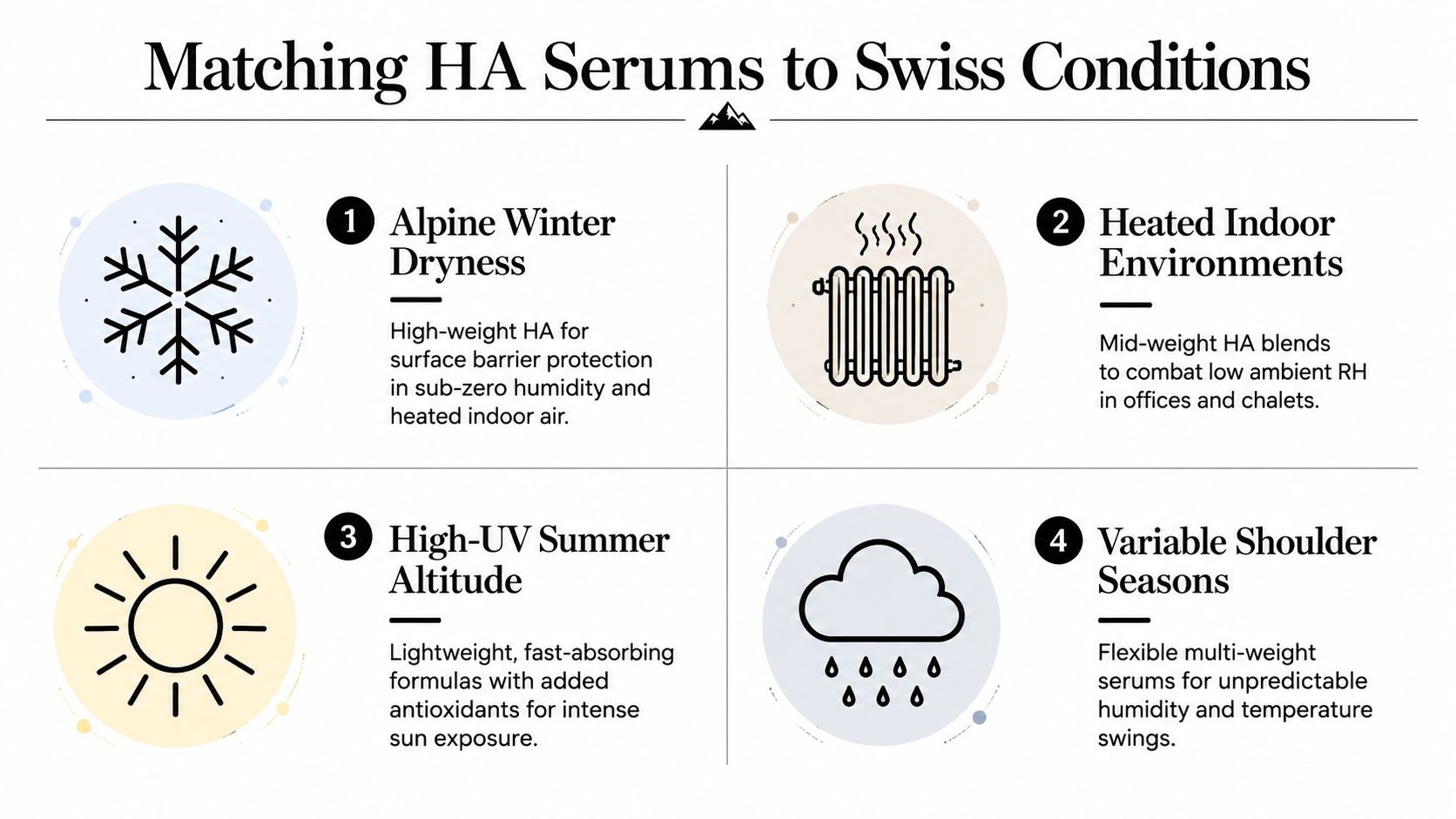
Swiss climate shifts should determine the serum recommendation. A formula that feels comfortable in a humid summer bathroom can become tight or tacky in a heated office, alpine chalet, or cold outdoor setting. HA binds water, but the result depends on application and the finishing layer.
Apply the serum to damp skin, then seal it with a cream. A damp surface gives humectants water to bind, while the cream slows moisture loss. This technique matters most with lower-weight formulas, which can feel less comfortable on completely dry skin in low-humidity conditions.
Four practical customer matches
Alpine winter dryness suits a dual-weight or multi-molecular serum under a richer barrier cream. Higher-weight HA improves surface comfort, while lower fractions add hydration without leaving only a surface film. Customers moving between cold air and heated rooms should not rely on a watery serum alone.
Heated indoor environments require disciplined layering, not a longer ingredient list. Mid-weight blends work well for offices, trains, and chalets. Recommend sealing the serum with cream instead of adding more drops.
Post-aesthetic recovery calls for a restrained formula. After filler, microneedling, or a mandelic acid peel, the treating professional's protocol takes priority, particularly when the skin barrier is compromised. A short, fragrance-conscious serum with few competing actives is easier for pharmacies and clinics to place in an aftercare routine. Packaging and staff guidance should make that limited role clear, rather than presenting the product as a complete recovery system.
Mature preventive routines benefit from a multi-molecular hydrator with barrier-supporting ingredients or antioxidants. HA provides the hydration base, while compatible actives address other routine goals. Keep the recommendation focused.
Oily skin and humid summer conditions favour a lighter single-weight gel. It absorbs quickly and avoids an unnecessarily rich finish. Variable shoulder seasons favour multi-weight formulas, especially when customers adjust the cream layer rather than replace the serum every few weeks. For Swiss retail, that flexibility can support one dependable shelf recommendation across changing indoor and alpine conditions.
The 2026 Default Pick and Where Simpler Formulas Still Win
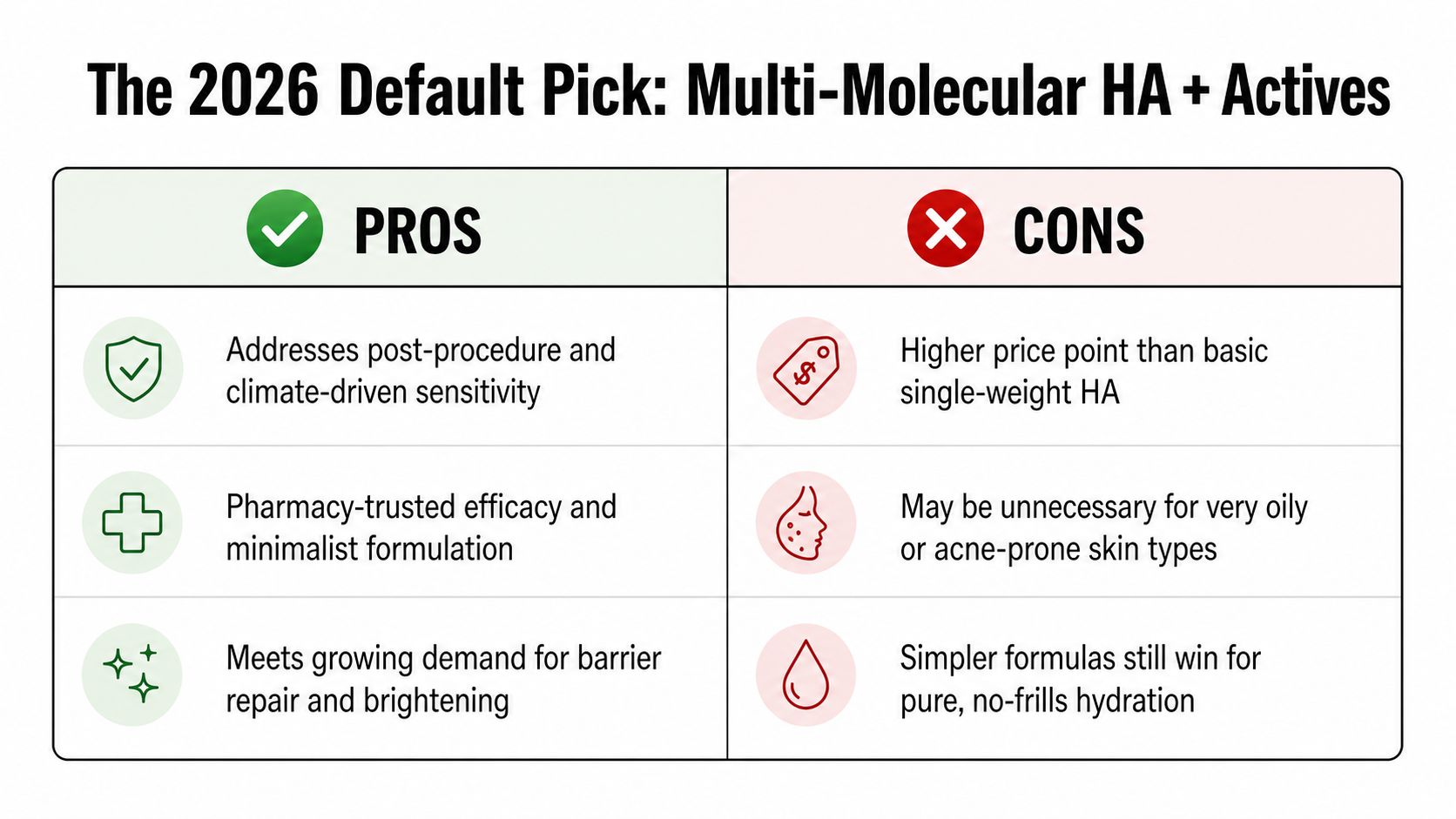
For a Swiss shelf planned around the 2026 projection period, the defensible default is a multi-molecular HA serum paired with niacinamide, panthenol, or an antioxidant system. The logic is commercial and practical. Customers increasingly want one elegant product that handles dry indoor air, seasonal shifts, preventive skincare, and the expectations created by aesthetic treatments.
That doesn't mean every formula should become crowded. A multi-molecular serum earns hero status when its architecture is clear, its texture layers well, and the added actives don't compromise sensitive-skin use. A premium price must correspond to a better experience and stronger documentation, not just a longer ingredient list.
Where the plain hydrator wins
A single-weight or low-complexity serum is the better recommendation for several buyers:
- Sensitive or rosacea-prone skin: Fewer actives mean fewer potential sources of discomfort.
- Post-peel recovery kits: Clinics may prefer a focused hydrator that fits a tightly controlled protocol.
- Minimalist customers: A plain serum is easier to understand and combine with an existing moisturiser.
- Entry-tier shoppers: A simpler formula can protect accessibility without pretending to be a complete anti-ageing routine.
- Oily or acne-prone skin: A lightweight, non-sticky hydrator may be more appealing than a rich multi-active gel.
The shelf should therefore have a clear hierarchy, not a wall of near-identical bottles. Make the multi-molecular product the hero, keep one single-weight sensitive-skin option, and add a third SKU only when it serves a different need, such as post-procedure recovery or an organic certification story.
My recommendation for 2026: Lead with versatility, retain simplicity as the safety valve, and never make customers decode more than three HA choices in one shelf bay.
Merchandising Hyaluronic Acid Serums for Swiss Trade Partners
A Swiss HA shelf should make three decisions clear: what the formula does, who needs it, and why its price is justified. Build a concise price ladder, assign each tier a distinct role, and train staff to assess climate, finish, molecular structure, and treatment context before recommending a serum. Concentration, molecular weight, and ECOCERT status must connect to retail economics, not sit on pack as isolated claims.
| Price tier, CHF | Typical formula | Certifications to highlight | Best channel | Bundle pairing |
|---|---|---|---|---|
| 25–45 | Single-weight HA or simple dual-weight formula | COSMOS or cruelty-free mark where verified | Drugstore, pharmacy gondola, entry e-commerce | Thermal mist and daily moisturiser |
| 40–65 | Dual-weight HA with niacinamide or panthenol | ECOCERT preferred, COSMOS where applicable | Pharmacy face-care zone, boutique | Barrier cream and SPF |
| 75–120 | Multi-molecular or crosslinked HA with post-procedure positioning | Verified certification plus clinical documentation | Clinic aftercare, premium pharmacy, curated e-commerce | Barrier cream and SPF 50+ |
The table is a merchandising framework, not a precise market report. Standard topical serums commonly sit below the premium clinical tier, while multi-molecular and post-procedure positioning can support a higher ticket when the channel offers professional guidance. Keep the justification visible through formula architecture, documented testing, certification, or aftercare support.
Put each tier where the customer can understand it
Use entry products on pharmacy gondola end-caps and drugstore hydration fixtures. Shoppers there need a direct answer, a familiar texture, and a price that does not require a long explanation. Place dual-weight formulas in the pharmacy face-care zone, with a small card explaining “surface comfort plus layered hydration” in plain language.
Clinical formulas belong at clinic aftercare counters and in professional e-commerce carousels. Their packaging should state whether the HA is crosslinked, whether the product was tested after procedures, and how it fits the treating professional's instructions. Do not let “clinical” function as a synonym for “better” without supporting documentation.
Staff should ask three questions:
- Are you dealing with alpine outdoor dryness, heated indoor air, or both?
- Do you want a lightweight hydrator or a more cushioning finish?
- Have you recently had filler, microneedling, a peel, or another aesthetic treatment?
The answers separate a basic daily hydrator from a climate-focused or post-procedure recommendation. Staff must not promise that a serum replaces professional care. For post-procedure customers, the treating professional's protocol takes priority.
Build the basket without confusing the category
Pair HA with a thermal mist, barrier cream, or SPF 50+. The serum provides the hydration step, the cream helps reduce moisture loss, and sunscreen protects the wider routine. Avoid bundling several competing hydrators. One clear layering sequence is easier to explain and less likely to make the customer question which product matters.
Seasonal rotation should follow customer behaviour. Refresh January displays around winter dryness, use September to address the return to heated interiors, and create post-summer fixtures that connect hydration with barrier recovery. POS cards should explain low, mid, and high molecular weight in three languages, with one practical instruction: apply to damp skin and follow with cream.
For launch content and retail demonstrations, AI generated skincare ads can help teams develop short-form UGC concepts around texture, layering, and climate use. Keep every script grounded in the actual formula, certification, and approved claims.
beautysecrets.agency supports Swiss retailers, pharmacies, spas, clinics, and premium e-commerce partners with curated natural and ethically sourced skincare assortments, including certified and cruelty-free positioning where documented. Visit beautysecrets.agency to discuss a Swiss HA category built around credible formulation stories, climate-specific merchandising, and clear pharmacy trade support.