The most popular advice about the best anti aging cream is also the least useful: find one hero product, apply it religiously, and expect it to solve every visible sign of ageing. Swiss pharmacy and spa buyers should reject that approach. A cream can improve hydration, support the barrier, soften the appearance of fine lines, or deliver targeted actives, but no single texture or ingredient suits every skin profile and commercial setting.
The smarter question is: which formulation delivers credible efficacy for this concern, this customer, and this retail channel? That means assessing retinoids, peptides, antioxidants, barrier-supportive lipids, photoprotection, clinical evidence, packaging stability, and clean-label credentials together. Switzerland's shoppers increasingly want natural formulations that still perform, while premium facial care remains a serious commercial category.
The market signals support a curated, evidence-led assortment. Switzerland's anti-aging skincare ingredients market was valued at USD 13.19 million in 2024 and is projected to reach USD 17.61 million by 2032, with a projected CAGR of 4.22% from 2025 to 2032, according to Swiss anti-aging skincare ingredients market analysis. Anti-wrinkle products were the largest segment, with USD 5.23 million in 2024 revenue, while serums reached USD 4.30 million and retinoids USD 2.70 million. Those figures point towards targeted, ingredient-led products rather than vague “youth” positioning.
Why the Best Anti Aging Cream Is a Moving Target
There is no universally best anti-aging cream. A customer with dehydration and a weakened barrier needs a different answer from someone prioritising pigmentation, expression lines, loss of firmness, or long-term prevention. A rich balm may be ideal for dry alpine winter skin and entirely unsuitable for an oily complexion in a humid lowland summer.
The phrase anti-aging also hides several biological processes. Visible ageing reflects cumulative oxidative stress, glycation, collagen degradation, changes in the skin barrier, and cellular senescence. Those pathways don't respond identically. Antioxidants help address environmental stress, retinoids support renewal and collagen-related processes, and barrier lipids improve comfort and water retention. Daily broad-spectrum sunscreen remains central because prevention cannot be separated from photoprotection.
The Swiss buyer's definition of best
Swiss consumers are asking for more than attractive packaging and a botanical story. Coverage of the Swiss market describes demand for “naturals with high performance”, with shoppers looking for scientifically supported results alongside safety and transparency, as reported by Cosmetics Design Europe's Swiss consumer coverage. That combination changes how pharmacies, spas, and premium retailers should assess a line.
A credible assortment should answer four questions:
- What does the formula target? Fine lines, uneven tone, dryness, laxity, or prevention should be clearly distinguished.
- Which active ingredients carry the claim? The INCI list should support the front-of-pack promise.
- What evidence exists for the final formula? Ingredient research alone isn't enough.
- Does the product meet the channel's expectations? A pharmacy needs clinical clarity, while a spa may also require a sensorial treatment experience.
Switzerland's older consumer base reinforces the category's durability. People aged 65 to 79 represented 13.8% of Switzerland's population in 2024, and the country's overall cosmetics products market was valued at USD 441.35 million in 2025, according to Swiss cosmetics market reporting. The same report projects the market to reach USD 571.78 million by 2031, with a projected CAGR of 4.41%.
Practical rule: Don't select a hero cream first. Select the skin concern, evidence threshold, formulation architecture, and customer journey first.
The strongest buyers therefore act as curators. They build a small, coherent system that covers prevention, correction, recovery, and daily protection, rather than filling a shelf with interchangeable jars.
Active Ingredients That Actually Deliver Results
Ingredient literacy separates a high-performance assortment from a collection of attractive claims. Buyers don't need to formulate products themselves, but they do need to recognise whether a supplier's language matches the chemistry, delivery system, and evidence.
Retinoids and renewal-focused actives
Retinol and retinaldehyde are vitamin A derivatives used to support cell renewal and improve the appearance of fine lines, uneven texture, and pigmentation. Retinaldehyde generally requires fewer conversion steps in skin than retinol, but it can still irritate poorly prepared or sensitive skin. Bakuchiol offers a plant-derived alternative for brands seeking a retinoid-adjacent positioning, although it shouldn't be presented as automatically equivalent to a retinoid.
Retinoids need disciplined use. Buyers should check the stated form, concentration, stability data, recommended frequency, and packaging. Combining a retinoid with strong exfoliating acids or other potentially irritating actives may be unsuitable for reactive customers, so staff need a simple introduction protocol.
Peptides, antioxidants, and hydration
Peptides work through different families and mechanisms. Signal peptides are positioned to support skin communication associated with firmness, carrier peptides may transport trace elements, and neurotransmitter-inhibiting peptides are used in expression-line products. The commercial claim must match the peptide type. “Peptide complex” alone doesn't tell staff or customers what the formula is designed to do.
Vitamin C derivatives and polyphenols support antioxidant positioning and can complement brightening routines. Niacinamide is especially useful because it can support barrier function, uneven tone, and visible redness while fitting into many routine designs. Hyaluronic acid is a humectant, not a collagen stimulant. Different molecular weights can create hydration at different levels of the surface structure, but the finished formula still determines the sensory result and water-loss behaviour.
For a clear consumer-facing vocabulary, buyers can also consult Skin Perfection's guide to anti-aging ingredients, then verify every supplier claim against the final INCI and clinical file.
| Ingredient Category | Cellular Mechanism | Primary Target Concerns | Effective Concentration Range | Layering Considerations |
|---|---|---|---|---|
| Retinoids | Supports renewal and collagen-related processes | Fine lines, texture, uneven tone | Supplier must disclose the exact active and level | Introduce gradually, manage irritation, use photoprotection |
| Bakuchiol | Plant-derived retinoid-alternative pathway | Texture, visible lines, prevention positioning | Require formula-specific efficacy data | Often easier to position for sensitive customers, but don't overclaim equivalence |
| Peptides | Supports signalling, transport, or expression-line pathways depending on family | Firmness, repair, expression lines | Request peptide identity and active level | Usually easy to combine, but evidence must match the peptide |
| Vitamin C derivatives | Antioxidant support and brightening activity | Dullness, uneven tone, environmental stress | Check the derivative and stability system | Pair with barrier support, protect from light and air |
| Niacinamide | Supports barrier function and tone-related pathways | Redness, uneven tone, dehydration | Formula-specific data is more useful than a generic claim | Generally versatile, but avoid unnecessary active overload |
| Hyaluronic acid | Binds water at the skin surface and within superficial layers | Dehydration, temporary plumping | Molecular weight and total system matter | Seal with an emollient cream in dry conditions |
| Polyphenols and botanical antioxidants | Helps defend against oxidative stress | Environmental stress, dullness | Standardisation and extract quality matter | Check fragrance allergens and sensitising botanicals |
Don't let “natural” become a substitute for efficacy. A clean-label cream can be commercially compelling, but its active identity, concentration, stability, and final-formula testing still need scrutiny.
Choosing the Right Formulation for Each Skin Profile
The active ingredient gets attention, but the delivery system often determines whether customers enjoy using the product consistently. A formula that pills, feels greasy, stings, or clashes with makeup won't earn repeat purchase, even if its ingredient list looks impressive.
Match texture to biology and behaviour
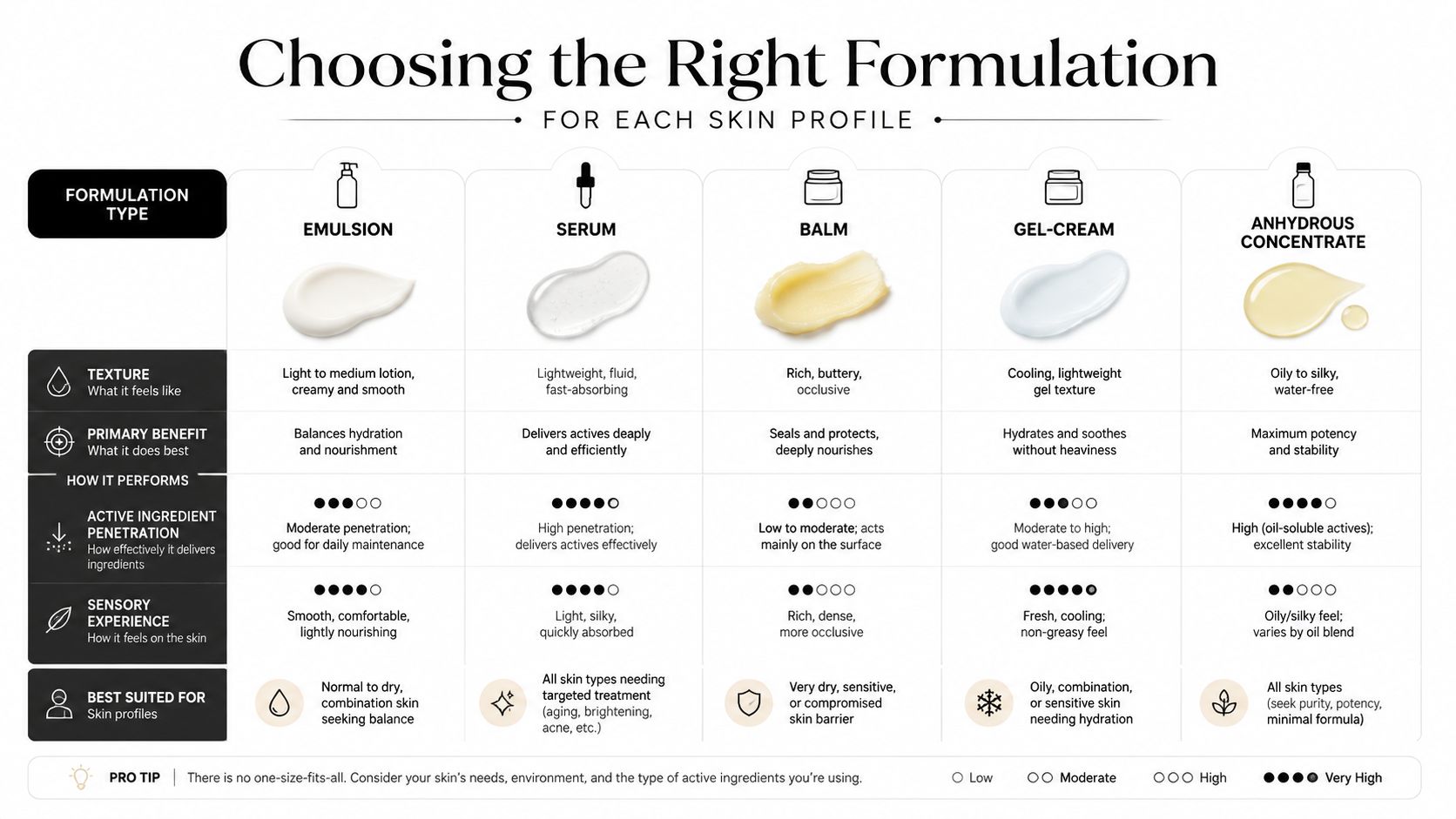
An oil-in-water emulsion usually feels lighter and suits normal, combination, or oil-prone skin. A water-in-oil emulsion creates a more protective, lipid-rich film and can work well for dry or barrier-compromised skin, particularly during cold, dry periods. Gel-creams offer a fresher sensory profile and make strong prevention products for customers who dislike traditional creams.
Serums typically carry a concentrated treatment message and fit pharmacy dermocosmetic shelves. Balms and rich creams belong naturally in spa retail, where massageability, comfort, and an at-home extension of treatment matter. Anhydrous concentrates can support clean-label and low-water positioning, but buyers should assess spreadability, oxidation risk, and whether customers understand how to dose them.
Encapsulation, including liposomal systems and nanoemulsions, may improve the stability or delivery profile of sensitive actives such as retinoids and vitamin C. Those terms still need documentation. Ask for stability results on the finished product rather than accepting technology language as proof of performance.
Build a seasonal assortment
Swiss climate variation should influence stock planning. Dry alpine winters favour richer emulsions, barrier creams, and balms. Warmer, more humid periods favour fluid emulsions, lightweight serums, and gel-creams that layer comfortably beneath sunscreen.
| Formulation | Sensory Profile | Strongest Retail Role | Suitable Customer Need |
|---|---|---|---|
| Emulsion | Balanced cream texture | Pharmacy daily care | Normal, dry, or combination skin |
| Serum | Light, concentrated treatment | Clinical pharmacy shelf | Targeted correction and layering |
| Balm | Rich, cushiony, protective | Luxury spa retail | Dryness, comfort, night care |
| Gel-cream | Fresh and fast-absorbing | Preventative or younger-care offer | Oily, combination, or dehydrated skin |
| Anhydrous concentrate | Oil-rich and potent-feeling | Clean-label premium niche | Dryness, barrier support, minimalist routines |
A buyer should stock complementary textures, not duplicate claims. One clinically positioned serum, one barrier-supportive cream, one lighter preventative moisturiser, and one richer night option can create a more useful assortment than several similar anti-aging jars.
Reading Clinical Evidence Like a Professional Buyer
“Clinically proven” is not a sufficient purchasing argument. It tells you that a brand wants the claim to sound authoritative, not whether the study was well designed, whether the final formula was tested, or whether the measured change matters to customers.
Start with the protocol. A Swiss-referenced cosmetic night-cream study selected subjects reporting sleep-related skin fatigue and used clinical and other endpoints to assess visible changes in tired signs and appearance. Its relevance for premium retail is methodological: buyers should favour documentation that combines controlled subject selection, pre- and post-use imaging, and defined endpoints such as wrinkle depth, roughness, hydration, or fatigue markers. The Swiss-referenced night-cream report illustrates the kind of file worth requesting.
Separate measurement from opinion
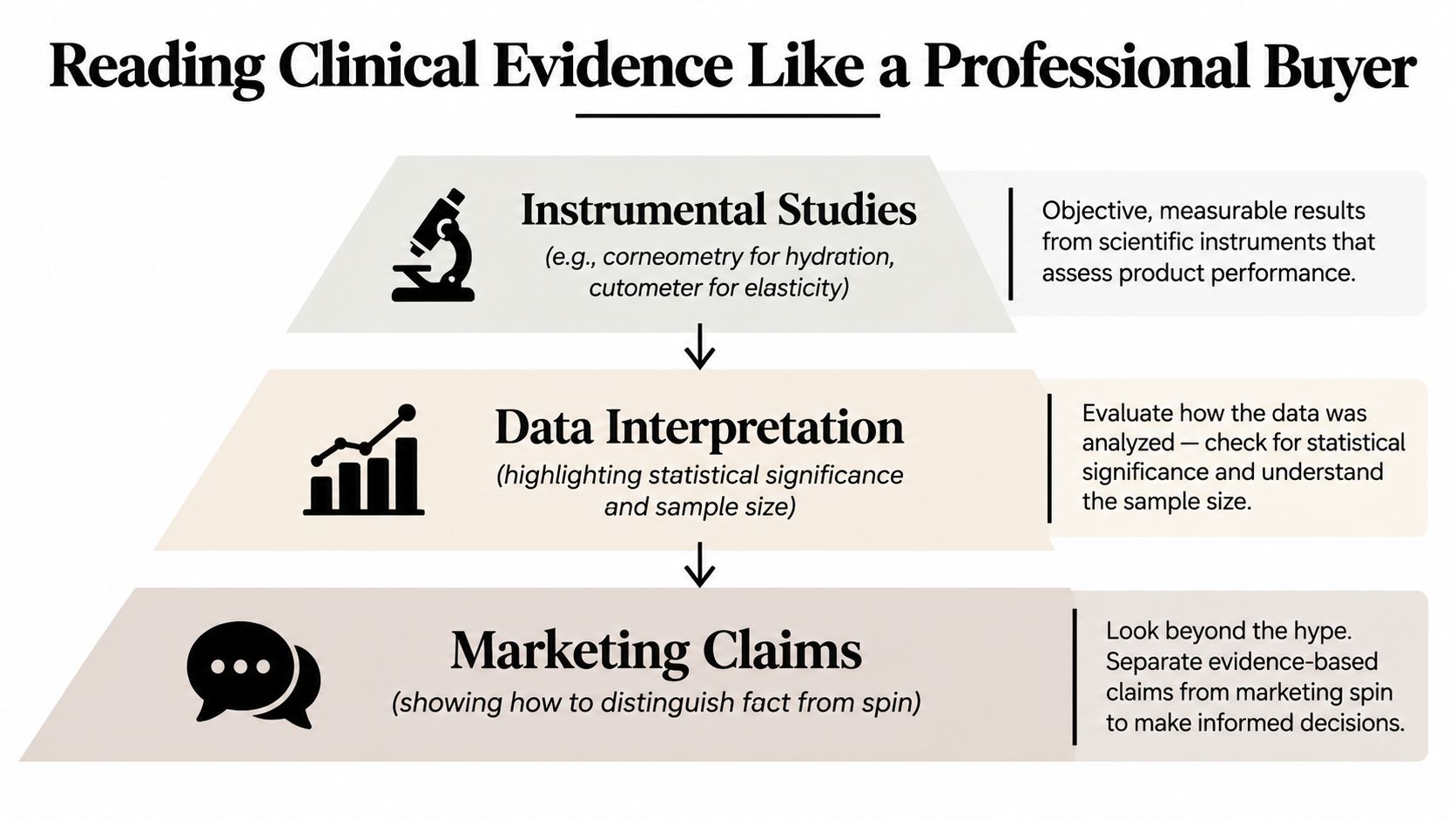
Different methods answer different questions:
- Corneometry measures changes associated with skin hydration.
- Profilometry assesses surface topography and wrinkle dimensions.
- Spectrophotometry can help quantify colour and pigmentation changes.
- Cutometry can support assessment of elasticity and firmness.
Consumer questionnaires have a place, especially for texture, comfort, and perceived appearance. They shouldn't replace objective measurement when a brand makes a strong efficacy claim.
A separate Switzerland-linked dossier for a cream containing SYN®-COLL evaluated 44 female volunteers and separated placebo and active-treatment groups, as documented in the SYN®-COLL clinical dossier. The important lesson isn't that every cosmetic product must copy that exact design. It's that a buyer should ask who participated, what comparator was used, how long testing lasted, which endpoint was measured, and whether the tested product was the finished formula.
Evidence check: A summary slide is a sales aid. The full report is the purchasing document.
Look for baseline measurements, inclusion and exclusion criteria, application instructions, statistical treatment, adverse-event reporting, and clear before-and-after methodology. Be cautious with vague wording such as “visibly reduces wrinkles” when the supplier provides no defined endpoint or quantified result. Also distinguish a statistically detectable change from a result customers can see and feel.
Use the following video as a staff-training prompt, then ask the brand representative to support every relevant claim with documentation rather than presentation language.
Sustainability Certifications and Packaging Stability
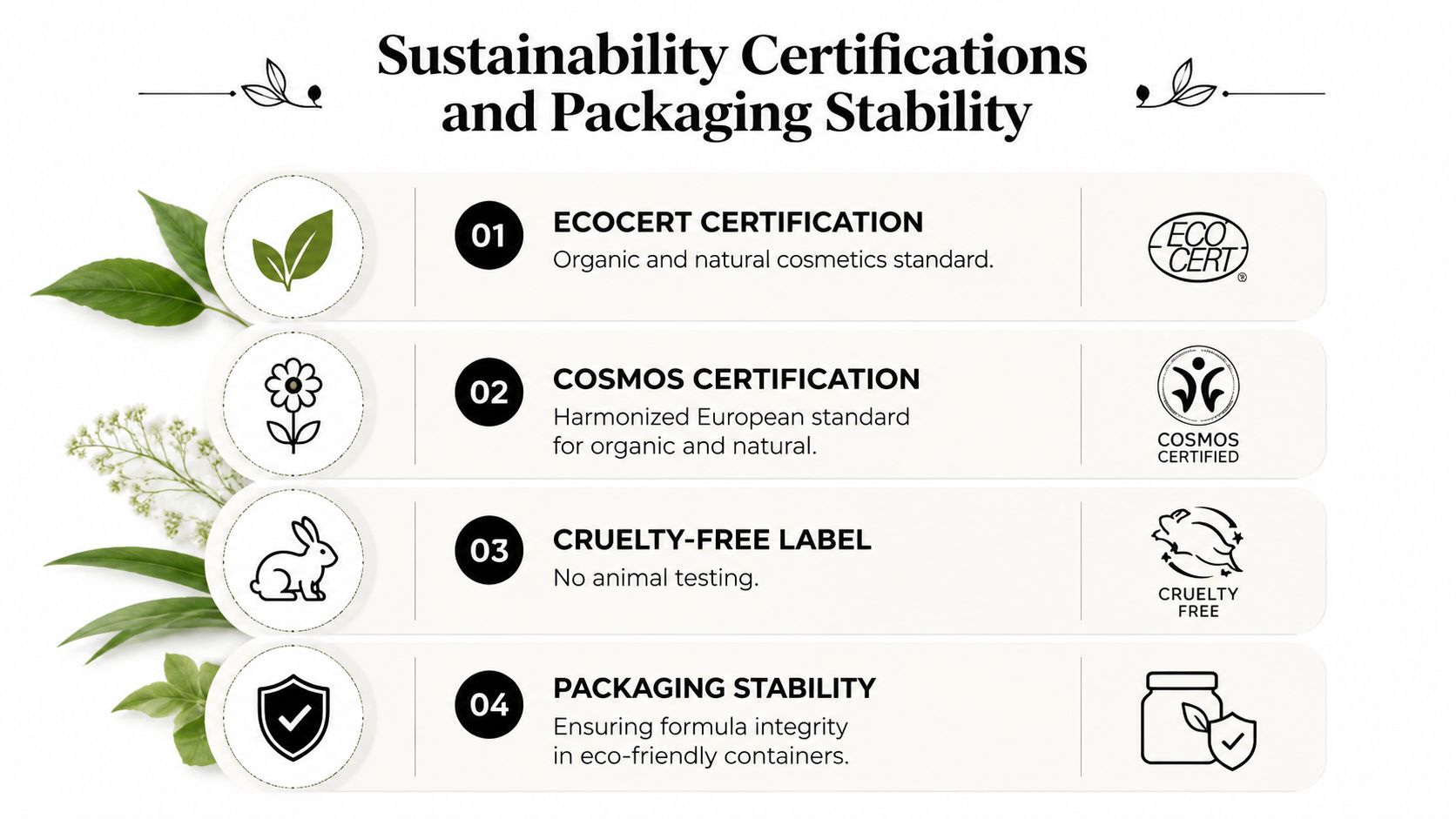
Clean beauty earns trust only when its ethical and technical claims align. A product may carry an appealing natural story, but buyers still need to confirm certification scope, packaging compatibility, shelf-life evidence, and Swiss compliance.
ECOCERT and COSMOS can support credible natural and organic positioning when certification is current and applies to the product being supplied. A cruelty-free claim also needs a recognisable standard or verifiable policy, not just a brand statement. Buyers should ask for the certificate number, issuing organisation, validity period, and exact product scope.
Packaging is part of efficacy
Sensitive actives need suitable protection. Airless pumps can reduce repeated exposure to air and fingers, while opaque containers can limit light exposure. Glass may support premium positioning, but material choice alone doesn't prove stability. A refill system may reduce packaging waste, yet it must preserve hygiene, dosing accuracy, and formula integrity.
Ask for:
- Finished-product stability: Look for accelerated and real-time testing, with conditions and acceptance criteria.
- Light and oxygen resistance: Confirm that the packaging protects the actual formula, especially where retinoids or oxidation-sensitive vitamin C systems are used.
- Closure compatibility: Check that pumps, seals, liners, and applicators don't interact adversely with the product.
- Opening and storage guidance: Staff need practical instructions for customers, not only technical files.
Swiss retailers should also verify INCI accuracy, allergen declarations, product information, and conformity with the Swiss Ordinance on Cosmetic Products. Sustainability cannot compensate for weak compliance, and a recyclable pack that allows an active formula to degrade is not a responsible outcome.
The best assessment combines three filters: ethical credibility, formula protection, and regulatory readiness. Remove a product from consideration if it passes only one or two.
Merchandising Anti Aging Creams in Swiss Retail Channels
The shelf should help customers choose by need, not force them to decode a wall of age labels. “For mature skin” can feel reductive and often says less than a clear concern-based system.
Pharmacy positioning
Pharmacies should lead with evidence, active ingredients, and staff confidence. Use shelf communication that identifies the primary concern, the hero active, the recommended routine position, and the relevant evidence type. Staff training should cover retinoid introduction, barrier support, sunscreen pairing, and when to recommend professional advice for highly reactive skin.
Facial care remains Switzerland's largest skincare segment, valued at CHF 363.4 million in 2025, according to the Swiss market context cited in Swiss premium skincare reporting. That makes shelf clarity commercially important, but the product story still needs to be specific.
Spas should sell the ritual and the result together. Pair a rich anti-aging cream with a facial treatment, massage protocol, or post-treatment home routine. Premium customers often want sensorial reassurance, so texture, fragrance, packaging, and application technique can sit alongside efficacy evidence without replacing it.
E-commerce needs to compensate for the lack of touch. Show the texture, explain the active system, publish the full INCI, specify routine order, and use customer reviews carefully. Before-and-after imagery should include clear usage context and shouldn't imply universal outcomes.
| Retail Channel | Positioning Focus | Key Tactics | Success Metrics |
|---|---|---|---|
| Pharmacy | Clinical clarity | Staff scripts, evidence-led shelf cards, concern-based navigation | Repeat purchase, recommendation confidence, returns |
| Spa | Treatment extension | Product pairing, therapist education, sensorial demonstrations | Homecare attachment, treatment-to-retail conversion |
| Premium e-commerce | Transparency and discovery | Detailed INCI, texture content, routine guides, verified reviews | Conversion quality, repeat orders, product questions |
| Boutique or department store | Differentiation | Curated clean-label stories and premium display | Basket composition, sell-through, staff feedback |
Create a visible routine architecture
Organise the assortment around prevention, correction, barrier recovery, and photoprotection. Cross-merchandise a targeted serum with a compatible cream and a daily SPF, but train staff to avoid unnecessary layering. The aim is a coherent routine customers can follow, not a larger basket at any cost.
For teams refining their visual layouts, it can be useful to compare fashion merchandising tools and adapt the same principles to skincare. Plan sightlines, hero-product placement, concern-based blocks, tester access, and seasonal rotations before products arrive.
Your Buyer Evaluation Checklist for New Product Lines
A brand representative presents a retinol cream with two headline claims: “clinically proven” and “ECOCERT certified”. Don't approve the line on the strength of those phrases. Put the product through a documented review that commercial, scientific, and compliance teams can repeat.
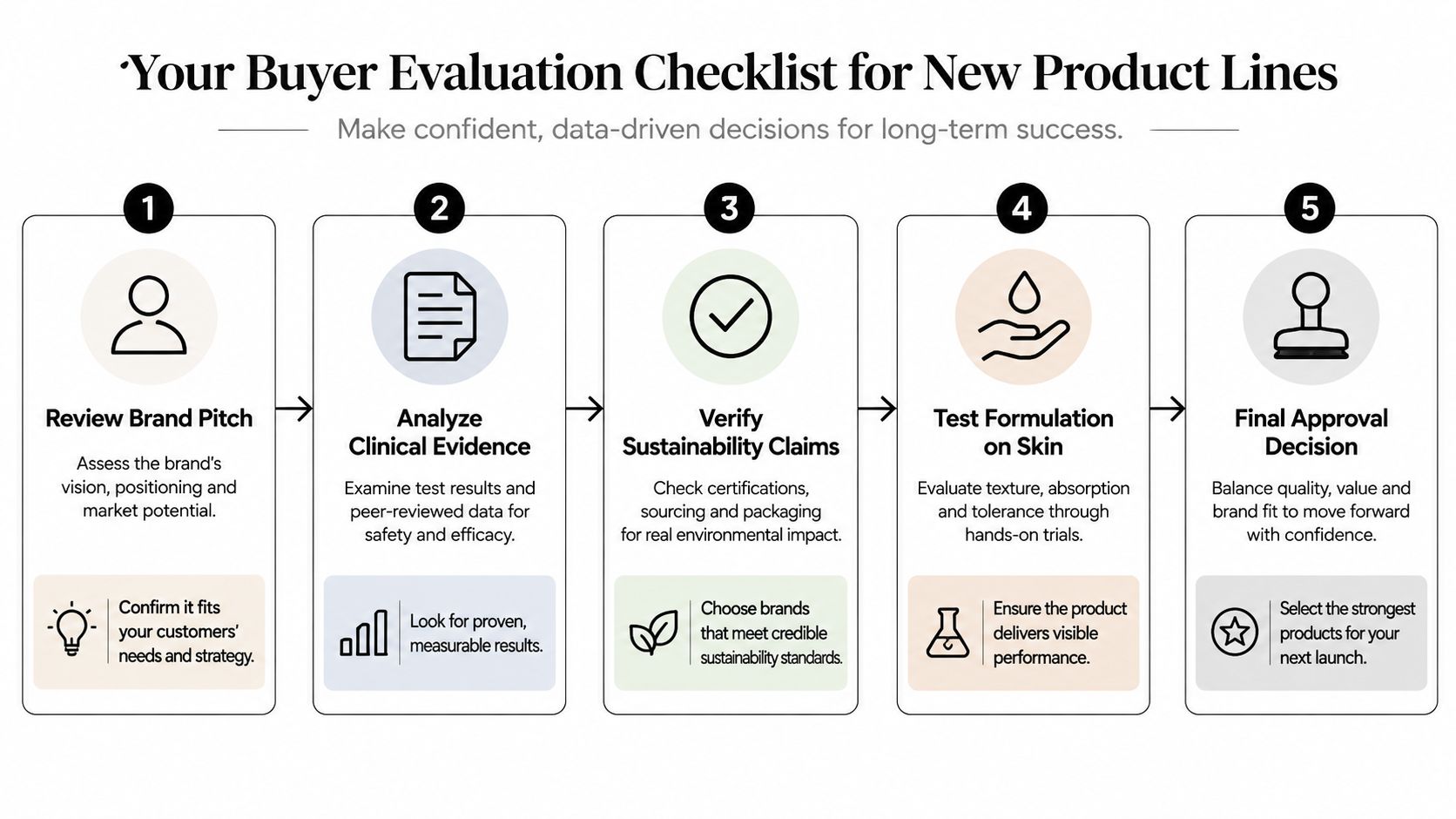
Five checks before approval
Review the pitch. Record every claim exactly as presented. Ask whether “retinol” means retinol, retinaldehyde, a retinoid ester, or a retinoid alternative. Request the full INCI, active levels, intended use, target customer, and storage requirements.
Analyse the clinical file. Request the complete study report, not selected slides. Check the participant profile, comparator, application schedule, study duration, objective endpoints, statistical analysis, and adverse reactions. Confirm that researchers tested the final commercial formula rather than an isolated ingredient.
Verify certification. Ask for current ECOCERT or COSMOS documentation and confirm that the certificate applies to the exact product and manufacturer. A “natural” claim isn't the same as third-party certification.
Test the formulation on skin. Assess absorption, pilling, scent, sting, residue, makeup compatibility, and packaging function. Test the product across the customer profiles you serve, including dry, combination, and sensitive skin where relevant.
Make the commercial decision. Review minimum order quantities, wholesale terms, margin structure, training support, tester policy, lead times, and expected sell-through. A scientifically credible cream still needs a viable retail model.
Use a decision matrix
Score each candidate internally across four headings: efficacy evidence, compliance readiness, sustainability alignment, and commercial viability. Keep the scoring scale consistent across brands and require written reasons for every rating. A product with polished packaging but weak evidence should not outrank a less glamorous formula with a complete technical file.
Watch for warning signs. “Dermatologically tested” without a named testing body or protocol is incomplete. An airless pump doesn't automatically solve stability problems, particularly when a formula contains oxidation-prone actives. A certificate presented without a verifiable scope should remain unconfirmed until the issuing organisation validates it.
Your final assortment should include products that staff can explain in plain language, customers can use consistently, and your compliance team can defend. That is a stronger definition of the best anti aging cream than any ranking list.
Swiss pharmacies, spas, and premium retailers can build evidence-led clean-beauty assortments with support from beautysecrets.agency, which connects trade partners with natural and ethically sourced facial, marine spa, and multipurpose skincare lines. Visit beautysecrets.agency to discuss ingredient-focused anti-aging ranges, certification requirements, and Swiss retail positioning.