Most advice on hair oils gets one point badly wrong. It treats every glossy botanical oil as if it can regrow hair.
For a Swiss retailer, that shortcut creates two problems. Customers arrive expecting dramatic results, and staff often have to explain why one oil belongs in a scalp treatment while another is better placed in a shine or repair category. If you want to win trust in a premium clean-beauty environment, the question isn't which bottle looks luxurious. It's which ingredients have a plausible mechanism, which claims stay within cosmetic boundaries, and which products fit the customer standing in front of the shelf.
That's why the best hair oil for hair growth should be merchandised as a targeted scalp-care category, not a generic haircare add-on. Retailers who also support customers seeking clinical options can point them towards ProMD Health's restorative hair treatments as an example of how medical hair restoration differs from cosmetic support.
The Growing Demand for Natural Hair Growth Solutions
Swiss customers are increasingly drawn to natural formulas, especially in categories where they want long-term use, visible ingredient lists, and fewer compromises on sensorial quality. Hair thinning sits right at that intersection. People want something botanical, elegant, and credible. They also want it to feel safer than a medicinal routine.
That demand has created a crowded aisle. Oils, serums, scalp elixirs, and overnight treatments all compete for the same customer, often using nearly identical language. “Strengthening”, “density”, “fuller-looking”, and “scalp revival” can appear on products that work in completely different ways.
Why this category confuses customers
Some oils act mainly on the hair fibre. They reduce friction, soften rough ends, and improve shine. Others are positioned for the scalp environment, where the growth conversation begins. When staff don't separate those two functions, customers leave with the wrong product and conclude that hair oils don't work at all.
A premium retailer should therefore organise the category around function, not just ingredient romance.
- Scalp-led products belong in a treatment story. These are the oils customers browse when they ask about thinning, shedding, or sparse-looking areas.
- Conditioning oils belong in a repair or finishing story. These suit dry lengths, frizz, or breakage-prone ends.
- Hybrid formulas need careful explanation. A beautiful blend can still be weak if its key active is present more for label appeal than practical performance.
What the retailer sells beyond the bottle
The strongest assortments don't just offer products. They offer interpretation. That means helping shoppers understand why rosemary belongs in a different conversation from argan, and why a scalp oil may need sustained, correct use before any visible benefit appears.
Retail reality: The customer asking for a “natural minoxidil alternative” usually needs expectation-setting before they need a basket recommendation.
In Switzerland, that consultative approach matters even more. Premium customers often read INCI lists, ask where ingredients were sourced, and expect responsible language around efficacy. If your team can explain the difference between stimulation, soothing, and surface conditioning, you've already created an advantage that mass channels rarely deliver.
Understanding How Hair Oils Actually Promote Growth
Hair oils don't “feed the hair” in the way marketing often suggests. Hair above the scalp is biologically inactive. The growth discussion starts lower, around the follicle, the scalp barrier, and the local environment that influences how comfortably hair can remain in its growing phase.
A useful way to explain this on the shop floor is gardening. Healthy plants need viable roots, decent soil, airflow, and consistent care. Hair follicles need a similarly supportive setting. A dry, irritated, congested, or inflamed scalp isn't ideal ground for resilient-looking hair.
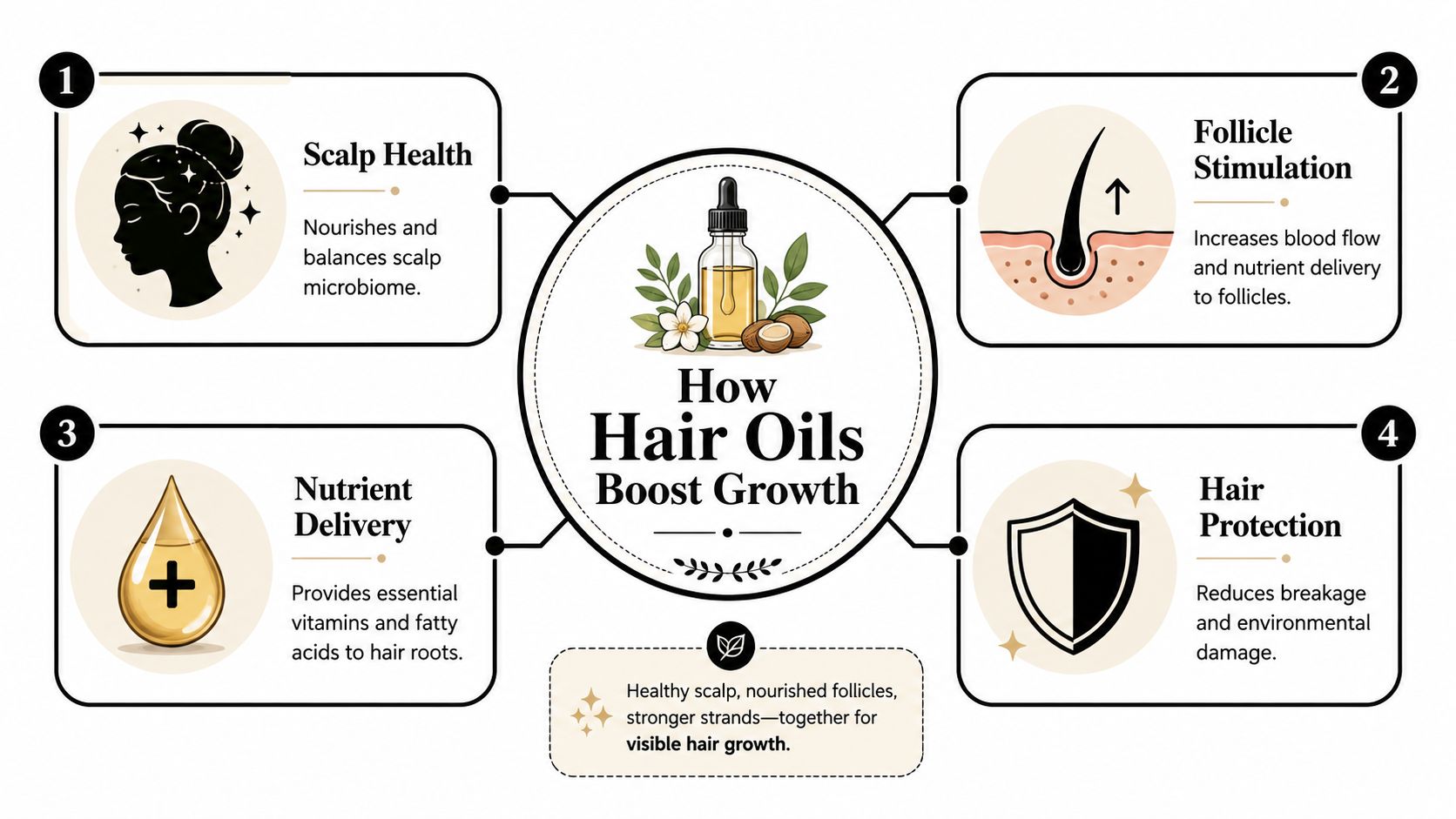
The four mechanisms retailers should know
Some oils matter because they may help influence pathways associated with thinning. Others matter because they improve the scalp setting around the follicle. In customer language, these are the four mechanisms worth remembering:
DHT-related support
In androgen-related thinning, one retail talking point is whether a botanical ingredient is associated with reducing the conversion of testosterone to dihydrotestosterone, often shortened to DHT. Customers don't need a biochemistry lecture. They need to hear that some oils are chosen because they may support follicles in a way that goes beyond simple moisturising.Improved microcirculation
Certain essential oils are discussed for helping increase local blood flow. Retail staff can describe this as helping deliver oxygen and nutrients more efficiently to the follicle area.Anti-inflammatory support
A reactive scalp can worsen the look and feel of hair health. Soothing ingredients may help reduce the irritation that discourages routine use.Breakage reduction
This doesn't create new follicles, but it does improve retained length and a fuller-looking result. Customers often confuse less breakage with faster growth, so this distinction helps.
Scalp oils and conditioning oils aren't the same
A point many retailers miss is the distinction noted by Allpa Botanicals' review of hair growth oils. Scalp health oils such as rosemary and peppermint are discussed as supporting density through DHT-blocking and blood flow enhancement, while conditioning oils such as coconut and argan mainly seal moisture and smooth the hair shaft rather than stimulate growth.
That single distinction can reshape your entire shelf strategy.
| Category | Primary role | Best retail placement |
|---|---|---|
| Scalp-stimulating oils | Follicle support and scalp treatment | Hair wellness, thinning, scalp care |
| Conditioning oils | Softness, shine, reduced friction | Repair, anti-frizz, dry hair |
| Multi-use oils | Mixed benefits with mixed expectations | Curated ritual sets with clear signage |
For staff education, it helps to share an accessible explainer on supporting healthy hair growth, especially when training teams to avoid overpromising.
A customer who says “my hair is falling out” may need a scalp-support product, a fibre-protective oil, or a referral onward. Those are not the same recommendation.
Evaluating the Evidence for Popular Hair Oils
Retailers don't need to memorise every botanical trend. They need to know which oils have a stronger evidence story, which ones work best as support acts, and which ones belong in a premium assortment because of texture, sourcing, and formulation quality rather than direct growth claims.
Rosemary oil stands at the top of the natural conversation
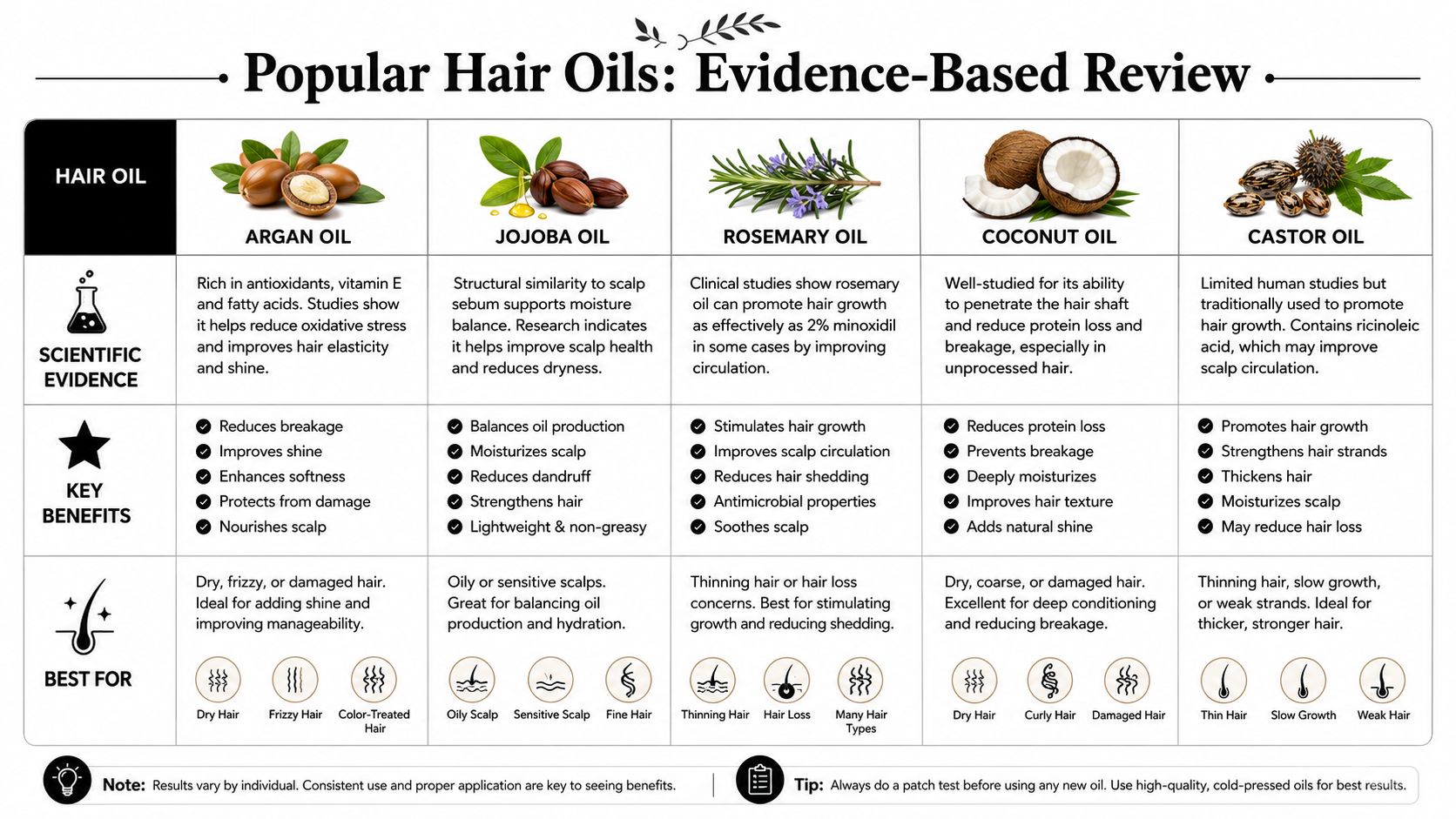
Among essential oils, rosemary oil has the clearest clinical support in the material provided. According to Xyon Health's review of rosemary oil evidence, rosemary oil is described as the most clinically supported essential oil for hair growth because of its DHT-blocking, antioxidant, anti-inflammatory, and oxytropic properties that enhance capillary perfusion to hair follicles. The same source notes that in a controlled human trial, rosemary oil showed statistically equivalent increases in hair density over six months when compared with minoxidil 2%, with no significant difference between groups.
For a retailer, that doesn't mean “sell it as medicine”. It means rosemary deserves pride of place in any premium natural scalp-treatment assortment.
Pumpkin seed oil has a stronger story than most botanical oils
Pumpkin seed oil also deserves serious attention. According to Hims' overview of pumpkin seed oil for hair growth, daily use in men with androgenetic alopecia was associated with a 40% increase in average hair count after 24 months, without significant adverse effects. The same source describes pumpkin seed oil as a natural 5-alpha-reductase inhibitor, meaning it's discussed in relation to reduced conversion of testosterone to DHT.
That makes pumpkin seed oil a compelling ingredient for retailers building a results-oriented natural scalp category. It gives staff a concrete reason to favour certain formulas over decorative oil blends that rely mostly on fragrance and finish.
Coconut, argan, jojoba, and castor need sharper framing
These oils often sell well because customers already recognise them. They also create confusion because familiarity gets mistaken for growth evidence.
- Coconut oil works best as a conditioning and protective oil. It can be very useful for dry lengths, pre-wash care, and reducing a rough feel. It shouldn't be the default recommendation for a shopper whose main concern is sparse density at the scalp. For sales teams, My Transformation's coconut oil hair guide is a useful example of how to distinguish fibre care from regrowth expectations.
- Argan oil earns its place through slip, gloss, and softness. It suits premium finishing rituals and anti-frizz displays.
- Jojoba oil is often easy to recommend for customers who dislike heaviness. In merchandising terms, it works well in sensitive-scalp or lightweight routine edits.
- Castor oil has a strong folklore reputation. Retailers should position it carefully. Its texture can support a richer, protective treatment story, but it shouldn't automatically be presented as a frontline growth active.
Processing quality matters in premium retail
In a mass channel, the label often does most of the work. In a premium Swiss setting, customers ask a better question. How was the oil processed?
Fresh-pressed, minimally degraded oils can support a more credible premium narrative because retailers can talk about preserving the natural profile of the plant instead of naming a fashionable ingredient. That matters for storytelling, giftability, and price justification, especially when the shopper compares a specialist scalp oil with a cheaper general-purpose oil online.
Merchandising rule: Put evidence-led actives at eye level. Place sensory or finishing oils nearby, but don't blur their purpose on shelf talkers.
Navigating Cosmetic Claims in the Swiss Market
Hair growth is one of the easiest categories in which to damage trust. The temptation is obvious. Customers want solutions, and botanical storytelling is persuasive. But in Switzerland, premium retail credibility depends on careful language.
The practical line is this. A cosmetic claim talks about appearance, condition, comfort, and cosmetic support. A medicinal claim talks about treating disease, reversing a diagnosed condition, or promising outcomes that imply a therapeutic effect.
What you can say and what you shouldn't
A retailer can usually stay on safer ground with language such as:
- Appearance-led claims like “helps hair look fuller”, “improves the appearance of thickness”, or “supports a healthier-looking scalp”.
- Condition claims such as “nourishes”, “softens”, “helps reduce dryness”, or “soothes scalp discomfort”.
- Routine-based framing like “supports a scalp-care ritual for thinning-prone hair”.
A retailer should avoid language that crosses into treatment territory, including statements such as “cures baldness”, “reverses androgenetic alopecia”, or “works like prescription therapy”.
Why restraint is commercially smart
The issue isn't only regulation. It's expectation management.
According to Perfect Hair Health's analysis of hair growth oils, much of the content around oils such as pumpkin seed oil overstates regrowth potential. The source states that extensive human data shows these oils are minimally effective as primary therapies, and that evidence quality is 49% compared with superior results from 5% minoxidil in women with FPHL. For retailers, the lesson is simple. Natural oils may play a meaningful supporting role, but they shouldn't be marketed as if they are interchangeable with drug-based hair loss treatments.
A compliant Swiss shop-floor script
Try a phrasing framework like this:
“This formula is designed to support scalp health and improve the appearance of fuller, healthier-looking hair. If you're experiencing ongoing or rapid thinning, it may also be worth speaking with a medical professional.”
That approach does three jobs at once. It stays responsible. It protects the retailer. It also signals expertise, which is exactly what premium customers expect from a curated Swiss assortment.
Matching Oils to Customer Hair and Scalp Needs
The best hair oil for hair growth isn't a universal winner. It depends on whether the customer needs scalp stimulation, barrier comfort, lighter texture, or fibre protection. Good consultations are less about naming the “best” oil and more about matching the formula to the problem.
Four common retail scenarios
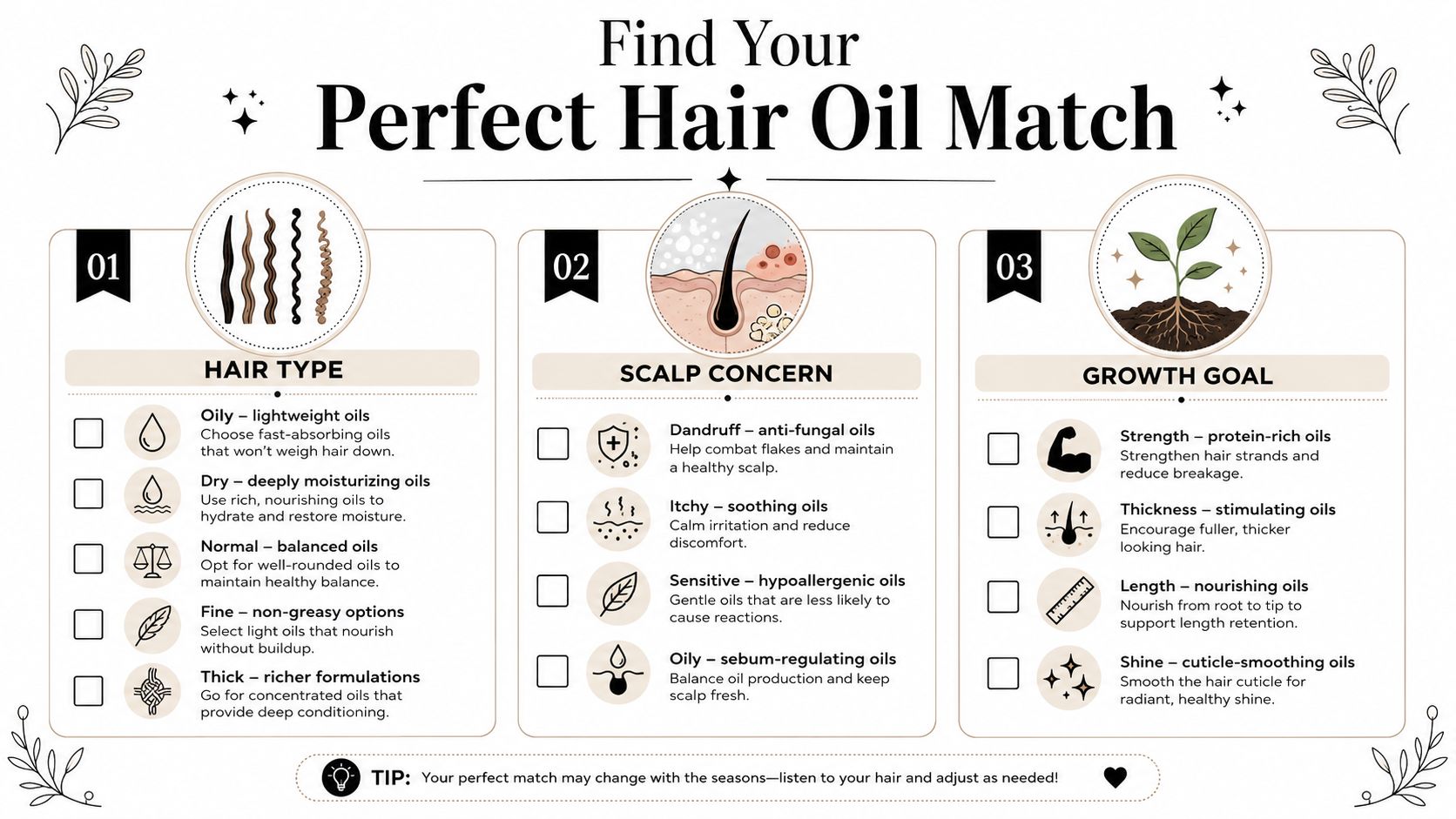
If the customer has fine, thinning hair, avoid heavy oils that flatten the root area and make the hair look sparser. Look for scalp-focused formulas built around rosemary or pumpkin seed oil. Pumpkin seed oil is especially relevant here because, as noted earlier, it has evidence associated with a 40% increase in average hair count after 24 months in men with androgenetic alopecia in the source already cited above.
If the scalp is dry, flaky, or reactive, prioritise comfort and compliance. Customers won't continue a routine that stings, overheats, or leaves residue. A soothing oil blend with a scalp-treatment identity is often a better recommendation than a highly perfumed styling oil.
If the scalp is oily but the customer still wants growth support, choose lighter textures and recommend pre-wash use. The wrong product can make sebum-heavy roots feel dirtier faster, which shortens adherence.
If the hair is coarse, porous, or breakage-prone, richer oils can perform well, but position them for retention, softness, and improved manageability rather than direct follicle stimulation.
A simple consultation grid
| Customer concern | Better oil profile | What staff should emphasise |
|---|---|---|
| Thinning at the scalp | Rosemary or pumpkin seed focused scalp oil | Scalp support, consistency, realistic expectations |
| Dry irritated scalp | Soothing, low-irritancy treatment oil | Comfort, barrier care, pre-wash ritual |
| Oily roots | Lightweight scalp oil | Small amounts, rinse-out use, non-greasy feel |
| Dry ends and breakage | Rich conditioning oil | Shine, softness, less breakage, not regrowth |
Questions staff should ask first
- Where is the concern? At the scalp, through the lengths, or both?
- How does the scalp feel? Tight, itchy, oily, flaky, or neutral?
- What's the main goal? Density, reduced breakage, scalp comfort, or shine?
- How much effort will they tolerate? Daily, a few times a week, or occasional use?
The right consultation often prevents the wrong return. A customer who wanted density but bought a finishing oil will usually blame the category, not the recommendation.
Application Techniques and Premium Merchandising
A premium hair oil can fail for one simple reason. The customer uses too much, applies it to the wrong area, or gives up before the routine becomes consistent. Retailers should therefore sell technique alongside the product.
How staff should teach application
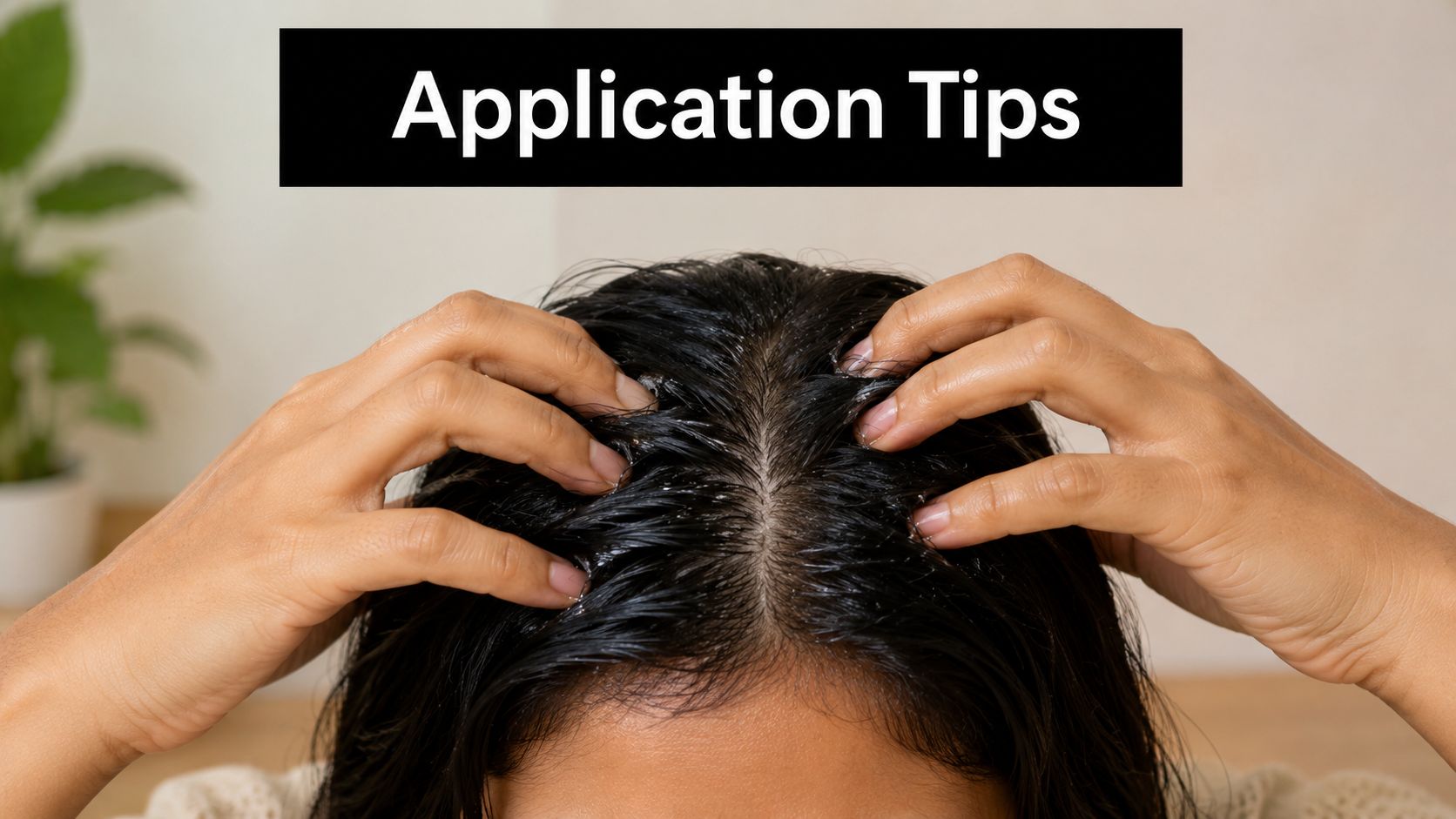
For scalp-focused oils, the simplest routine is often the most effective one to explain in store.
Part the hair first
Encourage customers to apply directly to the scalp rather than coating the hair lengths by accident.Use a modest amount
Enough to cover the target area is sufficient. Oversaturation makes fine hair look greasy and increases wash-out frustration.Massage with fingertips
A gentle circular massage helps distribute the formula and improves the treatment ritual. Staff should say “gentle” explicitly. Aggressive rubbing can irritate the scalp.Choose the right timing
Pre-wash application often suits premium shoppers because it's easier to integrate into an existing routine and less likely to affect styling.Stay consistent
Customers usually do better with a realistic plan they can maintain than an ambitious ritual they abandon.
Turning education into merchandising
The most effective displays show why a product belongs in the basket.
- Build a scalp-care zone with treatment oils, a scalp brush or massager, and concise signage about follicle-focused care.
- Create a hair wellness ritual set that combines a scalp oil, a gentle cleanser, and a silk accessory for reduced friction during sleep.
- Separate scalp treatments from finishing oils so customers don't assume all oils do the same job.
- Train staff with one-line product scripts. For example, “This one is for scalp support,” versus “This one is for shine and softening.”
A short video can help teams demonstrate the massage element clearly at point of sale or on a product page.
Premium details that increase conversion
Texture matters. So does packaging. Droppers tend to communicate treatment precision, while pumps and open-neck bottles often read as body or finishing oils unless the branding is very clear.
Sampling also matters in this category. If a retailer can let customers feel the difference between a lightweight scalp serum-oil and a heavier conditioning oil, the consultation becomes easier and the product's role becomes obvious.
Your Advantage in the Natural Hair Care Market
Retail success in this category doesn't come from carrying more oils. It comes from curating the right ones and explaining them well. Customers looking for the best hair oil for hair growth need help separating follicle support from fibre conditioning, evidence from folklore, and cosmetic care from medical treatment.
Swiss retailers are well placed to lead that conversation. The market already values clean formulation, transparent sourcing, and credible advice. When your team can explain why rosemary and pumpkin seed oil deserve serious attention, why coconut and argan belong in a different usage story, and how to communicate claims responsibly, the shelf becomes far more than a product line.
That is the premium advantage. A carefully organised assortment, clear consultation scripts, compliant language, and a sensorial ritual that customers keep using. In a crowded natural haircare market, expertise is what makes the range memorable.
If you're building a differentiated Swiss beauty or pharmacy assortment and want support with premium natural brands, compliant positioning, and retailer-ready product storytelling, beautysecrets.agency can help you curate a cleaner, more credible offer.