A Zürich pharmacy manager is looking at a client who wants softer sun damage around the mouth, but doesn't want to disappear from work for a week. At the same time, a Geneva spa buyer is weighing whether a resurfacing service belongs on the treatment menu, on the retail shelf, or both. That's the commercial question behind a skin resurfacing laser conversation in Switzerland, because the device choice, the aftercare basket, and the staff briefing all have to line up.
The technology itself has a long clinical lineage. The earliest widely cited resurfacing milestone came in 1985, when CO2 resurfacing was first reported for mucous membranes in actinic cheilitis, followed by facial actinic damage around 1989. Later, fractional thermolysis arrived in 2004, and that shift made resurfacing more precise and less destructive than older full-field approaches, which is why modern Swiss clinics lean so hard on controlled protocols rather than simple “laser facial” language (historical resurfacing timeline).
The Client Walking into Your Swiss Clinic or Spa
A 42-year-old client sits down in a Zürich pharmacy-based aesthetic clinic and says the same thing many buyers hear in practice. She wants the visible sun damage softened, early wrinkles eased, and the treatment to feel “serious”, but she can't afford to look bruised for long. At the same time, a Geneva spa buyer is looking at the retail floor and asking a different question, whether resurfacing should be sold as a standalone premium treatment, or as the centrepiece of a broader skin renewal programme.
Those two conversations are linked. The first is about clinical fit, whether the device can match the indication, skin type, and downtime tolerance. The second is about category building, whether the spa or pharmacy can support the procedure with compatible cleanser, barrier cream, and sun protection so the result doesn't get diluted once the client leaves the treatment room.
Why Swiss buyers need a service-plus-skin-care lens
Resurfacing is rarely just a machine purchase. In a Swiss setting, it sits at the intersection of practitioner skill, client expectations, and a retail follow-through that protects margin and outcome. A clinic that offers a strong treatment but weak aftercare creates avoidable complaints, especially when a client gets home and uses the wrong actives too early.
Practical rule: if the front desk cannot explain downtime, sun avoidance, and aftercare in one minute, the protocol is not ready for sale.
That's why the device conversation matters to both dermatology teams and premium spa operators. Clinics need precision and a defensible indication. Spas and retail buyers need a visible treatment story that can be translated into a shelf or back-bar assortment without overclaiming what the laser can do.
The rest of the decision comes down to whether the client needs deeper ablation, gentler fractional heating, or a different light-based approach entirely. Once that is clear, the commercial and clinical decisions become much easier to align.
What a Skin Resurfacing Laser Does
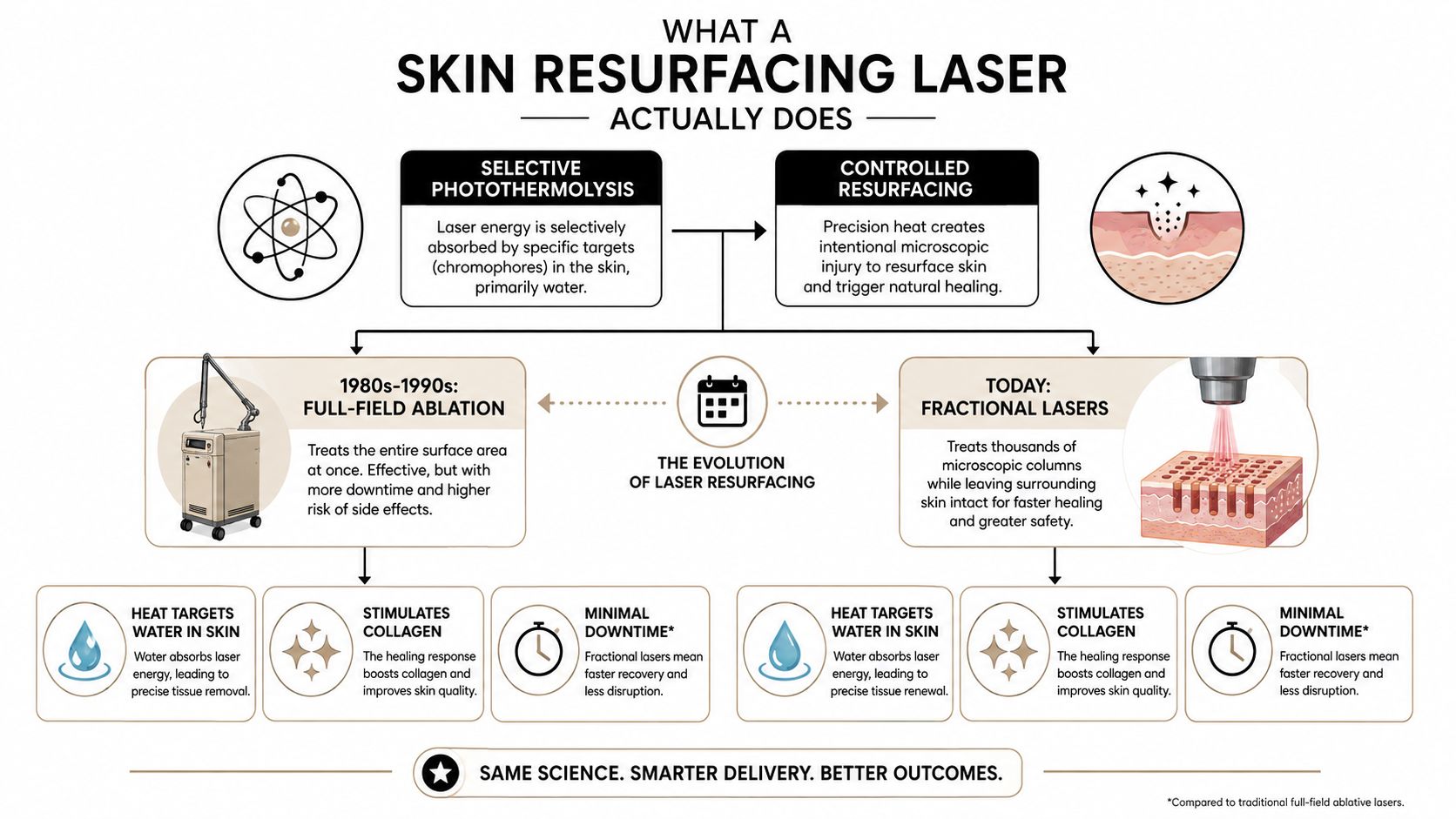
A skin resurfacing laser delivers light energy to skin in a controlled way so the surface is injured in a measured pattern, then heals with a smoother look. The key principle is selective photothermolysis, which means the device targets a specific chromophore, in resurfacing this is mainly water in the tissue, rather than heating everything in the same way. For Swiss clinics and spa buyers, that matters because wavelength, pulse duration, and fractional density are not abstract settings, they determine how much epidermis is removed, how much dermal heating is created, and how much downtime the client must accept.
From full-field removal to controlled resurfacing
Early resurfacing systems worked by removing broad areas of skin at once. The development path moved from full-field ablation to later fractional devices, which divide treatment into tiny columns and leave surrounding skin intact for faster recovery (device physics and historical comparison). In practice, the older model is closer to stripping and refinishing an entire floor, while the fractional model repairs selected sections and leaves the rest of the structure in use.
That difference matters in commercial terms, because clients buy outcomes, not laser theory. If the concern is deep wrinkles, scars, or marked photodamage, a more ablative approach may be justified. If the concern is texture refinement, mild photoageing, or maintenance, a more controlled fractional or non-ablative strategy usually makes more sense. For trade partners, that also affects the support products that sit beside the device, since stronger resurfacing protocols need stricter aftercare and simpler, non-irritating cosmeceuticals.
Ablative and non-ablative sit on a spectrum
Ablative systems remove tissue. Non-ablative systems heat tissue without removing the surface in the same way. The distinction is not only technical, it shapes recovery time, pigment risk, and how aggressive the treatment can be. Swiss buyers should treat this as a spectrum of tissue disruption, not a clean split between “good” and “bad” technology.
The historical physics help explain the commercial reality. CO2 resurfacing runs at 10,600 nm, while Er:YAG operates at 2,940 nm and is more strongly absorbed by water, which tends to produce more superficial ablation with less thermal spread (resurfacing milestones and fractional shift). That is why one client can leave with a visible, stronger result and another can be steered toward a gentler protocol with less downtime. It also explains why procurement decisions in Switzerland should separate medical indication from retail positioning, because the same platform can support very different expectations depending on how it is configured and who is allowed to use it.
The useful question is direct. Can the client's skin concern, skin type, and tolerance for recovery justify the level of thermal injury the device will create? If the answer is yes, the device can be appropriate. If the answer is no, the safer commercial choice is a lighter protocol or a different modality.
Comparing the Main Laser Resurfacing Modalities
The best way to compare resurfacing options is by matching the device family to the job it does well. Swiss trade buyers usually hear broad marketing labels from vendors, but the useful procurement question is simpler, which platform handles depth, which one handles texture, and which one is better for pigment or redness-prone skin.
A practical buying view
Ablative fractional CO2 is the workhorse for deeper resurfacing when the client can accept more downtime. Er:YAG is useful where a clinician wants more superficial ablation with tighter control. Non-ablative fractional 1550/1927 nm devices sit on the gentler end of the resurfacing spectrum and are commonly chosen for clients who want improvement without a heavy recovery burden. Picosecond systems are more often discussed for pigment and some textural concerns, while IPL sits outside true resurfacing and is better thought of as a light-based option for colour problems rather than surface removal.
Practical rule: if the vendor can't explain why the wavelength matches the skin concern, the brochure matters more than the treatment outcome.
Resurfacing modalities at a glance
| Modality | Wavelength | Depth profile | Typical downtime | Primary indication |
|---|---|---|---|---|
| Ablative fractional CO2 | 10,600 nm | Deeper, more thermal | Longer | Wrinkles, scars, stronger rejuvenation |
| Er:YAG | 2,940 nm | More superficial, precise | Usually shorter than CO2 | Texture, mild to moderate resurfacing |
| Non-ablative fractional | 1550 nm + 1927 nm | Controlled heating with surface preservation | Lower | Photoageing, maintenance, pigment-aware protocols |
| Picosecond | Varies by platform | Targeted energy delivery, not classic resurfacing depth | Usually low | Pigment, some texture support |
| IPL | Broad spectrum light | Not a true resurfacing depth tool | Low to moderate | Redness, pigment, photorejuvenation |
The main commercial implication is simple. If your client base wants the most dramatic change, you need a clinician-led setup that can handle the recovery. If your market values lower interruption and broader skin-type flexibility, non-ablative fractional or combined light-based protocols may be a better sell. The right choice is rarely the most aggressive one, it's the one that matches indication, staffing, and aftercare.
Parameters That Drive the Result
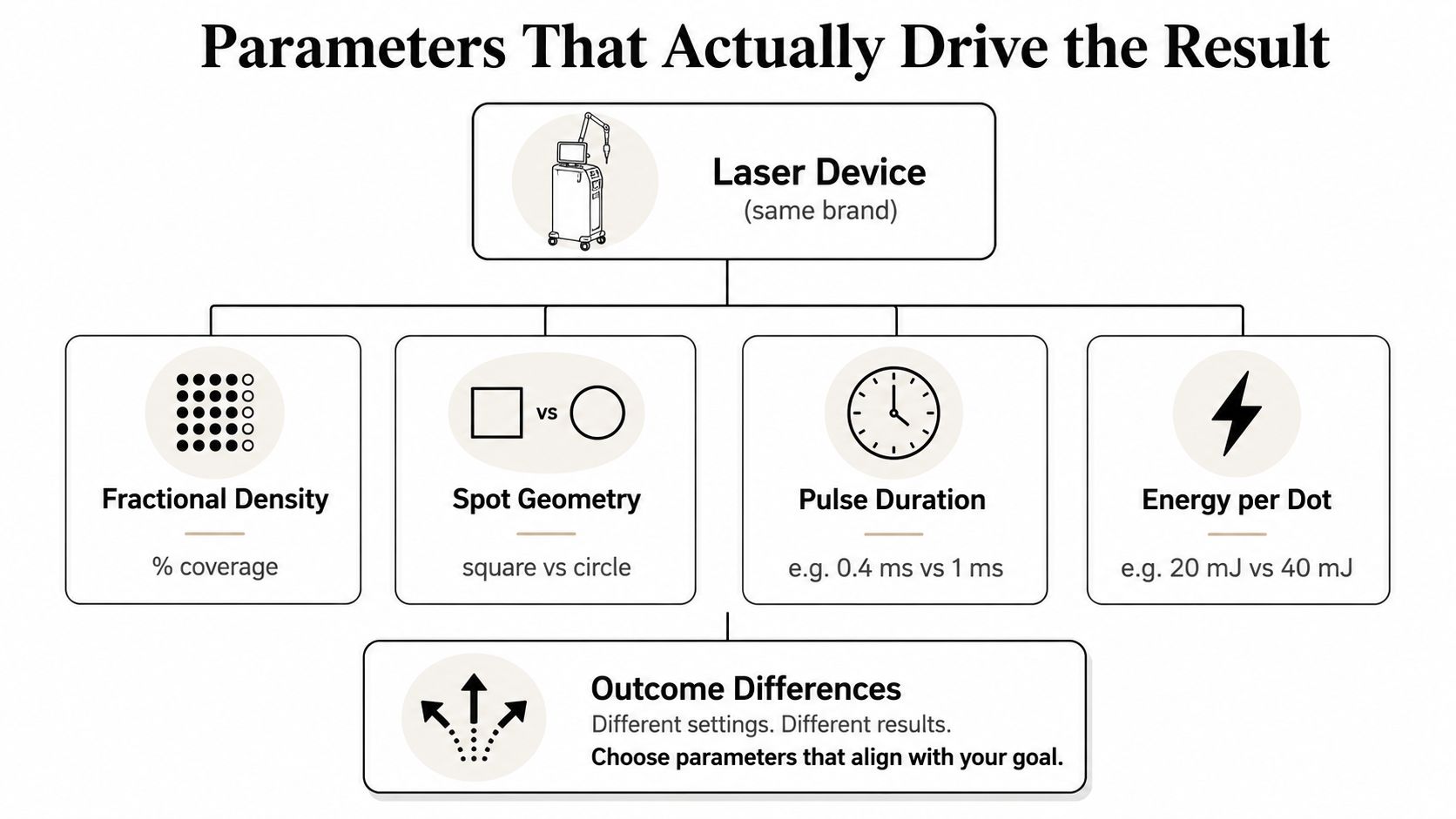
Fractional density, spot geometry, pulse duration, and energy per dot determine the outcome. Two clinics can buy the same laser and still deliver very different results because the operator chooses different settings, different pass patterns, and different recovery targets. In practice, those choices shape texture change, redness, pigment risk, and how much downtime a client will accept.
Density and geometry decide how hard the skin works
Technical references for fractional systems show scan areas up to 20 × 20 mm, energy per dot up to 300 mJ, and density settings ranging from 25 to 3,025 PPA/cm² in 12 levels for fractional CO2 platforms, while a non-ablative fractional platform combines 1550 nm + 1927 nm with 1 to 120 mJ/dot and a 20 × 20 mm scan field (fractional technical benchmarks). Those figures are not brochure filler. They define how much skin is treated per pass and how much recovery the client will need.
Higher density usually brings a stronger visible response, but it also raises thermal load. That means more erythema, a higher pigment risk, and longer interruption for many clients. For Swiss buyers working across mixed Fitzpatrick populations, that makes parameter literacy a commercial advantage, because it allows the team to offer tiered protocols instead of one blunt “laser facial” menu item. It also matters for procurement, since a device that can be tuned conservatively is easier to place in a medical setting where the clinic must justify indication, staff training, and post-care.
Pulse control is not a minor detail
Pulse duration and repeat rate shape how energy reaches the skin. Er:YAG systems operate with shorter pulse durations in the 100 to 1,000 µs range and repeat rates up to 20 Hz in one commercial Swiss-market-facing platform specification, which is part of why they can be more superficial and precise (Er:YAG technical profile). For buyers who need a cleaner recovery profile, that difference matters as much as wavelength.
CO2 platforms in the same technical literature are associated with a stronger thermal effect, and platform documentation describes operating powers up to 40 W in FDA-reviewed systems and 70 W in a fractionated CO2 catalog, which shows why settings must be matched carefully to indication and operator skill. The practical question for a clinic or spa is straightforward. Which machine gives the result the client wants with the least unnecessary heat, the least pigment stress, and a downtime profile that fits the market. In Switzerland, that also ties into device classification and clinic rules, since medical resurfacing setups are expected to sit under tighter oversight than cosmetic light treatments. For trade partners, the setting strategy, aftercare pathway, and whether the protocol can be paired with ECOCERT-aligned cosmeceuticals all affect how easy the device is to sell and sustain in daily use.
Matching the Treatment to Skin Type and Concern
Not every client who asks for resurfacing should get the same answer. A darker Fitzpatrick profile, a redness-prone complexion, or a history of pigment trouble changes the risk profile enough that the safest plan may be a different modality, a lower-density setting, or a complete change in treatment direction.
Skin of colour needs more than a generic consent form
Ablative resurfacing carries a higher dyspigmentation risk in darker skin, while non-ablative fractional lasers are generally preferred and supported in skin of colour (skin-of-colour guidance). That is the practical reason Swiss clinics should stop describing resurfacing as one universal service. A client can be a great candidate for texture refinement and still be a poor candidate for full-field aggressiveness.
For Fitzpatrick IV to VI, the consultation has to cover pigment risk, realistic downtime, and the possibility that a gentler protocol will be the better route. That is especially important in a multilingual market where consumer research often starts online and arrives in the treatment room with assumptions already built in.
Melasma and redness need a different conversation
Laser resurfacing is often marketed for rejuvenation, but it does not reliably solve everything. Melasma can worsen with heat or inflammation, and redness-prone skin can react badly if the platform is wrong or the parameters are too aggressive (Mayo Clinic overview). That's why the best consultation is often a triage conversation, not a sales conversation.
A useful way to brief front-of-house staff is to separate surface texture, pigment pattern, and vascular redness before anyone promises a result. If the concern is diffuse melasma or active rosacea-like redness, the clinic may need to steer the client towards other options first, or use resurfacing only in a very selective way.
For teams building image libraries or educational product sheets, the workflow also benefits from clean asset handling. A practical reference for organising catalog visuals is pipeline setup for catalog image prep, which can help a retail team keep before-and-after and aftercare visuals consistent across channels.
Pre- and Post-Care Protocols That Protect the Result
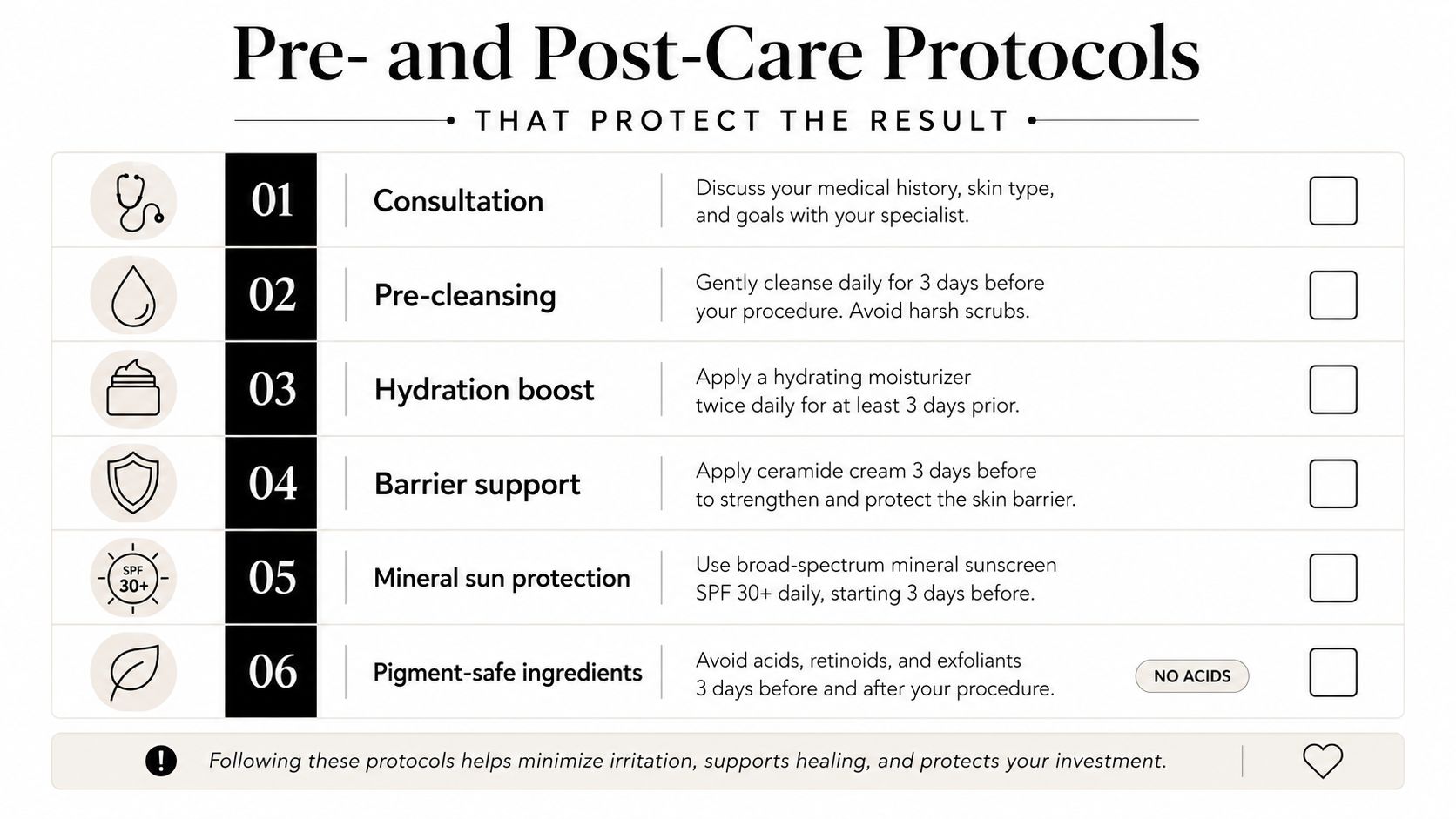
A resurfacing result is shaped before the handpiece touches the skin. It is shaped in consultation, in the pre-treatment window, and in the way the barrier is managed until recovery settles. The routines that hold up best are plain ones, clean the skin properly, support hydration, and do not let the client aggravate a fresh wound with the wrong home care.
A clean sequence that works in practice
Before treatment, the skin should be kept calm, well hydrated, and away from direct sun. In the weeks leading up to the session, many clinicians also screen for pigment risk and decide whether a pre-treatment brightening or lightening step makes sense, especially if the client has a history of post-inflammatory pigmentation. A simple routine is usually more dependable than a crowded one, because extra actives increase the chance of irritation right before a controlled injury.
Mineral sun protection should be in place before and after resurfacing. A low-irritation cleanser and a barrier-support cream with a straightforward formula should sit beside it. For Swiss pharmacies and spas, the shelf presentation can still look premium without behaving like a vanity edit. The post-laser routine should read as recovery care, not decorative skincare.
A useful product set in this phase also has to fit the device settings that were chosen. Higher fractional density, shorter pulse durations, and more aggressive tissue response usually mean more erythema, more crusting, and a narrower tolerance for active ingredients afterwards. That is where procurement decisions matter. A clinic buying for a CO₂ fractional protocol does not need the same aftercare profile as one working with a milder ablative or non-ablative platform.
For aftercare documentation and client education, see the Amazon PPC control guide. The link is not about skincare, but it is a useful example of how clear instructions reduce confusion when a process has to be followed exactly at home.
What the first 72 hours should look like
The first 72 hours after resurfacing are about comfort, moisture, and strict avoidance of unnecessary irritation. Clients should cleanse gently, apply barrier support as directed, and avoid anything that stings or heats the skin. Strong acids, retinoids, and high-concentration essential oils should stay out of the routine immediately after treatment.
A good clinic script helps here. If the skin feels hot, tight, or reactive, the client should stay with bland support products and stop chasing a faster cosmetic finish. In Swiss practice, that advice matters because a client who returns to work too early, or tests a new serum from a retail shelf, can turn a manageable recovery into a pigment or inflammation problem.
For aftercare, a Swiss clinic or spa can build a straightforward shelf plan around a mild cleanser, a fragrance-light moisturiser, and a mineral sunscreen. That gives the practitioner a cleaner compliance story, and it gives the client fewer chances to undo the result at home. It also makes the medical versus cosmetic boundary easier to explain, since barrier repair products can be presented as supportive care while anything more active stays under clinician direction.
Result maintenance is part of the protocol
The best resurfacing outcome is the one that still looks good after the skin has fully settled. Once recovery is complete, the maintenance plan can move back toward a more active routine, but only when the clinician says the barrier can tolerate it. If the goal is to preserve texture improvement and reduce complaint risk, the home routine has to be treated as part of the treatment plan, not as a separate retail add-on.
Why Clean Cosmeceuticals Are a Commercial Differentiator
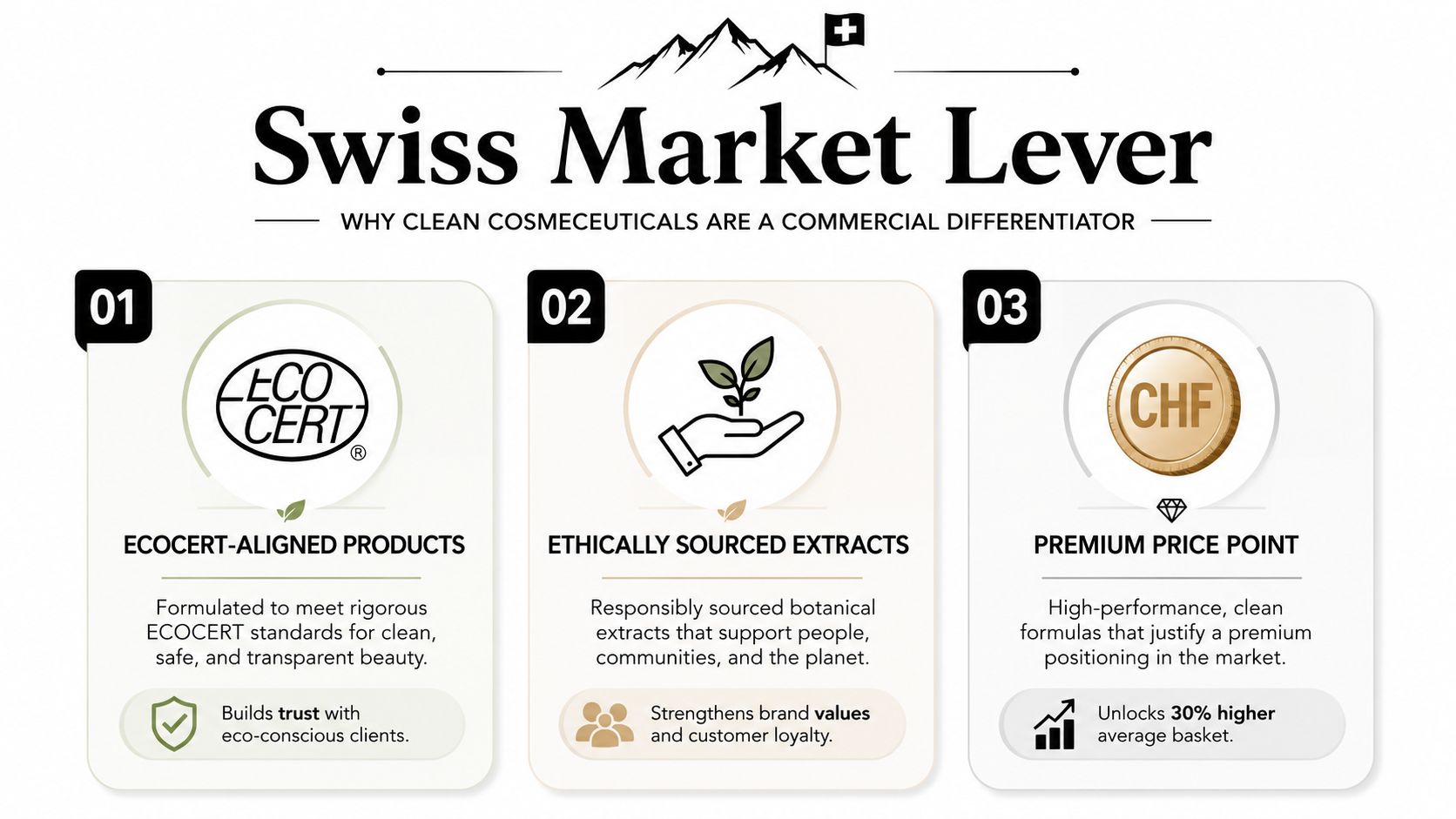
Swiss buyers already know that clients notice what sits on the shelf and what gets recommended after a procedure. Clean, certified cosmeceuticals turn the post-laser routine into a trust signal. They also help premium pharmacies, spas, and clinics avoid the feeling that aftercare is just an upsell with a prettier label.
Why the assortment matters
ECOCERT-aligned, cruelty-free, and naturally formulated products fit the premium transparency many Swiss consumers expect from a treatment environment. That matters even more after resurfacing, when the client is more sensitive to irritants and more alert to what touches the skin. A clean aftercare wall does not replace medical guidance, but it does reinforce it.
Beautysecrets.agency's portfolio is a good example of how that story can be built across categories, with ecological formulations, sensory body care, marine spa lines, and multi-purpose balms that suit different retail channels. For a buyer, the advantage is not just brand variety. It's the ability to map one resurfacing protocol to a coherent assortment story instead of stitching together unrelated products.
How to position it commercially
In retail, the best framing is “recovery support and maintenance”, not “extra skincare”. In spas, the language can be “treatment continuity”, which makes the home routine feel like part of the service. In clinics, the same products can support compliant aftercare without crowding the medical message.
A premium Swiss market rewards that kind of clarity. The shelf looks deliberate, the staff narrative is tighter, and the client understands why the recommendation exists. That is how aftercare becomes part of the treatment economics rather than a one-off add-on.
What Swiss Trade Partners Should Do Next
A strong resurfacing offer in Switzerland starts with a simple decision tree. First, decide whether the service is medical or cosmetic, because that changes who should lead the treatment, what the device category is, and how the claims need to be handled. Then match the modality to the concern, build the aftercare range, and train staff so they can explain downtime, sun avoidance, and skin-type limitations without hesitation.
A practical buyer checklist
- Confirm the service model. If the offering is dermatologist-led or medical-device based, the protocol, documentation, and staff competency need to reflect that. If it lives on the spa floor, the language should stay within cosmetic claims and conservative expectations.
- Match device to indication. Deeper wrinkles and scars call for a different platform than mild texture or pigment support.
- Stock the aftercare set. Cleanser, barrier support, and mineral SPF should be ready before the first treatment is sold.
- Brief the team on exclusions. Fitzpatrick IV to VI, melasma-prone clients, and redness-prone skin need more careful triage.
- Prepare the front-of-house script. Staff should be able to explain that “minimal downtime” does not mean “no risk”.
Useful buying question: if a client asks what the treatment is not good for, can your team answer without guessing?
Swiss regulatory reality also pushes the same discipline. Medical devices, cosmeceuticals, and consumer claims should be handled differently, even when they sit in the same customer journey. That's why the best procurement decision is usually a paired one, device plus aftercare, rather than a machine in isolation.
For the usual purchase-blocking questions, the answers are straightforward. Summer treatment is possible only with strict sun discipline. Results vary by modality and maintenance habits. Fitzpatrick IV to VI clients usually need more careful selection and more conservative settings. Front-of-house staff should be trained to screen, not to oversell.
If you're building a resurfacing offer for a Swiss clinic, spa, pharmacy, or premium retail floor, beautysecrets.agency can help you shape the aftercare and clean-beauty side of the story with certified, ethically sourced assortments that fit the treatment journey. Visit beautysecrets.agency to discuss a portfolio that supports resurfacing protocols, retail credibility, and a cleaner client experience.