A pharmacy owner in Zurich can spend a week chasing answers about one serum. The French manufacturer has approved the formula, but the stability report is with another laboratory. The packaging supplier in Italy needs final artwork, the regulatory consultant is waiting for an updated INCI list, and the branding agency in Geneva has created a label that still needs multilingual corrections. Nobody is deliberately creating risk, yet the launch keeps moving.
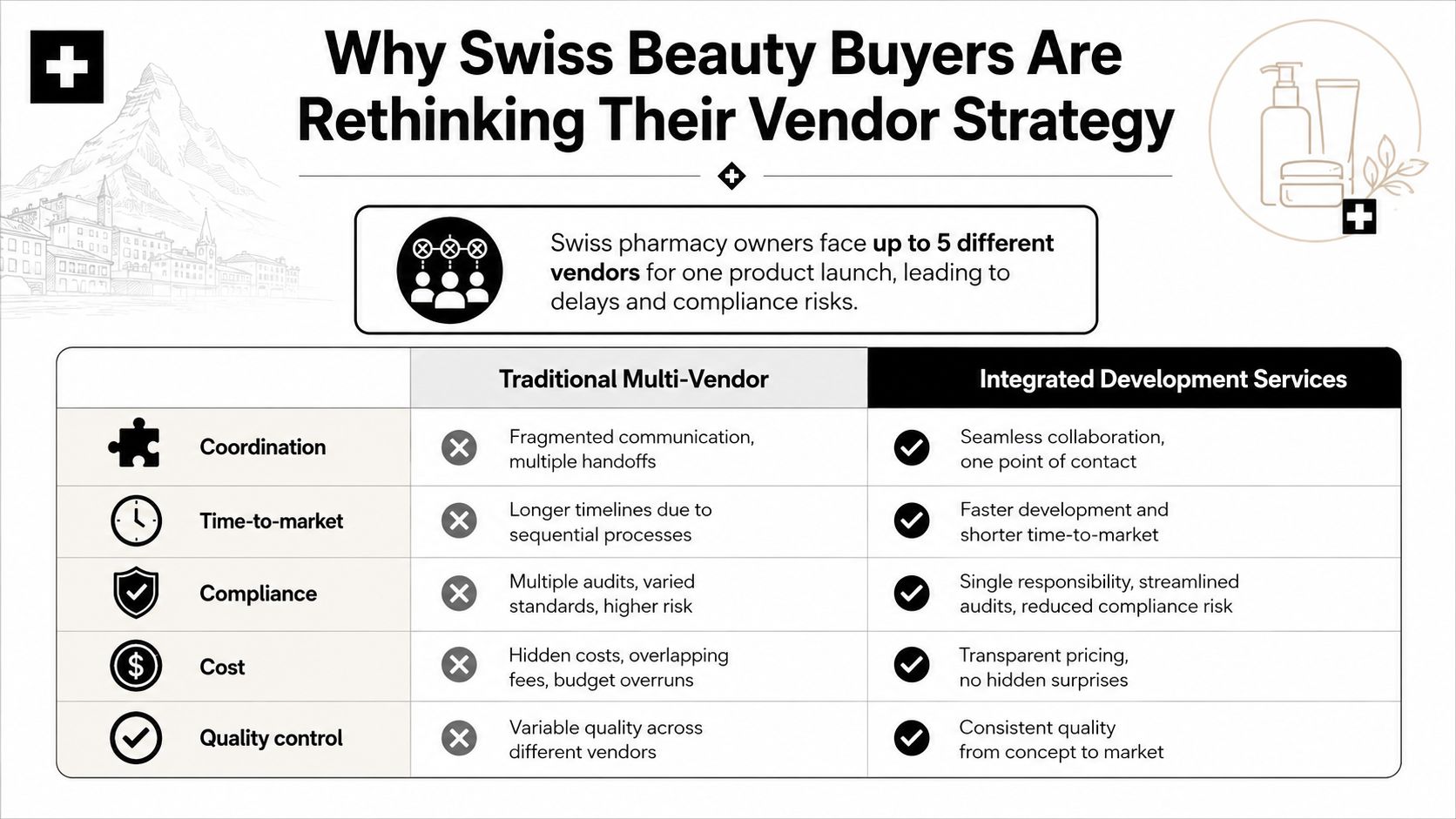
This is the hidden fragmentation behind many Swiss beauty launches. Formulation, compliance, testing, packaging, branding and distribution are often commissioned separately, leaving the buyer to manage technical handovers between companies that use different systems, timelines and definitions of “ready”. Integrated development services replace that chain with one coordinated workflow and one accountable partner.
Why Swiss Beauty Buyers Are Rethinking Their Vendor Strategy
The difficulty isn't finding capable suppliers. Switzerland has access to excellent laboratories, manufacturers, designers, logistics providers and regulatory specialists across Europe. The problem is that each supplier sees only one part of the product.
A pharmacy owner might approve an elegant botanical cream before discovering that the selected packaging isn't compatible with the formula. A spa may commission a private-label body oil before checking whether the proposed sustainability claim can be supported across the entire ingredient supply chain. An e-commerce retailer may receive finished stock without a complete product dossier, compliant translations or digital product assets.
Practical rule: A product isn't launch-ready when the formula is finished. It's launch-ready when the formula, evidence, artwork, stock and sales channels are ready together.
Switzerland's institutional environment makes this coordination especially important. Swiss development cooperation has operated as a structured, government-led system since the 1960s, and the agency now known as the Swiss Agency for Development and Cooperation was formally renamed in 1996. Switzerland's total official development assistance reached USD 4.6 billion in 2024, equal to 0.51% of gross national income, according to the SDC history and development cooperation publications. That doesn't describe cosmetics directly, but it reflects a wider national culture of institutional coordination, documentation and public accountability.
The commercial case is equally clear. Integrated care initiatives in Switzerland have grown steadily over 20 years, reflecting a broader movement from isolated provider structures towards coordinated, multi-actor delivery, as described in this peer-reviewed analysis of Swiss integrated care. Beauty buyers face a similar operational choice. They can continue acting as the project manager between specialists, or appoint a partner that owns the handovers.
A single provider won't remove every regulatory or manufacturing constraint. It should, however, make responsibility visible. If a test fails, the packaging conflicts with the formula or a label needs correction, someone should explain the impact, propose the fix and update the project plan without sending the buyer around the supplier network.
The Seven Pillars of Integrated Development Services
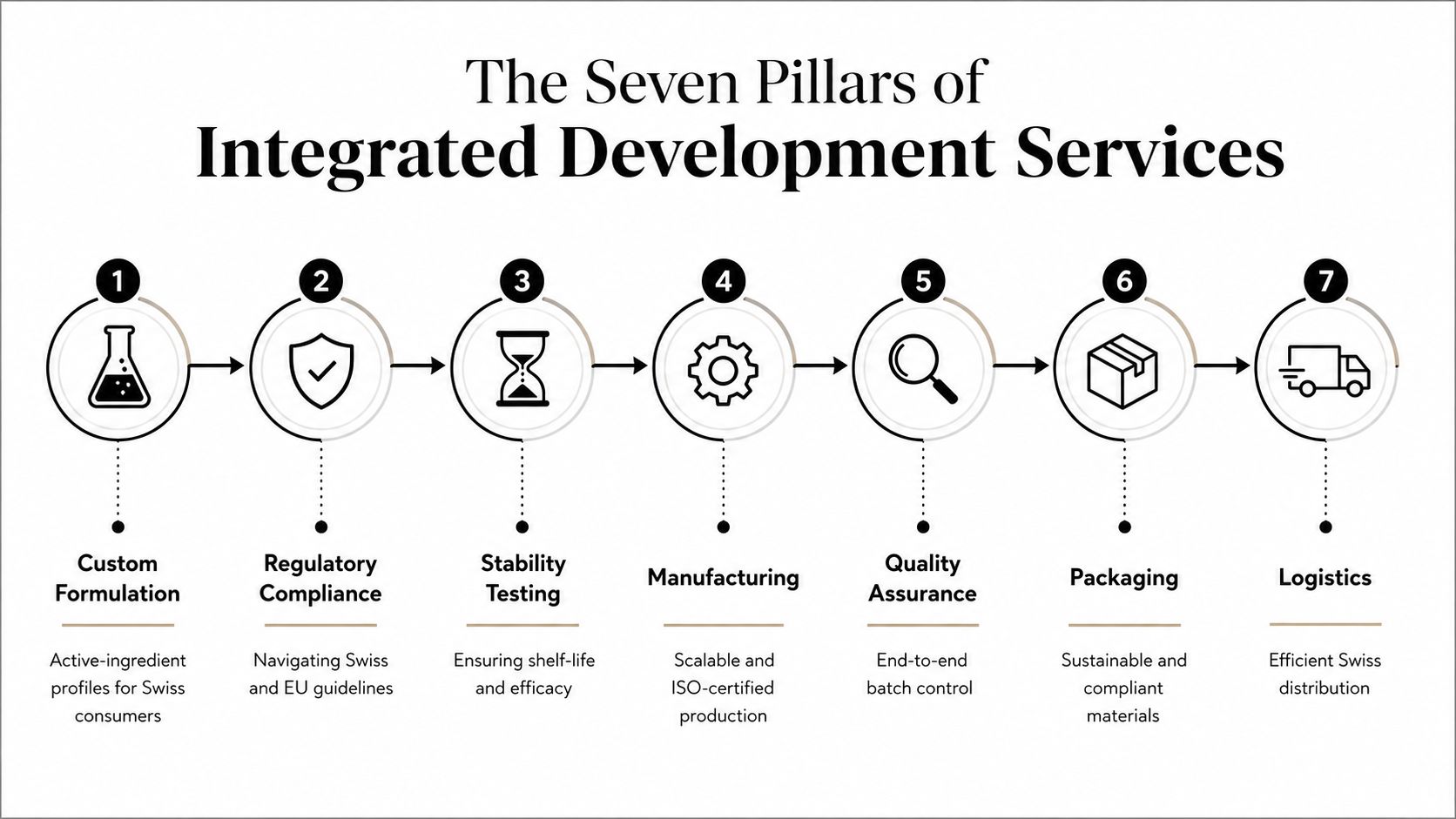
Integrated development services work when the seven core functions are designed as one pipeline rather than sold as unrelated tasks. Each decision affects the next stage, so the value lies in the connections.
1. Custom formulation
The process starts with a commercial and technical brief. A pharmacy may want a barrier-supporting facial cream with a restrained natural profile. A spa may need a sensorial body oil that performs in treatment rooms and at home. The formulator then selects the active-ingredient profile, texture, fragrance strategy and preservation approach around that use case.
The best brief includes claims, target markets, packaging format, price position and channel requirements from the start. “Clean” isn't a formulation specification on its own.
2. Regulatory compliance
Swiss market access requires more than a formula that feels effective. The partner should map the product category, claims, safety evidence, labelling obligations and any cross-border requirements before production. If the product will also be sold in the EU, the workflow must account for the EU Cosmetics Regulation 1223/2009, alongside Swiss requirements and relevant local procedures.
The practical test is whether the regulatory specialist reviews the brief before the designer creates artwork. Late compliance review is one of the most expensive forms of rework.
3. Certification management
ECOCERT, COSMOS and cruelty-free claims depend on documentation, sourcing and controlled processes. Certification management should connect supplier certificates, formula changes, manufacturing records and artwork claims in one audit trail.
A certificate shouldn't be treated as a marketing file that gets added at the end. It needs to influence ingredient selection and packaging language from the beginning.
4. Stability and challenge testing
A cream, serum or oil must remain suitable throughout its intended life and distribution route. Stability work helps identify changes in odour, colour, texture, viscosity, packaging interaction and microbiological quality. Challenge testing is particularly relevant for products containing water and ingredients that require preservation.
Testing should reflect real transport and storage conditions. Alpine winters, heated interiors, warehouse variation and long-distance freight can expose weaknesses that a laboratory-only development plan misses.
5. Packaging engineering
Packaging protects the product and communicates its market position. An airless dispenser may suit an oxidation-sensitive serum, while UV-protective glass can support a premium oil range. Refillable systems may align with a sustainability strategy, but only if the refill process remains hygienic, understandable and commercially practical.
Packaging choices should be locked alongside the formula, not after it. Material compatibility, pump performance, decoration, recyclability and minimum order requirements all affect the final product.
6. Branding and labelling
Swiss beauty products often need clear, carefully managed multilingual communication. The artwork workflow should cover the INCI declaration, responsible-party information, warnings, usage instructions, quantities, claims and language requirements under applicable Swiss labelling rules, including the OIP where relevant.
A polished label can still fail if the text is incomplete or a claim overreaches the available evidence. Regulatory and brand teams should approve the same master artwork, not separate versions that drift apart.
7. Manufacturing, quality assurance and logistics
Manufacturing turns the approved specification into a repeatable batch. Quality assurance then checks raw materials, production records, finished goods and release documentation. Logistics completes the chain through warehousing, order handling and delivery to pharmacies, spas, retailers or e-commerce fulfilment partners.
For a more detailed view of how businesses connect formulation, documentation, production and launch preparation, this product concept to production pipeline is a useful reference point. The key principle is simple: every handover needs an owner, a documented acceptance criterion and a clear escalation route.
Measurable Benefits for Pharmacies Spas and E-Commerce Partners
A pharmacy, spa or online retailer can receive a finished product while still managing separate contacts for formulation, compliance, artwork, manufacturing and fulfilment. That fragmentation creates hidden work: teams reconcile conflicting specifications, chase approvals and determine which version of a document is current. Integrated development services assign those handovers to one accountable workflow.
The practical benefit varies by buyer. A pharmacy needs dependable product information, replenishment and regulatory confidence. A spa may prioritise a distinctive treatment ritual with production quantities it can manage. An e-commerce partner needs approved claims, translations, digital assets, stock visibility and prompt answers to customer or platform questions.
Swiss buyers also expect suppliers to exchange documents, approvals and status updates through organised digital processes. The Digital Switzerland Strategy 2024 monitoring report records growth in the availability of digital public services for businesses. A partner that keeps formulation, regulatory files and commercial assets in one controlled system is better placed to meet that expectation.
| Buyer Type | Primary Benefit | Typical Outcome | Key Metric |
|---|---|---|---|
| Swiss pharmacy | One accountable launch and quality contact | Fewer unresolved handovers between manufacturer, laboratory and regulatory adviser | Completeness of launch documentation |
| Spa or wellness centre | Brand-specific product development | A treatment-linked range with coordinated packaging and replenishment | Fit between product, treatment and retail offer |
| E-commerce partner | Approved compliance and content package | Faster product-page onboarding, translations and technical-file responses | Availability of approved digital assets |
| Premium retailer | Consistent assortment and supply coordination | Fewer discrepancies between claims, packaging and sales copy | Artwork and dossier version control |
Measure the workflow rather than promising a fixed administration saving. Track meetings, specification reconciliations, unresolved ownership questions and the time needed to obtain a current launch status. One accountable contact should be able to state what is approved, what remains open and who owns the next action.
The opendata.swiss portal demonstrates the need for controlled data across distributed organisations. Beauty projects require the same discipline: consistent file names, version histories, structured product data and validation checks, rather than untracked email attachments.
Packaging decisions should include material compatibility, labelling and transport requirements. The Packaging Panda cosmetic guide can help teams frame sustainability questions before a supplier confirms the format. It does not replace a compatibility review or Swiss labelling assessment.
Comparing Service Models and Typical Timelines
A Swiss pharmacy may receive a formula from one vendor, packaging from another, compliance files from a third and finished goods through a separate logistics contact. The product can be attractive while ownership remains unclear. Integrated development services reduce that fragmentation by connecting formulation, regulatory review, branding, production and delivery in one accountable workflow.
The right model depends on differentiation, risk and operational readiness. A small pharmacy may need a proven formula with compliant packaging rather than a new composition. An established e-commerce business may require a proprietary texture, claims support and clear ownership of a distinctive formulation.
| Dimension | White-Label Turnkey | Semi-Custom Formulation | Full Bespoke Development |
|---|---|---|---|
| Minimum order quantity | Usually governed by existing stock and packaging options | Often shaped by the base formula and selected components | Negotiated around formulation, manufacturing and packaging complexity |
| Timeline from brief to shelf | Shortest when the product and documents already exist | Moderate, because the base is adapted and rechecked | Longest, because formulation, testing and packaging develop together |
| Cost structure | Lower development cost, with less control over customisation | Balanced development and production investment | Highest development commitment, with more technical work before launch |
| IP ownership | Commonly limited or shared according to the supplier agreement | Requires explicit agreement for adaptations and formula rights | Must be negotiated in detail before development begins |
| Best fit | A buyer testing a category or adding a proven product format | A pharmacy or spa seeking a differentiated house line without starting from zero | A scaled brand building a defensible signature product |
| Main trade-off | Speed versus distinctiveness | Flexibility versus dependency on the existing base | Control versus time, cost and development risk |
White-label is often practical for a first launch or assortment test. It becomes restrictive when competing products look similar, or when the brand needs a specific texture, scent or claim architecture.
Semi-custom development offers the strongest middle path for many Swiss pharmacies and spas. Proven manufacturing logic can remain in place while the supplier adjusts fragrance, actives, texture, packaging and presentation. Full bespoke work fits a product that carries the brand's competitive value and justifies a more demanding validation process.
Treat timelines as dependency maps, not promises. Ask which tasks can run in parallel, which must wait for stability or microbiological results, and which decision would restart artwork, packaging or production. The schedule should also show ownership for each open item.
Packaging availability, certification route, regulatory review and test results can all change the shelf date. A provider offering a firm launch date without confirming these dependencies is giving a sales estimate, not a project plan. One accountable contact should be able to state what is approved, what remains open and who owns the next action.
Your Vendor Selection Checklist
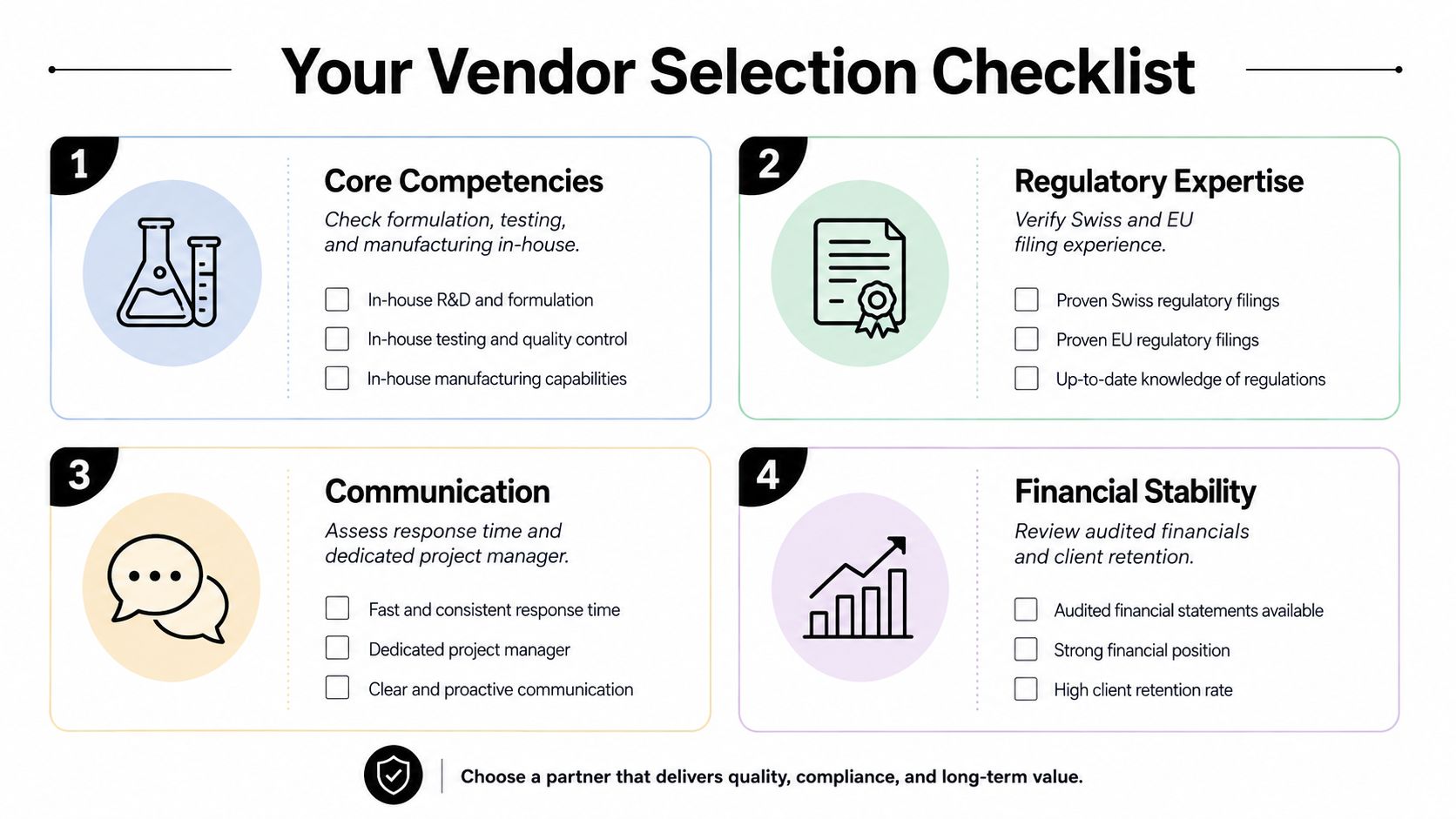
A supplier can issue one invoice without providing genuine integration. The difference is whether the company controls the technical interfaces or merely forwards messages between subcontractors.
Phase one, initial screening
Start with evidence, not a capabilities deck. Ask for a typical project plan showing the relationship between formulation, testing, regulatory review, artwork approval, manufacturing and delivery.
- Relevant experience: Request examples of pharmacy, spa, dermocosmetic or premium retail launches with similar claims and formats.
- Named accountability: Confirm who owns the programme, who approves technical changes and who answers during a quality incident.
- Transparent commercial logic: Ask how development fees, packaging costs, testing and production charges change as the brief evolves.
Phase two, technical capability audit
Visit the laboratory or request a documented description of the operating model. Clarify which activities are performed in-house and which are outsourced.
- Testing control: If stability or microbiological work is external, request the laboratory's identity, scope and reporting process.
- Batch traceability: Confirm that finished products can be traced to raw material lots, manufacturing records and release decisions.
- Packaging compatibility: Ask how the supplier tests pumps, closures, bottles and tubes against the final formula.
Phase three, compliance verification
The partner should explain Swiss and EU requirements in plain language, then show how those requirements enter the project schedule. Ask whether the Product Information File can be produced promptly and whether safety documentation, INCI translations and claims evidence are version-controlled.
Red flags include a vendor that can't show a current Product Information File, a broker that won't identify its testing laboratory, or a timeline that excludes notification, audit or artwork review. “We'll handle compliance later” is not a reassuring answer.
Phase four, commercial alignment
Finally, test whether the operating model fits your business. Discuss forecast changes, reorder rules, packaging substitutions, discontinued ingredients, complaint handling and escalation. A low initial quote can become expensive if every revision creates a new fee or if the buyer must coordinate the hidden supplier network.
Ask one decisive question: “If the product fails a quality check two weeks before launch, who calls me, who owns the corrective action and who pays for the rework?”
Navigating ECOCERT and Cruelty-Free Compliance
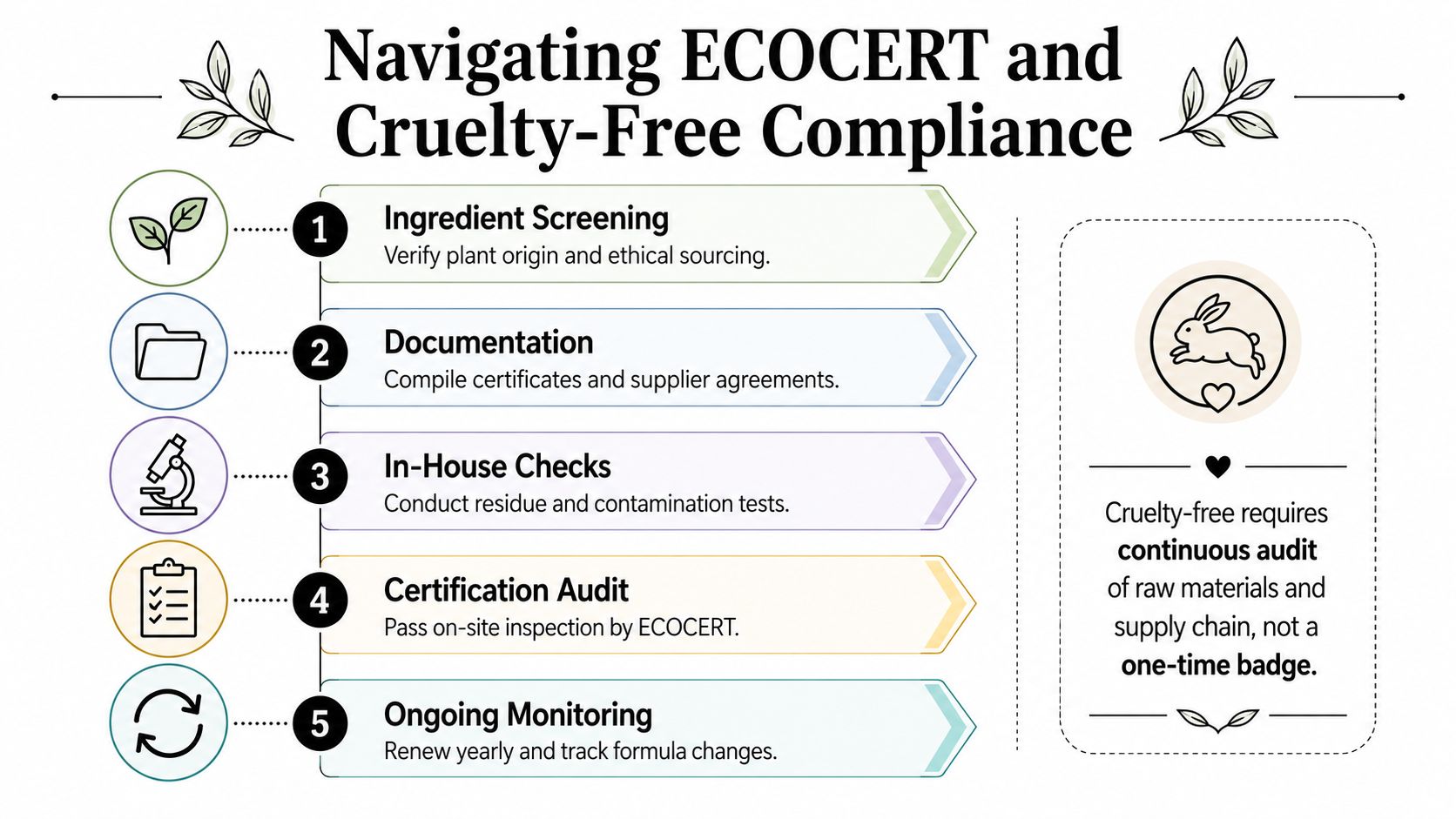
Certification isn't a badge that gets attached to a finished product. It changes the development brief.
ECOCERT and COSMOS pathways can affect ingredient selection, processing methods, documentation and claims. An integrated partner should screen raw materials before formulation approval, verify supplier documentation and maintain traceability when an ingredient, fragrance or packaging component changes. The formulation team must understand what the certification route allows, not merely ask a certification body to approve a completed project.
Cruelty-free positioning creates a different supply-chain challenge. A credible programme requires declarations and monitoring that extend beyond the finished-goods manufacturer. The buyer needs confidence that raw material suppliers and relevant upstream parties meet the chosen standard, and that a formula change won't invalidate the claim.
Run compliance work in parallel
Some tasks can proceed together. Ingredient screening, supplier document collection and preliminary artwork planning can start while the first samples are being assessed. Other steps should wait for confirmed formula and packaging decisions, particularly final claims, production release and certification sign-off.
The common failure is sequencing. A company develops the formula, orders packaging, prints labels and only then checks whether the full claim and certification package is supportable. If the audit raises a question, finished stock may need relabelling or remain on hold.
Swiss buyers should also examine retailer-specific requirements rather than assuming that a recognised certification automatically satisfies every trading partner. Sustainability policies, evidence standards and data requests may exceed a baseline label requirement.
Digital maturity adds another layer. The Federal Council's Digital Switzerland Strategy 2025 emphasises user orientation and barrier-free access, while recent benchmarking identified improvement in mobile availability, service transparency and eID alongside decline in some cross-border and personal-data transparency measures. For beauty businesses, that means certification files, privacy controls, accessible content and multilingual customer journeys should be managed as one trust system.
Practical Next Steps and Real-World Case Examples
A practical launch plan starts with a controlled brief rather than a supplier search conducted in isolation.
Weeks 1–2 should establish the commercial and compliance frame. Define the product purpose, target customer, claims, sales channels, languages, packaging preference, forecast and certification ambition. Ask shortlisted partners to identify dependencies and exclusions before they quote.
Weeks 3–8 should cover samples and pre-screening. Review formula iterations, initiate appropriate stability and microbiological work, check ingredient documentation and create the first compliant label architecture. Keep a decision log so the approved formula, claims and artwork remain aligned.
Weeks 9–12 should prepare the launch system. Finalise packaging, approve production specifications, complete product files, organise stock holding and test the order workflow with the pharmacy, spa or e-commerce channel. The roadmap is a planning framework, not a guaranteed market date.
Two illustrative scenarios show why the model matters. A Zurich pharmacy consolidating three suppliers into one integrated partner could reduce the number of handovers for a private-label retinol serum and give one team responsibility for Swiss compliance, packaging coordination and release documentation. A Geneva spa using a turnkey botanical body oil could move more directly from approved product selection to ECOCERT documentation, branded content and e-commerce onboarding, provided the product and certification evidence already meet the channel requirements.
The best next step is an audit of the current vendor stack. List every supplier, document, approval and unresolved dependency, then ask integrated providers to return a single workflow with named owners, decision gates and transparent exclusions.
If your pharmacy, spa or retail business is managing separate formulation, compliance, packaging and distribution suppliers, beautysecrets.agency can help you assess a more coherent clean-beauty supply strategy. Visit the agency to discuss curated natural and certified ranges, Swiss trade support and a practical route to fewer handovers and clearer accountability.