A first-time mother stands in front of the mirror, gently applying cream to her growing bump. An athlete notices new lines across the shoulders after a period of muscle gain. A teenager sees red-purple bands on the hips after a growth spurt and wonders whether they'll ever disappear. In each situation, a stretch marks cream can make the skin feel more comfortable and supported, but the right expectations matter from the start.

Stretch marks are a normal response to changes beneath the skin. They may appear during pregnancy, puberty, rapid weight change or muscle development, and they can affect people with every skin type. A well-formulated cream may help maintain hydration, ease tightness and support the appearance of newer marks, yet it can't reliably remove established striae.
For shoppers, that distinction is often difficult to see on a crowded shelf. For pharmacies, spas and premium retailers, it creates an opportunity to explain the difference between prevention, comfort, early support and correction. Readers looking for practical pregnancy advice may also find this guide to managing stretch marks during pregnancy useful alongside professional guidance.
This guide starts with skin biology, moves through ingredients and application, then considers professional treatments and Swiss cosmetic retail. By the end, the central promise is simple: a stretch marks cream can be valuable without being presented as a cure.
Introduction to Stretch Marks and Why Creams Matter
The phrase “stretch marks cream” covers several different customer needs. Someone in early pregnancy may want a nourishing daily product for dry, tight skin. A teenager may want reassurance after noticing fresh coloured lines. A customer with older silvery marks may be searching for visible correction, even though a topical formula has limited access to the deeper skin structures involved.
That difference should guide both product selection and communication. A comforting body cream can support a regular care ritual, while a treatment conversation needs clearer stage-based language. A product page that says only “prevents and corrects stretch marks” leaves too much room for misunderstanding.
Start with the person, not the promise
Stretch marks can affect confidence, but they aren't a sign that someone has neglected their skin. Pregnancy, puberty, rapid body changes and inherited differences in skin structure all influence whether marks appear. The first retail conversation should therefore be reassuring rather than alarmist.
A useful explanation is that creams work mainly at the skin surface. They can soften the feel of stretched skin, improve hydration and make the surface look smoother. They can't promise to rebuild every damaged fibre deep in the dermis, particularly once marks have become pale and established.
Practical rule: Sell the routine honestly. Comfort, softness and appearance support are meaningful benefits, even when complete removal isn't realistic.
This approach also makes the category easier to merchandise. A maternity formula can sit within a pregnancy body-care story, while a richer balm or oil can support dry-skin comfort. Premium positioning should come from formulation quality, sensory experience, ingredient transparency and responsible claims, not from an exaggerated promise of erasure.
The Swiss market already reflects this range. Local online pharmacies and beauty retailers list multiple stretch-mark products, including maternity-focused and premium formulas. Examples include a 200 ml Vichy stretch mark cream priced at CHF 44.85 and a Mustela maternity cream listed at CHF 126 per litre, as shown by Swiss retail listings for stretch-mark creams. These products sit within established pharmacy-commerce logistics rather than a novelty niche.
The most helpful advice begins with one question: Are the marks new and coloured, or older and pale? That answer changes the role a cream can reasonably play.
How Stretch Marks Form and What Influences Them
Think of skin as a layered knitted fabric. The outer surface is the visible finish, but the deeper dermis provides much of the structure and resilience. Within that layer, collagen gives support while elastin helps the skin stretch and return towards its original shape.
When the body changes faster than the dermal support can adapt, some of those fibres can become damaged. The surface then shows narrow bands that may look red, pink, purple, brownish or silvery, depending on the person's natural skin tone and the age of the mark.
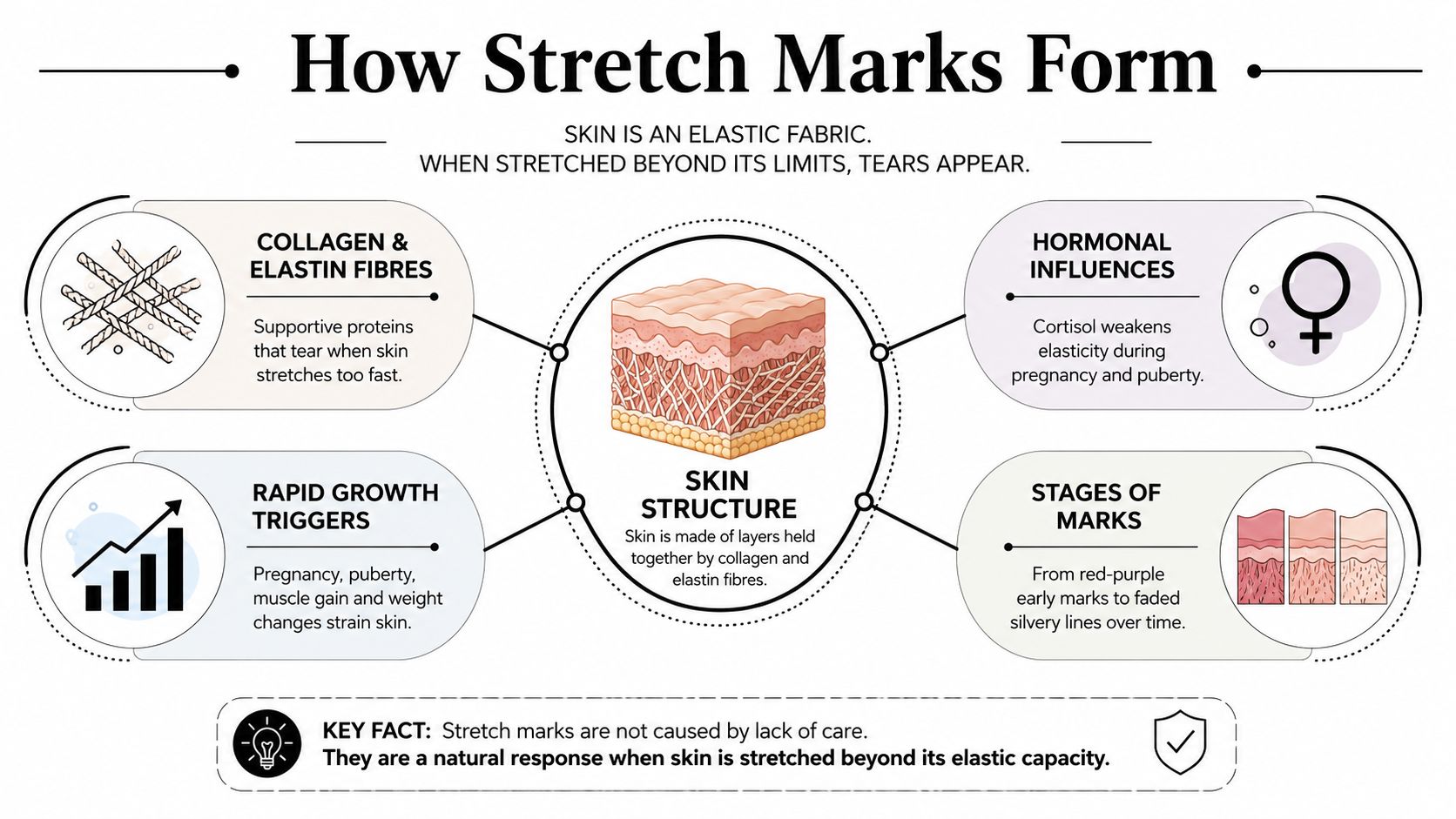
Four influences shape the result
Rapid change is the most familiar trigger. Pregnancy can expand the abdomen and breasts, puberty can alter the hips and thighs, and changes in body weight or muscle size can place additional strain on the skin. The marks may appear wherever the body is changing most quickly.
Hormonal shifts also affect the skin's behaviour. Hormones associated with pregnancy and puberty can influence collagen production and elasticity, making the dermis more vulnerable during periods of expansion. This isn't a simple surface-dryness problem, which explains why moisturising alone can't guarantee prevention.
Genetic tendency matters as well. Two people can follow similar routines and experience different outcomes because their skin's elasticity and response to stretching aren't identical. A family pattern may increase the likelihood, but it doesn't determine exactly where or when marks will appear.
Timing changes the visual character. Newer marks, known as striae rubrae, often have red or purple tones. Older striae albae tend to fade towards paler, silvery lines. The biological stage matters because early marks may respond differently from mature ones, and a customer's expectations should reflect that.
The term “tear” can sound frightening, but stretch marks themselves are generally a common skin variation. A shopper doesn't need to treat them as a failure or an emergency. However, intense itching, a rash or unusual inflammation deserves medical advice rather than a cosmetic response.
For customers considering nutrition alongside topical care, a separate discussion of the best collagen supplements for skin may be relevant. Supplements and creams address different parts of a broader personal-care routine, and neither should be presented as a guaranteed way to prevent striae.
How Stretch Marks Cream Works and Where Its Limits Lie
A topical formula has a practical job to perform, but that job isn't identical to repairing every structural change in the dermis. The strongest explanation separates three realistic functions: hydration, early support and appearance care.
Hydration helps the surface feel more flexible and less tight. Creams, balms and oils can reduce the uncomfortable sensation that accompanies dry, stretched skin. Humectants draw water towards the outer layers, while richer lipids and occlusive ingredients help reduce water loss.
Early support is more stage-sensitive. New red or purple marks may still be undergoing active changes. Expert guidance on striae distensae describes topical retinoids such as tretinoin as an option used to reduce inflammation and support early remodelling, while also noting that topical therapy alone often has limited durable efficacy and that no treatment is consistently effective with minimal adverse effects. The clinical overview of striae distensae provides that distinction.
Match the claim to the stage
Older white marks present a different challenge. The goal shifts towards improving hydration, texture and the appearance of uneven tone, with collagen and elastic-fibre stimulation often requiring more than a surface cream can provide.
| Skin stage | Sensible topical role | Claim language to favour |
|---|---|---|
| Skin at risk of stretching | Comfort and moisturising support | Helps keep skin soft and supple |
| New red or purple marks | Supportive care alongside realistic monitoring | Helps improve the appearance of early marks |
| Older white marks | Hydration and surface appearance | Helps smooth and condition the skin |
A cream can't reach every deeper fibre simply because it contains a fashionable active. Ingredient size, formulation, skin penetration and the age of the mark all influence the result. Consistency may improve how the skin feels and looks, but visible change should be described as gradual and variable.
Swiss clinical guidance also places creams and oils mainly in a preventive or supportive role. More visible improvement usually comes from device-based approaches, especially where collagen stimulation is the target. Swiss patient guidance on stretch-mark treatment explains that newer marks may respond better to retinoid cream, while microneedling and light or laser treatments are considered when controlled dermal stimulation is needed.
For pharmacy counselling: If a customer asks whether an old stretch mark will vanish, answer the question directly. Explain that a cream may improve softness and appearance, but established marks often need a different treatment conversation.
This honesty doesn't weaken the category. It protects trust, improves product fit and gives customers a reason to continue a routine for comfort and skin quality rather than waiting for an unrealistic overnight result.
Key Ingredients to Look For in a Stretch Marks Cream
Reading an INCI list becomes easier when ingredients are grouped by their practical role. A suitable formula may combine water-binding agents, emollient oils, occlusive lipids, soothing botanicals and antioxidants. The right choice depends on the customer's skin stage, sensitivity, pregnancy status and preferred texture.
Fresh-pressed organic oils can provide emollient comfort and a smooth massage slip. Oils such as botanical seed or fruit oils are useful in body-care rituals, especially when the customer prefers a nourishing finish. They don't repair a deep dermal change on their own, so their value should be framed around conditioning and sensorial use.
Shea butter brings a richer, protective feel. It suits dry, tight areas and can work well in a balm or cream designed for evening application. Vitamin E is commonly used as an antioxidant and skin-conditioning ingredient, while centella asiatica is popular in formulas focused on soothing and skin support.
Hyaluronic acid is a humectant. It helps attract water to the skin's outer layers, which can make the surface feel plumper and more comfortable. It works differently from an oil or butter, so a well-designed formula may combine both rather than treating them as interchangeable.
A practical ingredient matrix
| Ingredient Group | Best For | Natural and ECOCERT Notes |
|---|---|---|
| Humectants, including hyaluronic acid | Tight, dehydrated skin and lighter textures | Check the complete certified formulation, not only one ingredient |
| Plant oils and botanical lipids | Massage, softness and emollient comfort | Fresh-pressed organic oils can support a transparent clean-beauty story |
| Shea butter and richer occlusives | Dry skin and overnight care | Useful in nourishing balms, with texture matched to customer preference |
| Centella asiatica | Soothing-focused body care and early support routines | Botanical positioning should be paired with substantiated cosmetic claims |
| Vitamin E | Conditioning and antioxidant support | Communicate its cosmetic role without implying scar removal |
| Retinoids such as tretinoin | Selected early-stage clinical treatment | Not a pregnancy-friendly cosmetic choice and requires professional advice |
Natural doesn't mean claim-free
ECOCERT-friendly positioning can help a retailer build a coherent clean-beauty assortment, but certification doesn't turn a cosmetic into a medicine. A product still needs a safe formula, appropriate documentation and claims that match the evidence.
Fragrance deserves careful consideration. A perfumed cream may create a pleasurable ritual, yet pregnancy and sensitive-skin shoppers may favour low-fragrance or fragrance-free options. Retailers should make the sensory profile clear rather than assuming every customer wants the same finish.
Avoid labels that imply guaranteed prevention or complete correction. “Supports supple skin”, “helps reduce the feeling of tightness” and “improves the appearance of new marks” are more useful when they accurately describe the product's cosmetic role.
How to Apply Stretch Marks Cream for Best Results
Application technique affects whether a product becomes a routine or remains an unopened purchase. The customer should choose a texture they'll use regularly, apply it to clean skin and treat the ritual as body care rather than a test of willpower.
Start when the skin begins to feel tight or when the customer wants to establish a pregnancy body-care routine. For a person already seeing new marks, applying to the surrounding area can help condition the skin while making changes easier to observe over time.
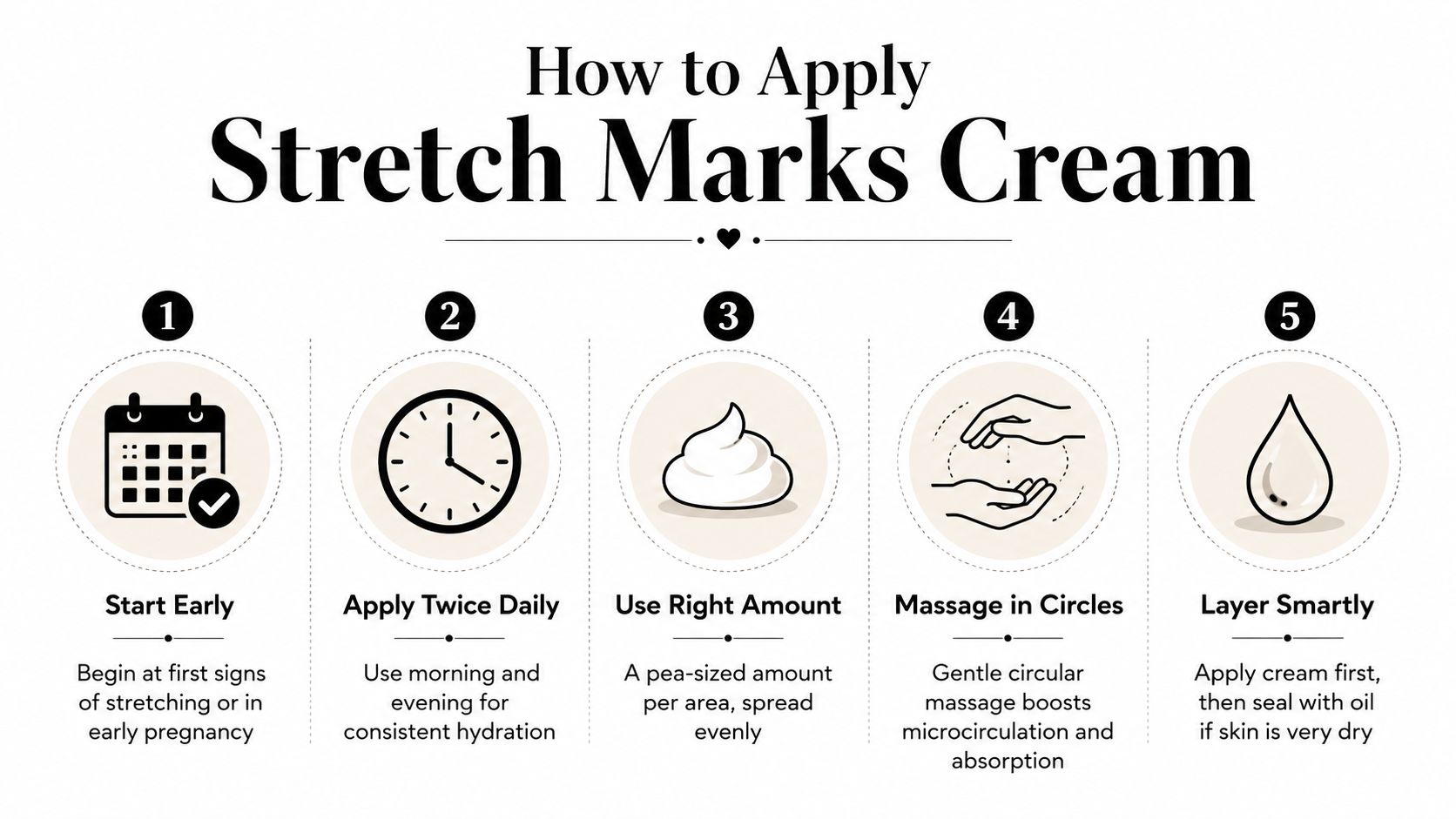
Build a repeatable ritual
Apply after bathing. Pat the skin so it remains comfortable and slightly receptive to a moisturising product, rather than rubbing vigorously with a towel.
Use a consistent amount. Cover the target area evenly without creating a heavy layer that feels unpleasant under clothing. A pharmacy adviser can demonstrate the texture on the hand before recommending a product.
Massage gently. Use slow circular movements across the abdomen, hips, thighs, breasts or areas affected by growth. Pressure should remain comfortable, particularly during pregnancy or when the skin feels tender.
Layer according to dryness. Apply a cream first, then add a small amount of oil or balm if the skin needs a more protective finish. This order keeps the lighter moisturising layer close to the skin before the richer product seals the surface.
Keep the habit visible. Place the product beside the shower, dressing table or bedside table. A routine linked to an existing habit is easier to maintain than one that depends on remembering an isolated task.
A morning and evening pattern can suit shoppers who want regular hydration, but a customer with sensitive skin should begin cautiously. Patch testing, checking the ingredient list and stopping if irritation develops are sensible safeguards. During pregnancy, avoid medicated or retinoid products unless a qualified healthcare professional has advised their use.
Counselling should include postpartum expectations. The skin may continue to change after delivery, and established marks won't be judged accurately after only a few applications. Encourage customers to assess comfort, texture and gradual appearance changes rather than promising a fixed result.
A useful counselling sentence: “Use this to keep the skin conditioned and comfortable, and give the routine time. It supports care, but it isn't a guaranteed eraser.”
This short video can help teams demonstrate a calm, consistent application ritual:
Complementary Professional Treatments Beyond Cream
Cream remains useful when a customer wants daily comfort, surface conditioning or maintenance. It becomes less suitable as the sole answer when the customer's main goal is substantial improvement in older, deeper marks.
Professional procedures work differently because they target the dermis through controlled stimulation. Microneedling creates tiny, deliberate channels that can encourage a wound-healing response and new collagen production. Fractional laser uses focused energy to stimulate remodelling, while radiofrequency uses heat-based energy for a similar collagen-focused purpose. Mesotherapy may also be discussed in aesthetic settings, depending on the practitioner and the formulation used.
Swiss clinical resources place these approaches ahead of creams when visible collagen stimulation is the priority. They also note that microneedling may carry less risk of pigment change than laser for darker skin types, although treatment suitability depends on individual assessment, device settings and practitioner expertise.
When a referral makes sense
A pharmacy or spa team can refer when:
- The customer wants removal. Explain that a cream can support the surface but won't reliably erase established striae.
- The marks are older and pale. A dermatologist or qualified aesthetic practitioner can discuss whether a procedure is appropriate.
- The skin is unusually itchy, inflamed or rash-like. This needs health advice rather than cosmetic upselling.
- The customer is pregnant or breastfeeding and asks about retinoids. Refer before recommending a medicated active.
- The customer has a deeper skin tone and is considering laser. Encourage a consultation that addresses pigment-change risk and practitioner experience.
A cream routine can continue around professional care, subject to the practitioner's instructions. It can support comfort during maintenance, but it shouldn't be presented as a replacement for clinical treatment.
Customers researching laser options may find this overview of reducing stretch marks with laser useful as background. It should complement, not replace, an individual consultation.
The strongest retail pathway is therefore not “cream versus procedure”. It is cream for everyday conditioning, professional assessment for deeper correction and clear referral when the goal exceeds cosmetic support.
Choosing and Selling Stretch Marks Cream in Switzerland
Swiss retailers need to treat stretch-mark products as cosmetics unless a product is marketed with a medical claim that changes its regulatory positioning. Swiss federal guidance explains that cosmetic products must be safe, require a Product Information File with a safety report and follow the core cosmetic framework aligned with EU principles under Swiss law. The Swiss authorities' cosmetics guidance is the appropriate reference point for distributors and responsible persons.
That affects every part of merchandising. Ingredient substantiation, safety documentation and claim support should be organised before the product reaches the shelf or online catalogue. “Prevents”, “corrects” and “repairs” need careful review because customers may interpret them as medical promises.
Build the assortment around needs
A practical Swiss assortment can include:
- Maternity care, with nourishing textures, clear pregnancy-use guidance and restrained language.
- Light daily moisturisers, suited to shoppers who dislike oily finishes.
- Rich creams and balms, for dry skin, postpartum care and evening rituals.
- Premium natural options, supported by transparent sourcing, certification and sensory storytelling.
- Professional referral support, with staff prepared to explain when creams aren't enough.
Clean beauty credentials can help differentiate an assortment when they are documented rather than used as decoration. ECOCERT-related certification, cruelty-free commitments and clear ingredient origins give trade partners useful proof points, but they don't remove the need for Swiss cosmetic compliance.
The existing retail range also shows that shoppers accept both accessible and premium price positioning. The Swiss examples cited earlier, including Vichy at CHF 44.85 for 200 ml and Mustela at CHF 126 per litre, can help retailers consider pack size, use occasion and perceived value without making unsupported performance promises.
A product such as Egyptian Magic, available through beautysecrets.agency, is positioned as an all-natural multipurpose cream containing olive oil, beeswax, honey, bee pollen, royal jelly and bee propolis. In a stretch-mark assortment, it can be considered as a richer balm-style option for skin conditioning, provided its presentation stays within substantiated cosmetic claims.
The best shelf talker may be simple: new marks need realistic early support, older marks need honest expectations, and every stage benefits from comfortable skin care. That message helps pharmacies, spas and online retailers earn repeat purchases through transparency rather than disappointment.
beautysecrets.agency helps Swiss pharmacies, spas, retailers and clean-beauty e-commerce partners source natural and ethically selected formulations, including body-care options suited to transparent stretch-mark counselling. Visit beautysecrets.agency to explore compliant, thoughtfully curated assortments for customers who value comfort, quality and realistic skin-care guidance.