You're probably staring at a vendor deck that looks polished, smells slightly of vanilla, and promises “clean colour with care.” Ignore the mood board. A tinted lip balm is a procurement decision, and in Switzerland the buyer who wins is the one who controls formulation lock-in, compliance file completeness, and merchandising logic. If any one of those three is weak, the SKU turns into dead stock with a nice shade name.
The right way to buy this category is simple. Demand a formula you can defend, documentation you can file, and a shelf story that sells repeat purchase rather than one-off curiosity. If you want a useful reminder that strong operational discipline can materially change ecommerce outcomes, the Karin Herzog 558 percent sales increase case is worth reading once, because the lesson is not “more hype,” it's tighter execution.
The Trade Buyer's Brief for Tinted Lip Balm
A pharmacy buyer and a spa buyer are not buying the same thing, even when the shade card is identical. One needs a reliable counter item that sits between skincare and makeup, the other needs a treatment add-on that feels premium enough to justify immediate use and repeat purchase. In both cases, tinted lip balm works only when the formula, compliance file, and shelf logic are aligned.
Start with the SKU, not the sample
Before you open a tester, ask for five things: pigment load expressed as % w/w, base system, fragrance-free status, shade range discipline, and refill architecture. A supplier who cannot state those clearly is asking you to take formulation risk on trust, and that is a bad buying habit in CH.
Keep the range tight. Four to eight SKUs is enough for most doors, because this category sells through clarity, not through endless shade sprawl. It also helps you avoid duplicated inventory across nearly identical nude and rose tones, which is where margin disappears.
Practical rule: if the supplier cannot explain what makes each shade commercially different, the range is too broad.
Treat it as hybrid basket building
This is not just a colour cosmetic. It sits in the same purchasing conversation as lip balm loyalists, lipstick buyers who want less commitment, and SPF shoppers who want one product that feels easier than a full sunscreen routine. That overlap is the commercial point. The more your team understands that overlap, the easier it is to place the product in pharmacy, spa retail, and premium self-service.
Your supplier brief should be one page. Put the formulation spec at the top, the compliance pack underneath, and the merchandising plan at the bottom. If the account manager cannot react to that structure, you are not dealing with a partner who understands how CH trade buys.
Formulation Archetypes Worth Stocking
A good tinted lip balm is a pigment-dispersed occlusive vehicle. In buying terms, that means the colour is there to convert usage, but the base still has to do the comfort work. The category breaks into four archetypes that cover most Swiss doors without forcing you into a shallow, me-too assortment.
Pick the base that matches the channel
The simplest starting point is the natural archetype, usually built on beeswax and shea. It gives solid glide, familiar sensorial cues, and easy merchandising in natural-focused doors. The tint usually relies on iron oxides, which are the workhorse pigments for lip-safe shades because they support earthy nude, rose, and brown-red families without looking decorative or loud.
The certified-organic archetype is stricter. It uses COSMOS or Natrue-friendly inputs and mineral pigments, so the story is cleaner for certification-led retail, but the payoff can feel less glossy and less forgiving in dry air. That trade-off is fine if your door values standards more than immediate shine.
Keep the premium stories operational, not theatrical
The marine-based archetype belongs in spa retail and hotel environments. Think algae extracts, salt-tolerant actives, and a sensorial profile that feels aligned with treatment-led selling. The texture can be elegant, but only if the formula stays stable and doesn't separate under shelf stress. The pigment system is still usually iron oxide-led, because traceability matters more than novelty.
The multipurpose archetype is the most pharmacy-friendly. Add peptides, a documented SPF system, or a more treatment-like claim profile, and you have a SKU that can sit above basic balm without becoming full lipstick. That said, you need to watch the base weight, because too much actives language can make the product feel overworked and less credible in a pure colour setting.
| Formulation Archetypes at a Glance | Base System | Pigment Type | Cert Fit | Best CH Channel |
|---|---|---|---|---|
| Natural | Beeswax, shea | Iron oxides | Natural-positioned, selective certification | Drogerie, premium self-service |
| Certified-organic | Botanical oils, waxes | Mineral pigments | COSMOS, Natrue, Bio | Natural retail, pharmacy |
| Marine | Wax-oil or balm gel with marine actives | Iron oxides | Spa-aligned, selective clean standards | Hotels, spas, thermal retail |
| Multipurpose | Balm with peptides or SPF system | Iron oxides, approved tint system | Pharmacy-adjacent, performance-led | Pharmacy, airport retail |
Choose two archetypes and build around them. For most Swiss portfolios, the most defensible pairing is certified-organic plus multipurpose, because it covers the ethical buyer and the performance buyer without making the range feel fragmented.
Swiss Compliance Essentials for Lip Tints
Swiss compliance decides whether a tinted balm can sit on shelf at all. In Switzerland, lip tint sits under the cosmetics framework linked to EU Cosmetic Regulation 1223/2009, so the formula has to stay inside the approved annexes for colourants, preservatives, and UV filters, with a safety assessment for the finished lip-contact product Swiss cosmetics framework guidance. If the tint or SPF claim sits outside that frame, the SKU is dead before the first listing meeting.
Traceability is the core buying filter
The practical issue is CI number traceability. Basel-Stadt's public lip-care guidance expects colour additives to be identified with their CI numbers and treats lip products as a separate category because they can be ingested in trace amounts Basel-Stadt lip care guidance. A supplier must give you the CI origin, not just a shade name. If a red, pink, or brown tone comes from blended pigments, you need to know exactly which pigment contributes what.
Lakes are usually the cleaner commercial choice because they are insoluble and easier to control in a lip vehicle. Dyes are harder work from both a buying and compliance angle, so I would push suppliers toward documented lake systems unless there is a clear reason not to.
Buy this way: insist on a compliance matrix that ties each shade to its CI numbers, safety status, and raw-material source.
MOSH, MOAH, and SPF claims need hard files
Swiss regional guidance also points to MOSH/MOAH assessment for lip care products, which means mineral-origin impurities are a quality parameter, not a side note. If the product uses iron oxides or other mineral inputs, ask how the supplier controls contaminant risk and what testing supports that position Basel-Stadt lip care guidance.
SPF makes the file heavier. An SPF claim needs an approved UV filter system, not colour and marketing copy, and the product information file should contain the safety assessment, INCI, allergen declaration, and traceable ingredient origin Swiss cosmetics framework guidance. Ask for the CPNP notification and the complete PIF in the first email. If the supplier hesitates, they are not ready for CH retail.
Matching Brands to Swiss Channels
Channel fit decides whether a tinted balm becomes a tidy contributor or a slow-moving indulgence. Swiss buyers should stop treating all clean lip products as interchangeable. The same SKU that works in a spa can fail in a pharmacy, and a mass formula that clears at self-service can get dropped if it has no clean-beauty angle.
Build the channel map around buying behaviour
Certified-organic indie brands suit Drogerie and selective Müller placements because the buyer there wants recognisable clean standards and a simple shelf story. Marine spa lines belong in hotel spas, thermal destinations, and treatment retail, where the texture and sensorial positioning support a higher ticket. Luxury multipurpose tints work in pharmacy prestige and airport retail, where the shopper is already prepared to pay for convenience and polish.
Mass tinted balms still have a place, but they need a clean or functional story to survive in mainstream Swiss retail. Pure colour without a credible positioning narrative gets old fast. In practice, it's the sort of range that category managers de-list when better-differentiated options show up.
If you're still sorting customs and tariff logic, use a proper tool to find the right HS code before you finalise landed cost assumptions. Too many range plans fail because the buyer priced the shelf, not the import reality.
| Tinted Lip Balm Sourcing Profiles for Swiss Channels | Wholesale (CHF) | Key Certification | Ideal Channel | Margin Risk |
|---|---|---|---|---|
| Certified-organic indie | Mid-teens | Natrue, Cosmos, Bio | Drogerie, Müller | Moderate if shade range is too wide |
| Marine spa line | Upper mid-teens to low premium | Selective clean standards | Hotel spas, thermal retail | Lower if the story fits the venue |
| Luxury multipurpose | Premium | Clean, cruelty-free, pharmacy-ready | Pharmacy prestige, airport | Higher if RRP drifts too far up |
| Mass tinted balm | Low-to-mid | Limited, needs clear clean story | Coop Vitality, Manor self-service | High if the brand looks generic |
A blunt rule applies here. Heavy SKUs with a high ticket price rarely turn quickly in pharmacy. Keep the product elegant, but don't make the shelf feel expensive to commit to.
Packaging, Shelf Life, and Merchandising
Packaging can save or sink this category. In tinted lip balm, pigment dispersion affects shelf life, because iron oxides can settle differently in anhydrous wax bases than in oil-rich balms. If a supplier won't show accelerated stability data, you're buying a visual problem that will arrive after launch, not before it.
Format should follow shopping mode
Tins sell well in spa because they feel treatment-led and easy to associate with ritual. Sticks convert better in pharmacy, where shoppers want speed and cleaner handling. Refills matter because they lock the second purchase, and aluminium refillable cases support both sustainability messaging and a more disciplined repeat-purchase mechanic.
Secondary packaging should do one job only. It should protect scent, preserve stability, and give the shopper enough information to pick up the product without opening every tester on the bar. Keep the shelf footprint tight, around 5 cm × 5 cm, so the product sits neatly in a premium block instead of drifting across the fixture.
Operational rule: ask for stability data at 25°C and 40°C before you merchandise any shade family.
Use tester bars with intent
Don't overbuild the tester plan. Put the top three SKUs per door on a tester bar, then keep the rest behind it as replenishment. That keeps the fixture tidy and stops the display from turning into a colour graveyard of nearly identical nudes.
One more thing. If the packaging story does not support low-waste or refill logic, the product has to win on formula alone. In Switzerland, that is a harder sell than many suppliers realise.
Pricing Architecture and Margin Targets
A Swiss tinted lip balm range needs a deliberate three-tier structure. Start at CHF 9.90 for entry, build a core at CHF 16.90, and hold a premium tier at CHF 25.00. That spread gives you room to serve mass, natural, and performance-led shoppers without collapsing the assortment into one blurred price band.
Price by role, not by aspiration
The entry tier should be simple, visible, and easy to recommend. The core tier should carry the natural or certified-organic story, because that's where many Swiss buyers are willing to pay for credibility. The premium tier belongs to the multipurpose products with actives or SPF, since those are the ones that justify a higher sell-through conversation.
| Margin Bands by Swiss Sales Channel | Tier | RRP (CHF) | Drogerie GM | Pharmacy GM | Spa Retail GM | Airport GM |
|---|---|---|---|---|---|---|
| Entry | Mass tinted | 9.90 | 55 to 60% | 45 to 50% | 65 to 70% | 50 to 55% |
| Core | Natural or organic | 16.90 | 55 to 60% | 45 to 50% | 65 to 70% | 50 to 55% |
| Premium | Multipurpose with actives | 25.00 | 55 to 60% | 45 to 50% | 65 to 70% | 50 to 55% |
Spas can absorb the highest wholesale because the retail environment supports a higher ticket and a stronger treatment connection. Airport retail can work too, but only if the product reads as compact, giftable, and immediately understandable.
Protect margin with refill logic
A CHF 2.00 refill programme helps recover margin lost to aluminium cases and blocks Amazon-style price pressure. It also gives the buyer a reason to keep the product on shelf beyond the first sale, which matters more than a one-time promotional spike.
Keep trade promotion discipline tight. Do not exceed 20% promotional allowance unless you have a listing fee or a real volume rebate to offset it. Anything looser than that trains the account to wait for discounts, and then your premium tier stops behaving like premium.
Sampling, Spa Retail, and Specification Checklist
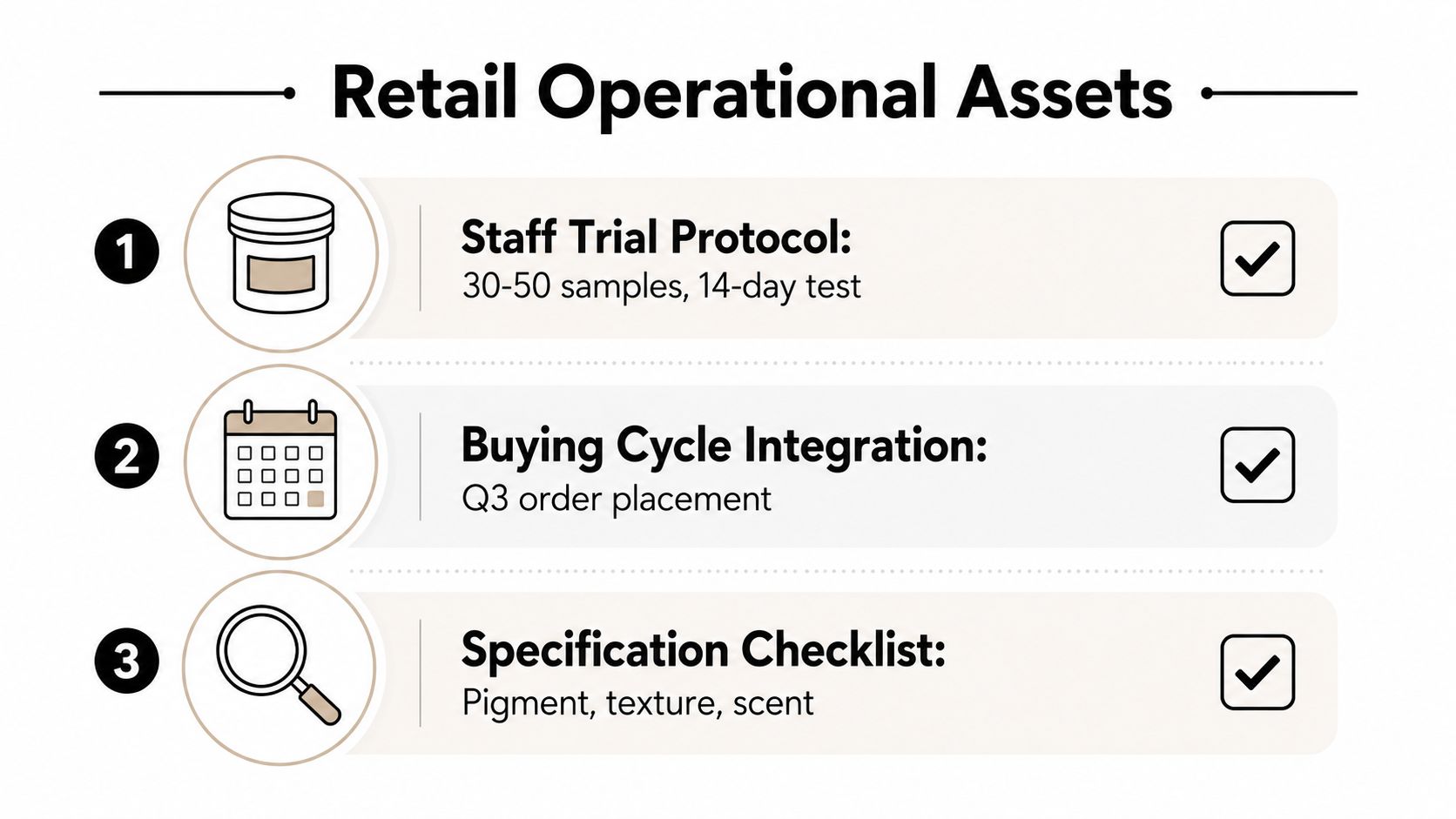
Sampling is where most tinted lip balm launches get serious, or die. You do not need a giant trial. You need a controlled one. Order 30 to 50 small samples per shade, run a 14-day staff trial at the pharmacy counter or spa reception, and score pigment pay-off, wear, and flavour on the same sheet so the feedback is comparable.
Use staff like buyers, not influencers
The sample test should be practical. Ask staff to wear the product during a normal shift, reapply it as they would on a customer recommendation, and note whether the balm stays comfortable in dry indoor air. If the product pills, feels gritty, or turns the lips chalky, the problem will show up fast.
Spa retail needs a different script. Put tinted balm on the bedside tray as part of aftercare, and train therapists to offer two shades per service, a nude for daytime and a rose for evening. That makes the product feel like an extension of the treatment, not an extra upsell.
Make the buying brief copy-paste ready
If you want the product to survive procurement, ask for the following before approval:
- Shade range with CI numbers: Every shade should be traceable back to its approved colour ingredients.
- MOSH/MOAH declaration: Confirm contaminant control on lip-contact materials.
- SPF claim justification: Only if the product really carries an approved filter system.
- Packaging recyclability: State the material and the refill logic, if any.
- Minimum shelf life on arrival: Request at least 75% remaining shelf life at receipt.
- Carton dimensions: Check planogram fit before listing.
- MOQ and lead time: Avoid surprises on launch timing.
- Target wholesale price: Lock this before the first order, not after the sample round.
Use this category the way a serious Swiss buyer should. Keep the range tight, the compliance file clean, and the shelf story honest. If you want help turning a clean-beauty lip brief into a sell-through plan for Swiss retail, pharmacies, or spa doors, visit beautysecrets.agency and brief the team on the channel, price tier, and certification standard you need. They work with Swiss partners on curated natural assortments, so the conversation starts from procurement reality, not guesswork.