Most buying advice starts with features: heat, kneading nodes, cordless operation, and intensity settings. Swiss pharmacy and spa buyers should start somewhere less comfortable. A neck and shoulder massager usually offers relief, not a complete answer to recurring neck pain. Stocking it as a cure risks disappointing customers. Positioning it as one practical component of a broader wellness routine is more accurate, easier to explain, and commercially stronger.
The category itself is established in Switzerland. Swiss marketplaces carry neck and shoulder massagers from accessible consumer devices to premium wellness products, with listed examples priced at CHF 28.50, CHF 89.00, and CHF 199.00 across a major Swiss retail category. That range gives buyers room to build a considered assortment, but only if the product promise matches the customer's actual problem.
Why Neck Pain Demands More Than a Gadget
A neck massager is not a prevention strategy. For Swiss pharmacy and spa buyers, that distinction should shape the product claim, staff briefing, and shelf position. A device may ease tight muscles for a limited time, but it does not correct screen height, chair position, movement habits, workload, or the repeated posture behind the discomfort.
Swiss workplace evidence gives this issue commercial weight. A ZHAW-linked study reports that 68% of Swiss office workers experience neck pain at least one day per year in research published through the Swiss Journal of Work, Environment & Health. The same research found that a 12-week multi-component intervention reduced neck-pain frequency by 1.55 days and disability by 2.23 percentage points. For buyers, the message is clear: a massager fits best beside workplace adjustments and exercises, not as a passive replacement for them.

Relief has a role, but it needs honest positioning
Massagers still have a credible place in the range. Customers want an accessible ritual after work, during travel, or at home. A heated Shiatsu device can support relaxation and temporarily reduce the sensation of muscular tightness. That benefit matters when the product is comfortable, simple to operate, and easy to use regularly.
The risk starts with a promise that the device treats the cause of persistent pain. Pharmacy staff should first establish whether the customer wants relaxation, occasional muscular comfort, or help with a recurring symptom. Those needs require different recommendations and different safety conversations.
Practical rule: Sell the device as a recovery aid and comfort tool, not as a substitute for ergonomic assessment, movement, or clinical advice.
For customer education, a guide to broader neck pain relief approaches can sit alongside product information. Keep the in-store explanation concise: adjust the workstation, take movement breaks, consider exercises, and stop using the device if symptoms worsen or spread.
What trade buyers should conclude
The strongest Swiss positioning is “this device supports a practical routine for tension and relaxation.” That wording respects the workplace evidence and gives staff a credible answer when relief keeps returning.
For a pharmacy or spa, build the retail story around use, not cure. Pair the massager with ergonomic guidance, movement products, or a consultation prompt. Customers receive a tangible wellness product, while the retailer shows it understands the difference between temporary relief and responsible wellbeing.
How Neck and Shoulder Massagers Actually Work
A neck and shoulder massager can look simple from the outside, but the mechanism determines the experience. Trade buyers should identify the primary action first, then assess heat, pressure control, fit, and safety features. Marketing terms matter less than what the motor, contact surface, and controls do.
Shiatsu-style kneading
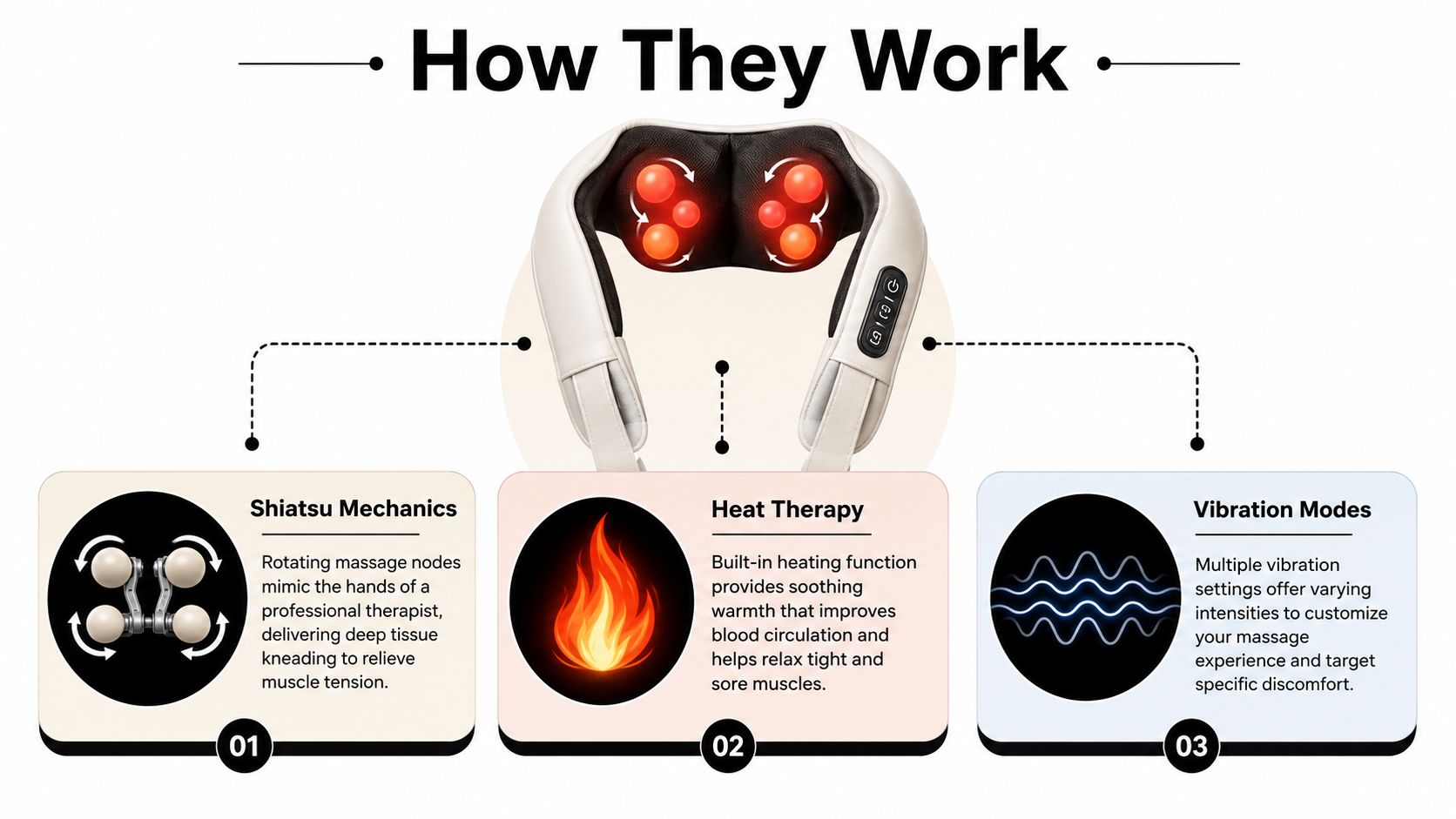
Shiatsu-style devices use rotating nodes that press and move against the muscles. Think of them as mechanical thumbs following a repeated circular path. A wrap format places those nodes around the upper shoulders, while a pillow format depends on the user leaning into the device to control pressure.
This format suits customers who want a passive, hands-free session across a broad area. Its limitation is positioning. A wrap may cover the trapezius effectively but won't necessarily reach a very specific point, and a pillow gives more control only if the customer is willing to adjust it.
Heat as preparation and comfort
Heat adds warmth to the contact area while the massage mechanism operates. It doesn't transform the device into a medical treatment, but it can make the experience feel gentler and more relaxing. Buyers should distinguish between integrated heat and a small warm patch concentrated near the motor housing.
Ask suppliers how evenly the heat spreads, how the user controls it, and whether the heat operates independently from the massage function. A customer who prefers warmth without kneading may value separate controls more than additional intensity settings.
Vibration and electrical stimulation
Vibration uses rapid oscillation rather than rotating kneading nodes. It generally feels lighter and more diffuse, making it relevant for customers who dislike strong pressure. Electrical muscle stimulation is a separate mechanism, using electrical impulses through contact pads rather than mechanical movement. Don't describe electrical stimulation as massage, and don't place it in the same product explanation without clearly identifying the difference.
Percussion tools also belong in a separate category. Their impact-based action may suit larger muscle groups, but a neck-focused product should never be explained as though every high-intensity tool is interchangeable. Staff need to know where the manufacturer permits use and where it doesn't.
For a neutral explanation of device categories and selection considerations, buyers can review this guide to top massagers for neck pain. It can help staff compare product formats without reducing the conversation to heat versus no heat.
The simplest staff script is effective: kneading imitates repeated manual pressure, heat adds warmth, vibration creates a different sensory input, and electrical stimulation is not the same as mechanical massage. Once that distinction is clear, customers can choose based on comfort, intended use, and tolerance rather than a crowded feature list.
Swiss Market Price Tiers and Feature Expectations
Swiss buyers should treat price as a positioning signal, not proof of therapeutic value. The category spans more than seven times, from the listed CHF 28.50 entry example to the CHF 199.00 premium example shown in Swiss marketplace listings. The gap reflects design, materials, controls, fit, brand presentation, and retail expectations. It does not show that the higher-priced device will relieve neck pain more effectively.
| Tier | Price Range (CHF) | Key Features | Target Customer |
|---|---|---|---|
| Entry | Around CHF 28.50 | Basic mechanical massage, simple controls, compact consumer format | First-time buyer seeking occasional relaxation |
| Mid-range | Around CHF 89.00 | Heated massage, broader contact area, more considered ergonomics and controls | Regular home user, office worker, wellness customer |
| Premium | Around CHF 199.00 | Higher-end construction, stronger brand presentation, refined fit and recovery positioning | Premium pharmacy buyer, gift customer, spa or wellness client |
Entry level should be easy to understand
The entry tier suits a customer making a low-commitment purchase. Staff should describe basic massage, straightforward operation, and the lower price without implying treatment for chronic pain or clinical recovery.
This tier gives pharmacies a clear category entry point and a useful price anchor. The packaging must state what the device does and does not do. Confusing instructions create avoidable returns, even when the product itself is simple.
Mid-range is the commercial centre
The heated massage cushion listed at CHF 89.00 sits in a practical position for many retailers. Heat and massage are familiar category features, so customers expect them to function together rather than appear as decorative additions.
The mid-range tier represents the strongest volume candidate for a general pharmacy or wellness retailer. Select models with comfortable shoulder coverage, intuitive controls, automatic shutoff, and surfaces that can be wiped clean. Product presentation should explain intended use without turning temporary relief into a medical promise.
For a buyer, ergonomics matter more than a long feature list. A device that sits securely on the shoulders and can be operated without repeated adjustments is easier to recommend and less likely to disappoint.
Premium needs a reason to exist
The premium example at CHF 199.00 must justify its price through a visibly better fit, finish, support package, user experience, or brand environment. If staff cannot explain the difference in one clear conversation, the unit is just a more expensive mid-range product.
Premium pharmacies and spas can use this tier for gifting and curated wellness merchandising. Discount-led retailers face greater stock risk if the added comfort or presentation is not obvious. Match the purchase to the customer segment, and present the device as support for relaxation or temporary relief alongside ergonomic changes, not as a solution to the underlying cause of neck pain.
Safety Standards and Compliance for Swiss Buyers
Safety is not a footnote for a neck and shoulder massager. The device operates near sensitive anatomy, often includes heat, and may be purchased by older customers or people living with recurring pain. Swiss buyers need documentation they can verify, not a vague badge copied into an online listing.
Swiss regulatory context matters because medical devices are governed by MedDO, and product classification affects the obligations placed on manufacturers, importers, and distributors. A consumer wellness device and a product making medical claims shouldn't be treated as identical stock. Before listing a product, establish what the supplier says the device is, what claims the packaging makes, and which conformity documents support those claims.
Verify the signals buyers can see
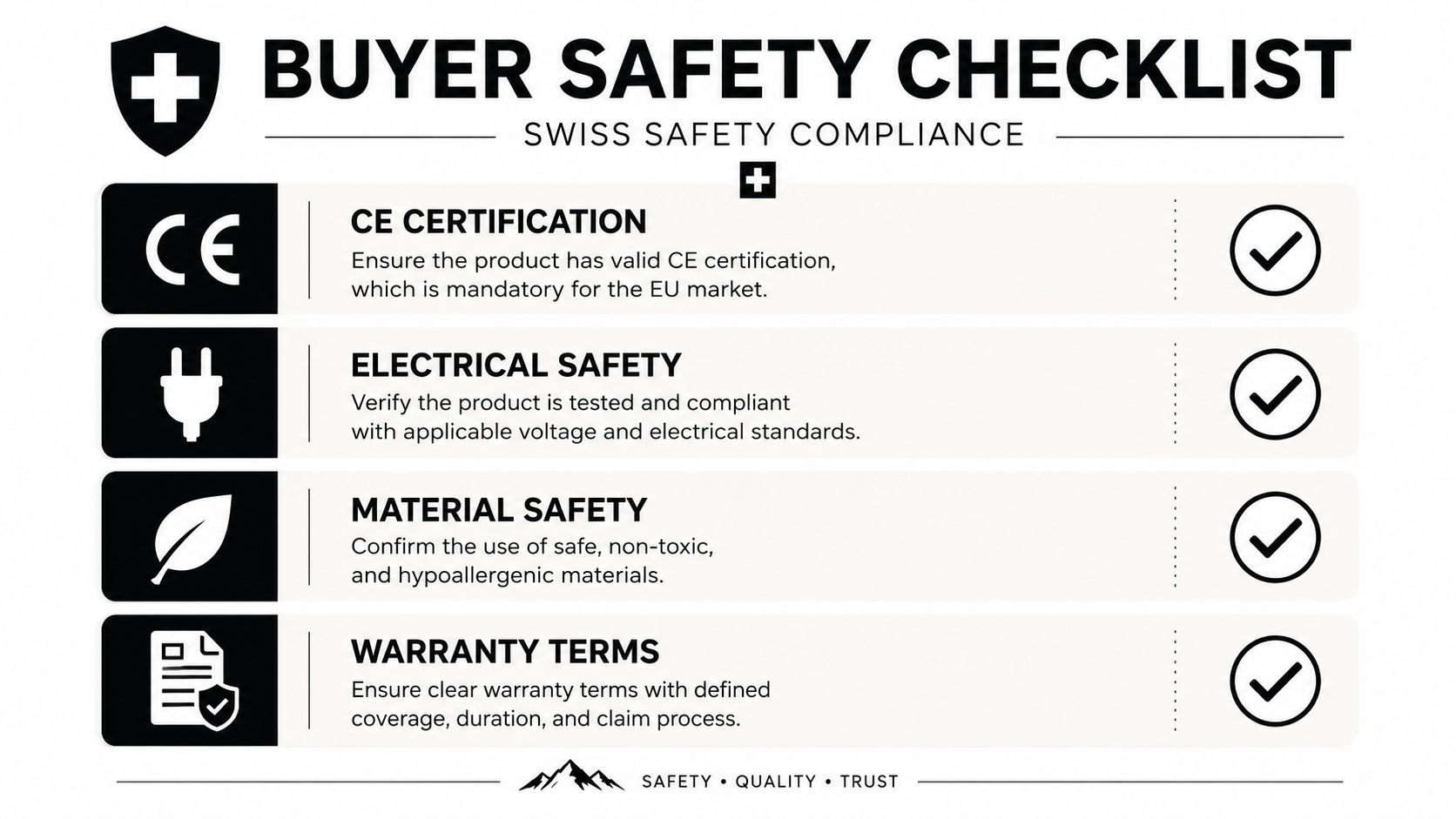
Independent Swiss retail listings show that some neck massagers are marketed as CE-certified and equipped with automatic shutoff, which confirms that conformity marking and timed operation are active purchase concerns in the Swiss market as illustrated by a Swiss retail listing. A CE mark alone isn't a substitute for a supplier file, however. Request the declaration of conformity, technical documentation appropriate to the product, electrical safety information, and clear instructions in the languages relevant to your sales channel.
Check these points before purchase:
- Conformity documentation: Ask for current documents that match the exact model, not a similar device from the same factory.
- Automatic shutoff: Confirm how the timer operates and whether heat and massage stop together.
- Electrical information: Verify the intended voltage, plug arrangement, charging method, and instructions for damaged cables or adapters.
- Materials and cleaning: Confirm which surfaces tolerate wiping and whether covers can be removed without exposing electrical components.
- Warnings and contraindications: Ensure the manual explains unsuitable use, heat sensitivity, pregnancy-related questions, implanted devices where relevant, and when customers should seek medical advice.
Match claims to evidence
A pharmacy buyer should be especially strict with phrases such as “treats chronic pain”, “improves circulation”, or “medical-grade”. Those claims may alter the product's regulatory position and create expectations that a comfort device can't satisfy. Retail copy should describe operation, intended comfort use, controls, and safety instructions unless the supplier provides an appropriate basis for stronger claims.
Train staff to refer customers with recent injury, unexplained severe pain, neurological symptoms, or persistent worsening symptoms to a qualified healthcare professional. A massager shouldn't delay assessment.
Compliance check: If the supplier can't explain the product classification and provide model-specific conformity information, don't make the device a featured recommendation.
Merchandising Strategies for Retail and Spa Partners
A neck and shoulder massager sells better when customers can understand its place in a routine. Put a device beside a promise such as “evening shoulder reset” or “desk-break comfort”, not beside a wall of unrelated electronics. The customer should immediately see who the product serves, how it feels, and what complementary habit belongs with it.
In a pharmacy, create a small wellness zone with the device, a concise ergonomic prompt, and an explanation of heat, kneading, and timed use. In a spa, place the product near treatment-related retail and describe it as a home continuation of relaxation, not as a replacement for professional care. E-commerce pages should lead with use case and fit before listing motor specifications.
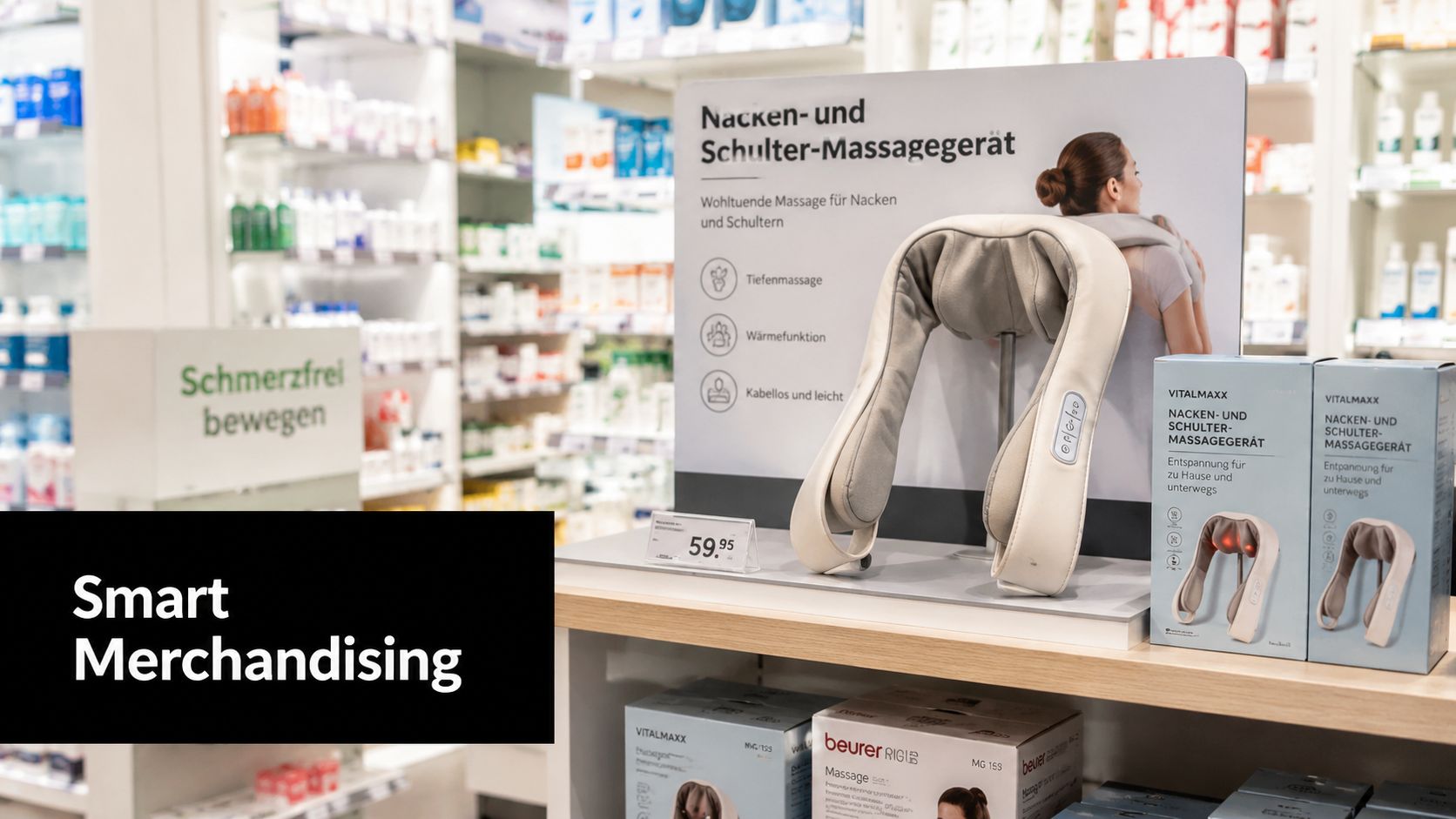
Build the shelf around decisions
Use three questions to organise the assortment:
- What does the customer want to feel? Warmth, kneading, gentle vibration, or a more active tool.
- Where will they use it? Sofa, office, treatment room, travel bag, or home relaxation area.
- What level of guidance do they need? A simple comfort purchase needs clear instructions, while a pain-related purchase needs stronger boundaries and referral advice.
Demonstration matters, but hygiene and consent come first. Use a cleanable demo surface, follow the supplier's cleaning instructions, avoid demonstrations on the front or side of the neck, and let customers control the intensity. A staff member should explain the automatic shutoff and stop the demonstration immediately if the experience feels sharp, dizzying, or uncomfortable.
Merchandising should reinforce the broader plan
Cross-sell with ergonomic accessories, relaxation products, or a spa ritual that doesn't imply medical treatment. A warm compress, gentle body-care product, or guided movement resource can support the same evening routine. For natural wellness retailers, beautysecrets.agency can sit within that broader ecosystem through its distribution of natural cosmetics and body-care lines, including products suited to ritual-led retail. Mention it as a complementary assortment option, not as evidence that a massager treats pain.
For online listings, use a repeatable structure: intended user, massage mechanism, heat function, fit, controls, cleaning, shutoff, contraindications, warranty, and a clear statement that recurring pain may need professional assessment. That format converts better than a dense feature block because it answers the buyer's actual questions.
Maintenance, Warranty, and Long-Term Support
A retailer's responsibility doesn't end at the till. Neck and shoulder massagers contain motors, heating components, fabric or synthetic covers, buttons, cables, and rechargeable batteries. Each part creates a potential return reason, particularly when customers expect a premium product to perform like professional equipment.
Set a supplier standard before stocking
Request the warranty terms, returns process, spare-parts position, and repair route before placing an order. Confirm whether the supplier handles assessment directly, whether the retailer must hold defective stock, and which faults qualify for replacement. A vague “manufacturer warranty” is not enough for a pharmacy or spa that needs predictable customer service.
Use this purchasing checklist:
- Test the controls: Check that heat, massage, direction, intensity, and shutoff operate as described.
- Inspect the fit: Place the device on different body shapes and check whether the nodes sit on the shoulders rather than pressing uncomfortably near the spine.
- Examine the finish: Look for loose stitching, exposed seams, unstable wiring, or surfaces that trap oils and perspiration.
- Read the manual: Make sure instructions are clear, warnings are visible, and cleaning guidance is practical.
- Record the batch information: Keep model and lot details with purchasing records so defects can be traced efficiently.
Cleaning is part of the product experience
Home users should wipe external contact surfaces according to the manufacturer's instructions and keep liquids away from motors, controls, charging ports, and power connections. Spa operators need a stricter routine because different customers may use the same demonstration or treatment stock. Select devices with surfaces that tolerate the cleaning products approved for the setting, and don't assume a removable cover is washable unless the manual confirms it.
Batteries and cables also deserve attention. Store cordless products with appropriate charge levels according to supplier guidance, inspect charging accessories regularly, and remove damaged units from sale immediately. Never allow staff to improvise repairs on electrical wellness devices.
Protect the customer relationship
When a customer reports soreness, ask how they used the device, which area they targeted, and whether they followed the instructions. Don't diagnose. If the symptom is severe, persistent, radiating, or associated with injury, direct the customer towards qualified medical advice and handle the product issue separately.
Premium pricing raises expectations for support. If the device costs more, customers expect better documentation, a clear contact route, and a retailer that can explain the controls confidently.
Building a Differentiated Massager Assortment
A strong Swiss assortment doesn't need every format. It needs a clear answer for each customer group and a compliance file behind every recommendation. Too many similar heated wraps create choice fatigue, while one low-cost device leaves premium customers without a credible option.
Use a practical buying matrix
| Customer need | Recommended position | Features to prioritise | Retail message |
|---|---|---|---|
| Occasional relaxation | Entry | Simple massage, clear controls, basic safety functions | Affordable comfort at home |
| Regular desk-related tension | Mid-range | Heat, comfortable coverage, adjustable operation, automatic shutoff | Part of an evening or workday recovery routine |
| Premium gifting or wellness retail | Premium | Fit, finish, documentation, presentation, after-sales support | A considered wellness product, not a novelty gadget |
| Spa demonstration or professional environment | Selected mid-range or premium | Cleanable surfaces, reliable operation, supplier support | Guided relaxation and home-care continuation |
Curate by trust, not by feature count
Swiss consumer testing has treated neck massagers as a mature wellness segment for years. SRF's consumer programme conducted a practical test in 2019, while Swiss retailers continued listing multiple neck and shoulder devices in 2025 and 2026, indicating an established category across at least a seven-year span in the SRF report and the Swiss retail context. That maturity means buyers should expect customers to compare prices, functions, safety claims, and brand credibility.
Choose one accessible product, one dependable heated model, and a premium option only if your staff can explain the distinction. Merchandise each beside honest guidance about ergonomic changes and responsible use. The commercial advantage comes from helping customers choose correctly, not from implying that a more powerful motor resolves every kind of neck pain.
The winning assortment is the one your staff can recommend responsibly in a short conversation.
Review your range now. Remove products with weak documentation or unclear cleaning instructions, test the fit and controls of remaining models, and rewrite product pages around customer use cases. Keep the device promise narrow, useful, and credible.
beautysecrets.agency supports Swiss pharmacies, spas, wellness retailers, and e-commerce partners with thoughtfully selected natural and premium beauty assortments that can complement a responsible neck and shoulder wellness offer. Visit beautysecrets.agency to discuss a differentiated product range built around compliance, clear customer guidance, and ritual-led wellbeing.