A customer stands at the pharmacy counter with two problems that often arrive together: persistent facial redness and dark marks left after breakouts. The usual rosacea conversation turns to metronidazole or ivermectin, while acne advice may point towards benzoyl peroxide or a retinoid. Then the customer asks about azelaic acid cream, and the buying team has to decide whether this is a passing skincare trend or a credible addition to the dermo-cosmetic shelf.
For Swiss pharmacies, the answer depends on more than ingredient popularity. Formulation, concentration, tolerability, labelling, off-label use and staff counselling determine whether the product earns repeat sales or becomes another poorly understood tube. This guide treats azelaic acid as a category decision, with particular attention to rosacea in Switzerland, vehicle selection, realistic treatment timing and merchandising that supports responsible recommendations.
Why Azelaic Acid Cream Matters on the Swiss Pharmacy Shelf
Azelaic acid occupies a useful space between medical treatment and everyday skin care. It can address inflammatory blemishes, redness-prone skin and uneven pigmentation without forcing every customer towards a highly aggressive routine. That versatility matters in Swiss pharmacy retail, where one consultation may involve acne, sensitive skin, post-inflammatory marks and uncertainty about whether a product is cosmetic or medicinal.
The local rosacea position requires careful language. Swiss dermatology literature describes azelaic acid as guideline-recommended for rosacea, while also noting that it has been used off-label in Switzerland because the local indication is acne rather than rosacea. The Swiss review of topical rosacea treatment is therefore particularly relevant for category managers. It supports a shelf strategy based on informed counselling, not on implying that every azelaic acid cream is an authorised rosacea medicine.
The category gap
Azelaic acid also fills practical gaps left by familiar actives. Benzoyl peroxide can be too drying for customers already struggling with a compromised barrier, particularly during cold, dry periods. Retinoids may be poorly tolerated by rosacea-prone or reactive skin. Hydroquinone raises a separate regulatory and positioning issue because it isn't a straightforward cosmetic brightening ingredient for Swiss shelves.
That doesn't make azelaic acid universally gentle. Stinging and dryness remain realistic concerns, and a high-strength formula can fail if the customer applies it too often or combines it with several other irritants. The commercial opportunity lies in matching the right vehicle and counselling promise to the shopper, rather than presenting the ingredient as a rapid spot treatment.
Practical rule: Stock azelaic acid where staff can explain its role. A product that needs concentration, vehicle and off-label clarification shouldn't be hidden in an unstaffed anti-ageing bay.
A strong range should help the pharmacist answer four questions quickly:
- What is the customer treating? Acne, papulopustular rosacea, redness, post-inflammatory marks or broader pigmentation concerns require different conversations.
- What strength and vehicle fit the skin? A cream may suit dryness, while a gel can feel more appropriate for an oilier or rosacea-focused routine.
- What can the label support? Staff must distinguish authorised indications from professional off-label counselling.
- Can the customer use it consistently? Azelaic acid earns its place through adherence, not an overnight claim.
What Azelaic Acid Is and How It Works on the Skin
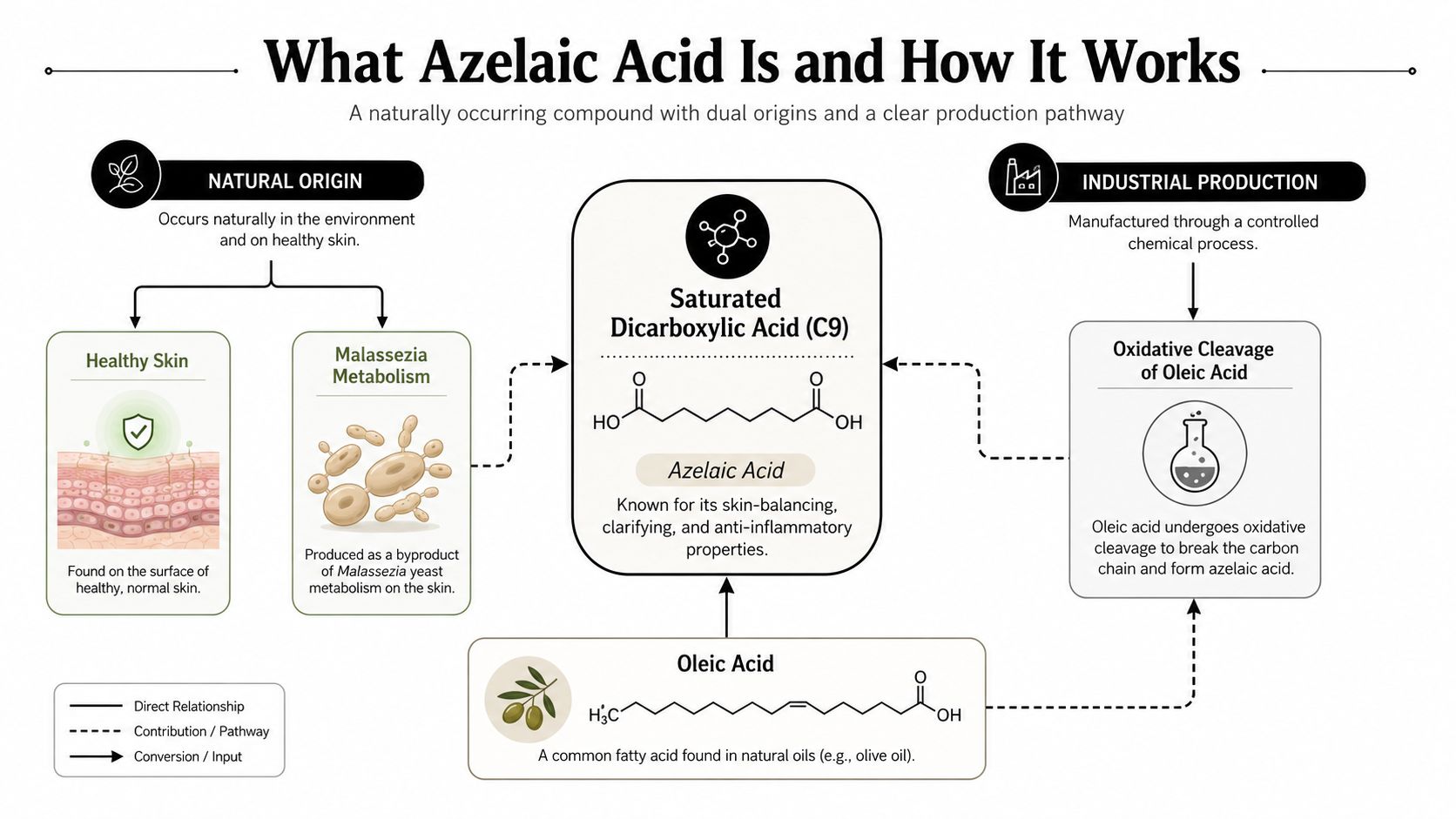
A customer presents with recurring blemishes, lingering marks, or facial redness and expects a quick spot treatment. Azelaic acid cream requires a more accurate explanation. Azelaic acid is a saturated dicarboxylic acid, a naturally occurring skin-related molecule that can also be produced industrially. Its value on a Swiss pharmacy shelf comes from several complementary actions, not from one exfoliating effect.
Four actions buyers should understand
Azelaic acid helps normalise excess cell build-up inside the follicle. That action can reduce the tendency toward congestion in acne-prone skin, giving staff a clearer explanation than calling the cream a simple exfoliant.
Its tyrosinase-inhibiting activity affects the pathway involved in melanin formation. This makes it relevant to post-inflammatory hyperpigmentation and melasma, while supporting a more measured tone-correction position than a harsh bleaching claim.
Azelaic acid also has antimicrobial activity relevant to organisms associated with acne and inflammatory skin conditions. Staff should describe this carefully. The ingredient is not being presented as a topical antibiotic, and the distinction matters for both counselling and product claims.
A further role is anti-inflammatory function. Dermatology explanations commonly discuss effects on inflammatory signalling, including the kallikrein and cathelicidin pathway. In practical terms, azelaic acid can help moderate an overreactive inflammatory response, which explains its continued relevance to redness and papulopustular rosacea.
Why the slow start matters commercially
Customers should expect a gradual treatment pattern rather than an emergency dab for the newest blemish. Clinical and market-facing references commonly place meaningful use within an 8 to 12 week window the evidence-based clinical update on azelaic acid, although tolerance and visible change may begin sooner.
That timing influences pharmacy merchandising and counselling. Regular application supports a more credible repurchase cycle, while an instant-redness promise can lead to abandonment after only a few uses. The product should therefore be positioned around consistent treatment of a defined concern, with the cream, strength, and authorised or off-label context explained at the counter.
Azelaic acid works best as a field treatment for a defined skin concern, not as an emergency dab applied only to the newest blemish.
Clinical Indications from Acne to Rosacea to Hyperpigmentation
Swiss counter teams usually encounter three main use cases. Each deserves a different recommendation and a different explanation of what success looks like.
Acne
For acne, the familiar benchmark is 20% azelaic acid cream. The ingredient combines follicular normalisation, antimicrobial activity and inflammation control, which gives it a useful role when the customer wants an alternative to more drying or irritating acne actives.
The late-1990s clinical record already provides a Swiss-relevant foundation. A multicentre randomised double-blind study included 116 patients with papulopustular rosacea, used 20% azelaic acid cream twice daily for 3 months, and reported a 73.4% mean reduction in total inflammatory lesions. The Acta Dermato-Venereologica study demonstrates that azelaic-acid-based treatment had measurable dermatologic evidence by the late 1990s.
Rosacea
Rosacea requires the most careful Swiss wording. Azelaic acid is clinically respected for inflammatory lesions and erythema, but the Swiss indication and local product status must be checked before staff describe a product as a standard authorised rosacea treatment. Off-label counselling can be appropriate within a pharmacist and dermatologist relationship, but cosmetic packaging shouldn't imply prescription equivalence.
A 2023 systematic review found azelaic acid outperformed vehicle across 20 rosacea studies. In two vehicle-controlled trials involving 329 and 335 participants, inflammatory lesions fell by 58% and 51% at 12 weeks. The systematic review indexed by PubMed also reported maintained remission in 75% of patients during an additional 24 weeks in one study. These findings justify informed shelf space, while still requiring staff to distinguish inflammatory bumps from other causes of facial redness.
Pigmentation and post-inflammatory marks
Azelaic acid suits customers whose dark marks follow acne or inflammation, especially when a stronger lightening approach would be inappropriate. A recent review describes its use in acne, rosacea, melasma and post-inflammatory hyperpigmentation. It also reports that 20% azelaic acid cream showed comparable efficacy to 2% hydroquinone for hyperpigmentation over 24 weeks in one comparison, with mild local irritation. The 2024 pharmacological review is useful when buyers need to explain why pigmentation claims should remain measured.
| Indication | Concentration / vehicle | Comparator | Trial duration | Key outcome |
|---|---|---|---|---|
| Papulopustular rosacea | 20% cream, twice daily | Clinical treatment setting | 3 months | 73.4% mean reduction in total inflammatory lesions in 116 patients |
| Rosacea | Azelaic acid formulations | Vehicle | 12 weeks | Inflammatory lesions fell by 58% and 51% in two trials with 329 and 335 participants |
| Pigmentation | 20% cream | 2% hydroquinone | 24 weeks | Comparable efficacy in one hyperpigmentation comparison, with mild local irritation |
Concentrations, Vehicles, and Swiss Regulatory Status
Concentration is only half the buying decision. The vehicle determines how the formula spreads, how occlusive it feels and whether customers will continue using it through a Swiss winter.
A 15% gel is commonly associated with rosacea-focused treatment, while a 20% cream is commonly associated with acne. Swiss retail listings also show 15% cream products marketed for once- or twice-daily facial application over at least 4 to 8 weeks, with positioning around redness and post-acne marks. Those market conventions are useful for assortment planning, but they aren't a substitute for checking the individual product's Swiss status and label.
Cream, gel and foam
Creams generally offer a more emollient experience and can be easier to accept on dry or sensitive skin. Their richer base may improve comfort, though some acne shoppers may dislike occlusion or a heavier finish.
Gels tend to feel lighter and can suit customers who prefer quick absorption or a less creamy texture. They may sting more noticeably on a compromised barrier, so “lightweight” shouldn't be treated as synonymous with “better tolerated”.
Foams can provide an elegant spread across larger facial areas, but they require careful packaging and use instructions. For a pharmacy shelf, the key question isn't which vehicle is most fashionable. It's whether the format supports the intended use and the customer's willingness to apply it consistently.
The Swiss status conversation
Higher-strength azelaic acid products may fall within medicinal product rules, while lower-strength products can sit in the cosmetic or borderline space. Prescription acne preparations, including Skinoren-class references, must be assessed according to the actual product authorisation and dispensing requirements. Imported cosmetic serums can create a grey zone when their concentration, claims or documentation don't align neatly with Swiss expectations.
| Concentration | Vehicle | Typical use | Swiss status, typical |
|---|---|---|---|
| Around 10% or lower | Cream, serum, suspension | Cosmetic acne, redness or mark support | Often cosmetic, subject to product claims and documentation |
| 15% | Gel or cream | Rosacea-focused or acne-oriented counselling | May be medicinal or cosmetic depending on the specific product |
| 20% | Cream | Acne and professional dermatology use | Frequently associated with medicinal products and prescription access |
For category managers, packaging and base deserve as much scrutiny as the front label. Review the INCI list, pH information, preservative system, tube or pump format, directions, claims and Swiss documentation. A technically strong formula can still underperform if the tube dispenses too much product, pills under moisturiser or leaves an unpleasant residue.
Building a Routine That Includes Azelaic Acid Cream
Azelaic acid is flexible, but flexibility can tempt customers to stack every active at once. Staff should give a simple order and a slower introduction.
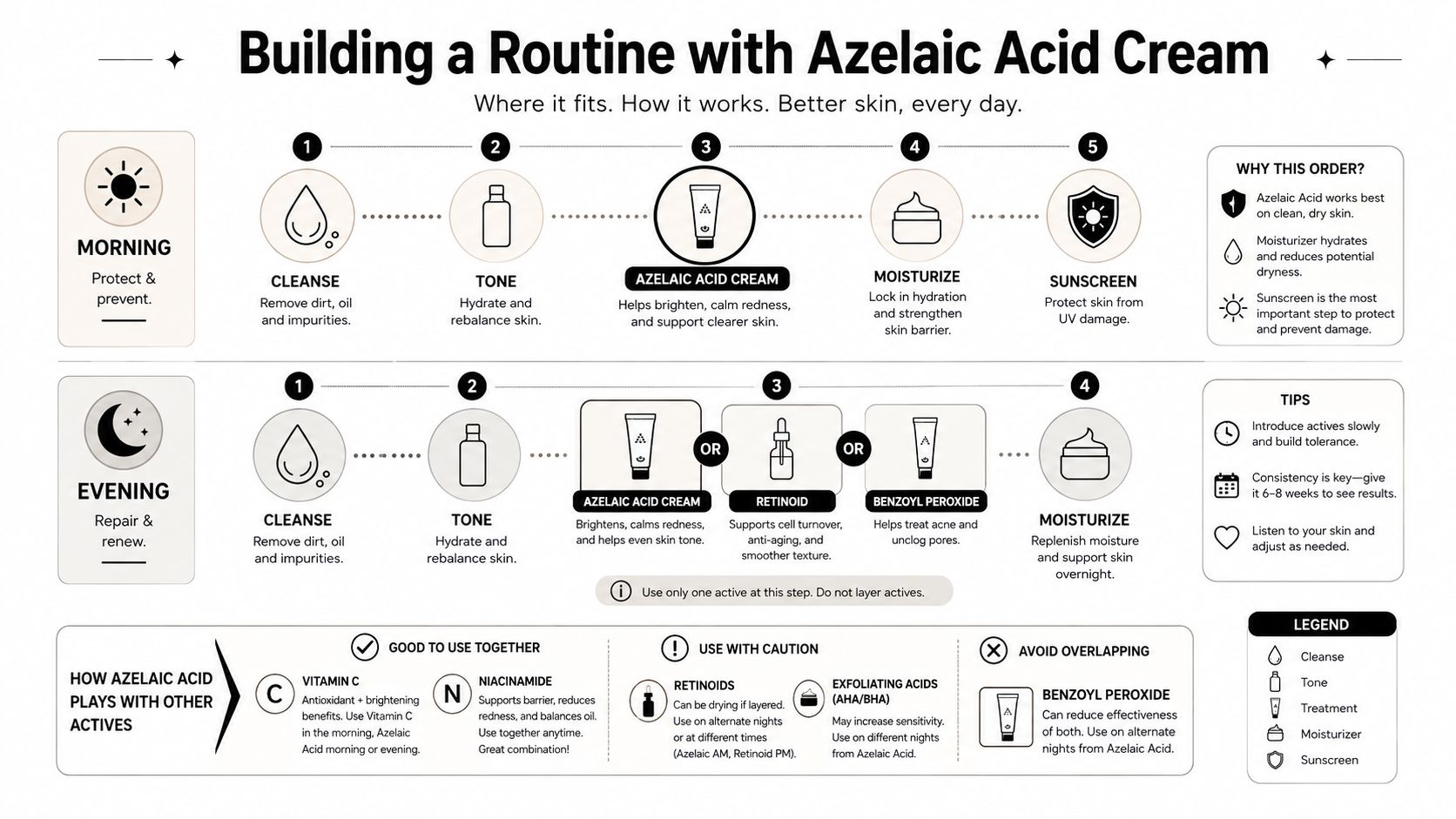
The basic sequence is:
- Cleanse with a non-stripping product.
- Tone, if the customer already uses a well-tolerated toner.
- Apply the active, using a thin, even layer of azelaic acid.
- Moisturise to support comfort.
- Finish with sunscreen in the morning.
Vitamin C and niacinamide can sit in the same broader routine, but the customer doesn't need to introduce them together. The safer retail recommendation is to keep the first routine simple, then add compatible products only after the skin has demonstrated tolerance.
A practical introduction plan
During the first two weeks, recommend application on alternate evenings. If the skin remains comfortable, move towards nightly use. A morning application can be added later, particularly when the customer needs broader support for redness or pigmentation and the product label allows that frequency.
Customers already using a retinoid, benzoyl peroxide or a strong AHA or BHA should avoid treating every evening as an active night. Separate potentially irritating products by time of day or alternate them across evenings. Applying azelaic acid after a moisturiser can also buffer the initial feel for reactive skin, although customers should follow the product directions and professional advice.
Simple routine templates
Morning: cleanse, optional niacinamide or vitamin C, azelaic acid if tolerated, moisturiser, sunscreen.
Evening: cleanse, azelaic acid on selected nights, moisturiser. On alternative evenings, use the retinoid or benzoyl peroxide rather than layering it automatically with azelaic acid.
Safety, Side Effects, and Patient Counselling
At the counter, the main counselling issue is usually irritation rather than expected benefit. Customers may notice temporary stinging, dryness or mild peeling during the adjustment period. Reducing application frequency and simplifying the rest of the routine can improve comfort. Persistent burning, swelling or a spreading rash requires stopping the product and reassessing the situation.
What staff should say at the counter
- Set the time horizon: Azelaic acid cream requires consistent use, not occasional spot treatment. A visible response commonly takes an 8 to 12 week course, as noted earlier in the clinical evidence discussion.
- Start with a thin layer: Applying more product does not improve tolerance. A thin, even film limits local overloading and makes regular use easier.
- Protect the result: Daily sunscreen is sensible for customers addressing pigmentation or redness. Environmental exposure can work against a more even tone.
- Keep the rest calm: Pause abrasive scrubs, strong peeling products and unnecessary active combinations while the skin is adapting. This reduces confusion about which product is causing irritation.
- Avoid sensitive sites: Keep the cream away from the eyes and mucous membranes, and follow the individual product label.
A short-lived tingling sensation can be acceptable during introduction. Pain, swelling, blistering, intense itching or spreading redness is not.
Pregnancy and lactation call for an individual professional discussion rather than a blanket assurance. Azelaic acid is generally regarded as a compatible topical option, although available data remain limited. A pharmacist can review the customer's treatment goal, current products and relevant risk-benefit considerations. Refer to a clinician when the situation is uncertain, the customer has additional medical concerns or the product is being considered outside its labelled indication.
When to refer
Refer customers with sudden or severe facial redness, eye symptoms, marked swelling, painful nodules, suspected infection or a rash that differs from their usual acne or rosacea pattern. Dermatological assessment is also appropriate when the diagnosis is unclear. Redness may reflect rosacea, dermatitis, allergy or another condition, and azelaic acid should not delay that assessment.
Ask about reactions to the complete formula, not only to azelaic acid. Excipients, including propylene glycol where relevant, can contribute to intolerance. The full ingredient list, product leaflet and labelled directions should guide the discussion.
For Swiss pharmacy teams, the practical boundary is clear. Mild, brief tingling can be monitored during introduction. Escalating discomfort or visible inflammation calls for discontinuation and medical advice, particularly where use is off-label or the customer cannot distinguish expected irritation from a skin reaction.
Claims, Sustainability, and the Clean-Beauty Question
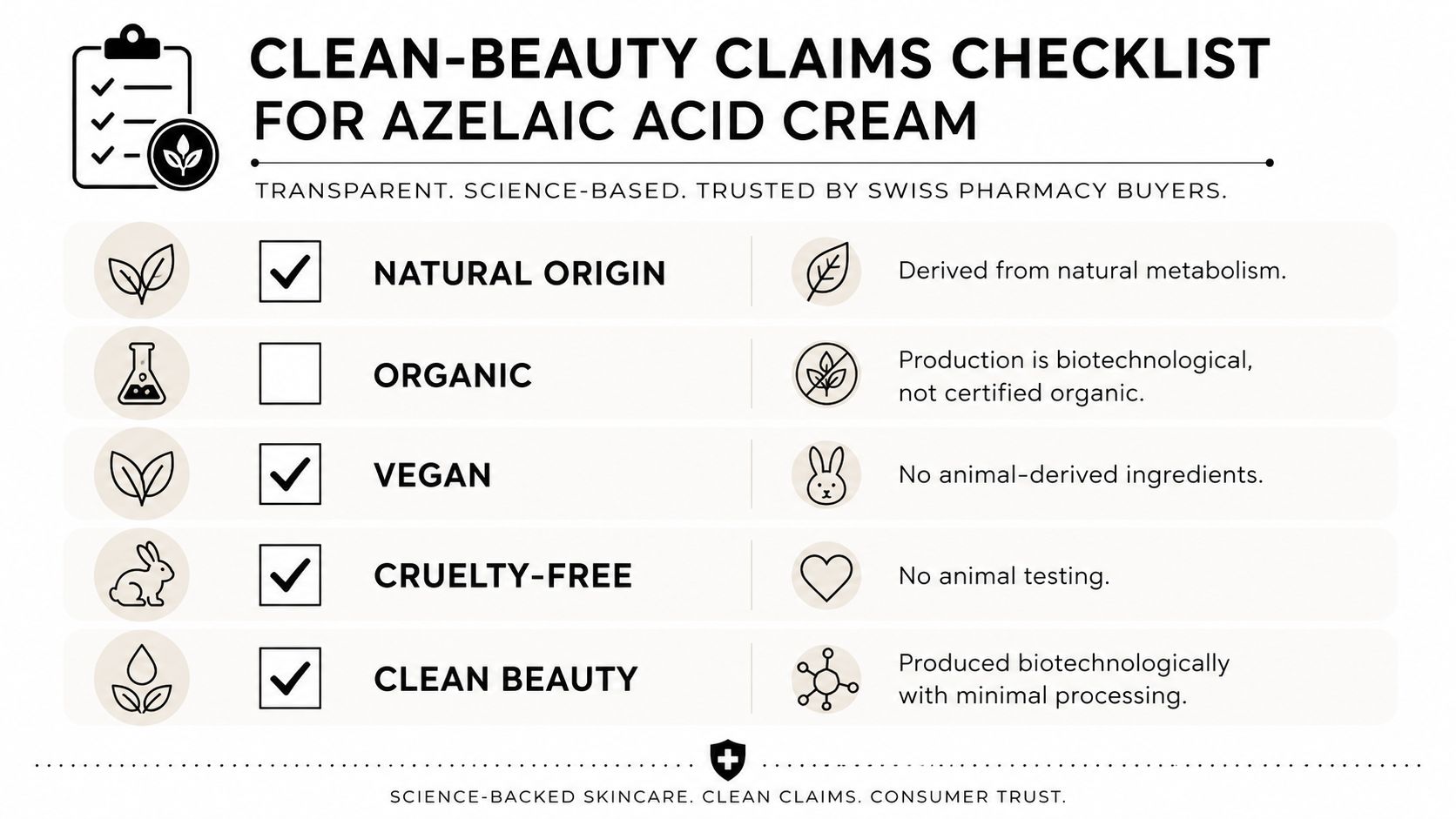
Azelaic acid creates a marketing trap because “natural” can refer to different things. The molecule may be associated with natural skin biology or produced through a biotechnological pathway, but that doesn't automatically make a finished cream natural, organic, vegan or clean-certified.
Industrial production may use oxidative cleavage of oleic acid or biotechnology linked to microbial metabolism. Those routes describe manufacture, not a complete certification claim. A formula can contain a nature-identical or bio-derived active and still include synthetic excipients, conventional preservatives or packaging that doesn't meet a retailer's sustainability standard.
Vet each claim separately
- Natural origin: Ask whether the supplier means biological association, bio-based feedstock or certified natural content.
- Organic: Request the relevant certification and scope. A biotechnological production method isn't the same as certified organic production.
- Vegan: Check the full formula, processing aids and capsule or applicator materials where relevant.
- Cruelty-free: Verify the supplier's policy, market distribution and testing declarations rather than relying only on a front-of-pack symbol.
- Clean beauty: Treat this as a retailer-defined positioning term unless a recognised standard provides the definition.
Packaging deserves a separate assessment. A tube may protect a semisolid formula and reduce unnecessary components, while an airless pump can improve dose control and reduce repeated exposure to air. Recyclability, material separation, refill practicality and transport weight should be documented rather than inferred from a muted colour palette or botanical imagery.
For a broader framework on evidence-led personal-care sustainability claims, buyers can review avoid greenwashing with Fillaree. The useful lesson is simple: ask suppliers to substantiate each claim independently and keep the customer-facing wording narrower than the internal marketing presentation.
A Swiss pharmacy should reject vague claims such as “chemical-free” or “completely natural”. Everything in a finished cream is chemical, and customers deserve a clearer account of the active's origin, the formula's certification and the package's end-of-life route.
Trade Guidance for Selecting and Merchandising Azelaic Acid
A practical assortment doesn't need every strength and vehicle. It needs a clear ladder that lets staff match product texture and regulatory position to the shopper's concern.
Build a focused range
Start with a 15% dermo-cosmetic option for customers who prioritise a lighter introduction, sensitive-skin comfort or post-procedure discussion, provided the product's claims and status support that positioning. Add a 20% cream for acne-focused and dermatologist-led recommendations where the product is appropriately classified and supplied.
A third format, such as a serum or foam, can serve customers who dislike cream textures or prefer layered routines. It should complement the core cream rather than confuse the shelf with competing claims. Keep rosacea and barrier-repair products nearby, not isolated in an anti-ageing section where the shopper may miss the relevance to redness and inflammatory skin.
| Tier | Concentration and format | Target shopper | Indicative price band (CHF) | Recommended placement |
|---|---|---|---|---|
| Core dermo-cosmetic | 15% cream or gel, subject to status | Sensitive, redness-prone or mark-focused shopper | Entry to mid-premium, set by brand positioning | Rosacea and barrier-care bay |
| Treatment-led | 20% cream | Acne-prone shopper or professional recommendation | Mid-premium to premium, subject to medicinal status | Pharmacy consultation area |
| Texture alternative | Serum or foam format | Layered-routine customer who dislikes cream | Mid-premium | Beside core azelaic acid products |
The table deliberately avoids a fixed price because Swiss retail pricing varies by medicinal classification, import route, pack size, reimbursement context and brand positioning. Category managers should set a coherent good, better, best architecture without making the higher concentration appear automatically superior for every skin type.
Merchandise for conversion and repeat use
Place concise POS education beside the products. It should state the concern addressed, the expected gradual course, the approved or cosmetic status, the application frequency and the most important irritation advice. Avoid promising that a cosmetic product treats rosacea unless the product's Swiss documentation supports that claim.
Staff training should cover three areas:
- Red-face triage: Recognise when facial redness needs medical assessment rather than an over-the-counter recommendation.
- Routine logic: Teach staff to separate azelaic acid from a customer's strongest retinoid, benzoyl peroxide or exfoliating acid during introduction.
- Pregnancy counselling: Provide a clear escalation route for pregnant or breastfeeding customers who want treatment for acne or pigmentation.
Bundles can work well when they solve a complete need, such as azelaic acid with a barrier moisturiser or sunscreen. Training cards, tester hygiene, staff sampling and a short follow-up prompt can do more for repeat purchase than a crowded shelf. The pharmacist's explanation remains the differentiator.
beautysecrets.agency supports Swiss retailers with curated natural and premium skincare assortments, including compliance-conscious brand selection and trade guidance for differentiated pharmacy offerings. Visit beautysecrets.agency to discuss how its portfolio and market support could complement a well-positioned azelaic acid cream category.