The Swiss hairdressing and beauty-salon sector has expanded sharply, by 65.6% in French-speaking Switzerland and 104.1% in German-speaking Switzerland over the last decade, according to the regional datasets cited by Hair.com and Copenhagen Fashion Summit. That growth gives retailers a useful commercial context for face framing layers. This isn't merely another photo-led haircut trend. It's a service-friendly category that connects consultation, repeat maintenance, styling tools, and hair-care products.
Face framing layers are shorter, graduated sections cut around the front hairline and blended into the rest of the haircut. The stylist chooses a deliberate stopping point, such as the cheekbone, jawline, chin, or collarbone, to soften, open, or emphasise the client's features without removing the full length. Natulique's technical explanation describes the cut as strategically placed front sections that blend into the haircut while shaping the appearance of facial structure.
For Swiss pharmacies, boutiques, salons, and premium e-commerce partners, the opportunity sits in the connection between a lower-commitment cut and a practical care basket. The best assortment doesn't sell a photograph. It helps a customer maintain the front pieces on fine, wavy, thick, coloured, or heat-styled hair.
Why Face Framing Layers Matter in the Swiss Market
The regional salon base is substantial and expanding. In French-speaking Switzerland, the hairdressing and beauty-salon industry grew by 65.6% over 10 years, with 2,939 new companies registered and 1,577 liquidated, as reported through the regional dataset linked by Hair.com. In German-speaking Switzerland, the sector grew by 104.1%, with 8,362 new companies registered and 3,680 liquidated, according to the dataset referenced by Copenhagen Fashion Summit.
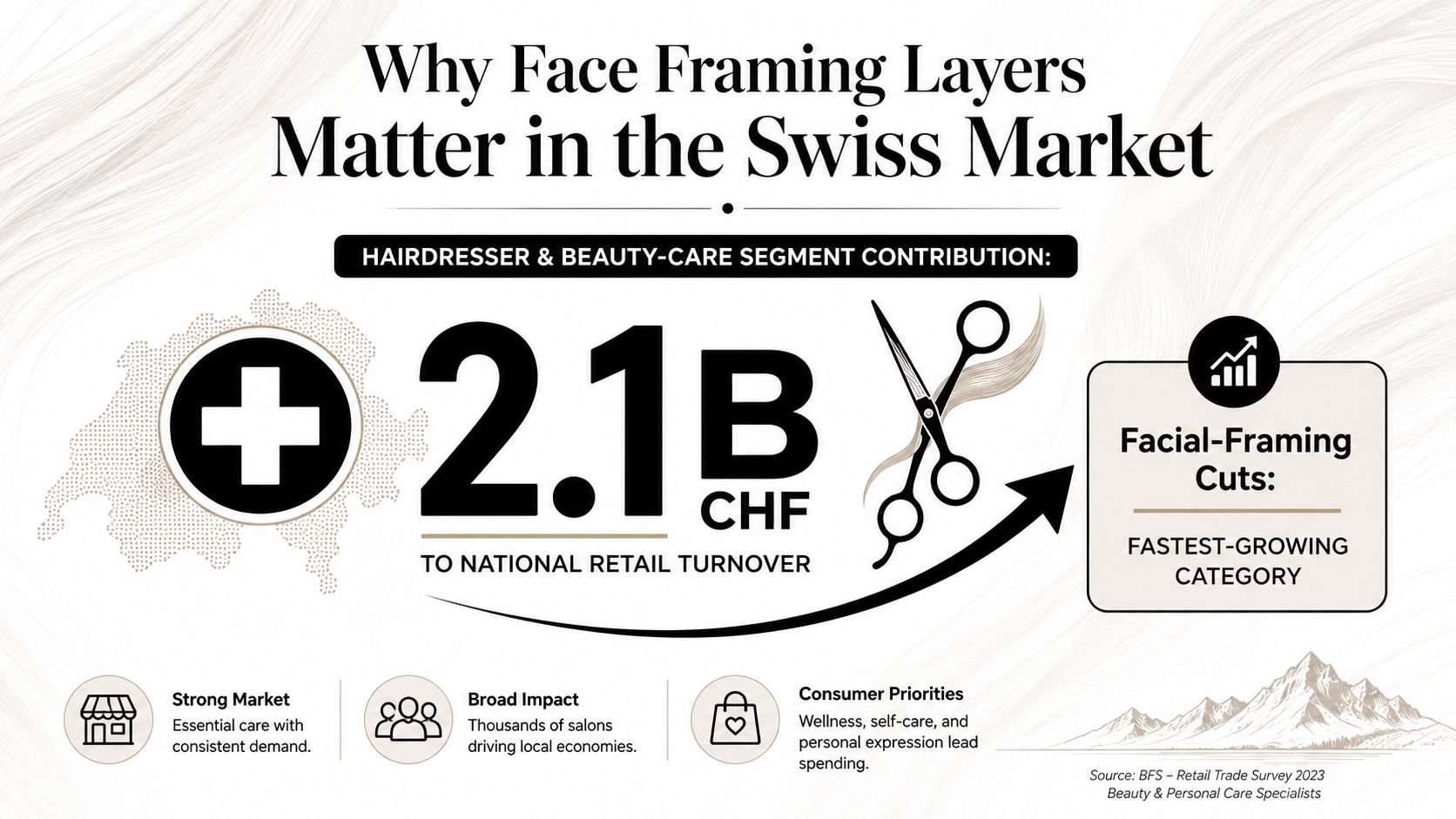
Those figures don't prove that face framing layers are the fastest-growing haircut request. They do show why a technique-led service deserves attention from buyers serving a dense, active Swiss salon ecosystem. The cut fits an established purchasing pattern: clients want visible refinement, but many don't want to surrender their length or commit to a demanding fringe.
The commercial definition
A good face frame creates a controlled visual break near the face. A cheekbone piece opens the eye area. A jawline or chin piece can soften the lower face. A collarbone piece gives long hair movement while remaining discreet. The placement matters more than the word “layers”.
That distinction should shape how retailers organise the category. “Layered hair” is too broad for a product card or staff recommendation. “Soft collarbone framing for fine, shoulder-length hair” is useful. So is “heat protection and lightweight shine care for short front pieces”.
The Swiss market also calls for a value argument. The AlixPartners Swiss consumer outlook reported that 29% of consumers planned to reduce beauty and cosmetics spending, 9% planned to spend more, and 62% expected to keep budgets stable (AlixPartners). That makes a lower-risk refresh relevant. A customer can change the front shape without buying into a complete restyle, and a retailer can support the decision with a focused care routine rather than an oversized product wall.
What deserves shelf space
Prioritise products that solve the problems created by front-focused styling:
- Heat protectants for clients who blow-dry the pieces away from the face.
- Lightweight oils or serums for dry ends and shine without flattening fine hair.
- Texturising sprays for separation and soft movement.
- Leave-in conditioners for detangling fragile front sections.
- Dry shampoo for clients who want to extend the style between washes.
A practical visual-merchandising resource such as this salon highlight clip in tips can also help teams think about placement, sectioning, and the way front-focused services translate into salon communication. Keep the offer specific. The product should answer, “How will I make these pieces behave tomorrow morning?”
Matching Face Framing Layers to Face Shape, Texture, and Length
Face shape gives the stylist a starting point, not a rigid rulebook. The decisive question is where the shortest front section lands and whether that position creates the client's preferred balance. Natulique identifies the cheekbone, jawline, chin, and collarbone as useful landmarks for placing the shortest piece.
Start with the landmark
For an oval face, the chin is a reliable commercial recommendation because it creates visible shape without demanding a fringe. A round face often benefits from a collarbone placement that keeps the movement lower and longer. A square face can take a softer jawline layer, while a heart-shaped face generally works well with a section that begins below the chin.
Texture changes the recommendation immediately. Fine hair needs fewer, softer front pieces so the perimeter doesn't look depleted. Medium hair offers more flexibility. Thick hair can support stronger definition, but the stylist still needs to blend the section into the sides instead of creating a disconnected shelf. Curly and coily hair require shrinkage planning and a cut that respects the client's finished texture.
Retailers should train staff to ask about density and styling behaviour before recommending a product. A volumising mousse may suit fine hair, but it can be the wrong answer for a dense curl pattern that needs slip, moisture, and controlled definition. The hair-texture product guide from Healtsy is useful background for building more precise recommendations.
Use length to control commitment
A short bob needs a carefully blended front because every section is visible. A lob gives the stylist room to place the shortest layer at the jaw or chin. Shoulder-grazing hair can carry a collarbone frame that feels polished and easy to tie back. Hair past the chest can take a more noticeable cheekbone or jawline shape, provided the front remains connected to the length behind it.
| Face Shape | Hair Texture | Length | Shortest Layer Falls At | Retail Fit |
|---|---|---|---|---|
| Oval | Fine, straight | Lob | Chin | Lightweight volumising spray, soft brush, and heat protectant |
| Round | Medium, wavy | Shoulder-grazing | Collarbone | Leave-in conditioner, flexible smoothing cream, and diffuser support |
| Square | Thick, straight | Long | Jawline | Weight-balancing care, smoothing serum, and large round brush |
| Heart | Fine, wavy | Long | Below the chin | Detangling spray, light mousse, and low-weight finishing oil |
| Oval or oblong | Curly | Long | Chin to collarbone, adjusted for shrinkage | Curl cream, diffuser, and moisture-focused cleanser |
| Round or square | Coily | Bob or lob | Jawline or longer, assessed in the natural shape | Slip-rich conditioner, gentle styling cream, and protective accessories |
For first-time buyers, stock the safer versions first. Chin-to-collarbone framing supports more hair types, more tie-back routines, and more accessible product pairings than very short cheekbone pieces. Reserve stronger texture sprays and precision styling tools for customers who actively want a styled finish.
How Face Framing Layers Compare to Other Cuts
Face framing layers occupy the useful middle ground in the haircut menu. Full layers create more movement throughout the head, curtain bangs make the forehead the main feature, and blunt cuts deliver a strong perimeter. Face framing layers change the front without forcing the client to change everything else.
The competing salon ticket
Full layering is the most movement-led option. It suits clients who enjoy blow-drying, rollers, curls, or visible bounce, but it demands more cooperation from the hair and more styling product. For a low-maintenance customer, the extra internal shape can feel like work.
Curtain bangs create a stronger visual identity around the forehead. They're attractive on the right client, but the shorter front requires regular directional styling and closer attention to how the fringe sits between washes. The customer needs to accept that the front will be the first part of the haircut to show poor styling or humidity.
Blunt cuts are the cleanest alternative. They make fine or medium hair look deliberate and polished, especially in a bob or sharp lob, but they don't contour the face in the same way. A client who wants a high-end, graphic finish may prefer bluntness over movement.
Buyer's rule: Sell the cut according to the client's tolerance for styling, not according to the most dramatic photograph in the lookbook.
The practical comparison
| Cut Type | Visual Effect | Maintenance Window | Grow-Out Behaviour | Ideal Client |
|---|---|---|---|---|
| Face framing layers | Soft contouring and movement at the front | Longer, blended maintenance cycle | Usually soft if the section is well connected | Wants visible change without losing overall length |
| Full layers | Movement and volume through the haircut | More involved upkeep | Shape can become uneven if styling is neglected | Enjoys blow-drying, waves, or a fuller finish |
| Curtain bangs | Strong forehead framing and a parted fringe effect | More frequent front adjustments | Can pass through an awkward stage if ignored | Accepts regular styling and wants a defining feature |
| Blunt cuts | Dense, polished, graphic outline | Perimeter-focused upkeep | Growth is obvious at the edge but easy to understand | Prefers precision, shine, and a structured silhouette |
For merchandising, don't place all four cuts under one generic “layered hair” message. Use separate needs: contour without commitment, movement and volume, fringe styling, and polished density. That language gives salon teams and online shoppers a reason to choose.
The Salon Consultation and the Right Questions to Ask
A face frame fails when the stylist cuts the reference photograph instead of the client's routine. The consultation should identify the desired front shape, the hair's actual behaviour, and the amount of daily effort the customer will tolerate.
Five questions that prevent poor recommendations
1. Establish the hair history. Ask about the last cut, colour or chemical services, breakage, washing routine, and heat use. Front pieces often receive more brushing and blow-drying than the back, so the stylist needs to know whether the visible hairline is already fragile.
2. Read the face using landmarks. Avoid treating face shape as a verdict. Look at the forehead, cheekbones, chin, and jawline, then decide whether the client wants more opening around the eyes, softer jaw movement, or length through the lower face.
3. Pin down the shortest point. Show two or three references and ask what detail attracts the client. Is it the cheekbone piece, the bend at the jaw, the full length, or the blowout? This question separates the haircut from the styling.
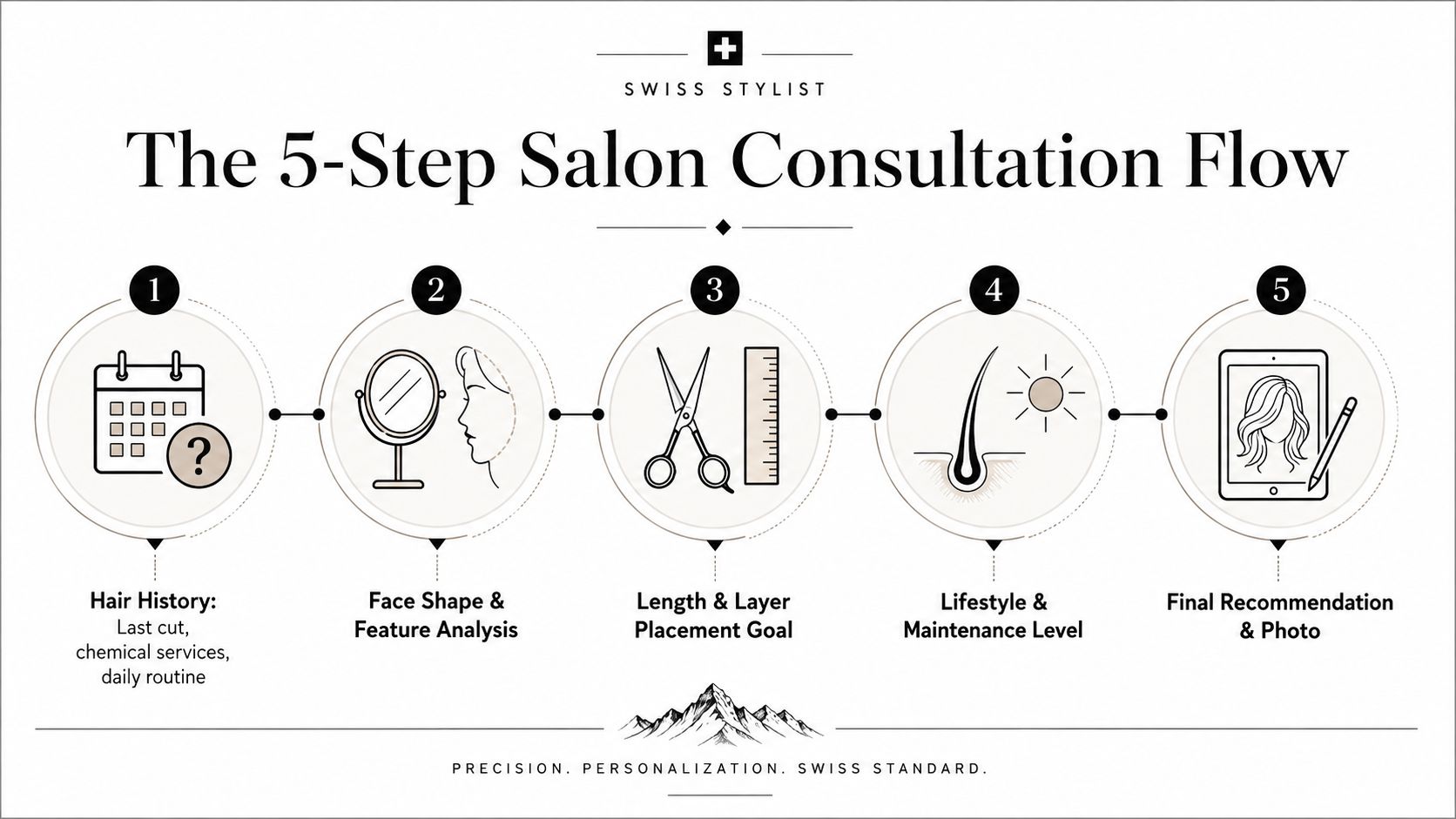
4. Test the lifestyle. Ask how many minutes the client will spend styling the front, whether they use a round brush, and whether glasses, headphones, sport, or a ponytail affect the choice. A cheekbone layer that needs daily direction is a poor recommendation for someone who air-dries and ties their hair back.
5. Recap the decision in plain language. State the length, the starting point, the connection to the sides, and the finishing product. Write that wording on the salon card so the retail advisor can repeat it accurately at checkout.
Useful phrases should work across Swiss retail settings:
- English: “Keep the length, start the frame at the chin, and blend it softly into the sides.”
- German: “Die Länge bleibt erhalten. Die kürzeste Partie beginnt am Kinn und wird weich in die Seiten eingearbeitet.”
- French: “Je souhaite garder la longueur, commencer l'encadrement au menton et le fondre doucement dans les côtés.”
The same clarity helps in Migros, Manor, independent salons, pharmacies, and online consultations. Staff don't need to diagnose a face shape. They need to translate a visual preference into a placement and a care recommendation.
The video below can support staff training when a team needs a visual reference for consultation and styling language.
Styling, Maintenance, and Grow-Out in Real Life
Take a representative client in Zürich with shoulder-length, fine, slightly wavy hair. She wants more movement around the face but doesn't want bangs, daily curling, or a shorter overall cut. The sensible recommendation is a collarbone-level frame, blended into the sides and kept soft enough to survive air-drying.
During the first week, she can apply a light volumising spray at the roots and mid-lengths, then use a round brush to direct the front pieces away from the face. The brush should create a bend, not a hard curl. Finish with a small amount of lightweight oil on the ends only, because the front sections can look greasy quickly when too much product is applied close to the roots.
Adapt the routine to the season
On the second wash day, a microfibre towel reduces rough handling while the hair is wet. A modest amount of curl cream can encourage the natural wave, and the client can either air-dry or use a diffuser on a gentle setting. The product choice should follow the texture that appears after washing, not the texture created by a salon blowout.
Swiss conditions make the routine more specific:
- Hard-water exposure: Limescale can leave hair feeling rough in homes and apartments around Geneva and the Lake Zürich area. A clarifying or mineral-removing wash can be useful when the hair feels coated, but it shouldn't replace a gentle regular cleanser.
- Heated office air: Winter heating can make the front pieces feel dry and static-prone. Recommend a light leave-in conditioner and careful brushing rather than repeated high-heat passes.
- Spring pollen: Mittelland pollen-heavy days can encourage more frequent washing or dry-shampoo use. Keep scalp cleansing balanced, and avoid layering heavy styling products on the hairline.
At six weeks, inspect the shape rather than automatically reshaping the whole haircut. If the front still opens correctly and the ends remain healthy, a small dusting may be enough. By ten weeks, the stylist should reassess whether the layer has dropped from its intended landmark.
Refresh the front only when the front has stopped doing its job. If the piece now lands at the chin instead of the cheekbone, or no longer blends into the side shape, adjust the frame rather than selling a complete restyle.
A fringe adjustment makes sense when the client likes the overall length but the shortest front section has become awkward. Recommend a full reshape when the perimeter, side connection, and front placement no longer work together. That distinction protects trust and gives cost-conscious clients a lower-risk maintenance option.
Pairing the Cut with Clean Beauty Care
Face framing layers put the hair around the eyes and cheeks on display. Dryness, frayed ends, static, and dullness become obvious in a front section that must sit neatly against the face. For Swiss pharmacies, boutiques, and e-commerce partners, this makes the cut a useful category anchor: the consultation can lead directly to care, styling, and protection products.
Swiss beauty audiences show strong interest in care categories. A Swiss audience analysis reported that beauty-salon followers over-index on hair care by 1.57 times and skin care by 1.77 times versus the national average, according to Rascasse. Use that interest to build a broader recommendation around scalp comfort, fibre condition, and daily styling rather than treating the haircut as a one-off service.
Match the formula to the problem
Face framing layers demand a specific formula matched to a specific need rather than a generic clean-beauty claim. Fine hair needs a weightless mousse or spray that adds body without coating the front. Coloured or heat-stressed pieces need a gentle cleanser, nourishing mask, and heat protectant. Wavy and curly clients need slip and definition, while a dry texturiser can disrupt the pattern.
Ingredient and certification cues help shoppers decide quickly:
| Client Need | Recommended Ingredient | Certification Cue | Shelf Placement |
|---|---|---|---|
| Fine front pieces that collapse | Lightweight conditioning agents and airy styling polymers | Vegan or recognised natural standard, where applicable | Volumising styling bay |
| Dry, heat-styled ends | Squalane or hemisqualane in a light serum | Ecocert, NATRUE, or relevant certified claim | Heat-care adjacency |
| Detangling and softness | Plant oils or gentle conditioning ingredients | Organic or cruelty-free certification | Leave-in and wash-care shelf |
| Wavy or curly movement | Flexible botanical styling agents and humectants | Vegan Society or natural certification, where verified | Texture-care section |
| Summer humidity control | Light smoothing formula that doesn't flatten the roots | Clear ingredient and certification communication | Seasonal styling display |
| Scalp comfort after product build-up | Gentle cleansing and scalp-focused care | Transparent natural-origin and cruelty-free cues | Scalp-care fixture |
Swiss salon businesses also show interest in advanced treatments, sustainability, and clean beauty themes, as noted in Rascasse's Swiss beauty analysis. Retailers should connect those themes to the haircut's actual demands. A precision frame needs products that respect scalp comfort and fibre condition, rather than an aggressive, heavily fragranced routine.
Certification can support trust, but shelf execution still decides whether the recommendation makes sense. Place the certification cue beside the benefit, state who the product suits, and show the texture. A silicone-free serum with squalane belongs near face framing layers when the goal is light smoothing. A rich mask belongs with dry ends, not fine roots.
Merchandising Playbook for Swiss Retailers
The strongest retail execution starts with the consultation phrase, not the product brand. If the stylist says, “Your collarbone frame needs light movement and heat protection,” the shelf should make that recommendation easy to find. If the online customer selects “fine, wavy, shoulder-length hair,” the assortment should return a restrained routine, not a catalogue of unrelated styling products.
Build the fixture in four tiers
Tier one, lead with the service. Use a clean trend card near the entrance or salon reception. Show the difference between chin, jawline, and collarbone placement, and label the expected styling effort qualitatively. Don't promise universal flattery. Give the customer a decision.
Tier two, create the care basket. Put heat protectant, leave-in conditioner, lightweight oil, texturising spray, and dry shampoo together. The display should answer the first-week and second-week questions without forcing the customer to search across unrelated aisles.
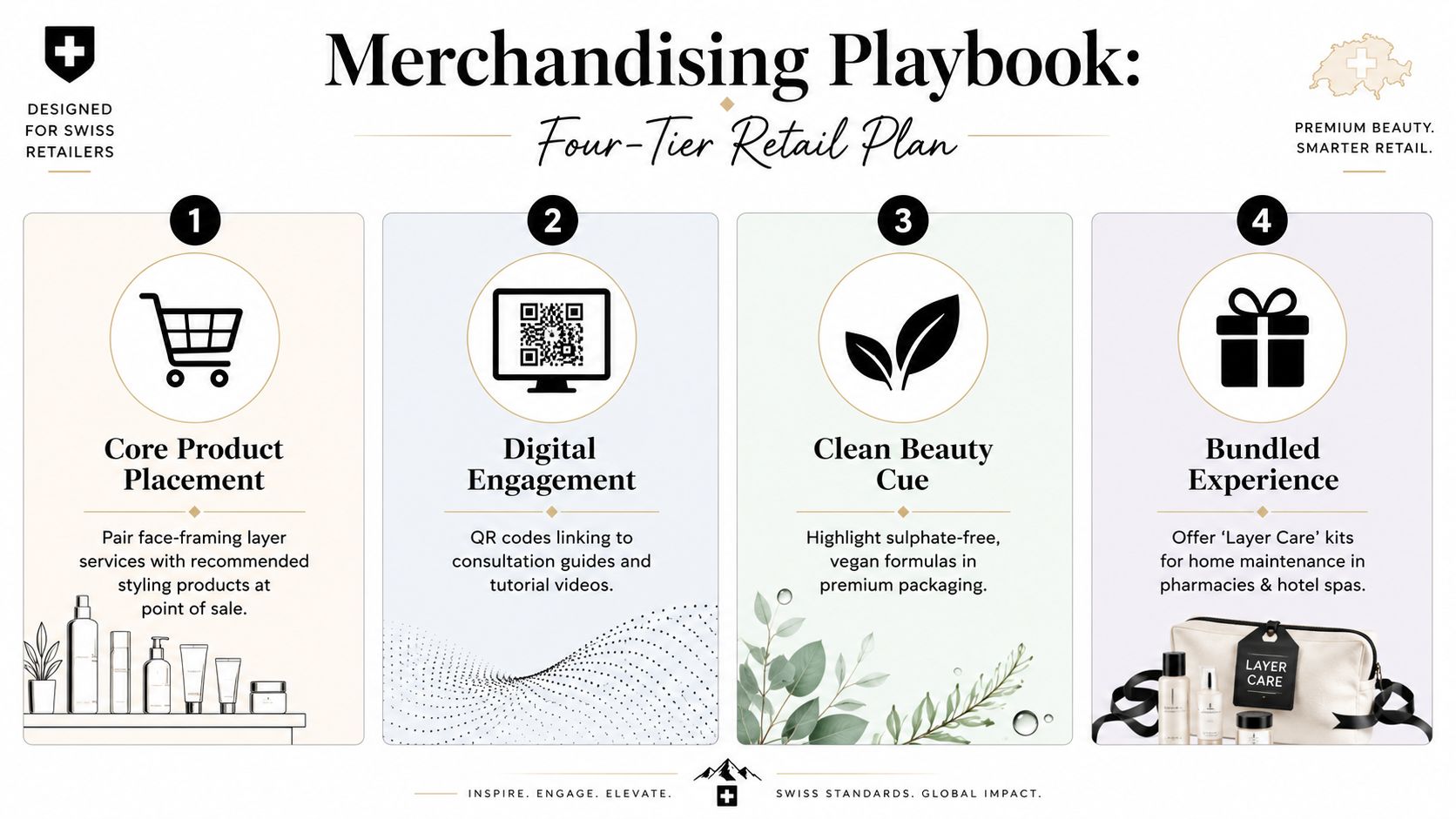
Tier three, give clean care the premium position. Put certified or clearly substantiated natural formulas at eye level, with ingredient cards that explain weight, finish, and hair type. A pharmacy customer wants reassurance. A boutique customer wants sensoriality and design. The same product needs different framing in each channel.
Tier four, use smaller formats at checkout. Minis, refill formats, combs, clips, and travel-friendly leave-ins make sense at the till, in hotel spas, and in Click & Collect collection zones. These are practical add-ons, not random impulse products.
Adapt the plan to the channel
Zurich and Geneva clusters can support editorial displays and consultation-led pop-ups. Apotheke-dense German-speaking cantons need concise staff prompts and easy-to-use product groupings. For Galexis and Amedis supply planning, buyers should confirm assortment availability, delivery windows, and pack-size consistency before promising a bundle to salon or pharmacy partners. Galenicum listing and cosmetic-claim requirements also demand disciplined wording. Keep claims tied to the product's documented cosmetic function.
Use visual merchandising guidance to transform your retail space with a clear path from inspiration to consultation to basket. Track attach rate, basket size, and DTC return rate as internal operating measures, but set targets only after establishing a baseline for the individual channel. A luxury boutique and a pharmacy shouldn't share the same benchmark.
Monday-morning checklist
- Define the hero service: Choose chin, jawline, and collarbone examples that match local clientele.
- Write the staff prompt: Ask about texture, heat use, and styling time before recommending products.
- Build three care bundles: Fine hair, textured hair, and heat- or colour-stressed hair.
- Verify claims: Check every natural, vegan, organic, and cruelty-free statement against approved documentation.
- Place the QR code: Link to the consultation guide or styling video, not a generic homepage.
- Review the basket: Measure which products attach to the service and remove items that confuse the choice.
- Protect the grow-out story: Sell maintenance and care, not unnecessary full reshapes.
The category is worth backing because it is easy to understand, adaptable across textures, and broad enough to support thoughtful retail without becoming a trend-only display.
Beautysecrets.agency helps Swiss pharmacies, salons, spas, boutiques, and premium e-commerce partners build differentiated clean-beauty assortments that support professional consultation and at-home care. Visit beautysecrets.agency to explore ethically sourced, certified brands and discuss a product mix that can sit naturally beside face framing layers and other salon-led services.