You're likely in one of two positions right now. Either you're a traveller trying to work out whether Crystal Waterworld Resort & Spa is a smart family booking, or you're a Swiss beauty or wellness brand manager scanning the Turkish Riviera for a partner that can move volume without diluting brand position.
Those are very different buying decisions, but this resort sits at an interesting intersection. It is big enough to matter commercially, broad enough in amenities to create multiple touchpoints for wellness spending, and mainstream enough that any premium brand partnership would need to be sharply defined to avoid getting lost inside a mass-market all-inclusive environment.
That's why Crystal Waterworld Resort & Spa deserves a closer read than the usual holiday summary. The property has the scale of a leisure complex rather than a simple hotel. For travellers, that changes how you think about atmosphere, dining, pool access, and the family experience. For Swiss cosmetic and spa suppliers, it changes the partnership question from “Can this hotel stock our products?” to “Which part of this operation can support a credible, profitable, and operationally realistic brand presence?”
An Introduction to a Resort of Scale
A Swiss brand manager looking for a new resort partner usually starts with the wrong filter. They look for beautiful treatment rooms, polished spa photography, and the usual luxury language about serenity and rituals. Those things matter, but they don't tell you whether a partnership will work.
What matters first is operational reality. Can the property support product turnover? Is there enough guest volume to justify training, samples, treatment protocols, and retail placement? Does the hotel attract the kind of guest who will use a spa beyond a single discounted massage?
Crystal Waterworld Resort & Spa is interesting because it raises those questions immediately. It presents itself as a holiday resort, but in commercial terms it operates more like a high-capacity hospitality ecosystem. That distinction is important.
Why this resort stands out commercially
At a resort like this, wellness isn't isolated in one quiet wing. It sits inside a broader machine that includes beach activity, family entertainment, multiple food outlets, water attractions, and all-inclusive guest behaviour. That can weaken a premium spa concept if management treats the spa only as an ancillary service. It can also create strong partnership potential if the spa, in-room amenities, and retail offer are aligned properly.
For Swiss beauty brands, the attraction is straightforward:
- Volume exposure: A large resort creates repeated guest contact points.
- Audience variety: Families, couples, and wellness-driven guests don't buy the same products.
- Layered procurement options: Professional cabin use, boutique retail, amenity supply, and co-branded rituals can sit under different budget lines.
Commercial test: A resort becomes attractive for high-end brand entry when its guest scale is matched by enough operational structure to support training, replenishment, and consistent treatment delivery.
The challenge is just as clear. Large all-inclusive resorts often default to generic spa menus and price-led promotions. If a Swiss brand enters that environment without a controlled rollout, it risks becoming an invisible back-bar line rather than a visible premium partner.
The right way to assess Crystal Waterworld
I'd assess Crystal Waterworld Resort & Spa through three lenses.
First, guest flow. Big leisure resorts live or die by how they distribute people across pools, restaurants, treatment spaces, and family areas.
Second, wellness positioning. A spa inside a family-heavy resort has to work harder to feel restorative and premium.
Third, procurement fit. Swiss brands need a realistic path into Turkish hospitality operations, not just a good-looking concept deck.
That combination makes Crystal Waterworld more than a destination review subject. It's a live market-entry case.
Location and Strategic Access
Crystal Waterworld Resort & Spa sits in the Belek-Bogazkent area of Antalya, a stretch of coastline known for large resort developments and package-friendly infrastructure. That setting matters because location is never just about scenery. It shapes transfer planning, staffing practicality, supplier timing, and the kind of guest who books the property in the first place.
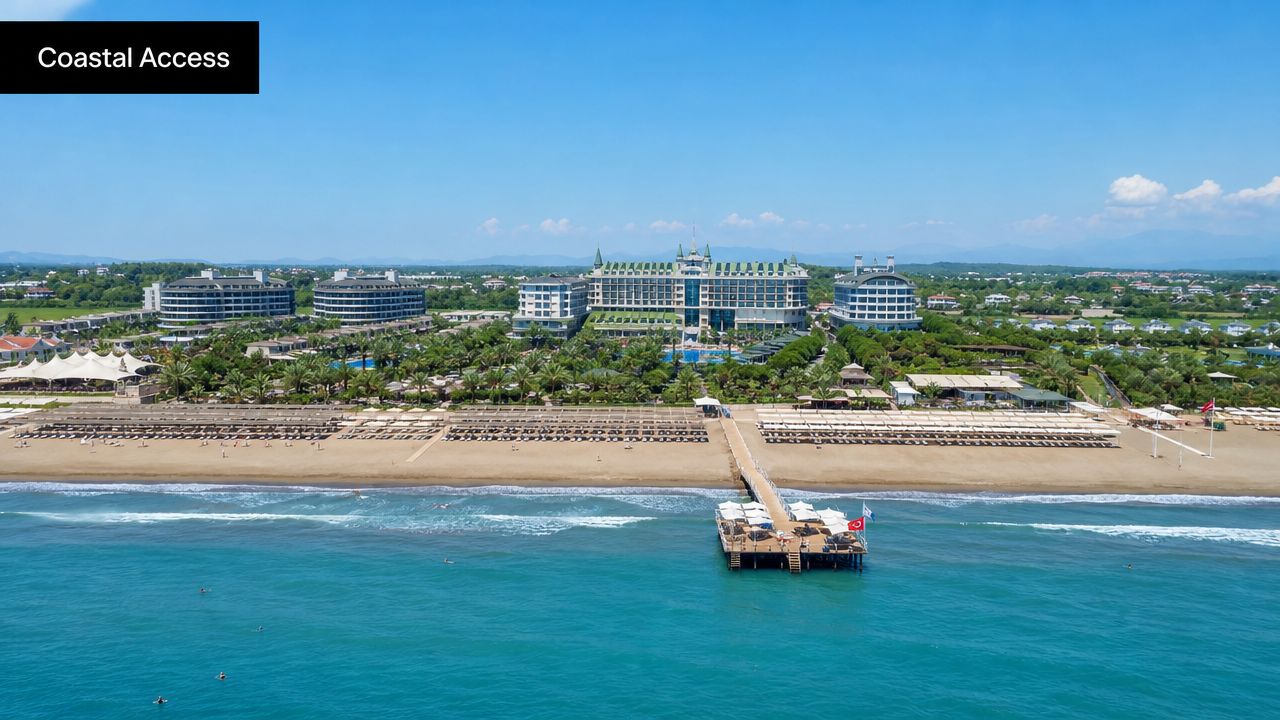
For a Swiss travel buyer, the area is familiar territory in the best sense. It is built for resort stays. For a Swiss beauty brand, that means the property isn't operating in isolation. It sits inside a regional tourism system where transfer providers, excursion operators, hotel groups, and seasonal demand patterns all influence the commercial rhythm.
What the location means in practice
Belek and Bogazkent aren't the right fit for travellers who want a highly walkable old-town experience directly outside the hotel gate. They are the right fit for guests who want a contained resort holiday with beach access and a strong amenity mix.
That distinction matters for wellness partnerships. In a self-contained destination, the resort captures more of the guest's day. If the hotel does its spa merchandising properly, retail opportunities improve because guests aren't constantly leaving the property to spend elsewhere.
For business visitors evaluating the site, keep the planning focused on three questions:
- Arrival efficiency: Can your team inspect the property, meet operators, and return without wasting a day in fragmented transfers?
- Stock planning: Will deliveries need to be timed around the seasonal operating window and resort reopening cycles?
- Training cadence: Can treatment and retail training be concentrated around pre-season ramp-up rather than peak occupancy?
Seasonal access is not a footnote
One detail deserves more attention than it usually gets. The hotel is reported as closed from November 21 to March 31, according to Tripadvisor's hotel feature page for Crystal Waterworld Resort & Spa.
That affects more than holiday dates. It affects how a Swiss brand should schedule almost everything:
- Launch timing: Don't build a winter activation plan around a property that isn't operating in that window.
- Procurement cycles: Pre-opening supply decisions often happen before guests arrive.
- Trainer deployment: Staff education is usually more effective before high season pressure starts.
- Campaign logic: A family beach resort with a closure period isn't the place for a year-round retail forecast built on static assumptions.
Resorts with seasonal closure windows reward brands that plan backwards from reopening, not forwards from first contact.
A Swiss operator's view
Swiss buyers often want transparency. They want to know what's included, what isn't, and whether a trip or partnership can be organised without hidden friction. Crystal Waterworld fits best when approached with that same discipline.
If you're inspecting it as a travel product, confirm operational dates and transfer arrangements early. If you're inspecting it as a spa partnership target, treat the location as an execution variable, not just a map pin.
Understanding the Resort's Infrastructure
Crystal Waterworld Resort & Spa is best understood as a large-scale 5-star all-inclusive resort rather than a boutique hotel with added leisure facilities. Expedia's property listing describes it with 882 air-conditioned accommodations, a private beach, and 8 restaurants, which establishes the resort as a high-capacity complex on the Turkish Riviera, as shown on Expedia's Crystal Waterworld Resort & Spa listing.
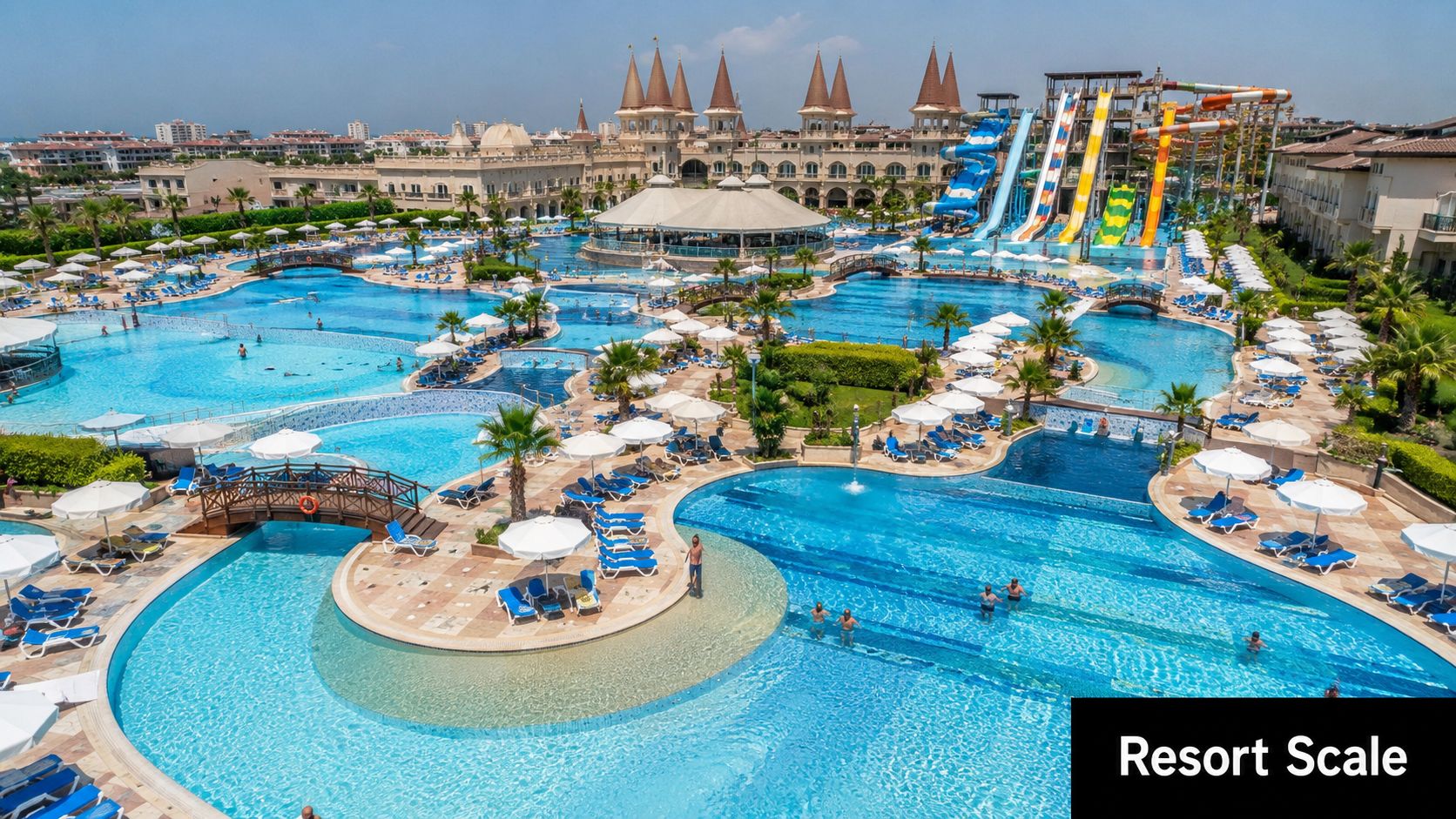
That single fact changes the reading of the whole property. Once a resort reaches this kind of room count and amenity spread, guest experience depends less on individual décor touches and more on circulation, zoning, staffing consistency, and how well the hotel prevents bottlenecks.
Scale creates opportunity and friction
The upside of this infrastructure is obvious. A property of this size can support multiple guest moods at the same time. Some people can stay close to the beach, some can stay inside the water-activity orbit, and others can use indoor wellness facilities or quieter corners of the resort.
The downside is just as real. Big all-inclusive resorts rarely feel intimate. Guests who expect a hushed luxury atmosphere across the whole site may find the overall energy too busy, especially in peak family periods.
For a spa or cosmetic partner, though, that scale is exactly what creates commercial relevance. It opens several distribution layers:
| Resort asset | Operational meaning | Brand implication |
|---|---|---|
| Large accommodation base | High guest turnover across the season | Amenity and sample programmes can matter |
| Multiple restaurants | Longer on-site dwell time | More chances to convert guests into spa users |
| Private beach setting | Full-day resort behaviour | In-room recovery, sun-care, and body-care positioning become relevant |
| Broad leisure mix | Mixed demographics | Product segmentation matters more than one-line selling |
The water infrastructure tells you even more
Booking.com's inventory highlights 3 outdoor pools, an indoor pool, and free water park access, while the resort's aquapark material states that the main aqua park pool covers 800 square metres and includes seven slides, according to Booking.com's Crystal Waterworld Resort & Spa page.
This is more than a family-friendly selling point. It signals capacity segmentation. Multiple pools and slide-based attractions spread guests across different activity types, which helps reduce single-point crowding and supports distinct guest flows.
That matters for wellness planning because a spa performs better when it isn't forced to compete with one overloaded central leisure zone.
A resort with distributed aquatic infrastructure gives the spa a better chance of functioning as a choice, not just a rainy-day fallback.
What this means for Swiss wellness brands
The clearest opportunity is not blanket premiumisation. That usually fails in large all-inclusive settings. The opportunity is selective placement.
A Swiss brand should ask where guests are most receptive:
- Treatment rooms for premium protocol use
- Spa reception retail for post-treatment purchase
- Higher-tier accommodation for premium amenities
- Family-adjacent wellness such as gentle body care or mother-and-child positioning
If your broader strategy includes sustainability and guest transfer planning around resort properties, the Solana EV sustainable property guide is a useful reference point for thinking about how transport expectations increasingly shape premium hospitality positioning.
Crystal Waterworld has the infrastructure to support a brand partnership. It does not automatically have the curation to make that partnership feel premium. That's the fundamental distinction.
A Deep Dive into the Spa and Wellness Centre
The spa is where Crystal Waterworld Resort & Spa either justifies a serious wellness partnership or falls into the common all-inclusive trap of offering a serviceable but generic menu. In a resort of this scale, the spa cannot rely on ambience alone. It needs a clear operating identity.
The baseline proposition is easy to infer from how these resorts usually function. Guests expect a mix of thermal experiences, beauty treatments, massage options, and a practical indoor wellness escape from the more active parts of the property. The question isn't whether the spa can provide that. The question is whether it can convert standard wellness demand into a more premium, differentiated offer.
This visual framework captures the guest journey a well-run resort spa should support.
What a resort spa like this needs to do well
At Crystal Waterworld, the spa should be judged less by brochure language and more by sequence. A proper wellness journey in a high-volume resort has to move cleanly from arrival to consultation, from heat and water experiences into treatment, and from treatment into retail or repeat booking.
The most commercially important zones are usually these:
- Hydrothermal spaces: Turkish bath, sauna, steam, and indoor wet areas often drive first-time entry.
- Treatment rooms: Within these rooms, product quality becomes visible to the guest.
- Relaxation areas: These spaces determine whether the spa feels restorative or transactional.
- Retail touchpoint: Without a structured retail moment, product partnerships remain invisible.
Where premium positioning can succeed
A spa inside a large family-oriented all-inclusive resort should not try to imitate a remote destination wellness retreat. Guests are in a different mindset. They want ease, sensory quality, and visible results, but they also want treatments that fit around pool time, meals, and family schedules.
That changes the ideal product strategy. Long, highly conceptual rituals may have a place, but the strongest commercial fit usually comes from:
| Spa Facility / Service | Description | Potential Brand/Product Alignment |
|---|---|---|
| Thermal and Hammam area | Pre-treatment cleansing and relaxation rituals | Black soap, body polish, mineral or marine prep products |
| Signature massage menu | High-demand core treatment category | Aromatherapy oils, muscle-relief blends, sensorial body oils |
| Facial cabin services | Premium upsell category for adults | Swiss-positioned anti-ageing or radiance facial protocols |
| Relaxation lounge | Post-treatment sensory reinforcement | Herbal tea rituals, homecare recommendation cards |
| Spa boutique | Retail conversion point | Curated edit of face, body, sun-exposed skin, and recovery care |
A useful benchmark for positioning is how other leisure destinations frame premium wellness without losing holiday appeal. For comparison, the curation approach in these luxury spa breaks in Algarve shows how resort spas can package indulgence, recovery, and destination identity in a way that still feels commercially coherent.
The likely gap in the current model
The most common weakness in resorts like this is not lack of facilities. It's lack of product narrative. Treatments exist, but they don't ladder up to a recognisable wellness concept.
That creates a clear opening for Swiss beauty brands. The right partner doesn't need to replace the whole menu. It needs to strengthen the categories where guests already see value.
What I would test first
I would start with a focused audit rather than a broad proposal.
A premium spa partnership fails when the brand tries to sell philosophy before it understands treatment speed, therapist skill level, guest expectations, and retail discipline.
The audit should check:
Menu structure
Are treatments named and priced in a way that supports upselling, or are they mostly generic and interchangeable?Therapist dependency
Can the team deliver a branded facial or body ritual consistently, or would service quality vary too much?Retail handoff
Does the spa team actively recommend homecare, or does the guest leave without product education?Guest fit
Does the clientele skew toward quick recovery treatments, family-friendly wellness, or adults seeking a more refined spa session?
Best-fit categories for Swiss brands
Swiss brands should think in terms of category fit, not abstract prestige.
- Marine and body recovery lines suit a beach-resort setting well because guests spend long hours in sun, water, and heat.
- High-touch facial brands can work if they offer visible results and manageable treatment protocols.
- Mother-and-child adjacent care may fit selected retail or amenity use, given the family-heavy profile discussed elsewhere.
- Ritual bathing products are strong candidates where Hammam or wet-area experiences already shape guest behaviour.
Crystal Waterworld's spa has partnership potential if it is treated as a structured operating unit rather than a decorative extra. The winning move isn't to make it more complicated. It's to make it more coherent.
Strategic Partnership and Procurement Pathways
A procurement meeting at Crystal Waterworld is unlikely to start with brand storytelling. It will start with practical questions. Which department buys the line, how many SKUs are required, how quickly can therapists learn the protocol, and what revenue comes from treatment use versus retail sell-through? Swiss brands that answer those points early have a real opening here.
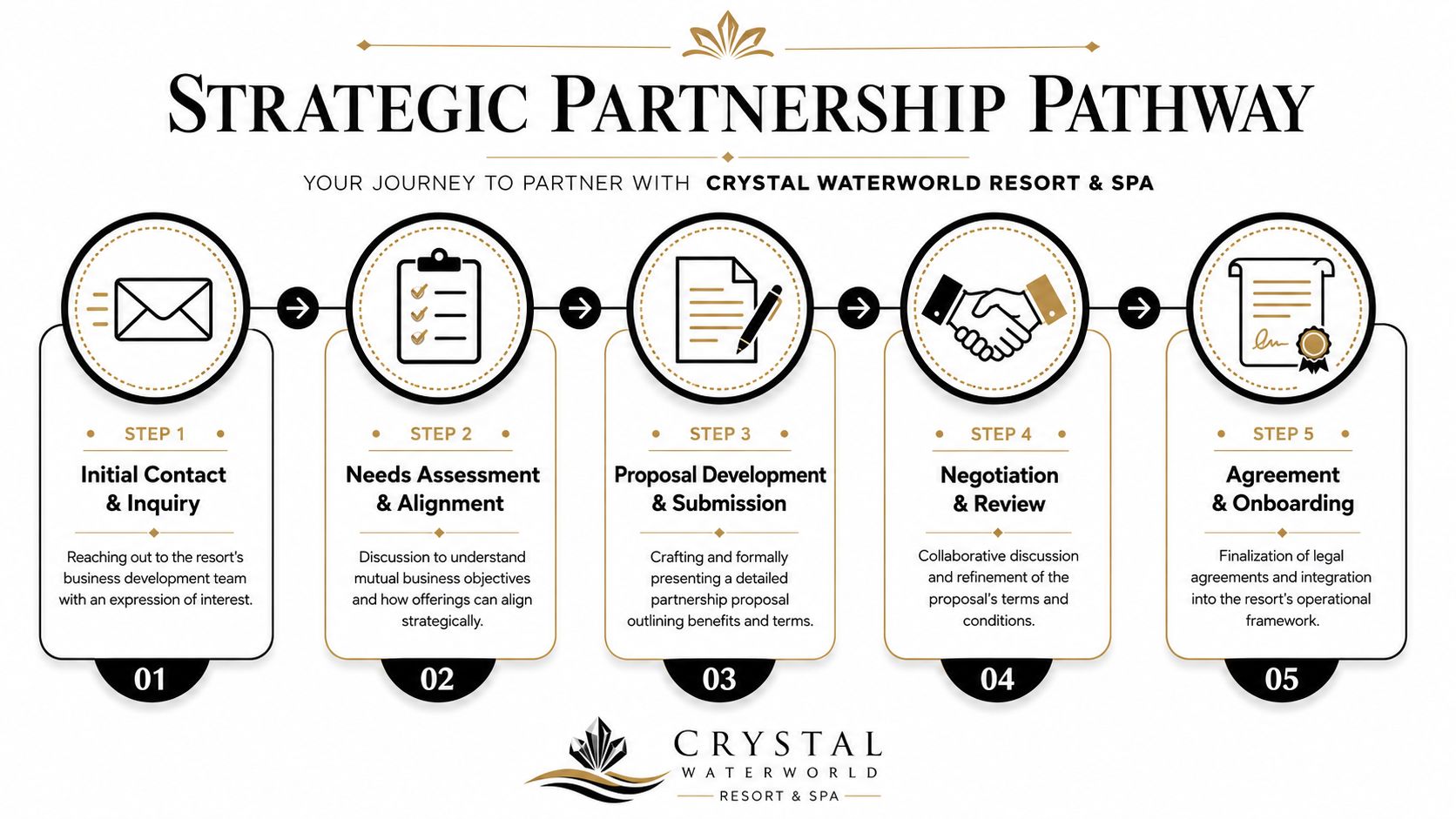
Crystal Waterworld should be handled as a multi-channel hotel account with spa, room category, and guest-segmentation layers. A single proposal for "spa supply" is too broad. The better route is to match one offer to one operational use case, then expand only after the first test proves stable on service quality, replenishment, and guest response.
Four realistic entry models
The strongest entry model depends on where the brand can hold margin without creating training drag.
Professional cabin use is usually the best first step. It puts the formula into a paid service, gives therapists a reason to learn the product story, and creates visible guest contact without asking the hotel to reset its whole menu.
Spa retail can work, but only where the assortment stays tight. Resorts with broad footfall often over-range shelves. A focused retail capsule of after-sun care, body recovery, and one or two facial heroes is easier to sell than a full boutique wall.
Co-branded signature treatments suit resorts that want distinction without rebuilding operations. This model works well if the supplier provides the treatment script, timing, cabin setup, and post-treatment recommendation card.
Premium in-room amenities are narrower in volume but useful for brand sampling. Suite categories, honeymoon rooms, and VIP arrivals are the obvious placements.
What Swiss brands should actually propose
Procurement teams respond better to staged commercial offers than to full-range presentations. At a property of this size, the safest opening is a contained pilot with clear operating limits.
A workable proposal would include:
- A pilot treatment pair consisting of one facial and one body ritual
- A retail capsule with a small number of products that staff can explain in under a minute
- Training materials covering treatment steps, contraindications, and retail recommendation language
- A sampling plan tied to suites, spa reception, or post-treatment takeaway
- A review point after the initial operating period, with decisions based on uptake, therapist feedback, and replenishment discipline
Hotels rarely resist a focused test because it is modest. They resist supplier plans that create too many moving parts across purchasing, training, and stock control.
Category fit and Swiss portfolio logic
The best categories here are practical, climate-relevant, and easy to repeat at scale. Marine body products, post-sun recovery treatments, herb-based massage oils, and visible-result facials all fit the operating logic of a large Mediterranean resort. Family-adjacent retail can also make sense, but only in selected placements where the product purpose is obvious.
That is where Swiss distributors with mixed portfolios have an advantage. A company such as beautysecrets.agency can cover more than one demand point across treatment room, retail shelf, and amenity use, which matters because resort buyers often prefer to reduce supplier complexity rather than add specialist vendors for each category.
Who to approach and how to frame the offer
The first contact should usually be the spa operator or the hotel-side buyer responsible for wellness categories. Front office teams do not own this decision, and generic luxury decks sent to reservations addresses rarely reach the right person.
The proposal should answer hotel concerns in commercial language:
| Proposal focus | Hotel concern it answers | Better framing |
|---|---|---|
| Product quality | Will guests notice the upgrade? | Show the treatment benefit and where it appears in the guest journey |
| Training support | Can therapists repeat it consistently? | Keep protocols short, timed, and easy to audit |
| Retail range | Will the shelf become crowded? | Limit the assortment and define hero SKUs |
| Supply continuity | Will service stop because stock runs out? | Present lead times, reorder points, and local distribution logic early |
For Swiss brands assessing the wider business case, it also helps to learn about Turkey's investment appeal. The resort opportunity sits inside a larger hospitality market where foreign suppliers, distributors, and investors all weigh growth against currency, seasonality, and operating complexity.
What tends to work
Specificity wins. A marine recovery ritual for sun-exposed guests. A short facial with visible results. A controlled retail shelf with clear staff scripting. A premium amenity set reserved for higher room categories.
What fails is the city-spa import model. Long consultations, heavy cabin customisation, and oversized product menus create friction in a family-heavy resort where treatment windows are tighter and team consistency matters more than theatrical complexity.
At Crystal Waterworld, the commercial opportunity is credible if the brand enters with discipline. The goal is not to look more luxurious on paper. The goal is to fit the hotel's operating reality well enough to stay.
Practical Tips and Exploring the Antalya Region
For Swiss travellers and business visitors, Crystal Waterworld makes the most sense when approached with realistic expectations. This is an all-inclusive beach resort in Antalya, not a small design hotel with a stand-alone destination spa. That sounds obvious, but expectations drive satisfaction.
Independent review patterns, as referenced on the Tripadvisor feature page discussed earlier, suggest the resort's family appeal is strong, while guest reactions can vary on practical points such as food repetitiveness, room comfort, and how the property feels during busier periods. That's why logistics matter more here than glossy brochure promises.
How to plan the stay well
If you're travelling as a family, the key question isn't whether the resort has child-friendly amenities. It clearly does. The better question is how you want to use a very large property.
A practical approach is to decide this before arrival:
- Pool-first holiday: Prioritise room location and morning timing around water facilities.
- Spa-plus-family balance: Book treatments at calmer parts of the day rather than waiting until peak demand.
- Business inspection trip: Keep time for a full site walk. Large resorts can look manageable on a map and feel very different on the ground.
Value from a Swiss perspective
Swiss travellers often compare all-inclusive stays through the lens of total-trip clarity. That means not only room rate, but transfer planning, optional extras, on-site spending patterns, and whether the resort's operational model reduces surprises.
The resort's seasonal closure window, already noted earlier, makes timing especially important. For a brand visit, shoulder-season inspections can be useful because you can observe the property without the same level of peak crowding. For leisure travellers, shoulder periods may also feel more manageable if you prefer less noise around family-heavy amenities.
If you're also assessing the broader country context for hospitality or wellness business, this piece on learn about Turkey's investment appeal is a useful starting point for understanding why Turkey continues to attract attention from operators and commercial entrants.
The strongest value in a resort like this comes when you use its breadth deliberately. Guests who drift without a plan often experience the property as crowded. Guests who choose their zones and timings usually get more from it.
Add cultural depth to the trip
A stay in this part of Antalya doesn't need to be only about pool decks and treatment rooms. For Swiss business visitors especially, adding a cultural day can turn a site visit into a more rounded market trip.
The region gives you access to well-known historical attractions such as Perge and Aspendos. Those aren't just sightseeing add-ons. They help place the resort economy in a wider Antalya context, where beach tourism, heritage travel, and large-scale hospitality all sit side by side.
That matters commercially too. Brands entering this market should understand that the Turkish Riviera isn't selling one narrow experience. It sells a layered destination proposition, and resorts like Crystal Waterworld benefit from that wider appeal.
Conclusion A Destination of Dual Opportunity
A Swiss spa brand evaluating Crystal Waterworld should read the property in two ways at once. It is a mass-market leisure resort with enough scale to sustain serious wellness demand, and it is a commercial test site where product performance, treatment design, and retail discipline can be measured in real operating conditions.
For guests, the proposition is clear. The resort suits travellers who value choice, family-friendly infrastructure, and an all-inclusive format that keeps most of the stay on site. It is less suited to visitors who define luxury through privacy, silence, and highly personalised service.
For premium Swiss cosmetic and wellness companies, the stronger question is not whether the hotel looks upscale enough on first impression. The real question is whether its spa operation can support repeatable revenue through treatment cabins, post-treatment retail, wet-area rituals, and in-room or public-area amenity placements. On that basis, the opportunity is credible, but only for brands that can adapt to volume, train therapists properly, and protect margin across wholesale, cabin use, and retail sell-through.
The commercial upside sits in selective execution. Edited treatment menus. Professional-use lines with clear protocols. Retail assortments that match guest behaviour instead of copying an urban day spa model. Signature wellness concepts can work here if they are operationally simple and visibly differentiated.
Crystal Waterworld Resort & Spa therefore deserves attention beyond standard travel coverage. For the right Swiss partner, it offers access to Antalya's resort economy through a property large enough to justify procurement discussions and structured enough to support a phased brand entry. Treated that way, the resort becomes both a hospitality asset and a practical route into the Turkish wellness market.
If you're a Swiss spa, retailer, pharmacy group, or wellness brand looking at resort partnerships in Turkey, beautysecrets.agency is a practical point of contact for discussing natural and premium cosmetic lines suited to treatment use, retail placement, and hospitality positioning.