A warm afternoon on Lake Geneva can end in a familiar way, a forearm feels hot, the shoulders are pink, and everyone in the car starts searching for something that cools skin quickly without turning sticky in the heat. That's where aloe vera after sun gel earns its shelf space in Swiss retail. It sits between sunscreen and full repair care, giving shoppers a soothing option for the hour after exposure, not a promise to undo the day.
For pharmacies, drugstores, spas, and hotel boutiques, the category matters because customers rarely want a lecture when their skin is uncomfortable. They want something that feels calming, looks trustworthy, and fits the occasion. A well-chosen gel can do that, while a poorly chosen one can sting, pill, or leave buyers disappointed.
The useful way to think about this product is simple. Pure aloe is an ingredient, while a finished after-sun gel is a formula with texture, stability, and added ingredients that can help or hurt performance. If you stock the category with that distinction in mind, you'll serve both the practical shopper and the premium natural-beauty customer looking for calming after-sun care.
Introduction to Aloe Vera After Sun Gel
A customer walks into a Zurich pharmacy after a weekend in the Alps. They're not asking for a miracle, just relief from heat, redness, and that tight, dry feeling that follows a long day outdoors. In that moment, Aloe Vera After Sun Gel acts like the retail equivalent of a cold cloth and a light moisturiser in one, a familiar format that feels immediately relevant.
The category works because it matches the way people use it. In Switzerland, after-sun products often support post-outdoor recovery after hiking, lake days, terrace lunches, and summer travel. That's a different job from sunscreen. Sunscreen prevents damage before exposure, while after-sun gel is there after the skin has already been stressed.
Retail teams sometimes blur that line, which creates avoidable confusion. Aloe vera after sun gel can feel comforting, and it can support skin hydration, but it shouldn't be sold as UV protection or as a replacement for sunscreen. That distinction matters for customer trust, especially in premium channels where shoppers read labels closely and expect accuracy.
A good analogy is tea after a long walk. The tea doesn't reverse the hike, but it can help you settle. In the same way, a well-formulated gel gives post-sun comfort without overpromising. If you explain it that way, customers understand why the product belongs next to sun care, not in place of it.
Understanding Skin Benefits and Mechanisms
In the shop, aloe vera after sun gel often wins the first customer impression because it feels cooling and familiar. That immediate comfort matters, but the key question for retailers is what the skin can reasonably expect from the formula once the initial cooling fades.
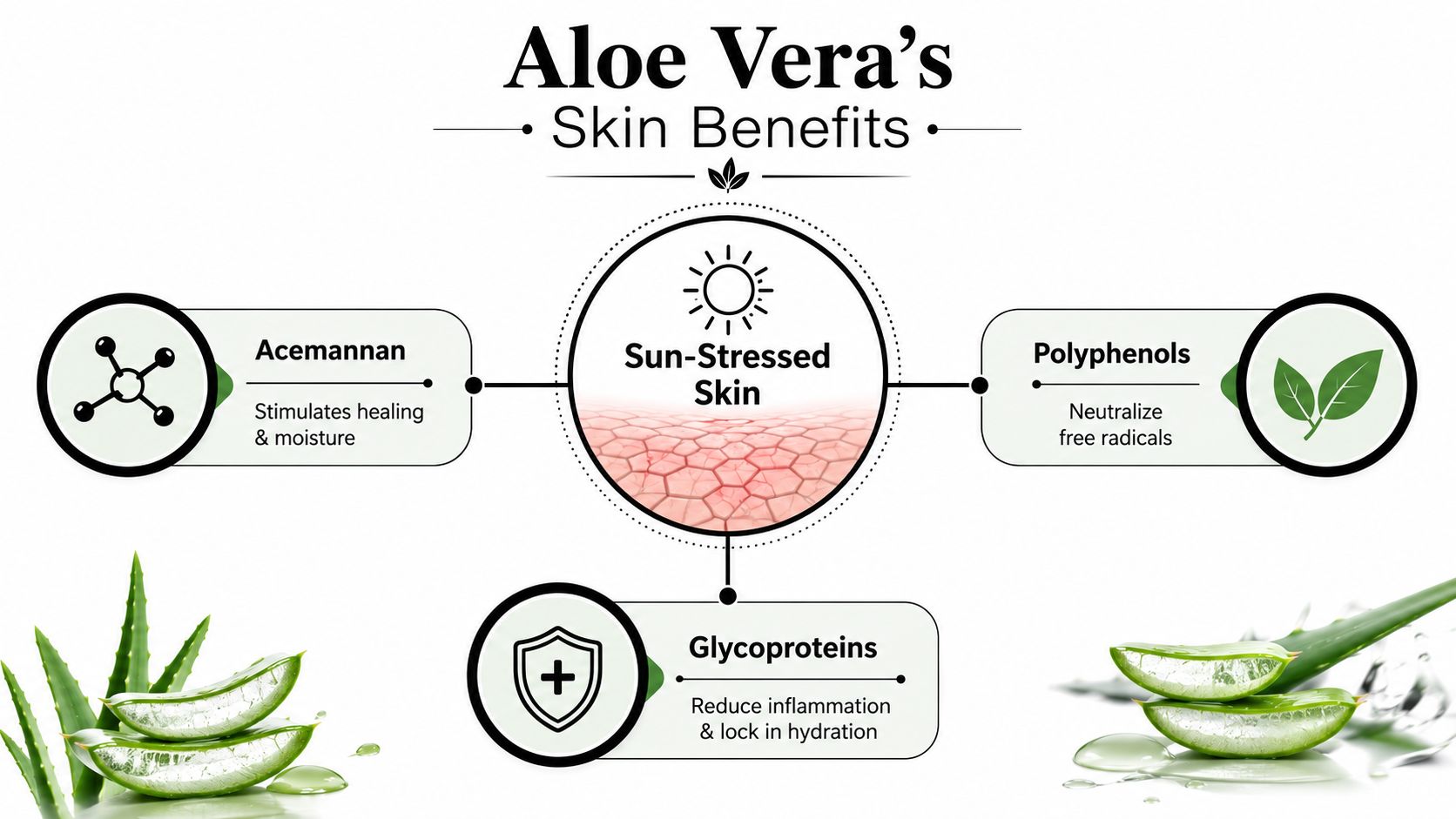
The evidence is mixed, which is why staff need to speak with precision. One randomized study of a 97.5% aloe vera gel found a significant reduction in UV-induced erythema after 48 hours, and the effect was described as superior to 1% hydrocortisone in a placebo gel, while another clinical trial found aloe vera cream had no efficacy in sunburn treatment compared with placebo and no sunburn or suntan protection (PubMed study on aloe vera and sunburn). A 2022 review also noted that only aloe vera gels standardized to ≥0.4% acemannan and ≥0.05% polyphenols showed measurable acceleration of re-epithelialization, while non-standardized products behaved like placebo (2022 evidence summary on aloe vera gels).
For Swiss retailers, that distinction is the practical benchmark. A gel with a clear aloe profile and controlled composition can be presented as a soothing post-sun product, while an unstandardized formula is closer to a cosmetic comfort item with less predictable support. The same review reported 92.4 ± 14.7 hours for complete re-epithelialization with aloe versus 95.1 ± 16.3 hours for placebo, a difference that was not statistically significant (p = 0.18), so it is safer to explain the category as supportive rather than corrective.
Why customers feel relief first
Early comfort is where aloe tends to make the clearest impression. The same 2022 summary reported 42% pain reduction at 6 hours versus 18% for placebo (p < 0.001) and a 29% reduction in peak erythema at 24 hours (p = 0.003). That pattern helps explain why shoppers often describe the product as calming before they see any visible change in the skin.
The simplest way to explain it is to compare the gel to a cooling compress that also leaves a light hydrating film. It does not erase sun exposure, but it can make hot, tight skin feel more manageable while the surface recovers. For a retailer, that is the clean message to repeat, comfort first, hydration support second, and no promise of repair beyond what the evidence supports.
Practical rule: sell the gel for soothing, hydration, and comfort, then direct severe burns, blistering, or spreading redness to medical care.
Independent medical guidance reaches the same conclusion. Cleveland Clinic notes that aloe may feel soothing, but it does not reverse sun damage or work better than placebo for sunburn recovery (Cleveland Clinic guidance on aloe vera for sunburn). For Swiss shoppers who expect careful product claims, that makes the category easier to position accurately, especially when the shelf talker focuses on comfort, not cure.
Key Ingredients and Formulation Essentials
A premium gel works like a small system, not a single hero ingredient. Aloe Barbadensis Leaf Juice forms the soothing base, glycerin helps hold water at the skin surface, and carbomer or xanthan gum gives the product its gel structure. Optional additions such as vitamin E, allantoin, niacinamide, or tea tree oil can extend what the formula does, but they also change how well different shoppers tolerate it, so the whole blend has to be judged together.
For Swiss buyers, the technical checkpoint is stability. A benchmark aloe vera after-sun gel shows a pH of 6.0–7.0, 5–10% solids, successful freeze/thaw stability over 3 cycles, and 1-month stability at 4°C and 43°C (stable aloe vera after-sun gel benchmark). That matters because the product may move from cool storage to a warm shelf, then into a suitcase or poolside bag.
| Formulation Component Overview | ||
|---|---|---|
| Ingredient | Function | Typical % |
| Aloe Barbadensis Leaf Juice | Soothing base, water binding, post-sun comfort | Varies by formula |
| Glycerin | Humectant, supports hydration | Varies by formula |
| Carbomer | Gel network, viscosity control | Varies by formula |
| Xanthan Gum | Stabilises texture, improves slip | Varies by formula |
| Vitamin E | Antioxidant support | Varies by formula |
| Allantoin | Comfort and skin-conditioning support | Varies by formula |
| Niacinamide | Barrier-supportive cosmetic active | Varies by formula |
What the benchmark tells you in practice
A neutral to slightly acidic gel base helps the product feel comfortable on compromised skin while still keeping its shape and clarity. The benchmark source also reports a clear gel appearance at 25°C, which matters on a pharmacy shelf because visual clarity signals cleanliness and low particulate load. That is not just about appearance, it also shapes how customers judge quality at first glance.
A buyer can use that as a simple mental check. If the formula looks steady in storage and stays clear under normal handling, it is more likely to behave well in a Swiss retail setting where temperature changes are part of daily life.
If the supplier cannot explain pH, stability, and texture control, the formula probably is not ready for a premium Swiss shelf.
Buyers should ask for finished-product stability data, not just raw-ingredient claims. A tube that looks good but separates in summer heat will create returns and customer complaints that cost more than the margin it saved. In this category, formulation discipline is part of merchandising, because the product has to withstand the same conditions as the customer who buys it.
Safety and Contraindications to Watch
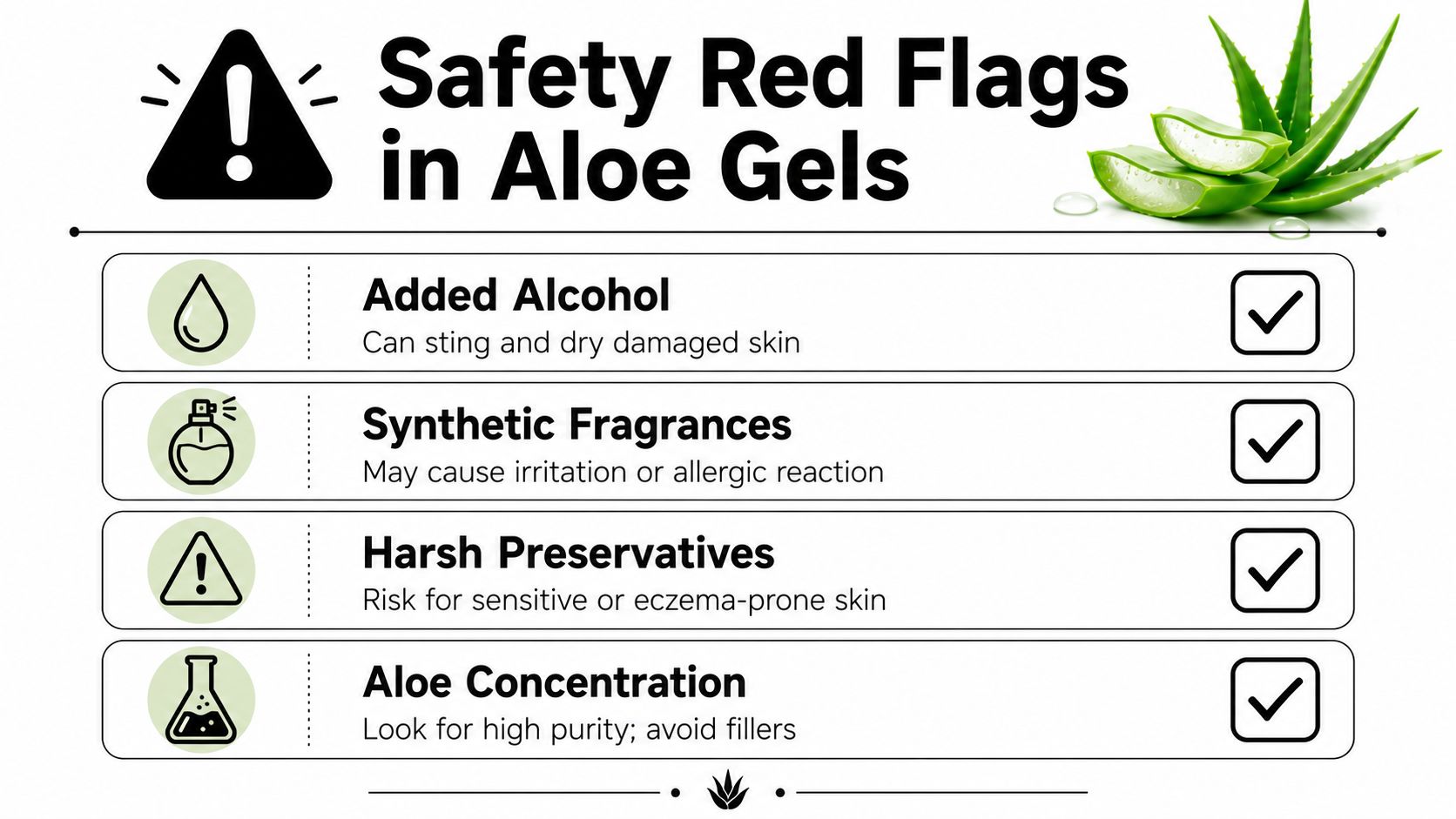
The biggest mistake is assuming that every aloe gel is automatically gentle. Pure aloe can be comforting, but finished products often include alcohols, fragrance, or preservatives that sting skin that's already sun-stressed. Clinical-style advice warns that alcohol-containing aloe products can irritate already-burned skin, which is why fragrance-free and preservative-safe formulas matter for reactive shoppers (medical guidance on aloe vera for sunburn).
Reading the INCI list like a buyer
Retail staff don't need to memorise every formula, but they do need a quick screening habit. Look for products that are clearly positioned for sensitive skin, then check the INCI list for obvious irritants. If a shopper mentions eczema, rosacea, or a history of stinging with leave-on products, steer them away from heavily fragranced gels and toward the simplest formula available.
A practical filter helps:
- Added alcohol: can sting and dry damaged skin, especially on hot, pink areas.
- Synthetic fragrance: may trigger irritation or an allergic response on compromised skin.
- Harsh preservatives: can be a problem for eczema-prone or highly reactive users.
- Low aloe emphasis: when aloe is buried under fillers, the soothing story gets weaker.
The retail lesson is straightforward. A gel that feels luxurious on intact skin may feel sharp on sunburned skin, so texture alone can be misleading. For Swiss outlets serving families, spa guests, and sensitive-skin customers, fragrance-free and minimalist formulations are usually the safer recommendation.
Certifications Sourcing and Ethical Standards
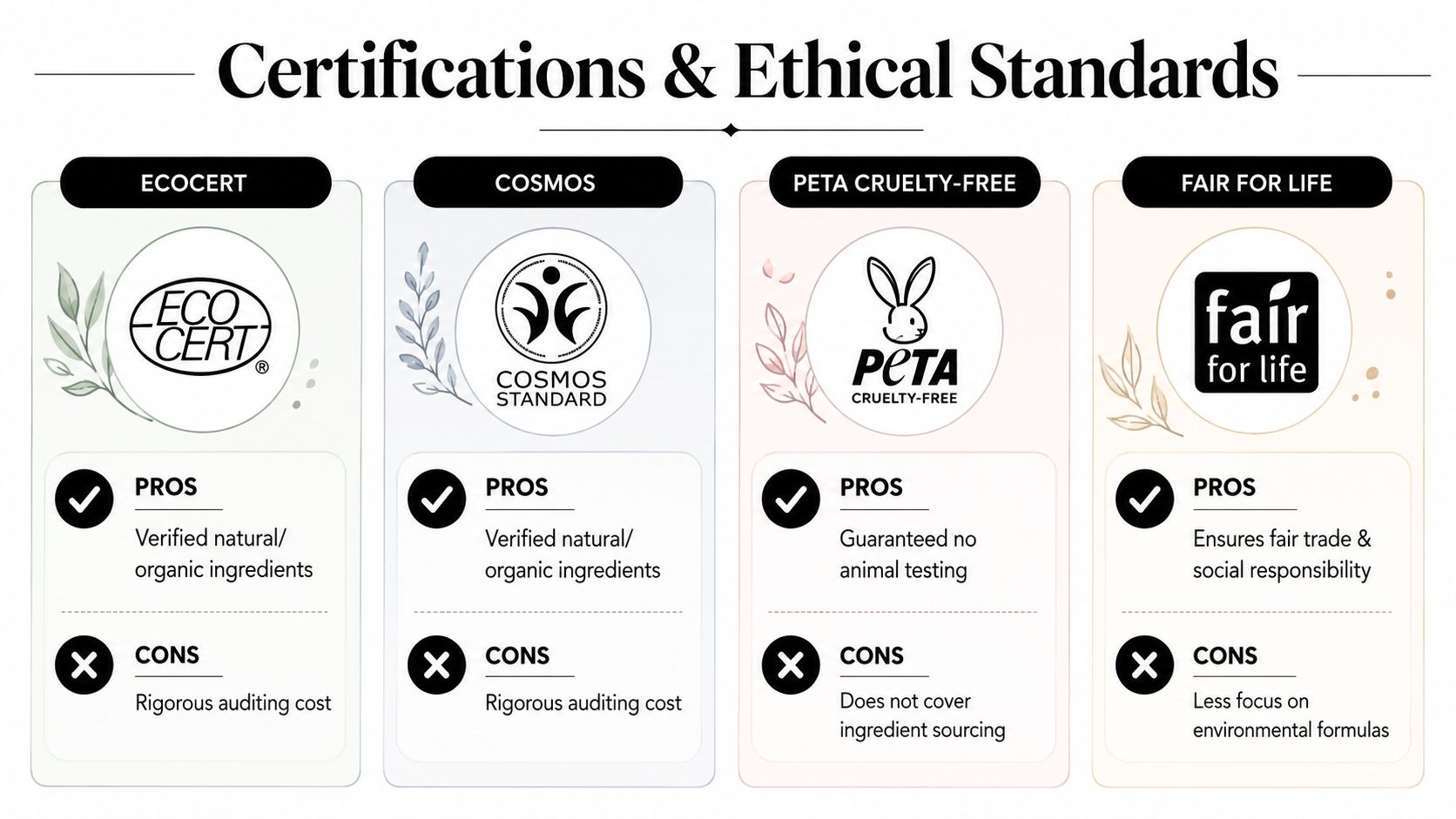
Swiss shoppers often read a seal before they read the ingredient list. That makes certification a trust signal, not decoration. In this category, ECOCERT and COSMOS support the natural-beauty story, while cruelty-free and fair-trade labels help shoppers judge the ethics behind the formula as well as the formula itself.
A local buying lens matters here. Many Swiss retailers prefer ECOCERT-certified natural cosmetics because the label points to ingredients of natural origin and tighter rules around what can go into the product, which supports premium positioning (Swiss retailer certification context). That fits the shopper who wants an aloe gel that feels clean, transparent, and credible on the shelf.
How to compare the labels
ECOCERT and COSMOS work best when the customer wants reassurance about natural origin and stricter ingredient rules. Their trade-off is straightforward, compliance and auditing ask more from the supplier, so these labels usually fit premium assortments better than discount bins. PETA Cruelty-Free supports the no-animal-testing message, while Fair for Life strengthens the social-responsibility story by focusing on fair trade and ethical supply chains.
For buyers, the better question is not which label sounds best. It is which label matches the promise on the pack. A minimalist aloe gel in a premium pharmacy feels more coherent when its certification, texture, and ingredient list all point in the same direction. That coherence also helps staff explain the product in one sentence instead of three.
For merchandising, certification should not sit in isolation. Pairing a clear label story with shelf placement and packaging that feels credible gives the customer a faster read on quality, much like a clean front label helps them trust what is inside before they open the tube. For format and shelf presentation ideas, MSP Packaging's retail guide is a useful reference for Swiss spas and pharmacies that want the shelf to do some of the explanation work.
Selecting and Merchandising for Swiss Spas and Pharmacies
Aloe gel sells best when it's placed where the customer already feels the need. Put it beside sunscreens, alongside post-travel travel-size essentials, or next to cooling body products in summer displays. The product should look like the obvious answer for redness, heat, and tight skin, not like an afterthought.
The clinical reality should shape the sales pitch. Despite high UV indices in Swiss summers, at least one controlled study found aloe cream had no sunburn-treatment benefit versus placebo, which is why staff should position gels as symptom relief rather than cure (PubMed study on aloe vera and sunburn). That message protects trust and keeps expectations grounded, especially in premium stores where shoppers ask sharper questions.
For merchandising inspiration on packaging formats and shelf presentation, a useful reference is MSP Packaging's retail guide. It's a practical reminder that the right tube, label, and shelf-blocking strategy can make a natural product feel more credible before anyone opens it.
A simple buyer checklist
- Clinical backing: choose formulas with some evidence behind the soothing claim.
- Stability data: ask suppliers how the gel holds up in heat and cold.
- Sensitive-skin fit: favour fragrance-free, low-irritant options.
- Certification: match the seal to the channel, premium, spa, or family pharmacy.
- Staff script: teach teams to say relief, hydration, and comfort, not cure.
Year-round placement makes sense too. Swiss customers don't only need after-sun care in July, they need it whenever outdoor exposure, travel, or mountain weekends leave skin overheated. If you want a retail range that fits that reality, build around formulas you can explain confidently, then visit beautysecrets.agency to explore Swiss-ready natural and ethically sourced beauty assortments that align with premium after-sun merchandising.