
You're standing at a pharmacy counter in Zürich, prescription in hand, when you notice that something doesn't look right. You know what you want to ask, yet your jaw tightens, the sentence gets rehearsed, and the moment passes. Or perhaps you're leading a meeting in Geneva, hear the answer forming in your mind, and stay quiet while someone else says something similar.
These moments aren't proof that you're weak, unprepared, or lacking personality. They show a gap between knowing what you think or need and expressing it clearly. In Swiss clinical practice, affirmation de soi is treated as a trainable behavioural skill. It can be practised through words, posture, role-play, and small everyday rituals, including a quiet sensory practice such as Aroma Warehouse voice support incense when used as a personal cue to pause and find your words.
When Speaking Up Feels Harder Than It Should
The difficulty often arrives before the conversation begins. You may notice a shallow breath while waiting for your turn, a lowered gaze when someone senior enters the discussion, or a polished sentence that never reaches your lips. The body has already interpreted the exchange as risky, even when the request itself is ordinary.
A woman checking a prescription might worry about appearing difficult. A project lead may fear that correcting a colleague will sound confrontational. Someone discussing body changes with a healthcare professional might decide that discomfort is easier than asking a direct question. These choices can look small from the outside, but repeated silence can leave people feeling overlooked, resentful, or disconnected from their own preferences.
A useful distinction: Feeling nervous doesn't cancel your right to speak clearly.
Affirmation de soi doesn't require a forceful voice or a dramatic personality change. It means identifying what matters in the moment and communicating it with respect for yourself and the other person. “I'd like to check this dosage before I leave” is assertive. So is “I have another priority today, so I can't take this on without changing the deadline.” Neither statement attacks anyone.
The pause between reaction and response
A practical way to understand the skill is to notice the pause between an external event and your response. Someone makes a request. Your mind predicts disappointment. Your body prepares to comply or withdraw. Training creates a small space in which you can name the facts, identify your need, and choose a response rather than following the first impulse.
That process is especially relevant in Switzerland, where communication can vary across language regions, workplaces, generations, and social settings. A sentence that feels natural in one environment may feel too direct in another. The answer isn't to erase your identity or copy a louder style. It's to develop wording that remains honest, calm, and recognisably yours.
The pages ahead focus on practical application. You'll find a clinical definition, ready-to-adapt English and French scripts, common misconceptions, and ways wellness brands can turn the skill into a respectful ritual rather than an empty confidence message.
What Affirmation de Soi Means
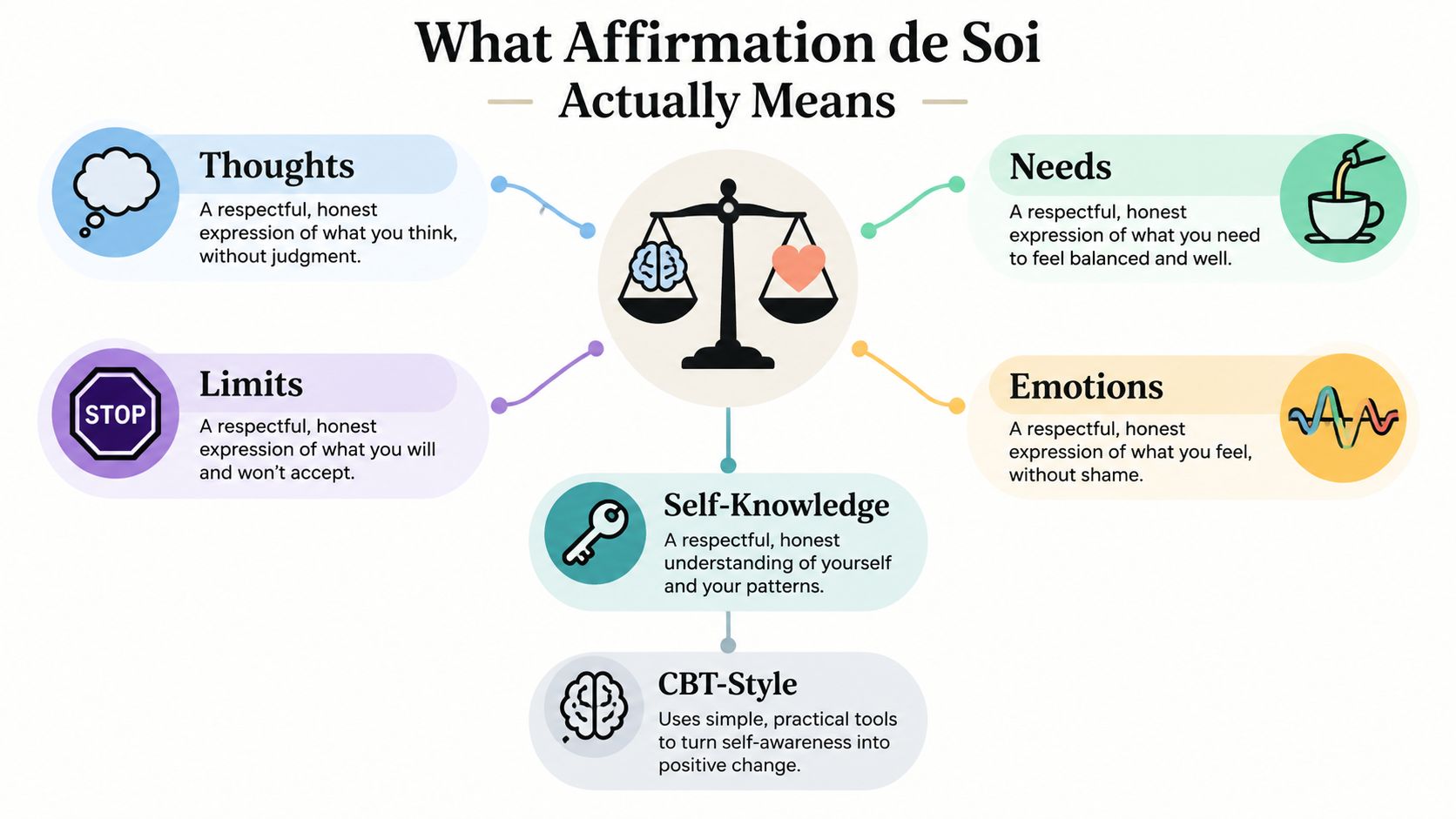
Affirmation de soi is the respectful expression of your thoughts, emotions, needs, and limits. It is a behaviour, not a permanent feeling. Uncertainty can be present while you still say what needs to be said.
Swiss university-hospital materials describe the skill as expressing thoughts, emotions, and needs directly while respecting other people. Clinical group programmes use structured CBT methods, including psychoeducation, role-play, and video rehearsal, so participants can practise assertive responses in different social situations. These programmes commonly work with cohorts of 4 to 9 participants across 14 sessions, as described in the Swiss clinical programme material.
A calm inner barometer
Affirmation de soi functions like a calm inner barometer. A barometer does not create the weather or argue with the sky. It helps you notice what is happening before you choose a response. That small ritual turns a clinical skill into something you can use before a conversation, a treatment appointment, or a wellness purchase.
Ask yourself:
- What am I thinking? “This instruction seems different from what was agreed.”
- What am I feeling? “I'm anxious and slightly irritated.”
- What do I need? “I need clarification before I continue.”
- What limit matters? “I can't discuss this properly while being interrupted.”
Your answer does not need to become a long explanation. A short, accurate sentence often communicates more clearly than an elaborate defence.
More than confidence
Confidence is often the feeling that you can manage a task. Positive thinking tries to influence your thoughts through encouraging statements. Affirmation de soi describes what you do in the interaction. You may feel unsure before asking a doctor to repeat an explanation, yet still say, “I haven't understood that part. Could you explain it again in simpler terms?”
The skill also protects the relationship. It keeps communication from becoming either self-erasure or an attempt to overpower someone. Your needs matter, while the other person remains a person rather than an obstacle. For wellness brands, this distinction matters: a product ritual can invite a pause, help someone name a need, and support a clear choice, rather than selling confidence as a mood.
The Psychology Behind Confident Self-Expression
Three ideas help explain why affirmation de soi can be practised rather than wished for. Assertiveness training focuses on observable behaviour. You rehearse a sentence, adjust your posture, listen to the reply, and try again. Swiss clinical programmes use role-play and video-based rehearsal because a person needs more than an intellectual definition. They need repeated experience of expressing themselves while remaining safe and respectful.
Self-determination adds the question of agency. Swiss Life's Self-Determination Barometer found that 83% of Swiss residents considered self-determination a fundamental need linked with satisfaction, optimism, and reduced stress, while 61% said they led a self-determined life in 2020. The reported share was 63% in 2021 and 61% in 2023, showing a broadly stable baseline across the surveyed waves (Swiss Life's 2023 barometer). The practical meaning is simple: people need to experience choice, not merely hear that they should be more confident.
Switzerland's wider well-being context reinforces that interpretation. In the Federal Statistical Office's SILC reporting, 73.4% of the population said they felt happy most or all of the time in 2021, while 3.9% rated their health as bad or very bad. In 2022, 37.9% of people aged 16 and over were very satisfied with their current life, and the average life-satisfaction score was 8.0, compared with an EU average of 7.3 (Federal Statistical Office data). These figures don't mean every person feels secure in every conversation. They provide a useful social backdrop for understanding affirmation as part of agency and perceived place in society.
| Pillar | Core idea | Why it matters |
|---|---|---|
| Assertiveness training | Practise direct, respectful behaviour | Turns intention into a response you can use under pressure |
| Self-determination | Name choices, needs, and personal direction | Supports agency instead of automatic compliance |
| Relatedness | Stay connected while expressing a difference | Keeps honesty from becoming hostility or withdrawal |
The role of psychological context
Self-affirmation doesn't guarantee that another person will be persuaded. A Swiss academic presentation describing a prevention study reported that self-affirmed participants judged a health poster as less convincing, credible, and effective than smokers in the comparison condition, concluding that self-affirmation didn't increase preventive-message efficacy in that setting (Swiss academic presentation). This is an important boundary. Affirmation may reduce defensiveness in some contexts, but it can also change how forcefully a message is received when people feel threatened or ready to argue.
Wellness routines should therefore support reflection, not promise psychological transformation. A calming practice may help someone settle before speaking, just as resources discussing anxiety relief with red light can prompt consumers to examine claims carefully. The behavioural step remains personal and concrete: notice, choose, express.
Affirmation Templates You Can Use Today
A useful template contains three parts: your observation, your experience or need, and your request or boundary. Keep it specific. “I want to be more confident” is too broad to guide behaviour. “I need time to review this before I agree” tells you exactly what to say.
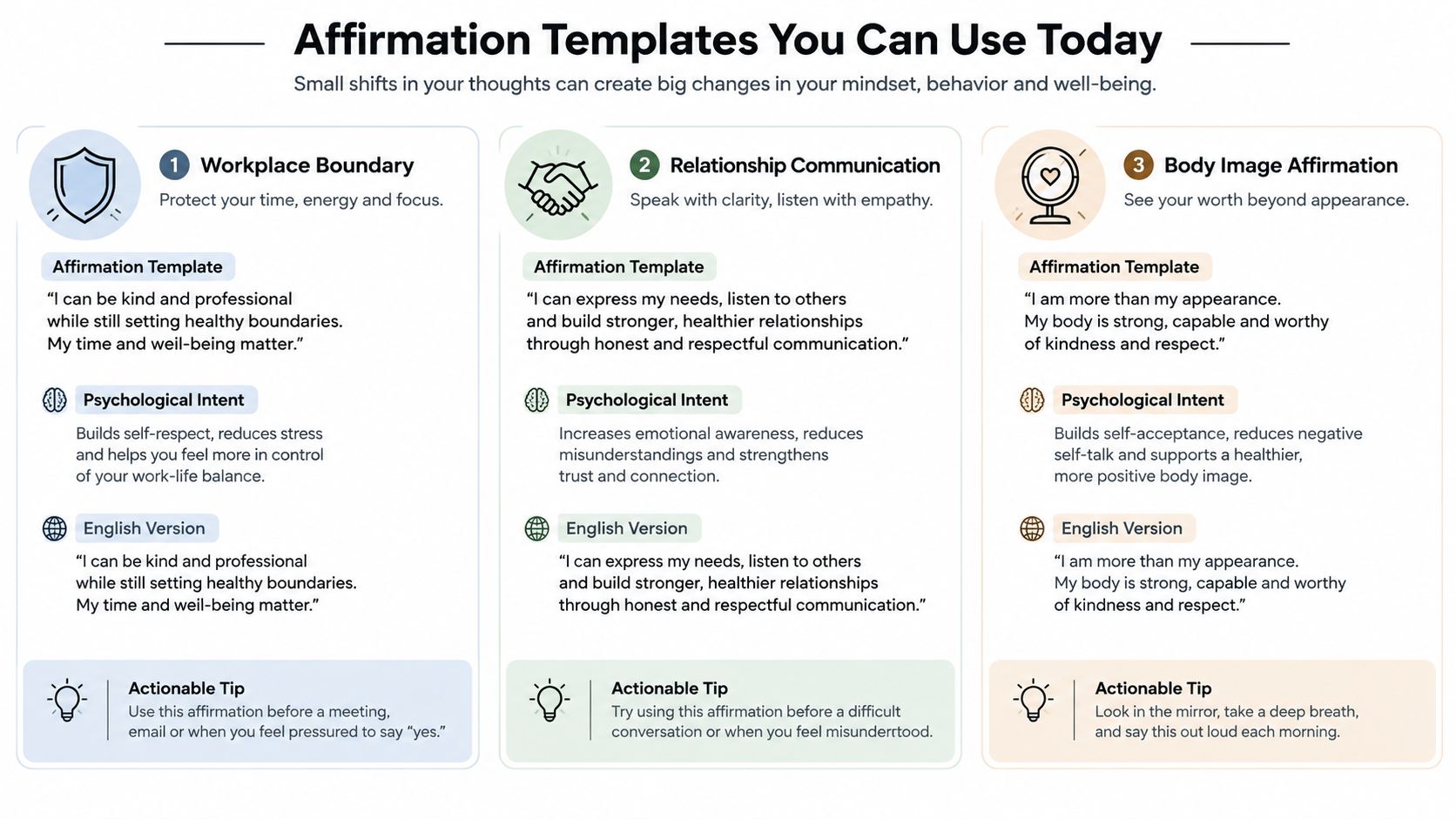
At work
English: “I'm working on [specific priority]. I can take this on if we move [existing task] or adjust the deadline. Which option would you prefer?”
French: “Je travaille actuellement sur [priorité précise]. Je peux prendre cette tâche si nous déplaçons [tâche existante] ou si nous adaptons le délai. Quelle option préférez-vous ?”
The intent is to set a boundary without blaming a colleague. Replace the brackets with real details before the meeting. If you need a moment, say, “I'd like to think about that and come back to you this afternoon,” or, “J'aimerais y réfléchir et revenir vers vous cet après-midi.”
In a relationship
English: “When [specific situation] happens, I feel [emotion]. I need [clear need], and I'd like us to [practical request].”
French: “Quand [situation précise] se produit, je me sens [émotion]. J'ai besoin de [besoin clair] et j'aimerais que nous [demande concrète].”
For example: “When plans change without telling me, I feel unsettled. I need more notice, and I'd like us to send a quick message.” The sentence describes your experience rather than assigning a character judgement.
With body image
English: “My body doesn't need to earn care. Today I choose [supportive action], without comparing myself with anyone else.”
French: “Mon corps n'a pas besoin de mériter les soins. Aujourd'hui, je choisis [action bienveillante], sans me comparer aux autres.”
The aim isn't to force admiration. A believable statement can acknowledge neutrality: “My body is here with me today, and I can treat it with respect.” Use it while applying skincare, getting dressed, or preparing for an appointment.
Speak slowly enough to hear your own words. Keep your shoulders relaxed, look towards the person rather than at the floor, and avoid adding several apologies after a clear request. A morning skincare ritual can provide a consistent cue, but the product is only the reminder. Your action is the sentence and the boundary that follows it.
Common Misconceptions and Quieter Truths
Affirmation de soi is often confused with performance. The louder person in a room may be dominating the exchange, not expressing themselves well. A quiet person may be highly assertive if they state a position clearly, listen to the response, and maintain their boundary.
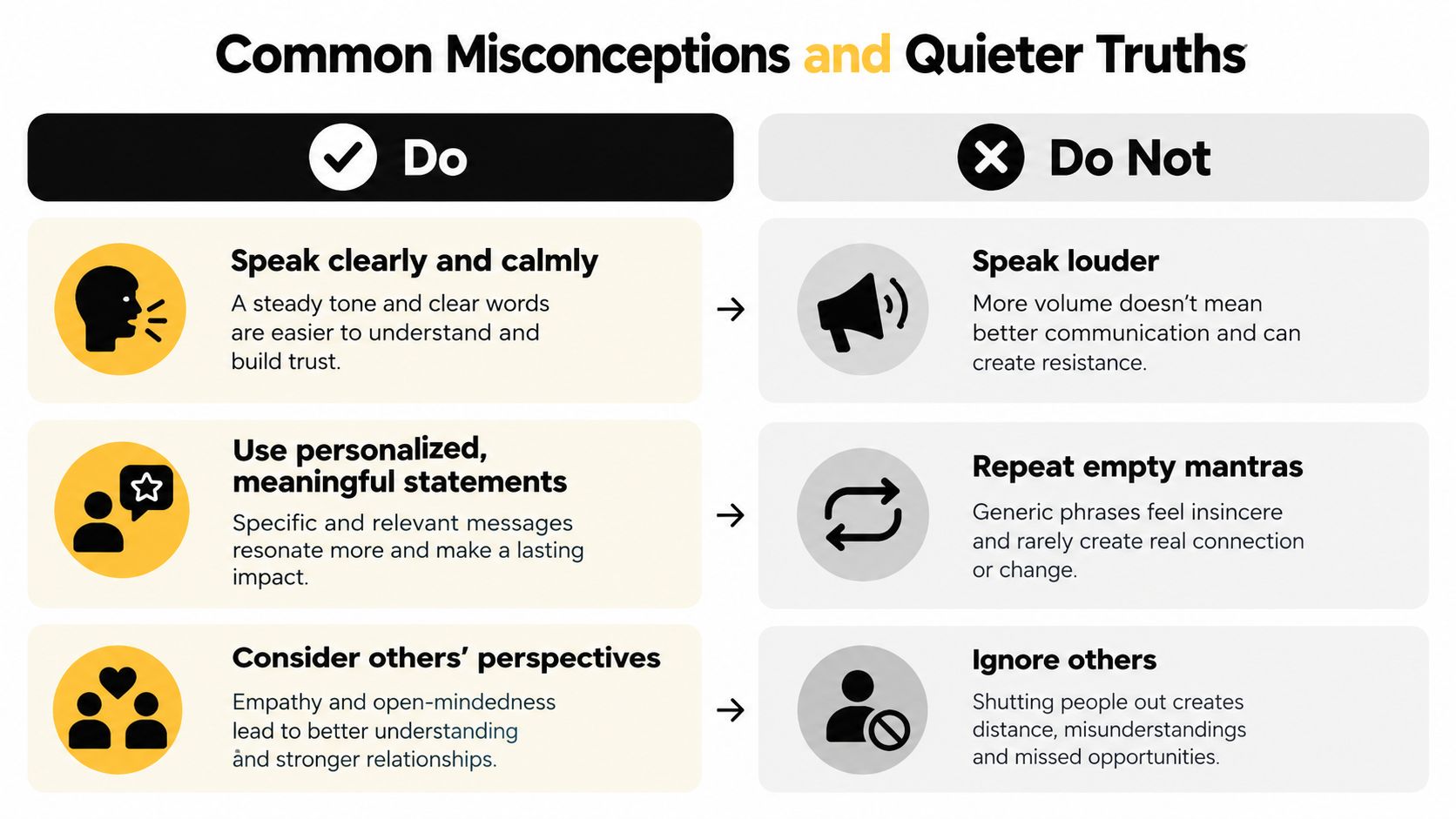
| Do | Do not |
|---|---|
| Speak clearly and calmly | Speak louder to force attention |
| Use a meaningful statement | Repeat an empty mantra you don't believe |
| Name your own experience | Ignore the other person's perspective |
| Set a specific limit | Expect others to guess what you need |
| Allow disagreement | Treat disagreement as rejection |
A mantra can be useful when it reflects a real value. “I can ask for clarification” is more actionable than a broad declaration that you're perfect. The first phrase prepares a behaviour. The second may feel disconnected from the situation, especially if your body is tense and your mind expects criticism.
The quieter truth: Assertiveness can sound measured, reserved, and kind.
Another misconception is that respecting others means putting their comfort first every time. Listening matters, but listening doesn't cancel your limit. You can understand why a colleague is under pressure and still say that you can't complete an additional task without changing another commitment.
The clinical view is balanced. Passivity hides your needs. Aggression dismisses someone else's needs. Affirmation de soi holds both in view and accepts that an honest conversation may remain uncomfortable. That discomfort is not proof that you've done something wrong.
Bringing Self-Affirmation into Wellness Rituals
A wellness ritual gives the skill a physical setting. Warm water, a massage, or the familiar sequence of cleansing and moisturising can slow the pace enough for you to notice your needs before moving into the next task. The ritual doesn't create confidence by itself. It offers a repeatable moment for practising attention, language, and choice.
Bathing as a pause
A bath can begin with one sensory observation: warmth on the hands, the scent of the water, or the feeling of the shoulders lowering. Pair it with a sentence that doesn't demand positivity, such as, “I'm allowed to pause before I answer.” The statement supports a practical choice, including delaying a message, asking for time, or declining a request.
Brands can include a small printed card inside a bath product, with bilingual wording that invites rather than instructs. “I give myself permission to pause” and “Je m'autorise à faire une pause” work because they leave room for the customer's own meaning.
Massage and embodied awareness
A therapist can ask about pressure, temperature, silence, and conversation before treatment. During the session, a simple check-in such as “Would you like me to adjust anything?” teaches that comfort and boundaries can be communicated without embarrassment.
After treatment, the therapist might offer a neutral reflection: “What would you like to take with you from this moment?” The question doesn't diagnose, interpret, or promise a mental-health outcome. It returns agency to the client.
Clean beauty without the lecture
A skincare routine can connect sensory grounding with body respect. A product story might focus on texture, hydration, ingredients, origin, and the pleasure of applying it. It can then offer a gentle prompt: “What does your skin need today?” That wording recognises that needs change and avoids suggesting that appearance determines worth.
A mirror decal in a spa or changing area could use restrained bilingual phrasing, such as “I can care for myself without comparison” and “Je peux prendre soin de moi sans me comparer.” The message should be easy to ignore if the customer doesn't want reflection. Good wellness communication creates an invitation, not a new obligation.
How Swiss Spas and Retailers Can Lead
Swiss spas, pharmacies, drugstores, hotels, and clean-beauty retailers can make affirmation de soi practical by designing the interaction around choice. The experience should never imply that a serum, facial, or bath product treats anxiety or creates self-worth. It can support a pause in which the client identifies comfort, preference, and intention.
A multilingual staff checklist
Train staff to use the same underlying concept across French, German, and Italian settings, while allowing each language to sound natural. Formal address may be appropriate, and some clients will prefer privacy over personal discussion.
- Explain, don't prescribe: Present the ritual as an optional moment of reflection.
- Offer language choice: Ask whether the client prefers French, German, Italian, or English where available.
- Invite rather than interpret: Use open questions instead of telling someone what they feel.
- Respect silence: A customer can choose quiet, guidance, or no reflection.
- Avoid treatment language: Don't imply that a product replaces psychological or medical care.
A staff member might ask, “What would you like to acknowledge about yourself today?” Another option is, “Would you prefer quiet, guidance, or a short reflection?” In French, a formal version could be, “Souhaitez-vous du calme, des explications ou un court moment de réflexion ?” The wording remains gentle because the client can decline.
A three-step ritual
- Settle the body. Offer water, a quiet seat, a warm towel, or a sensory cue.
- Notice one personal strength. This might be patience, care, persistence, or the ability to ask for help.
- Choose a practical intention. “I'll tell the therapist if the pressure is uncomfortable” is more useful than a vague promise to feel better.
Retail teams can pair a clean-beauty product with an honest story about texture, hydration, bathing, or self-care. A spa facial can also be presented through practical service guidance, including affordable spa facial insights, without turning the experience into a claim about emotional transformation.
Measure usefulness through optional feedback about comfort, clarity, and whether the client felt able to choose. Don't claim clinical improvement unless qualified professionals and appropriate evidence support that claim. Affirmation de soi should make the customer's agency more visible, not make the purchase feel compulsory.
A Simple Starting Point for This Week
Choose one setting, not your whole personality. It might be the next team meeting, a pharmacy counter, a family conversation, or a medical appointment. Beforehand, identify what makes speaking difficult. Are you worried about disagreement, unsure of your need, concerned about judgement, or accustomed to putting everyone else first?
Write one sentence that feels true enough to use. “I may feel uncertain, and I can ask for a moment to respond” is grounded because it doesn't pretend anxiety has vanished. Then attach the sentence to one behaviour:
- Ask a clarifying question before agreeing.
- Say no without adding a long defence.
- State a preference in one clear sentence.
- Make eye contact briefly and keep your voice steady.
- Request a pause when you need time to think.
Pair the practice with something already in your day. While applying a clean-beauty product, bathing, or stretching, say, “I care for my body,” followed by, “I can choose what happens next.” Keep the words believable. If a sentence feels false, make it smaller and more precise.
Record three observations: what you expressed, how your body felt, and what you'd like to practise next. At the end of the week, keep only the phrase or action that felt useful. If self-expression consistently causes significant distress, disrupts daily life, or involves trauma, bullying, or a mental-health concern, seek qualified professional support. Affirmation de soi is a life skill, not a substitute for care.
For Swiss beauty and wellness businesses, the same principle becomes a thoughtful customer experience: give people language, sensory space, and genuine choice without overpromising. Start with one script, one ritual cue, and one respectful invitation.
beautysecrets.agency helps Swiss pharmacies, retailers, spas, hotels, and clean-beauty partners build thoughtful assortments around natural, ethically sourced skincare and sensorial wellness rituals. Visit beautysecrets.agency to explore brand partnerships that make self-care feel tangible, transparent, and respectful of every customer's needs.