A pharmacy buyer in Zurich, Bern, or Geneva usually doesn't need another generic shampoo explanation. The practical question is harder: does I Am shampoo earn its shelf space, attract the right shopper, and remain straightforward to manage under Swiss cosmetic rules? The answer depends on price architecture, variant clarity, ingredient communication, and whether the line complements your existing assortment rather than merely adding another bottle.
I Am sits in a useful middle ground. It has the accessibility of a mainstream retail product, natural-haircare cues that support a mass-premium story, and enough Swiss distribution evidence to merit serious consideration. It isn't a substitute for a clinically positioned scalp treatment or a prestige salon line. For the right pharmacy, drugstore, spa shop, or online reseller, however, it can be a credible everyday entry point.
What I Am Shampoo Means for Swiss Buyers
A Swiss buyer assessing I Am shampoo should begin with the shelf role, not the brand story. The range already has consumer-facing visibility through Migros and Migipedia, including German and French product pages. That reduces the education burden compared with an unfamiliar imported label. Shoppers may recognise the bottles from supermarket or drugstore browsing, while pharmacy staff can present them as accessible everyday haircare rather than a niche experiment.
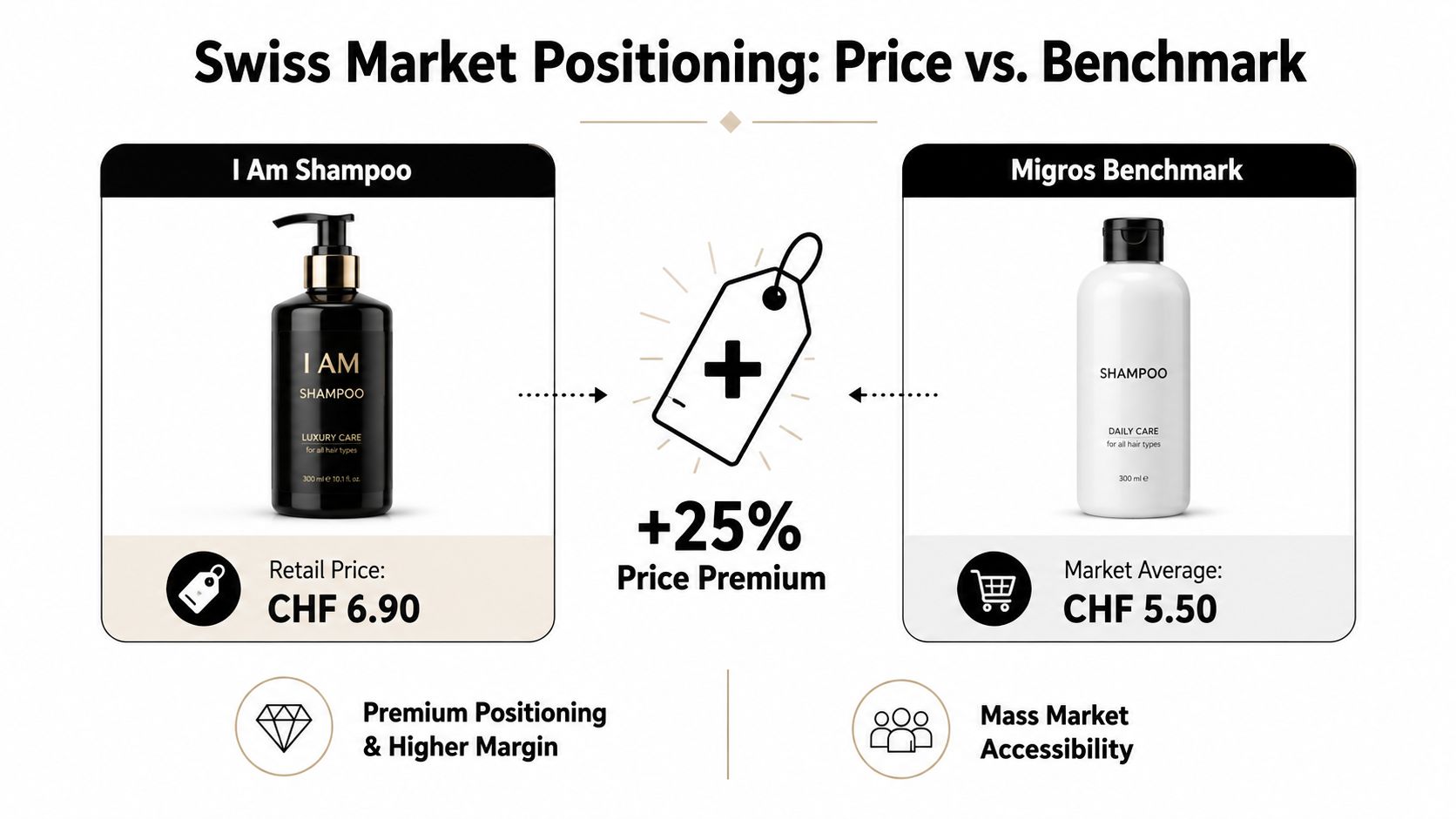
The retail reference point is clear. Several I Am natural cosmetics variants, including Repair Shampoo for dry and damaged hair and Volume Shampoo for fine, lifeless hair, are listed at CHF 5.50 for 250 ml on the Swiss market. This equals CHF 2.20 per 100 ml, a practical benchmark for assessing an accessible mass-premium position. See the pricing benchmark below for the linked market reference.
Read the route to market
The Swiss footprint extends beyond one regional listing. Migipedia records a German-language Volume Shampoo page and a French-language Hydrating Shampoo page, both using the same CHF 5.50, 250 ml format in its German product documentation. Swiss online listings also show local currency and Swiss delivery references, supporting a durable local retail presence.
That route to market gives each channel a distinct stocking rationale:
- Supermarkets and drugstores provide familiarity and direct price comparison.
- Pharmacies can add consultation around dryness, sensitivity, and ingredient preferences.
- Independent beauty retailers can create a natural-haircare tier without adopting luxury pricing.
- Spas and salons should select variants carefully, where an approachable home-care recommendation supports the treatment experience.
Private label remains the main commercial pressure. I Am needs a visible reason to sit beside a cheaper alternative, whether variant recognition, natural positioning, or a stronger consultation story. Select the variants that answer a clear consumer need, then organise the shelf so shoppers can distinguish them quickly. That is the appropriate use of the brand's familiarity.
Buyer rule: Treat I Am as a known mass-premium line with local retail proof, not as an exotic import requiring a long introduction.
Brand Positioning and Formula Philosophy
I Am's commercial strength is its balance between everyday affordability and natural-haircare signalling. The brand's language is generally more approachable than clinical dermocosmetics. It speaks to self-care, hair feel, volume, repair, hydration, and routine use. That tone helps it reach shoppers who want a formula that appears considered, but who aren't specifically seeking a dermatologist-led treatment.
The mass-premium position is visible in the combination of a standard pack format, a familiar retail environment, and a price that remains within routine purchase territory. The product doesn't need to claim prestige exclusivity. Its job is to make a natural or naturally positioned choice feel easy to try and easy to repeat.
Ingredient cues need disciplined interpretation
Trade buyers should distinguish consumer cues from proven performance claims. Aloe vera, panthenol, natural oils, biotin, keratin complexes, botanical extracts, and gentle cleansing language can help shoppers understand a range. They may suggest hydration, conditioning, softness, strengthening, or manageability in the consumer's mind. They don't automatically authorise claims about treating scalp disease, preventing hair loss, or repairing biological tissue.
A useful shelf message is descriptive:
- Aloe or botanical cues can support a fresh, caring, hydration-oriented presentation.
- Panthenol and conditioning cues can fit dry-feeling or rough hair conversations.
- Natural oils can make a nourishing or smoothing variant easier to understand.
- Biotin or keratin language should remain tied to cosmetic appearance and hair feel unless the approved product claim substantiation supports more.
- Silicone-light or silicone-free positioning, if confirmed on the current pack and formula, can appeal to shoppers who actively compare ingredient lists.
Don't assign certifications that the product packaging or technical file doesn't prove. The brief supports an ECOCERT-aware positioning angle for Swiss trade discussions, but that isn't the same as claiming every I Am SKU is ECOCERT certified. A buyer should verify the exact certification status, INCI list, claims file, and market artwork for each variant before using certification language at shelf.
Know the comparison set
In a Swiss shopper's mind, I Am may overlap with accessible natural or naturally positioned brands such as Garnier Bio, Weleda, and Lavera. The overlap is strongest around botanical imagery, ingredient awareness, and the expectation of gentler everyday care. The distinction is usually commercial rather than purely scientific: I Am can occupy a more mainstream, price-transparent position, while Weleda and Lavera may carry stronger specialist or natural-brand associations depending on the shopper and channel.
That makes I Am a useful bridge product. It can introduce a consumer to a cleaner-feeling haircare conversation without forcing an immediate move into premium pharmacy or salon pricing.
Swiss Regulatory and Compliance Essentials
Swiss shampoo sales depend on more than attractive packaging. Switzerland's cosmetic regime dynamically references the EU Cosmetics Regulation, and the Swiss Federal Food Safety and Veterinary Office states that only permitted colourants, preservatives, and UV filters may be used, while unlisted ingredients require a documented safety assessment in its guidance on regulated cosmetic substances. CMR substances in categories 1A, 1B, and 2 are prohibited in the relevant cosmetic context.
For a pharmacy buyer, the practical message is simple. A formula claim, label statement, or promotional phrase must sit on top of a documented safety and substantiation process. Product safety considers factors such as concentration, frequency of use, and application site. A shampoo is rinse-off, but that doesn't remove the need for proper review.
Check the product file before the shelf
Before listing a new variant, request and retain:
- The current INCI artwork, matched to the supplied batch and market packaging.
- Safety documentation, including the responsible party's assessment.
- Claims substantiation, especially for words such as repair, sensitive, strengthening, or natural.
- Batch and traceability information, so complaints and withdrawals can be handled quickly.
- Swiss-compliant labelling, including the information required for the intended sales channel.
Fragrance needs particular attention. SGS notes that fragrance allergens must be declared at 0.01% in rinse-off cosmetics, including shampoo in its explanation of cosmetic allergen rules. That threshold makes fragrance review operationally important for sensitive-skin assortments. A low-allergen fragrance system or fragrance-free option may be easier to place in a pharmacy environment, but staff shouldn't promise that any product is allergy-proof.
Separate supplier responsibility from retailer responsibility
If you buy through an established Swiss distributor, confirm who holds responsibility for the product on the Swiss market and who maintains the technical file. If you import, repackage, or create sample units yourself, your obligations can change. Don't assume that a product compliant in another European market is automatically ready for every Swiss presentation.
Packaging should communicate clearly to the relevant language audience, and online product pages should reproduce the same ingredient and usage information rather than relying on lifestyle copy alone. The open-jar Period-After-Opening symbol, best-before information where applicable, batch number, and directions for use all support stock control and consumer confidence. For a pharmacist or spa buyer, compliance isn't a back-office detail. It determines whether staff can recommend the product without creating avoidable risk.
Matching Variants to Scalp and Hair Profiles
For a Swiss pharmacy, variant selection should begin at the counter, not with the front label. Ask for the customer's main concern, then separate scalp condition from hair-fibre condition. A dry-feeling scalp and damaged lengths require different recommendations. Volume may improve lift while offering little comfort to a reactive scalp.
Use visible cues and direct questions. Ask whether roots become oily quickly, whether lengths feel rough after washing, whether the hair is coloured or heat-styled, and whether fragranced products cause discomfort. Keep the wording cosmetic. Use “dry-feeling”, “tight”, “rough”, or “difficult to manage”. Do not diagnose eczema, seborrhoeic dermatitis, or another medical condition at the shelf.
A fast recommendation matrix
| I Am Variant | Best For Scalp | Best For Hair | Hero Benefit Cue |
|---|---|---|---|
| Hydrating or Moisturising | Dry-feeling or comfort-seeking scalps | Coarse, thirsty, or rough-feeling lengths | Aloe, panthenol, or conditioning cues |
| Sensitive, where available and substantiated | Shoppers concerned about reactivity or fragrance | Hair needing a simpler-feeling cleansing routine | Low-allergen or fragrance-aware positioning |
| Volume | Normal scalp with fine, limp hair | Fine hair lacking body and movement | Lightweight cleansing and lift |
| Repair | Normal to dry-feeling scalp | Chemically treated, heat-stressed, or brittle-feeling lengths | Keratin, protein, or strengthening cues |
| Colour Care, where available | Normal scalp with treated hair | Coloured hair needing a care-focused routine | Colour-care and conditioning language |
| Clarifying or Balance, where available | Oily roots or heavy product build-up | Hair that feels weighed down | Freshness, balance, or residue-removal cues |
The Volume Shampoo for fine, lifeless hair and the Repair Shampoo for dry and damaged hair have clear consumer-facing roles in Swiss retail listings, as noted in the retail pricing section above. Use these names as merchandising anchors, then verify the live assortment and current claims before printing shelf talkers. Variant availability and wording must match the stock supplied to the pharmacy.
Avoid overpromising
Repair language should describe the appearance and feel of damaged hair. It should not suggest that shampoo reverses every form of structural damage. Rinse-off products can support cleansing and conditioning, while stronger repair claims require suitable evidence and approved wording.
For clients reporting persistent flaking, pain, intense itching, or suspected scalp disease, refer them to a pharmacist, doctor, or dermatologist. I Am fits everyday cosmetic care. It does not replace a clinically appropriate product.
Retail Pricing and Market Positioning in Switzerland
A pharmacy buyer should start with the channel, not the bottle. I Am sits in routine mass retail, so a pharmacy must justify its shelf price through advice, assortment clarity, and service rather than copying supermarket promotions. The benchmark cited earlier remains useful for pack-size and price checks, but this section should focus on what that benchmark means for the buying decision.
Compare the full economics across channels. Supermarket volume can support sharper promotions, while pharmacy sales must cover consultation time, slower-moving variants, and stockholding. A pharmacy can therefore accept a different margin structure if staff recommendation and targeted cross-selling produce value beyond the ticket price. Confirm landed cost, distributor terms, payment conditions, promotional support, and returns before setting the target margin.
Build the margin logic around the channel
Use a simple assortment architecture:
- Core daily SKU: Choose the variant with the broadest local demand and clearest benefit.
- Problem-led companion: Add Repair, Hydrating, or Sensitive only when staff can explain the distinction.
- Routine attachment: Pair shampoo with conditioner or treatment where the supplier assortment supports it.
- Promotion discipline: Use loyalty pricing or bundles without training shoppers to wait permanently for discounts.
Review competitor pricing, pack size, channel fees, and promotion frequency together. Buyers seeking a structured method can use resources on pricing algorithms for CPG when reviewing price changes and promotional decisions.
ECOCERT-aware positioning can support a mass-premium conversation, but certification status and approved wording must be checked for the specific product. Do not imply certification from general natural or sustainability language. Keep the commercial message aligned with the pack, the current INCI information, and Swiss allergen disclosure obligations.
The Swiss haircare market offers meaningful demand, yet buyers should avoid over-ranging. Shampoo is the largest haircare segment, representing 43.02% of 2025 value, while one forecast places the Swiss haircare market at USD 0.32 billion in 2025 and projects a -1.22% CAGR during the forecast period in the Swiss market outlook. Stock I Am where the variant gives shoppers a clear reason to choose the pharmacy, then measure sell-through before expanding the range.
Merchandising, Sampling, and Labelling for Trade Partners
I Am performs best when the shelf answers a question immediately. Group variants by consumer need, not only by colour or bottle design. Put hydration, sensitivity, volume, repair, and colour care in a sequence that lets a shopper scan from scalp concern to hair concern without reading every label.
In a pharmacy, a position near allergy-aware skincare can make sense if the packaging and claims support that context. It doesn't mean the shampoo treats allergy or that every fragrance component is suitable for every sensitive customer. The placement creates a more coherent consultation environment.
Use sampling as a controlled recommendation tool
Samples should support staff advice, not replace it. Offer single-use sachets after a consultation, with a loyalty programme, or alongside a relevant haircare purchase. Record the product name, batch reference, and distribution date according to your internal traceability process. Don't decant into unmarked containers or distribute samples without the information a customer needs for safe use.
A practical sampling card can include:
- Variant name: Match the sachet to the staff recommendation.
- Hair profile: State whether it suits volume, hydration, repair, or another cosmetic need.
- Usage direction: Keep the instruction consistent with the approved packaging.
- Ingredient access: Provide the current INCI list through the pack or product page.
- Feedback route: Tell the customer where to report irritation or an adverse reaction.
Keep e-commerce pages as transparent as shelves
Online resellers should show the full product name, pack size, current ingredient list, directions, warnings, and batch or delivery information where appropriate. If a buyer requests a Certificate of Analysis, route that request to the responsible supplier rather than uploading uncontrolled technical documents publicly.
Shipping checks matter, too. Pressurised products and alcohol-based variants can carry carrier or transport restrictions, so confirm the current formula and logistics classification before creating a nationwide delivery promise.
Trade buyers who need a stronger retail presentation should also prepare a concise buyer narrative around customer, price, proof, and repeat purchase. A structured guide to how to pitch retail buyers can help turn those points into a commercially focused proposal.
Sampling standard: Every sample should remain identifiable, traceable, and understandable after it leaves your counter.
When I Am Shampoo Fits Your Assortment
I Am shampoo fits a Swiss assortment when the buyer wants recognisable, accessible haircare with natural-positioning cues, not a medical treatment or a luxury ritual. The strongest customer is value-conscious but ingredient-aware. They want a familiar shampoo for everyday use, a clear benefit such as volume or repair, and a price that doesn't make routine repurchase feel difficult.
That profile includes families, supermarket-trained shoppers entering a pharmacy, and customers who prefer naturally positioned cleansing products without moving directly into specialist dermocosmetics. It can also include online shoppers who want to add a dependable haircare item to a broader clean-beauty basket.
Three situations where the line earns attention
Independent pharmacy rotation. Choose a focused group of high-clarity variants. Staff can recommend the product during a short consultation, particularly when the customer describes dry-feeling lengths, fine hair, or a desire for a more natural routine.
Spa and wellness retail. Use I Am as an accessible secondary tier beside a more premium anchor. It can serve guests who appreciate the treatment environment but want a practical home-care purchase rather than a prestige fragrance experience.
Online discovery bundles. Add a selected shampoo to body-care, scalp-care, or styling bundles. The standard pack format and established Swiss retail visibility make the product easier to explain to shoppers comparing several routine options.
Situations where you should choose another line
I Am is a weaker fit for customers with clinically diagnosed scalp conditions who need dermatologist-grade products and medical guidance. It also won't be the natural choice for luxury spa guests seeking a highly sensorial prestige fragrance profile, or for specialist stores built around artisan, sulfate-free, or strongly certified natural formulations.
Use this decision matrix before placing an order:
| Store Format / Customer Profile | Fit for I Am Shampoo | Rationale |
|---|---|---|
| Independent pharmacy, everyday haircare shopper | Strong | Accessible price benchmark and simple variant-led consultation |
| Drugstore with high mainstream traffic | Strong | Familiar retail context and broad consumer recognition |
| Premium spa shop | Moderate | Works as an accessible secondary tier, not always as the hero product |
| Online clean-beauty reseller | Moderate to strong | Useful for discovery bundles when ingredient and claim data are complete |
| Dermatology clinic serving diagnosed scalp conditions | Limited | Doesn't replace clinically directed scalp care |
| Artisan natural specialist | Limited | May not provide the certification or formulation story that specialist shoppers expect |
| Prestige salon targeting luxury rituals | Limited | Mass-premium positioning may sit below the desired sensory and prestige level |
Before listing, ask four questions. Does the price tier match your current shelf? Can staff identify the right variant quickly? Will the product turn often enough for its space? Can you cross-merchandise it with conditioner, body care, styling, or accessories? If the answer is yes across those points, I Am deserves a controlled trial with a tight SKU selection. If not, choose a line whose technical proof or prestige positioning better matches your customer.
Beautysecrets.agency supports Swiss pharmacies, retailers, spas, and clean-beauty e-commerce partners with natural and ethically sourced cosmetic assortments, including help selecting compliant, differentiated products for the right channel. Visit beautysecrets.agency to discuss a Swiss haircare or beauty assortment built around clear positioning, responsible sourcing, and practical retail requirements.