You're standing in a Swiss pharmacy with a basket in one hand and a product you don't recognise in the other. The label is crowded, the ingredient list is difficult to scan, and the display beside you requires several taps before it reveals anything useful. In a spa, the problem may look different. Your hands are wet, background music is playing, and you'd rather ask a question than handle a shared screen.
A natural user interface, or NUI, reduces that friction by letting people interact through familiar actions such as speaking, touching, pointing, looking, or moving. Instead of making customers learn a device's logic, the interface responds to behaviour they already understand. For Swiss pharmacies, spas, and clean-beauty retailers, that makes NUI less about futuristic hardware and more about helping customers find trustworthy information, compare products, and make confident choices.
What Happens When Technology Gets Out of the Way
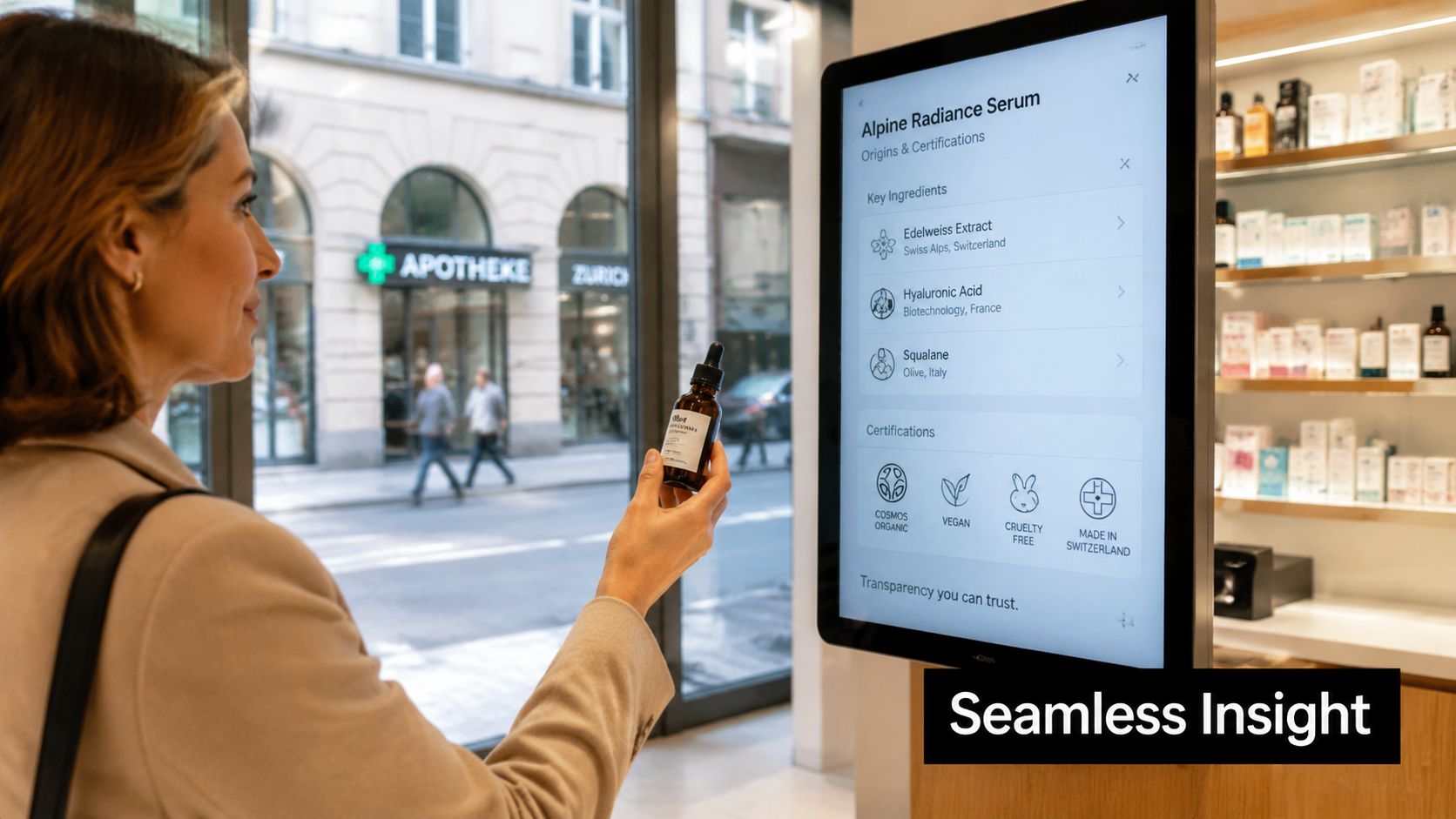
A customer picks up a natural serum and holds it towards a nearby display. The screen recognises the product and presents its ingredient origins, certifications, texture, and suitability for a particular skin concern. The customer can ask a question aloud, point to a certification badge, or use the screen directly. The experience feels less like operating a kiosk and more like receiving assistance from a knowledgeable member of staff.
That's the promise of a natural user interface. Traditional digital journeys often require customers to press a button, choose a menu, scroll through options, and confirm an action. NUI changes the starting point. It treats voice, touch, gesture, gaze, and other signals as parts of a conversation between person and system.
From digital steps to human behaviour
A voice assistant can answer a question while a customer carries products. A gesture-enabled display can support browsing without requiring contact with a shared surface. Eye tracking can help a system understand which information deserves prominence, although it must be designed carefully and transparently. Biometric signals may support personalised experiences, but they also introduce serious consent and privacy obligations.
The technology shouldn't be added just because an interaction looks impressive in a demonstration. It should remove a specific obstacle. In a pharmacy, that obstacle might be product discovery. In a spa, it could be contactless browsing. In clean-beauty e-commerce, it might be the difficulty of judging texture, provenance, or routine compatibility from a flat product page.
Swiss adoption suggests that customers are already familiar with voice interaction. A representative 2018 Swiss survey found that 37% of the population used voice functions, while the same study projected that 62% would use them regularly within 12 months (University of Lucerne coverage of the Swiss voice-interface survey). That doesn't mean every retailer needs a voice kiosk. It does mean speech can be a credible customer pathway rather than a novelty.
Start with the experience, not the device
Retailers exploring adaptive interfaces can benefit from understanding how to build with DOM Studio, particularly when an interface needs to respond to changing customer intent rather than display the same fixed journey to everyone.
The strongest NUI concept is often the least visible one. Customers should remember that they found the right serum, understood a product's certification, or received useful advice. They shouldn't have to remember which sensor or algorithm made that possible.
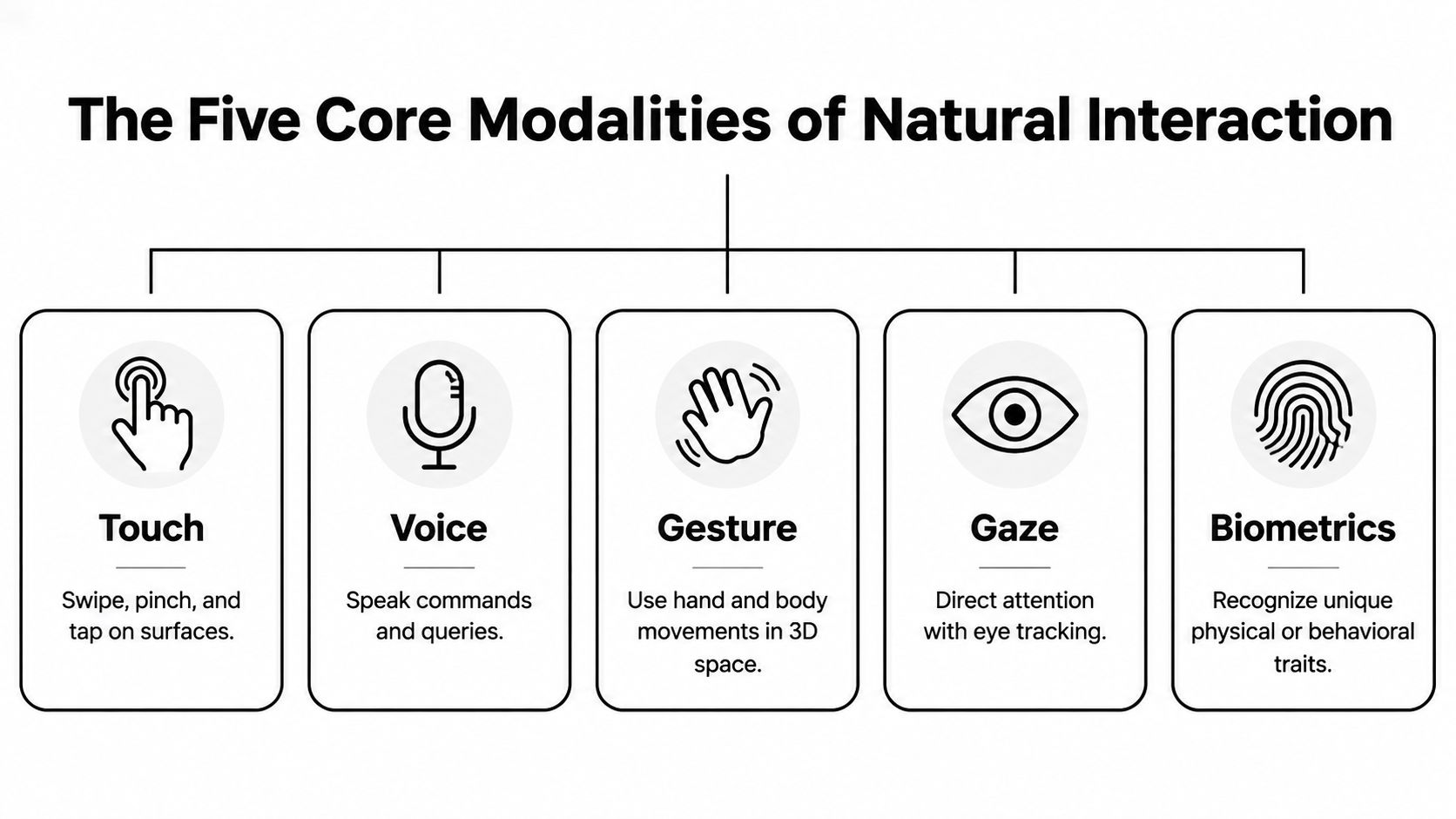
The Five Core Modalities of Natural Interaction
Natural interaction uses different human behaviours as inputs. Each modality solves a different problem, and each introduces its own limitations.
Touch
Touch is familiar because customers already swipe, tap, pinch, and zoom on phones and tablets. It works well for product comparison, ingredient exploration, shade selection, and guided consultation screens. Its weakness is physical contact. A customer carrying a prescription bag, wearing gloves, or avoiding shared surfaces may find a touch-only journey inconvenient.
Voice
Voice allows customers to ask questions in ordinary language, such as “Which moisturiser is suitable for sensitive skin?” or “Does this product contain marine-derived ingredients?” It's useful when hands are occupied or when a customer needs help finding a product without navigating categories.
The trade-off is context. A busy pharmacy, treatment room, or quiet relaxation area may make speaking uncomfortable or reduce recognition quality. Voice systems also need clear confirmation, especially when product names, ingredients, or dosage-related information could be misunderstood. Retailers considering automated telephone or conversational support can review a 24/7 voice AI answering service as one example of how voice can extend assistance beyond a physical screen.
Gesture
Gesture turns hand or body movement into a command. A wave might begin a consultation, while pointing could select a product on a large display. Contactless browsing can suit wellness environments, but gesture recognition depends on camera position, lighting, distance, and the customer's willingness to perform movements in public.
Gaze
Gaze tracking estimates where someone is looking. A display might expand the information area that attracts attention, or offer help when a customer repeatedly looks between two products. Gaze is passive, which can make it convenient, but looking at something doesn't always mean wanting to select it. Privacy communication must be particularly clear.
Biometrics
Biometrics includes physical or behavioural signals such as fingerprints, facial characteristics, skin conductance, or heart rate. These signals may support highly personalised services, but they're sensitive. A beauty retailer should only collect what it needs, explain the purpose in plain language, and provide an alternative route for customers who don't consent.
The practical choice isn't about finding one perfect modality. It's about matching the input to the setting, the task, and the customer's comfort.
How Multimodal Coordination Creates Fluid Experiences
A spa client with damp hands wants to compare two facial oils. They point to one bottle, ask about an ingredient, and look toward its certification mark. A coordinated NUI can treat these signals as one request, rather than making the client name the product, open a menu, and search for certification details separately. Swiss research describes this approach as coordinating speech, pen input, touch, hand gestures, head and body movements, and multimedia output across one interaction (NCCR IM2 research on natural multimodal interfaces).
Coordination matters because each channel can become unreliable in a real pharmacy, spa, or clean-beauty store.
- Voice can be obscured: Pharmacy conversations, spa music, and nearby customers can reduce speech-recognition accuracy.
- Touch can be inconvenient: Wet hands, gloves, products, and shared surfaces may make physical interaction awkward.
- Gesture can be ambiguous: A customer may move naturally without intending to issue a command.
- Gaze needs context: Looking at a product may signal interest, comparison, or simple browsing.
- Pen and body movement need space: A crowded counter or small consultation area limits where these inputs work well.
A well-coordinated system offers another route when one channel is unsuitable. A customer with wet hands might point, then confirm by voice. Someone who prefers not to speak can use touch. Someone with limited mobility can select a larger, simpler target.
The customer should not have to start again after an input fails.
Practical rule: Design around the customer's situation first. Choose the modalities that support that situation second.
FHNW describes Human-Computer Interaction research through interfaces that are natural, user-friendly, and intuitive (FHNW Human-Computer Interaction research). This Swiss research context supports a broader view of NUI, including multimodal interaction and accessibility, rather than treating one fashionable input type as the answer for every setting.
For a pharmacy customer holding a prescription, voice may be faster than touch. For a spa client with damp hands, a gesture may reduce contact with a shared display. For an online shopper comparing marine skincare, typed questions and spoken questions may need to coexist. Fluidity comes from coordination, while conventional controls remain available when they are clearer, more private, or more reliable.
Designing NUI That Feels Natural, Not Forced
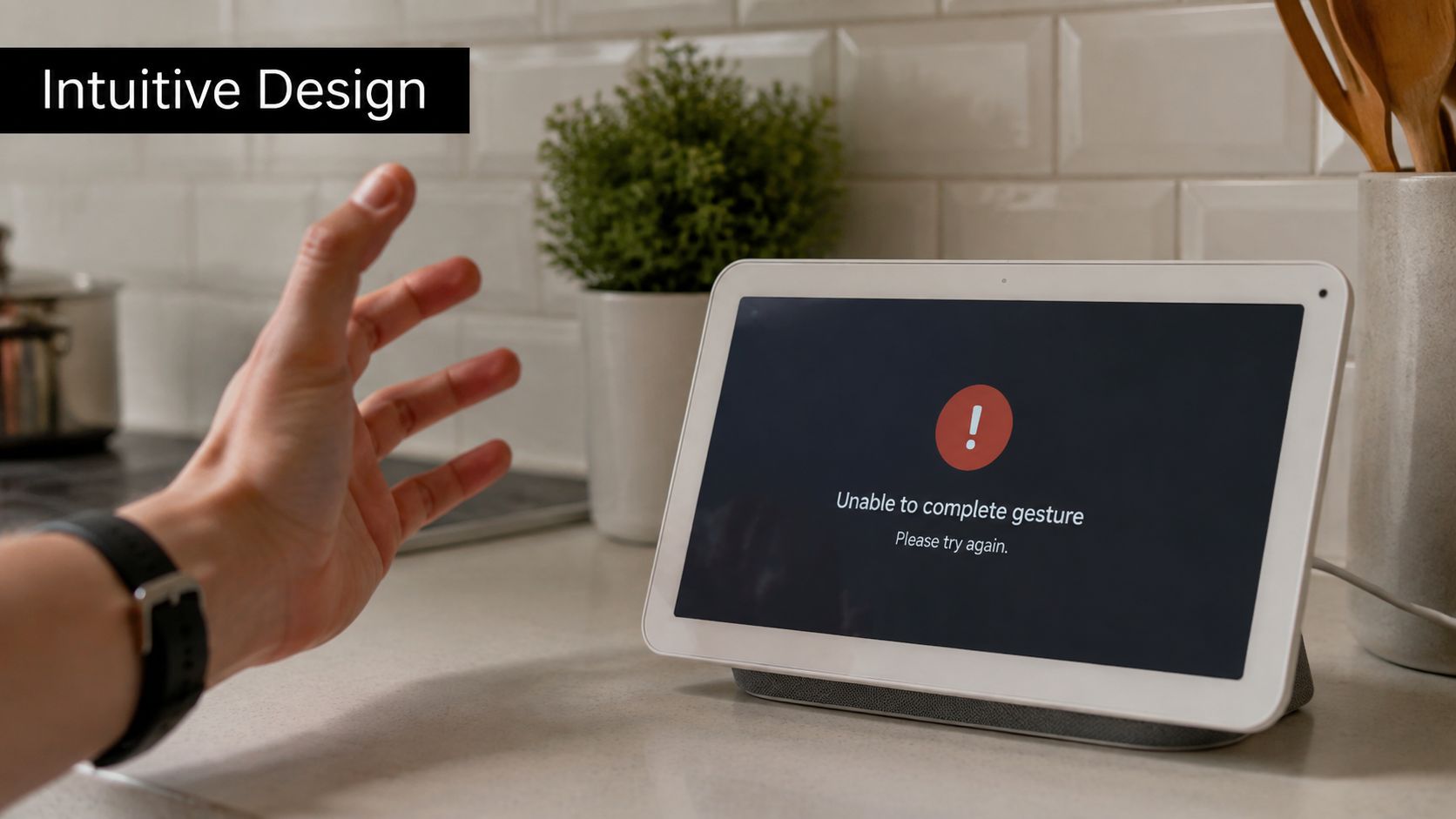
A poorly designed NUI can feel more difficult than a keyboard. If a display misreads a gesture, a voice assistant misunderstands a product name, or gaze tracking selects the wrong information, customers usually blame the retailer's experience, not the underlying technology.
Good design depends on three disciplines: feedback, fallback, and restraint. Customers need to know that the system has registered an action, what it understood, and what they can do next.
Compare the trade-offs before choosing
| Modality | Strong fit | Main risk | Useful fallback |
|---|---|---|---|
| Touch | Product comparison and visual browsing | Contact and reach limitations | Voice or larger controls |
| Voice | Hands-free questions and search | Noise, privacy, and recognition errors | Touch or visible answer options |
| Gesture | Contactless exploration | Ambiguous movement and calibration | Touch, voice, or physical staff help |
| Gaze | Attention-led information display | Misinterpreting interest and privacy concerns | Manual selection |
| Biometrics | Personalised consultation | Sensitive data and consent complexity | Non-personalised experience |
Every action should produce understandable feedback. A voice system can repeat the interpreted request before presenting a recommendation. A gesture system can show a brief visual acknowledgement. A gaze-led display can make it clear when attention is being treated as a selection, rather than automatically changing the screen.
Accessibility is part of the core experience
ZHAW highlights natural interaction concepts alongside ICT accessibility work for people with disabilities and older users (ZHAW research context on accessibility and natural interaction). That principle applies directly to pharmacy and wellness retail. A gesture-only kiosk may exclude someone with limited movement, while a voice-only station may be inappropriate for someone in a quiet treatment area.
Offer several routes to the same outcome. Let customers browse by touch, ask a question, use a simple gesture, or request staff support. Test the experience with real customers in the actual environment, including noise, reflections, queues, wet hands, interruptions, and accessibility needs.
Tools that support fast visual asset preparation can also help teams prototype alternative interface states. An AI Clipper overview may be useful when preparing product imagery or interaction concepts for testing, but polished visuals can't compensate for unclear feedback or a missing fallback.
Swiss NUI Adoption: Market Readiness and Customer Familiarity
Switzerland offers a useful setting for NUI experimentation because voice interaction has entered everyday behaviour. That familiarity gives pharmacy, spa, and clean-beauty retailers a starting point, not proof that every voice feature will work in a store or online journey.
A Swiss survey found that 37% of the population used voice functions in 2018, with 62% projected to use them regularly within 12 months (University of Lucerne report on voice-interface adoption). Coverage of the Swiss Voice First Barometer reported that about one in two people in Switzerland used voice user interfaces, while 30% of users used them during the purchase decision process. The report also recorded 7.26% completing an actual purchase via voice, described as a 45.83% year-over-year increase in voice-assisted buying. These figures indicate growing familiarity, while leaving the quality of the retail experience as a separate design question.
The 2021 follow-up found that 48% of respondents had used voice assistants or speech functions, compared with roughly one-third in 2018. Among users, 44% used them at least weekly, and 16% used them one or more times per day (2021 Swiss Voice First Barometer coverage).
What readiness does and doesn't prove
Customers may be comfortable asking a voice assistant for product information and still prefer to compare ingredients visually, consult a pharmacist, or complete checkout with staff support. For a Swiss retailer, readiness means testing where voice reduces effort and where it creates uncertainty, privacy concerns, or an awkward handover.
Swiss HCI research provides relevant expertise for this work. FHNW and the SwissCHI community connect natural interaction research with human-computer interaction across Swiss institutions. The opportunity for pharmacy, spa, and clean-beauty businesses is to translate that knowledge into service decisions, such as when a spoken answer should lead to a screen, a product demonstration, or a staff member.
A shared Swiss benchmark for NUI usability and return on investment across regulated and high-stakes settings remains limited. ISO/IEC 4944:2024 offers a framework for evaluating NUI usability, supporting more consistent testing (ISO/IEC 4944 usability framework discussion). Retail teams can combine that structure with practical measures: whether customers understand the response, complete the intended task, and know how to continue when the system cannot answer.
Natural User Interfaces in Swiss Pharmacy, Spa, and E-Commerce
A pharmacy NUI should help customers make sense of products without replacing professional advice. A customer could hold a product near an information display, ask about organic certification, and receive a clear explanation from the connected catalogue. A prescription bag or basket shouldn't prevent access to useful information, so the system could offer voice, gesture, and touch rather than relying on a single path.

The interface should also know its boundaries. Product information can explain ingredients, certifications, texture, and intended use, but health-related questions may require a pharmacist. A helpful NUI makes that handover visible instead of presenting automation as a substitute for human judgement.
A spa consultation can reduce handling friction
A spa consultation station might let a client explore marine-derived actives, ecological sourcing, or treatment benefits by looking at product areas, speaking a question, or selecting options on a screen. A guest with wet hands can avoid touching the display, while another guest can choose a conventional interface without feeling observed.
The design should respect the atmosphere. A loud spoken response may be unsuitable in a relaxation area, so the system could provide captions, headphones, or a quiet visual mode. Customers should also understand whether a camera is detecting gestures, gaze, or presence, and whether any information is stored.
E-commerce needs conversational discovery
Online clean-beauty shopping creates a different challenge. Customers can't directly smell a balm, feel an oil, or ask a pharmacist about sensoriality. A conversational interface can let them type or speak questions about texture, ingredient provenance, routine compatibility, or application technique, then present recommendations alongside ordinary product pages.
The same principle applies to products such as Fushi organic oils, Abahna bath products, Little Butterfly London skincare, Les Thermes Marins de Saint-Malo marine cosmetics, or Egyptian Magic multi-purpose balm. NUI shouldn't hide the catalogue. It should make the catalogue easier to explore by translating customer language into useful product pathways.
The outcome to design for is confidence, not spectacle. Customers should understand why a product appeared, what information supports the recommendation, and how to continue browsing if the first answer isn't right.
Evaluating NUI Performance and Planning Your Next Steps
A natural user interface needs a measurement plan before customers encounter it. Otherwise, a retailer may mistake novelty for usefulness, or treat an impressive demonstration as evidence that the complete service works.
The discussion of ISO/IEC 4944:2024 and NUI usability evaluation offers a recognised basis for assessing NUI usability. It helps pharmacy, spa, and public-facing retail teams compare touch, voice, gesture, gaze, and multimodal interaction consistently, rather than relying only on informal testing or vendor assurances.
Measure the task, not just the technology
Select a focused set of customer tasks: finding a product for a stated concern, checking certification information, comparing formulations, or requesting staff assistance. Observe whether customers complete each task comfortably, understand the result, and recover when the system misinterprets a voice command or gesture.
Useful measures include:
- Task completion: Can customers reach the intended information or action?
- Recovery effort: Can they correct a misunderstanding without starting again?
- Interaction comfort: Does the experience suit the pharmacy, spa, or retail setting?
- Customer understanding: Do users know why a recommendation appeared?
- Privacy confidence: Do customers understand consent, storage, and opt-out choices?
- Commercial relevance: Does NUI support useful browsing or consultation without interrupting the existing journey?
Privacy and data governance should be designed at the beginning. Gaze and biometric signals may be sensitive. Explain collection clearly, minimise data use, define retention practices, and provide a non-biometric alternative. In a Swiss pharmacy or spa, that alternative also protects customers who prefer a quieter or more familiar interaction.
Use a controlled rollout
Begin with one high-impact use case. A pharmacy could test voice-based product lookup. A spa could trial gesture-supported browsing at a consultation station. A clean-beauty e-commerce retailer could start with conversational discovery of ingredients and textures.
Run the test in its real setting, then refine the interaction before adding modalities or locations. Swiss HCI groups at FHNW, ETH, EPFL, and ZHAW offer relevant knowledge, while Swiss voice adoption suggests that readiness is not the only challenge. The practical task is to create an experience that customers find useful, accessible, trusted, and easy for the team to measure.
beautysecrets.agency helps Swiss pharmacies, spas, retailers, and clean-beauty e-commerce partners shape product experiences around natural, ethically sourced cosmetics and pharmaceuticals. Visit beautysecrets.agency to explore curated brands and discuss how a clearer assortment and customer journey can support your next NUI initiative.