Nearly 60% of women over 25 were identified as having hooded eyes in a 2023 facial morphology study cited in the source set, which is why eyeshadow for hooded eyes is not a niche request, it's a mainstream counter need (source). In a Swiss retail setting, that matters because the client standing at the tester mirror may not need a dramatic new trend, she needs colour that still shows when her eye is open.
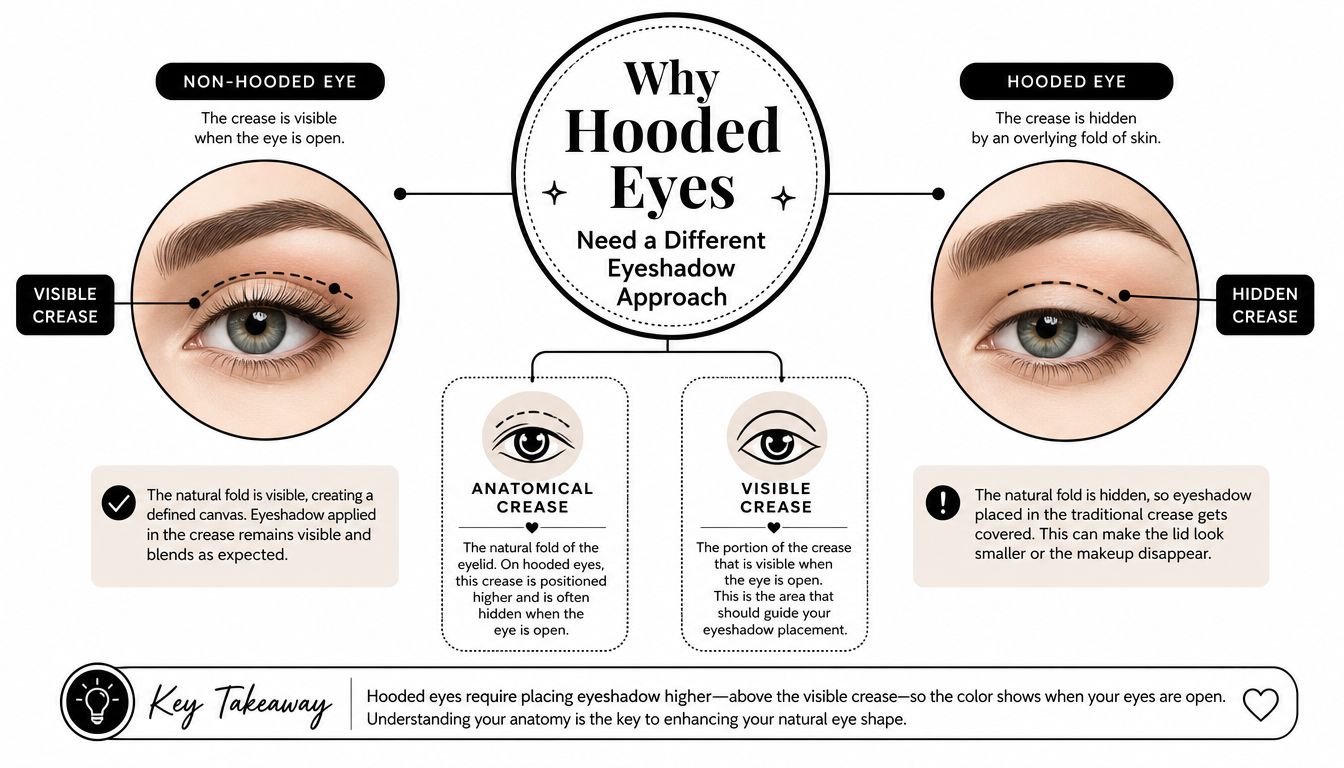
Hooded lids change the map. The anatomical crease sits where the fold forms, but the visible lid space can be much smaller, and the guide used in the source set defines under 5 mm of visible lid as hooded (source). That's why standard lid-based placement often disappears, and why hooded-eye technique has to be built around the open eye, not the closed one.
Why Hooded Eyes Need a Different Eyeshadow Approach
Hooded eyes change how colour reads in the mirror and how it survives real wear. On counters, I see the same problem again and again, a shade looks polished on a closed lid, then nearly disappears once the eye opens or starts blinking against the fold. That is why standard lid placement often fails for hooded eyes, especially when the formula relies on visible surface area that the hood covers.
The visible lid is the working canvas
On hooded eyes, the anatomical crease is not the same thing as the visible crease. The fold may be there, but the practical canvas is the skin that still shows when the eye is relaxed and open. In the source set, visible lid thresholds are described clearly, with under 5 mm reading as hooded, 6 to 10 mm as standard, and over 10 mm as prominent (source). That makes the open-eye view the only reliable reference point.
For artists, that means placement is decided at the counter, with the client looking straight ahead, not by following a flat diagram. For buyers, it means assortment and education need to reflect anatomy, not force every customer into the same crease, lid, highlight routine. A hooded-eye customer needs products that can be seen when the lid folds back under the brow bone, and the SKU mix has to support that reality.
Practical rule: if the shade cannot be seen with the eye open, it has been placed too low for a hooded lid.
The prevalence figures matter for assortment planning as well. The source set cites hooded-eye anatomy at an estimated 65% of Asian women, 45% of Hispanic women, and 30% of Caucasian women in a 2023 clinical facial mapping study (source). In other words, this is a broad customer need, not a niche shelf.
Step-by-Step Eyeshadow Application for Hooded Eyes
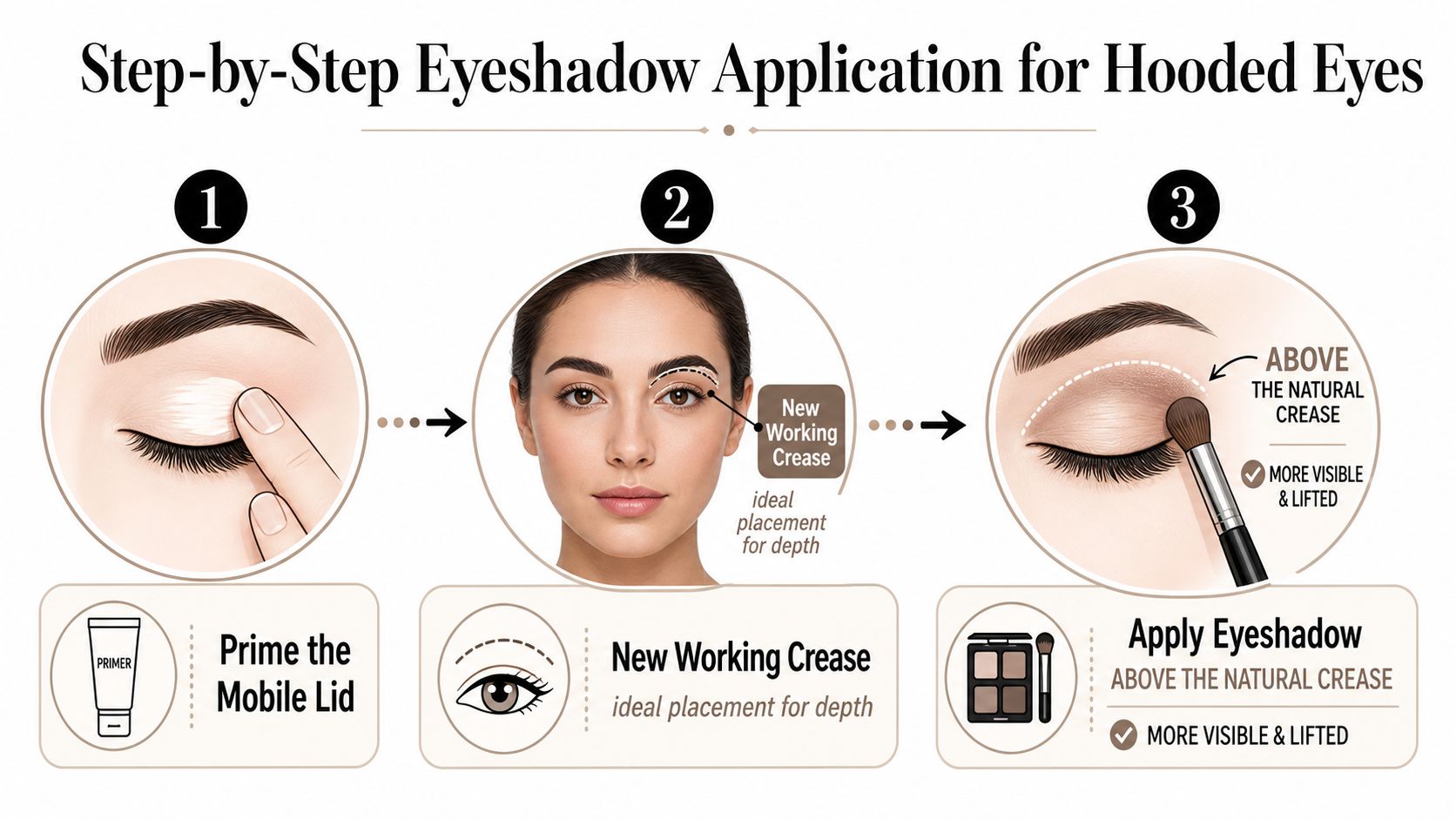
A hooded eye only shows the usable lid space when the eye is open, so application has to be built around that view, not around the closed lid. That matters for clients, and it matters for buyers too, because the products that sell best are the ones that still read clearly after blinking, smiling, and a full working day.
The cleanest application starts before colour goes on. A thin primer layer on the mobile lid gives powder something to grip, and it reduces the chance that the first blend mark disappears into the fold by lunchtime. I prefer a soft, flat shader for primer placement, then a fluffy crease brush for the shaping work so the product stays where it is meant to.
Map the eye while it's open
Look straight ahead and mark a new working crease where the colour will still read when the eye is open. That is not always the anatomical fold, and on many hooded eyes it sits slightly higher. The first placement of the deepest matte shade should sit slightly above the natural fold so the eye keeps depth without burying the colour in skin contact.
Use a mid-tone matte first, then deepen gradually at the outer third. A tapered blending brush helps create that soft outer-V without dropping pigment too low. In practice, this is the point where many counter demonstrations go wrong. The artist keeps blending only on the closed lid, then the finished shape vanishes once the client opens her eyes. A better result looks restrained when the eye is closed and clearly structured when it is open.
Keep the lid centre light
Shimmer belongs on the mobile lid centre, where blinking can catch the light without spreading shine across the hood body. That placement gives dimension while keeping the fold from looking heavy. On the inner corner, a small highlight can brighten the eye, but the rest of the lid should stay controlled.
The eye-open check is required. If the shadow line disappears once you relax your brow, move it higher and blend again.
A clean lower edge helps too. Instead of chasing a sharp line across the whole lid, blend upward in a soft arc that stops before the brow bone takes over. That preserves visible lid space and keeps the final look lifted rather than crowded.
For wear-focused routines, it also helps to choose formulas that behave well under movement and humidity, then set them in a way that suits the client's day. In Swiss pharmacies and premium retail, that is the practical difference between a pretty tester and a product that keeps working after the customer leaves the counter.
Choosing the Right Finish and Formula for Hooded Eyes
Finish changes how hooded-eye shadow reads from a distance, and formula changes how long it survives. On counters, that's where shoppers often get misled by pretty swatches. A palette can look rich on a finger and still fail on the lid if the finish is too reflective in the wrong place or the texture creases under movement.
Matte and satin carry the structure
Matte shades do the heavy lifting. They belong in the working crease, the outer V, and any area that needs shape without extra shine. Satin behaves similarly, but with a softer sheen, so it can bridge the gap between structure and light if the shopper wants a less flat finish.
For hooded eyes, these finishes are the safest place to build definition higher on the lid. They read cleanly when the eye opens, and they don't exaggerate the fold the way high shine can.
Shimmer and metallic need strict placement
Shimmer and metallic shades are best kept to the mobile lid centre and, if used, the inner corner. That's where they flash back through blinking instead of sitting on the hood body as extra weight. The contradiction in current expert coverage is real, some artists avoid reflective shine on the prominent hood because it can make the lid look heavier, while others use it in a tight zone on the mobile lid to create movement. Both approaches work, but only when the placement is disciplined.
Creams and powders also behave differently under the hood. Creams can give a rich first impression, yet they need careful setting if the client has a busy day. Powders usually give more control for layered depth, especially when the goal is visible shape rather than intense reflectivity.
Merchandising rule: if a shade is highly reflective, sell it as a lid accent, not as the main crease colour.
Long-Wear Tricks That Beat Blinking and Brow-Bone Contact
Hooded lids put eyeshadow under constant pressure. Blinking, oil transfer, and contact with the brow bone work against visible pigment, especially when the wearer moves through a full Swiss workday that shifts between heated interiors and colder outdoor air. Wear performance matters as much as placement, and in counter work I see that trade-off show up fast on clients who chose a shade for its swatch, then watched it fade in the fold.
Build the base for endurance
A dedicated eye primer should go on first, followed by a thin setting layer before any colour is placed. That order helps stop the lid from turning slick, and it gives powder something stable to grip. If a shopper prefers cream shadow, use it sparingly, then lock it down with powder where the fold makes contact most often.
For buyers, this is the part that separates a nice tester from a reliable SKU. A product can look strong in the pan and still fail under repeated blinking, so the shelf edit should reward formulas that hold their shape on a moving lid. In store terms, that means asking whether the shade still reads after wear, not just whether it photographs well.
Match the routine to the day
For long office hours, a powder-based look with primer and a light set is easier to refresh. For evening events, a cream-to-powder combination can work if the mobile lid stays controlled and the crease remains matte. Check the eye open again after application, then blot gently if the lid starts to collect product where the hood touches.
A quick mid-day check-in takes little time, and it can keep the look from sliding into the crease before dinner. If the centre of the lid has lost clarity, press a touch of shadow back in place with a fingertip or a small flat brush instead of adding more all over. That approach keeps the finish cleaner and reduces the risk of building up too much texture right where the brow bone presses.
For a broader all-day routine, the method in setting makeup for all day aligns with hooded-eye wear logic, even though the eye shape still needs tighter placement discipline.
Liner and Mascara Choices That Complement Hooded Eyeshadow
A hooded eye can lose liner shape fast, so placement matters more than drama. Thick, straight-across liner usually vanishes under the fold once the eye opens, which makes the lid look smaller instead of more defined. A thinner line that lifts at the outer third stays visible more often and supports the shape created by the shadow.
Keep the lid line narrow
Tight-lining gives density without adding bulk to the lid. It fills the lash base so the eye looks fuller, but it does not take space away from the shadow work above it. A softly smoked edge also tends to sit better on hooded eyes than a hard graphic line, because it blends into the matte depth already built into the crease.
Lower-lash liner needs restraint. A heavy dark line can pull the face down, while a soft lower-lash shadow keeps the frame balanced without closing the eye. That detail matters when the upper lid already has limited visible space, especially for clients who want lift without a heavy perimeter.
Mascara should lift, not weigh down. Curl first, then coat from root to tip with separation in mind. Clumping creates shadow on the lid and can undo careful placement above it, which is why brush shape and formula deserve attention at the counter. For shoppers comparing formulas, tips for choosing mascara is a practical reference, especially for anyone trying to match brush shape and finish to a hooded eye.
For Swiss pharmacies, spas, and premium retail, this is the useful merchandising lens. Keep one liner edit that favours slim, lift-oriented pencils or pens, then pair it with mascaras that separate cleanly, hold curl, and do not dump product onto the lid. In practice, that gives buyers a range that supports hooded-eye placement without overpromising on graphic effects that are hard to maintain on a moving lid.
Common Hooded-Eyeshadow Mistakes and How to Fix Them
The most common failure is over-blending too high. When the transition shade climbs too far, the eye loses definition and the brow bone starts to dominate. The fix is simple, stop blending once the shape is visible open, then reinforce the outer corner with a deeper matte rather than spreading the wash wider.
Another frequent mistake is placing all the colour in the natural crease. On hooded eyes, that work vanishes the moment the eye opens. Move the placement slightly higher, check it with the eye relaxed, and rebuild the line where it stays visible.
What usually goes wrong at the counter
- Heavy shimmer across the whole lid: this makes the hood body look larger. Keep sparkle to the mobile lid centre or inner corner.
- Flat brush in the crease: it packs product instead of diffusing it. Swap to a tapered blending brush for softer control.
- Skipping the open-eye check: the look can seem balanced closed and vanish open. Always inspect it straight ahead.
- Too much lower liner: it closes the eye shape. Use a softened lower lash shadow instead.
A separate issue is texture overload. If a lid is already prone to creasing, layering too many creamy products without setting them turns the eye look muddy by mid-afternoon. The correction is to simplify, choose a matte structure shade, add controlled shimmer only where it can show, and keep the fold area cleaner than the rest of the lid.
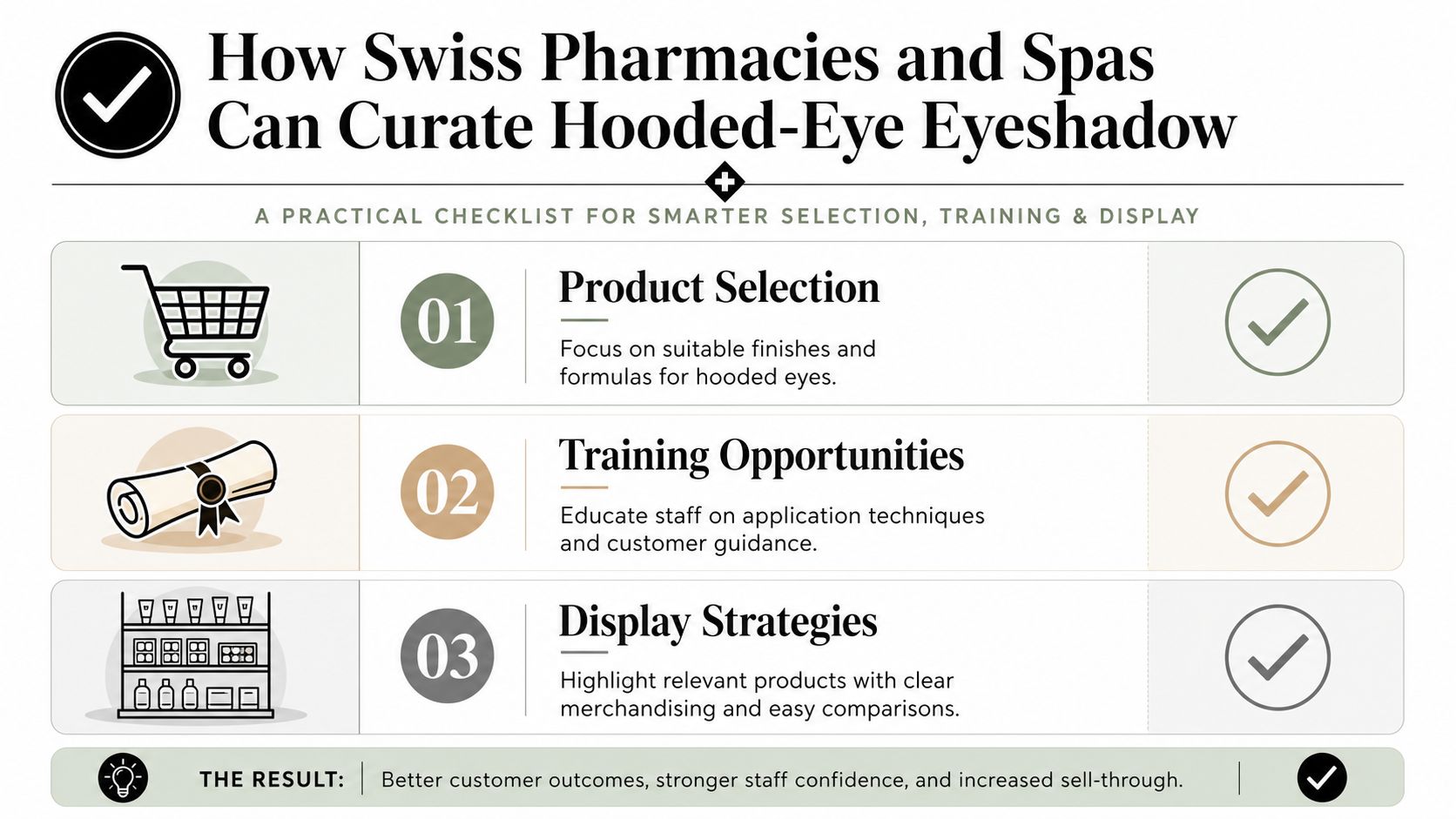
How Swiss Pharmacies and Spas Can Curate Hooded-Eye Eyeshadow
In Swiss pharmacies, spas, boutiques, and premium e-commerce assortments, hooded-eye suitability is a practical buying criterion, not a side note. The customer pool is broad, the application problem is common, and many purchases happen quickly, often in front of a mirror with little room for trial and error. Shelf choices need to reflect anatomy, wear, and education together, so the counter advice and the SKU mix support the same result.
Build the shelf around use, not just colour
Start with long-wear and transfer-resistant claims, then separate palettes by finish so shoppers can find matte structure and shimmer accents without guessing. Clear ingredient information helps too, especially with premium buyers who want to know what the formula stands for as well as how it performs. In Swiss retail, brands that align with ECOCERT, cruelty-free expectations, or a natural-positioning story often fit the way customers shop, because those signals affect trust at the shelf.
The service layer matters just as much as the product matrix. Staff should be able to show the open-eye mapping method, not only point to shade names. A tester mirror held at eye level lets the client see where the colour lands, which is more useful than a quick handheld glance.
Merchandise the routine
A paired primer-and-shadow display works well because hooded-eye success starts with prep. Shelf signage should say exactly what the customer gets, such as visible crease definition, less transfer, or stronger lid-centre shine. That kind of wording is more useful than vague “lifted look” copy, because it connects directly to the wear problem and the way hooded lids move through the day.
Formula choice matters too. Cream shadows can look rich on the hand and still crease once the lid folds onto itself, so buyers need to balance pigment payoff against set time and comfort. A well-edited fixture should also separate textures by behaviour, since some clients want a soft matte base for structure while others only need a small amount of reflective colour placed where blinking will not break it down.
For clients looking beyond make-up into broader eye-area refinement, a professional conversation about non-surgical eye lift options can sit alongside cosmetics advice in premium spa settings, provided the discussion stays clear about what make-up can and can't do. Cosmetics shape the look. Treatments address the tissue. Trade partners should keep that boundary clear so advice stays credible.