You're likely looking at the same shelf problem many Swiss buyers face now. Customers still want a healthy-looking glow, but they're less willing to expose their skin to sun or tanning devices to get it. At the same time, they've become much less forgiving of poor cosmetic performance. If a lotion turns orange, catches on dry elbows, or leaves marks on bedding, they won't buy it twice.
That's why sun look natural tan lotion has moved out of the novelty zone. In a pharmacy, spa, or premium beauty setting, it now sits closer to body care than to beach-season impulse purchase. The winning products don't just colour skin. They moisturise well, apply evenly, develop believably, and come with clear safety language that your staff can explain in a few seconds.
For Swiss retail, that combination matters. The customer is informed, ingredient-aware, and often shopping in a climate that exposes every weakness in a formula. Dry winter air, indoor heating, fair complexions, and a strong preference for understated results all shape what sells.
The Growing Demand for a Safer Sun-Kissed Glow
The commercial case is straightforward. Consumers haven't lost interest in looking sun-kissed. They've changed how they want to get there.
The strongest proof is the broader move towards sunless tanning as an alternative to UV exposure. The global self-tanning products market is forecast to rise from USD 1.30 billion in 2025 to USD 2.40 billion by 2034, with Europe holding 33.66% market share in 2025, and a peer-reviewed U.S. study found that 17.7% of women reported using sunless tanning products. The same study reported 15.3% using lotion tanning, 6.8% using spray tanning, and 12.0% still using indoor tanning, which makes the shift in behaviour especially relevant for Swiss retailers positioning safer beauty options (peer-reviewed market and usage data).
Why this matters in Swiss retail
In Switzerland, this isn't just a beauty story. It's a credibility story.
Pharmacies and premium retailers operate in a market where shoppers often want two things at once. They want visible cosmetic payoff, and they want products that fit a health-conscious lifestyle. A natural tan lotion answers that only if the assortment is built carefully. The product has to look elegant on shelf, deliver realistic colour, and avoid the old stigma attached to self-tanners.
Commercial reality: customers don't ask for “self-tan technology”. They ask for something that looks natural and won't make them regret applying it.
That changes how the category should be stocked. The strongest performers usually aren't merchandised as summer-only add-ons. They work better as part of a year-round body-care and glow-maintenance offer, especially in stores already selling moisturisers, exfoliants, barrier-support products, and premium bath-and-body lines.
What buyers should look for
A useful buying lens is simple:
- Safety-led appeal means the product is easy to position without encouraging UV tanning.
- Natural-result appeal means the finish suits Swiss preferences for subtle colour rather than aggressive bronze.
- Routine compatibility means the lotion can sit naturally beside body care, spa products, and premium skincare.
That's why the category has staying power. If you treat sun look natural tan lotion as a practical cosmetic solution, not a seasonal gimmick, it becomes easier to sell and easier for staff to recommend with confidence.
Decoding the Modern Natural Tan Lotion
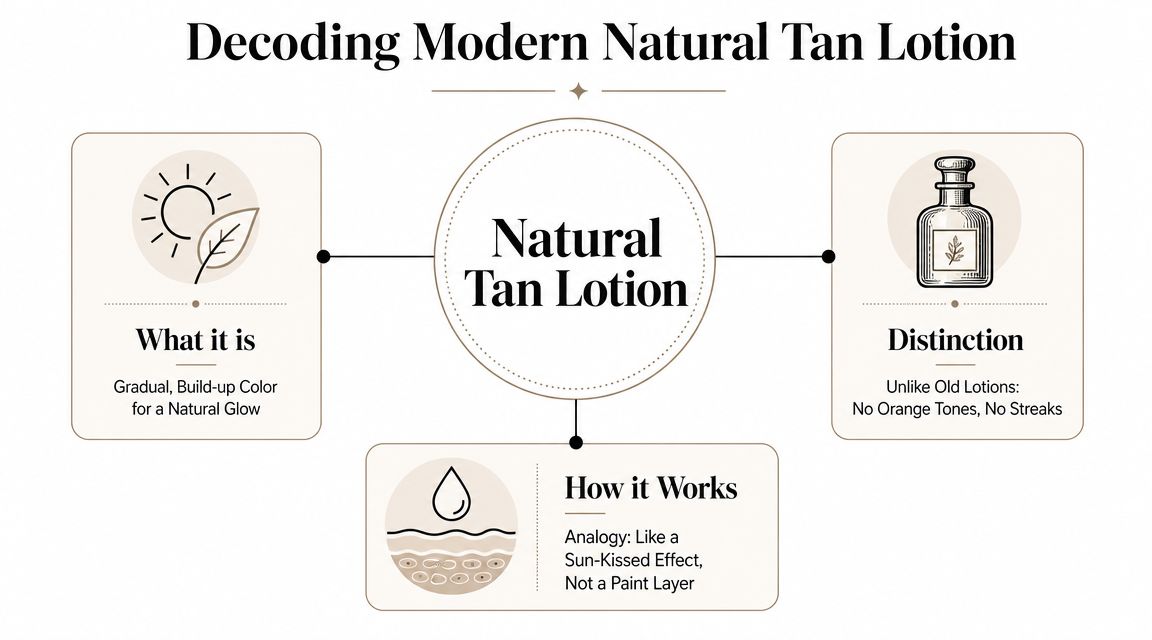
The old objection to self-tan still appears in-store. Customers remember orange undertones, streaks, and that obvious “fake tan” look. Modern lotion formats improved because the category shifted from instant-impact thinking to controlled colour build.
A gradual tan uses a lower concentration of the tanning active and builds colour over several applications. NIVEA describes this model as one that develops subtly over time, giving the user more control over the final shade and reducing the risk of streaks, which fits the understated preferences seen in premium Swiss beauty retail (gradual tan explanation).
Why gradual formulas sell better in premium channels
A good way to explain a modern sun look natural tan lotion to staff is this. It behaves less like paint and more like a controlled tone enhancer. The customer isn't trying to jump from pale to a dramatic bronze in one evening. They're trying to add believable warmth.
That distinction matters commercially because gradual formulas lower the fear factor. They attract first-time users, cautious users, and customers with fair skin who want control more than intensity.
What “natural-looking” actually means
In retail conversations, “natural-looking” should never be left vague. It usually means:
- Buildable colour that doesn't force the final result too fast
- Even fade rather than patchy breakdown
- Tone realism that looks closer to a holiday glow than stage bronzing
- User control so mistakes are easier to avoid
Modern buyers often respond better to words like “subtle”, “buildable”, and “believable” than to “dark”, “instant”, or “ultra bronze”. That's particularly true in Swiss pharmacies and spas, where trust is built through precision, not hype.
A natural tan lotion sells faster when staff frame it as body care with cosmetic colour, not as a dramatic transformation product.
One more practical point. The best gradual lotions create repeat purchase because they become part of a maintenance habit. That's commercially useful. A product used several times per week has stronger routine value than a special-occasion bottle that sits half-finished in a cupboard.
The Formulation Secrets of a Superior Tanning Lotion
Not all tan lotions fail for the same reason. Some develop an artificial tone. Some apply unevenly. Others look promising on first use but break apart on dry skin. If you're buying for Swiss retail, formulation quality is what separates a credible line from a return problem.
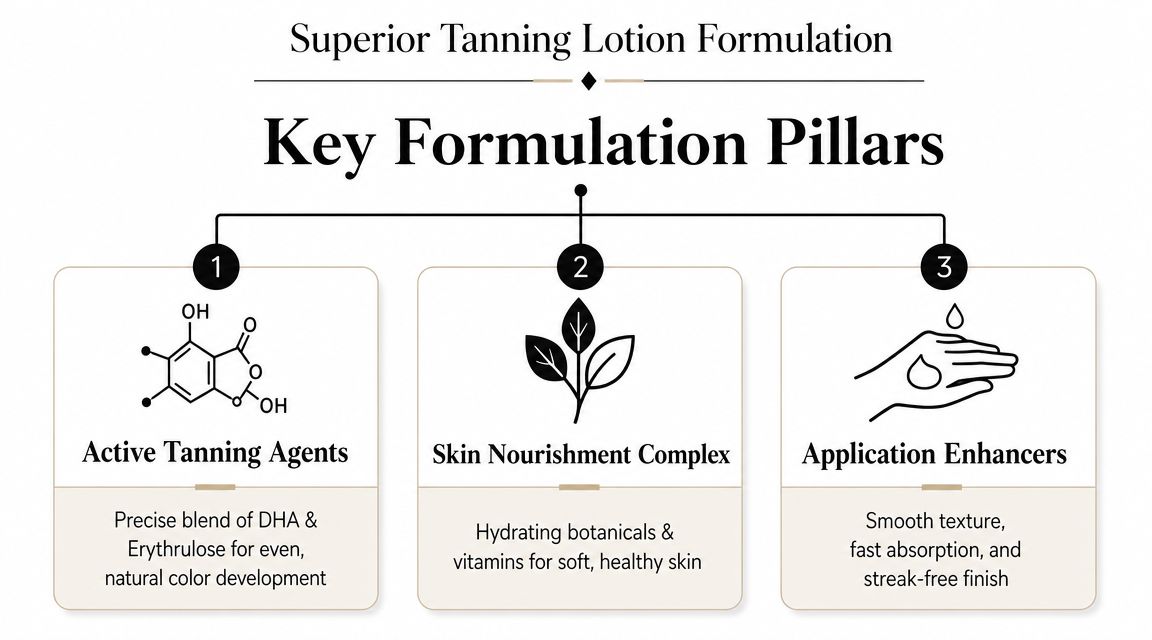
The strongest formulas usually stand on three pillars. Tanning actives, the lotion base, and application behaviour.
The actives that matter
The core active in self-tan remains dihydroxyacetone, or DHA. It reacts with amino acids in the outer stratum corneum to create visible colour without UV exposure. In higher-performing products, DHA is paired with erythrulose.
According to formulation guidance from the School of Natural Skincare, the most effective formulas combine DHA with erythrulose, with DHA providing the primary colour and erythrulose developing more slowly to create a deeper, more realistic, longer-lasting tan with less risk of an orange tint. That pairing is widely regarded as the strongest route to a non-streaky, natural-looking result (DHA and erythrulose formulation guidance).
For a buyer, this matters because customers don't experience ingredients in theory. They experience them as tone, wear, and forgiveness. DHA alone can still work, but the combined system tends to give a more refined finish when the formula is well balanced.
The lotion base decides whether the tan looks even
A common problem arises with purchasing decisions. Buyers focus on the tanning actives and ignore the vehicle.
In practice, the base often determines whether colour develops smoothly or catches unevenly. A well-built lotion usually includes humectants such as glycerin and propanediol, plus emollients and barrier-supporting lipids that improve glide and reduce dry-patch overdevelopment. Premium examples in the category also use ingredients such as aloe, plant oils, butters, and squalane to support spreadability and skin feel.
A market example shows this architecture clearly. One self-tanning cream discloses a full INCI that includes water, DHA, emollients such as coco-caprylate/caprate and coconut alkanes, humectants such as glycerin and propanediol, plant oils and butters including avocado oil, sweet almond oil, cocoa butter and shea butter, plus squalane. Another premium product highlights 99.8% natural ingredients and 24-hour hydration while emphasising no streaks and no orange tint (premium self-tanning body cream example).
What works and what does not
A simple evaluation table helps when comparing suppliers.
| Formulation area | What tends to work | What often causes problems |
|---|---|---|
| Tanning system | DHA paired with erythrulose | Fast-colour formulas that prioritise impact over realism |
| Hydration profile | Glycerin, aloe, oils, butters, squalane | Thin bases that don't cushion dry areas |
| Skin feel | Creamy spread with controlled slip | Draggy texture that encourages over-rubbing |
| Finish | Buildable, believable warmth | Sharp, high-contrast bronze on first use |
Questions worth asking a supplier
- Which tanning actives are used and is erythrulose included alongside DHA?
- How moisturising is the base on dry body areas such as knees, elbows, and shins?
- Is the formula positioned as gradual or rapid, and does that match your customer profile?
- Does the texture support even spread, especially for non-expert users?
If a supplier can't answer those points clearly, your staff will struggle to answer them at the shelf.
Ensuring Trust Through Certifications and Safety Messaging
In Swiss retail, trust is rarely created by glossy packaging alone. It comes from disciplined messaging, consistent quality, and claims that a trained member of staff can defend without improvising.
That matters even more in tanning, because the category still carries a built-in misunderstanding. Some consumers hear “sun look” and assume the result is somehow related to healthy sun exposure. That assumption needs correcting at shelf level.
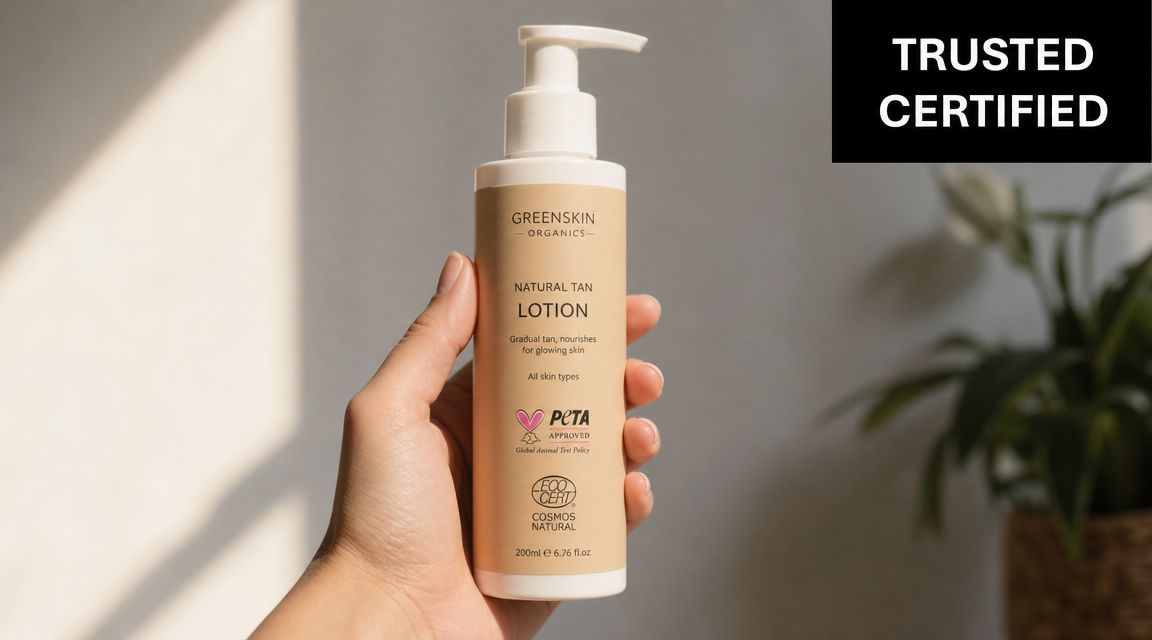
The safety message should be explicit
Swiss public health messaging is clear on the core point. Any tan from UV exposure is a sign of skin damage, and a sunless tan lotion should be positioned as a cosmetic colour product that does not provide sun protection and does not justify further sun exposure (sunless tanner safety positioning).
That single distinction changes how the product should be sold. It should not sit in a “healthy tan” narrative. It belongs in a “cosmetic glow without UV exposure” narrative.
Stock the category with sunscreen education close by. A bronzing lotion can complement a summer body-care routine, but it can't replace SPF.
Why certifications still matter
Certifications and cruelty-free commitments don't replace performance, but they do reduce friction in the sale. In the Swiss premium and clean-beauty market, labels such as ECOCERT or recognised cruelty-free schemes help staff answer the customer who asks, “What stands behind this brand besides marketing?”
A useful internal rule is this:
- Use certifications to support trust
- Use formulation details to support efficacy
- Use safety language to prevent misuse
If one of those three is missing, the retail story weakens.
Shelf language that builds credibility
The strongest safety copy is simple and direct. For example:
- Natural-looking cosmetic colour without UV exposure
- For face and body if directed by the product format
- Does not replace sunscreen
- Best used on well-moisturised skin for an even result
What doesn't work is vague “healthy glow” language without context. In a pharmacy or dermatology-adjacent setting, that creates confusion where the customer expects clarity.
Mastering Application for Flawless Results in Switzerland
A premium tan lotion can still disappoint if the user applies it like ordinary body lotion on dry winter skin. Swiss conditions make this worse. Indoor heating, seasonal dryness, and fair complexions all make uneven development easier to trigger.
For that reason, application guidance should be part of the merchandising strategy, not an afterthought.
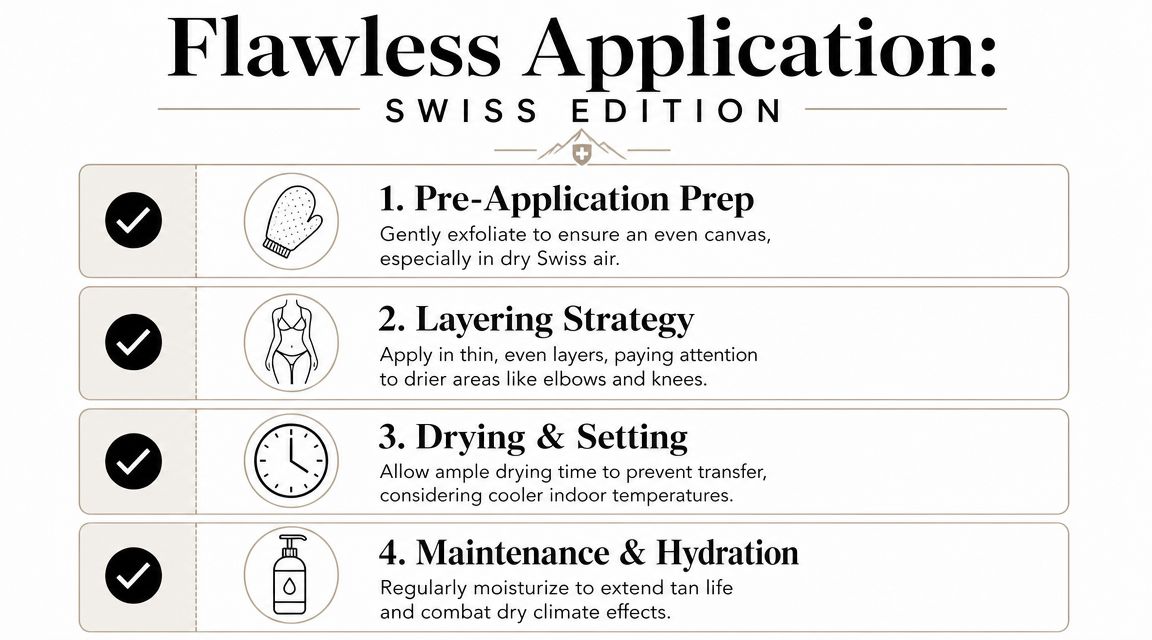
A visual demonstration often helps staff explain the routine clearly:
The non-negotiable prep step
For dry indoor-heated environments, the practical guidance is consistent. Users should exfoliate carefully and apply a barrier cream to dry areas such as knees and elbows before applying the tan lotion. That reduces the tendency of the product to “grab” and develop into darker patches on rough skin (dry-climate self-tan prep guidance).
Many complaints arise, not with the formula, but with poor prep.
A retail-ready application routine
You can train staff to recommend this sequence:
Exfoliate first
Focus on ankles, knees, elbows, and any visibly rough areas. The goal is an even canvas, not aggressive scrubbing.Apply a plain barrier cream to dry points
Use a light layer on elbows, knees, ankles, and sometimes hands. This reduces overdevelopment where skin is thicker or drier.Apply the tan lotion in thin layers
Encourage less product than the customer expects. Buildable colour nearly always looks better than heavy first-pass application.Blend carefully at joints
Wrists, ankles, and between fingers need deliberate blending because excess product settles there.Let it set fully before dressing
Tight clothing too soon is one of the easiest ways to create transfer and uneven wear.Maintain with daily moisturising
Dry skin sheds unevenly. Hydrated skin usually keeps the colour looking cleaner for longer.
Swiss-specific trouble spots
Swiss buyers should prepare staff for three recurring concerns:
Winter dryness
Customers often need more prep and more post-application moisturising than summer users.Very fair skin
Gradual products are usually easier to recommend than stronger one-step bronzing lotions.Face versus body tone mismatch
Many customers want less depth on the face than on the body. Staff should recommend caution and patch testing rather than assuming one application style suits both.
The customer who wants “no streaks” usually needs a method change as much as a product change.
A sun look natural tan lotion performs best when sold with a usage protocol. That can be a shelf talker, a staff script, or a paired display with exfoliation and body moisturising products.
Effective Retail Positioning and Merchandising Strategy
This category sells best when it's treated as a body-care-plus-colour solution. If you place it with beach sunscreens, customers read it as seasonal. If you place it with premium body moisturisers, exfoliants, and glow products, they understand its real use case much faster.
Where to place it
In pharmacies and premium beauty stores, the strongest placements are usually:
- Adjacent to body care because the lotion logic is familiar
- Within a “safe sun” or “sunless glow” story if your store builds educational category blocks
- Near exfoliation tools and moisturisers to support the routine, not just the hero product
Spas and hotel boutiques can also position it near aftercare or body ritual products. That works because the tanning lotion then reads as part of polished self-maintenance rather than a one-off cosmetic trick.
How to train staff to sell it properly
The sale becomes easier when staff stop leading with “tan” and start leading with outcome and method.
A practical staff script sounds like this: this lotion builds a believable glow gradually, it works best on well-prepared skin, and it gives cosmetic colour without replacing sunscreen. That message is clean, defensible, and suited to Swiss expectations.
For stores modernising shelf communication, even the operational layer matters. If you're reviewing in-store presentation, this overview of digital price tag benefits is useful because electronic shelf labelling can support cleaner category education, faster claim updates, and more consistent multilingual product messaging across pharmacy environments.
Marketing Claims and Technical Justifications
| Marketing Claim | Technical Justification |
|---|---|
| Natural-looking glow | Gradual colour development gives the user more control over depth and tone |
| Less streak risk | Buildable formats are more forgiving than aggressive instant-colour products |
| Skincare feel | Humectants, emollients, and barrier-supporting lipids improve spreadability and comfort |
| Better for dry skin routines | Lotion textures fit naturally into body-care habits common in pharmacy retail |
| Cosmetic colour without UV tanning | The colour comes from a surface reaction, not from sun exposure |
One assortment mistake to avoid
Don't overload the shelf with too many shades or too many textures at launch. In Swiss retail, a smaller range with clear positioning usually performs better than a broad but confusing selection. Start with one gradual lotion, one richer body-prep or maintenance product, and clear advisory language.
If you want to offer a service-based extension, beautysecrets.agency can also be considered where a partner needs Swiss distribution support for natural and ethically positioned beauty assortments, alongside premium body-care and spa-oriented lines.
Answering Your Customers Most Common Questions
Front-line questions are usually predictable. What matters is whether the answer is short, accurate, and calm.
Useful answers for staff
Does this protect my skin in the sun?
No. It gives cosmetic colour only. Customers still need sunscreen for UV protection.
Will it make me look orange?
A well-formulated gradual lotion is designed to build colour more naturally. The final result still depends on skin prep, application amount, and skin condition.
Can I use it on dry skin?
Yes, but dry skin needs more prep. Exfoliation and moisturising dry areas first usually make the biggest difference.
Is it suitable for fair skin?
Usually yes, especially in gradual formats. Fair-skinned customers often do better with a slower build rather than a strong first application.
Why did my previous self-tan go patchy?
Patchiness often comes from uneven skin texture, dry areas, or applying too much product at once.
Can I use it on face and body?
Only if the product format is intended for both. Staff should always guide customers back to the label and patch-test advice.
Good answers also support online sales
If you sell through Shopify as well as in-store, turn these questions into short FAQ blocks and product page summaries. This guide on how to optimize for featured snippets on Shopify is a practical reference for structuring those answers so they're easier to surface in search.
The key is consistency. The same answer your sales advisor gives in-store should appear on the shelf card, product page, and follow-up care guidance. That's how a sun look natural tan lotion becomes a trusted repeat-purchase item rather than a hesitant first trial.
If you're building a Swiss assortment around natural, premium, and clearly positioned beauty products, beautysecrets.agency can support that process with curated cosmetics and pharmacy-relevant brand selection for retailers, spas, clinics, and e-commerce partners.