You're staring at a desk full of supplier invoices, batch certificates, signed forms, and old printouts that someone swears are “the latest version”. In a Swiss beauty or pharmacy store, that pile turns into lost time fast, especially when a buyer asks for a product file, a clinic needs a compliance record, or a retail manager must prove which document was approved and when.
A DMS document management system replaces that scramble with one controlled digital library. Swiss enterprises with 10 or more employees already have the connectivity base for that shift, with 96% internet access and 94% fixed broadband adoption in 2023, which makes cloud and hybrid document workflows realistic for day-to-day operations in Switzerland (Swiss digital connectivity reporting). For beauty and pharma retailers, the question isn't whether the files can be stored somewhere. It's whether the system can protect sensitive records, show who changed what, and keep documents usable during audits, recalls, and supplier checks.
Introduction to DMS in Beauty Pharma Retail
A Swiss pharmacy rarely handles just one kind of document. Staff deal with product specifications, supplier declarations, quality records, training logs, invoices, and customer-facing compliance forms, often while serving customers at the counter. A boutique or spa faces a similar mix, only with brand approvals, ingredient statements, eco-certification files, and seasonal product releases added on top.
A DMS document management system gives those teams one searchable home instead of scattered cabinets, shared drives, and inbox attachments. That matters in regulated retail because the problem is usually not storage alone, it's traceability. When a colleague asks for the approved version of a document, the team needs the answer immediately, not after a round of calls and folder hunting.
Practical rule: if a document affects sales, compliance, or product release, it should live in a system that can prove where it came from, who touched it, and which version is valid.
Swiss beauty and pharma businesses are a strong fit for this approach because they work with brands that depend on trust. A clean-beauty importer may need to keep eco and ingredient documentation aligned with product listings, while a pharmacy may need controlled access to sensitive supplier and batch information. A proper DMS brings structure to that mix, so the business can move faster without losing control.
Understanding the Key Concepts of DMS Document Management System
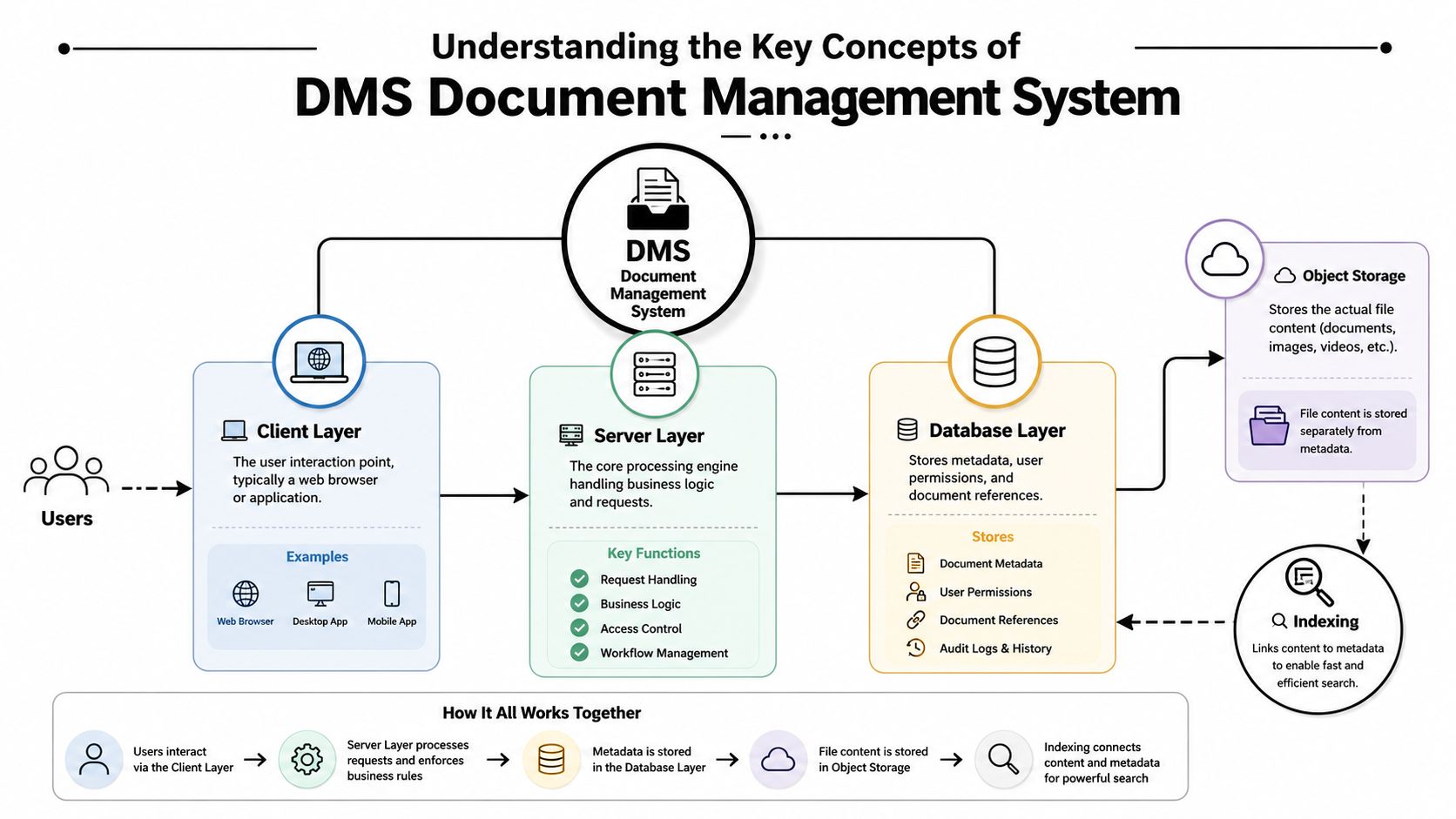
A DMS document management system usually follows a three-layer setup. The client layer is the interface your staff use, often a browser or app. The server layer processes requests and applies the business rules. The database layer stores the structured information that keeps documents searchable and controlled, a pattern described in the DMS architecture paper.
For Swiss beauty and pharma retailers, that structure matters because the system has to serve both front-line work and controlled recordkeeping. A store associate may need quick access to a product sheet, while head office may need to verify who approved the latest version. The layered design keeps those tasks separate without forcing staff to manage everything through one crowded folder tree.
Why metadata matters
The file itself should not carry all the intelligence. Many DMS setups store file content in object storage and keep metadata in a relational database, which separates heavy document files from the indexed details that make them easy to find. That approach supports faster full-text search, cleaner versioning, and clearer retention for large document sets, as explained in the DMS storage and metadata guidance.
For a Swiss retailer, metadata works like the label on a pharmacy drawer, it tells staff exactly what belongs inside. It can include the product line, supplier, market, language, approval status, or expiry. If your team has ever opened several nearly identical PDFs just to confirm the approved one, metadata is what removes that wasted effort.
How control and auditability fit in
Two other ideas matter just as much, access control and audit trails. Access control decides who can view, edit, approve, or archive a file. Audit trails record the action history, so the business can show how a record changed over time.
The right access model can be more specific than simple role labels. A store manager may only need view rights, while QA, regulatory, or head office teams may need edit or approval rights. For a practical comparison of access design, the ABAC implementation guide is useful if you are comparing role-based and attribute-based approaches for different user groups.
Use this test: if you cannot explain who can change a file, where the approved copy lives, and how the history is preserved, you do not yet have document control. You have document storage.
The architecture is not technical decoration. It is the reason a DMS can support regulated work without turning into folder sprawl.
Exploring Key Features for Effective Document Management
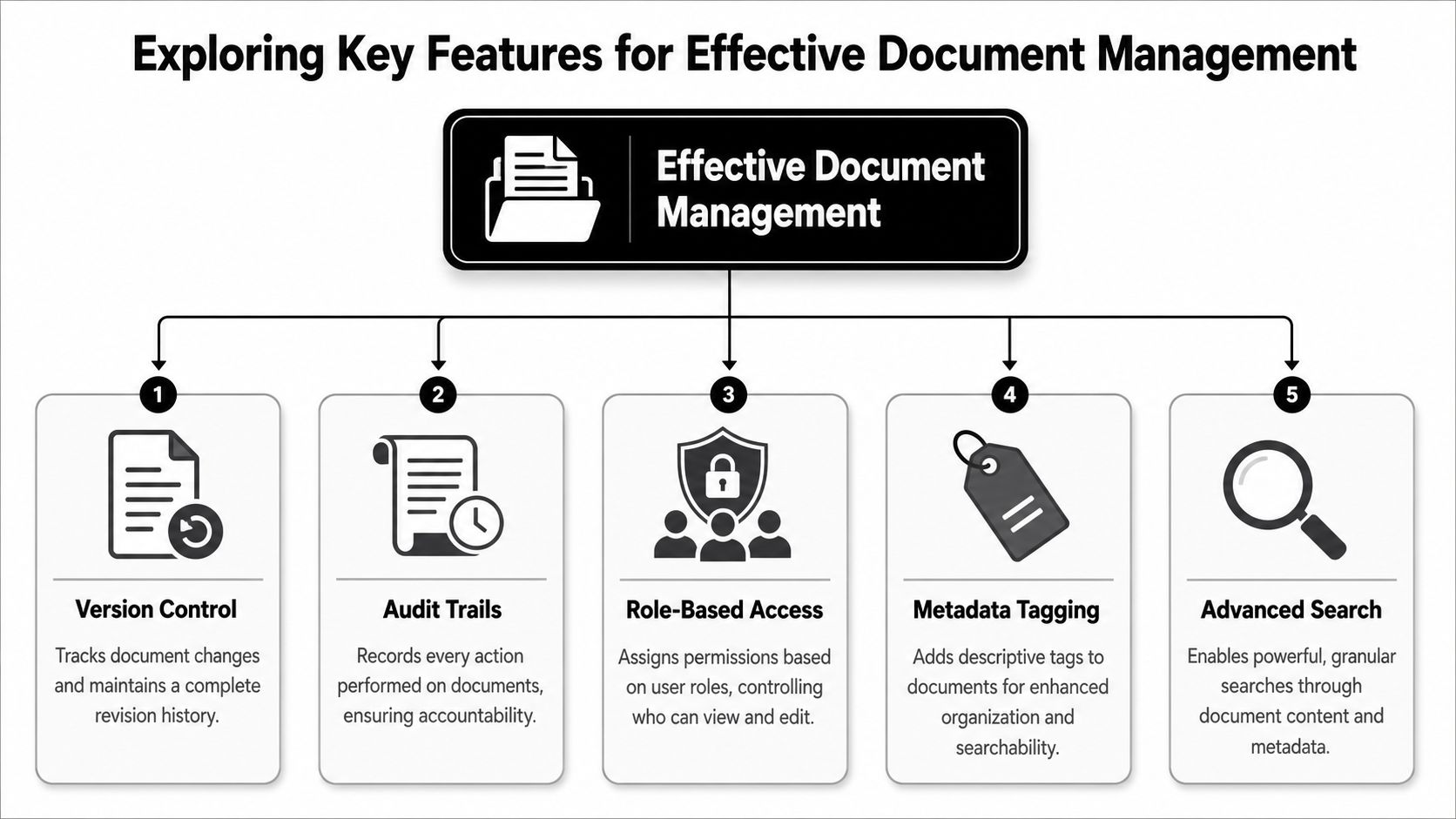
The five features below are the ones Swiss beauty and pharma retailers feel every day. Leave one out, and the system starts behaving like a better shared drive instead of a compliance tool.
Version control and audit trails
Version control stops staff from working on the wrong file. In a cosmetics context, that might mean a product label or ingredient sheet. In a pharmacy context, it might be a training record or supplier approval form. Audit trails then show who opened, edited, approved, or archived the document, which matters when someone later asks why a file changed.
Role-based access and metadata tagging
Role-based access keeps sensitive files in the right hands. A store manager may need view access, while QA, regulatory, or head office teams may need edit or approve rights. For a practical overview of access design, a useful external reference is the ABAC implementation guide, especially if you're comparing role-based and attribute-based approaches for different user groups.
Metadata tagging is what makes the system usable at scale. Tag documents by brand, product family, supplier, expiry, market, or compliance category, and you turn a folder maze into a controlled catalogue. That helps with seasonal assortment updates, batch documentation, and recall readiness.
Advanced search in real workflows
Advanced search is where the DMS pays back the time you used to waste. A buyer can search by supplier name and approval status, while a pharmacist can search by document type and date range. The point isn't just speed, it's confidence that the right file was found the first time.
Operational insight: document control fails less often because of missing software and more often because staff can't find the approved record quickly enough.
For a compact demo of how these ideas work together, the embedded video can help teams visualise the workflow before implementation.
Industry Benefits for Cosmetics Pharma and Retail
Swiss beauty and pharma retailers don't buy document systems for abstract neatness. They buy them because product files, supplier approvals, and compliance records move through the business every day, and every delay creates friction somewhere else.
Better control for premium and natural brands
A retailer carrying certified-organic or ethically sourced lines needs documentary evidence to match the brand promise. If a certificate, declaration, or approval note sits in the wrong folder, the team can't respond quickly when a partner or auditor asks for proof. A DMS keeps the file linked to the correct product record, which reduces confusion during range launches and seasonal relists.
For spa, boutique, and clinic settings, the same logic applies to treatment-linked retail products and test kits. Teams often want one source of truth for ingredient information, brand approvals, and internal sign-off. Without that control, the same document gets duplicated into emails, desktops, and local folders, and nobody is fully sure which one is current.
Faster retrieval and cleaner handovers
Beauty retail moves fast. Staff change shifts, buying teams hand off projects, and e-commerce teams update listings while store teams keep serving customers. A DMS reduces the back-and-forth because the right document is already indexed, permissioned, and ready to open.
That also helps with batch-level traceability in pharma-adjacent workflows. When a document supports a specific product line, the business needs a clear path from file to decision. The system becomes the handover point between procurement, compliance, and customer-facing teams, not just a digital filing cabinet.
Less version conflict during launches
Version conflicts are especially painful when marketing, product, and operations all touch the same material. If one team is editing a draft while another thinks it's final, the launch slows down. A DMS gives everyone a controlled reference point, so the team works from one approved copy instead of three almost identical files.
The practical gain is simple. Fewer mismatches, fewer follow-up emails, and fewer panicked searches just before a launch or audit.
Meeting Swiss Regulatory and Security Requirements
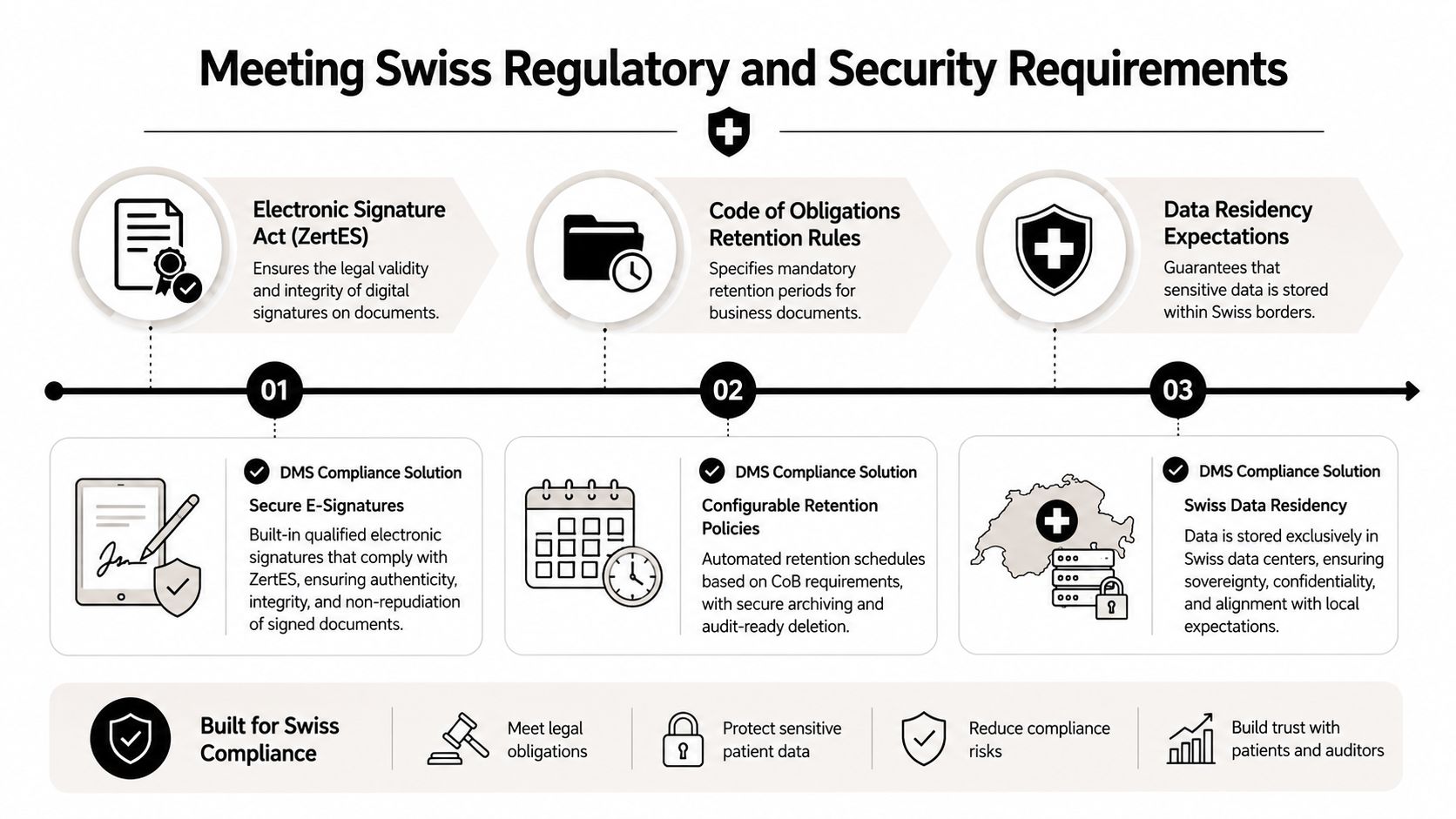
A Swiss beauty or pharma retailer can have a tidy filing system and still fail a compliance review if the platform cannot prove who approved what, when it changed, and where it is stored. Generic DMS advice often misses that point. In Switzerland, ZertES supports qualified electronic signatures for business processes where authenticity, integrity, and traceability matter, and that makes document control part of the compliance workflow rather than a back-office task (Swiss DMS and compliance context). The federal administration's Digital Administration strategy also signals where practice is headed, with public services moving further toward digital delivery and stronger process control.
What the regulations mean in practice
For pharmacies, clinics, and regulated beauty distributors, a DMS needs to support qualified electronic signatures, tamper-evident archives, and strict access controls. Records also need retention discipline, because saving a file is not the same as being able to defend it later. Under Swiss record-keeping duties tied to the Code of Obligations, the business must keep evidence usable over time, not just stored.
That difference matters on the shop floor and behind the scenes. A treatment consent form, a supplier declaration, or a batch-related approval should be easy to retrieve, but also hard to alter without leaving a trace. If staff can edit, copy, or forward documents too freely, the system starts to behave like a shared folder instead of a controlled record set.
Cloud setups need the same careful review. Swiss teams should confirm where data is hosted, how transfers are controlled, and whether permissioning follows job roles instead of broad share links. A DMS should also fit local hosting needs where sensitive records must stay under tighter control.
Why governance matters as much as software
Software alone does not create control. A DMS only works inside a clear governance model, and that is where IT governance frameworks become useful for mapping policy, ownership, and control responsibilities.
For Swiss organisations, the system should sit inside retention schedules, review duties, escalation paths, and audit preparation. If those rules are vague, the platform will preserve poor habits more efficiently. A regulated retailer needs the same discipline a lab or clinic would expect, with named owners for approvals, defined archive rules, and a way to show an auditor that the process was followed.
Integration and Implementation Strategies
A successful rollout starts with the business, not the software. In a Swiss retailer, pharmacy, or clinic, the first step is to map document types by risk, because a supplier declaration does not need the same controls as a release approval or staff training record. From there, identify who creates, reviews, approves, and archives each document, then turn that into role design and workflow rules.
A useful way to plan the rollout is to separate the documents that are routine from the ones that carry regulatory weight. Beauty and pharma teams often handle both in the same day, but a stock image consent form, a product quality record, and a complaint file do not belong in the same control bucket. Once you sort them by sensitivity, the implementation decisions become clearer.
Build the architecture around use, not convenience
Swiss enterprise deployments often use a five-layer logical architecture, with application, engine, business management, production, and archive layers, so different services can scale independently (enterprise DMS architecture). That matters if your business expects heavy capture activity during product launches, but quieter archive access later. A modular structure keeps those workloads from fighting each other.
The same logic helps a Swiss beauty chain with a central office and many branches. Store teams may need quick capture and retrieval, while compliance staff need controlled review, and quality teams need stable archives for audits. A layered setup lets each group work in a way that matches its task, without forcing everyone into the same workflow.
Hybrid setups are often a practical fit when some records need local control and others need flexible access. The decision should follow the document risk profile, internal IT capability, and the location of sensitive data. In multilingual teams, that architecture should also support tagging and search rules that work across the languages your staff use.
Avoid the rollout traps
The two biggest traps are messy migration and weak user adoption. Legacy files need clean naming, consistent metadata, and a clear owner before they move. Staff also need short, role-specific training, because a system people don't understand becomes another place to hide files.
Migration should be treated like moving products into a new storage room. If boxes are unlabeled, nobody trusts the shelves later. The same applies to a DMS, old files need an approved version, a clear status, and enough metadata for someone in Lausanne, Basel, or Zurich to find them without guesswork.
- Clean the source files first: remove duplicates, identify the approved copy, and archive the rest.
- Define metadata rules early: keep tags simple enough for store, pharmacy, and head office teams to apply consistently.
- Lock down governance: set review dates, approval ownership, and access review routines before go-live.
- Test with real documents: use live supplier records, label files, and compliance forms, not sample placeholders.
Implementation advice: start with the documents that cause the most friction, because that's where staff will feel the benefit quickly and support the change more readily.
AI-assisted search and summarisation can help multilingual teams, but only if the underlying governance is strong. If documents are misfiled or permissions are loose, smarter search just exposes the disorder faster. In Swiss beauty and pharma settings, the system should make controlled work easier, not hide weak filing habits behind better technology.
Choosing Your DMS Buyer Checklist and ROI Tips
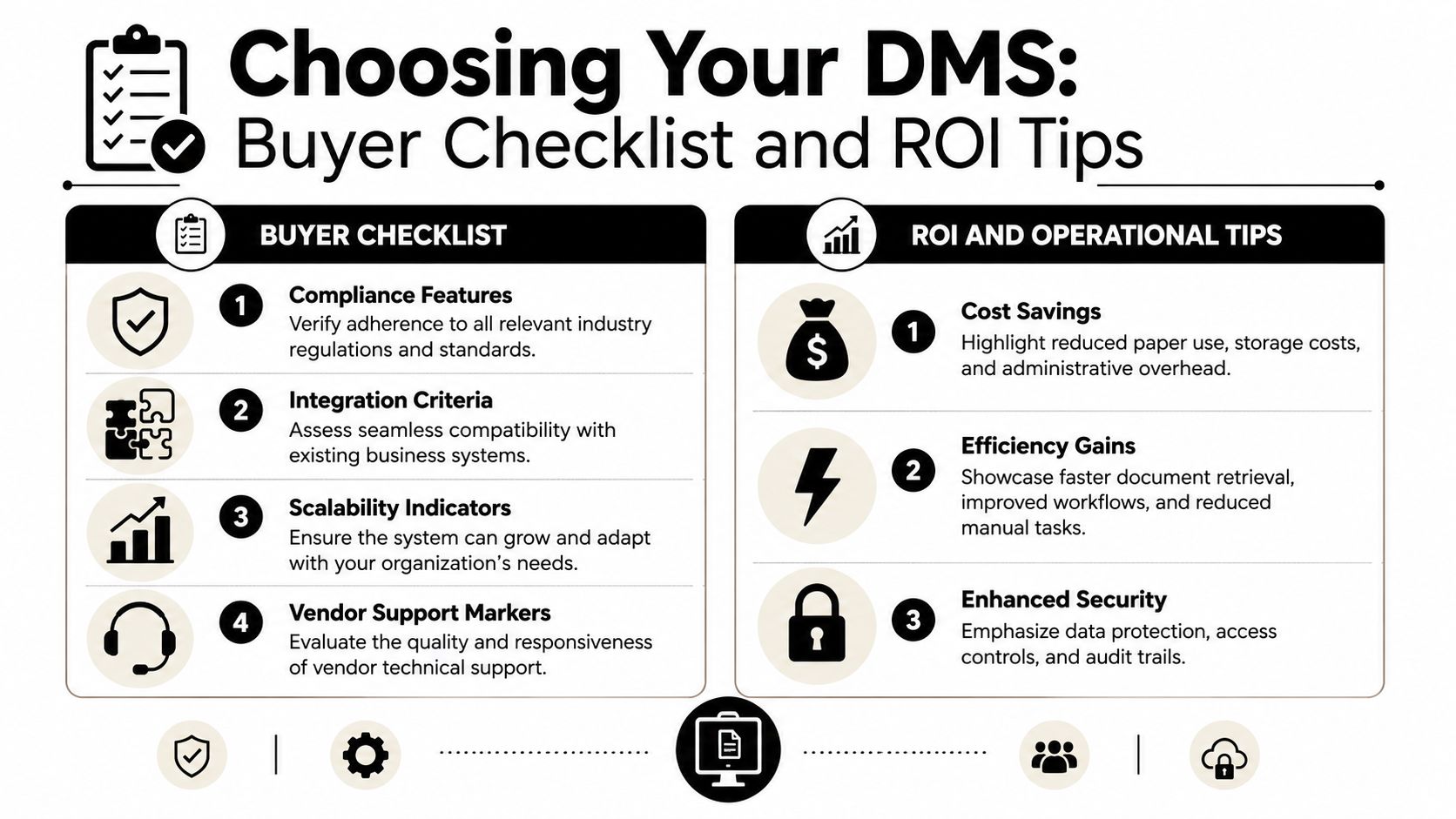
A good buyer checklist starts with the Swiss question, not the vendor pitch. Can the system support retention, audit trails, and cross-border data considerations under the Code of Obligations, or is it just a polished file-sharing tool? Generic guides often miss that point, even though it's central to defensible document handling in Switzerland (Swiss compliance criteria gap).
Buyer checklist
- Compliance features. Confirm support for signatures, retention rules, access controls, and immutable history.
- Integration criteria. Check whether it connects cleanly with ERP, quality, e-commerce, or pharmacy systems already in use.
- Scalability indicators. Make sure the structure can handle more documents, more users, and more archive demand without becoming disorganised.
- Vendor support markers. Ask how training, change requests, and issue escalation are handled after go-live.
ROI tips that matter in daily work
- Cost savings. Look at paper handling, storage overhead, and the time staff spend searching for documents.
- Efficiency gains. Measure faster retrieval, smoother approvals, and fewer manual handoffs.
- Enhanced security. Track how much better the business can control access, maintain history, and prepare for audits.
For Swiss beauty and pharma retailers, ROI usually shows up less as a headline number and more as fewer interruptions. When product files are easy to find and approvals are controlled, teams spend less time cleaning up document chaos and more time serving customers, managing assortment, and supporting compliance.
Conclusion and Next Steps
A DMS is not just digital storage. For Swiss beauty and pharma retailers, it's the control layer that keeps product records, approvals, and audit evidence usable when the pressure rises. The smartest next move is to review your current workflow, pick three documents that cause the most friction, and test whether your system can control versions, permissions, and history cleanly.
Beautysecrets.agency helps Swiss trade partners build premium, compliant assortments, and that includes thinking carefully about document control across natural, ethical, and regulated product lines. If you're planning a DMS rollout for your beauty or pharmacy business, visit beautysecrets.agency to see how a compliance-first partner can support your next step with clarity and care.