You can have a perfectly ordinary Swiss morning, step off the tram in Zurich or finish a ski weekend in the Engadine, and still notice it. Fine lines that weren't there last winter. A slightly rougher texture around the cheeks. A neck that seems to show every season you've ever spent outdoors. That's how premature skin ageing usually appears, long before anyone thinks to call it ageing at all.
For pharmacies, spas, and premium retailers, the practical question isn't which trend is fashionable. It's how to prevent premature skin aging in a way clients can follow in real Swiss conditions, where altitude, snow reflection, cool weather, and daily commuting all add up. The strongest prevention plan is still built on boring fundamentals, consistent UV protection, a barrier-friendly routine, and lifestyle choices that don't keep accelerating visible change.
Why Premature Skin Aging Deserves Your Attention
A lot of people still picture skin ageing as a beach holiday problem. In practice, I see it show up in people who spend most of the year under cloud cover, on city streets, or at altitude, then wonder why their skin looks more lined than it should.
A woman in her early thirties might see new crow's feet after a winter of commuting in bright daylight. A man who skis regularly may notice that his cheeks and neck look more textured than his office-based peers. Neither of them has to be sunbathing for skin to age visibly. Cumulative UV exposure is enough, and Swiss routines often hide that exposure behind cool air and low perceived heat.
The hard part is that prevention has to start before the changes feel dramatic. By the time people are actively hunting for corrective treatments, the skin has already been through years of repeat stress. That's why a structured prevention approach matters more than reactive fixes.
Practical rule: if the skin is exposed, it's being aged, even when the weather feels harmless.
For Swiss buyers, that changes the brief. The best prevention assortment doesn't just promise glow. It helps clients protect skin every day, in winter, on trains, at lunch terraces, on mountain walks, and during short bursts of sun they never planned for.
Understanding the Root Causes of Premature Skin Aging
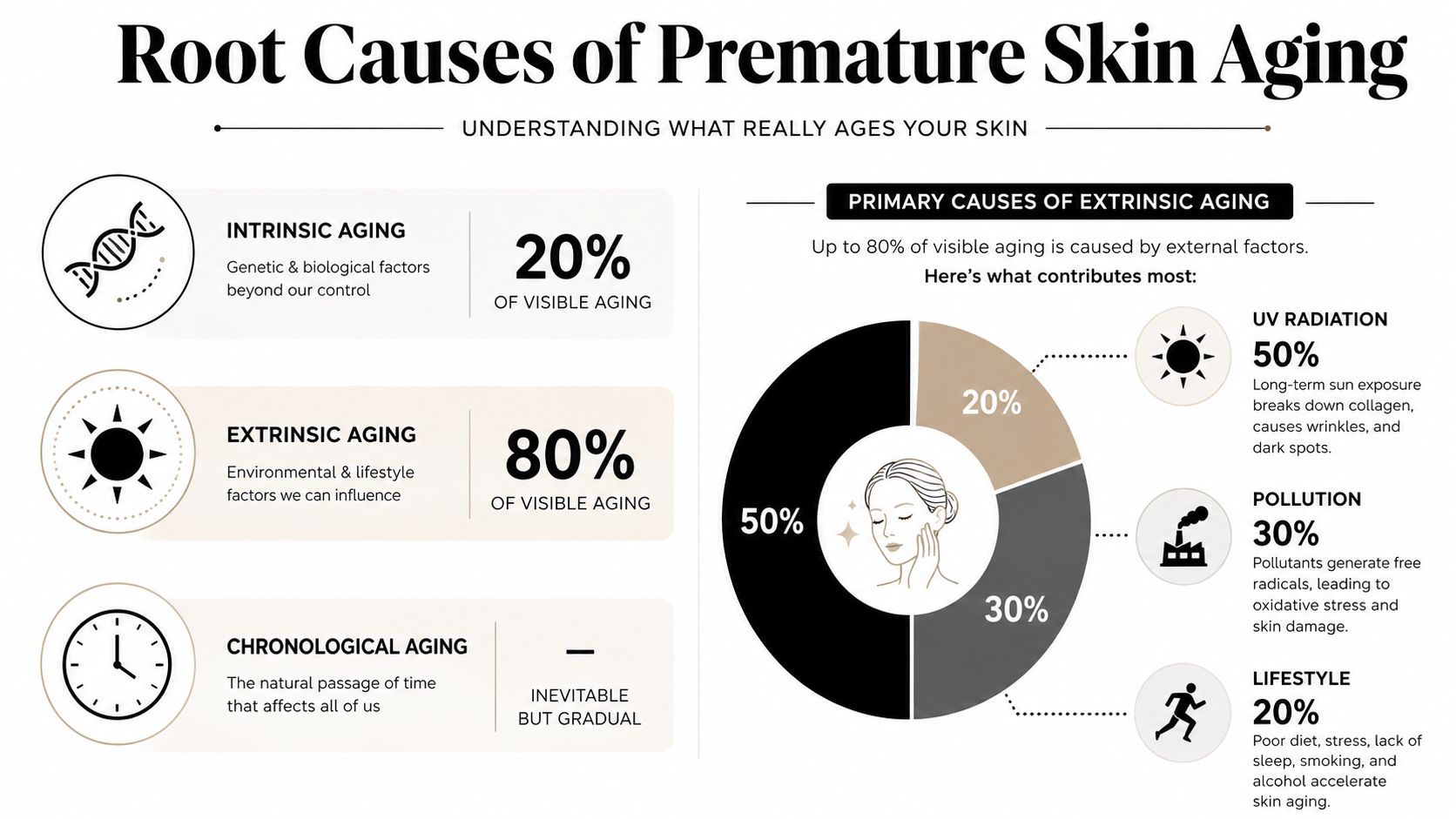
A client in Zürich may spend most days indoors, then pick up visible facial ageing from the commute, a terrace lunch, and a winter ski weekend. That is the pattern I see most often. Intrinsic ageing sets the baseline, but extrinsic ageing drives the changes people notice first, especially where bright alpine light reflects off snow and amplifies UV exposure.
The clearest proof still comes from the Nambour randomised trial. Daily sunscreen use led to less visible skin ageing than discretionary use, which is a practical reminder for Swiss pharmacies and clinics that prevention has to be built into routine care, not saved for beach holidays Nambour randomised trial. In mountain settings, the hidden risk is that cool air lowers awareness while reflected light keeps the skin under pressure.
Sun and smoking do most of the visible damage
A clinical wrinkling study linked heavier lifetime sun exposure with more excessive wrinkling, and it also found a strong association between heavy smoking and visible facial lines clinical wrinkling study. When both factors were present, wrinkling was much more common. That matters in practice because topical care can soften some surface stress, but it cannot offset repeated UV exposure or tobacco-related oxidative damage on its own.
The same study also showed that many participants already had signs of premature skin ageing, with worse severity after early adulthood and higher risk in fairer skin types clinical wrinkling study. For Swiss retail teams, that is the useful takeaway. Clients rarely need a complicated theory. They need to know that skin type, long-term sun habits, and smoking history all shape what shows up on the face and neck.
For a broader consumer-friendly overview of common wrinkle drivers, wrinkle causes to know is a useful companion read for clients who want a simple list without technical language.
The best prevention plan is usually the one people can repeat every day, because visible ageing follows habits long before it follows age.
Building a Daily Prevention Skincare Routine
A routine that works is one people can keep doing in January, not just in July. For prevention, the morning should be built around protection, while the evening should focus on repair and barrier support.
Morning protection first
Start with a gentle cleanse, especially if the skin is oily or has residual night products. Then use an antioxidant serum if the skin tolerates one, because vitamin C is a sensible daytime choice when the goal is to reduce free-radical load before UV exposure. Finish with a moisturiser suited to skin type and a broad-spectrum sunscreen.
The sunscreen step matters most. Public guidance from the U.S. National Institute on Aging recommends applying sunscreen 15 to 30 minutes before sun exposure, using at least SPF 15 with broad-spectrum protection, and reapplying at least every two hours NIA guidance. In practice, many Swiss clients are better served by a higher everyday SPF in formulas they'll wear, but the key principle is consistent, repeated UV defence.
Evening repair without overcomplicating it
Evening care should be calmer. A double cleanse helps remove sunscreen and daily grime, then a retinoid can be introduced if the skin tolerates it. For sensitive clients, a gentler alternative is often a better starting point, especially if they already deal with redness, dryness, or barrier disruption. Seal the routine with a nourishing cream that supports comfort overnight.
Retail rule: the best anti-ageing routine is the one clients can repeat without irritation, not the one that looks most aggressive on paper.
Seasonal adjustment matters in Switzerland. Lighter textures tend to work better in warmer months, while richer emollients are often more comfortable in winter, especially in heated interiors. The mistake I see most often is skipping protection because the day looks grey. The skin doesn't care whether the light feels warm.
How to set expectations
Give clients time before they judge a product. Prevention is about maintaining skin quality and slowing visible change, not about creating an overnight transformation. If the routine is too complicated, simplify it rather than pushing harder actives.
Sun Protection Strategies Tailored to Swiss Conditions
The Swiss Federal Office of Public Health uses a UV Index-based protocol that's practical for everyday use. From UV Index 3 upward, people should apply broad-spectrum sunscreen, wear sunglasses, and cover exposed skin. From UV Index 8 upward, they should avoid direct midday sun and add a hat, long clothing, and shade-seeking behaviour Swiss public health guidance.
That approach fits Switzerland better than generic beach advice because the exposure pattern is different. Mountain air feels cooler, but altitude increases UV load, and snow can reflect light back onto the face and neck. The result is that people often underestimate how much exposure they've had after a ski day, a winter hike, or even a bright terrace lunch.
Hidden exposure is the real Swiss problem
Swiss consumers don't usually need to be convinced that summer sun exists. They need to be reminded that winter sun, reflected light, and altitude all count. The country's UV forecast service publishes real-time regional UV values, which makes daily decisions easier, especially for clients who live between urban centres and the mountains Swiss UV forecast context.
Cloud cover doesn't remove the need for protection either. It only changes how obvious the exposure feels. That's why retailers should frame sunscreen as a daily habit, not an optional seasonal one.
What to recommend at point of sale
For Swiss clients, the clearest advice is simple. Check the UV Index, use broad-spectrum SPF every day, and treat mountains and snow as higher-risk settings. Sunglasses, hats, and clothing do more than protect comfort. They reduce the repeat exposure that drives visible ageing.
A useful buying rule is to prioritise textures clients will wear without resistance. If the finish feels too heavy, too shiny, or too fragranced for daily use, compliance drops. The best Swiss sun care is the one people keep in their bag, ski jacket, or desk drawer.
Reducing Lifestyle and Environmental Risk Factors
Topical care can only do so much if the client keeps feeding the same damage pathways. Smoking is the clearest example. The wrinkling study above showed a prevalence ratio of 12.0 when high sun exposure and smoking occurred together clinical wrinkling study, which is why smoking cessation belongs in any serious anti-ageing conversation.
What matters beyond the bathroom shelf
Stress, poor sleep, low antioxidant intake, and dehydration don't create the same clean clinical headline as UV exposure, but they still shape how skin looks. In winter, alpine air and indoor heating make dryness more noticeable, especially on cheeks, lips, and hands. Clients often blame their cleanser or moisturiser when the bigger issue is the environment they're living in.
That doesn't mean everyone needs a complicated wellness programme. It means skin care should be paired with ordinary habits that reduce strain on the barrier. Regular sleep, enough water, and a diet that doesn't run on ultra-processed snacks all support the look of skin, even if they're not glamorous enough for most marketing campaigns.
What to say to clients who want simple rules
Keep the conversation direct.
- Stop smoking if premature wrinkling is already a concern. The evidence on combined risk is too strong to soften.
- Use moisturiser more consistently in winter. Dry air makes fine lines more visible and makes active products feel harsher.
- Treat hydration as support, not a miracle. Water won't replace sunscreen, but it helps keep the routine comfortable enough to stick with.
- Choose antioxidant-rich foods when possible. Think of this as supporting the skin from within, not as a substitute for topical protection.
Clients usually don't need perfection. They need fewer accelerants. Remove one or two of the biggest ones, and topical prevention becomes far more effective.
Choosing Evidence-Backed Clean Beauty Ingredients
The clean-beauty conversation works best when it stays honest. Natural doesn't automatically mean effective, and synthetic doesn't automatically mean bad. Retailers that understand that distinction can guide clients towards products that are both credible and pleasant to use.
Ingredient choices that actually make sense
Retinoids remain the benchmark for visible anti-ageing support because they're widely used for cell turnover and collagen signalling. For clients who want a gentler route, bakuchiol is the most common clean-beauty alternative to discuss, especially with sensitive skin. If you want a practical comparison point, retinol alternative for Indian skin is a useful read for understanding why some shoppers look for lower-irritation options.
Vitamin C is still one of the most logical daytime actives because it fits well into a prevention-first routine. Niacinamide supports barrier function and helps make routines more tolerable, which is often what keeps clients compliant. Hyaluronic acid is useful when the goal is hydration and a smoother surface feel, while peptides can be positioned as supportive ingredients in more premium formulas.
| Active Ingredient | Clinical Evidence | Clean Alternative | Key Certification to Look For |
|---|---|---|---|
| Retinoid | Widely used for collagen support and cell turnover | Bakuchiol | ECOCERT where applicable |
| Vitamin C | Antioxidant support for daytime routines | Plant-derived antioxidant blends | Cruelty-free commitments |
| Niacinamide | Barrier support and tone improvement | Botanical barrier-support complexes | ECOCERT where applicable |
| Hyaluronic Acid | Hydration and visible plumping | Aloe-based hydration systems | Cruelty-free commitments |
| Peptides | Supportive anti-ageing signal ingredients | Amino-acid or botanical support blends | ECOCERT where applicable |
For Swiss buyers, certification matters because it reduces guesswork. ECOCERT, along with cruelty-free commitments aligned with PETA and Cruelty Free International, gives shoppers a clearer ethical frame. That's especially relevant in premium retail, where the product story has to feel clean, not merely trendy.
Buying skill is balance. Don't overstock harsh actives for clients who want a calm, repeatable routine. Don't undersell the value of barrier support just because it's less dramatic than exfoliation. Prevention works better when the formula is wearable.
Professional Interventions and Retail Recommendations
There's a clear line between prevention and correction. Daily care helps slow visible ageing, but some clients will still want clinic-grade support for early lines, texture changes, or uneven tone. Chemical peels, light-based therapies, and medical-grade topical programmes can sit alongside home care when the client is ready for more structured intervention.
Retail and clinic teams should position these services clearly. A client who is just starting to think about prevention doesn't need an aggressive corrective plan. A client with established sun damage may benefit from being referred for professional assessment while their home routine is tightened around UV defence and barrier support.
How to curate with confidence
For buyers, the most useful assortment is one that covers prevention, maintenance, and escalation. That means sunscreen, barrier creams, antioxidant serums, and selected actives at home, with referral pathways to practitioners for deeper interventions. If a brand talks beautifully but can't explain its sourcing, certification, or stability, it's not ready for a discerning Swiss shelf.
That's where the clean-beauty lens matters most. Products should feel credible, transparently sourced, and appropriate for the skin type they're meant to serve. Retailers who can explain formulation choices clearly tend to build more trust than those who stack premium claims.
If you're assessing where to direct clients once at-home care is no longer enough, skin booster injections Portsmouth is a practical example of how clinics position more advanced hydration-focused services. The lesson for Swiss retailers is not to sell the procedure, but to understand where the line sits between topical prevention and in-clinic correction.
For distributors and store buyers, the best assortment strategy is simple. Offer products that help prevent premature skin ageing every day, then build a referral mindset around services that belong in a professional setting. That gives clients a clean path from maintenance to intervention without confusing the two.
beautysecrets.agency helps Swiss pharmacies, spas, and premium retailers build that kind of prevention-first assortment with natural, ethically sourced skincare and body care. If you're planning a cleaner, evidence-informed anti-ageing range for your clients, visit beautysecrets.agency and explore how a curated selection can fit Swiss market expectations for efficacy, transparency, and sustainability.