Why do so many shoppers stand in front of two nearly identical serum bottles and still end up guessing? The label says exfoliating, the texture feels similar, and yet one formula should smooth a dull surface while another should work inside oily pores. That difference matters more in Switzerland than people realise, because AHA BHA serum shopping here sits at the intersection of premium skincare, pharmacy guidance, and careful, repeatable home use.
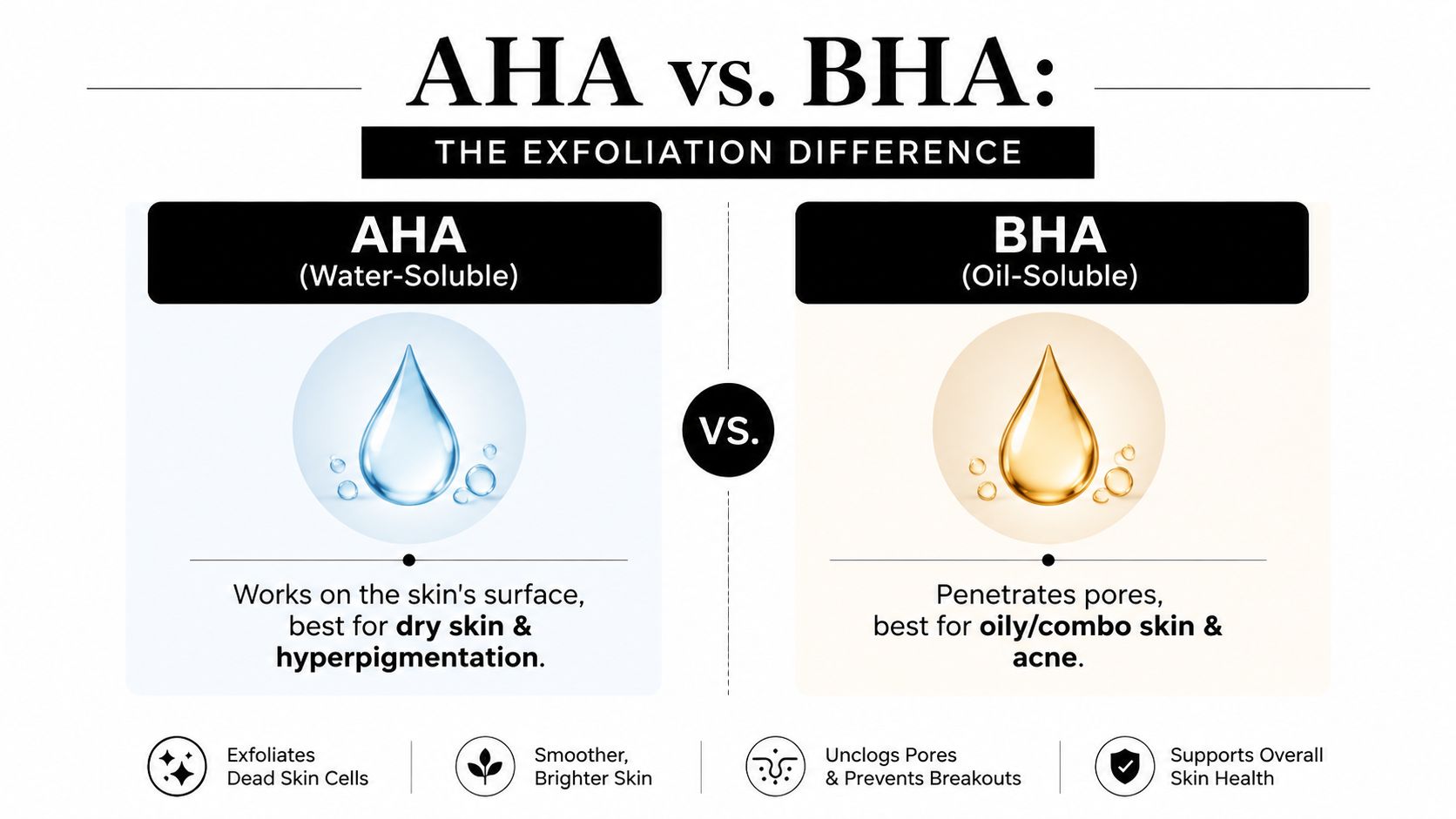
An aha bha serum is not one product with one job. It's a family of formulas built around alpha hydroxy acids (AHAs), which are water-soluble and work mainly on the skin's surface, and beta hydroxy acids (BHAs), which are oil-soluble and can reach into sebum-rich pores. In Swiss pharmacies, drugstores, and premium retailers, that usually means the serum is positioned as a controlled exfoliant for regular use, not as a peel-level treatment. The practical question is not just what it does, but how strong it is, how acidic it is, and whether your routine can tolerate it.
The category also keeps growing because consumers keep buying texture-refining and blemish-focused formulas. A peer-reviewed review indexed on PubMed Central reports that the global AHA market was valued at USD 1.2 billion in 2021 and is projected to reach USD 3.2 billion by 2030, with a CAGR of 8.5% from 2021 to 2030 (PubMed Central review). That doesn't tell you what to put on your face tonight, but it does explain why Swiss buyers now expect acid serums to be clearly engineered, clearly explained, and clearly merchandised.
What AHA and BHA Actually Do on Your Skin
If both acids exfoliate, why are there usually two bottles on the shelf? The answer is that they don't travel to the same place on skin, and they don't solve the same problem.
Surface smoothing versus pore work
AHAs are water-soluble. In plain terms, they stay comfortable in the watery part of a formula and work mostly where the skin is dull, rough, or visibly uneven. That's why people use them for glow, texture refinement, and the look of flatter, smoother skin.
BHA, usually salicylic acid, is oil-soluble. It behaves differently because it can mix with sebum, which makes it more relevant for blackheads, clogged pores, and shine-prone zones. A consumer with a dry winter cheek and an oily T-zone can understand the distinction quickly, because the cheek usually benefits from surface smoothing, while the T-zone often needs pore-level work.
That's the primary reason the market keeps both categories separate. An aha bha serum can combine those functions, but the combination still obeys the chemistry of each acid. AHA reaches the outer layers more readily, while BHA is the part buyers reach for when congestion is the main complaint.
Practical rule: if your issue looks like dullness or roughness, think AHA. If it looks like congestion, blackheads, and an oily sheen, think BHA.
Why combination formulas feel different
A combined formula doesn't behave like two single-acid serums poured into one bottle. The formula has to balance surface exfoliation with pore-clearing action, and it usually does that by keeping the active load modest enough for repeated use. That's why Swiss pharmacies and premium retailers tend to treat these products as routine exfoliants, not as aggressive peel substitutes.
The other useful distinction is tolerance. An AHA-only serum can feel elegant on dull, dry skin, but it may not address pore congestion well. A BHA-only serum can be ideal for blemish-prone skin, but it may not deliver the same glow effect that shoppers want from a resurfacing routine. The combined format exists because many customers don't fit neatly into one camp.
A Swiss buyer usually ends up choosing one of three paths. They want a glow-focused AHA formula for surface texture, a BHA formula for clogged pores, or a balanced combination serum for mixed concerns. Once that's clear, the rest of the decision becomes much easier.
The pH, Concentration, and pKa Window That Decides Everything
A serum label tells you which acids are present. It does not tell you how those acids will behave on skin, and that is where concentration and pH start to matter as a pair rather than as separate numbers.
For leave-on AHA products, a commonly cited regulatory benchmark keeps them below 10% total AHA, while levels above 15% are linked with a higher irritation risk and are not meant for routine skincare. In the same consumer-strength category, salicylic acid, the best-known BHA, is often seen at 2% in over-the-counter blemish-control products, and cosmetic AHA/BHA serums are typically formulated around 0.5% to 5% BHA or low-to-moderate AHA percentages (DailyMed reference). Those ranges separate repeatable home use from products that behave more like a peel.
Why pH near pKa is the key lever
The useful formulation question is not only how much acid is in the bottle, but how much of it is in the free-acid form on skin. A peel formula can sit at a pH of approximately 3.6, and glycolic acid has a pKa of 3.6. That puts the system around the point where acid and salt forms are balanced, which supports exfoliating activity while keeping the product in a usable home-care range (The Ordinary peel reference). In plain terms, the pH-to-pKa window helps decide how active the acid feels, and how likely it is to sting.
Buffered formulas exist for that reason. Ingredients such as sodium hydroxide adjust pH, while humectants like glycerin and sodium hyaluronate help the formula feel less harsh during repeated use (The Ordinary peel reference). A 7% AHA serum with a softer vehicle and a lower-intensity BHA component can behave very differently from a peel, even if the ingredient panel looks familiar. That difference is why Swiss buyers should read the formula, not just the headline acid name.
Bottom line: concentration tells you how much acid is present. pH tells you how much of that acid is likely to act aggressively on skin.
For Swiss shelf planning, that is the decisive technical point. A 9.5% AHA + 0.5% BHA serum can be merchandised as a repeat-use exfoliant, while a stronger peel belongs in a separate lane. Retailers should position it that way, and buyers should judge it that way too.
If you want a market-facing example of how a category can be presented without overpromising a peel, see this marketplace optimization case: see this marketplace optimization case
Building a Routine Around an AHA BHA Serum
The safest routine is the one the skin can repeat. That starts with a simple onboarding plan, not a complicated matrix of ten steps and three nights of active layering.
A clean first two weeks
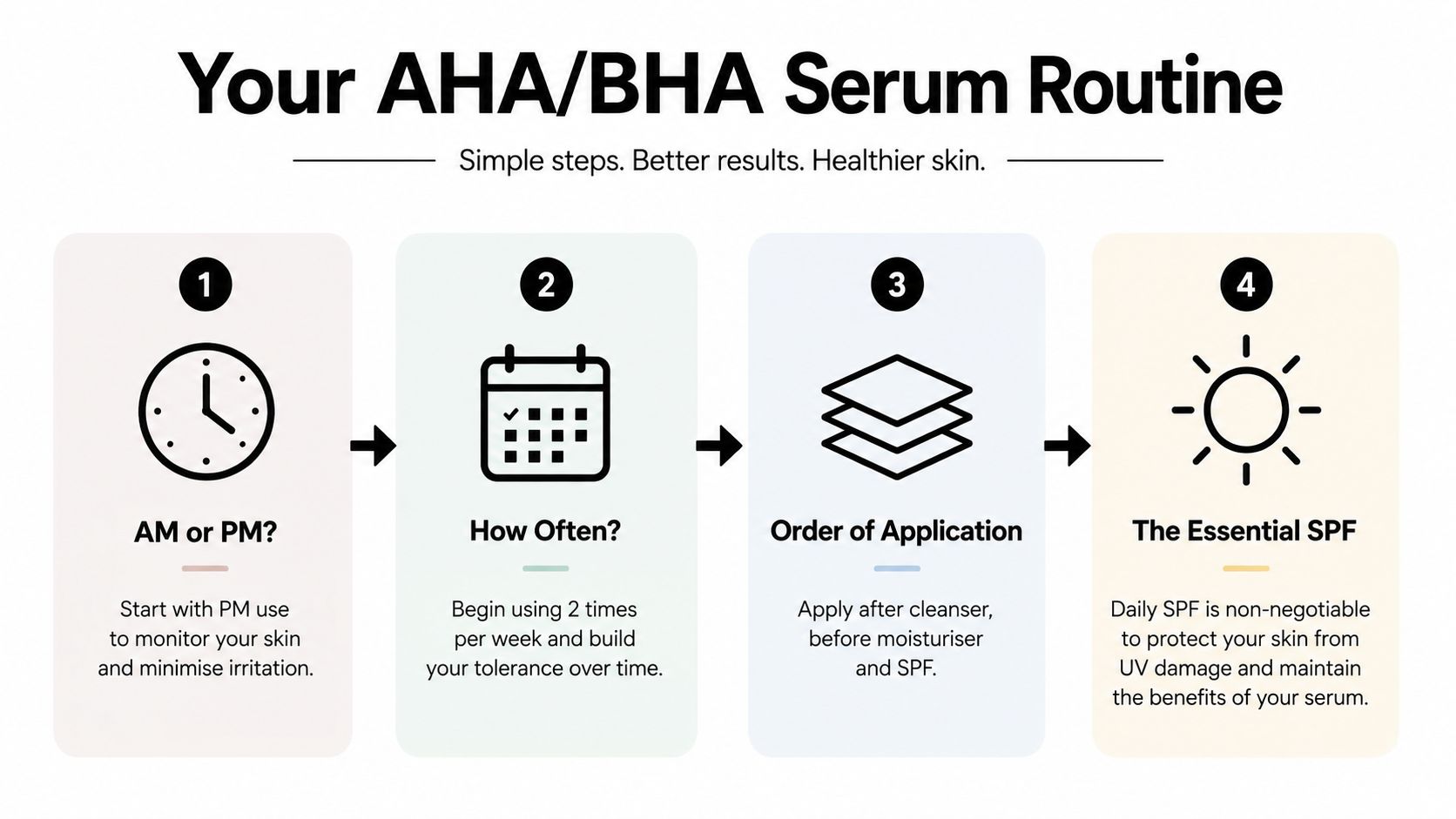
Start on a PM application so you can watch what happens while you're awake and not layering makeup over the result. Use a patch test on the jawline or behind the ear first, then wait 48 hours before you decide the formula is acceptable for full-face use. If the skin stings, gets tight, or starts to peel, the formula is telling you it's too much for the moment.
For actual use, begin with twice a week, then only move towards more frequent use if the skin stays calm. Swiss buyers often do better with that slower ramp in autumn and winter, when many people naturally run a richer moisturiser routine and spend less time in stronger sun. The rhythm matters more than the calendar date.
A simple order works best:
- Cleanser.
- Aha bha serum.
- Moisturiser.
- SPF the next morning, without skipping.
If you want a routine that respects both product and barrier, leave the serum on for a short wait before sealing it in with moisturiser. A practical 10 to 15 minute pause is enough for many users to avoid the feeling of “piling on” too much at once. The point is not precision theatre, it's giving the acid a clean moment on skin.
Practical rule: if the serum is new, keep every other evening simple. No scrub, no retinoid, no bonus acid, no self-inflicted mystery.
For retailers and educators building content or seasonal campaigns, this kind of sequence is more useful than vague “start slow” language. A useful external example of category optimisation and product presentation is see this marketplace optimization case, which shows how clean positioning helps a formula read clearly to shoppers.
Skin Types and the Limits of Routine Advice
“Dry skin uses AHA, oily skin uses BHA” is a starting point, not a decision tree. Real shoppers bring in sensitivity, winter dryness, acne, rosacea tendency, prescription routines, and past irritation, and all of that changes the answer.
Who usually fits, and who usually doesn't
Oily or combination skin often tolerates BHA well because the ingredient targets the sebum-rich environment where congestion tends to build. Dry or dull skin often prefers AHA, especially when the goal is smoother texture rather than pore cleaning. Acne-prone skin can use BHA, and some people with mixed concerns do best with a combination serum at a modest strength.
The caution area is just as important. Sensitive skin, rosacea-prone skin, and barrier-impaired skin often react badly when the acid load is too high or the routine is too crowded. Higher concentrations can trigger peeling, dryness, and irritation, and recent guidance also points towards cautious use and patch-testing before full application (First Derm guidance). That's a useful reminder for Swiss buyers in alpine climates, where winter dryness can make a formula that felt fine in another season suddenly feel too sharp.
When to step away from acids
If skin is already compromised, a serum is usually not the first fix. That includes:
- Post-procedure skin, where the barrier needs recovery rather than exfoliation.
- Prescription retinoid users, who should not add acids casually on the same night.
- Freshly irritated or over-exfoliated skin, where almost anything active can keep the cycle going.
- Eczema-prone or rosacea-prone skin, where low tolerance often wins over theoretical benefits.
In those cases, a gentler alternative may make more sense than forcing an acid routine. Some customers do better with PHA or azelaic acid instead of a standard AHA/BHA serum. The point isn't to ban exfoliation, it's to match the formula to the skin state in front of you.
For Swiss pharmacies and spa counters, that distinction helps avoid overpromising. A shopper asking for “something brightening” may need a different answer if their skin is dry, reactive, or on prescription treatment. A careful recommendation earns more trust than a generic acid sale.
Layering Acids With Retinoids, Vitamin C, and Niacinamide
The biggest routine mistake is not choosing the wrong acid. It's stacking too many barrier-stressing steps on the same night because each one sounded helpful on its own.
What plays well together, and what doesn't
Niacinamide usually coexists well with acids and can fit into the same routine without drama. Vitamin C, especially L-ascorbic acid, tends to want its own low-pH moment, so it's usually cleaner to separate it from an acid serum rather than force both into one application. Retinoids are the bigger clash point, because AHAs plus retinol can turn a manageable routine into a flaky one very quickly.
The practical rule is simple. Do not combine two barrier-stressing actives on the same night unless you already know your skin tolerates that exact pairing. That means:
- AHA/BHA serum plus retinoid, usually alternate nights at first.
- AHA/BHA serum plus benzoyl peroxide, avoid casual stacking.
- AHA/BHA serum plus a fresh clinical peel, give the skin time.
- AHA/BHA serum plus a physical scrub, don't pair them in the same routine.
A sample weekly rhythm can stay quite modest. Two acid nights, two recovery nights, one retinoid night, and the rest moisturiser plus SPF is already enough for many users. If the skin starts to sting, tighten, or flake, stop the actives and run a plain moisturiser and sunscreen recovery phase for several days.
Recovery rule: if your face feels hot, tight, or papery, the fix is usually less, not more.
Routine architecture matters more than ingredient enthusiasm. Swiss consumers often buy premium actives because they want results, but the skin only sees what it can process. A calm, repeatable schedule beats a crowded shelf in the bathroom.
Positioning, Merchandising, and Compliance for Swiss Trade
For Swiss trade, the smartest assortment is not the loudest one. It is the range that lets shoppers self-sort by intensity, skin state, and use case without accidentally buying a peel when they wanted a serum.
A clean assortment shape
A useful category structure is straightforward. Keep one lane for a daily BHA format around the consumer-strength range, one lane for a 7% to 10% AHA glow serum, and one lane for a sensitive-skin alternative that either lowers acid load or swaps to a gentler exfoliant. That gives pharmacists, spa teams, and e-commerce staff a defensible way to guide customers without over-claiming.
The other shelf question is messaging. An aha bha serum should be described as a controlled exfoliant, not as a peel-equivalent miracle. Swiss and EU cosmetics practice usually keeps the product in a cosmetic lane when it's sold for routine exfoliation, while stronger use levels sit much closer to treatment-style expectations. That's why wording matters. “Helps refine texture” is safer than “professional peel at home”.
For retailers that sell into online channels, accessibility and clear product education matter as much as label copy. A useful reference for store readiness is European Accessibility Act for ecommerce, because product pages that explain use, caution, and routine fit reduce confusion before the cart stage.
Assortment matrix for Swiss trade
| Product format | Typical concentration band | Target customer | Shelf placement | Safe claim language |
|---|---|---|---|---|
| Daily BHA toner or serum | Low-to-moderate BHA, often consumer strength | Oily, congested, blemish-prone shoppers | Pharmacy dermo-cosmetic bay | Helps reduce the look of clogged pores |
| AHA glow serum | Moderate AHA within routine-use limits | Dull, dry, texture-focused shoppers | Premium skincare, adjacent to resurfacing | Helps smooth the look of rough texture |
| Combination AHA BHA serum | Modest AHA plus modest BHA | Mixed-concern, experienced users | Dermo-cosmetic and premium hero shelf | Combines surface exfoliation with pore care |
| Sensitive-skin alternative | Lower acid load or gentler exfoliant | Reactive, winter-dry, beginner users | Nearby but visually distinct | Offers gentler exfoliation support |
If your assortment also carries certified-organic or natural-led ranges, the acid category can sit alongside them without confusion if the copy stays factual. For instance, a brand like beautysecrets.agency can be used as one trade option for retailers looking at natural, ethically sourced portfolios that emphasise recognised standards such as ECOCERT and cruelty-free commitments. The key is to avoid implying that natural positioning cancels the need for proper concentration, pH, or usage guidance.
A small but useful merchandising move is to keep the stronger acid formats slightly apart from the gentler spa products. Shoppers then read the category as a spectrum, not as one undifferentiated shelf of “active” formulas.
A Practical Checklist Before You Buy or Recommend
A fast acid check makes recommendations cleaner. It also prevents the most common mistakes, which usually come from assuming every exfoliating serum behaves the same way.
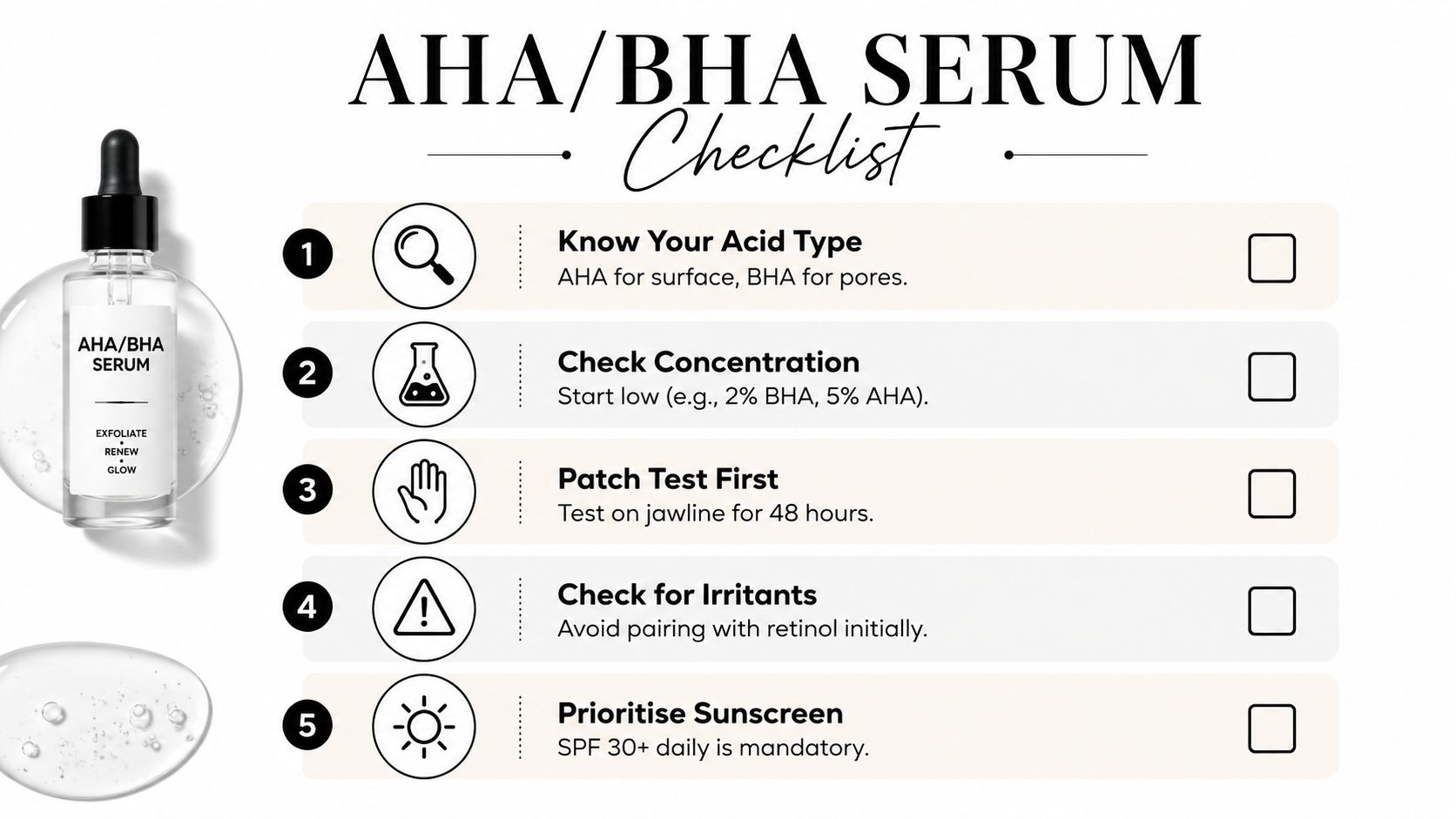
Two-minute buy-or-recommend screen
- Know the acid type. AHA is better for surface smoothing, BHA is better for pore work.
- Check the label strength. Start with modest concentrations, not the strongest bottle on the shelf.
- Patch test first. A jawline test gives you a useful early signal before a full-face commitment.
- Look for irritant overlap. If the routine already includes retinoids or other strong actives, simplify first.
- Commit to sunscreen. Daytime SPF is part of the routine, not an optional add-on.
If clean-beauty criteria matter to the customer, verify those too. Swiss buyers often want transparent sourcing, ECOCERT alignment, and cruelty-free commitments, so the label should match the promise. For teams shaping content, product pages, or SEO around this category, tools like the Nuwtonic AI SEO Platform can help structure the educational copy without losing the technical details that matter.
The main rule is simple. Respect the pKa window, respect the barrier, and respect the routine already in place. That's how an aha bha serum becomes a useful part of skin care instead of another bottle that gets abandoned after one irritated week.
Beautysecrets.agency supports Swiss retailers, pharmacies, spas, and premium e-commerce teams with curated natural and ethically sourced skincare assortments that fit this kind of category education. If you want help selecting acid-compatible brands, building a compliant shelf story, or positioning exfoliating serums alongside certified-organic ranges, visit beautysecrets.agency and explore how their portfolio can support your next skincare range.