You're in the meeting already. The pharmacy buyer has the carton in front of them, the words natural, ethical, and cruelty-free are on the pack, and the next question is simple, “Can you prove it?” In Switzerland, that question now reaches beyond branding. It reaches into supplier files, ingredient origin, packaging inputs, transport records, and the due-diligence logic behind the claim.
For a Swiss distributor, a sustainable supply chain isn't a marketing layer added at the end. It's the evidence system behind what you sell, especially when your assortment includes cosmetics, pharmaceuticals, spa products, and premium natural lines. Switzerland has pushed sustainability into formal supply-chain governance, and that changes the burden of proof for everyone supplying the market, not just the companies named in a regulation.
Why Sustainable Supply Chains Matter for Cosmetics and Pharma
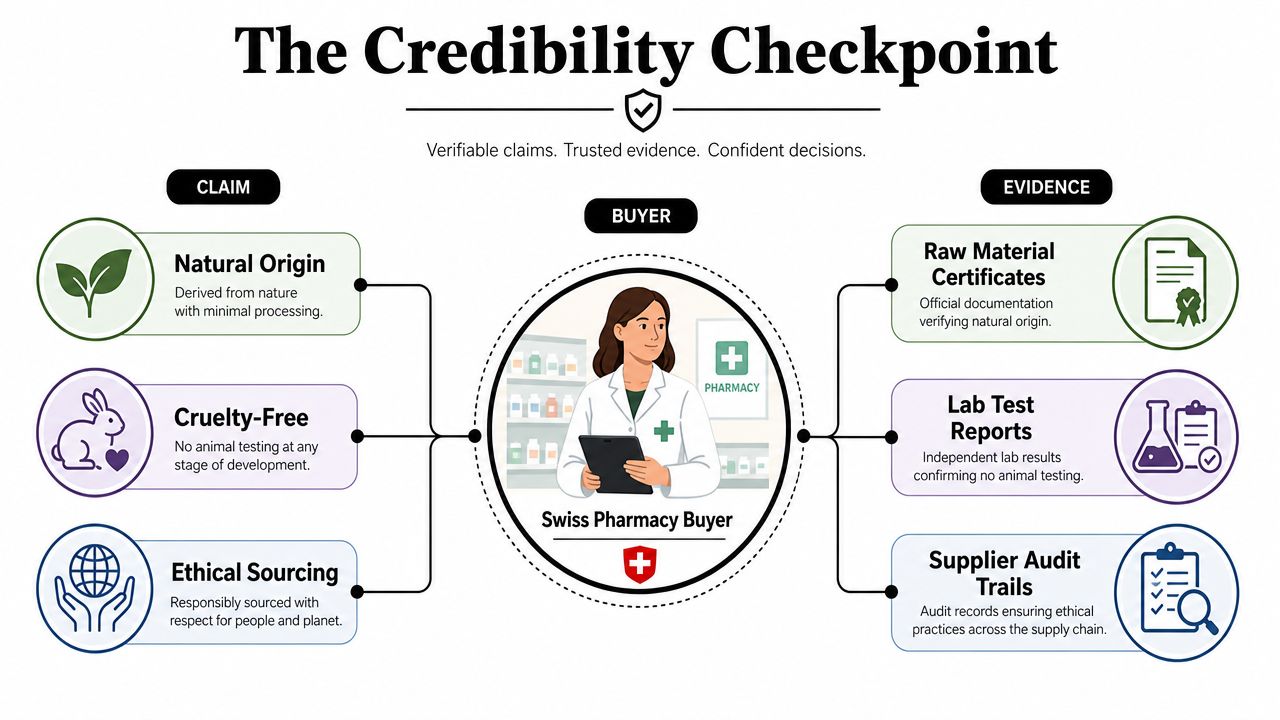
A Swiss pharmacy buyer does not need a long speech. They need one clear answer to a short question, and they usually ask it right when a brand rep starts using words like natural origin or cruelty-free. The moment that happens, the discussion moves from packaging to proof. If the claim cannot be traced back to ingredients, suppliers, and processing steps, the buyer has a compliance problem, not a copywriting problem.
Switzerland has made that burden of proof more formal. The national ordinance that entered into force on 1 January 2022 requires Swiss companies to carry out supply-chain due diligence and reporting for specified high-risk commodities, and the Federal Council's guidance places human-rights and environmental checks on the sourcing chain, not just the final product. That matters for beauty and wellness importers because buyers now expect documented traceability for ingredients, packaging inputs, and processing steps (European Logistics Supply Chain Sustainability 2024).
The three pressures hitting Swiss distributors
Consumer expectations are one pressure. Retailer procurement standards are another. Formal regulation is the third, and in Switzerland the regulatory bar often arrives before many suppliers expect it. That is why a distributor selling a premium serum or a pharmacy-grade balm cannot treat sustainability as a soft brand story anymore.
Practical rule: if the claim would matter to a buyer, it should also be documentable by procurement, quality, or compliance.
A sustainable supply chain is the structure that makes that possible. It covers sourcing, manufacturing, logistics, and verification in one chain of evidence, so a Swiss buyer can see not only what a product says, but why that statement is defensible. For transport-related evidence, a sustainable freight transportation guide can help connect logistics choices with the wider claims file.
What a Sustainable Supply Chain Covers
A product usually sits in three linked layers. The first is the recipe, which is the formulation. The second is the kitchen, which is manufacturing. The third is the supply trip, which is sourcing and logistics. A sustainable supply chain reaches across all three, because a clean formula can still sit inside a poor sourcing model, and a well-sourced ingredient can still be undermined by inefficient transport or opaque processing.
A cosmetics example makes the point clearly. Take argan oil from a Moroccan cooperative. The question is not only whether the oil is “natural.” It is whether the cooperative, the pressing facility, and any intermediary traders can be traced cleanly enough for audit, documentation, and claim support. The same logic applies to shea butter processed in West Africa or marine actives used in a spa line. The sustainability issue changes at each tier, but the need for visibility does not.
Why Tier 2 and Tier 3 matter
Tier 1 is your direct supplier. Tier 2 is the supplier's supplier. Tier 3 reaches further upstream, into the farms, processors, and extractors that often hold the evidence behind a claim. If you only map Tier 1, you may know who invoiced you, but not where the raw material came from or how it was handled.
Swiss and EU-aligned guidance emphasises that companies need to identify direct suppliers and sub-suppliers, their activities, and the related sustainability aspects before they prioritise risk (critical data points for mapping a multi-tier supply chain). That is the difference between guessing and knowing. For a Swiss distributor, it also helps show that sourcing controls are built for due diligence, not just for a voluntary CSR statement.
A distributor trying to support a certified organic or cruelty-free claim needs that upstream visibility because the claim usually lives or dies on chain-of-custody, not on a single contract. A buyer may accept the final invoice, then ask for the upstream path that connects field, processor, and packer. Without that path, the claim remains fragile.
The logistics side matters too. Transport choices affect emissions, handling, and service levels, so freight is part of the evidence file as well as the cost file. A sustainable freight transportation guide can help connect route and load decisions with the wider claims file.
A clean label on a carton is only the starting point. The test is whether each step behind that label can survive a buyer's follow-up questions.
The Ethical and Regulatory Drivers Swiss Buyers Face
A pharmacy buyer in Switzerland often starts with one simple question. Can you prove the sourcing story behind this claim? Ethical pressure is already in the room before any regulator speaks, because buyers, retailers, and end customers are asking harder questions about animal welfare, biodiversity, fair labour, and whether the brand can back up its sourcing language with records rather than wording. That scrutiny is especially sharp in cosmetics and pharma-adjacent assortments, where trust depends on safety, provenance, and consistency.
A useful reference for supplier behaviour is supplier ethics for biobanks. The product category is different, but the governance logic is the same, suppliers need a code of conduct that can be checked and audited, with expectations that hold up under review.
Why the Swiss regime changes the baseline
Switzerland's due-diligence regime turned sustainability into a formal supply-chain governance issue. The national ordinance that entered into force on 1 January 2022 requires Swiss companies to carry out due diligence and reporting for specified high-risk commodities, and the Federal Council's guidance explicitly places human-rights and environmental checks on the sourcing chain. For Swiss buyers, that means sustainability claims sit inside compliance work, not beside it, because the evidence must follow the product through the sourcing chain itself.
That changes how distributors should think about their role. A cosmetic or pharmaceutical item may not be on the regulated list, yet the discipline still reaches it through supplier selection, audit trails, and document control. In practice, the rule works like a checking frame around the assortment, once a company builds that frame for one category, pharmacy buyers expect the same standard elsewhere.
The pressure also shows up in commercial conversations. Swiss distributors rarely sell a single isolated item, they sell assortments, and pharmacy buyers expect the same level of documentation discipline across the range. If one hero SKU cannot be substantiated, confidence in the rest of the line weakens as well.
What this means in practice
Sustainability verification is being built into corporate compliance systems rather than treated as optional CSR. Documentation matters more than intent. A brand can say it cares about ethical sourcing, but a buyer will ask for the records that show who was audited, what was checked, and what evidence supports the claim.
The practical implication is direct. If your sourcing model cannot produce supplier-level proof, it is not ready for serious Swiss retail scrutiny. That applies whether the product is a serum, a balm, a marine treatment, or a wellness staple. In other words, the claim has to survive the file review, not just the shelf test.
Standards and Certifications That Hold Up in Switzerland
Certification works best when you choose it for the claim, not for the sticker count. A Swiss buyer usually wants to know three things. What does the standard verify, what does it not verify, and does it match the promise on the pack?
Organic and natural standards sit in one family, cruelty-free standards in another, and ethical or fair-trade standards in a third. That grouping helps because the logos often overlap in the customer's mind even when the underlying evidence is different. A product can be organic without being cruelty-free certified. It can be cruelty-free without being organic. It can also be ethically sourced without carrying a beauty-specific badge.
Standards Comparison for Swiss Beauty Buyers
| Standard | What It Verifies | Best Fit |
|---|---|---|
| ECOCERT | Ingredient and process requirements linked to organic and natural formulation claims | Brands selling on organic or natural origin positioning |
| COSMOS | Common criteria for organic and natural cosmetics, with an audit trail around formulation and sourcing | Premium beauty lines that need a recognisable cross-border cosmetics standard |
| PETA Beauty Without Bunnies | Animal-testing stance for products and ingredients | Products making a cruelty-free claim |
| Cruelty Free International Leaping Bunny | A stricter cruelty-free programme with supplier monitoring expectations | Brands wanting stronger cruelty-free credibility in retail and pharmacy channels |
| Fair Trade | Ethical sourcing conditions and trade relationships | Ingredients or lines that need a fair-trade story |
| B Corp | Broader business and governance performance, not a single-product ingredient test | Companies wanting enterprise-level responsibility evidence |
For hemp-derived ingredients, certified hemp quality standards are a useful reminder that the wording of the claim and the scope of the proof have to match.
How to choose without badge fatigue
If a product is sold as natural, use a natural or organic standard. If it is sold as cruelty-free, use a cruelty-free standard. If it is sold on supplier ethics, use an ethical sourcing frame. Stacking three logos that all point to the same claim doesn't make the claim stronger, it usually makes the pack harder to read.
Buyer rule: one claim, one primary proof path, one clean story. Add only the logos that actually expand verification.
A Five-Part Implementation Playbook for Trade Partners
Start with procurement, not after it. The first move is to write sourcing criteria into the brief, because if the brief is vague, every downstream team ends up improvising. A one-page sourcing brief should name the claim, the ingredients in scope, the minimum evidence required, and the supplier documents needed for sign-off.
1. Put sourcing criteria into the brief
A pharmacy buyer doesn't want marketing language. They want a traceable requirement. Build the brief around origin, processing, and evidence, then attach it to the buying decision. This can be done quickly, usually before the next range review.
2. Audit beyond Tier 1
A supplier audit that stops at the direct vendor misses the chain behind the chain. Use an audit checklist that covers legal entity, facility location, ownership, material flow, ESG evidence, and sub-supplier visibility. That's the part many teams skip because it takes more effort, but it's also where the risk usually sits.
3. Trace the top three ingredients
Pick the top three ingredients by volume or risk and build a traceability map for each one. A basic map should show origin, processors, transport legs, and supporting evidence. If the product is a hero SKU, this step gives the buyer something concrete to inspect rather than a general sustainability statement.
4. Measure carbon and water at product level
Product-level footprinting becomes much easier once the sourcing map exists. At that point, carbon and water don't have to be abstract corporate totals. They can be tied to a specific unit, a specific lane, and a specific warehouse process. That's why data discipline in sourcing makes later reporting cheaper and cleaner.
5. Tighten packaging and logistics design
Packaging and transport are usually the last place teams look, but they're often the simplest to improve once evidence is in place. Reduce unnecessary weight, review lane consolidation, and align shipment planning with demand. The best improvements compound because each better data set makes the next decision easier.
For a distributor managing multiple brand lines, operational discipline becomes a business advantage. Better sourcing data makes footprinting easier. Better footprinting makes packaging changes defensible. Better packaging and logistics choices make retailer scorecards easier to pass.
The Question Most Sustainability Content Skips
The awkward part of sustainable sourcing is that someone pays for the change. Too much sustainability language treats upstream compliance as if it were free, but it isn't. Small farms, processors, and niche ingredient producers often carry the heaviest burden because they must absorb new record-keeping, audit preparation, and process changes with the thinnest margins.
That concern is backed by global research from WRI. In a review of more than 1,000 supply-chain goals set by nearly 700 firms, the paper identifies a major blind spot, companies rarely include people-centred targets such as skills, financing, or long-term partnerships for smaller suppliers and affected communities (The Elephant in the Boardroom). That gap matters in beauty and wellness, where the upstream actors are often farmers, co-ops, distillers, and specialist processors.
What fair transition support looks like
A Swiss buyer can reduce hidden harm by building support into the procurement model. Pre-financing helps suppliers buy inputs or fund certification work. Multi-season contracts make it easier to plan and invest. Agronomy training improves quality and resilience without forcing every supplier to relearn the process alone.
Practical rule: if your compliance ask creates a cost, your procurement model should also create a way to carry that cost.
A sustainable supply chain becomes more than a documentation exercise. It becomes a partnership. If the buyer only asks for proof, the burden lands upstream. If the buyer also offers time, visibility, and commercial continuity, the transition becomes more realistic for the people producing the ingredients.
KPIs and Reporting Templates That Actually Work
A control panel beats a pile of PDFs. Three KPIs are usually enough to keep a Swiss distributor honest without drowning the operations team in reporting.
The first is grams of CO2e per ton-mile, which shows transport carbon intensity and helps compare lanes. The second is kWh per shipped unit, which shows how efficiently warehousing is using energy. The third is percent of spend with audited suppliers, which shows how much of the sourcing base is covered by evidence.
How the KPI set works together
Transport intensity is only useful if route and load data are clean. Warehousing energy only tells you something if the unit of measure is consistent. Audited spend only matters if the audit criteria are standardised. The point is not to create a perfect model, it's to create a repeatable one that an MD or pharmacy buyer can scan quickly.
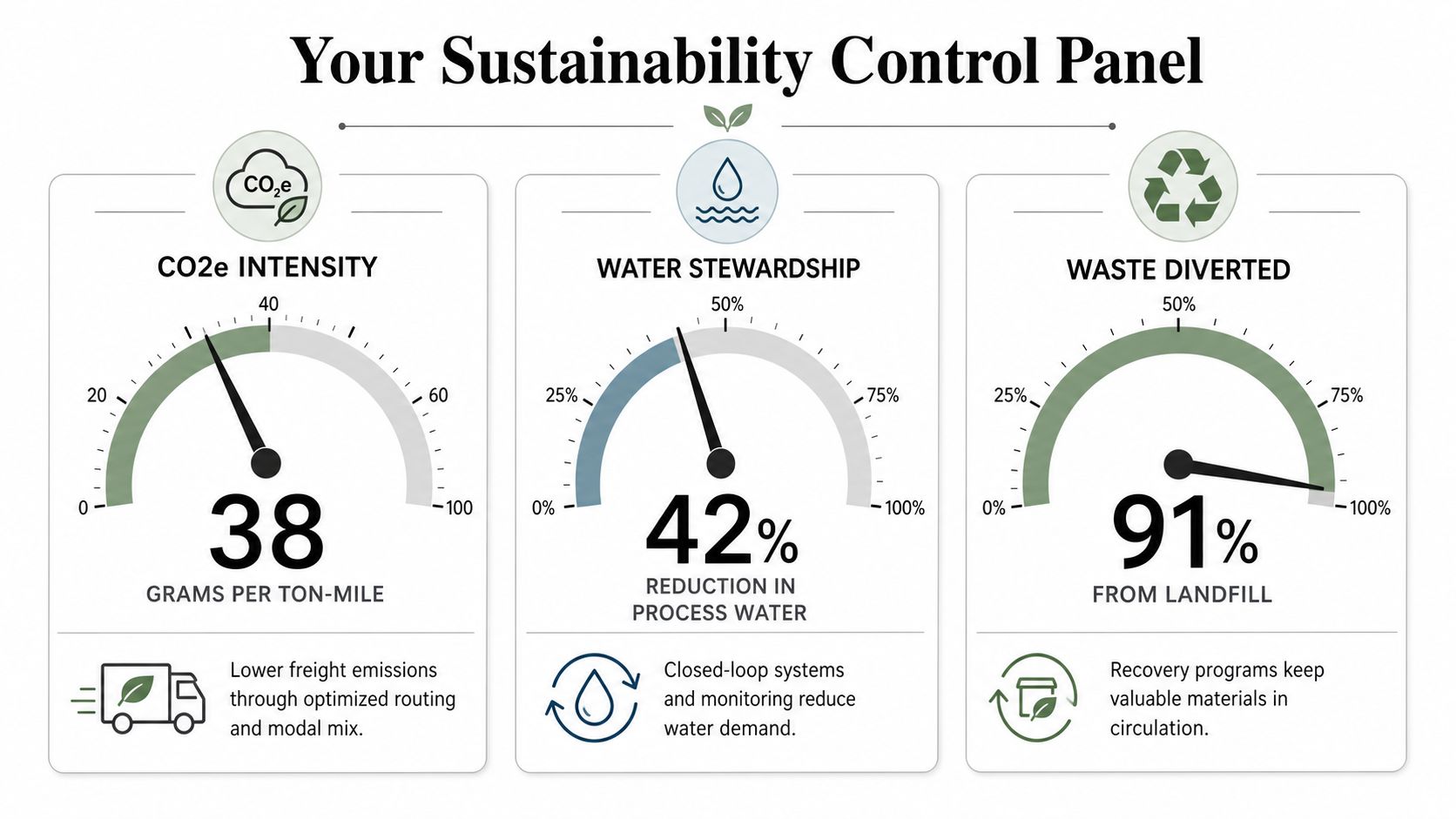
A one-page monthly report can carry those figures in a simple layout, KPI, trend note, action owner, and next decision. That's enough for a leadership meeting and enough for a pharmacy buyer who wants evidence, not a lecture.
The wider reporting trend is also moving away from self-reported ESG questionnaires and towards verified third-party assessments for strategic and high-risk suppliers (BSR supply-chain guidance). That means the report template needs third-party-validated inputs, not just supplier-completed PDFs.
How Beautysecrets.agency Brands Put This into Practice
Fushi is a good example of a short, traceable chain. Fresh-pressed organic oils and herbs, blended in London, are easier to defend when the source ingredients, processing steps, and batch logic are visible. That doesn't make the model simple, but it does make the evidence easier to organise for a Swiss buyer who wants clarity on origin and handling.
Little Butterfly London pushes the brief in a different direction. A certified-organic mother-and-baby line asks for tighter supplier audits, because the claim set is narrow and the expectation for proof is high. In practice, that means more attention to raw materials, processing hygiene, and the chain of custody behind each certified input.
JULISIS takes the conversation into sourcing tradition. Alchemical positioning can be compelling, but it also creates a documentation burden, because buyers will ask what parts of the story are metaphor, what parts are formulation practice, and what parts are verified sourcing facts. Les Thermes Marins de Saint-Malo adds another layer, since marine actives bring environmental sensitivity and coastal sourcing considerations into the discussion. Abahna shows how globally inspired formulations can still be anchored responsibly if the ingredient story and supplier evidence are kept coherent.
Beautysecrets.agency also curates Egyptian Magic, a multipurpose, all-natural staple that demonstrates how a single hero SKU can carry a clear sustainability story when the sourcing trail is well managed. In a Swiss assortment, that kind of product often becomes the easiest place to start because buyers can inspect it without needing to decode a complex line architecture.
For a pharmacy buyer, spa director, or e-commerce partner, the practical sequence is simple. In weeks one to two, pick one hero SKU and ask for full Tier 1 and Tier 2 traceability. In weeks three to six, agree on three KPIs, one for sourcing, one for logistics, one for packaging, and add them to the next category review. In weeks seven to ten, request the brand's most recent third-party-verified sustainability or due-diligence report. In weeks eleven to twelve, brief the internal team and update the procurement scorecard.
A sustainable supply chain gets built one verified claim at a time. Swiss trade partners often have more influence than they realise, because the right questions at the right moment force the whole chain to become clearer.
If you're reviewing Swiss assortment claims and need a sharper sourcing story for pharmacy, spa, or premium retail buyers, visit beautysecrets.agency to see how its brands are positioned around natural ingredients, traceable sourcing, and recognised standards. The right next step is often a tighter proof pack, not a louder claim, and that's exactly where a distributor can strengthen both compliance and shelf credibility.