
The most repeated advice about retinol and vitamin C is also the least useful for Swiss retail teams: “never use them together”. That rule came from older formulation limits, not from the full reality of modern skincare development.
For pharmacies, spas, and premium retailers in Switzerland, the better question isn't whether these ingredients are enemies. It's which form, which protocol, and for which client. That matters even more in a market where clients are informed, ingredient-literate, and often dealing with climate stress from cold winters, indoor heating, urban pollution, or Alpine UV exposure.
A strong retinol vitamin C recommendation can raise basket value, but only if the advice is precise. If the recommendation is too aggressive, clients abandon the routine. If it's too cautious, they don't see enough change to repurchase. The commercial opportunity sits in that middle zone: effective, stable, tolerable, and compliant.
The Power Duo Your Clients Are Asking About
Swiss clients ask about retinol vitamin C for one reason. They want visible skin improvement without turning their routine into a chemistry experiment. They've heard retinol smooths lines and texture. They've heard vitamin C brightens and protects. Then they hear they must be kept apart at all costs, and the consultation becomes confusing.
That old rule is no longer absolute. Data cited in this discussion of vitamin C and retinol compatibility notes that products combining sodium ascorbate with 0.5% retinol reduced irritation by 34% compared with separated use in sensitive skin cohorts, and that 42% of adults in Switzerland report sensitive skin. For Swiss professionals, that changes the conversation. The issue isn't simple separation. The issue is formulation quality.
What professionals should take from this
A client doesn't buy “retinol” in the abstract. They buy a vehicle, a concentration, a derivative, a texture, a usage schedule, and an experience on skin.
That's why two products labelled with the same hero ingredients can behave very differently. One may sting, oxidise quickly, and leave the client flaky. Another may feel elegant, support the barrier, and deliver gradual visible change.
Practical rule: Don't treat ingredient pairing as the main risk. Treat poor formulation and poor client matching as the main risk.
Why this matters in Switzerland
Swiss retail is unusually sensitive to trust. Clients expect premium performance, but they also expect restraint. They don't want dramatic claims. They want educated recommendations that fit their skin, their season, and their lifestyle.
That makes retinol and vitamin C a strong category if you position it correctly:
- For pharmacies: it fits anti-ageing, tone correction, and preventative daily care.
- For spas and clinics: it supports homecare continuity after in-cabin treatments.
- For clean beauty retailers: it creates space for gentler, stable, natural-leaning formulas rather than harsh “maximum strength” positioning.
The commercial win comes from moving beyond fear-based rules and into protocol-based selling.
How Retinol and Vitamin C Renew the Skin
Retinol and vitamin C work best when you explain them in roles, not just in ingredient names. Clients remember functions better than biochemical pathways.
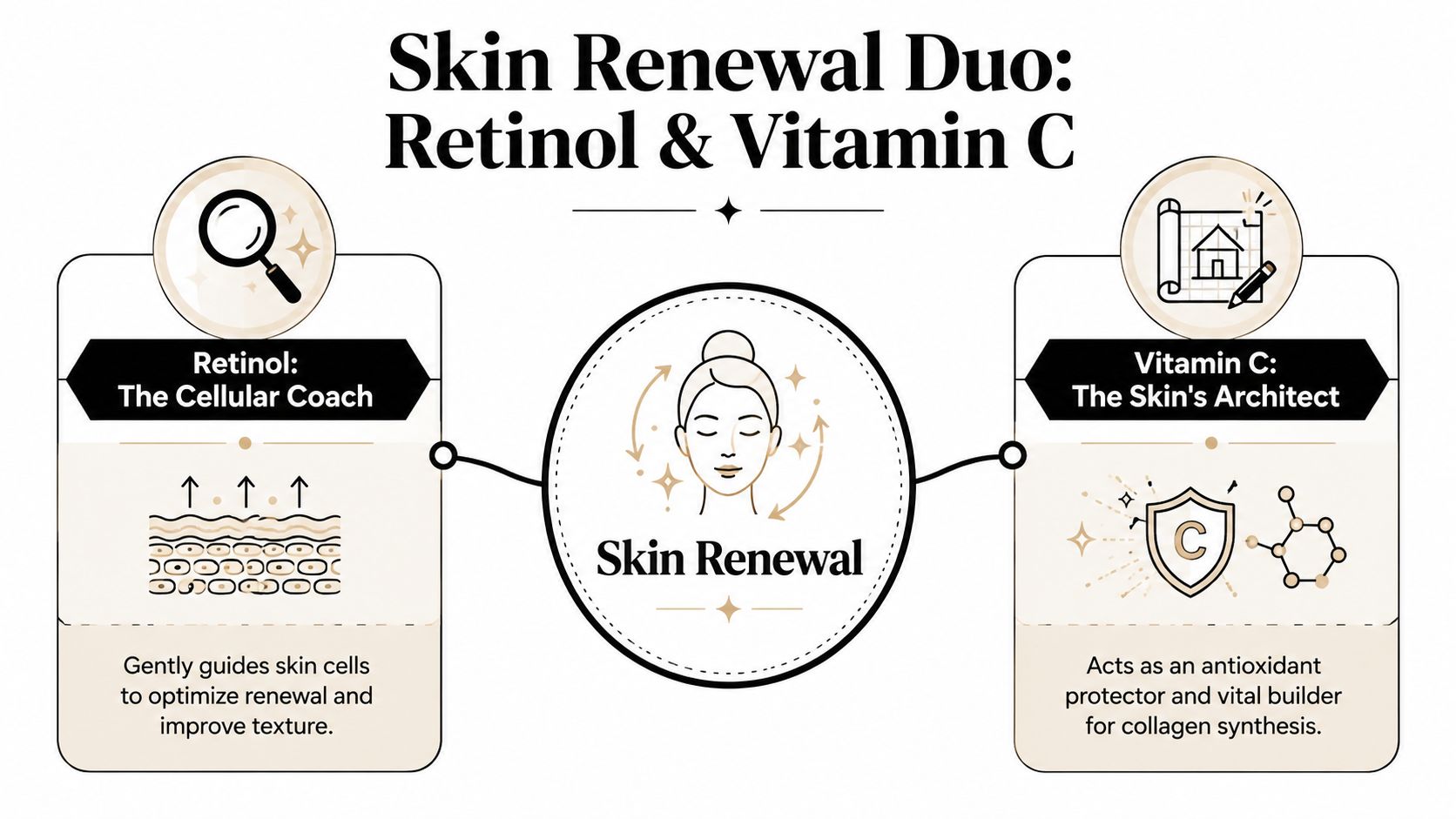
Think of retinol as the skin's project manager. It encourages skin to renew itself more efficiently. Think of vitamin C as the bodyguard and architect. It helps defend skin from daily oxidative stress while also supporting a more even, brighter look.
Retinol as the project manager
Retinol is a form of vitamin A. In skin, it is converted through metabolic steps toward retinoic acid activity. In practical terms, that means it helps push sluggish, uneven-looking skin towards a more organised renewal pattern.
For clients, that often translates into these visible goals:
- Smoother surface texture
- Softer appearance of fine lines
- A more refined overall look
- Better response in photodamaged skin
Retinol isn't a quick glow ingredient. It's a programme ingredient. It works through repeated use and careful tolerance building.
Vitamin C as bodyguard and architect
Vitamin C does two jobs that clients care about immediately. First, it acts as an antioxidant support ingredient. Second, it helps target uneven tone.
Histological evidence summarised in this PubMed record on topical vitamin C and retinol synergy confirms that a retinol and vitamin C combination reverses photoaging changes. It also notes that retinol speeds cellular turnover while vitamin C inhibits tyrosinase to reduce dark spots, with measurable improvement in discolourations within four weeks.
That's why vitamin C often feels easier to “see” at the start. The complexion can appear more even and fresh before deeper renewal changes become obvious.
For consultations, retinol is the long-game texture ingredient. Vitamin C is the daily defence and tone-support ingredient.
Why the pairing makes sense
These ingredients don't do the same job. That's exactly why they're useful together.
Retinol focuses on renewal. Vitamin C focuses on protection and visible brightness. One improves how skin cycles. The other supports how skin holds up under stress and how uneven tone presents.
For professionals comparing antioxidant options, resources such as Skinceuticals CE Ferulic serum are useful because they help clarify why stabilisation systems, supporting antioxidants, and delivery design matter just as much as the headline ingredient name.
The Truth About Combining Retinol and Vitamin C
The confusion around combining these ingredients didn't come from nowhere. It came from a real formulation issue. Pure L-ascorbic acid prefers a low pH, while classic retinol systems can be more sensitive to instability and irritation under the wrong conditions. Older advice turned that chemistry challenge into a blanket consumer rule.
That blanket rule is too crude for today's market.
Where the myth came from
If a client layered a sharp, acidic vitamin C with a strong retinol product and a weak moisturiser base, irritation was predictable. Retailers then simplified the message into “don't combine them”.
That was understandable, but not precise. A formulator doesn't evaluate only the ingredient name. A formulator evaluates:
- The form of vitamin C
- The retinoid system
- The pH environment
- The emulsion or serum base
- Barrier-supporting co-ingredients
- The intended use pattern
What modern formulation changed
Today, brands often use more stable vitamin C derivatives and smarter delivery systems. Retinol can also be encapsulated or buffered within better vehicles. That gives chemists more room to build formulas that are easier to tolerate and more commercially reliable on shelf.
The result is not that every combined formula is good. It's that good combined formulas are possible.
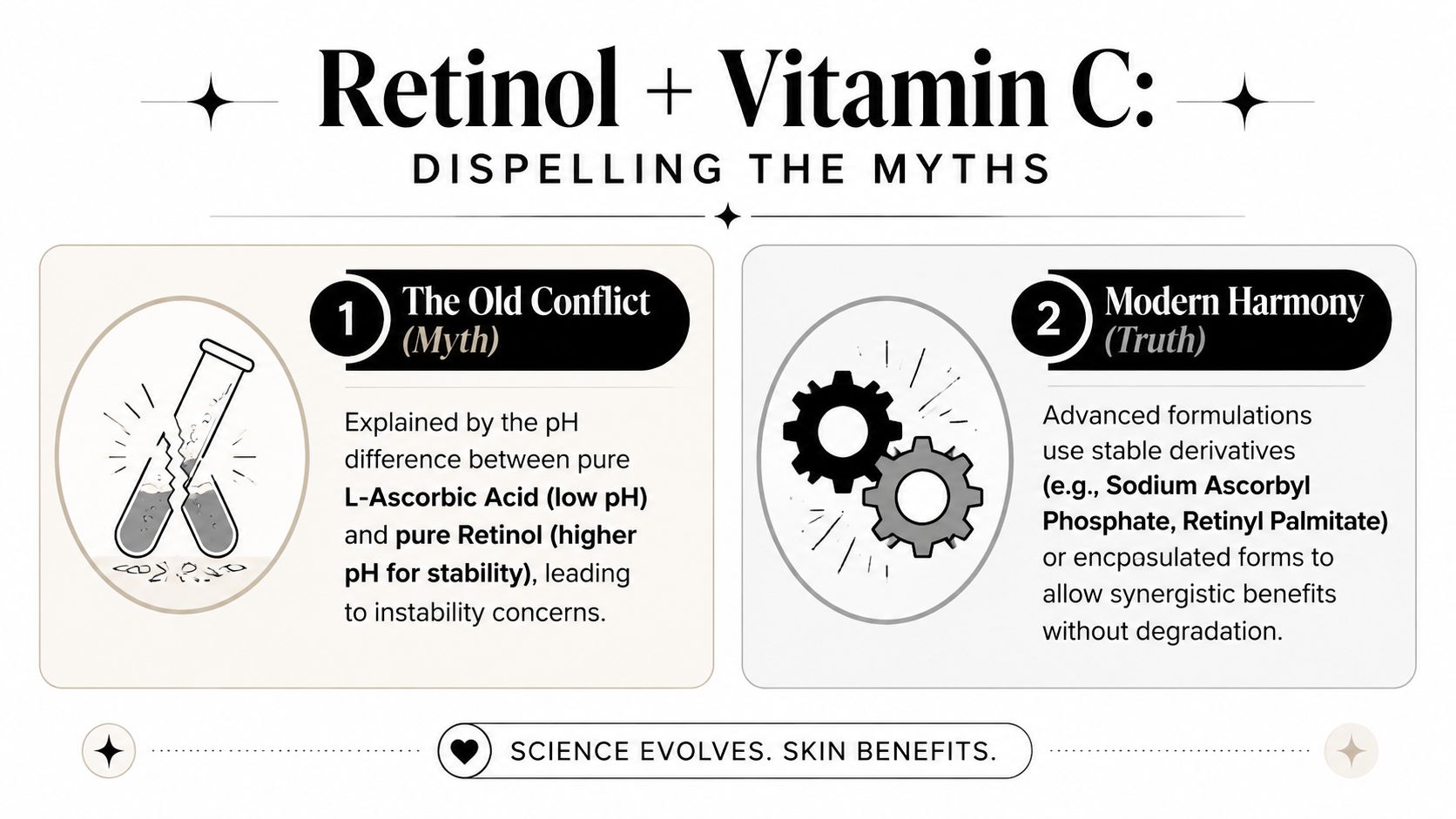
A useful visual summary helps teams explain that shift quickly.
Clinical results also support the point. In an open-label clinical trial, subjects using a retinol and vitamin C regimen showed statistically significant improvement in photodamaged skin parameters by week 8, while also showing a significant increase in dryness. The study is summarised in this clinical trial report on a retinol and vitamin C facial regimen. For retail teams, the lesson is simple: efficacy is real, but tolerability must be engineered and coached.
For professionals who want a consumer-facing explanation of sequencing logic, this guide with expert guidance on ingredient layering is a useful reference point.
A short video can also help staff visual learners grasp the formulation debate before client consultations.
The commercial takeaway
A retailer shouldn't ask, “Can retinol and vitamin C ever coexist?” The retailer should ask, “Is this formula stable, is the routine sensible, and can this client tolerate it?”
That's a much better sales and education framework.
The Gold Standard AM PM Application Protocol
Even though combined formulas can work, the AM/PM protocol remains the safest default recommendation for most Swiss clients. It's easier to explain, easier to follow, and easier to adjust when sensitivity appears.
The logic is straightforward. Vitamin C belongs in the morning because that's when antioxidant support is most useful. Retinol belongs at night because renewal-focused actives fit better into an evening routine and are easier to manage away from daytime exposure.
Why Swiss clinics favour this routine
Expert guidance favours morning vitamin C and evening retinol, and Swiss dermatology clinics particularly favour this protocol for sensitive skin types in a climate that can compromise the barrier. That recommendation is described in the earlier linked source on ingredient compatibility.
For CH retail teams, that protocol solves several problems at once:
- It reduces confusion for beginners.
- It lowers overload risk for reactive skin.
- It creates a simple repeatable habit that improves compliance.
- It leaves room for barrier repair products in both routines.
Morning vitamin C and evening retinol isn't old-fashioned advice. It's still the most reliable baseline for retail recommendation.
A practical consultation sequence
When a client stands at the shelf asking how to use retinol vitamin C, this order works well.
Cleanse gently
Avoid starting with an aggressive foaming cleanser if the routine already contains strong actives.Apply vitamin C in the morning
Use a stable serum or cream format that matches the client's tolerance level.Seal with moisturiser
Swiss clients often need more barrier support than they realise, especially in winter.Finish with sunscreen
This is essential when discussing any anti-ageing routine.Use retinol at night
Apply to dry skin if the client is reactive, then follow with moisturiser.
How to reduce drop-off in the first month
Many clients don't fail because the actives fail. They fail because nobody prepared them for adjustment.
A retail team should say plainly:
- Start slowly: beginners often do better with non-nightly retinol use at first.
- Expect some dryness: mild adjustment doesn't mean the product is wrong.
- Watch the barrier: persistent stinging, tightness, or visible irritation means the routine needs to be simplified.
- Keep the rest boring: a calm cleanser and straightforward moisturiser help the active routine succeed.
When to break the default rule
Advanced users may do well with integrated formulas or more complex regimens. But that should be an exception based on assessment, not a default shelf recommendation.
For most pharmacy and premium retail settings, the AM/PM split remains the best blend of efficacy, clarity, and tolerance.
Formulation Insights for Natural and Ethical Brands
The natural and ethical segment often gets trapped between two extremes. One side sells “clean” formulas that are sensorially lovely but underpowered. The other side sells high-strength actives that perform on paper but overwhelm real skin.
The better path is selective formulation. Choose stable systems, gentle support ingredients, and delivery formats that respect the barrier.
What to look for in the retinoid side
For natural-leaning or ethical assortments, retailers often do well with gentler retinoid choices instead of leading with the harshest retinol story. The point isn't to dilute efficacy. The point is to improve adherence.
Useful positioning options include:
- Retinyl esters for lower-intensity entry routines
- Encapsulated retinol for improved user comfort
- Retinoid alternatives or next-generation systems where the brand has a clear evidence story
A good retail script avoids saying one form is universally “best”. It explains that different forms serve different tolerance profiles.
What to look for in the vitamin C side
Vitamin C is where many natural brands either excel or disappoint. Pure ascorbic acid can be effective, but it can also be temperamental. In curated Swiss assortments, stable derivatives often make better commercial sense because they're easier for clients to use consistently.
Prioritise formulas that show thought in these areas:
- Stability in the chosen packaging
- Supportive antioxidant network
- Low-irritation base
- Compatibility with barrier-supportive lipids or humectants
Ethical positioning still needs technical literacy
Clients drawn to ethical beauty still want performance. They want performance without unnecessary compromise in sourcing, processing, or animal welfare standards.
Retail teams can strengthen that conversation by drawing on broader educational resources around understanding ethical beauty products, especially when clients ask why one premium formula costs more than another that appears similar on the front label.
The strongest clean beauty assortment isn't the one with the longest “free from” list. It's the one where the ingredient form, delivery system, and ethics all make sense together.
In practice, that means looking beyond hero claims and judging the full formula architecture.
Sample Routines for Key Swiss Client Profiles
One routine doesn't fit the whole Swiss market. A client in central Zurich with pollution exposure and office heating stress doesn't need the same recommendation as a skier spending time in mountain air.
A practical consultation starts with profile matching, not product enthusiasm.
Retail table for consultations
| Client Profile | AM Routine | PM Routine |
|---|---|---|
| Beginner with sensitive skin | Gentle cleanser, stable vitamin C derivative in a mild serum or cream, barrier moisturiser, sunscreen | Gentle cleanser, nourishing serum or cream, low-intensity retinoid on selected nights, barrier cream |
| Urban anti-pollution client in Geneva or Zurich | Cleanser, antioxidant vitamin C serum, moisturiser suited to skin type, sunscreen | Cleanser, hydrating support layer, retinol product, moisturiser |
| Alpine or high-altitude client | Creamy cleanser, vitamin C-focused antioxidant step, richer moisturiser, sunscreen with strong daily compliance | Gentle cleanser, hydrating serum, retinol product used cautiously, richer barrier cream or overnight balm |
| Experienced anti-ageing client | Cleanser, vitamin C serum, optional peptide or hydrating layer, moisturiser, sunscreen | Cleanser, retinol treatment, moisturiser adjusted to tolerance |
The Alpine profile needs its own rules
A 2026 EPFL study reported that retinol-treated skin in high-altitude regions requires 2.3x higher vitamin C concentration to maintain collagen synthesis because of more intense UV and dry air. For Swiss pharmacies and mountain-region retailers, that isn't a niche detail. It changes recommendation logic.
For the Alpine client, don't frame vitamin C as optional brightness support. Frame it as part of the structural support around a retinol routine.
How to personalise without overcomplicating
Use three questions in store:
- Where do you live and work most of the week
- Does your skin react easily
- Are you trying to correct damage, prevent it, or both
Those questions quickly reveal whether the client needs a starter routine, an urban defence routine, or a mountain-adapted routine.
Swiss skincare retail works best when geography is treated like a skin variable, not just a lifestyle detail.
That's especially true for clients moving between cities, ski regions, and heated indoor environments in the same week.
Retail Messaging and Compliance for the Swiss Market
Selling retinol vitamin C well in Switzerland means translating science into careful language. The best retail messaging is confident, specific, and compliant. It doesn't drift into medical promises, and it doesn't hide the possibility of dryness.
Phrases that work in real consultations
Use language like this:
- “This pairing supports smoother-looking, brighter-looking skin over time.”
- “We usually place vitamin C in the morning and retinol in the evening for comfort and consistency.”
- “If your skin is reactive, we'll start with a gentler format and build slowly.”
- “Barrier support and daily sunscreen matter just as much as the active itself.”
Avoid turning cosmetic support into treatment claims. Stay with appearance, texture, radiance, and visible signs of photoageing.
How to manage expectations without losing the sale
Clients trust retailers who set a transparent pace. Don't promise instant transformation. Explain that some visible changes can appear early, while overall texture and line refinement take more commitment and regular use.
A good consultation also normalises adjustment:
- Dryness can happen, especially with stronger retinol systems.
- Less is often more in the first weeks.
- Stopping all supportive products is a common mistake.
- Sunscreen is part of the protocol, not an optional add-on.
Basket building that feels helpful, not pushy
The smartest cross-sell is functional. If a client buys vitamin C and retinol, the supporting products should solve known friction points:
| Need | Helpful companion category |
|---|---|
| Tightness or flaking | Barrier cream or nourishing moisturiser |
| Uncertain tolerance | Gentle cleanser |
| Daytime protection | Broad-spectrum sunscreen |
| Climate stress | Hydrating serum or comforting balm |
That approach raises value while improving the odds that the client succeeds with the routine.
For Swiss retailers, the commercial edge isn't louder marketing. It's better matching, better education, and fewer abandoned regimens.
If you're building a Swiss skincare assortment that needs stronger clinical logic, cleaner positioning, and better retail training support, beautysecrets.agency can help you curate natural and ethically sourced brands that fit pharmacy, spa, clinic, and premium retail environments.