USD 1.87 billion. That was the global pimple patch market value in 2023. For a small-format skincare item, that scale changes how retailers should assess the category.
In Switzerland, pimple patches deserve a buying decision based on margin, credibility, and placement strategy, not novelty. Pharmacies, drugstores, spas, and premium beauty counters can all sell them, but only if the range is built with clear logic. The key questions are practical ones: which patch types solve a visible consumer need, which claims store staff can defend, and which brands match Swiss expectations on ingredient transparency, hygiene, and sourcing standards.
I usually tell new retail partners to treat pimple patches as a focused problem-solution category. Customers want fast, discreet blemish care. Retailers need products that are easy to explain, easy to merchandise, and credible enough to earn repeat purchase.
That is where assortment discipline matters. A poorly chosen range turns the category into a low-value impulse item. A well-curated range can support acne care, teen skincare, travel retail, and premium self-care baskets at the same time.
This guide examines the category from a retail operator's perspective, with attention to product performance, ethical sourcing, and the merchandising choices that make pimple patches commercially worthwhile in the Swiss market.
The Pimple Patch Market Opportunity in Switzerland
USD 1.87 billion. That was the global pimple patch market value in 2023, as noted earlier. For Swiss retailers, that matters because this is no longer a novelty add-on. It is a compact skincare category with repeat-purchase potential, clear merchandising logic, and room for premium positioning.
In Switzerland, the commercial case is stronger than the pack size suggests. Pimple patches sit across several demand channels at once: acne care, teen skincare, travel, convenience beauty, and discreet SOS treatment. That gives pharmacies, parapharmacies, premium beauty counters, hotel boutiques, and selected e-commerce shops more than one route to sell-through.
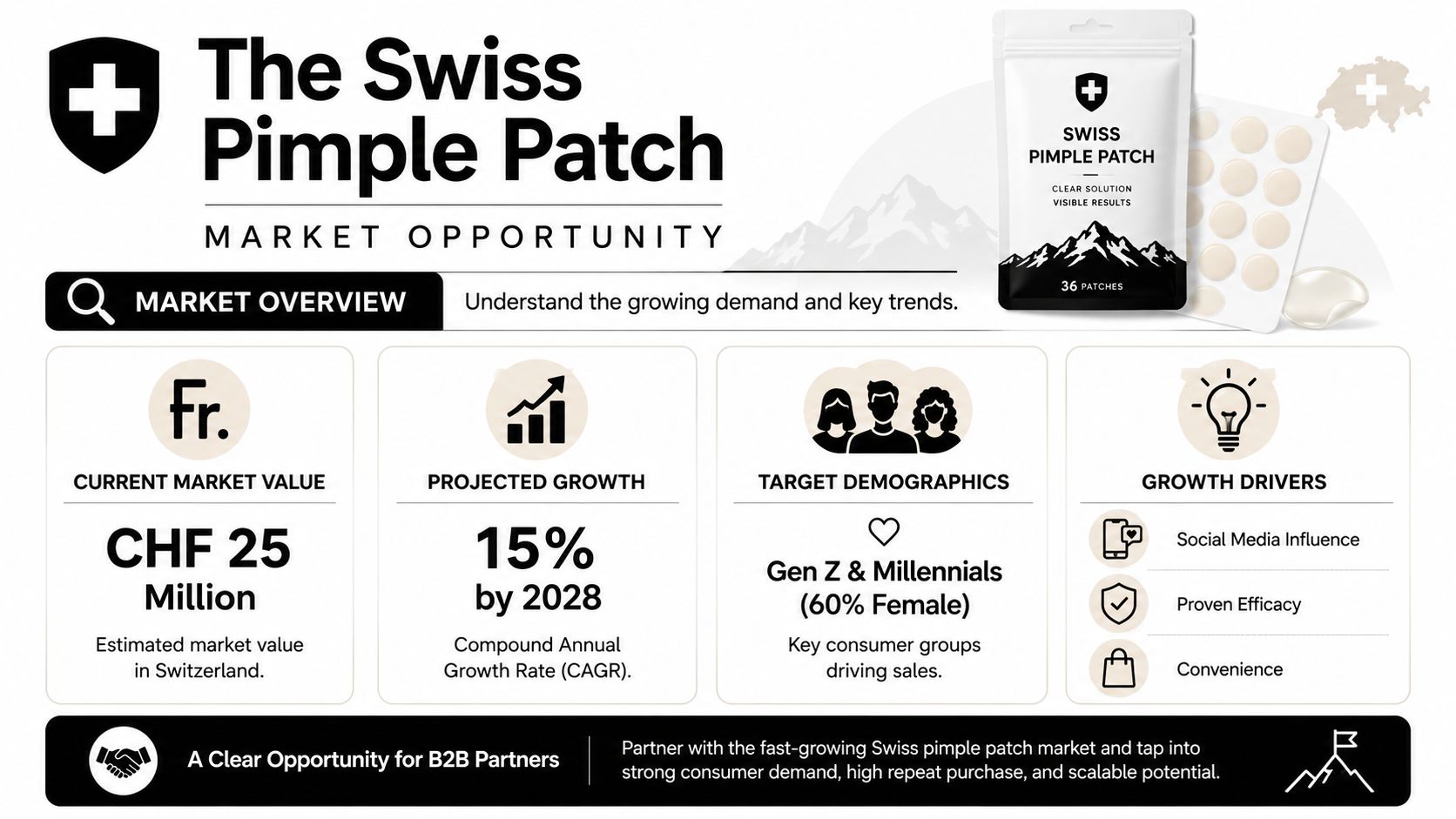
Swiss consumers usually expect a tighter standard than many neighbouring markets. They look for hygiene, visible function, restrained claims, and ingredient transparency. A patch that appears gimmicky or poorly explained will stall. A patch range that is clinically credible, easy to compare, and ethically sourced can perform well in-store because it answers a simple need quickly.
The opportunity also depends on channel discipline. In pharmacies, pimple patches work best as a problem-solution item supported by staff advice. In premium beauty, design, clean formulation standards, and brand story carry more weight. In spas, clinics, and hotel retail, the strongest role is emergency blemish care with travel relevance. Each setting can sell the category, but the assortment and price architecture need to match the shopper mission.
Margin comes from basket building as much as unit turnover. Customers buying patches often need a gentle cleanser, a barrier-supportive moisturiser, a salicylic acid treatment, or a post-blemish care product. Retailers who merchandise patches beside compatible acne and recovery products usually get better average basket value than those who place them as a disconnected till-point item.
A practical rule for Swiss buyers is simple: position pimple patches as the first step in a blemish-care system. That framing helps staff recommend them accurately, keeps claims realistic, and supports repeat purchase.
It also protects trust. If a retailer presents patches as a targeted solution for visible surface blemishes, customers understand where the product fits and what it can realistically do. That matters in Switzerland, where credibility, sourcing standards, and consistent staff guidance often decide whether a trend product becomes a stable category.
Understanding How Pimple Patches Work
Most pimple patches work because of hydrocolloid. That's the core material pharmacists and shop staff should understand well enough to explain in plain language.
A hydrocolloid patch sits over a surface blemish and absorbs fluid from it. As it does that, it creates a protected environment over the spot. In practical terms, the patch helps keep the area cleaner, reduces direct touching, and limits picking.
What hydrocolloid is doing on skin
Think of hydrocolloid as a smart dressing rather than a classic cream. It doesn't need to spread across the whole face. It acts where it's placed.
For a typical whitehead or a pimple that has come to the surface, the patch can help in four ways:
- Absorption by drawing out visible exudate from the blemish
- Protection by shielding the spot from fingers, dirt, and friction
- Moist healing support by keeping the area from drying out excessively
- Behaviour control by making it harder to squeeze or scratch the lesion
That last point is underrated in retail advice. Many acne customers damage their skin less from the original pimple than from repeated touching.
What pimple patches do not do
Staff training matters. Pimple patches don't solve the underlying cause of acne. They won't regulate oil production, fix hormonal triggers, or prevent future congestion on their own.
They also aren't equally effective on every lesion. Surface whiteheads and visibly active spots tend to be the best candidates. Deep, under-the-skin blemishes are a different conversation and often need a different patch type, or a different treatment route entirely.
A good pimple patch should make the customer's routine simpler. If it creates confusion, irritation, or unrealistic expectations, it's the wrong recommendation.
The easiest in-store explanation
When customers ask whether patches “really work”, the clearest answer is this:
- They work best on the right kind of pimple
- They help absorb fluid and stop picking
- They're a spot tool, not a full acne programme
That explanation is honest, easy to remember, and much more useful than vague claims about miracle results.
Comparing Pimple Patch Technologies and Brands
Category growth attracts copycat products. Shelf performance still comes down to a few basics. Does the patch adhere well, stay discreet on skin, and deliver a result the customer can see by morning or by the end of the day?
For Swiss retail, the most useful way to compare the category is by treatment role, not by packaging claims. In practice, that means separating the assortment into non-medicated hydrocolloid, medicated patches, and microneedle patches. Each format answers a different need, carries a different return risk, and earns its place on shelf for different reasons.
| Patch Type | Mechanism of Action | Best For | Key Feature |
|---|---|---|---|
| Non-medicated hydrocolloid | Absorbs surface fluid and protects the blemish | Whiteheads and surface-level spots | Simple, low-friction everyday use |
| Medicated patch | Combines patch occlusion with active ingredients such as salicylic acid or retinol | Early inflamed blemishes and customers who want stronger spot care | Targeted treatment beyond plain coverage |
| Microneedle patch | Uses dissolving micro-structures to deliver actives more directly into the upper skin layers | Deeper, emerging blemishes that haven't formed a head | More advanced format for difficult spots |
Non-medicated hydrocolloid patches
This is the core pharmacy SKU. It suits the broadest audience, creates the fewest usage errors, and gives staff the simplest recommendation path.
It also gives a new retail partner a reliable entry point into the category. Swiss customers buying for teens, sensitive skin, travel, or first-time acne care usually understand this format immediately.
The commercial downside is equally clear. Plain hydrocolloid has a narrower treatment range than active or microneedle formats. If the customer is dealing with a deep, painful lesion, the result may feel underwhelming even when the patch is performing as designed.
Medicated patches
Medicated patches support a stronger treatment position, especially for customers who want more than coverage and behaviour control. The category commonly uses ingredients such as salicylic acid and retinol to add a spot-treatment story on top of occlusion.
That stronger position can support a higher price point, but it also increases the need for staff training. A customer already using exfoliating acids, retinoids, or prescription acne care may not tolerate an active-loaded patch well. In Swiss pharmacy, that is where responsible recommendation matters. Better to convert the right customer than create avoidable irritation and lose the repeat purchase.
Microneedle patches
Microneedle patches sit in the premium end of the segment. They are built for earlier-stage, under-the-skin blemishes where plain hydrocolloid often has little visible effect.
They can work well in a dermocosmetic or consultation-led setting. They are less suited to a broad impulse fixture because they need explanation on use, expectations, and price. Stores that stock them should treat them as a specialist SKU, not as the volume driver.
Brand selection and performance standards
Brand discipline matters more here than many buyers expect. A patch that lifts at the edges, shows too visibly under pharmacy lighting, or fails to absorb on a surface blemish will damage confidence in the whole category.
Analysts at DataIntelo's global pimple patches market report identify major players including CosRx, Hero Cosmetics, ZitSticka, and Peace Out Skincare. For Swiss assortment planning, those brands are useful benchmarks because they have shaped customer expectations around adhesion, discretion, and visible performance.
That does not mean a retailer should stock only the best-known names. It means any alternative brand has to meet the same practical standard. I advise new pharmacy partners to compare three things before listing a patch line: adhesion over several hours, visible fluid absorption on a true surface blemish, and pack communication that clearly explains who the product is for.
If a patch cannot hold well, stay discreet, and deliver a visible result in the right use case, it does not deserve permanent shelf space.
Evaluating Formulations and Clean Ingredients
Once the patch technology is right, the next filter is formulation quality. Many otherwise decent assortments become muddled at this point. Retailers mix gentle hydrocolloid patches with harsh, poorly balanced active systems and then wonder why repeat purchase stalls.
Swiss customers often read the back of pack. They want to know what's in the patch, why it's there, and whether it fits a sensitive or minimalist routine.
When active ingredients help
Active ingredients can improve the value proposition when they're used with precision. The most commercially relevant examples in this category are salicylic acid and retinol, because they support a stronger treatment position for selected blemishes.
That doesn't mean “more actives” automatically means “better patch”. Some customers need a simple barrier and absorption tool. Others want the stronger intervention of a medicated spot patch. If you stock only active-loaded products, you narrow your audience unnecessarily.
What clean means in practice
In Swiss retail, “clean” can't remain a vague marketing word. It has to show up in the product selection process.
A clean patch line usually performs better commercially when it aligns with the following:
- Clear ingredient logic so staff can explain what the patch contains and why
- Sensitive-skin awareness with unnecessary irritants avoided where possible
- Ethical positioning through recognised cruelty-free commitments and responsible sourcing
- Certification readiness for retailers whose customer base actively looks for standards such as ECOCERT-aligned products
This doesn't mean every SKU needs the same certification profile. It does mean the assortment should feel coherent.
What to avoid in buying meetings
I'd be cautious when a supplier leans entirely on design or trend language but can't explain formulation choices. That's usually a sign the patch is being sold as an accessory rather than a treatment support product.
A better supplier conversation sounds different. It covers adhesive quality, active compatibility, patch thickness, ingredient transparency, and whether the line fits a pharmacy environment, a premium beauty floor, or both.
Retailers don't need the longest ingredient list. They need the shortest list that still matches the patch's job.
That approach tends to reduce confusion for staff and lowers the risk of mismatched recommendations at point of sale.
Curating Your Assortment for the Swiss Market
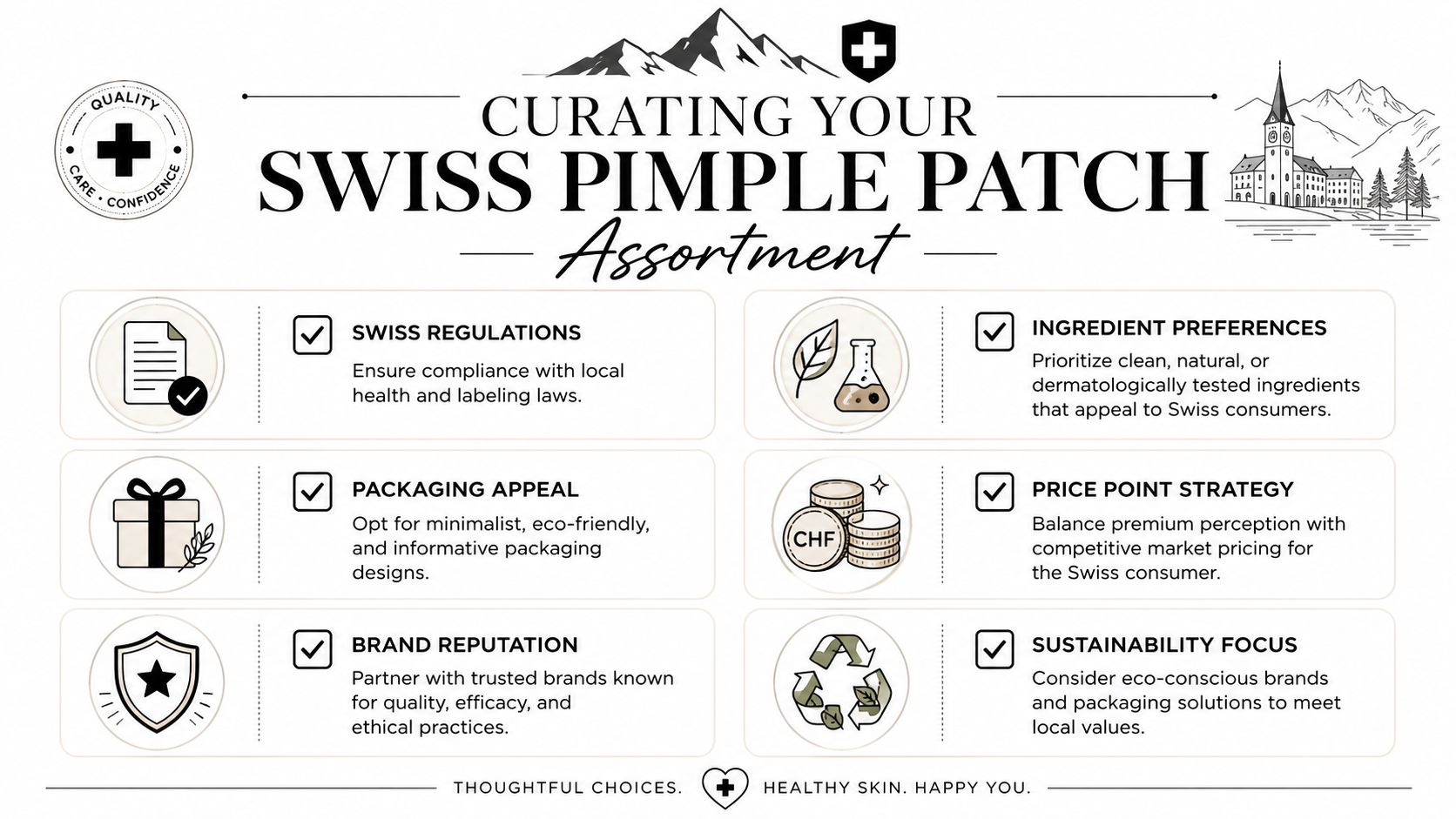
European demand is broadening beyond basic hydrocolloid dots, and Swiss retailers have room to build a more profitable category than a single hero SKU can deliver. In practice, the best assortment is the one that helps a customer choose quickly, gives staff a clear recommendation path, and still reflects Swiss expectations around quality, ethics, and presentation.
That mix will not look the same in every channel. A pharmacy in Zürich usually needs stronger treatment credibility and clearer shelf logic. A clean beauty boutique in Lausanne may need more emphasis on ingredient story, packaging finish, and ethical sourcing. An e-commerce partner can carry more variation, but it still needs a disciplined range if you want repeat purchase instead of one-off trial.
Build around shopper roles
I usually advise new retail partners to buy by use case first, brand second. That keeps duplication down and makes the category easier to merchandise.
A practical structure often includes:
- Entry patch for first-time buyers who want a plain hydrocolloid option at an accessible price
- Treatment patch for shoppers actively seeking added ingredients and a more intervention-led proposition
- Targeted specialist patch for customers who want options positioned for stubborn or more advanced blemish concerns
- Expressive design patch for younger shoppers and gift-driven purchases where visibility can support trial
- Sensitive-skin patch with a simple positioning and a low-friction recommendation in pharmacy settings
This structure gives the customer a reason to trade across the category instead of comparing five nearly identical clear dots.
Assess fit for Swiss retail standards
Good pimple patch ranges do more than sell through. They also protect the credibility of the shelf they sit on.
For Swiss buyers, the screening questions are straightforward:
- Can staff explain what the product is for in one sentence?
- Are ethical and claims standards easy to defend at point of sale?
- Does the packaging suit pharmacy, premium beauty, or both?
- Will the line add a distinct role, or only duplicate an existing SKU?
If a supplier cannot answer those points clearly, the line usually creates work for store teams without strengthening the category.
Use design strategically, not as a gimmick
Decorative patches deserve shelf space if they bring a different shopper into the category or improve repeat use. Analysts at Simporter's pimple patch trend analysis note rising interest in more expressive patch formats, which matters in Switzerland because discretion is not the only purchase driver. For teen customers, travel retail, and beauty-led stores, visible designs can reduce hesitation and turn a treatment accessory into a socially acceptable skincare item.
That does not mean every retailer should overstock novelty formats. A pharmacy-led assortment still needs clinical credibility at the center. The better approach is balance. Keep the core range grounded in efficacy, then add one expressive SKU where it supports trial, gifting, or younger customer acquisition.
What weak buying looks like
Poor assortments usually fail in one of three ways:
- Too generic, with several similar hydrocolloid patches and no clear reason to pick one over another
- Too trend-led, with strong graphics but weak treatment credibility
- Too clinical, with no entry point for younger shoppers or beauty customers who also care about design
The strongest Swiss assortments sit between those extremes. They treat pimple patches as a serious skincare subcategory, but they also respect the way modern shoppers buy. That is the commercial opportunity behind this category. Curate for treatment role, ethical fit, and retail presentation from the start, then support it in-store with the same discipline used in how visual merchandising works.
Effective Merchandising and In-Store Sales Advice
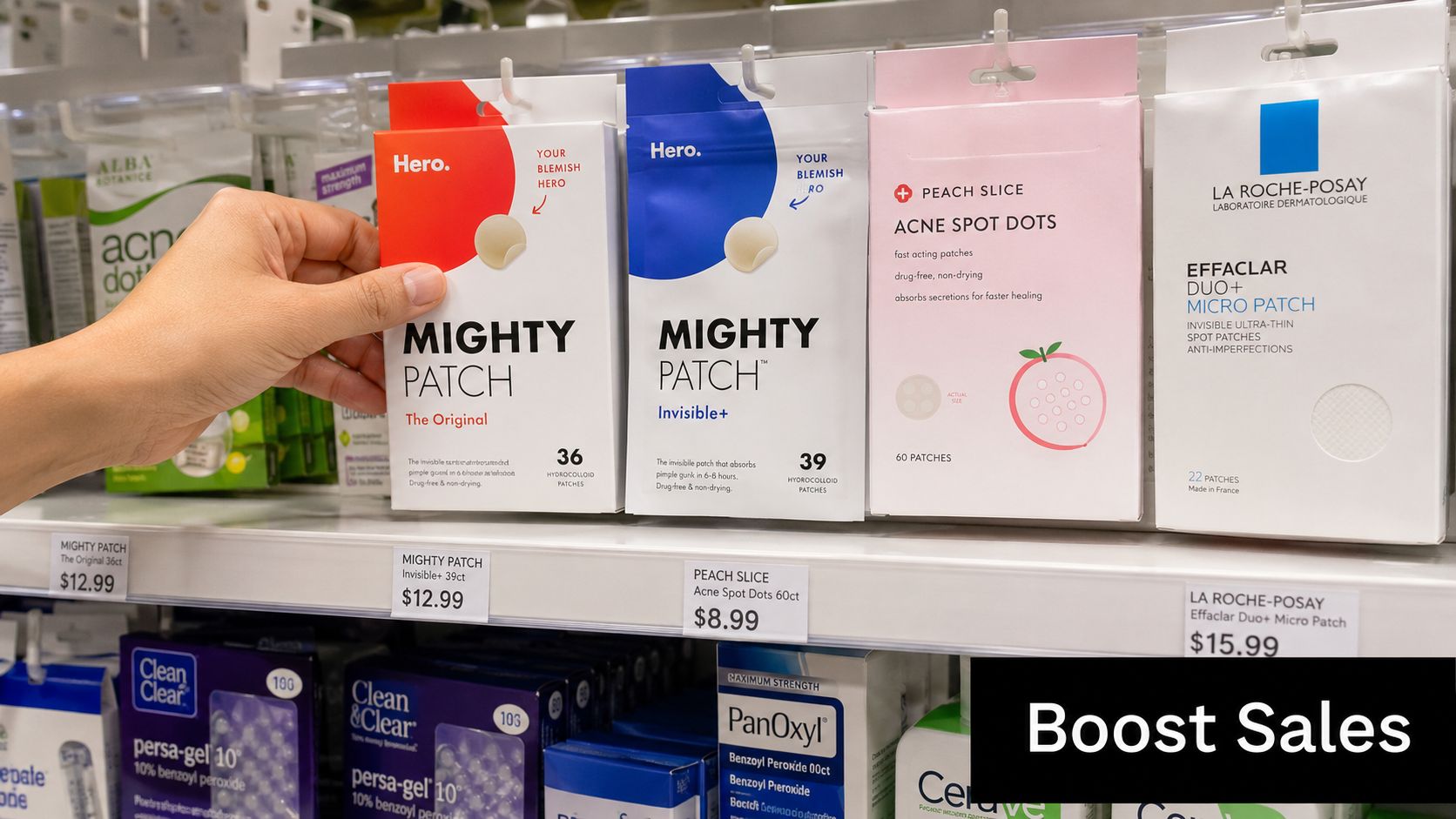
A good assortment can still underperform if no one notices it. Pimple patches are compact, easy to miss, and often purchased on impulse or in response to an immediate skin concern. Merchandising has to reflect that.
Where to place them
The best locations are usually the ones that connect urgency with visibility.
- At the checkout area for impulse and emergency purchase
- Inside the blemish-care section beside cleansers and spot treatments
- Near teen and young adult skincare where discovery is high
- Alongside travel and overnight care in stores with strong convenience traffic
If you want a useful external primer for store teams, Display Guru's explanation of how visual merchandising works is a practical reference because it frames display decisions around shopper behaviour rather than decoration.
What staff should actually say
Sales advice should stay concrete. Avoid phrases like “works for all acne” or “instant fix”. Better talking points are narrower and more credible.
Use lines such as:
- For visible surface spots this is the easiest patch type to start with.
- If you tend to pick at blemishes a patch helps protect the area.
- If your breakouts sit deeper under the skin this stronger format may be more suitable.
- If your skin is reactive start with a simple hydrocolloid version rather than an active-heavy patch.
Bundle intelligently
Patches sell better when they're part of a routine solution.
Effective bundles include:
- Gentle cleanser plus patch for first-time acne care shoppers
- Patch plus barrier-supportive moisturiser for sensitive or dehydrated skin
- Travel kit plus patches for convenience-driven customers
- Teen starter set with a mild wash, simple patch, and basic guidance card
Keep the message short at shelf. “Protect. Absorb. Don't pick.” sells better than a paragraph of cosmetic science.
Fix the most common retail mistake
The biggest in-store error is hiding pimple patches among crowded acne treatments without any explanation. Customers often don't know whether the product is medicated, decorative, invisible, or suitable for their skin type.
A small shelf card can do a lot of work if it answers three questions quickly: what kind of blemish it's for, whether it contains actives, and when to use it.
Frequently Asked Questions for Retail Partners
How should we handle customer complaints about efficacy
Start by checking whether the customer used the right patch for the right blemish. Many complaints come from using a plain hydrocolloid patch on a deep under-the-skin spot. The next check is wear conditions. Skin should be clean and dry, and the patch should be applied to the area it's designed to treat.
Should a new retailer start with a broad assortment
Usually no. Start with a narrow, clearly segmented range. One plain hydrocolloid option, one medicated option, and one more specialised format is often easier for staff to recommend than a cluttered wall of similar packs.
What matters most for Swiss compliance conversations
Retailers should review local cosmetic and labelling requirements carefully before launch. In practice, that means checking ingredient declarations, language requirements, claims language, and packaging consistency. It's better to slow the launch than to introduce a product with unclear compliance positioning.
How do we decide between pharmacy-first and e-commerce-first launches
Look at who needs explanation. If the product requires staff education, in-store launch often works better first. If the range has strong packaging communication and clear differentiation, online rollout can be effective as well. For online partners, the same discipline used in optimizing e-commerce conversion rates applies here too. Product pages need clear use cases, straightforward claims, and visual clarity around patch type.
What's the right response when a customer wants a “miracle cure”
Reset expectations without dismissing the sale. Explain that patches are excellent spot tools for selected blemishes, especially when the customer wants protection and less picking. If the person has frequent, persistent, or severe acne concerns, advise them toward a broader treatment conversation rather than overselling the patch.
If you're building or refining a pimple patch assortment for Swiss retail, beautysecrets.agency can help you evaluate brand fit, ethical sourcing standards, and premium positioning across pharmacy, spa, and beauty channels. The right category strategy starts with disciplined curation, not more SKUs.