A client sits down, opens Instagram, and shows you a deep brunette that flashes ruby at the ends when the light hits it. She doesn't want bright red. She doesn't want flat brown. She wants that expensive in-between tone that looks polished indoors and more vivid outside.
That's where Cherry Cola hair earns its place in a premium Swiss salon. It's visual enough to justify a specialist service, technical enough to separate professional colourists from quick-fix retail colour, and maintenance-led enough to open a strong aftercare conversation from the first consultation.
The Cherry Cola Hair Trend Your Clients Want Now
Cherry Cola hair didn't arrive as a formal colour category with decades of salon history behind it. It emerged as a named trend much more recently, and mainstream beauty reporting tied its latest surge to early 2024, noting that it “initially soared to fame when Dua Lipa showcased it in early 2024” in InStyle's coverage of the shade. That matters in the salon because clients aren't asking for a fixed formula. They're asking for a mood, a finish, and a reference image.
What clients usually mean by Cherry Cola hair
In practical salon terms, Cherry Cola hair is a chocolatey brunette base with deep red-burgundy or red-violet undertones. The colour reads darker than copper, richer than auburn, and more reflective than a standard brunette. Its value sits in movement. Under indoor lighting it can look like espresso or soft chocolate. In daylight, the red-violet reflect becomes obvious.
That shift is exactly why the service belongs in salon hands.
A single-process brown with a red name on the box won't reliably deliver that dimensional result. The look depends on controlled depth, reflect balance, and an honest diagnosis of the starting canvas. When salons understand that, Cherry Cola stops being just another trend request and becomes a profitable colour category.
Why it works commercially in a Swiss premium salon
Swiss clients often want polish without obvious artificiality. Cherry Cola hair fits that brief because it feels wearable, but still directional. It gives brunettes a change that's visible without becoming costume colour.
For a premium salon owner, the business opportunity is clear:
- It showcases colour expertise because the finish depends on undertone control, not just depth.
- It supports premium ticketing because consultation, formulation, and maintenance all need custom decisions.
- It creates repeat visits because red-brown reflects need planned care to stay glossy rather than dull.
- It opens retail naturally because colour longevity depends on what the client does at home, not only on what happened at the basin.
Practical rule: Treat Cherry Cola hair as a customised service family, not as one fixed shade. The client photo is the brief. The hair history decides the method.
What works and what usually disappoints
What works is a result that still looks brunette first, then reveals its red dimension selectively. What usually disappoints is going too bright, too flat, or too warm. Once the cola depth disappears, the finish loses the sophistication clients came in for.
That's why the best salons don't sell Cherry Cola as novelty colour. They sell it as a dimensional brunette service with red-violet architecture. That language helps clients understand why the appointment takes skill, why maintenance matters, and why the result can't be copied well by generic home colour.
Consultation and Hair Base Assessment
A client sits down with two reference photos. In one image, the hair reads as a polished brunette with a red-violet flash at the ends. In the other, it looks closer to burgundy under direct light. If the consultation stays at the level of “something like this,” the formula will miss the brief before you even start.
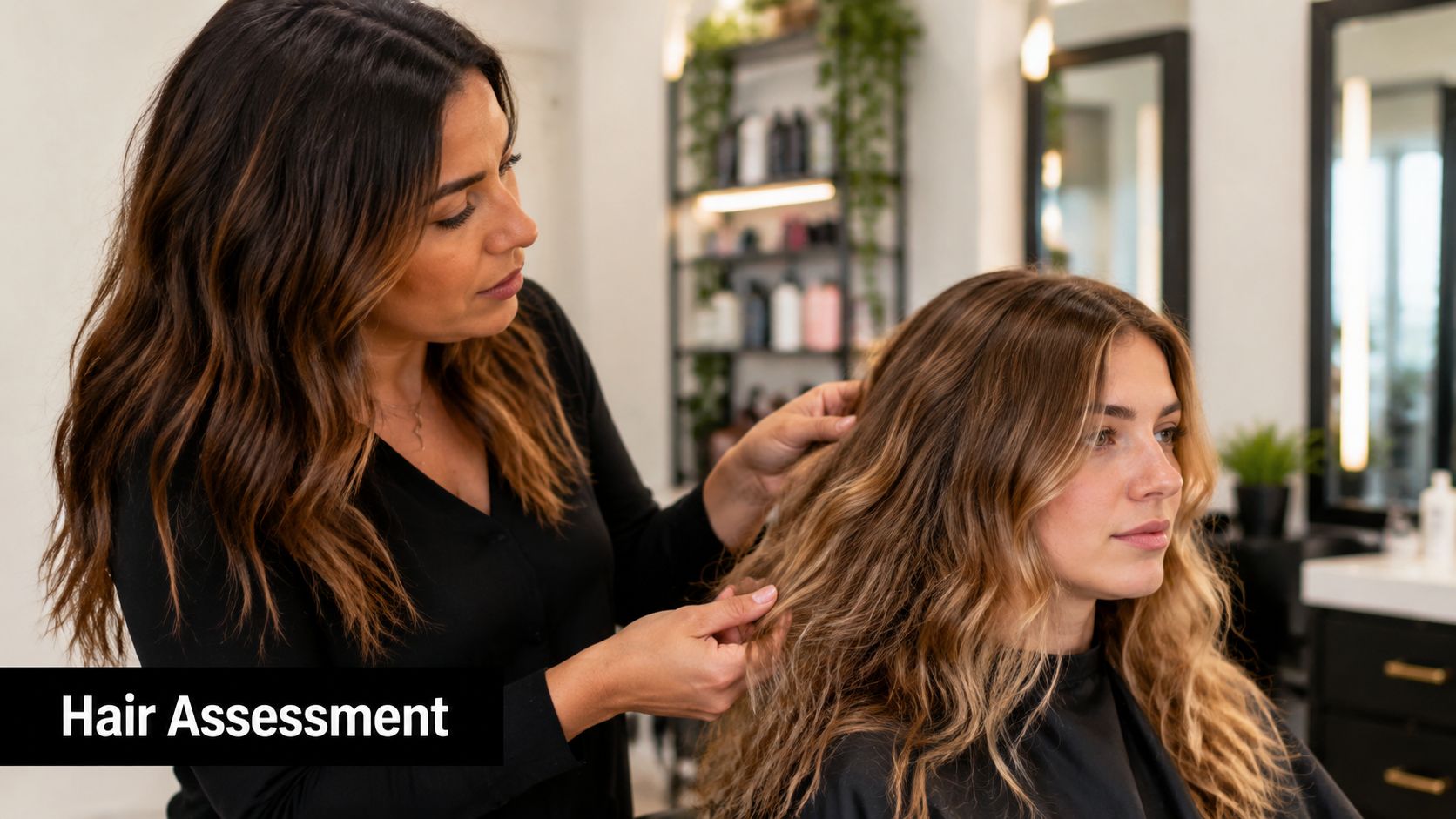
Cherry Cola is a consultation-led colour service. For salon teams in Switzerland, that matters commercially as much as technically. The result depends on undertone control, previous colour history, and the client's tolerance for maintenance. That gives you room to price correctly, plan revisit timing, and recommend natural aftercare with a clear reason behind each product.
Start with the visual brief
One image is rarely enough. Ask for photos in different lighting and ask the client what they like in each one. Many clients save a studio-lit burgundy photo, but desire a dark brunette result that only shows cherry under movement and daylight.
Get specific early:
- How visible should the red look indoors
- Should the finish read brunette first, or red-violet first
- Do you want a solid result or dimension through the mid-lengths and ends
- Are you comfortable if the colour looks deeper in shade and brighter in sun
- How often are you prepared to refresh gloss, tone, or home care
Those questions shorten the gap between client language and colourist language. “Cherry” can mean soft reflect to one client and clear burgundy to another.
Assess the canvas, not just the level
The base decides the method. Level alone does not.
Virgin level 4 or 5 hair can often carry a Cherry Cola result with deposit and shine as the priority. Previously coloured brunette may reject red in one area and grab it too strongly in another. Old balayage hidden under toner often reappears as soon as you add red-violet. Faded copper or mahogany residue can push the whole result too warm.
Less experienced teams lose control of the service margin. They book one colour appointment, then spend extra time correcting porosity or neutralising old pigment without having priced for it. A stronger consultation protects the result and the booking column.
Use a clear canvas assessment:
- Virgin dark hair usually gives the cleanest cola finish and the most light-reflective surface.
- Previously coloured brunette often needs porosity management and selective rebalancing before full tonal application.
- Lightened pieces or old balayage can turn too bright or too hollow unless you rebuild depth first.
- Porous ends may absorb red-violet too quickly and fade unevenly after the first washes.
- Grey percentage and texture affect opacity, reflect strength, and product choice.
If you have not mapped porosity, artificial pigment, and uneven depth, you are not customising the service properly.
Use a consultation sequence your team can repeat
For multi-stylist salons, consistency matters. A simple assessment framework also makes training easier for junior staff and supports better retail conversations at the end of the appointment.
A practical sequence looks like this:
Check the last 12 months of colour history
Ask about salon colour, home glosses, tinted masks, box dye, henna, and corrective work.Read the hair in more than one light source
Red-brown reflects can look muted under salon lighting and much brighter near natural light.Assess porosity by zone
Roots, mid-lengths, hairline, and ends rarely behave the same way.Look for hidden warmth and old stain
Hair that “looks brown” can still hold copper, red, or violet residue.Test elasticity and surface condition
Shine and cuticle condition affect how polished Cherry Cola will look.Strand test if the history is unclear
That is often faster than correcting a full-head surprise.
Set expectations with technical honesty
Clients accept a staged plan when the reasoning is clear. They object to surprises.
Explain the trade-off directly. On dark, healthy hair, Cherry Cola may show as richer depth and controlled reflect rather than obvious brightness. On mixed-history hair, appointment one may focus on evening out the canvas, restoring shine, and placing the red-violet direction correctly. Maximum visibility can come later if the hair supports it.
That language positions your salon as expert, not cautious. It also creates a stronger retail handover. When clients understand that tone retention depends on cuticle condition, washing habits, and pigment-safe aftercare, recommending a premium natural shampoo, mask, or gloss-supporting routine feels like professional planning rather than an upsell.
For Swiss salon owners, this section of the service is where technical judgement turns into business value. Better consultation reduces rework, supports premium pricing, and gives the team a clear route into aftercare sales that match the result.
Formulating the Signature Cherry Cola Shade
Cherry Cola hair looks soft and indulgent to the client. Under the surface, it's a balancing act. Too much warmth and it turns mahogany or red-brown. Too much neutrality and it reads as a plain brunette. Too much violet and it can look inky, especially on dense bases.
The Swiss benchmark formula
For the Swiss market, the strongest technical starting point in the verified data is a dual-tone deposition strategy of 40% warm burgundy (4RV) and 60% cool chocolate base (4N) with a 10-volume developer. The same benchmark states that application in subsections under 2mm is critical for even saturation and avoiding splotchiness.
That ratio works because it protects the cola identity. The cool chocolate base gives the shade its depth and wearability. The warm burgundy adds the visible cherry reflect without pushing the result into obvious red.
Why the balance matters
A good Cherry Cola formula has two jobs:
- hold enough brown structure to look polished on Swiss premium clients
- carry enough red-violet reflect to show movement under light
The brunette base is not there to mute the trend. It's there to anchor it. That's why the cola effect disappears when the base is too light, too warm, or too sheer.
Here's a practical starting-point table you can adapt during consultation and strand testing.
| Starting Base Level | Suggested Base Formula | Suggested Red/Violet Formula | Developer Volume |
|---|---|---|---|
| Dark brunette | 4N dominant | controlled 4RV addition | 10-volume |
| Medium brunette | balanced cool brunette base | moderate burgundy-red violet overlay | 10-volume |
| Light brunette or faded brunette | re-establish brunette depth first | softer red-violet layering after depth is rebuilt | 10-volume |
How to think about base level decisions
On a dark base, resist the urge to overcompensate with extra red. Clients often think they want “more cherry” when what they desire is better reflect. A controlled red-violet addition over a strong brunette base usually looks more expensive than a brighter formula.
On medium brunette, the challenge shifts. This is the level where Cherry Cola can become the most beautiful, but also the easiest to misread. If the formula leans too warm, it can look chestnut rather than cola. If it leans too violet, it can lose softness.
On lighter or faded brunette, rebuild the architecture first. Don't chase the final reflect before the base has enough density to hold it.
Educator's note: The “cola” part of Cherry Cola hair is a depth decision. The “cherry” part is a reflect decision. Most formulation errors happen when stylists try to solve both with one tone.
Saturation is part of formulation
Many colourists think the formula failed when the actual problem was coverage consistency. With this trend, application thickness changes the visible tone. Sparse loading creates translucent areas that look warm. Oversaturated patches go denser and darker. The result is patchiness that clients describe as muddy or uneven.
That's why the under-2mm subsection rule matters so much. It's not a fussy detail. It's how you get the same deposit pattern across a service designed to shift with light.
Use a methodical setup:
- Mix enough product from the start so you don't begin stretching the bowl through the final quadrants.
- Work with fine, clean sections and visible control lines.
- Fully load the brush rather than dry-brushing colour across the surface.
- Comb only where appropriate and only if it won't disturb placement or reduce deposit.
Clean-beauty thinking without sacrificing performance
For salons with a natural-focused positioning, Cherry Cola is a useful service because it lets you talk about performance and care together. Clients drawn to premium, lower-aggression routines usually respond well when you explain that you're building reflect through deposit and gloss rather than chasing unnecessary lift.
That framing matters commercially. It positions the service as considered, hair-respectful, and expert-led. In a Swiss premium setting, that often resonates more strongly than selling the most dramatic transformation.
Application Techniques for Flawless Results
The formula can be correct and the result can still fail in the chair. Cherry Cola hair demands clean physical execution because the signature finish depends on controlled depth, even deposit, and light-responsive dimension.
The strongest route for pre-coloured hair
For pre-coloured hair, the verified protocol is a no-bleach approach using a semi-permanent gloss processed for exactly 15 minutes and rinsed with cool water below 20°C, with a 91% success rate for vibrancy retention over 10 washes. The same verified data notes that using heat tools within 48 hours can cause an 83% reduction in colour longevity.
That tells you two things. First, not every Cherry Cola service should begin with lift. Second, execution after application is part of the technical result, not just an afterthought.
A chairside sequence that holds up
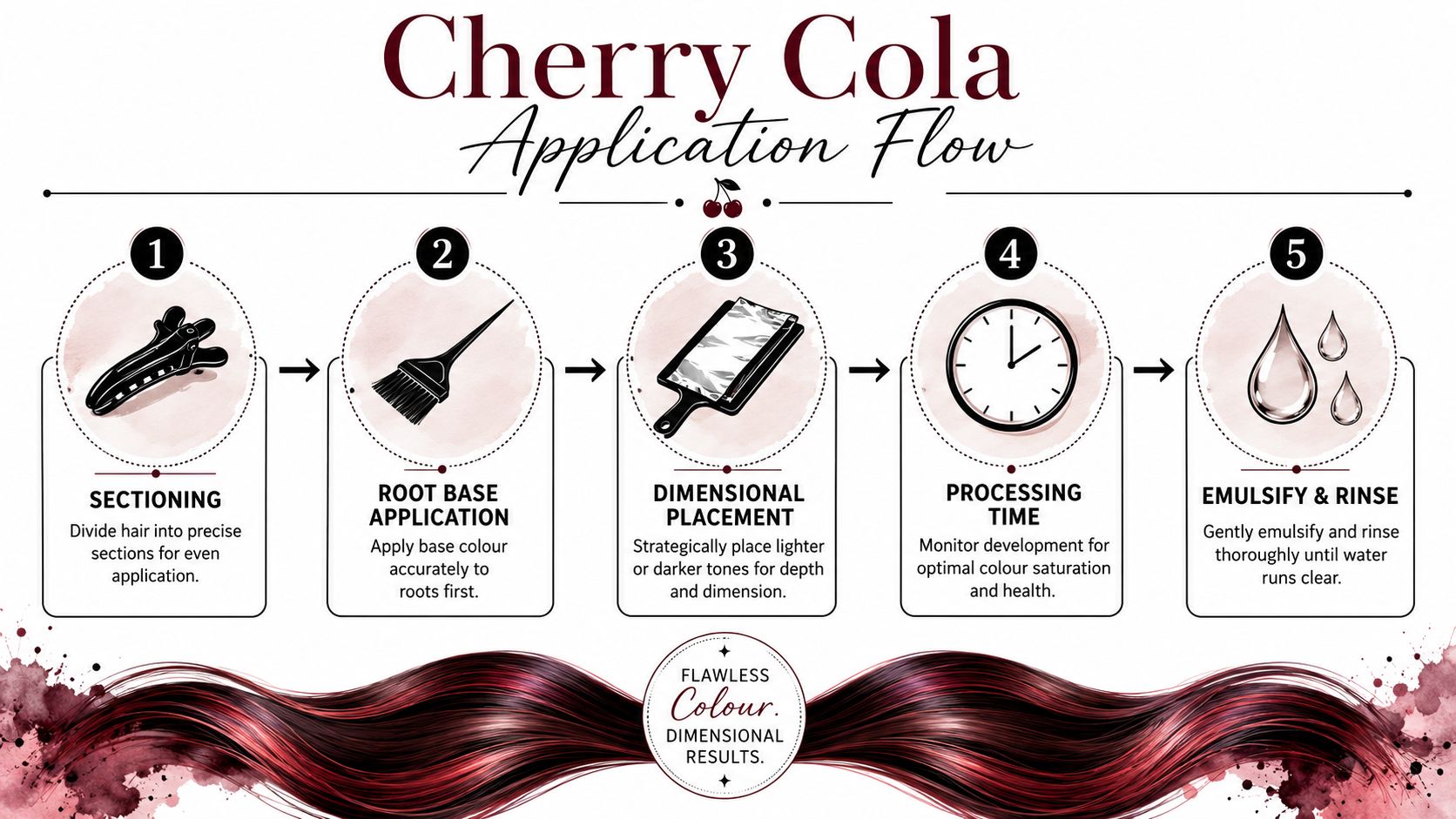
For previously coloured lengths, use glossing as a precision service rather than a compromise. Apply root to end with disciplined sectioning and enough product to saturate consistently. Keep subsections fine so the gloss behaves evenly through denser interiors and more porous ends.
A reliable sequence looks like this:
Section with intent
Clean quadrants are the minimum. Add sub-panels where density or old colour build-up varies.Apply where resistance is greatest first
Resistant mids often need more attention than stylists expect. Don't assume the roots are the only technical zone.Keep timing exact
With Cherry Cola glossing, longer processing doesn't mean better saturation. It often means a duller result.Rinse cool and thoroughly
Warm water encourages premature loss of the very reflect you've just built.
Where application usually goes wrong
The most common failure isn't dramatic. It's subtle inconsistency that makes the hair look expensive at the crown and tired through the lengths.
Watch for these problems:
- Over-wide sections that leave dry interiors or irregular deposit
- Rushed mids and ends because the stylist assumes the gloss will self-correct at rinse
- Extra processing time in the hope of “locking it in”
- Immediate hot-tool finishing to create a social-media reveal the same day
Cherry Cola hair rewards restraint. More heat, more processing, and more manipulation don't improve it. They strip out the nuance that made the colour desirable in the first place.
Preserve dimensionality during the service
A beautiful Cherry Cola result should move between espresso and ruby rather than sit as one solid red-brown blanket. That doesn't require gimmicks. It requires intentional placement and disciplined emulsification.
If the hair has natural variation, preserve some of it. If the hair is too uniform and flat, create dimension through controlled tonal layering rather than aggressive contrast. The trend is luxurious because it looks rich, not striped.
One more practical point. Don't let the styling plan sabotage the colour plan. If you know you need to avoid heat in the immediate post-colour window, prepare the client for an alternative finish before you begin. That conversation protects the technical result and avoids awkward upselling pressure at the mirror.
Finishing Touches and Initial Styling
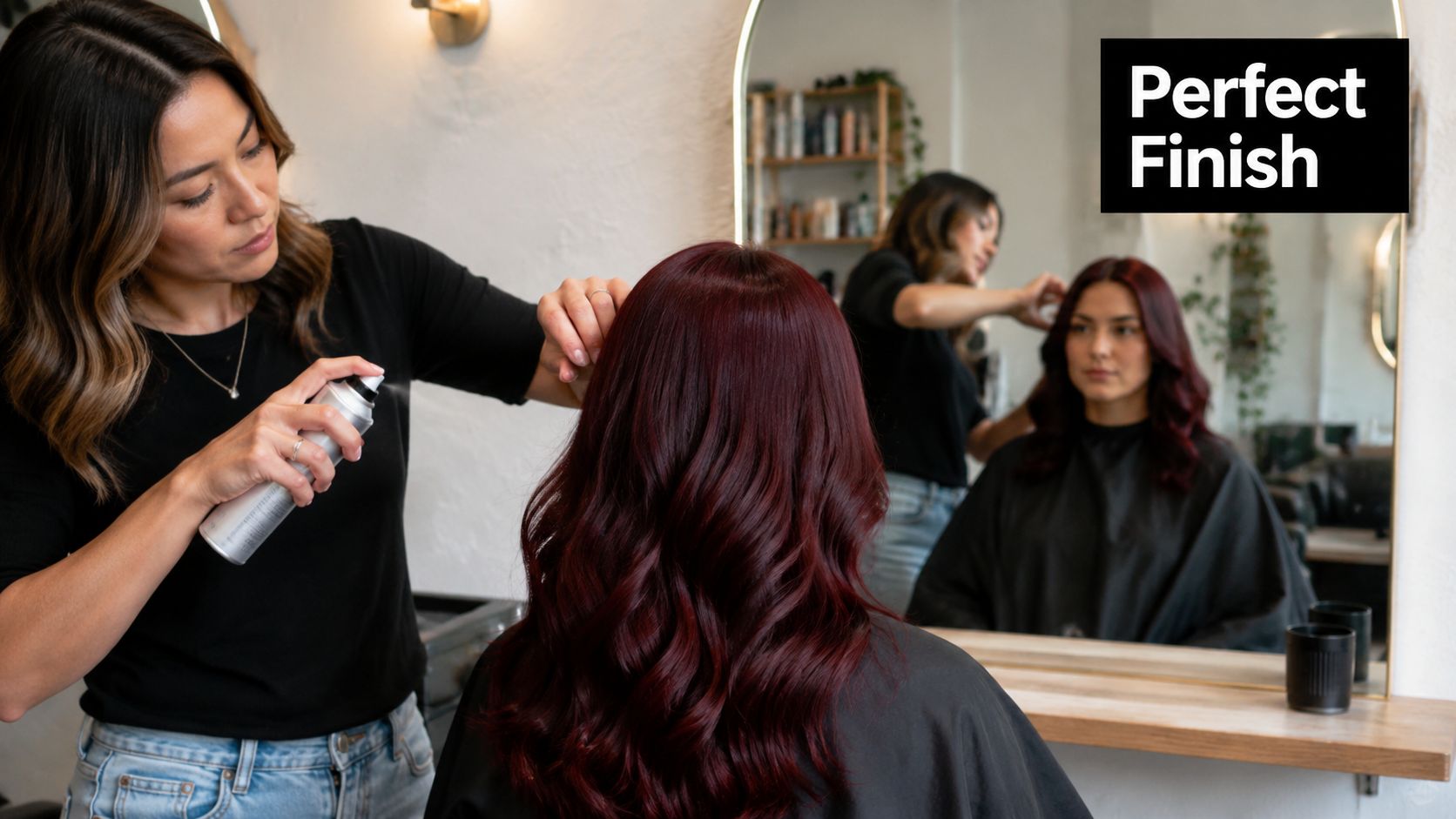
The rinse is not the end of the service. It's the moment where either the colour tightens into a glossy, premium finish or starts to lose clarity before the client has even seen it properly.
Why finishing matters commercially
Cherry Cola hair sells itself best when the client can see the shade changing across the surface. If the cuticle feels rough, the shine is weak, or the hair is styled too flatly for the reflect to show, the service can look less special than it is.
That's why a post-colour, pH-conscious finishing routine matters. It helps settle the surface, improve light reflection, and present the colour in its best form. In a premium salon, that final presentation is part of the service value.
The best ways to reveal the colour
Soft movement usually shows Cherry Cola hair better than rigid styling. Loose bends, polished waves, and brushed-out shape allow the brunette base and red-violet reflect to shift naturally as the client turns. Pin-straight finishing can work too, but only if the shine is excellent and the colour is even from root to end.
Use styling to demonstrate the character of the shade:
- Soft waves reveal dimension through the bend.
- Glossy blow-dries show surface shine and richness.
- Smooth, tucked finishes can be elegant for darker versions of the trend.
- Over-texturising often makes the colour look matte and less refined.
A short visual reference can help teams align on presentation standards:
Don't style against the chemistry
If you've chosen a colour direction that relies on deposited red-brown reflect, respect the first finishing window. Harsh heat straight after colour can work against longevity and against shine. A lower-stress finish often gives a better result in the mirror anyway.
Salon standard: Present Cherry Cola hair as polished and touchable, not overworked. Clients should see gloss, depth, and movement. They shouldn't smell a hot tool before they see the colour.
This is also the moment to educate without sounding clinical. Show the client how the shade looks near the face, at the crown, and through the ends. If there's a deeper root or a more reflective mid-length, point it out. Once clients understand what they're looking at, they value the customisation more.
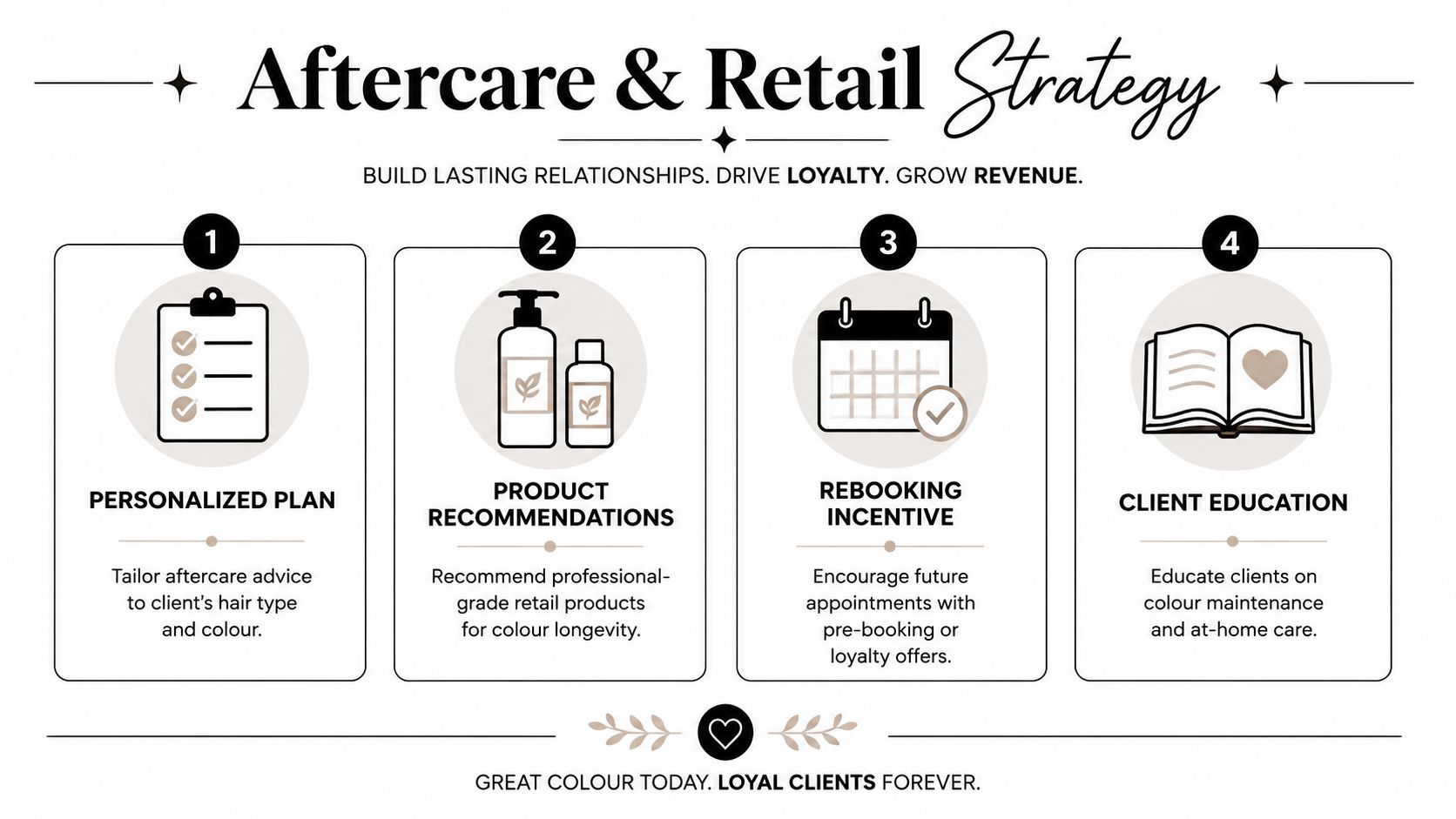
Building a Client Aftercare and Retail Plan
A client leaves thrilled with her new Cherry Cola result on Saturday. By the second or third week, the red reflect has dulled, the brunette base looks flatter, and she starts washing more aggressively to “freshen it up.” If the salon has not set a maintenance plan at checkout, the colour can look tired long before the next visit, and both retention and retail suffer.
Cherry Cola performs best as a system, not as a one-off colour service. Red-brown tones fade unevenly, especially on porous mids and ends, and Swiss salon clients often add two local stress factors. Hard water can roughen the cuticle over time, and winter sun at altitude still affects exposed colour. That is why the home routine needs to protect deposit, reduce unnecessary stripping, and keep the finish glossy between appointments.
Turn technical advice into a retail system
Clients follow aftercare more consistently when the plan is specific. “Use something for coloured hair” is too broad to change behaviour or support retail conversion.
Build the take-home prescription around three jobs:
Cleanse without pulling colour too fast
Recommend a gentle, colour-safe shampoo and conditioner pair that supports shine and keeps the cuticle calm. For natural-focused salons, formulation standards are especially important. Products need to feel premium, but they also need to perform on freshly coloured hair.Replace lost reflect before the colour looks dull
A weekly depositing mask or conditioner helps maintain the cherry tone between gloss appointments. The trade-off is simple. Too much pigment can grab on very porous ends, while too little does nothing. Give the client a clear frequency and timing recommendation.Protect against heat, friction, and dry indoor air
A leave-in or styling product that shields the fibre helps preserve gloss and surface smoothness. This is often the easiest add-on sale because clients can see the result immediately in the mirror.
For Swiss salons with a clean-beauty position, a tight edit usually sells better than a crowded shelf. One cleanser pair, one tone-support treatment, and one protective styler is enough for a strong Cherry Cola retail menu. Curated ranges also make staff training easier and reduce random substitutions at reception.
A script that improves compliance
At the mirror, keep the language practical:
“This shade stays richer when you wash less often, keep the water lukewarm to cool, and use your depositing treatment every week. If you wait until it looks faded, we need correction instead of maintenance.”
That script works because it links product use to visible results. It also frames aftercare as part of preserving the salon finish, not as an optional extra.
Then book the next visit before the client leaves. Cherry Cola usually needs a clear refresh rhythm, whether that is a gloss, a face-frame refinement, or a full colour service. Clients who leave with product, timing, and a date are easier to retain and more profitable over the year.
The operational side salons often miss
Colour retention is not only about formulation. It is also about access.
Clients call when the tone shifts, when they need a quick gloss before an event, or when they are unsure which home product to replace. If those calls are missed, the salon loses rebookings, retail orders, and high-margin colour corrections that could have stayed in-house. This guide on managing missed calls for beauty salons is useful for owners who want tighter control over colour revenue.
What to package together
Single-item selling leaves too much to chance. Package the service around outcome and timing:
- Core care with a colour-safe shampoo and conditioner
- Tone support with a weekly depositing treatment chosen for the client's fade pattern
- Finish support with a protective styling product that suits her routine
- Rebooking for the next gloss or refresh before checkout
That package completes the service and gives the salon a cleaner retail story. It also fits a premium, natural-focused business model, where trust is built through thoughtful recommendations rather than volume selling.
beautysecrets.agency helps Swiss retailers, pharmacies, spas, and premium beauty partners build differentiated clean-beauty assortments with natural, ethically sourced formulations. If you're looking to strengthen your colour-care or luxury self-care offer with curated brands and trade support, explore beautysecrets.agency.