The most popular advice on azelaic acid serum is also the least useful for professional buyers. It usually reduces the ingredient to a simple menu of strengths, then implies that a higher percentage automatically means better results. That framing fails in practice.
An Azelaic Acid Serum isn't a miracle product, and it isn't a universal brightening shortcut. It's a strategic active with a broad mechanism profile, a distinct tolerability pattern, and a very specific commercial advantage for Swiss pharmacies, spas, and premium retailers that want to serve clients with redness, blemish-prone skin, and post-inflammatory marks without pushing them straight into harsher routines.
For trade buyers, the key question isn't whether azelaic acid is “good”. It's whether a given formula is positioned correctly, whether the concentration matches the use case, and whether staff can explain why results are gradual rather than dramatic. That's where successful sell-through happens.
Beyond the Hype What Azelaic Acid Serum Really Does
Azelaic acid is often sold with the wrong promise. For professional buyers, the commercial risk is obvious. If a pharmacy or spa frames it as a fast brightening shortcut, clients expecting quick cosmetic change often stop too soon and blame the formula rather than the positioning.
The stronger case for Azelaic Acid Serum is narrower and more useful. It serves clients who want visible correction with a lower irritation profile than many acid-led or retinoid-led routines. In Swiss retail, that makes it especially relevant for pharmacies and spas serving cautious, treatment-aware clients who want progress they can maintain.
Why the cure-all narrative fails in practice
Azelaic acid works best when staff recommend it for a defined pattern of concerns. Redness with blemish activity. Post-inflammatory marks in clients who do not tolerate stronger exfoliating systems well. Persistent unevenness in routines that need to stay simple.
That is a very different sales story from generic “radiance.”
For assortment planning, azelaic acid belongs in the corrective category, but not in the instant-results segment. It earns shelf space because it covers several common concerns at once and remains usable for many clients who struggle with more aggressive actives. That combination supports steady sell-through in advice-led channels, provided the consultation is disciplined.
Three points matter in practice:
- Breadth has limits. Azelaic acid can support blemish-prone skin, visible redness, and post-breakout discolouration, but it is not the top performer for every single indication.
- Consistency determines value. Clients who apply it regularly and follow a stable homecare plan usually get the best outcome.
- Staff explanation affects retention. Texture, frequency, tolerance, and timeline all need to be explained clearly at point of sale.
Where it justifies a place in a professional assortment
Its best commercial role is sensitive correction. That gives pharmacies and spas a credible option for clients who want clearer, calmer skin but have already reacted poorly to stronger peels, higher-strength retinoids, or overly active brightening stacks.
In professional buying terms, the key distinction is not just whether a formula contains azelaic acid. It is whether the product is built for maintenance, for treatment-adjacent support, or for cosmetic brightening with an azelaic acid claim attached. Those are different recommendation pathways, with different margins, different compliance demands, and different client education needs.
Practical rule: Position azelaic acid serum as a steady corrective option for redness-prone, blemish-prone, or post-inflammatory skin behaviour. Do not position it as a stronger brightening serum.
That framing is more accurate. It also reduces avoidable returns, improves client satisfaction, and gives Swiss pharmacies and spas a more defensible way to recommend the category.
The Scientific Mechanisms of Azelaic Acid
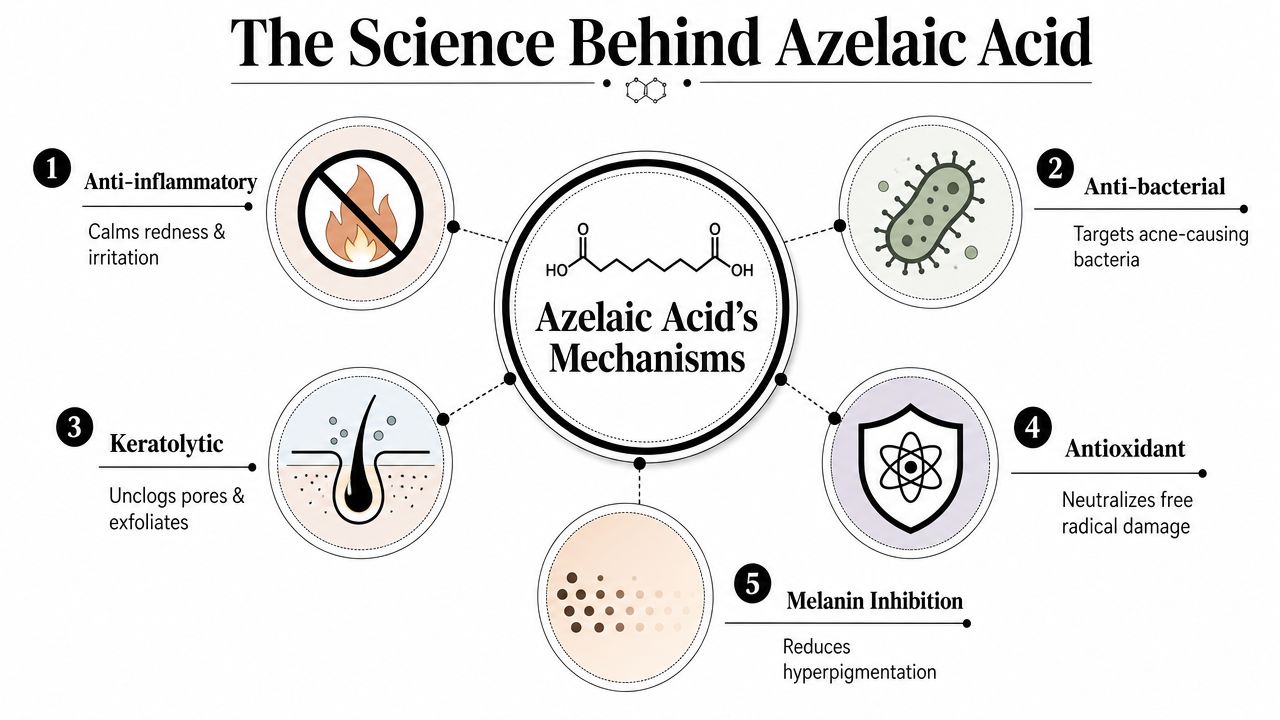
Azelaic acid deserves a place in professional skincare because it acts on several pathways that often appear together in the same client. The person with inflammatory blemishes may also have lingering marks. The client with redness may also have uneven texture. A single active that addresses multiple linked processes can simplify retail recommendations.
Topically, azelaic acid is a saturated dicarboxylic acid used for mild-to-moderate acne vulgaris and for hyperpigmentation-related indications. Its key actions include inhibition of tyrosinase, mitochondrial respiratory chain enzymes and DNA synthesis, plus free-radical scavenging and suppression of neutrophil-derived reactive oxygen species. In commercially available gels and creams, it is typically formulated at 5%–20% (clinical review of azelaic acid mechanisms and formulation range).
Pigment control without the harsh profile
The easiest mechanism to explain in consultation is tyrosinase inhibition. Think of tyrosinase as part of the control system for excess pigment production. Azelaic acid helps turn that signal down. For clients with post-blemish marks, that makes it more relevant than many “radiance” products that improve surface appearance without addressing the pigment pathway.
This doesn't mean dramatic overnight brightening. It means slower, more credible progress in clients whose tone irregularity is linked to inflammation.
Redness support through inflammatory control
Azelaic acid also has a strong place in anti-redness recommendations because it acts on inflammatory processes rather than relying on superficial soothing alone. That's why it often fits better in a professional assortment than products that market themselves around comfort but don't do enough corrective work.
For spas and pharmacies, this creates a practical distinction:
| Skin concern | What clients often ask for | What azelaic acid actually offers |
|---|---|---|
| Redness | “Something calming” | Ongoing support through anti-inflammatory activity |
| Post-spot marks | “A brightening serum” | Gradual pigment pathway control |
| Congestion | “An acne product” | A gentler corrective route for some acne-prone users |
Why one ingredient can cover several concerns
Azelaic acid's broader mechanism profile explains why it shows up in so many recommendation conversations. It doesn't just sit in one category.
- For pigmentation concerns, it can help where inflammation and overactive pigment production overlap.
- For reactive blemish-prone skin, it offers a route that may be easier to tolerate than more aggressive exfoliating routines.
- For professional retail, it bridges aesthetic and dermatological logic, which is useful in pharmacy and clinic-adjacent settings.
It's one of the few actives that can reasonably sit in a redness shelf, an acne shelf, and a post-blemish correction shelf without feeling out of place.
That versatility is a strength only if staff understand the mechanism well enough to stop overpromising.
Choosing the Right Azelaic Acid Concentration
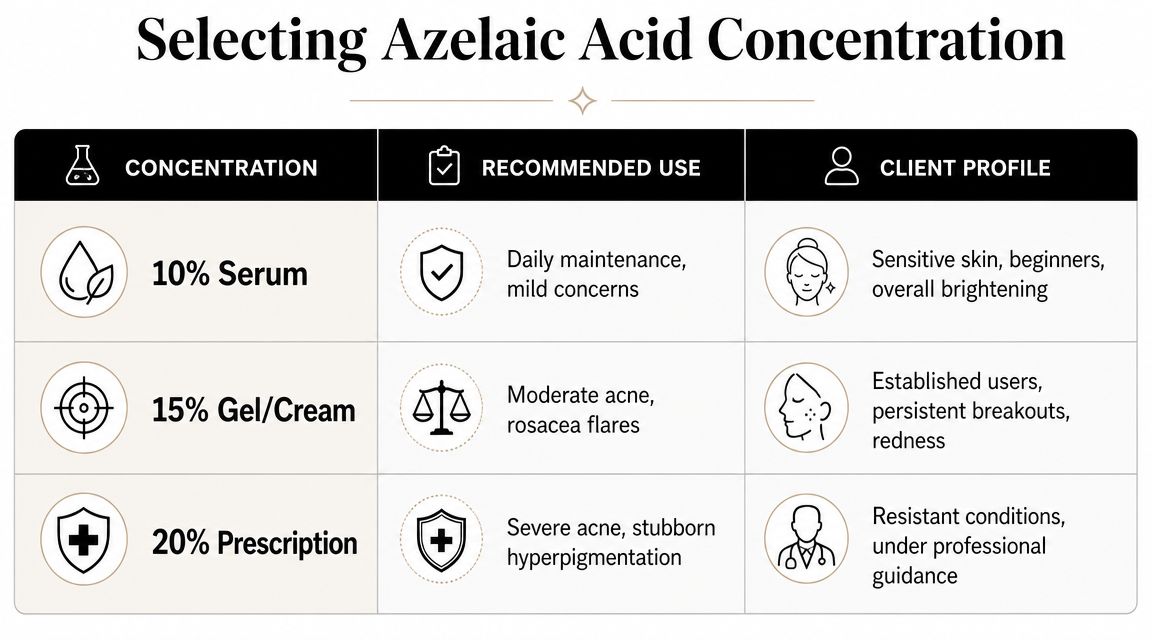
Percentage claims sell product. They do not build a credible assortment.
For Swiss pharmacies and spas, the better question is not “Which strength is best?” but “Which strength will deliver visible improvement with acceptable tolerance, clear counselling, and repeat purchase potential?” Azelaic acid is a category where stronger can look more impressive on pack, yet perform worse commercially if irritation, poor texture, or unrealistic client expectations reduce compliance.
Cosmetic range versus treatment-adjacent range
The practical split in the Swiss market is clear. Cosmetic serums usually sit at the lower end of the concentration range and are positioned for regular use, while treatment-adjacent pharmacy options are positioned more aggressively and often align with the stronger concentrations discussed earlier.
That distinction matters because concentration changes the consultation model as much as the formula profile.
| Concentration band | Best role in retail | Best fit client |
|---|---|---|
| Lower cosmetic strength | Entry product, maintenance, routine correction | Sensitive users, cautious beginners, clients already using multiple actives |
| Mid to higher professional or pharmacy positioning | More targeted corrective recommendation | Persistent blemishes, visible redness, clients seeking treatment-adjacent results |
A pharmacy can support both bands if the team is trained to explain pace, tolerance, and realistic timelines. A spa usually benefits from a tighter edit. Fewer options, better staff confidence, and a clearer recommendation path tend to convert better than a broad shelf full of near-duplicates.
What concentration does not tell you
Two serums with the same stated percentage can behave very differently on skin. Vehicle choice, suspension quality, pH, supporting humectants, and the presence of competing actives all affect tolerability and client perception.
Inexperienced buying often goes wrong. A high percentage in a dry, inelegant base may create more drop-off than a lower concentration in a well-built serum that clients will finish.
For professional buyers, I use a simple screen:
- Barrier status first. Reactive or overtreated skin often needs the easier entry point, regardless of how motivated the client sounds at the counter.
- Primary indication second. Maintenance support, visible post-blemish marks, and redness-prone skin do not always justify the strongest available option.
- Routine load third. Clients already using retinoids, exfoliating acids, or strong acne treatments usually need less friction, not another aggressive layer.
A commercial way to choose
A lower-strength azelaic acid serum often makes sense as the core SKU in a spa or selective pharmacy assortment. It serves more skin profiles, creates fewer tolerance problems, and gives staff a safer first recommendation. That improves adherence, which is what drives outcomes and reorders.
Higher-strength positioning has a place, but it needs tighter guardrails. It works best where staff can assess current routine use, explain the adjustment period properly, and steer the client away from stacking too many corrective products at once.
For a Swiss clientele, premium positioning rarely comes from the highest number on pack. It comes from elegant texture, low-irritation design, disciplined claims, and advice that feels medically literate without drifting into overstatement.
How to Integrate Azelaic Acid Serums in a Routine
Routine design matters as much as product selection. A well-formulated azelaic acid serum can still underperform if staff give vague instructions or encourage clients to combine too many corrective products at once.
The biggest operational mistake is treating azelaic acid like a plug-and-play add-on. It needs a place in the routine, a pacing strategy, and some thought around neighbouring actives.
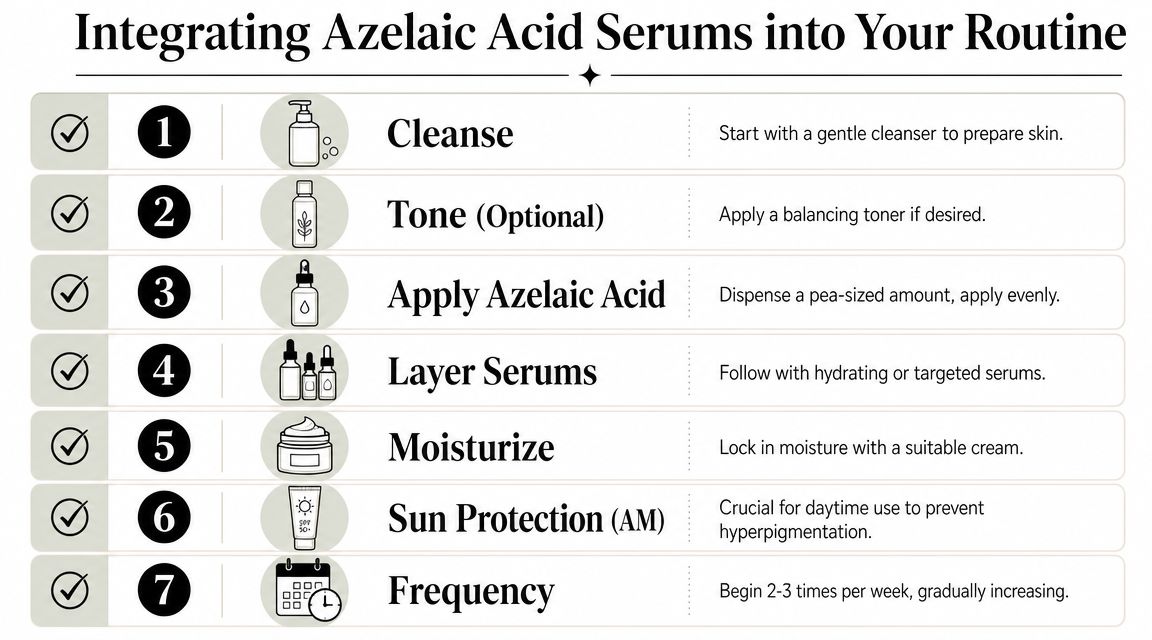
A practical layering sequence
For most clients, azelaic acid serum belongs after cleansing and before moisturiser. If the formula is light, it can sit comfortably in the serum step. If the product is a thicker gel-cream, staff should explain that it may behave more like a treatment layer.
A simple recommendation script works well in-store:
- Cleanse gently. Avoid stripping cleansers when the skin is already reactive.
- Apply azelaic acid serum to dry skin. This helps reduce the chance of unnecessary sting in clients with a fragile barrier.
- Follow with hydration. A moisturiser with a comforting base improves overall compliance.
- Use sun protection in the morning. This is especially important when the target concern includes visible uneven tone.
Pairings that tend to work
Clients often ask what they can use with azelaic acid. The answer depends less on trend ingredients and more on cumulative irritation.
These pairings are usually the most commercially reliable:
- With niacinamide, because the routine stays focused on barrier support and visible calm.
- With humectant-led hydrators, where the objective is to preserve comfort and reduce dropout.
- With a gentle vitamin C routine, if the skin is already stable and the client wants broader antioxidant support.
Pairings that need more supervision
For Swiss buyers, there is an opportunity to add real value. The local advice gap is strongest around clients using retinoids or stronger acids, especially when they buy one product in a pharmacy and another elsewhere.
If a client is already on retinoids, don't default to “more correction”. Default to “less friction”.
When azelaic acid sits beside retinoids, exfoliating acids, or abrasive cleansing habits, problems usually come from frequency rather than the ingredient itself. The safer recommendation is often separation by time of day or alternating nights until the skin proves it can cope.
That consultative approach is what distinguishes a professional recommendation from a generic online routine card.
Safety Profile and Managing Client Expectations
Azelaic acid has one of the more useful safety profiles in active skincare because it often suits clients who can't tolerate louder, harsher categories. That doesn't mean it is sensation-free or disappointment-proof. Clients can still experience stinging, tightness, or dryness, especially early on or when the rest of the routine is badly chosen.
The commercial issue isn't whether some clients react at first. The issue is whether your team framed those possibilities clearly enough before purchase.
The real retention tool is expectation setting
A strong recommendation includes a timeline, not just an application method. That matters because a contrarian but important message for the Swiss market is this: azelaic acid is helpful, but it isn't the fastest or most universal brightening serum. Results can take weeks, and its value in post-inflammatory issues and rosacea is tied to anti-inflammatory and pigment-targeting pathways rather than instant cosmetic change (derm-led perspective on slower azelaic acid results and positioning).
A client who expects overnight radiance will often decide the product “isn't doing anything”. A client who understands that progress is cumulative is far more likely to stay consistent.
What to say in consultation
Use language that is calm, specific, and non-defensive. Avoid dramatic claims, and avoid apologising for the product being gradual. The gradual profile is part of the value proposition.
Good consultation language sounds like this:
- For redness-prone clients: “This is designed for steadier improvement, not instant masking.”
- For post-blemish marks: “Think in terms of regular use and gradual clearing, not a quick brightening effect.”
- For sensitive clients: “If your skin feels active at first, simplify the rest of the routine before you assume the ingredient is wrong for you.”
A client will forgive slow progress. They usually won't forgive being promised fast progress that never arrives.
When not to push the sale
Sometimes the right recommendation is restraint. If the client is already over-exfoliated, using multiple strong actives, or shopping in a highly reactive phase, adding azelaic acid can still be a poor decision even if the ingredient itself is generally well tolerated.
That judgement matters in Swiss premium retail, where trust and repeat custom depend on sound advice. The best teams know when to pause correction, stabilise the barrier, then introduce azelaic acid later under better conditions.
Marketing and Merchandising in a Swiss Pharmacy or Spa
Azelaic acid often sells poorly when it is placed in the wrong story. If it sits beside “instant glow” products, clients misunderstand it. If it sits only in a medicinal corner, many cosmetic shoppers never consider it. Merchandising needs to reflect what the ingredient does best.
The strongest retail position is usually calm correction. That gives staff a clear language set and helps clients self-identify without feeling pushed towards an aggressive treatment category.
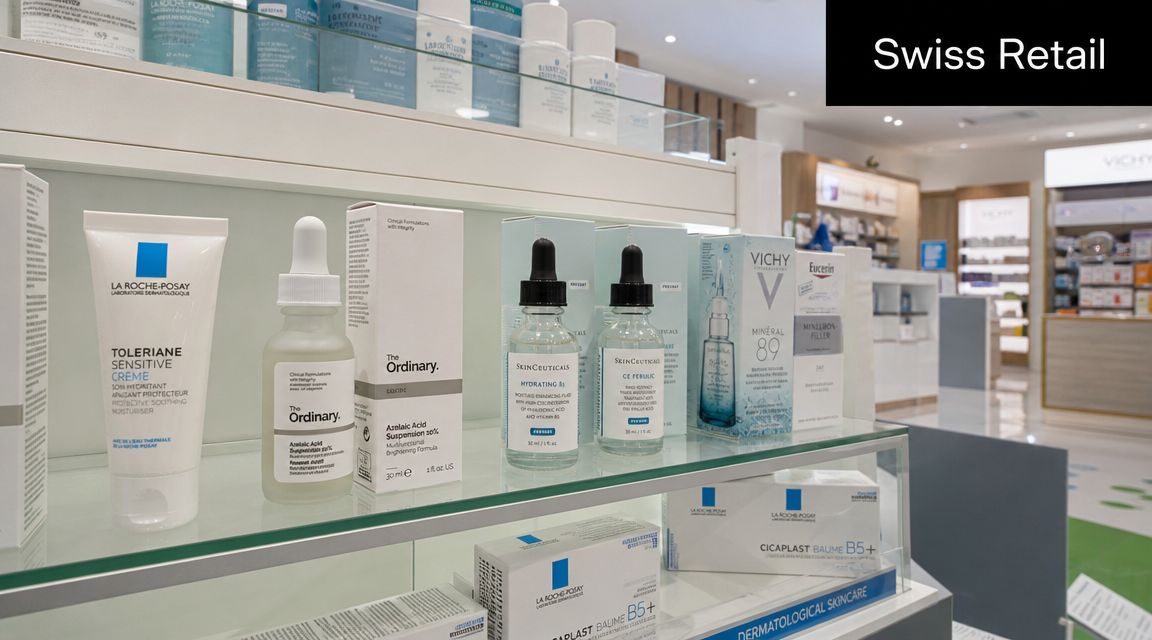
Better merchandising categories
Instead of shelving azelaic acid serum only by ingredient, build use-case clusters that mirror client language.
Examples that work well in a Swiss pharmacy or spa include:
- Anti-redness and reactive skin
- Blemish care without harshness
- Post-blemish tone correction
- Barrier-friendly active routines
This makes the product easier to discover and easier for staff to explain.
Claim language that stays credible
Avoid language that implies immediate transformation or medicinal certainty unless the product classification supports it. Better claim phrasing is usually softer, more precise, and more useful to the client.
Consider language such as:
| Weak retail phrasing | Stronger professional phrasing |
|---|---|
| Instant brightening fix | Supports more even-looking tone over time |
| Acne cure serum | Suitable for blemish-prone, easily irritated skin |
| Redness eraser | Helps support calmer-looking skin |
| Strong active treatment | Daily corrective active for targeted concerns |
For buyers handling product documentation and importer responsibilities, staff should also understand the difference between cosmetic communication and more formal safety documentation. Teams reviewing technical files can use this essential guide for EU chemical SDS compliance as a practical reference point when comparing supplier standards and document quality.
How to train staff to recommend it well
Staff performance improves when they can answer one simple question: why this instead of retinol or vitamin C?
A useful internal script is:
- Choose azelaic acid when the client reports redness, sensitivity, post-blemish marks, or a history of irritation with stronger actives.
- Choose retinoid-led options when the primary goal is a broader correction strategy and the client tolerates active routines well.
- Choose classic antioxidant brightening when the client wants surface radiance and doesn't need azelaic acid's specific anti-inflammatory positioning.
That approach makes the category feel curated rather than crowded.
Sourcing High-Performance Azelaic Acid Formulations
Buying an azelaic acid serum on concentration alone is a common procurement error. Two products can present the same percentage and behave very differently on skin. Texture, solvent system, supporting ingredients, and finish all affect whether clients use the product long enough to benefit from it.
A buyer should assess the full formulation architecture, not just the hero active.
What to check before listing
Start with product feel and use context. In spas and premium retail, elegance matters because it drives compliance. A formula that pills, drags, or leaves a heavy residue will create routine friction, especially when clients want to layer moisturiser or daytime protection afterwards.
Then review the supporting system:
- Humectant support matters. Glycerin and similar hydration-supportive components often improve user comfort.
- Barrier-friendly design matters. A well-formulated azelaic acid serum should feel compatible with reactive skin positioning.
- Supporting actives should be coherent. Niacinamide can make sense. A formula crowded with multiple aggressive exfoliating claims often doesn't.
Texture must match the channel
A pharmacy can support more treatment-coded textures if staff are comfortable coaching use. A spa or boutique retailer usually benefits from more elegant serum or emulsion formats that fit a premium ritual and don't feel clinical in the wrong way.
I'd also look closely at how the brand describes the formula. Strong suppliers usually explain the product's intended client, usage rhythm, and tolerability logic in a way that aligns with real professional selling. Weak suppliers lean too heavily on hero-ingredient headlines.
A sourcing checklist for discerning buyers
Before range approval, ask these questions:
- Is the concentration appropriate for the channel and target client?
- Does the texture support repeat use, morning or evening layering, and good sensory acceptance?
- Are the accompanying ingredients helping tolerance, or merely inflating the marketing copy?
- Can staff explain the difference between this formula and a stronger treatment-led alternative?
- Does the brand's positioning support realistic claims for redness-prone, acne-prone, or tone-irregular skin?
The best azelaic acid serums are not necessarily the strongest. They are the ones most likely to be recommended accurately, used consistently, and repurchased because the client understood what they were buying.
Swiss retailers, pharmacies, spas, and clinics that want cleaner, better-positioned skincare portfolios can explore curated brand support through beautysecrets.agency. The team helps trade partners source premium, ethically minded cosmetic lines with strong formulation logic, clear positioning, and the kind of assortment discipline that builds long-term client trust.