A customer is standing at the counter with a familiar brief. She wants help for marks that won't fade, but she doesn't want a harsh peeling programme, an overcomplicated routine, or a product that sounds fashionable and vague. In a Swiss pharmacy or premium retail setting, that question matters because the answer has to satisfy three tests at once. It has to be scientifically credible, commercially positionable, and practical enough for real repeat purchase.
That's why tranexamic acid serum deserves serious attention. It isn't just another brightening label claim. In Switzerland, tranexamic acid already has a recognised medical history through Exacyl, a Swissmedic-listed prescription medicine containing 500 mg tranexamic acid per tablet for reducing or preventing bleeding, which gives the ingredient unusual credibility before it ever reaches a cosmetic shelf (NIH/PMC review). For a market that values regulated ingredients, premium efficacy, and restrained claims, that heritage matters.
The Rise of a Clinically Proven Brightening Star
Swiss buyers are right to be sceptical of ingredients that appear everywhere at once. Most brightening actives arrive with oversized promises and very little language that a pharmacist, clinic partner, or trained beauty adviser can use confidently. Tranexamic acid is different because its story begins in medicine, not marketing.
In practice, that changes the sales conversation. You're not introducing an obscure botanical with unclear relevance. You're introducing an ingredient with a regulated medical background that later moved into dermatology and topical skincare. That gives it a more serious foundation than many cosmetic actives aimed at uneven tone.
Why the Swiss context makes it stronger
The Swiss customer often wants efficacy without drama. They'll accept a slower timeline if the mechanism is plausible, the formulation is elegant, and the recommendation feels disciplined. Tranexamic acid fits that profile well.
Its appeal also suits premium and natural-leaning assortments that want to avoid the harsh-acid stereotype. A well-positioned tranexamic acid serum can sit comfortably between pharmacy dermo-cosmetics and more sensorial prestige skincare, provided the merchandising language stays clinical and measured.
For teams that need a clean consumer explainer before they brief staff, this overview on how to discover tranexamic acid for skin is useful because it frames the ingredient in accessible skincare terms without turning it into hype.
Practical rule: Stock tranexamic acid when you need an answer for persistent pigmentation that sounds credible in a pharmacy and still attractive in premium skincare.
Where it earns shelf space
A good tranexamic acid serum isn't a replacement for every pigment strategy. It's strongest when you need a non-exfoliating brightening option, a maintenance recommendation after stronger treatment plans, or a gentler route for customers who are hesitant about retinoids and acids.
That's the commercial opening in Switzerland. The ingredient doesn't need to win on novelty. It wins on trust.
How Tranexamic Acid Calms Pigmentation Pathways
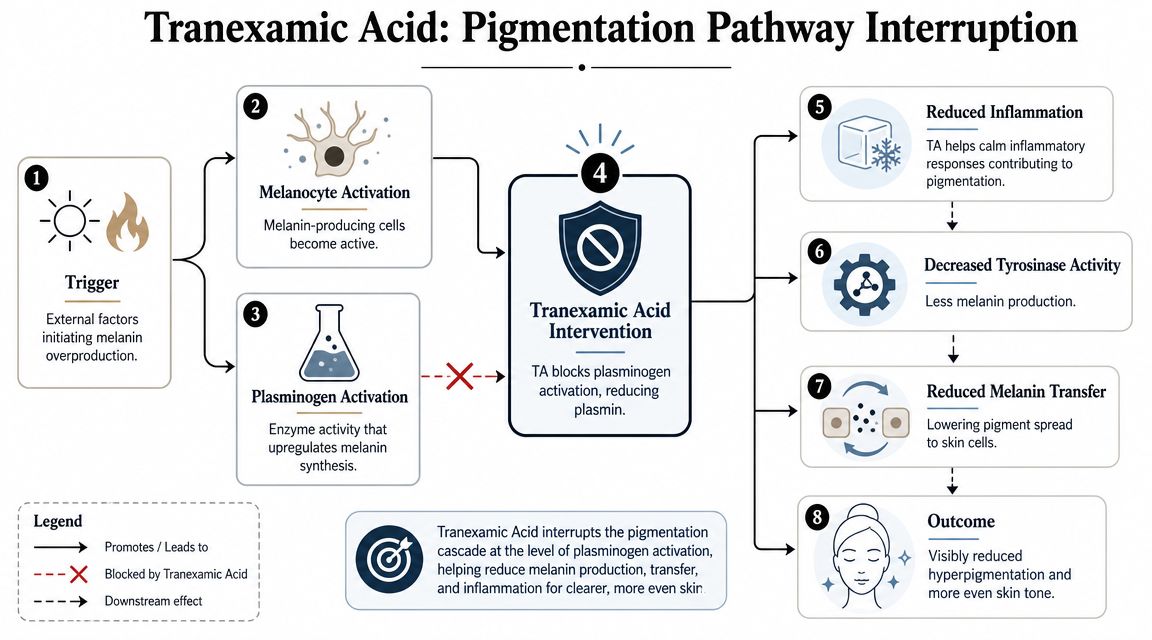
Tranexamic acid works best when staff can explain it clearly. If the explanation sounds like biochemistry lecture notes, customers switch off. The easiest way to teach it is to describe tranexamic acid as a traffic controller for unwanted pigment signalling.
When skin is exposed to triggers such as UV radiation or inflammation, it can send messages that push pigment cells into overactivity. Tranexamic acid helps interrupt part of that chain. Rather than bleaching skin or speeding visible peeling, it acts further upstream by reducing the signalling that contributes to excess pigmentation.
The mechanism customers can understand
The technical shorthand is that tranexamic acid affects the plasminogen to plasmin pathway. For retail use, the cleaner explanation is this:
- Trigger first: Sun exposure and inflammation can push skin towards excess pigment production.
- Signal amplification next: Those triggers increase the chemical signalling that tells melanocytes to stay active.
- Tranexamic acid steps in: It helps disrupt that message flow.
- Result over time: Skin can look more even because fewer signals are pushing pigment production and spread.
That explanation matters because it separates tranexamic acid from exfoliating acids. Customers often assume every “acid” works by stripping or peeling. This one doesn't sit naturally in that category.
What it is not
It is not a bleaching agent. It is not a fast-resurfacing acid. It is not the ingredient to present as an overnight eraser for deep melasma or established post-inflammatory marks.
That distinction protects trust. If a buyer positions tranexamic acid serum as a refined pigment regulator rather than a dramatic spot remover, the product will usually meet expectations better.
A helpful comparator for teams reviewing broader dark-spot category messaging is this guide to Karin Herzog dark spot treatment. It's useful not because tranexamic acid works identically, but because it shows how customers already think about correcting visible discolouration.
Customers usually respond well to one sentence: tranexamic acid helps quiet the signals that keep pigmentation active.
Why this matters for premium retail
Premium Swiss retail works best when product logic is easy to repeat. Advisers need one clear sentence, one realistic outcome, and one obvious place in the routine. Tranexamic acid delivers on all three when trained correctly.
It also gives natural and clinically led brands a useful middle position. It sounds more advanced than a generic brightening serum, but less aggressive than a resurfacing treatment. That's a valuable gap.
Evaluating the Clinical Evidence for Tranexamic Acid
A Swiss pharmacy buyer does not need more ingredient hype. They need to know whether the evidence is good enough to justify shelf space, staff training, and a premium price.
For tranexamic acid, the answer is yes, with clear limits. The ingredient has unusual credibility for a cosmetic active because its medical history is established. In Switzerland, tranexamic acid is known first as the active ingredient in the prescription medicine Exacyl, used to reduce or prevent bleeding. That background matters commercially. It gives advisers a scientific starting point that many brightening ingredients do not have.
What the current evidence actually supports
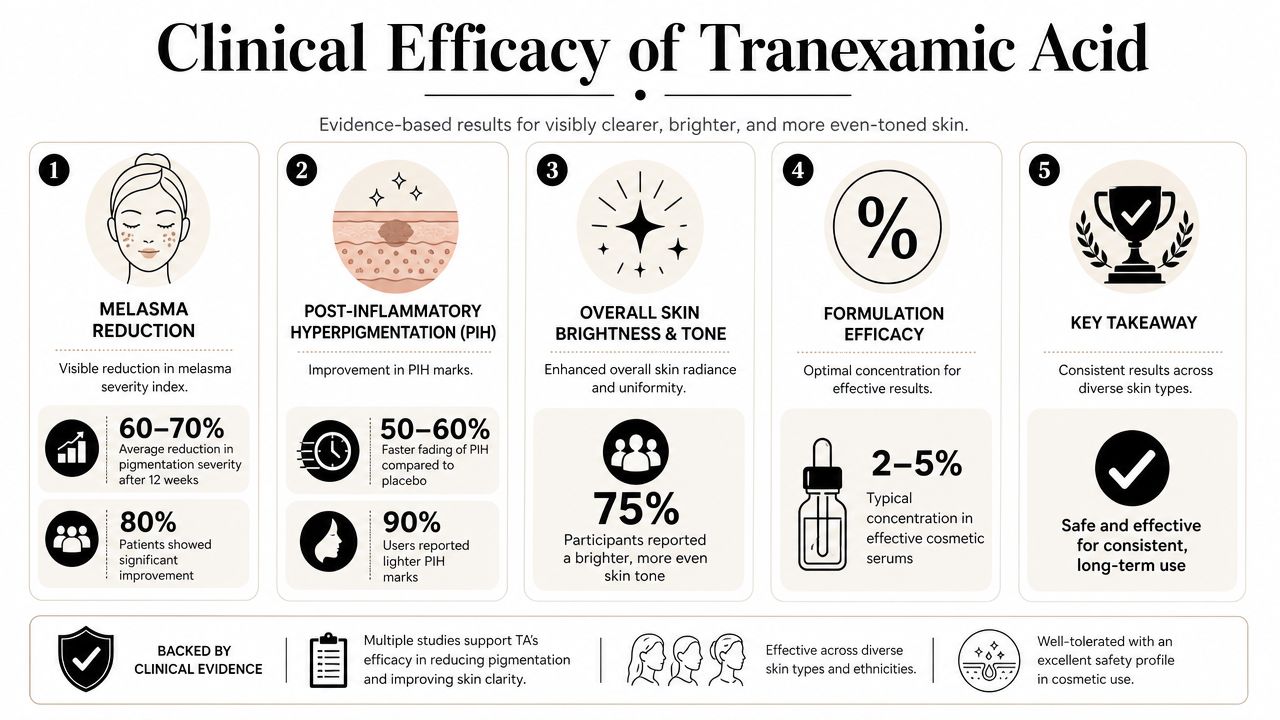
As noted earlier in the article, published review data cover both topical and oral tranexamic acid. That distinction matters. Oral use in dermatology, especially for melasma, supports the ingredient's relevance to pigment disorders. It does not justify cosmetic claims for a serum. Topical studies are the more useful benchmark for retail, but they are still product-specific, protocol-specific, and usually modest in scale.
That means a pharmacy chain should treat tranexamic acid as evidence-backed, not outcome-guaranteed.
| Evidence type | What it supports commercially | What it does not support |
|---|---|---|
| Medical precedent | Credibility, seriousness, regulated history | Automatic cosmetic efficacy claims |
| Topical study data | Confidence that the ingredient has moved into evidence-backed skincare | A promise that every cosmetic serum performs the same way |
| Oral melasma data | Proof that tranexamic acid has real dermatological relevance for pigmentation | A claim that topical serum will match oral outcomes |
The practical interpretation is straightforward. Tranexamic acid earns a place in a premium assortment as a pigment-management active with a credible clinical story. It should not be sold as a replacement for prescription care, procedural treatments, or strict photoprotection.
That framing is particularly useful in Switzerland, where pharmacy customers often expect measured claims and visible logic behind pricing. A well-trained adviser can position a tranexamic acid serum in three credible ways:
- Maintenance care after more intensive pigment correction
- Adjunct support within a broader routine for uneven tone
- A gentler entry point for customers who are not good candidates for stronger acids or retinoids
A significant gap in Swiss-facing guidance
Current consumer education still leaves an important practical question underexplained. The issue is not whether tranexamic acid has relevance in pigmentation. The issue is which patient groups topical serum data reflect, how consistently redness-prone or reactive skin tolerates it, and how to present realistic outcomes across different skin tones and trigger patterns.
A recent PubMed study listing on topical tranexamic acid serum in hyperpigmentation adds to that discussion, but it does not answer the retail questions advisers hear every day at the counter. How fast will a customer see change. Is it suitable after irritation. Is it better for diffuse post-inflammatory marks than for long-standing melasma. Those are the questions that determine returns, repeat purchase, and credibility.
This is also where sensitive-skin positioning becomes commercially interesting. In premium Swiss retail, many shoppers want brightening support but have already reacted badly to exfoliating acids, aggressive vitamin C formats, or multi-active routines. Tranexamic acid can meet that need if the formula is well built and the counselling is disciplined. For category teams reviewing adjacent premium merchandising ideas, expert tips for skincare beauty listings can help sharpen how that quieter clinical benefit is presented.
Buying insight: The strongest sales message is not “this removes all dark spots”. It is “this fits into a disciplined plan for pigment and visible redness management”.
That message is more defensible, more useful for staff, and better aligned with how premium Swiss pharmacies build trust.
Integrating Tranexamic Acid Serums into Skincare Routines
A tranexamic acid serum succeeds or fails at the shelf largely because of how well you teach routine use. Poor advice leads to two common problems. Some customers give up too early. Others layer it into an already overloaded routine and blame the serum for irritation that was predictable.
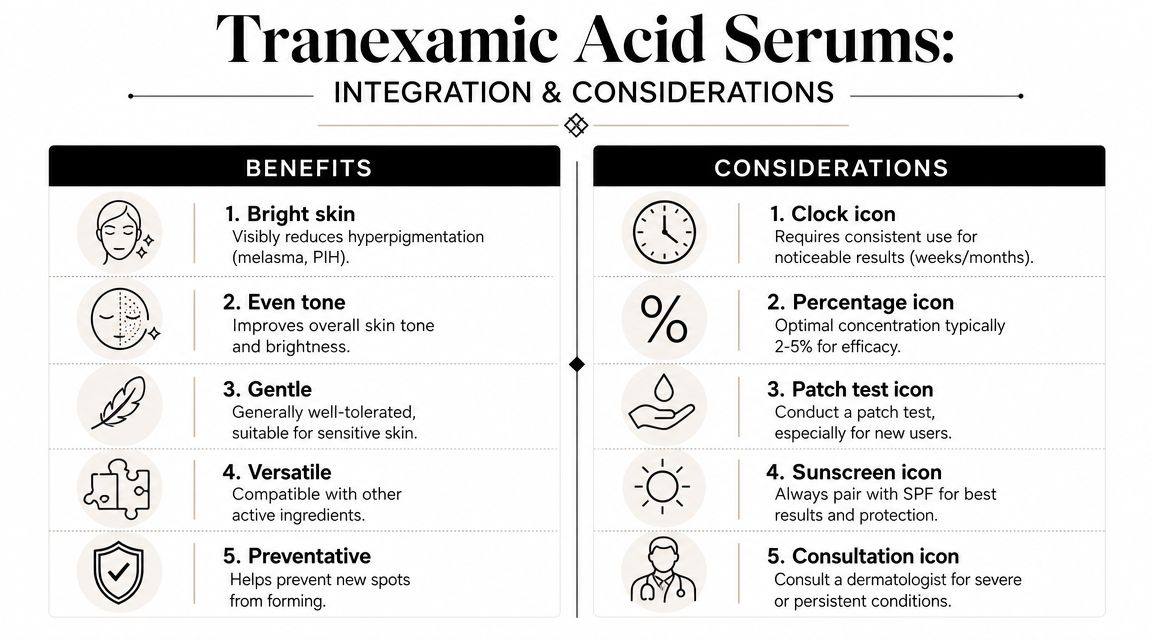
For formulation work, a common benchmark is 1 to 3% tranexamic acid in the water phase, with processing temperatures kept below 50°C to preserve stability. Independent dermatology sources also indicate that visible improvement in discolouration typically requires 8 to 12 weeks of consistent use, which is exactly the kind of expectation-setting premium retailers need to do well (formulation guide).
A simple visual summary helps staff remember the counselling points:
The routine that works in practice
Most customers do well when tranexamic acid is placed in a straightforward structure:
- Cleanse gently. Don't start with an aggressive wash if the customer is already pigment-prone or reactive.
- Apply the tranexamic acid serum on dry skin or after a simple hydrating layer, depending on texture.
- Follow with moisturiser. This matters more than many buyers think because dryness can make users quit early.
- Use daytime sun protection. Without that, pigment management becomes much harder.
Later in the section, this video can support staff education or customer content planning:
Pairings that usually make sense
Tranexamic acid often sits well in mixed-active routines when the rest of the formula is balanced. In retail counselling, these combinations are usually easiest to explain:
- With niacinamide: Good for customers wanting a more complete even-tone story.
- With vitamin C: Useful for shoppers focused on radiance and daily antioxidant routines.
- With retinoids: Better for experienced users who already tolerate active skincare.
- With hydrating support: Smart for sensitive, dry, or barrier-impaired customers.
What usually goes wrong
The mistakes are predictable:
- Stopping too early: If a customer expects visible change in a fortnight, they'll often abandon a good product before it has had enough time.
- Buying too many brighteners at once: A crowded routine confuses cause and effect.
- Treating it like a corrective peel: Tranexamic acid isn't there to give instant resurfacing feedback.
Start with one clear goal. If the customer wants help for uneven tone, don't sell them four competing pigment products in the same visit.
For retailers improving online assortment pages or education copy, these expert tips for skincare beauty listings are useful because the category often fails at the basics: clear use order, compatibility guidance, and realistic timelines.
A simple pharmacy script
Use language like this: apply consistently, keep the routine calm, and judge progress over the medium term rather than day by day. That framing reduces returns, improves adherence, and protects trust in the category.
A Calming Agent The Untapped Potential for Sensitive Skin
Most retailers still place tranexamic acid in a single box labelled “dark spots”. That's too narrow. A more interesting question is whether this ingredient deserves space in the sensitive skin conversation as well.
There is growing expert commentary suggesting that topical tranexamic acid may help not only with hyperpigmentation but also with redness and barrier function. That matters because many customers with post-inflammatory marks also have reactive skin, and many rosacea-prone shoppers won't tolerate stronger brightening routines well.
Why this angle matters commercially
Sensitive-skin customers are often underserved by the brightening aisle. They read “corrector”, “resurfacing”, or “acid” and assume the product will sting, peel, or destabilise their routine. Tranexamic acid gives retailers a more nuanced option.
If the serum is well formulated, you can position it as:
- A pigment-support product for reactive complexions
- A recovery-adjacent active after periods of irritation
- A steadier alternative for shoppers who reject harsher brightening formats
This doesn't mean every tranexamic acid serum should be sold as a redness treatment. It means the ingredient may sit credibly inside a broader skin recovery story, especially in pharmacy, clinic-adjacent, and dermo-cosmetic channels.
What not to overclaim
The available evidence here is still more qualitative than definitive for retail decision-making. That means staff training should stay disciplined. Don't promise that tranexamic acid will solve rosacea. Don't present barrier support as a guaranteed outcome across all formulas.
What you can say, more carefully, is that expert commentary has highlighted its potential relevance for redness-prone and sensitive skin, which makes it more versatile than standard dark-spot messaging suggests (expert commentary on YouTube).
Some customers won't buy a “pigment serum”. They will buy a product framed as helping skin recover while also supporting a more even tone.
That difference in wording can change who engages with the shelf.
Where this sits in a Swiss assortment
For Swiss retailers carrying premium, natural, or dermo-cosmetic lines, this is the underused angle worth testing. It allows one ingredient family to cross three adjacent needs: visible discolouration, post-inflammatory skin behaviour, and low-drama active care for customers who don't want an abrasive routine.
That's much more valuable than treating it as another narrow brightening SKU.
Retail Strategy for Tranexamic Acid in Switzerland
A Swiss pharmacy customer often arrives with a mixed brief. She wants fewer marks after breakouts, worries that acids will sting, and may already be spending on clinic treatments or prescription care. Tranexamic acid earns shelf space because it addresses that real retail scenario better than a narrow “dark spot serum” label suggests.
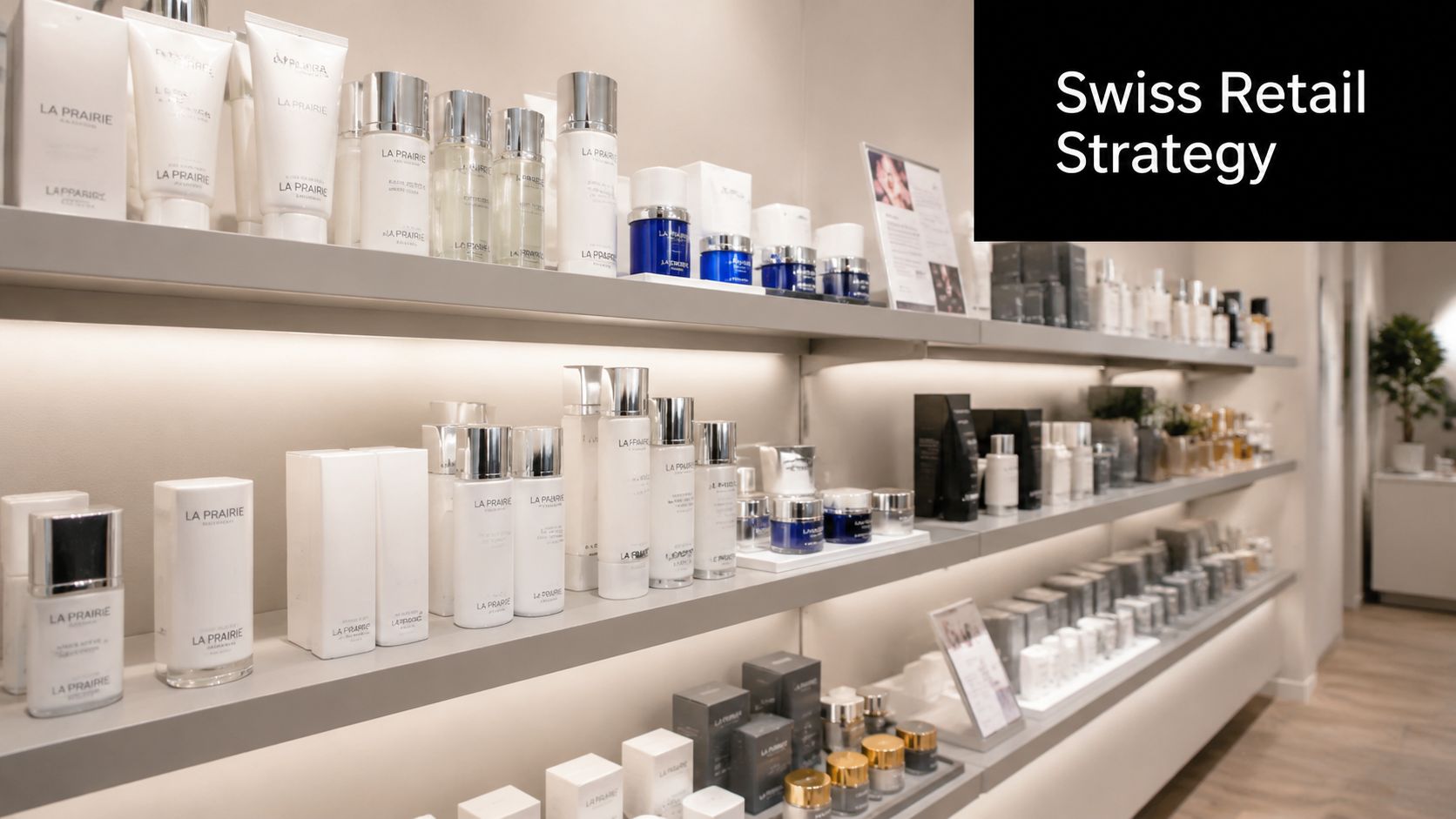
For Switzerland, the commercial opportunity is clear. Position tranexamic acid as a pharmacy-grade active with crossover appeal: pigment management, routine maintenance, and gentler care for customers who do not tolerate stronger brightening systems well. That matters in a market where premium shoppers expect clinical logic, but often prefer elegant, low-irritation formulas and brand stories that still feel clean and considered.
The best shelf position
On shelf, tranexamic acid works best when it supports three distinct consultations rather than one isolated category claim.
| Placement zone | Customer need | Best message |
|---|---|---|
| Pigmentation correction | Melasma-prone or uneven tone concerns | Helps support a more even-looking complexion |
| Sensitive active care | Shoppers wary of aggressive brighteners | Non-exfoliating approach to visible discolouration |
| Post-procedure or maintenance | Customers trying to maintain gains from clinic care | Useful adjunct in a longer pigment-control plan |
This kind of placement does two jobs. It protects the ingredient from being reduced to a commodity brightener, and it gives advisers more than one credible entry point in consultation.
The language that sells without overpromising
Swiss premium customers usually respond better to restraint than hype. The right wording sounds informed, measured, and useful in practice.
Use phrases such as:
- Clinically credible active
- Non-exfoliating pigment support
- Suitable for disciplined maintenance routines
- Helpful for customers who want active care without a harsh feel
Avoid speed claims and avoid certainty claims. “Erase”, “cure”, and “instant correction” create the wrong expectation for an ingredient that works best with consistency, good routine fit, and patient follow-through.
The Swiss retail gap
The underserved opportunity is not only pigmentation. It is the customer who wants visible tone support without the friction that often comes with peels, strong acids, or irritation-prone brightening blends.
That is especially relevant in Swiss pharmacy and dermo-cosmetic retail, where advisers regularly see customers with reactive skin, post-inflammatory marks, redness, and an understandable reluctance to over-treat. As noted earlier, the clinical story for tranexamic acid is strongest in pigment control, but the retail value is broader. It can sit credibly in a recovery-oriented assortment when the formula is well built and staff stay disciplined about claims.
For premium natural brands, this creates a useful merchandising angle. Tranexamic acid can anchor a more clinical SKU inside an assortment otherwise dominated by barrier, soothing, and botanical narratives. That balance often strengthens the category rather than diluting it.
Stocking recommendation
I would stock tranexamic acid serum when four conditions are met:
- The formula is elegant enough for repeat use
- The brand gives realistic routine guidance
- The positioning avoids inflated medical claims
- The line fits premium pharmacy, clinic-adjacent skincare, or sensitive-skin retail
Texture matters more than many buyers expect. A technically sound serum that pills under sunscreen, feels tacky, or clashes with the rest of the routine will not reorder well. Staff education matters too. Advisers should know who it suits, how long results may take, and when a customer needs referral rather than another cosmetic promise.
Handled well, tranexamic acid becomes a reputation product for the store. It signals that your assortment is built around practical outcomes, credible science, and formulas chosen for Swiss customer behaviour, not just trend visibility.
Final Recommendations for Your Premium Assortment
Tranexamic acid serum is worth stocking when you treat it as a credible specialist active, not a fad brightener.
For a busy Swiss buyer, these are the key decisions:
- Stock it for credibility: The ingredient carries unusual weight because of its medical precedent in Switzerland.
- Sell it with patience: Improvement typically requires consistent use over time, so staff must set expectations properly.
- Position it broadly, but carefully: It fits pigmentation, maintenance care, and sensitive-skin adjacent merchandising.
- Train advisers on trade-offs: It's a strong option for customers who want non-exfoliating support, but it shouldn't be presented as a replacement for every prescription or procedure.
- Use better category language: “Maintenance”, “adjunct”, and “skin recovery” are often more commercially effective than “spot eraser”.
- Choose formulas, not just ingredients: Texture, tolerance, and adherence will decide whether the product reorders.
A well-chosen tranexamic acid serum can strengthen a premium assortment because it gives your team something increasingly rare in skincare retail. An ingredient with a clear story, a plausible mechanism, and a role that extends beyond one trend cycle.
If you're building a Swiss premium beauty or pharmacy assortment and want help selecting clinically credible, natural, and differentiated skincare lines, beautysecrets.agency can help you curate brands that fit modern retail expectations for efficacy, transparency, and clean formulation standards.