A customer is standing at the counter with their phone open to a basket full of The Ordinary products. They ask a simple question that rarely has a simple answer. “Which one is for my acne?”
That moment is where many pharmacy conversations go off track. The bottles look clinical, the names sound scientific, and online advice often turns into a generic list of serums rather than a clear recommendation for the person in front of you.
The useful way to approach The Ordinary acne question is to stop thinking in product names first. Start with the acne pattern. Is the customer dealing with blocked pores, red inflamed spots, or the marks left behind after breakouts? Once that is clear, product choice becomes much easier and much safer.
Navigating the Hype Around The Ordinary and Acne
The popularity of The Ordinary has created a familiar retail problem. Customers arrive informed enough to ask for niacinamide, salicylic acid, or azelaic acid by name, but not always informed enough to know which one matches their skin.
That matters because acne isn't a fringe concern. Acne vulgaris is a chronic inflammatory disorder with prevalence estimates ranging from 35% to over 90% among adolescents, and it commonly begins in adolescence, according to StatPearls on acne vulgaris. For Swiss pharmacies and dermocosmetics teams, that makes acne one of the core conditions behind everyday demand for cleansers, anti-imperfection serums, barrier-support moisturisers, and post-blemish care.
Why customers get confused
The confusion usually comes from three things:
- Ingredient-first branding means customers buy a molecule before understanding the skin problem.
- Minimalist packaging makes several products look functionally interchangeable when they are not.
- Online routines often focus on what is trendy instead of what is tolerable.
A blackhead-prone teenager, an adult with tender jawline spots, and someone with lingering post-acne marks may all ask for “something for acne”. They should not leave with the same routine.
Practical rule: If you can identify the dominant lesion type before recommending a product, you immediately improve the quality of the advice.
The better question at the counter
Instead of asking, “Which The Ordinary product do you want?” ask, “What are you trying to change first?”
That small shift changes the consultation. It moves the conversation from catalogue browsing to problem solving. It also helps staff avoid one of the biggest mistakes in the ordinary acne recommendations: giving every customer an acid, a retinoid, and niacinamide all at once.
Acne care often works better when the routine is narrow, deliberate, and easy to follow.
Decoding The Ordinary's Scientific Approach
The Ordinary works like a dispensary of active ingredients. Traditional skincare often behaves like a finished sauce. You buy one cream and trust that the brand has blended everything into a single elegant formula. The Ordinary often behaves more like a shelf of individual spices. You choose niacinamide, salicylic acid, or a retinoid separately, then build the routine yourself.

What this model does well
This ingredient-led approach has real strengths.
- Clarity of purpose helps customers see what the product is meant to do.
- Targeted selection makes it easier to build around a main concern such as congestion or post-acne discolouration.
- Transparent naming encourages better questions at the point of sale.
For trained staff, this is useful. You can match function to concern more precisely than with a vague “blemish serum”.
Where the model creates risk
The same model can also lead to overuse. When products are sold as individual actives, customers may stack too many of them. They assume that if one exfoliant is helpful, two must be better. In acne-prone skin, that often leads to irritation, barrier disruption, and worsening redness.
A strong acne routine doesn't need to feel aggressive. It needs to be consistent and tolerable.
The four practical acne targets
From a counselling perspective, most The Ordinary acne routines revolve around four treatment targets:
Reducing pore blockage
This is the job of exfoliating ingredients that help loosen compacted dead cells and debris.Managing excess oil
Not every acne patient is oily, but many report visible shine and repeated congestion.Calming inflammation
Red, tender lesions need a different strategy from rough, non-inflamed bumps.Improving post-acne changes
Once the active breakout settles, many customers are left with marks or uneven texture.
If staff understand those targets, The Ordinary stops looking like a wall of similar bottles. It becomes a tool kit.
The Key Active Ingredients for Acne Treatment
Many articles on The Ordinary acne routines stay too general. They tell readers to use a cleanser, an acid, and a moisturiser, but they don't clearly map ingredients to acne subtype. That gap is exactly what many professionals need to close. As noted in this discussion of common content gaps around The Ordinary and acne, generic routines often fail to explain whether salicylic acid, niacinamide, mandelic acid, or azelaic acid is better for inflammatory lesions, clogged pores, or post-acne marks.
Ingredient matrix for quick reference
| Ingredient | The Ordinary Product Example | Primary Function | Best For |
|---|---|---|---|
| Salicylic Acid | Salicylic Acid 2% Solution | Exfoliates inside pores | Blackheads, whiteheads, congestion |
| Niacinamide | Niacinamide 10% + Zinc 1% | Helps balance visible oil and supports calmer-looking skin | Oily acne-prone skin, mild inflammatory patterns |
| Azelaic Acid | Azelaic Acid Suspension 10% | Helps with uneven tone, texture, and visible redness | Post-acne marks, mixed acne concerns |
| Mandelic Acid | Mandelic Acid 10% + HA | Surface exfoliation with a gentler feel than stronger direct acids for some users | Dull, congested, more reactive skin |
| Glycolic Acid | Glycolic Acid 7% Exfoliating Toner | Surface exfoliation | Rough texture, not the first choice for very reactive acne |
| Retinoids | Retinol in Squalane, Granactive Retinoid Emulsion, Retinal 0.2% Emulsion | Supports cell turnover | Recurrent comedones, texture, post-acne recovery plans |
Salicylic acid for blocked pores
Salicylic acid is the most logical first choice when the main complaint is blackheads, whiteheads, and pore congestion. Think of it as the ingredient that goes where the traffic jam is. It is oil-soluble, so it is especially useful when debris and sebum are trapped in the follicle.
For a customer with many tiny bumps across the forehead or nose, Salicylic Acid 2% Solution is usually easier to justify than a broad brightening serum. It answers the actual problem.
Use salicylic acid carefully in customers who are already dry, peeling, or using prescription acne medicines. In those cases, “more exfoliation” is often the wrong instinct.
Niacinamide for oil-prone and easily reactive skin
Niacinamide often gets oversold as a fix for everything. It isn't. It does, however, fit well into acne-prone routines when skin looks shiny, uneven, and easily irritated by stronger actives.
Niacinamide 10% + Zinc 1% is usually best treated as a support serum rather than the main anti-acne weapon. It suits the customer who says, “My skin gets greasy by midday,” or, “Everything stings if I use acids too often.”
It is not the best answer for deep clogged pores on its own. It also won't replace a retinoid in someone with persistent comedonal acne.
Azelaic acid for inflammation and marks
Azelaic acid sits in a useful middle ground. It can suit customers who need help with visible redness, uneven tone, and breakout aftermath without jumping straight to a stronger exfoliation plan.
Azelaic Acid Suspension 10% often fits mixed presentations. For example, a customer may still get occasional spots, but what bothers them most now is the lingering trace each breakout leaves behind. In that case, azelaic acid is often easier to position than salicylic acid.
Mandelic acid and other AHAs for texture
Mandelic acid is an alpha hydroxy acid. In practical counselling terms, it is usually a texture-refining option rather than the first-line product for inflamed acne. It can suit skin that feels rough, uneven, or dull alongside mild congestion.
Mandelic Acid 10% + HA can be a sensible option for customers who say salicylic acid feels too sharp, but it still requires caution. It exfoliates the surface. It does not replace the pore-focused role of salicylic acid.
Glycolic acid can also improve texture, but in acne-prone customers with active redness, it often needs more careful timing and less frequent use.
Retinoids for long-term pattern control
Retinoids are not usually the quickest answer for a customer in front of you who wants a spot treatment by tonight. They are the long-game option. They support cell turnover and often make more sense in recurrent comedonal acne, uneven texture, and maintenance routines after the inflammatory phase is calmer.
The Ordinary offers several retinoid formats, including Retinol 0.2% in Squalane, Granactive Retinoid 2% Emulsion, and Retinal 0.2% Emulsion. For pharmacy staff, the key point is not to rush customers into the strongest option. Start where tolerance is realistic.
Matching Products to Acne Types and Concerns
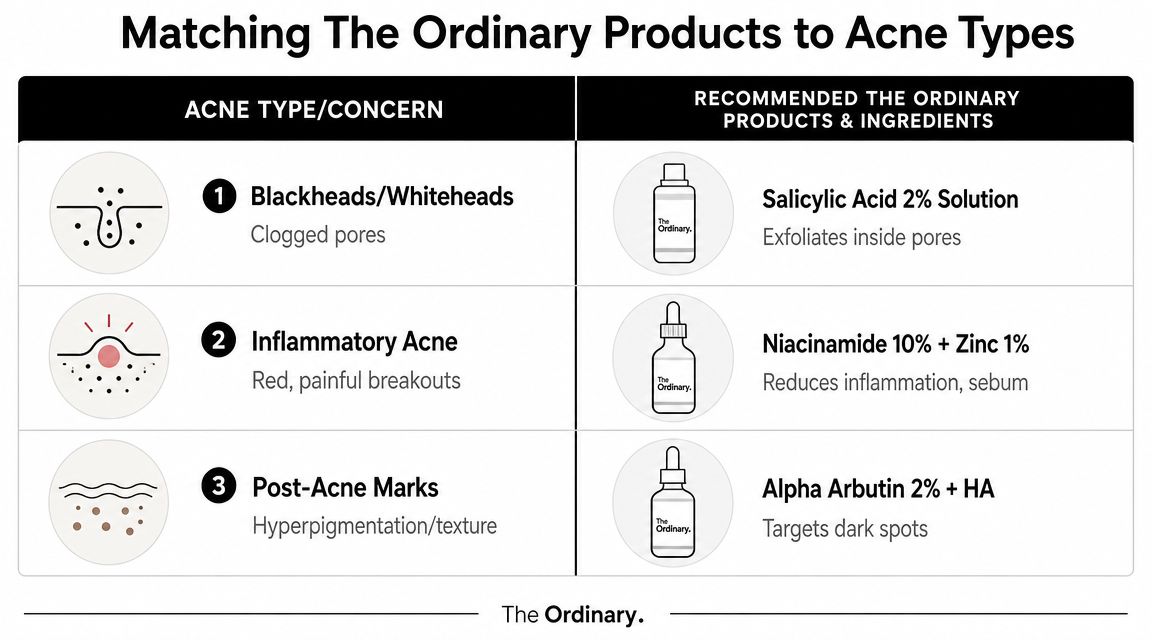
Customers rarely describe acne in textbook language. They say, “I have loads of little bumps,” or, “I keep getting angry red spots,” or, “The spots are gone but the marks stay for ages.” Those descriptions are more useful than you might think.
Comedonal acne
Blackheads, whiteheads, and uniform clogged bumps point towards comedonal acne. The skin often feels rough rather than sore.
Primary recommendation
Salicylic Acid 2% Solution
Supporting product
A simple moisturiser, such as Natural Moisturizing Factors + HA, to reduce the risk of over-drying the barrier.
Why this pairing works: salicylic acid addresses the blockage itself. The moisturiser lowers the chance that the customer starts strong, peels heavily, then gives up because the skin feels tight and uncomfortable.
A useful counter example is niacinamide alone. It may help the skin look less oily, but it is usually not enough if the problem is compacted congestion.
Inflammatory acne
Red papules and pustules require a calmer strategy. Staff often make the mistake of treating these lesions as if they are “clogged pores plus stronger acid”. That can backfire.
Primary recommendation
Niacinamide 10% + Zinc 1% for customers whose skin is oil-prone and easily upset by stronger exfoliation.
Secondary option
Azelaic Acid Suspension 10% when the customer also reports visible redness or lingering uneven tone.
The reasoning is simple. Inflamed acne needs respect for the barrier. If the customer's face is already hot, sore, or flaky, adding multiple acids often worsens the appearance. Niacinamide can play a steadier support role. Azelaic acid can be especially useful when inflammation and post-breakout traces overlap.
If the lesions are widespread, painful, deep, or likely to scar, referral matters more than product enthusiasm.
Post-acne marks
This group often gets the wrong recommendation because the customer says “acne” even though active lesions are no longer the main issue. They may be dealing with residual red or brown marks, not current pore blockage.
Primary recommendation
Azelaic Acid Suspension 10%
Supporting product
A retinoid introduced gradually at night if the skin is stable and the customer can follow a slow build-up plan.
For dark traces and uneven tone after acne, aggressive scrubbing is usually a poor strategy. A controlled approach with azelaic acid often makes more sense than merely adding another exfoliant.
A quick matching framework for staff
Use this if the consultation is brief:
Tiny bumps, blackheads, roughness
Start by considering salicylic acid.Red spots, visible oil, sensitivity to stronger actives
Consider niacinamide first, then azelaic acid if marks or redness are also part of the picture.Acne is calmer, but the skin is left marked or uneven
Think azelaic acid, with a later retinoid plan if suitable.
Many generic online guides fail on this point. They give a routine. They don't give a match.
Building Safe and Effective Skincare Routines
Good product selection can still fail if the routine is chaotic. Most irritation linked to The Ordinary acne routines isn't caused by one terrible product. It's caused by stacking too much, too soon, in the wrong order.
The basic order that keeps routines workable
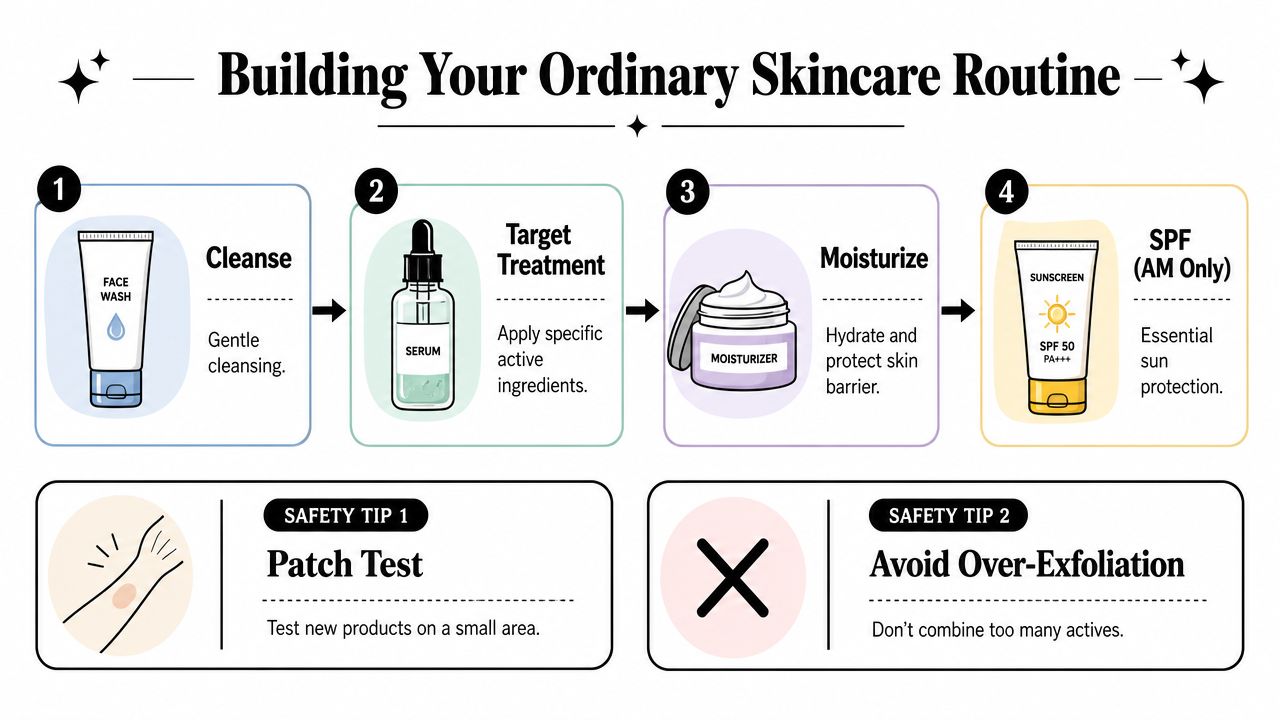
For most customers, the sequence is straightforward:
Cleanse gently
Remove oil, sunscreen, and debris without leaving the skin squeaky or stripped.Apply the target treatment
This step includes salicylic acid, niacinamide, azelaic acid, or a retinoid.Moisturise
A routine that treats acne but damages the barrier usually becomes unsustainable.Use SPF in the morning
This is especially important when exfoliating acids or retinoids are involved.
What not to pile together
The most common mistake is over-exfoliation. If a customer is already using salicylic acid, glycolic acid, mandelic acid, and a retinoid in the same week, the problem may be routine design rather than “stubborn acne”.
Retinoids deserve particular caution. The Ordinary's own guidance on retinoids notes conflicts with direct acids, direct vitamin C, copper peptides, and other retinoids, and recommends gradual introduction with sunscreen use in the daytime, as outlined in The Ordinary's retinoid guide.
Counselling shortcut: one active for the pores, one support step for the barrier, and patience. That's usually safer than a maximalist routine.
Two copy-ready routine examples
Beginner with sensitive or easily irritated skin
Morning
- Cleanser
Gentle, non-stripping cleanser - Treatment
Niacinamide 10% + Zinc 1% - Moisturiser
Barrier-supporting cream - Protection
Broad-spectrum SPF
Evening
- Cleanser
- Treatment
Azelaic Acid Suspension 10% on alternate nights to begin with - Moisturiser
This suits customers who flush easily, react to strong exfoliation, or have active redness alongside breakouts.
More resilient skin with clear comedonal pattern
Morning
- Cleanser
- Treatment
Niacinamide 10% + Zinc 1% if oil control is also needed - Moisturiser
- SPF
Evening
- Cleanser
- Treatment
Salicylic Acid 2% Solution several nights per week - Moisturiser
Later, if tolerated, a retinoid can replace some salicylic acid nights rather than being added on top.
Purging or irritation
Customers often use the word “purging” for any reaction. That's not safe counselling. If the skin becomes diffusely red, hot, itchy, burning, or persistently sore, think irritation first.
If tolerance drops, the fix is usually simple:
- Reduce frequency of the active
- Remove extra exfoliants
- Keep moisturiser consistent
- Pause and reassess if symptoms continue
A Counselling Guide for Pharmacy Staff
Advice builds trust when it sounds specific, calm, and proportionate. Customers can tell when someone is reciting a trend versus matching a product to a skin pattern.

Five questions that sharpen the recommendation
Before naming a product, ask:
What does the acne mostly look like?
Blackheads, tiny bumps, red spots, larger painful lesions, or leftover marks.What are you using already?
This catches accidental over-layering fast.How sensitive is your skin?
Some customers tolerate acids easily. Others sting from almost anything.What bothers you most right now?
Active breakouts and post-acne marks need different priorities.Are you using any medical acne treatment?
If yes, cosmetic advice should stay conservative.
These questions are simple, but they change the quality of the recommendation more than any ingredient lecture.
How to explain the science in plain language
Avoid dense formulation language unless the customer wants it. Instead, use practical analogies.
- Salicylic acid works like clearing debris out of the pore lining.
- Niacinamide acts more like a balancing support step for oil-prone, reactive skin.
- Azelaic acid is often the bridge ingredient when redness, texture, and marks overlap.
- Retinoids are the slow-build option for long-term texture and recurring congestion.
If a customer wants broader reading before committing to a routine, a practical overview of skin care acne solutions can help frame the difference between treatment steps and supportive care.
When to slow down or refer
Staff add the most value when they know when not to sell another serum.
Refer or advise medical review if the acne appears deep, painful, widespread, or scarring. Also pause cosmetic escalation if the skin shows clear intolerance such as persistent burning, pronounced peeling, or worsening irritation after repeated use.
Clear guidance sounds like this: “You don't need more products. You need fewer variables and better tolerance.”
That sentence often saves the customer money and saves the skin barrier.
Exploring Clean and Natural Alternatives for Acne
Not every customer wants a clinical single-ingredient routine. Some prefer a cleaner, more botanical framework, or they want to complement a targeted acne product with gentler support around it. The useful approach is to compare functions, not marketing styles.
Natural ingredients that pursue similar goals
A botanical routine can still be organised by acne phenotype.
- Willow bark extract is often used in formulas aimed at congestion and surface renewal. It is not identical to a direct salicylic acid product, but the functional intention is similar.
- Bakuchiol is often positioned as a plant-derived alternative in routines focused on texture renewal and smoother-looking skin.
- Tea tree oil and green tea extract are commonly discussed where calming and clarifying support are needed.
The point is not to claim botanical and clinical ingredients are interchangeable. They are not. The point is that both can be mapped to the same treatment logic: unclog, calm, support renewal, and protect the barrier.
Where natural support fits best
Clean and natural options often fit well in two places. First, as supportive products around stronger acne actives, such as a barrier-friendly cleanser or a nourishing moisturiser. Second, as the main routine for customers who won't tolerate or won't use an aggressive exfoliation plan.
For oil selection, many people get stuck. “Oil-free” isn't the only route for acne-prone skin. The smarter question is whether the chosen oil is appropriate for breakout-prone skin and how it is formulated. A useful explainer on best non-comedogenic oils helps frame that conversation clearly.
A practical place for curated natural ranges
In Swiss pharmacy and premium retail settings, some customers want ingredient transparency and ecological sourcing alongside acne-aware formulation choices. In that context, beautysecrets.agency distributes natural and ethically sourced cosmetic lines for the Swiss market that can sit alongside more clinical acne conversations, particularly when the need is barrier support, gentle cleansing, or a cleaner complementary regimen rather than a direct high-strength acne active.
Key Takeaways for Effective Acne Management
The most reliable way to handle The Ordinary acne questions is to match the acne type to the right active, then build the smallest routine the customer can follow well. Salicylic acid suits clogged pores. Niacinamide supports oil-prone and easily irritated skin. Azelaic acid often makes sense when inflammation, redness, and post-acne marks overlap. Retinoids belong in the long-term texture and recurrence plan, not in every first purchase.
That is the actual shift from generic skincare advice to professional counselling. Don't start with the bottle. Start with the lesion pattern, tolerance, and current routine.
For customers whose acne needs a more treatment-led route beyond over-the-counter skincare, it can help to point them towards specialist options such as advanced acne therapy in Amersham as an example of how procedural care can complement home routines when breakouts are persistent.
If your pharmacy, clinic, spa, or retail business is building a more informed acne and clean-beauty offering in Switzerland, beautysecrets.agency can be a useful trade resource for exploring natural, ethically sourced skincare lines that fit alongside professional counselling and premium category development.