CHF 1.2 billion. That's where the Swiss hair care market landed in 2024, and multifunctional styling tools already accounted for 22% of sales volume according to the verified Swiss market data provided in the Swiss hair care market summary. For retailers, that changes the conversation. A hair styler 5 in 1 isn't a novelty appliance. It's a serious category decision sitting at the intersection of beauty, wellness, travel, and clean-living preferences.
In Switzerland, premium beauty customers don't separate performance from ethics as neatly as mass-market assortments do. They expect both. If a device earns shelf space next to natural oils, scalp treatments, and salon-grade finishing products, it has to justify itself on hair results, product longevity, safety, and sourcing discipline. That's where many retailers get the category wrong. They either merchandise it like electronics or talk about it like a gadget.
The better approach is to treat the hair styler 5 in 1 as a high-tech beauty tool. It belongs in the beauty consultation model, not in a bargain-tech display. When introduced well, it strengthens basket building, gives staff a stronger premium story, and helps position the store as a destination for complete routines rather than isolated products.
The Market Opportunity for All-in-One Hair Stylers in Switzerland
Swiss retailers do not need proof that interest exists. They need a disciplined plan for where this category sits, how it earns trust, and which assortments can support it profitably.
The strongest opportunity is in premium beauty environments where the purchase is explained, demonstrated, and linked to a broader hair routine. In Switzerland, that matters more than in many neighbouring markets because customers in the clean-beauty segment scrutinise claims, materials, durability, and after-sales support before they accept a device beside natural treatments or scalp-care products.
A 5-in-1 styler works commercially when it solves two retail problems at once. It raises average transaction value, and it gives the haircare assortment a more complete routine story. Used well, it also helps justify adjacent sales in heat protection, smoothing creams, leave-ins, brushes, and travel accessories.
Why the category fits premium retail
The best retail fit is not every door. It is the store that already sells consultation, not only stock.
That usually includes:
- Clean-beauty specialists that already explain ingredient philosophy, hair condition, and routine building
- Premium pharmacies and para-pharmacies where shoppers expect safety, product guidance, and credible advice
- Department store beauty floors with enough service space for live demonstration
- Spa boutiques and curated e-commerce assortments that position beauty as care, not impulse hardware
In those channels, the device should be presented as a beauty tool with a clear role in hair maintenance and styling discipline. That framing is commercially smarter than presenting it as small electronics, especially in Switzerland, where premium shoppers often ask who made the device, what standards it meets, how hot it runs, and whether it supports healthier styling habits over time.
Where the margin really comes from
The unit sale matters, but the category becomes attractive when retailers build the full basket around it.
A well-chosen styler creates a reason to recommend preparatory and finishing products with more credibility. Staff can explain which clean heat protectant gives slip before a smoothing pass, which lightweight oil works on ends after drying, and which repair treatment supports frequent styling without making hair heavy. That advice increases attachment sales and reduces the risk that the tool feels disconnected from the rest of the assortment.
It also improves the quality of gifting and repeat purchasing. A customer may buy the tool once, but the routine around it continues to drive replenishment.
The Swiss-specific opportunity
Swiss partners should assess the category through three filters. Regulatory fit. Merchandising fit. Service fit.
Regulatory fit matters because a premium beauty retailer in Switzerland cannot treat an electrical styling device as a simple accessory. Product files, conformity documentation, language requirements, safety labelling, plug compatibility, and claims discipline all affect whether the range is suitable for sale and for staff recommendation. Clean-beauty credibility is easy to damage if a device looks impressive on shelf but arrives with weak documentation or vague hair-health claims.
Merchandising fit matters because these tools perform best beside hair rituals, not in a detached gadget zone. The cleaner the story, the better the conversion.
Service fit is often the deciding factor. If staff can demonstrate attachment logic, explain hair-type suitability, and set realistic expectations on results, returns fall and confidence rises. If they cannot, the category quickly turns into a price comparison exercise.
What retailers often miss
Retail buyers sometimes focus too heavily on the promise of "five functions" and not enough on whether the customer will use those functions with confidence. The better commercial question is simpler. Does the device reduce friction in the routine while protecting the standards your store already stands for?
For Swiss clean-beauty retail, that means choosing assortments that feel consistent with ingredient-led care, low-waste habits, and measured performance claims. The category can grow well here, but only when the device is selected and sold with the same discipline applied to premium skincare, scalp health, and natural haircare.
Deconstructing the 5-in-1 Hair Styler Category
In Swiss retail, this category performs best when it is presented as a styling system with a defined routine, not as a box of attachments. That distinction affects sell-through, returns, and where the product belongs in a clean-beauty assortment.
The five functions customers value most
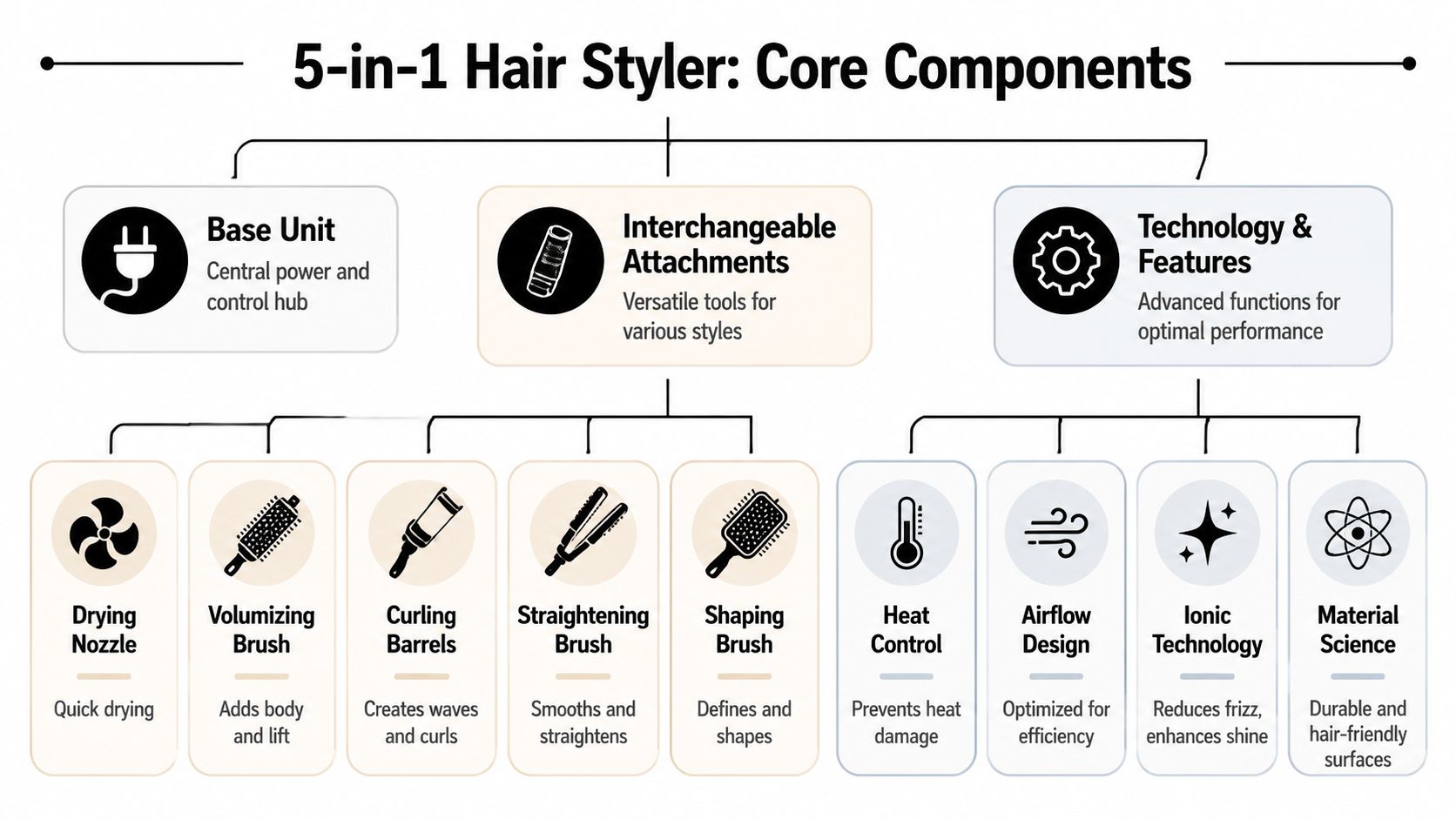
Most 5-in-1 platforms are built around five repeatable salon-style tasks. Retail teams should learn these as use cases, not just attachment names.
Pre-styling dryer attachment
This gets hair from wet or damp to the right level for styling. It shortens preparation time and sets up better results with the other heads.Volumising brush
Best for root lift, crown shaping, and a blowout effect. This is often the easiest attachment to demo because the result is visible within minutes.Smoothing or straightening brush
Used to align the surface of the hair and reduce puffiness. For many shoppers, this is a lower-commitment alternative to a flat iron.Clockwise curling barrel
This creates curl in one direction and helps users keep the pattern consistent on one side of the head.Counter-clockwise curling barrel
This handles the opposite side and improves symmetry. In-store, that is one of the clearest ways to show why the category is more advanced than a single hot brush.
Why consolidation matters
The primary value is routine simplification. One motor unit, one power cord, one storage footprint, and a smaller learning curve than maintaining several separate tools.
That matters commercially. A retailer can position the device as a longer-term purchase when the build quality is sound, attachment changes are intuitive, and the shopper can understand how the system supports protecting hair from heat damage through more controlled styling habits.
The sustainability angle needs discipline. A multi-use styler does not qualify for clean-beauty adjacency on function count alone. It needs durable components, clear care instructions, credible claims, and packaging that does not undermine the premium, lower-waste story your store already tells.
Shoppers do not need five modes for their own sake. They need one device that covers the styling jobs they do every week.
What works in retail, and what creates friction
The strongest sales conversations start with the customer's existing habit. Fine hair and flat roots point to the volumising brush. Frizz-prone lengths point to the smoothing head. A customer replacing both a dryer and curling tong is a better match for the full system story.
Teams lose credibility when they try to demonstrate every attachment in one interaction. The tool starts to feel complicated, and the shopper shifts straight to price comparison. A better method is to prove one daily benefit first, then frame the remaining attachments as added utility.
For Swiss partners, that approach also supports cleaner claims discipline. Staff can describe what each head is designed to do, where it fits in a routine, and which hair types are likely to benefit, without drifting into exaggerated promises about repair, damage reversal, or universal suitability.
Understanding the Core Technologies and Hair Health Benefits
Premium retailers need a better language for this category than “powerful motor” and “less frizz”. Customers paying for a high-end device want to know why the engineering changes the result on the hair.
Fast airflow matters more than aggressive heat
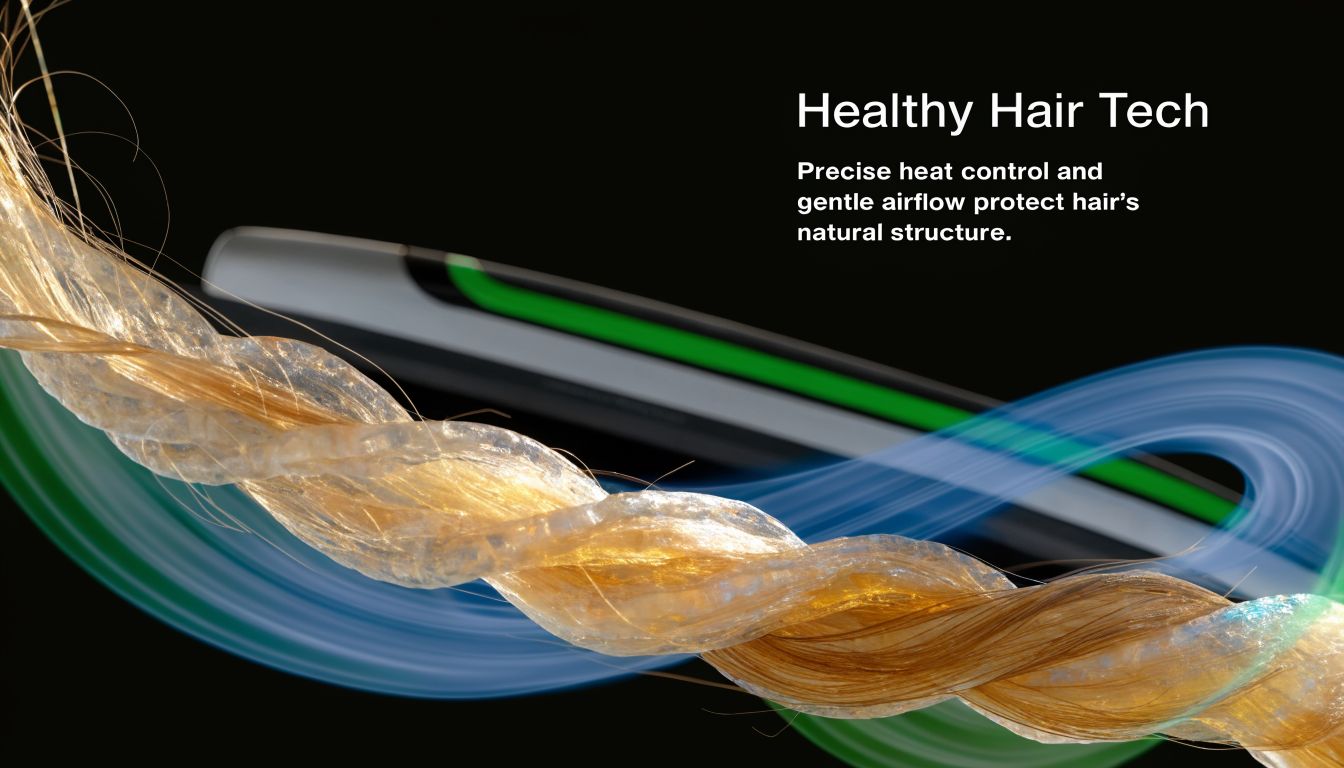
One verified Swiss study gives staff a useful performance benchmark. A 2025 GfK Switzerland study found that 74% of users reported 50% faster styling times, under 15 minutes, with these devices, and 92% reported satisfaction with frizz-free results, according to the GfK Switzerland finding on styling time and frizz control.
That performance claim is easier to explain when staff understand the motor. Verified technical product information notes that high-performance models operate at approximately 110,000 RPM, a specification associated with stronger airflow and more efficient heat distribution in the high-speed motor product reference.
For the customer, the translation is simple. The tool should rely more on directed air and controlled heat than on brute-force scorching. That doesn't mean heat disappears. It means the styling process becomes more efficient.
Ionic technology and finish quality
Frizz control is one of the clearest benefits in this category because the result is visible immediately. When a device combines steady airflow with ionic output, the hair often looks smoother and more finished, especially on hair that easily turns fluffy after blow-drying.
That makes the hair styler 5 in 1 particularly relevant for retailers selling premium serums, oils, and post-wash treatments. Those formulas perform better when the tool doesn't fight them. A good styler should help seal in the polished finish those products are designed to support.
For teams training customers on routine building, it helps to pair the device conversation with practical education on protecting hair from heat damage. The strongest retail message isn't “buy this tool and forget technique”. It's “use a better tool with better prep”.
Better technology doesn't replace good haircare. It makes good haircare more visible.
What separates premium devices from disappointing ones
Cheap alternatives often fail in predictable ways:
- Unstable airflow creates uneven results and longer styling sessions
- Poor attachment fit makes the device feel flimsy during demonstrations
- Weak temperature control increases the risk of overworking sections
- Mediocre finishing performance leaves customers wondering why they didn't just keep using a dryer and brush
Premium models justify their position when the technology delivers a calmer user experience. Less snagging. Faster dry-down. More consistent curl formation. Smoother finish with fewer repeated passes. Those are the practical signs your staff should notice during training, because that's what they'll need to communicate on the shop floor.
How to Evaluate Stylers for Swiss Regulatory and Quality Standards
In Switzerland, product selection in this category is partly a merchandising decision and partly a risk-management decision. Retailers who treat it only as a sourcing conversation are exposed.
The most important verified warning is clear. A 2025 Swiss Consumer Protection Report noted that 23% of imported hair tools failed EMF limits, many online dupes lack the mandatory Swiss CB certification, and new ordinances can create potential fines up to CHF 20,000, according to the Swiss compliance risk summary.
That single fact should change how buyers screen suppliers. A low acquisition cost is not an advantage if the product creates liability, customer complaints, or regulatory scrutiny.
Start with documents, not aesthetics
A polished box and a stylish finish tell you almost nothing about compliance. Swiss retailers should ask for documentation before discussing launch timing or promotional support.
Focus your due diligence on:
Swiss-relevant certification evidence
Don't accept vague statements like “tested for Europe”. Ask for the exact documents relevant to Swiss market entry and stocking.EMF and safety verification
If a supplier cannot clearly explain the device's testing status, move on. This isn't a secondary issue for premium retail.Material and component traceability
Premium customers increasingly ask what touches the hair, what heats up, and what may degrade over time.Warranty and repair process
High-ticket beauty tools need a post-sale plan. If the supplier only offers replacement-by-email with no clear service route, the retail burden lands on your team.
The category standard should be higher than online marketplaces
Swiss pharmacies, wellness boutiques, and curated e-commerce shops should not compete with marketplace dupes on price. That's a race they can't win and shouldn't try to win. Their advantage is trust.
If a supplier's main argument is “we're cheaper than what's on TikTok Shop or Amazon”, they've already told you the wrong story.
Premium clean-beauty environments should demand more than legal minimums. The product also needs to fit the customer expectation created by the rest of the assortment. That includes build quality, calm operation, clear instructions, responsible claims language, and packaging that doesn't undermine a sustainability position.
5-in-1 Styler Evaluation Checklist for Premium Retailers
| Evaluation Criterion | What to Look For | Why It Matters |
|---|---|---|
| Regulatory compliance | Verifiable Swiss CB certification and documented safety testing | Protects the retailer from stocking non-compliant goods |
| EMF and ionic claims | Clear technical documentation, not marketing language alone | Reduces legal and reputational risk |
| Attachment quality | Secure fit, consistent attachment changes, no wobble during use | Affects demo quality and long-term customer satisfaction |
| Heat and airflow control | Stable settings and predictable performance across attachments | Supports safer, more reliable styling outcomes |
| Materials and finish | Durable surfaces, clean assembly, no cheap-feeling joins | Signals premium value and improves returns resistance |
| Service support | Clear warranty terms, spare-part logic, and repair pathway | Essential for higher-priced electrical beauty tools |
| Instructions and training | Usable manuals and supplier training assets for staff | Makes in-store selling and aftercare guidance easier |
| Assortment fit | Natural pairing with premium haircare and clean-beauty positioning | Prevents the product from feeling out of place in-store |
A practical sourcing filter
Before ranging a device, buyers should ask one blunt question: would I be comfortable defending this product to a regulator, a premium customer, and my own store team at the same time?
If the answer is uncertain, the product isn't ready for a Swiss premium channel.
Effective Merchandising and In-Store Demonstration Strategies
A hair styler 5 in 1 should not be stranded in a generic appliance corner. That kills context and lowers perceived value. In premium beauty retail, the device should be presented as part of a hair ritual, not as a stand-alone electrical item.
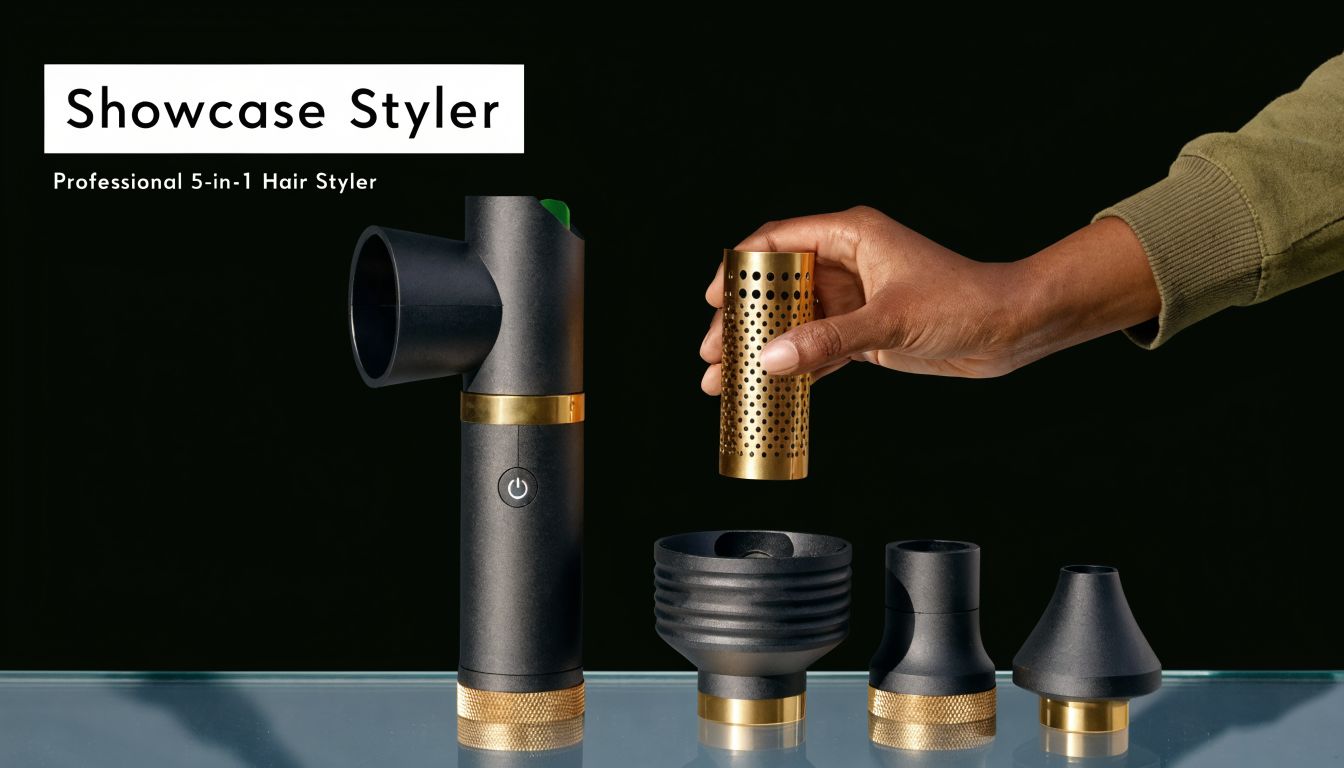
Place it where beauty logic is strongest
The best location is usually alongside premium haircare, especially smoothing products, treatment oils, scalp serums, and finishing products. That tells the customer this is a beauty tool that works with formulations, not apart from them.
Retailers get better engagement when the display answers one practical question: “What do I use this with?” If the device sits next to compatible prep and finish products, the answer is immediate.
Good display themes include:
- Blowout and polish
- Travel-ready styling
- Frizz control and shine
- At-home styling with fewer tools
Demonstrate outcome, not mechanism
Staff often make demos too technical. Customers don't need a lecture on airflow engineering during the first minute. They need to see one visible result quickly.
A better demonstration sequence is:
- Show the base unit and one attachment only.
- Explain the style outcome in plain language.
- Use a small hair section to show the finish.
- Then introduce the attachment swap as a convenience point.
This keeps the interaction commercial rather than educational in the abstract. The customer sees the result first, then accepts the feature story.
Merchandising should make the tool feel like tech-couture. Clean lines, premium adjacency, and a visible role in the routine.
Bundles that feel natural
Bundles work best when they solve a styling sequence instead of forcing a discount story. A stronger package might combine the styler with a heat-protective leave-in, a smoothing oil, or a brush-cleaning accessory, depending on the retail environment.
Signage should also stay benefit-led. “Salon finish at home”, “One tool, multiple looks”, and “Designed for a more organised routine” are more effective than a list of technical specs on shelf talkers. The technical detail belongs with trained staff and detailed product pages, not as the first line a customer sees from two metres away.
Staff Training Your Team to Sell with Confidence
Most premium beauty teams can learn this category quickly if the training is translated into customer language. The technical detail matters, but only after staff know how to turn it into a benefit.
A useful verified detail for staff training is that high-performance models feature motors running at approximately 110,000 RPM and an extended 2.1-metre cord length, as noted in the technical overview of premium 5-in-1 styler specifications. Those details help justify premium positioning, but they need interpretation.
Turn specifications into phrases customers understand
Don't train staff to say “This has a 110,000 RPM motor” and stop there. Train them to say what that means.
Examples that work on the floor:
On motor speed
“It uses fast airflow to style efficiently, so you don't need to keep reheating the same sections.”On cord length
“The longer cord makes it easier to use comfortably during a demo or at a dressing table without awkward positioning.”On multiple attachments
“You're not buying five separate tools. You're buying one platform that covers your main styling needs.”
Prepare for the common objections
Staff should be ready for the same few questions every day. The best answers are honest and controlled.
Is it suitable for fine hair?
Usually yes, if the customer chooses the right attachment and doesn't overwork the section. Fine hair often benefits from controlled airflow and a lighter touch.Will it replace every other tool I own?
For many customers, it replaces most routine styling tools. It may not replace every specialist tool for every hair type or every look.Is it difficult to use?
Not if the customer starts with one attachment and one style goal. Problems usually start when users try everything at once.How do I maintain it?
Keep the filter area clean, store attachments properly, and follow the manufacturer's maintenance instructions. Staff should physically show the cleaning points during training.
Build confidence through repetition
The most effective training format isn't a long brand deck. It's repeated hands-on practice. Let staff attach, detach, style, clean, and repack the unit several times before launch.
A team sells this category well when they can explain it without sounding impressed by the technology itself.
That's the benchmark. Calm explanation. Clear use cases. No overclaiming. If the device is premium, it won't need theatrical selling.
Conclusion Key Marketing Angles for E-commerce and In-Store
In Swiss premium beauty retail, the winning message for a 5-in-1 styler is rarely the number of attachments. It is the commercial fit. Partners get better results when they present the device as a high-value routine tool that saves space, reduces product clutter, and sits comfortably beside a clean-beauty assortment without weakening brand standards.
For this category, positioning matters more than excitement. Swiss shoppers respond well to products that feel considered, durable, and easy to justify. A multi-tool format supports that case if the copy stays disciplined and the claims stay precise. Avoid broad sustainability language unless the brand can document it properly under Swiss and EU-aligned expectations for environmental marketing. A safer approach is to describe consolidation, routine efficiency, and reduced need for multiple separate tools.
Marketing angles that work in practice
Consolidated routine
Present the styler as one purchase that covers several common styling tasks and reduces the need for multiple electrical tools.Premium order, not gadget clutter
Place it within an organised bathroom routine, alongside heat protection, scalp care, and finishing products with clean positioning.Travel and second-home convenience
This angle performs well in Switzerland, where mobility, compact storage, and practical premium purchases often matter more than novelty.Controlled styling with a hair-health message
Keep the wording careful. Focus on managed airflow, smoother finishing, and pairing with quality prep products rather than overpromising repair or protection.
The strongest copy usually sounds calm. It does not chase tech language for its own sake, and it does not force a salon tone onto a retail environment.
Copy hooks for retail teams
Use short lines that support conversion across product pages, email, paid social, and shelf talkers:
“One styling system for a more organised routine.”
“Less tool clutter. Better daily usability.”
“Built for premium hair care rituals, not impulse gadget shelves.”
For e-commerce, campaign structure matters as much as wording. Separate convenience-led ads from hair-finish ads and from premium-gifting ads. This gives your team cleaner performance data and better creative testing discipline. If your team is refining ad messaging by audience and intent, this guide to AI in advertising is a useful reference for building cleaner creative angles without reducing the product to generic tech claims.
In store, keep the final message consistent with the wider basket. A 5-in-1 styler should feel compatible with natural shampoos, scalp serums, heat protection, and low-fragrance finishing products. That alignment is what helps Swiss clean-beauty retailers introduce a technical category without losing trust.